1. Introduction
Specific Language Impairment (SLI) is a delay and/or disorder of the normal acquisition of language in the absence of neurological trauma, cognitive impairment, psycho-emotional disturbance or motor-articulatory disorders, which is believed to be largely genetically determined (Leonard, Reference Leonard1998; Levy and Kavé, Reference Levy and Kavé1999).
Linguistic research on individuals with SLI aims at providing detailed characterizations of their strengths and weaknesses in different domains of language and across different languages, and of how their language differs from that of typically developing children. This research has identified syntax and morphology as areas of specific difficulty for many children with SLI. Different linguistic accounts of these difficulties have been proposed, some of which posit relatively broad impairments in the syntactic representations of SLI individuals, while others have identified specific grammatical markers of SLI; see Clahsen (Reference Clahsen, Ball, Perkins, Mueller and Howard2008) for a review. However, what is common to these approaches is that the children's difficulties with syntax and morphology are explained in terms of domain-specific deficits or limitations affecting linguistic representation and computation, rather than in terms of domain-general processing limitations. These latter approaches subsume different proposals, including, for example, perceptual and/or auditory deficits (e.g., Leonard, Reference Leonard1998), working-memory deficits (Archibald and Gathercole, Reference Archibald and Gathercole2006; Leonard, Ellis Weismer, Miller, Francis, Tomblin & Kail, Reference Leonard, Ellis Weismer, Miller, Francis, Tomblin and Kail2007), and procedural memory deficits (Ullman and Pierpont, Reference Ullman and Pierpont2005). Common to these proposals is that they all posit domain-general processing impairments or limitations as the source of the linguistic difficulties of children with SLI.
Whilst much previous research has focused on monolingual children with SLI, more recently researchers from different disciplines have begun to investigate different kinds of bilingual children with SLI; see Paradis (Reference Paradis2010) for a review. The study of bilingual children with SLI raises a number of complex theoretical and practical issues. Does bilingual language development affect language impairments and if so, how? What are the linguistic characteristics and markers of SLI in children who are simultaneously or successively acquiring two or more languages? Is it possible to identify SLI in bilingual children on the basis of impairments in one of the children's languages? We will address these questions from a specifically linguistic perspective. If SLI is indeed associated with distinct (possibly syndrome-specific) grammatical profiles or markers that are explainable in terms of domain-specific constraints or limitations, then these constraints should be operative irrespective of whether a child is acquiring one or more than one language. Thus, bilingual (as opposed to monolingual) language acquisition as such should not have any effect on SLI, and consequently, SLI should be diagnosable from one of a bilingual child's languages. However, bilingual language development is affected by other factors, for example, age of acquisition, amount of input/intake and social context. Regarding age of acquisition, for example, adult second language (L2) acquisition is usually less successful than child first language (L1) development; see, for example, Hawkins (Reference Hawkins2001). The same has been reported for child L2 acquisition, i.e., in cases in which another language is learnt after the L1, particularly in later childhood (e.g., Chilla, Reference Chilla2008; Meisel, Reference Meisel2009). It is therefore conceivable that SLI in successive bilinguals exhibits different linguistic characteristics from those of monolingual or bilingual children who acquire more than one language simultaneously.
The present study compares two groups of German-speaking children with SLI, seven monolingual children and seven early successive bilingual children (L1: Turkish, L2: German) who started to learn German before or at around the age of three years and were independently diagnosed with SLI in both their German and their Turkish. The findings come from longitudinal data with large samples of spontaneous speech from both participant groups. We investigated the children's German, focusing on subject–verb agreement marking, which has been argued to represent a grammatical marker of SLI in monolingual German-speaking children (Clahsen, Bartke and Goellner, Reference Clahsen, Bartke and Goellner1997; Eisenbeiss, Bartke and Clahsen, Reference Eisenbeiss, Bartke and Clahsen2005/2006; Rothweiler and Clahsen, Reference Rothweiler and Clahsen1994). In addition, two alternative linguistic accounts, that ‘optional infinitives’ are overused in SLI German (Rice, Noll & Grimm, Reference Rice, Noll and Grimm1997), and that in SLI German the functional projection CP (‘Complementizer Phrase’) is affected (Hamann, Penner & Lindner, Reference Hamann, Penner and Lindner1998) will also be examined.
2. Previous studies on bilingual children with SLI
Studies comparing monolingual children with SLI to simultaneous bilinguals with SLI, i.e. children who learned two languages before the age of 3;0, typically from birth, have found similar performance patterns and grammatical markers for both groups. For French–English bilingual children with SLI, for example, Paradis, Crago, Genesee and Rice (Reference Rice, Levy and Schaeffer2003) and Paradis, Crago and Genesee (Reference Paradis, Crago and Genesee2005/2006) identified tense and subject–verb agreement markers as affected, with similar (low) accuracy rates as those of monolingual children with SLI. Furthermore, in the French of the bilingual children with SLI the use of clitic pronouns was impaired, again with similar (high) omission rates as those of monolingual French-speaking children with SLI. Converging evidence comes from simultaneous Spanish–English bilinguals with SLI (Gutiérrez-Clellen, Simon-Cereijido & Wagner, Reference Gutiérrez-Clellen, Simon-Cereijido and Wagner2008). These authors found that the same grammatical markers that characterize SLI in monolingual English-speaking children also hold for the English of Spanish–English bilinguals, namely “significant difficulties with the finiteness morphemes ‑s, ‑ed, auxiliary and copula” (Gutiérrez-Clellen et al., Reference Gutiérrez-Clellen, Simon-Cereijido and Wagner2008, p. 14). Taken together, these results indicate that simultaneous bilingualism does not necessarily aggravate the language problems of children with SLI. Specifically, the finding that the same grammatical markers of SLI were found in monolingual and simultaneous bilingual children is consistent with the view that SLI is characterized by domain-specific limitations that affect language acquisition regardless of whether a child is growing up with one or two languages.
The picture that emerges from studies investigating successive or sequential bilinguals who have begun to learn a second language after the age of 3;0 is less clear. Whilst some studies found patterns of impairment in the second language of children with SLI similar to those for monolingual SLI, other studies reported significant differences in grammatical abilities between successive bilingual and monolingual children with SLI. Paradis (Reference Paradis, Haznedar and Gavruseva2008), for example, investigated the use of tense marking in the English of a successive (Chinese–English) bilingual child with SLI (‘WLLS’, age of onset of English: 3;11). She found that this child exhibited the characteristic pattern of ‘extended optional infinitives’ that has been reported for SLI in monolingual English-speaking children, including reduced accuracy scores for tense-related morphemes and few substitution errors with be. Likewise Chilla (Reference Chilla2008), investigating three successive bilingual (Turkish–German) children with SLI who began to learn German between ages 3;0 and 4;0, found patterns of impairment in the children's German known from previous studies of monolingual children with SLI (e.g., Clahsen et al., Reference Clahsen, Bartke and Goellner1997). Armon-Lotem, Adam, Siege-Haddad and Walters (Reference Armon-Lotem, Galit, Siege-Haddad and Walters2008) examined fifteen English–Hebrew bilinguals, three of which were successive bilinguals with ‘atypical language development’ and an age of onset of Hebrew of 2;7 to 4;9. For these bilingual children, Armon-Lotem et al. reported considerably more substitution errors for subject–verb agreement in the impaired than in the unimpaired children (50% to 60% vs. 16%, Armon-Lotem et al., Reference Armon-Lotem, Galit, Siege-Haddad and Walters2008, p. 36). The same contrast was found for monolingual Hebrew-speaking children with SLI, who were also reported to produce more agreement errors than typically developing monolingual controls (Dromi, Leonard, Adam & Zadunaisky-Ehrlich, Reference Dromi, Leonard, Adam and Zadunaisky-Ehrlich1999).
Several other studies on successive bilinguals with SLI have observed patterns of performance that appear to be different from those of monolingual children with SLI. Stavrakaki, Vogindroukas, Chelas and Ghousi (Reference Stavrakaki, Vogindroukas, Chelas, Ghousi, Gavarró and Freitas2008) examined subject–verb agreement in Greek of one successive bilingual (Albanian–Greek) child with language impairment (age of onset of Greek: 3;0), in comparison to groups of monolingual Greek children and typically developing (Albanian–Greek) bilingual children. Subject–verb agreement turned out to be “a reliable marker for identifying monolingual and bilingual children with language impairments” (Stavrakaki et al., Reference Stavrakaki, Vogindroukas, Chelas, Ghousi, Gavarró and Freitas2008, p. 417), confirming earlier findings on monolingual Greek preschool children with SLI (Clahsen & Dalalakis, Reference Clahsen and Dalalakis1999). Yet, Stavrakaki et al. (Reference Stavrakaki, Vogindroukas, Chelas, Ghousi, Gavarró and Freitas2008) observed that the bilingual child performed worse on some agreement forms (notably plural markings) than the group of monolingual children with SLI. They tentatively attributed this difference to the bilingual child being faced with “simultaneous learning of verb endings of two languages” (p. 417).
Differences between successive bilingual and monolingual children with SLI were also observed in two studies on Dutch SLI that investigated children from immigrant families. Steenge (Reference Steenge2006) found that bilingual Turkish–Dutch and Arabic–Dutch children (age range: 7 to 9) performed significantly worse on some aspects of grammatical morphology (plurals, participles) in their Dutch than monolingual Dutch-speaking children with SLI. Note, however, that for subject–verb agreement, there was no such bilingual/monolingual contrast. Orgassa and Weerman (Reference Orgassa and Weerman2008) examined monolingual and successive bilingual (Turkish–Dutch) children with and without SLI with respect to gender agreement within noun phrases in Dutch. They reported worse performance for the bilingual than the monolingual children with SLI, a difference they attributed to processing overload due to a cumulative effect of having to deal with a dual language input plus an impairment of language. On the other hand, Orgassa (Reference Orgassa2009), investigating the same children with respect to subject–verb agreement in Dutch, did not find any significant differences between bilingual and monolingual children with SLI, hence no evidence for any cumulative effect. Instead, Orgassa reported similar mean correctness scores for the three relevant exponents, bare stems, -t, and -n, in both groups (SLI-L1: 80%; SLI-L2: 75%).
The empirical picture from previous studies of SLI in successive bilinguals is inconclusive, and the question of how to explain these partly conflicting findings remains open; see Paradis (Reference Paradis2010) for discussion. Clearly, more research on grammatical markers of SLI in successive bilinguals is needed.
3. Grammatical markers of SLI in German
This section presents a brief overview of previous proposals for grammatical markers of SLI in monolingual German-speaking children. Three candidates will be discussed, ‘agreement deficits’ (e.g., Clahsen, Reference Clahsen1989), ‘extended optional infinitives’ (Rice et al., Reference Rice, Noll and Grimm1997), and ‘defective CPs’ (Hamann et al., Reference Hamann, Penner and Lindner1998).
One of the earliest attempts at characterizing the grammatical difficulties of children with SLI in linguistic terms was the ‘Agreement Deficit’ hypothesis (Clahsen, Reference Clahsen1989; Reference Clahsen1991), according to which the grammatical mechanism responsible for matching features of different syntactic categories within a sentence, as, for example, required for subject–verb agreement, is impaired in SLI. The hypothesis was later revised in terms of Chomsky's (Reference Chomsky1995) theory of formal features (Clahsen et al., Reference Clahsen, Bartke and Goellner1997). Agreement features of verbs (and adjectives) form a natural class in this system of formal features in that they are non-interpretable and need to be checked off in the course of the derivation. The agreement deficit hypothesis claims that these features are specifically affected in SLI. Much of the empirical evidence for agreement deficits as a marker of SLI comes from studies of monolingual German-speaking children (e.g., Clahsen & Rothweiler, Reference Clahsen, Rothweiler, Booij and van Marle1993; Clahsen et al., Reference Clahsen, Bartke and Goellner1997; Rothweiler & Clahsen, Reference Rothweiler and Clahsen1994). Persistent difficulties with subject–verb agreement were found in German SLI, even for children at relatively advanced developmental levels in other domains of grammar. Eisenbeiss et al. (Reference Eisenbeiss, Bartke and Clahsen2005/2006), for example, reported high accuracy scores indistinguishable from unimpaired controls for a group of five monolingual German children with SLI for structural case marking on direct and indirect objects, despite the fact that the same children were impaired in subject–verb agreement marking. Specific difficulties with subject–verb agreement for people with SLI have also been found for other languages; see Clahsen (Reference Clahsen, Ball, Perkins, Mueller and Howard2008) for review.
An alternative proposal comes from Rice et al. (Reference Rice, Noll and Grimm1997) according to which the ‘Extended Optional Infinitive’ (EOI) hypothesis originally developed for English also applies to German SLI. Investigating samples of spontaneous speech from eight monolingual German children with SLI at two cross-sections and a control group of MLU-matched unimpaired children, Rice et al. found that non-finite verb forms in finite contexts and omissions of the copula were more common in the speech of the children with SLI than the controls. Furthermore, Rice et al. did not find many agreement errors but, instead, high accuracy scores for the 3rd sg. -t, the 2nd sg. -st, and for finite forms of sein. These findings were argued to support the EOI account and to disconfirm the agreement deficit hypothesis for German SLI.
A third proposal of how to characterize the grammatical problems of German SLI in linguistic terms is the hypothesis that the CP as a separate clause-level projection is defective in the SLI grammar (Hamann et al., Reference Hamann, Penner and Lindner1998). On the basis of spontaneous speech data from fifty children with SLI, Hamann et al. made three main observations. First, finite verbs were more common than non-finite verbs in the SLI data. Second, verb-final placement was preferred in main clauses, instead of the required verb-second pattern. Third, wh-questions and subordinate clauses were often ‘target-inconsistent’. Hamann et al. pointed out that this cluster of phenomena cannot be explained in terms of either the agreement deficit or the optional infinitives hypotheses. In particular the observation that approximately 80% of the children's wh-questions and subordinate clauses were ‘target-inconsistent’ was said to challenge accounts that focus on impairments or delays of verb-finiteness markers and to support the idea that the CP-layer is affected in the SLI grammar.
4. The present study
This study has two closely related aims. First, it seeks to determine whether and how bilingual language development affects language impairments. As pointed out, answers to this question are still controversial, particularly with respect to successive bilinguals. Whilst several studies have shown that bilingual (as opposed to monolingual) language acquisition does not exacerbate SLI, others found an extra cost of bilingualism on language impairments, particularly in successive bilingual children whose L1 is a minority language. To address this question, we studied a group of early successive bilingual children with SLI from immigrant families who speak a minority language (Turkish) as their L1, asking whether these children present with the same grammatical markers in their German as monolingual (German-speaking) children with SLI.
Second, this study presents a detailed investigation of subject–verb agreement in German-speaking children with SLI, examining difficulties with agreement in relation to other potential grammatical markers of SLI in German, particularly (present vs. preterit) tense marking and CP-related phenomena, i.e., the production of wh-questions with overt wh-elements and embedded clauses with overt complementizers.
The linguistic phenomenon under study is the encoding of person and number features of the grammatical subject on the finite verb in German. Person and number marking is found in preterit and present tense forms in the indicative as well as in the subjunctive mood. There are four overt person and number affixes, -e, -st, -t and -n. The paradigm of the weak verb lachen “to laugh” is shown in (1) for illustration.
(1) Inflectional paradigm for lachen “to laugh”

Some person and number pairings have the same exponent across the different tenses and moods, 2nd sg. -st, 2nd pl. -t, and 1st pl. and the 3rd pl. -n. First person singular and 3rd sg. do not have overt person/number affixes in the preterit, the subjunctive and the present tense of modal verbs. It should also be noted that the -e affix of the 1st sg. present tense is often left out in the spoken language, yielding perfectly acceptable bare forms without an affix, e.g. ich lach “I laugh”. Finally, the verb sein “to be” has a suppletive paradigm and was therefore analyzed separately.
5. Method
5.1 Participants
We examined data from fourteen participants with SLI (all males), seven monolingual German-speaking children (L1) and seven Turkish–German bilingual children (L2). All children attended special language therapy classes and/or received individual language therapy, and they were all independently diagnosed by speech therapists/clinicians as having SLI. The educational and socio-economic background of the L1 and L2 children included in the present study was similar; see below for further details. The names given to the children were not their real names.
The L1 data come from the Düsseldorf corpus (Clahsen & Rothweiler, Reference Clahsen, Rothweiler, Booij and van Marle1993; Clahsen et al., Reference Clahsen, Bartke and Goellner1997; Rothweiler & Clahsen, Reference Rothweiler and Clahsen1994), which consists of two to five spontaneous speech samples each from nineteen children with SLI recorded over chronological ages ranged from 3;1 (first recording of the youngest child) to 7;11 (final recording of the oldest child). In terms of their parents’ education and professions, these children come from low- and lower-middle-class families. According to the clinicians’ reports, their non-verbal cognitive abilities fell within the normal limits for their chronological age, there were no reported hearing losses, obvious neurological dysfunctions or motor deficits; see Bartke (Reference Bartke1998) for more information. The seven monolingual children with SLI selected for the present study were chosen because these children were relatively more advanced than the other twelve children in that they consistently produced subordinate clauses and/or wh-questions from the first recording onwards.
The L2 data come from the Hamburg corpus (Rothweiler, Reference Rothweiler and Lleó2006) and consist of spontaneous and elicited speech samples from twenty-four Turkish–German bilingual children with Turkish as their L1 and a mean age of onset of 3;8 (SD: 0.90) for German. Twelve of these children were independently diagnosed with SLI. All parents were visited by a Turkish-speaking member of the research group at their homes and were (informally) interviewed in turkish about their children's development and their living conditions in general. In terms of their socio-economic background, the L2 children come from low- and lower-middle-class families. All families regard themselves as Turkish, and for all children, the language spoken at home is Turkish, with at least one parent having very limited knowledge of German. None of the children had older siblings who attended German schools. All children were living in Turkish-dominant neighbourhoods. All children attended kindergarten or primary school for at least four hours per day, and here German was the dominant language, as is clear from interviews with the children's teachers. Although the Hamburg corpus covers an extended period of development, for the present study we applied the same selection criteria as to the monolingual children, selecting seven bilingual children whose German was relatively advanced and who all produced subordinate clauses and/or wh-clauses. These children were all diagnosed with SLI in both their Turkish and their German. Their non-verbal cognitive levels were independently assessed by speech therapists or psychologists. The L2 children exhibited language impairments in both languages whereas their non-verbal cognitive abilities were within the normal age range (Babur, Rothweiler & Kroffke, Reference Babur, Rothweiler and Kroffke2007; Chilla, Reference Chilla2008; Chilla & Babur, Reference Chilla, Babur, Topbas and Yavas2010; Rothweiler, Reference Rothweiler2010; Rothweiler, Chilla & Babur, Reference Rothweiler, Chilla and Babur2010). Two children (Sadi, Murat) attended a school for children with language and communication disorders, and three children (Arda, Erbek, Ferdi) received language therapy during the time of testing. Furthermore Chilla and Babur (Reference Chilla, Babur, Topbas and Yavas2010), applying the Turkish version of the SALT assessment procedure (Acarlar, Miller & Johnston, Reference Acarlar, Miller and Johnston2006) to four of the children (Ferdi, Devran, Arda, Erbek), obtained scores for these children's Turkish that were three standard deviations below those of typically developing successive bilingual (Turkish–German) children.
5.2 Data scoring and analysis
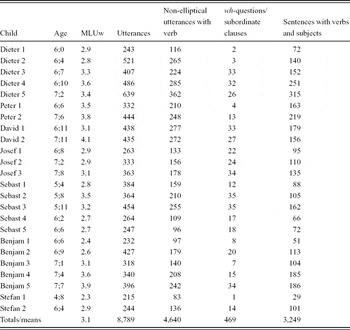
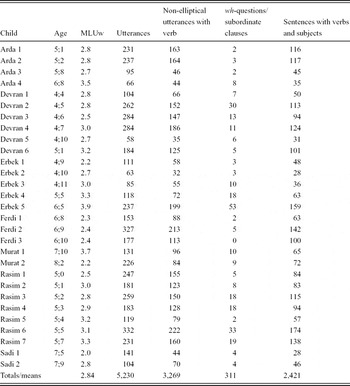
The data come from fifty-three recordings of spontaneous speech of 40 to 60 minutes each. Participants were the child and one or two other participants familiar to the child under study. The recordings took place in the institutions and clinics where the children were treated. Most of the recordings of both groups of children involved free-play sessions. For some of the recordings with both groups, we presented children with cartoon-like drawings in a semi-naturalistic setting and encouraged them to talk about the properties and actions of the people and animals depicted in the drawings. Tables 1 and 2 provide an overview of the data.
Overview of data from monolingual children with SLI (L1).

Overview of data from bilingual children with SLI (L2).

The monolingual and bilingual datasets we examined for the present study were similar in terms of mean chronological age (L1: 6;7, SD: .81; L2: 5;8, SD: 1.1), number of recordings (24 for L1, 29 for L2), and mean MLU (L1: 3.13, SD: .47; L2: 2.84, SD: .45); see the second and the third columns of Tables 1 and 2. It is true that the period of exposure to German was shorter for the bilingual than the monolingual children. However, in terms of their level of language development (as measured in terms of MLU scores), the bilingual and monolingual children were similar to each other. Furthermore, they all produced sentences in which the CP-layer was overtly instantiated, specifically wh-questions with overt wh-elements and embedded clauses with overt complementizers. The MLU scores were calculated in words for each recording, on the basis of the number of utterances shown in the fourth column. The fourth column (“Utterances”) shows the total number of a child's utterances in each recording. For these totals, simple yes/no responses, imitations, stereotypes and unintelligible utterances were excluded. The column “Non-elliptical utterances with verb” includes the total number of main clauses, yes/no questions, echo questions, wh-questions and subordinate clauses that contain at least one verb, i.e., a main lexical verb, a modal or auxiliary verb, or another verb-like element such as a participle, a separable verb prefix (e.g., ab of ab-trennen “to separate”), or predicative adjective. For the column “wh-questions/subordinate clauses”, we only included sentences with an overt finite and/or non-finite verb and an overt wh-element or overt complementizer. The final column shows the number of sentences (including main clauses, yes/no questions, intonation questions, wh-questions and subordinate clauses) that contain a verb and an overt subject. Imperatives were excluded from this analysis because they lack an overt subject and person/number markings on the finite verb. For this column, we also excluded sentences that contained a bare non-finite verb (e.g., verb particle or participle) without a co-occurring finite verb form. The analysis of subject–verb agreement to be presented in the following sections is based on the totals shown in this column. As can be seen from the two tables, the total number of relevant sentences is 3,249 for the monolingual and 2,421 for the bilingual children.
To analyze the data statistically, we used non-parametric tests, the Wilcoxon test for within-group comparisons, and the Mann–Whitney test for between-group analyses. Furthermore, Cohen's d (Cohen, Reference Cohen1988) was calculated to estimate effect sizes of significant differences. The means for the two participant groups for all comparisons were based on individual participant means, each of which was calculated over all samples from each individual participant.
6. Results
The results on subject–verb agreement marking reported in this section are based on sentences that contained both an overt subject and a verb. Two analyses were performed, an exponent-based analysis and a morphosyntactic, feature-based analysis. These two analyses examine the same dataset from two different perspectives. The exponent-based analysis looks at the distribution of the morphological forms produced by the children, e.g., the occurrences of -t, -st, -n, etc., and determines whether they were correctly or incorrectly used in terms of subject–verb agreement. The second analysis considers a given grammatical subject's pairing of person and feature features, e.g., first person singular, second person plural, etc., and determines which inflectional form appeared on the co-occurring verb.
6.1 Subject–verb agreement: inflectional forms
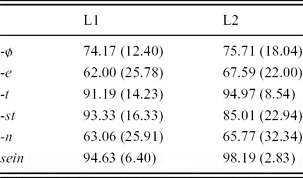
Consider first the exponent-based analysis. Table 3 presents mean accuracy scores and standard deviations of agreement inflections in the two groups of children with SLI; the individual subject data are presented in “Appendix” A and B. The scores are presented separately for regular agreement affixes and for agreement with finite forms of sein. Bare forms without an overt affix, as for example in (ich) lach “(I) laugh”, are shown as -ø forms. Each mean score represents the proportion of the total number of occurrences of a given exponent in a child's speech that was correct with respect to agreement.
Mean correctness scores (and standard deviations) of the inflectional forms in the two SLI groups.

From these data, we can make four observations. First, the mean overall accuracy scores were similar in the two groups of children, 70.5% (1828/2594) for the L1 and 73.6% (1228/1668) for the L2 group, a non-significant between-group difference (Z < 1). Second, the mean scores for the individual inflectional forms shown in Table 3 were also parallel in the two groups and did not show any significant between-group differences (for -st: Z = 1.38, p = .17; for all other forms: Z < 1). Third, all exponents were represented in both groups of children. This was also the case for individual participants. All children produced all exponents, with the exception of the monolingual child Peter who did not have any instances of -st. Fourth, whilst -st, ‑t and forms of sein had high accuracy scores of 85% to 98%, the scores for bare forms (‑ø), as well as for -n and -e forms were considerably lower, between 62% and 75%. “Appendix” A and B shows that the contrast in accuracy scores between the former and the latter group of inflectional forms can be also be seen at an individual participant level. These observations show that with respect to the accuracy of agreement forms, both groups of children with SLI showed similar patterns of performance. Although the children (with one exception mentioned above) had acquired all the exponents required for subject–verb agreement in German, the reduced accuracy scores are indicative of difficulties in this domain, particularly with respect to -ø, -n and -e forms.
To further examine the nature of these difficulties, consider first the role of morphological differences between these exponents. It is true that the finite forms of sein are highly irregular. Unlike most of the other inflectional forms under study, these forms are likely to be directly retrieved from the lexicon, and this might be the reason for the relatively high correctness scores of finite forms of sein. However, even if we only compare the non-suppletive inflectional forms, there were still significant within-group differences between the averaged scores for -st and -t forms on the one hand, and the averaged scores for -ø, -n and -e forms on the other, in both the L1 (91.19% vs. 69.59%, Z = 2.20, p < .05) and the L2 group (89.86% vs. 73.66%, Z = 2.37, p < .05). For both participant groups, these contrasts represent large effects (L1: d = 1.84; L2: d = 1.04). Likewise, within-group analyses did not reveal any significant difference between the accuracy scores for sein forms on the one hand and for the averaged -st/-t scores on the other, in either the L1 (94.63% vs. 91.19%, Z < 1) or the L2 group (98.19% vs. 89.86%, Z = 1.36, p = .17).
Another morphological difference is between bare (-ø) forms and other exponents that involve overt affixation. To determine whether this difference had any effect on the performance patterns, we removed -ø forms and only contrasted inflectional forms with overt affixes. Again, the averaged -st/-t accuracy scores came out as significantly higher than the averaged -n/-e scores in both the L1 (91.19% vs. 60.76%, Z = 2.20, p < .05) and the L2 group (89.86% vs. 67.01%, Z = 2.37, p < .05), a large effect in terms of Cohen's d in both participant groups (L1: d = 1.67; L2: d = 1.13).
These comparisons indicate that the observed accuracy differences between the various subject–verb agreement forms cannot be explained in purely morphological terms, e.g., between suppletive vs. non-suppletive forms or between affixed vs. non-affixed forms. Alternatively, these contrasts could be due to the morphosyntactic properties of the exponents under study.
6.2 Subject–verb agreement: morphosyntactic encoding
One property that clearly distinguishes inflected forms of sein, -st and -t from -ø, -n and -e forms is that the former yield finite verbs that encode agreement features, whereas the latter are potentially non-finite forms. It is true that -ø, -n and -e are forms of the person and number agreement paradigm in German, for example, the 1st and 3rd plural -n or -ø forms for the 3rd sg. of modal verbs and preterit forms. However, these forms also occur with non-finite verbs, -n for infinitives and -ø forms on bare uninflected stems. Furthermore, -e forms, which are produced with a reduced vowel [ə], are used by (unimpaired) German-speaking children as phonological variants of -ø and -n forms (Clahsen & Penke, Reference Clahsen, Penke and Meisel1992). Thus, the relatively low correctness scores for -ø, -n and -e forms are likely to result from children using non-finite forms in cases in which finite forms were required. Omissions of finiteness markers and non-finite forms in finite contexts are indeed well-known phenomena of the speech of monolingual and bilingual children with SLI and have been reported across a range of languages (e.g., Paradis et al., Reference Paradis, Crago and Genesee2005/2006; Rice, Reference Rice, Levy and Schaeffer2003) including (monolingual) German children with SLI (Clahsen, Reference Clahsen1991; Rice et al., Reference Rice, Noll and Grimm1997). Examples illustrating the incorrect (potentially non-finite) use of -ø, -n and -e forms in finite contexts are shown in (2).
(2)


In addition to cases such as (2) and despite high accuracy scores for some exponents (e.g., -t and -st), the children (in both groups) also produced true agreement errors in which an inflectional form was clearly finite, but incorrect in terms of its agreement features. Examples of that are shown in (3), illustrating substitution errors for -t and -st.
(3)
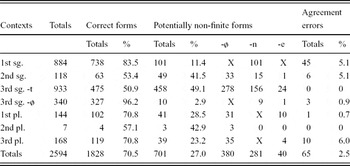
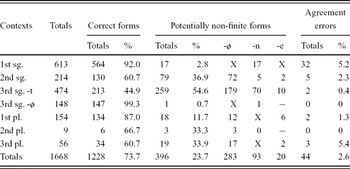
To determine morphosyntactic impairments in the domain of subject–verb agreement more systematically, the following analysis presents percentages of correct use of verb forms in obligatory contexts for person and number agreement. For this analysis, we compared the verb forms against the person and number feature pairings of the grammatical subjects in the sentences produced by the children. Three cases were distinguished: correct forms, potentially non-finite (-ø, -n, -e) forms, and agreement errors. In a sentence with a 2nd singular subject, for example, the child may produce the correct -st form, a -ø, -n and -e form (e.g., (2f)), or an agreement error (e.g., (3c)). Tables 4 and 5 show totals (summed over the seven children in each of the two participant groups) and proportions (out of the total number of forms) for each pairing of person and number features. For sentences with 3rd person singular subjects, an additional distinction is made between verbs that require the -t affix, on the one hand, and modal verbs and preterit forms which require a -ø form, on the other. The individual subject data are presented in “Appendix” C and D.
Inflectional forms by morphosyntactic context: L1.

Inflectional forms by morphosyntactic context: L2.

Tables 4 and 5 show similar rates of correct use in obligatory contexts for the monolingual and the bilingual children. Between-group comparisons of the accuracy rates did not reveal significant differences for most of the person and number pairings (3rd sg. -t/-ø, 2nd pl., 3rd pl.: all Zs < 1; 2nd sg.: Z = 1.47, p = .14). Differences were found, however, for the 1st pl. (Z = 2.16, p < .05) and the 1st sg. (Z = 1.73, p = .084), for which the bilingual children had higher correctness scores than the monolingual ones. Furthermore, the tables show that all person and number feature pairings occurred in the data of both the L1 and the L2 group. This also holds for individual participants, with the exception of the 2nd pl., which did not occur in the data of several L1 and L2 children (Peter, David, Sebastian, Stefan, Devran, Ferdi, Murat).
As in the analysis of inflectional forms, the accuracy rates in Tables 4 and 5 show a contrast between different forms of the paradigm. Whilst relatively high correctness scores of 80% to 90% can be seen for 1st sg., 3rd sg. (-ø), and to a lesser extent, for 1st pl. and 3rd pl. contexts, the scores for 2nd sg., 3rd sg. (-t), and 2nd pl. were considerably lower. This contrast holds for both groups of children with SLI. Statistical analyses confirmed these observations. Within-group comparisons showed that accuracy scores averaged over the 2nd sg., 2nd pl. and the 3rd sg. -t on the one hand were lower than the average of the 1st sg., 3rd sg. -ø and the 1st pl./3rd pl. on the other hand (L1: 59.09% vs. 84.84%, Z = 2.37, p < .05, d = 1.58; L2: 61.5% vs. 80.21%, Z = 1.86, p = .063, d = 1.08). An additional between-group analysis confirmed that the groups again performed similarly (59.09% vs. 61.5%, 84.84% vs. 80.21%, Z < 1).
Although the accuracy scores for the 1st sg., 3rd sg. -ø and the 1st pl./3rd pl. were relatively high, as pointed out above, the exponents required in these cases are ambiguous between a finite and a non-finite inflectional form. When, for example, a child produced a bare (-ø) form in a 1st sg. context, this may indeed correctly encode agreement features, but a bare (-ø) form could also represent an uninflected stem, i.e., a non-finite form. Thus, the relatively high accuracy rates in these cases are not by themselves indicative of intact subject–verb agreement. This is confirmed by considering person/number pairings in which an unambiguous agreement marking is required, i.e., the 2nd sg. -st, 2nd pl. -t and the 3rd sg. -t. As mentioned above, the rates of correct subject–verb agreement marking in these cases were significantly lower in both groups of children. Instead of the correct forms, the children often produced potential non-finite forms and, albeit to a lesser extent, agreement errors; see Tables 4 and 5. These observations are a clear sign of the children's difficulties with subject–verb agreement.
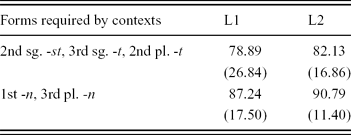
Previous studies on SLI, particularly with English-speaking children, have shown that children typically omit affixes that encode verb finiteness, e.g., the 3rd sg. -s, but that they do not substitute one finite form for another. This is likely to be an artefact of the inflectional paradigm in English, which lacks competing affixes for different person and number combinations. Given that the paradigm in German is richer than in English, substitution errors become a more realistic option. To examine these errors, we reanalysed the data leaving out all (correct and incorrect) cases of -ø forms. The results are shown in Table 6.
Percentages correct (and standard deviations) by contexts (without bare forms).

If the findings from English generalized to SLI in German and the children only omitted finiteness markings, the scores in Table 6 should be close to ceiling. As can be seen, this was not the case, which means that the children produced a considerable number of true agreement errors in which a correct affix was substituted by an incorrect one. The scores were again parallel in both the monolingual and the bilingual children without any significant between-group differences (both Zs < 1). With 10% to more than 20%, the rates of substitution errors are not negligible. Errors of this kind are practically non-existent in typically developing German children, once the 2nd sg. -st has been acquired (Clahsen & Penke, Reference Clahsen, Penke and Meisel1992).
6.3 Additional analyses
Four additional analyses were performed to further explore the observed impairment in subject–verb agreement marking and how it is related to other domains of grammar.
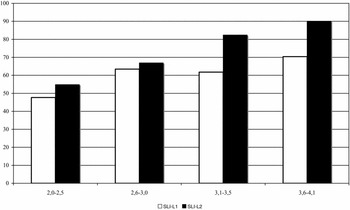
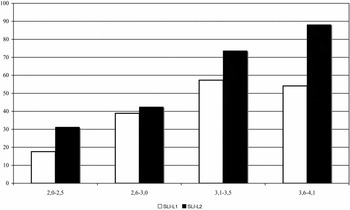
The first analysis investigates potential developmental changes with respect to agreement marking in the present data set. Recall that for each of the fourteen children, several recordings were available covering a period of approximately one year for the monolingual and between 2 months and 20 months for the bilingual children with SLI. To determine potential developmental changes of subject–verb agreement over this period of time, the data were arranged according to the MLUW scores of each recording, assuming that the MLUW provides a reasonable general measure of language development (Hickey, Reference Hickey1991; Paradis, Reference Paradis2010). The MLUW scores range from 2.3 to 4.1 for the L1, and from 2.0 to 3.9 for the L2 group. As in the overall analyses of subject–verb agreement, we again examined accuracy of inflectional exponents separately from correct use in obligatory contexts. Figure 1 shows the proportions of potential non-finite forms (-ø, -n, -e) that were correct and Figure 2 the percentages of correct use of -st and -t in 2nd sg., 2nd pl. and 3rd sg. (-t) contexts, separately for four MLUW bands.
Mean correctness scores of -ø, -n and -e forms in four MLUW bands.

Percentages correct of -st and -t in obligatory contexts in four MLUW bands.

These graphs indicate that although the correctness scores increased with MLU level in both participant groups, both measures were still reduced, even at the highest MLU band. The children's scores for subject–verb agreement at the highest MLU level represented in our dataset were considerably lower than those reported for both monolingual and bilingual typically developing German-speaking children at similar MLU levels. For typically developing monolingual children, high accuracy levels close to ceiling were found for all forms of the subject–verb agreement paradigm at this MLU level; see, for example, Clahsen (Reference Clahsen1986; Reference Clahsen1991). Likewise, Rothweiler (Reference Rothweiler and Lleó2006) and Chilla (Reference Chilla2008) reported data from typically developing early successive bilingual (Turkish–German) children, indicating mastery of subject–verb agreement well below an MLU of 3.6. That this was not the case for either the monolingual or bilingual children with SLI confirms that subject–verb agreement is a domain of persistent difficulty for these children. One caveat, however, is that (due to unbalanced datasets) the observed developmental trends can at present not be statistically verified. We must therefore interpret the ‘persistence’ in the children's difficulties with subject–verb agreement as tentative.
Consider next individual differences between the children. Clearly, SLI is a heterogeneous syndrome and individual differences have been widely reported for this population. This was also the case for the current dataset. Although all children with SLI under study exhibited difficulty with subject–verb agreement, individual differences were also seen. For illustration, consider the examples in (4).
(4)
Unlike other children, the monolingual SLI child Sebastian often overapplied the -t affix to all person and number pairings; see (4a, 4b). He produced a total of 124 verb forms with -t, 48 of which were incorrect, yielding an error rate of 38.7%, which is much higher than for any other child with SLI. Apparently, -t functions as a kind of non-agreement-marked default form in Sebastian's grammar. A similar case is David who, in addition to bare stems, overapplied -t forms more than other children. Likewise, the bilingual child Devran produced overapplications of -st forms, which were practically non-existent amongst the other thirteen children, particularly incorrect uses of the word form has(t) “have-2nd sg.” as shown in (4c) and (4d). It should be noted, however, that despite these differences, Sebastian, David and Devran are similar to the other children with SLI in that subject–verb agreement was affected. The observed performance patterns seem to reflect different individual responses to a common deficit.
The third additional analysis is concerned with tense marking in the two groups of children. This was motivated by studies on English-speaking children with SLI (e.g., Rice, Reference Rice, Levy and Schaeffer2003), which found impairments of both agreement and tense marking. However, English does not have a pure agreement affix and consequently, tense and agreement are difficult to dissociate in English. Furthermore, Clahsen et al. (Reference Clahsen, Bartke and Goellner1997) reported results from a dataset of English-speaking children with SLI in which the 3rd sg. -s (which encodes both tense and agreement) was significantly more affected than -ed (which does not encode agreement). Clahsen et al. (Reference Clahsen, Bartke and Goellner1997) also compared (preterit) tense marking with subject–verb agreement marking in monolingual German-speaking children with SLI. The results showed a clear dissociation, with higher accuracy scores on tense than on subject–verb agreement. In fact, for tense, the scores of children with SLI were indistinguishable from those of typically developing, MLU-matched children. The same picture emerges from the seven bilingual children under study here, although the relevant dataset for examining preterit forms was considerably smaller than the one examined by Clahsen et al. (Reference Clahsen, Bartke and Goellner1997). Present and preterit tense marking were almost error-free in the bilingual children. In present tense contexts, they used present tense forms only and no single preterit form. Furthermore, there were no present tense forms in unambiguous past tense contexts. Most of the past tense contexts had a composite form, i.e., an auxiliary plus a participle, in which the auxiliary was often omitted. There were also twenty-nine preterit forms, most of which were forms of sein “to be”, all but one of which were correctly used in past tense contexts. We conclude that (preterit vs. present) tense marking is not impaired in German SLI, either in monolingual or in bilingual children.
The final additional analysis was performed to assess the defective CP hypothesis, according to which the grammar of SLI German fails to project an intact CP layer, i.e., “an extended structure that unifies the CP shell with the propositional core of the clause” (Hamann et al., Reference Hamann, Penner and Lindner1998, p. 228). Consider the data from Tables 1 and 2 with respect to this claim. As can be seen from the sixth column of these tables, all children with SLI produced wh-questions with overt wh-elements and subordinate clauses with overt complementizers. The presence of overt wh-elements and complementizers indicates that these children's grammars do in fact generate CP-level syntactic representations. For the monolingual children, there were 469, and in the data from the bilingual children, 311 such cases. The proportions of wh-questions and subordinate clauses (relative to the total number of (non-elliptical) utterances with verbs) in the two groups of children did not significantly differ from each other (L1: 469/4,640, 10.11% vs. L2: 311/3,269, 9.51%, Z < 1). The numbers of wh-questions and subordinate clauses were initially small, particularly at low MLU levels, but consistently increased over time. Examples illustrating the use of wh-questions and subordinate clauses in the first recording of each of the children are shown in (5) for the monolingual and (6) for the bilingual children.
(5)
(6)
It is, of course, possible that the emergence of the CP-layer in children with SLI is subject to a developmental delay and that at lower levels of grammatical development than the ones represented in our sample, children with SLI do not produce sentences with the CP-layer. Importantly, however, the present dataset shows that the same children who show persisting problems with subject–verb agreement produce sentences that include full instantiations of the CP-layer, indicating that ‘defective CPs’ is not an appropriate clinical marker for grammatical difficulties in children with SLI.
7. General discussion
The present dataset shows that although both groups of children have acquired exponents required for subject–verb agreement marking and there were no gaps in the paradigm, German-speaking children with SLI are impaired in this domain. Whilst occurrences of finite forms of sein and forms with -st and -t were typically correct, occurrences of -ø, -n and -e forms were often incorrect in terms of subject–verb agreement. We suggest that the reduced scores for the latter exponents are due to children using non-finite forms in cases in which finite forms were required. The percentages of correct use of (unambiguous) agreement affixes in obligatory contexts were also low, between 45% and 65%, and children often produced non-finite verb forms instead. In addition, agreement substitution errors were found in these contexts, between 10% and 20%, a clear indication of the children's difficulties in reliably encoding agreement features. Finally, the performance patterns were found to be similar in the two participant groups, showing that subject–verb agreement is impaired in both monolingual and bilingual children with SLI. We conclude that both monolingual and (early successive) bilingual children with SLI are limited in reliably producing verb forms with correct subject–verb agreement. In the following, we discuss these findings with respect to two broader issues: first, the relationship of bilingual language development and SLI, and second, the significance and nature of agreement deficits as a grammatical marker in SLI.
7.1 Similarities between monolingual and bilingual children with SLI
The present set of findings on bilingual children with SLI confirms results of previous studies that showed performance patterns similar to monolingual children with SLI, not only for simultaneous, but also for early successive bilinguals; see section 2. Our results complement and extend this body of research, by demonstrating that even in an immigrant setting, early successive bilingualism does not worsen the grammatical difficulties caused by SLI. It is likely that the successive bilingual children we examined received less input in their L2 compared to monolingual German children. Moreover, their attention needed to be split between two languages. They were faced with a dual language learning task, and they grew up in a social context in which German was not the language spoken at home. Yet, for the grammatical phenomena tested, there was no extra cost of bilingualism for the Turkish–German bilingual children we examined. Instead, the observed similarities in both the kinds and the extent of agreement deficits in monolingual and bilingual children with SLI suggest that these impairments affect the use of grammar, independently of whether this is in the child's L1 or in an early learned L2.
On the other hand, some studies have reported particular disadvantages of early successive bilinguals with SLI, relative to monolingual children with SLI. These additional difficulties were attributed to the dual language learning task (Stavrakaki et al., Reference Stavrakaki, Vogindroukas, Chelas, Ghousi, Gavarró and Freitas2008) or to a kind of processing overload caused by the cumulative effect of bilingualism and language impairment (Orgassa and Weerman, Reference Orgassa and Weerman2008; Steenge, Reference Steenge2006). As the present findings do not confirm these claims, the question arises of how the observed discrepancies can be explained.
With respect to Stavrakaki et al.'s (Reference Stavrakaki, Vogindroukas, Chelas, Ghousi, Gavarró and Freitas2008) study, the bilingual (Albanian–Greek) child examined there was described as “generally language impaired” (p. 414), rather than as a clear case of SLI. Furthermore, although this child's scores on plural agreement forms were below that of the SLI group, this child's accuracy scores for plural agreement were indeed very similar to “SLI3”, one of the monolingual children with SLI, indicating that reduced scores on plural number agreement can also be found in monolingual Greek children with SLI.
Steenge (Reference Steenge2006) also reported worse performance scores on bilingual than on monolingual children, but only with respect to plurals and participles. Paradis (Reference Paradis2010, p. 242) reanalyzed Steenge's data on plurals and participles using an effect-size measure. She found that although accuracy scores were lower for the bilinguals than the monolinguals with SLI, the bilinguals did not display larger effect sizes than the monolinguals, indicating that there was no cumulative effect, even for this measure; see also de Jong's (Reference De Jong2010, p. 275) commentary on this finding.
This leaves us with Orgassa and Weerman (Reference Orgassa and Weerman2008), who reported worse performance on gender agreement within noun phrases in Dutch for bilingual than for monolingual children with SLI. The linguistic phenomenon they investigated is a highly exceptional case of an otherwise fully regular paradigm in Dutch, namely a bare form of the attributive adjective of neuter nouns preceded by an indefinite determiner. Orgassa and Weerman (Reference Orgassa and Weerman2008, p. 353) obtained low accuracy scores for all five participant groups (monolingual L1 with/without SLI, child L2 with/without SLI, adult L2) they tested. It is true that the group of the L1 children without SLI outperformed all other groups, but with 45% correct responses, even typically developing monolingual Dutch children performed at chance level on this measure. For the other participant groups accuracy scores ranged from 16% to 31%. What can be concluded from these data is that this ‘special rule’ of Dutch (Orgassa & Weerman, Reference Orgassa and Weerman2008) is indeed hard to acquire, for all language learners. However, whether any further conclusions about SLI or bilingualism and SLI can be drawn from this particular finding is questionable.
Summarizing, the evidence currently available favours the view that monolingual and early successive bilingual children with SLI exhibit parallel patterns of grammatical impairment. In contrast, evidence for bilingualism exacerbating SLI is scarce and inconclusive.
7.2 Grammatical impairments in German-speaking children with SLI
The results of the present study are indicative of persistent problems with subject–verb agreement for German-speaking children with SLI. At the same time, these children were able to produce wh-questions with overt wh-elements and embedded clauses with overt complementizers. Furthermore, despite their difficulties in reliably encoding subject–verb agreement, children with SLI achieved high correctness scores for (present vs. preterit) tense marking. Whilst these findings provide support for the agreement deficit hypothesis, they are not consistent with the view that SLI German is characterized by a CP-defective grammar (Hamann et al., Reference Hamann, Penner and Lindner1998) or that German children with SLI overuse ‘optional infinitives’ (Rice et al., Reference Rice, Noll and Grimm1997). We also note additional problems in how these authors analyzed their data, which could be the reason for how these conflicting interpretations of the grammatical difficulties of German children with SLI came about.
Rice et al. (Reference Rice, Noll and Grimm1997) reported high accuracy scores for finite verb forms and rare cases of agreement errors in their SLI data, which they claim challenges the agreement deficit hypothesis. Note, however, that the datasets investigated by Rice et al. were much smaller than those from other previous studies (e.g., Rothweiler & Clahsen, Reference Rothweiler and Clahsen1994) and that their analysis was restricted to just two affixes, -t and -st. These limitations reduced the chances of finding agreement errors, as would have been the case if we had restricted the analysis of our dataset to -t and -st. Closer inspection of Rice et al.'s (Reference Rice, Noll and Grimm1997) data indicates, however, that the children with SLI they studied did indeed perform worse than typically developing children with respect to agreement. Unlike in the control children, for example, the agreement paradigm was still incomplete at the first cross-section (T1) in five of the eight children with SLI, who did not produce a single instance of -st. Likewise, the frequencies for the -t suffix at T1 in the SLI data were extremely low, indicating that the 3rd sg. -t was only used on a small set of verbs and not yet as a productive agreement marker, similarly to what has been observed for other German-speaking children with SLI (Clahsen, Reference Clahsen1991, pp. 165ff.). Thus, it is likely that the frequent use of non-finite verb forms in finite contexts, ‘optional infinitives’ in Rice et al.'s (Reference Rice, Noll and Grimm1997) terms, is indeed a consequence of the children's difficulties with agreement. Furthermore, the contrast observed in Clahsen et al. (Reference Clahsen, Bartke and Goellner1997) and in the present dataset for German SLI between intact (present vs. preterit) tense and impaired agreement marking is inconsistent with positing ‘optional infinitives’ as the critical grammatical marker of SLI in German, because according to the ‘optional infinitive’ hypothesis as well as its more recent incarnations (Wexler, Schütze & Rice, Reference Wexler, Schütze and Rice1998), difficulties with verb finiteness should affect both agreement and tense marking. For (monolingual and bilingual) SLI German, this prediction does not seem to be correct.
Hamann et al. (Reference Hamann, Penner and Lindner1998) argued that CP-related phenomena such as verb second, wh-questions and subordinate clauses are particularly affected in German SLI. They observed that approximately 80% of the children's wh-questions and subordinate clauses were “target-inconsistent”, whereas finite verb formation was not particularly affected. This contrast was said to challenge accounts that focus on deficits or delays of verb-finiteness markers and to support the idea that the CP-layer is affected in the SLI grammar. Hamann et al. also claimed that the rare use of verb-second patterns, which were only found in 3% of the main clauses produced by the children with SLI, confirms their account, as verb-second is thought to involve movement into the CP-domain.
One problem with this study is that Hamann et al. did not provide a proper analysis of verb finiteness. Instead, they simply distinguished between ‘infinitives’ and ‘finite verbs’ (Hamann et al., Reference Hamann, Penner and Lindner1998, pp. 209, 216). This could mean that all non-infinitive forms, for example, bare forms without affix, were counted as ‘finite’, even though these forms may indeed be uninflected stems, i.e., non-finite. Hence, the preference of finite verb forms reported in their study should be treated with caution. Furthermore, as verb-second in German is restricted to finite verbs, the infrequent use of verb-second Hamann et al. observed in their data may actually be a consequence of the children's difficulties in forming finite verbs, rather than due to a missing or affected CP. Finally, for calculating the reported “high percentage of target-inconsistent wh-questions and subordinate clauses” Hamann et al. included a wide range of phenomena, e.g., sentences with non-target-like wh-elements or complementizers (so-called ‘place holders’), sentences without overt wh-elements or complementizers, and sentences without subjects or verbs. However, several of these phenomena, e.g., the presence or absence of a subject or of a finite verb in a subordinate clause, do not directly bear on the presence or absence of a CP-layer. It is also not quite clear why place-holder elements were treated as indicative of defective CPs. Instead, place-holder elements have been claimed to fill the Comp position, despite being lexically inappropriate (e.g., Clahsen, Kursawe & Penke, Reference Clahsen, Kursawe, Penke, Koster and Wijnen1996). Thus Hamann et al.'s counts of “target-inconsistent” CPs in the German SLI data seem to be inflated, through the inclusion of unrelated phenomena that do not directly bear on the presence or absence of a CP.
On balance, the evidence available on German SLI is in line with the view that agreement deficits are at the core of the children's grammatical difficulties in this language. Alternative proposals appear to be less successful.
7.3 Subject–verb agreement in SLI
Difficulties with (subject–verb) agreement in monolingual children with SLI have been found across a range of typologically different languages and different age groups, even for children whose grammars were otherwise relatively advanced; see Clahsen (Reference Clahsen, Ball, Perkins, Mueller and Howard2008) for review. Likewise, for bilingual (Turkish–German) children with SLI, Chilla and Babur (Reference Chilla, Babur, Topbas and Yavas2010) described an underdeveloped agreement system in the children's L1 (Turkish). These findings raise theoretical questions concerning the nature and possible causes of agreement deficits in SLI that require further investigation and elaboration. Here we consider different accounts focusing on how the results reported above on German SLI can be explained.
One possible source of difficulties with (subject–verb) agreement might be at the level of the phonological and/or morphological form inventory. Children with SLI may, for example, have difficulty perceiving and recognizing non-salient phonological material (Leonard, Reference Leonard1998), and the degree of phonological accessibility of grammatical morphemes may determine their performance on these morphemes, with better results for phonologically more substantive forms (Chiat, Reference Chiat2010). These factors may lead to incomplete or otherwise insufficient sets of exponents or inflectional paradigms in SLI; see, for example, Clahsen (Reference Clahsen, Ball, Perkins, Mueller and Howard2008, p. 177) referring to SLI Greek. This possibility can be ruled out for the present dataset, given that the children with SLI produced all exponents required for subject–verb agreement marking and did not show any gaps in the paradigm. Moreover, if phonological accessibility determined SLI performance, we would expect German-speaking children with SLI to do worse on subsyllabic morphemes such as the -st and -t than on the phonologically highly salient forms of sein. This was not the case, however. Hence, a purely form-based account of the children's difficulties with agreement seems to be insufficient.
Alternatively, children's difficulties with (subject–verb) agreement could be the result of a more fundamental ‘checking’ deficit (see, e.g., Wexler et al., Reference Wexler, Schütze and Rice1998), in that the grammatical mechanism that normally checks the person and number features of grammatical subjects against those of a co-occurring finite verb form might be missing from the SLI grammar, or otherwise affected. If the agreement checking mechanism was missing, we should find many subject–verb agreement errors in the speech of children with SLI, because the choice of an inflected verb form would then not be controlled by the person and number features of the grammatical subject. This was not the case, however. Moreover, in cases in which the children produced (unambiguous) finite verb forms, they were most often correctly marked for agreement. On the other hand, there were agreement errors in the present dataset, and the children produced many non-finite instead of agreement-marked verb forms. Taken together these findings suggest that the grammatical mechanism for checking agreement features is not functioning reliably in SLI, but is unlikely to be missing completely.
Another possibility is that the difficulties of these children with agreement are due to a delay of language development, which might even be specific to this domain of language, a “delay within a delay” in Rice's (Reference Rice, Levy and Schaeffer2003, p. 65) terms. If that was the case, we would expect patterns of performance in children with SLI similar to those of younger typically developing children. It is true that like in German SLI, non-finite verb forms in finite contexts are often found in the speech of two- to three-year-old unimpaired German children. However, once the 2nd sg. affix -st has been acquired, typically developing children reliably mark subject–verb agreement and rarely produce non-finite verb forms in finite contexts any more (e.g., Clahsen, Reference Clahsen1986; Clahsen & Penke, Reference Clahsen, Penke and Meisel1992). In German SLI, on the other hand, persistent problems with subject–verb agreement were observed even after -st has been acquired. In the present dataset, for example, thirteen of the fourteen children with SLI have acquired -st and yet, unlike typically developing children, they still produced agreement errors and many instances of non-finite verb forms in finite contexts. These differences indicate that the use of (subject–verb) agreement in (German) SLI does not correspond to an early stage of typical development.
From the previous considerations, it appears that attempts at explaining the difficulties with agreement observed in children with SLI, at least those observed in the present dataset, in terms of missing or delayed components of linguistic knowledge, are not particularly successful. There were no indications that the children we examined lack particular forms of the paradigm or other elements of the grammar that are required for encoding (subject–verb) agreement, or that their development was delayed in this domain of grammar. Nevertheless, the children's production of agreement-marked verb forms was found to be unreliable, with many non-finite verb forms in cases in which finite forms were required and some agreement errors. Hence, it is possible that the children's unstable use of agreement-marked verb forms represents a production-specific problem. Although this may indeed be the case for the present dataset, difficulties with subject–verb agreement in SLI have also been found in grammaticality judgment (Rispens & Been, Reference Rispens and Been2007). It is also conceivable that the functioning of mechanisms involved in the (real-time) processing of agreement features is affected in SLI, in which case one may find difficulties with agreement in children with SLI not only in production, but also in comprehension or judgment. To properly test these possibilities, experimental data are required that provide insight into the detailed processes involved in language production, comprehension or judgment. For agreement in SLI, however, such data are not yet available.
8. Conclusion
Three main empirical results have come out of the present study. First, the German-speaking children with SLI we studied did not reliably encode subject–verb agreement in production. Accuracy scores for (unambiguous) agreement affixes in obligatory contexts were low. Instead, the children produced agreement substitution errors and non-finite forms in cases in which agreement marking was required. Second, problems with subject–verb agreement were observed even though the children were relatively more advanced in other domains of their grammar, as indicated by correct tense marking and the use of wh‑questions with overt wh‑elements and embedded clauses with overt complementizers. Third, the two participant groups were found to perform similarly for the phenomena under study.
Our results are in line with other studies of bilingual children with SLI that reported patterns of grammatical impairment similar to those of monolingual children with SLI, and no extra cost or cumulative effect of bilingualism. We found that this is also the case for children from immigrant families in Germany who speak a minority language (Turkish) as their L1 and grow up in a social context that does not support bilingualism. Importantly, the bilingual children we studied here were all early bilinguals. The picture may change for bilingual children with SLI at later ages of onset of the L2, for whom additional effects of the L2 may come into the picture; see, for example, Chilla (Reference Chilla2008). For early bilinguals, however, this was not the case.
Our findings also confirm difficulties with (subject–verb) agreement as a marker of grammatical difficulties in German SLI, for both monolingual and (early successive) bilingual children. We suggest that the observed similarities between these two groups are consistent with the view that grammatical agreement deficits in SLI are due to domain-specific constraints or limitations on the use of grammar. By contrast, it is difficult to see how the specific difficulties with agreement could be explained in terms of domain-general limitations, reduced input or general processing or capacity limitations, when related or potentially more demanding phenomena appear to be functioning much better. Different linguistic accounts of the grammatical agreement deficit in SLI were discussed, several of which could be ruled out for the present dataset. Alternatively, agreement deficits in SLI might be explained in psycholinguistic terms, i.e., at the level of real-time mechanisms of language production and comprehension. However, further (experimental) study is required to explore this possibility.
Appendix
A. Percentages correct use of inflectional forms: L1

B. Percentages correct use of inflectional forms: L2

C. Percentages correct by morphosyntactic context: L1

D. Percentages correct by morphosyntactic context: L2