Within political socialization research and social network studies, researchers have made use of both individual questionnaires and information gained from key informants. In the first case, every social network member reports directly, in the latter one member reports on what s/he perceives to be the preferences of others. However, there is hardly any research on the differences between the results obtained from both methods. One of the studies that has been conducted in this respect was conducted by Acock and Bengtson (Reference Acock and Bengtson1980), who explored the difference between actual and perceived similarity between parents and children. They used a limited data set of 466 mother–father–child triads to investigate whether stated attitudes (what parents think) or attributed attitudes (what children report on what their parents think) are the best predictor for adolescents’ political orientations. Their results suggest that conclusions drawn from self-administered questionnaires can be completely different from the ones established on the basis of reported information. One of the reasons for the erroneous reports of the adolescent children could be that adolescents project their own attitudes on what they believe are the attitudes of their parents, a mechanism that has been called the “self-directed bias” (Niemi Reference Niemi1974; Whitbeck and Gecas Reference Whitbeck and Gecas1988). This self-directed bias is also documented in the work of Tedin (Reference Tedin1976), who argues that adolescents’ perceptions should only be used when the actual correlation between parents and children is expected to be very high. In this respect, Westholm describes a similar pattern in which adolescents are likely to overestimate the impact of the political socialization process and he concludes that “little confidence should be placed in studies of interpersonal influence based on a single source” (Reference Westholm1999, 548). An accurate perception of parental preferences, however, can be enhanced by political discussion within the family, parental value agreement and political knowledge of the adolescent (Niemi Reference Niemi1974).
In this research note, our aim is to investigate this possible measurement bias more systematically within the setting of political socialization studies. In this particular field, a substantial amount of research attention has been devoted to the transmission processes that take place between parents and children (Zuckerman, Dasović and Fitzgerald Reference Zuckerman, Dasović and Fitzgerald2007; Jennings, Stoker and Bowers Reference Jennings and Niemi2009). Some of these studies are based on self-administered questionnaires (e.g., Kroh and Selb Reference Kroh and Selb2009), while others are based on reported (thus perceived) information obtained from one family member only (e.g., Nieuwbeerta and Wittebrood Reference Nieuwbeerta and Wittebrood1995). The aim of this research note is to arrive at a better understanding of how the bias in self-reported data can influence our understanding of political socialization processes.
We use data from the Parent-Child Socialization Study (PCSS), conducted among 3426 15-year-old adolescents and their parents in the Flemish region of Belgium. Adolescents and both their parents filled out a survey containing questions on their own political preferences. Simultaneously, adolescents were asked how they perceive the political preferences of their parents. This unique data set allows us to investigate the differences between perceptions of political preferences and self-reported political preferences.
The questions we address are the following: (1) Can adolescents make a reliable assessment of their parents’ voting intentions?; (2) Which factors contribute to an actual or perceived similarity with parental voting intentions?; and (3) What are the implications of the difference between actual and perceived voting intentions for political socialization and social network research?
Data and Methods
The first wave of the PCSS was conducted in 2012 among a representative sample of adolescents and their parents in Belgium (Hooghe et al. Reference Hooghe and Boonen2012). For this study, a sample of 3426 14–15-year-old adolescents were interviewed using a written self-administered questionnaire in a stratified random sample of 61 Dutch language schools. All adolescents received a similar questionnaire for both their parents which could be completed at home. In 60.8 percent of cases, both parents completed the survey and for 72.7 percent of the adolescents at least one parent returned a completed questionnaire.
Looking at gender and educational level, the sample resembles the distribution in the population. As we will compare mother–child, father–child and mother–father dyads, we can only use complete triads where we have information from both the mother and the father. This brings the total of father–mother–child triads to 2085 with 6255 individual respondents. In the interpretation of the results, we should take into account that the analyses will not include single-parent households.
The questionnaires included information on the individual preferences of every family member, but also about the perceived preferences of the other family members and this allows for a direct comparison of the effects of actual and perceived attitudes. We use voting intentions as the dependent variable, in line with some of the works on political socialization within the family (Zuckerman, Dasović and Fitzgerald Reference Zuckerman, Dasović and Fitzgerald2007; Jennings, Stoker and Bowers Reference Jennings and Niemi2009). We have opted for the analysis of voting intentions, not only because this can be considered as a summary statement of political positions, but also because this measure leads to clear and discrete choices: either one has the same voting preference as his/her family members, or one does not. Furthermore, voting intention is the only variable in the PCSS survey for which we have both self-reported individual measures and perceived measures of the parents.
Dependent Variable
Voting intentions
Voting intention is measured using a standard question: “If you could vote in an election for the Belgian parliament today, which party would you vote for?” For both actual and perceived measures, the respondents were given eight options: Christian-Democrats, Greens, Flemish Nationalists, Liberals, Socialists, the radical right “Vlaams Belang,” Libertarians and radical left-wing socialists, with an additional open response category for “other party.” A previous analysis showed that adolescents at this age already make a clear decision on voting preferences (Hooghe and Boonen Reference Hooghe, Quintelier, Verhaegen, Boonen and Meeusen2015). Adolescents were asked two separate questions: they were asked which party they think their mother would vote for, and which party they think their father would vote for. These will be the perceptual measures in this study.
In comparison with other studies, item non-response for these questions remained limited. Non-response rates for the questions on own voting intention are 7.4 percent for adolescents, 10.1 percent for mothers and 11.9 percent for fathers. The non-response rates for the perceived voting intention of the parents are 10.0 percent for the perception of the mother and 13.2 percent for the perception of the father. The non-response rate was neither significantly related to perceived voting intention nor to political knowledge. However, to overcome possible bias, we used multiple imputations for these missing cases (with 20 imputations). We imputed missings for parent–child correspondence, parental homogeneity, correct knowledge and perceived correspondence, using auxiliary variables from both parents’ and children’s samples (gender, educational level, political interest, voting intention and political discussion within the family). In total, we imputed one or more items for 851 cases (Durrant Reference Durrant2009). In a separate analysis, we also made exactly the same calculations but without imputation, and this did not lead to substantively different results.
Correspondence
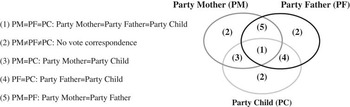
Given the fact that eight different parties for three family members could lead to 512 different combinations, we will not predict every distinct combination, but focus on specific party correspondence between child and parents, one of the main factors that is used to study intergenerational transmission. As the Belgian parties cannot be ordered on one single ideological dimension or divided in clear party blocs (Deschouwer Reference Deschouwer2009), we will use a conservative estimate of party correspondence that refers to voting for exactly the same party and not include any vague resemblance of party families. Theoretically, voting correspondence within a family triad can have five different outcomes (Figure 1). If all three members of the triad vote for the same party, there is full correspondence (area 1). If all members vote for a different party, there is no correspondence at all (area 2). The three other options are as follows: the child has the same preference as the mother, but a different one than the father (area 3); the child has the same preference as the father, but a different one than the mother (area 4); mother and father have the same preference, but they differ from the child (area 5). Every family can be situated in one of the five areas in Figure 1.
Combinations for vote correspondence within families

Independent variables
For the models explaining the correspondence between parents and children, we draw on previous literature to include some of the most important independent variables. These include the homogeneity between parents (Jennings and Niemi Reference Jennings and Niemi1981; Nieuwbeerta and Wittebrood Reference Nieuwbeerta and Wittebrood1995; Zuckerman, Dasović and Fitzgerald Reference Zuckerman, Dasović and Fitzgerald2007), political discussion within the family (Kroh and Selb Reference Kroh and Selb2009) and the strength of the party preference of the parents (Niemi Reference Niemi1974; Jennings, Stoker and Bowers Reference Jennings and Niemi2009). Therefore, we have included parental ideological homogeneity, political discussion with parents and the strength of the parental preferences as main independent variables in our regression models. Furthermore, we control for gender, political knowledge and educational level (Jennings, Stoker and Bowers Reference Jennings and Niemi2009).
The ideological homogeneity of both parents is taken into account by including the absolute difference between the self-placement of both parents on a 0–10 left-right scale. Parental dyads are considered to be homogeneous if this difference is 0, while the maximum difference can take the value of 10. Next, we include information about the strength of the party preference. Parents were asked to indicate on a 0–10 scale how likely it is that they will vote for their preferred party (propensity to vote), which we used as an indication of the strength of their preference. Political discussion with the parents is measured using a four-point sum scale, asking how often the respondents talk about politics with their mother and their father, with a higher score indicating more discussion. Gender is a dichotomous variable (girl=1). We operationalized Child’s education with a dummy variable coded “1” for the general education track and “0” for all other educational tracks.Footnote 1 As preliminary analyses suggested that vocational, art and technical education are closely related with regard to socio-economic characteristics, these educational tracks were grouped. For political knowledge, we use a sum scale of four multiple choice political knowledge questions concerning Belgian politics. The total sum scale ranges from 0 (all questions answered wrongly) to 4 (all questions answered correctly). We added the full question wording of all the used variables in the Appendix.
Results
Correct Knowledge of Voting Intentions
First, we explore to what extent the adolescents have a correct perception of the political preferences of their parents. We find that 42.9 percent of all adolescents have a correct perception of the voting intention of their father, while 46.5 percent has a correct perception of the voting intention of their mother and 30.1 percent has a correct perception of the party preference of both their parents.Footnote 2
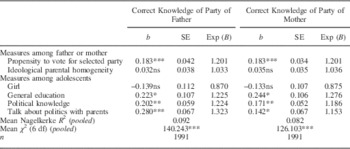
In a first binomial regression model, we use this correct knowledge on parental voting intentions as a dependent variable (Table 1). We find that respondents with a higher level of political knowledge are more likely to make a correct judgment of the voting intention of both mother and father. Talking about politics with parents also enhances the chances of having a correct knowledge of the voting intention, but this relation is only significant for the voting intention of the father. We can note that this has nothing to do with talking more frequently about politics with one’s father, as we have observed that adolescents talk just as frequently about politics with their mother as with their father. Finally, we can observe that when parents are strongly motivated to vote for a specific party (propensity to vote for selected party) adolescents are more likely to have an accurate perception of this preference. Ideological homogeneity between parents, gender and educational level are not significantly related to the correct assessment of parental voting intentions.
Predicting Children’s Correct Assessment of Parental Voting Intentions

Note: Hooghe et al. (Reference Hooghe and Boonen2012). Entries are unstandardized b coefficients from a logistic regression analysis with standard errors (SE) and odds ratios Exp (B). The n of the analysis is not 2085 because we have information on cases in the dependent variable that cannot be used (such as “blanc” or “invalid” voting intention). We did not code these as missings that should be imputed, but as cases of which the information is not useable in the analyses.
*p<0.05, **p<0.01, ***p<0.001.
Perceived Correspondence Between Parents and Children
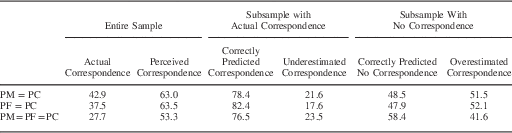
Next, we turn to the main question of this paper: Is there a difference between actual intra-family correspondence and perceived correspondence? In Table 2, we split up the results for the different correspondence measures in three subsamples: one for the entire sample (left column), one for the families in which there is a real correspondence between parent(s) and child (middle column) and one for the families in which there is no correspondence between parent(s) and child (right column). It is clear that there is a strong overestimation of correspondence between family members. In the first column, we can see that more than 60 percent of all respondents assume that they have the same vote preference as their father or their mother, while in reality this is no more than 40 percent. In all, 53.3 percent of all adolescents think both parents vote for the same party as they do, while this is the case in only 27.7 percent of the families. Note that the level of correspondence between mothers and children is higher than the level of correspondence between fathers and children, and this is in line with earlier studies on the intergenerational transmission of party preferences (Jennings and Niemi Reference Jennings, Stoker and Bowers1971; Jennings and Niemi Reference Jennings and Niemi1974; Zuckerman, Dasović and Fitzgerald Reference Zuckerman, Dasović and Fitzgerald2007).
Actual and Perceived Correspondence of Voting Intentions

Note: Hooghe et al. (Reference Hooghe and Boonen2012). Entries are row percentages.
PM=party mother; PF=party father; PC=party child.
In the second column, we can see that adolescents tend to overestimate the degree of resemblance they have with their parents. When there is actual correspondence (with one or both parents) the large majority (e.g., 78.4 percent for the mother) of the adolescent respondents are correct in their assessment. Therefore, if there is political correspondence, adolescents seem to be well aware of this and most mistakes are made in the cases where there is no actual correspondence.
The overestimated scores of similarity in the third column of Table 2 are in line with what Niemi (Reference Niemi1974, 62) and Tedin (Reference Tedin1976) observed in earlier studies and has been called the “self-directed bias” in adolescent’s reports. In the Niemi study, 90 percent of the students correctly reported their parent’s vote, but when the perception was incorrect, 69 percent was in the direction of the student’s own preference. Although this study differs strongly in terms of party system, age of the respondents and timeframe in which it took place, the results are in line with the current results, in the sense that there is a strong self-directed bias toward overestimating the correspondence between vote choices.
Are the Two Assessments Interchangeable?
While the results in Table 2 have shown that there is some correlation between actual and perceived correspondence, it is important to examine what the determinants are of the difference between both measurements. Therefore, in a next regression model (Table 3) actual and perceived correspondence function as the dependent variable. We limit ourselves to full family correspondence, i.e., families in which all surveyed members vote for the same party. As this is a dichotomous variable (full correspondence or not), we use a binomial logistic regression. We construct our model with a number of independent variables that have been found to predict correspondence of political preferences within the family, such as discussing politics within the family, strength of party preference and ideological homogeneity (e.g., Levine Reference Levine2005; Jennings, Stoker and Bowers Reference Jennings and Niemi2009).
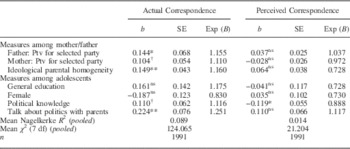
Predicting Actual and Perceived Political Correspondence of Voting Intentions Within the Family

Note: Hooghe et al. (Reference Hooghe and Boonen2012). Entries are unstandardized b coefficients from a logistic regression analysis with standard errors (SE) and odds ratios Exp (B).
Ptv=propensity to vote.
†p<0.10, *p<0.05, **p<0.01, ***p<0.001.
First, we can observe that the full model is more effective in predicting actual correspondence (Mean Nagelkerke pseudo R 2=0.089) than correspondence as perceived by the adolescent (R 2 =0.013). As expected from political socialization theory, the intensity of party preferences among the parents, the homogeneity of parental preferences, political discussion within the family and the level of political knowledge of the adolescent all predict actual correspondence. However, almost none of these coefficients is significant in the corresponding model that is aimed to explain perceived family correspondence (right column). Moreover, we even find a negative effect (−0.119) of political knowledge on perceived family correspondence, while we found a small positive effect (0.110) of political knowledge on actual family correspondence, which can be explained by the fact that less politically knowledgeable adolescents tend to systematically overestimate the correspondence between themselves and their parents. Generally, it is safe to state that the effects run differently for actual and perceived correspondence. Actual correspondence can be explained by political knowledge, parental homogeneity and political discussion within the family, while for perceived correspondence this is not the case. This is an important finding, as it shows that results of an analysis with perceived political attitudes can produce highly different or even opposite results with regard to these political socialization mechanisms.
Particularly for the study of intergenerational transmission of voting intentions, a correct assessment of correspondence across generations is of crucial importance. The main challenge for this kind of research is to investigate under what conditions adolescents develop the same political preferences as their parents (Nieuwbeerta and Wittebrood Reference Nieuwbeerta and Wittebrood1995; Zuckerman, Dasović and Fitzgerald Reference Zuckerman, Dasović and Fitzgerald2007). In the subsequent analysis, we ascertain what happens if the actual or the perceived correspondence are used in such an analysis. As we want to predict adolescent voting intentions and not party correspondence as the dependent variable, we need an analysis for every party separately. By splitting the parties up, we can use the voting intention of both their parents as an independent variable in the model. Note that the comparison between actual and perceived measures is still the main purpose of the analysis and we will therefore not be comparing the parties themselves. For reasons of data reliability, we restrict the analysis to the three largest parties with each over 250 adolescent voters in the sample (i.e., Christian-Democrats, Greens and Flemish Nationalists).Footnote 3
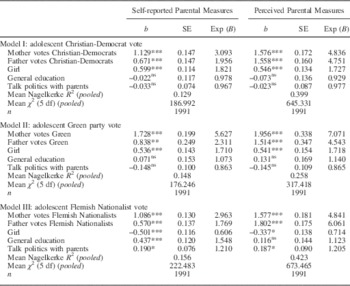
In the first model (Table 4), we explain a vote for the Christian-Democrats. Differences between the analysis with self-reported voting preferences and perceived voting preferences are remarkable. In both cases there is a positive and significant relation, but the effects are much weaker in the analysis with real voting intentions than in the analysis with perceived voting intentions. While the “direct information” analysis allows for 12.9 percent explained variance (mean pooled Nagelkerke pseudo R 2), this is a massive 39.9 percent in the analysis with perceived voting intention. To express it differently: adolescents who have a preference for Christian-Democrats very often assume that their parents will vote for the same party, while in reality this is not always the case.
Predicting Adolescent Voting Intentions Using Self-reported and Perceived Measures of Parental Voting Intentions

Note: Hooghe et al. (Reference Hooghe and Boonen2012). Entries are unstandardized b coefficients from a logistic regression analysis with standard errors (SE) and odds ratios Exp (B).
*p<0.05, **p<0.01, ***p<0.001.
Subsequently, we conduct the same analysis for the Greens (Model II in Table 4), and here we can observe 14.8 percent explained variance in the analysis with self-reported information and 25.8 percent in the analysis with perceived information. While both for the model using the actual measures as for the model using the predicted measures the coefficients are strong and significant, the model with the direct information is in general weaker than the model with perceived information using the indices for model fit.
Finally, in Model III we run the same for the Nationalist party. If we would rely on perceived correspondence for the transmission of voting for this party, our conclusion would again be that we can explain a very large 42.3 percent of the observed variance. The actual correspondence limits the explained variance to 15.6 percent. All measures for parental voting are highly significant, but they are considerably weaker when we use information obtained directly from the parents. These three models therefore are very clear: relying on perceived correspondence leads to a huge overestimation of the importance of the intergenerational transmission of voting intentions from parents to children.
Discussion
In this article, we explored the limitations of social network studies by examining the specific study of transmission of voting intentions within the family. We tested the difference between a study that would rely on information from one key informant in the family (the adolescent child), to studies that would rely on information from all members separately.
Our results show that adolescents often do not know the voting intention of their parents and strongly overestimate the political resemblance between themselves and their parents. Next, we found that there are some important differences between research results using perceived voting intentions versus analyses using actual similarity. On the one hand, political discussion within the family, political knowledge, parental homogeneity and strength of parental preferences each proved to be strongly associated with an actual correspondence of voting intentions, but not with a correspondence of perceived voting intentions. This already suggests that both measures could lead researchers to opposite conclusions if they are not clearly distinguished. Finally, a test using both forms of correspondence showed that using the perceived correspondence measures leads to a very powerful model of intergenerational transmission, while the reality of this intergenerational transmission is a lot more modest, as is shown by the model in which the self-reported measures of voting intention were used. Again, the analysis confirms the important distinction between the two methodological approaches.
The results in this study suggest that researchers using survey data or interviews among individual social network members need to be cautious when interpreting the data obtained from one informant. These findings are not only relevant for political socialization researchers, but could have consequences for other research using a similar design as well, such as social network research investigating the effects of ideological preferences among colleagues, peers, spouses, etc. (Mutz Reference Mutz2002a; Huckfeldt, Morehouse Mendez and Osborn Reference Huckfeldt, Morehouse Mendez and Osborn2004). Previous studies in this respect have shown that the difference between self-reported and perceived measures within social network research can indeed change our interpretation of the interactions between discussion partners (Morehouse Mendez and Osborn Reference Morehouse Mendez and Osborn2010).
Studies on political discussion have shown that politics is mostly discussed with conversation partners with similar political views and that people generally try to avoid contested conversations (e.g., Witschge Reference Witschge2004). The findings in this article, however, suggest that due to a self-directed bias, people might actually overestimate agreement with potential discussion partners. Therefore, they might actually interact more with people they disagree with than they—and researchers—would expect.
Another side note is that we should take into account that these judgement errors also found to be dependent on individual characteristics. For instance, gender (Morehouse Mendez and Osborn Reference Morehouse Mendez and Osborn2010), discussant expertise (Huckfeldt Reference Huckfeldt2001), but also political knowledge (cfr. supra) are individual determinants that change the accuracy of perceptions of social network members. This means that these findings can have implications for research fields that rely strongly on individual perceptions, such as studies on political discussion, but also, for instance, for analyses on the relation between political engagement and social network homogeneity (Mutz Reference Mutz2002b; Huckfeldt, Morehouse Mendez and Osborn Reference Huckfeldt, Morehouse Mendez and Osborn2004; Fitzgerald and Curtis Reference Fitzgerald and Curtis2012). For these particular studies we should take into account the possibility that an accurate perception of the level of diversity within a social network is dependent on the level of political knowledge of the respondent and the intensity of the interactions with the social network members. If the same logic applies in other social network settings, we could expect that people with lower levels of political knowledge tend to overestimate the agreement between themselves and their discussion partners (friends and colleagues) more strongly than those with higher levels of political knowledge. Following this, differences in reported network diversity between higher and lower politicized citizens in previous studies could, for instance, be overestimated (Mutz Reference Mutz2006).
Finally, a potential limitation to the current study is that we have obtained all the information on perceptions from an adolescent sample. Studies have shown that political knowledge levels tend to increase further into adulthood (Chan and Clayton Reference Chan and Clayton2006; Howe Reference Howe2010), and therefore we could expect the levels of perceptual accuracy in this respect to be higher among adults. This does limit the possibility to generalize the current findings toward an adult population. Furthermore, one should be careful with comparisons with results from an easier two-party system such as the United States. The limited number of parties obviously increases the likelihood of a correct perception, as “guessing” will be more effective in such a setting with fewer outcomes. Earlier research within the US context has indeed shown that citizens are quite capable of attributing political positions to certain political groups, such as Democrats and Republicans (Brady and Sniderman Reference Brady and Sniderman1985). The Belgian party system is an outlier on the other end of the spectrum, as it is one of the most fragmented multiparty settings in Europe (Deschouwer Reference Deschouwer2009). Within such a multiparty system, we might indeed expect the level of perceptual accuracy to be lower compared with two-party systems (Westholm Reference Westholm1999). Finally, it should be noted that discussions and other interactions with family members could differ from interactions in other social networks that have been studied such as colleagues and neighbors. We could, for instance, expect that perceptions from members in these more formal or more distant networks will be generally based on more selective information than perceptions from family members.
Appendix: Question wording
Self-Reported Voting Intention (Child, Mother and Father Survey)
If you could vote in an election for the Belgian parliament today, which party would you vote for?

Perceived Voting Intention (Child Survey)
If your mother could vote in an election for the Belgian parliament today, which party do you think she would vote for?
If your father could vote in an election for the Belgian parliament today, which party do you think he would vote for?
Propensity to Vote (Parent Survey)
Do you think that you would ever vote for the following parties? (0=definitely not, 10=definitely)

Left-right Identification (Parent Survey)
In political matters, people often talk about “the Left” and “the Right.” How would you place your views on a scale from 0 to 10?
Political Knowledge (Child Survey)
Sum scale of four multiple choice political knowledge questions concerning Belgian politics:
-
1. Who is Belgians Prime Minister?
-
2. Who is the Flemish Minister-President?
-
3. Who are the members of the Flemish government?
-
4. Who is the President of the European Council?
Political Discussion with Parents (Child Survey)
Sum scale of two highly correlated (0.70) questions about political discussion with parents:
-
1. How often do you talk about politics with your mother?
-
2. How often do you talk about politics with your father?
-
1. Never
-
2. Once or twice
-
3. Several times
-
4. A lot
Educational Level
In which educational track are you enrolled?
-
1. General education
-
2. Technical education
-
3. Artistic education
-
4. Vocational training
This variable is recoded into 1=general education and 0=all other forms.