1. Introduction
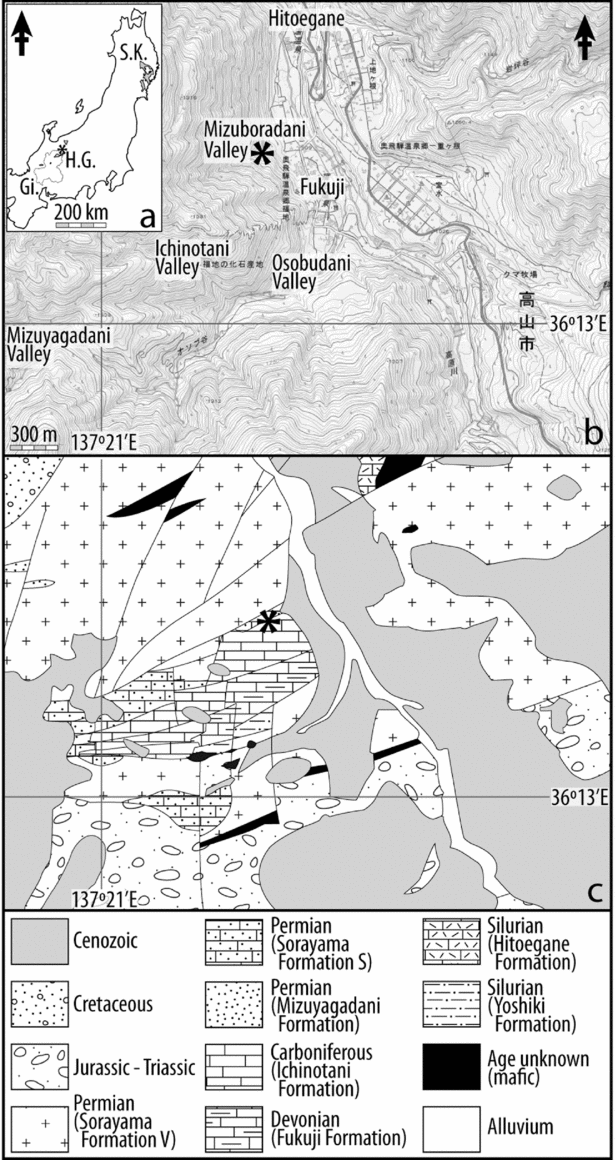
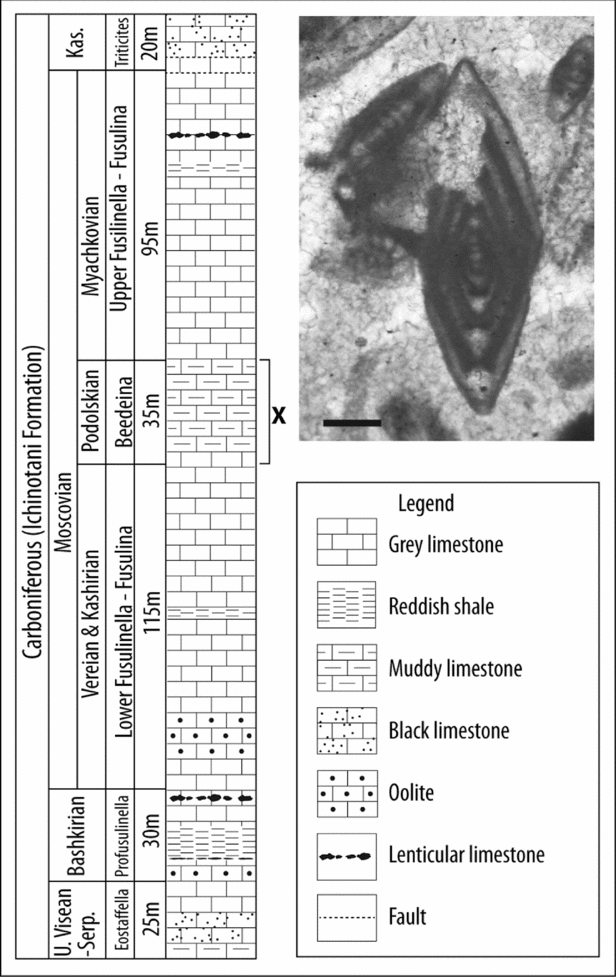
The Mizuboradani Valley in the Fukuji district of Gifu Prefecture, Honshu Island, Japan, is situated within the Palaeozoic Hida Gaien (Hida Marginal) Terrane (as characterized by Kojima, Takeuchi & Tsukada, Reference Kojima, Takeuchi and Tsukada2005). Along with the neighbouring valleys of Ichinotani and Mizuyagadani (Fig. 1) it has some of the best exposures of Carboniferous sedimentary rocks in central Japan. Several exposures within these valleys are represented by thick successions of marine limestones, intercalated with red mudstones, the latter displaying a potentially non-marine signal (Igo, Reference Igo1960; see Fig. 2). Igo (Reference Igo1956) erected a fusulinid biozonation for the Carboniferous Ichinotani Formation comprising five biozones. Niikawa (Reference Niikawa1980) revised the scheme, dividing the formation into six fusulinid biozones. The fossiliferous limestones of the Ichinotani Formation contain abundant corals (e.g. Fujimoto & Igo, Reference Fujimoto and Igo1958), spiriferid and productid brachiopods (Ibaraki, Tazawa & Miyake, Reference Ibaraki, Tazawa and Miyake2009; Tazawa, Miyake & Niikawa, Reference Tazawa, Miyake and Niikawa2010), and cephalopods (Niko & Hamada, Reference Niko and Hamada1987; Niko, Reference Niko2000). Adachi (Reference Adachi1989) published thumbnail sketches of ostracods from the Ichinotani Formation in its eponymous river valley, and from the Mizuyagadani Valley, but there have been no systematic descriptions of the fauna. Here we describe a new ostracod fauna sourced from three limestone nodules from the Ichinotani Formation, collected in the Mizuboradani Valley. Biostratigraphically diagnostic fusulinids (e.g. Ozawainella mosquensis) sourced from two of these limestone nodules (samples I-02 and K-01 herein) have identified an age of middle Moscovian (Pennsylvanian, Carboniferous), which signals derivation from the middle part of the Ichinotani Formation (Figs 2, 3). The third, lithologically similar limestone nodule (sample I-01), was found to contain the same ostracod fauna, suggesting it is likely to be from the same horizon. Previously described limestone nodules from the upper part of the Ichinotani Formation (Fusulinella–Fusulina Biozone) were also recovered as allochthonous blocks from within the Mizuboradani Valley (Isaji & Okura, Reference Isaji and Okura2014). They yielded a wide range of fossils, including fusulinids and other foraminiferans, sponges, gastropods, bivalves, cephalopods, brachiopods, trilobites, crinoids, conodonts and isolated teeth of cartilaginous fishes (Goto & Okura, Reference Goto and Okura2004). A similar macrofossil assemblage is found in the tuffaceous mudstone that surrounds the three nodules we have analysed for microfossils, with poorly preserved brachiopods, gastropods and bivalves, as well as conodonts, ostracods and fusulinids. The overlying Permian Mizuyagadani and Sorayama formations have been shown to contain many limestone clasts that also could possibly have been derived through erosion of the underlying Devonian Fukuji and Carboniferous Ichinotani formations (Tsukada, Reference Tsukada2005).
(a) Location of Fukuji, Okuhida-onsen-gou, Takayama City, Gifu Prefecture, Honshu Island, Japan (*): Gifu Prefecture (Gi.) is highlighted with a thin outline, and the two grey shaded areas of the map show the extent of the lower Palaeozoic sedimentary rocks in the South Kitakami (SK; Saito & Hashimoto, Reference Saito and Hashimoto1982) and Hida Gaien terranes (HG; Kurihara, Reference Kurihara2004); (b) Location of the Mizuboradani, Ichinotani and Mizuyagadani valleys and the fossil-bearing locality (*), Fukuji region, Hida Gaien Terrane (after the 1:25 000 scale topographic map ‘Yakedake’ published by the Geospatial Information Authority of Japan, Ministry of Land, Infrastructure, Transport and Tourism, Japan); with simplified geological map of the area (c) modified from Harayama (Reference Harayama1990). Note the distinction between sedimentary [S] and volcanic rocks [V] of the Sorayama Formation.

Stratigraphy of the Ichinotani Formation with fusulinid zones (based on Niikawa, Reference Niikawa1980); the probable interval from which the ostracod-bearing nodules (I-01, I-02 and K-01) were derived is highlighted (X). The reddish shale horizons have been suggested as evidence for non-marine deposits (Igo, Reference Igo1960). The lithostratigraphy is variable in the Ichinotani, Mizuyagadani and Mizuboradani valleys as correlated by Igo (Reference Igo1956, p. 221, fig. 2). Abbreviations: Serp. –Serpukhovian; Kas. – Kasimovian. Inset is a thin-section of Ozawainella mosquensis Rauser-Chernousova (OUMNH EY.54), from nodule I-02 collected in the Mizuboradani Valley (see Fig. 1). O. mosquensis is a member of the Beedeina fusulinid assemblage indicating strata of middle Moscovian age (Niikawa, Reference Niikawa1978, Reference Niikawa1980). Scale bar 100 µm in length.

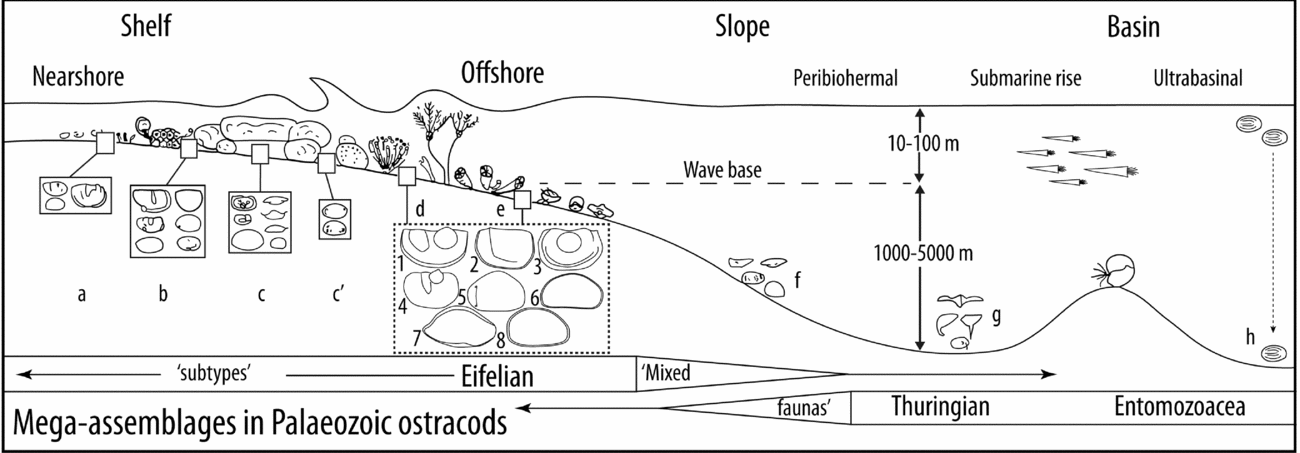
Idealized palaeoecology of ostracod assemblages (modified from Becker, Reference Becker1971), with the inferred position of the Ichinotani Formation ostracod assemblage (box with dotted lines). The Eifelian mega-assemblage is characteristic of mid Palaeozoic high-energy environments, with distinct subtypes: a – lagoonal; b – back-reef; c – reef core; d – fore-reef; e – off-reef (zone of solitary corals); f – Thuringian mega-assemblage indicative of low-energy marine environments; g – Entomozoacean mega-assemblage, zooplankton; h – The material from the Ichinotani Formation is interpreted as sourced from ecotype d/e – a fore-reef to off-reef environment, as highlighted. The ostracods illustrated are: Kirkbya (1, 2), Amphissites (3), Aechmina (4), Healdia (5), cavellinids (6, 8) and Bairdia (7).

Carboniferous ostracods have previously been described from other parts of Japan, including the Onimaru and Nagaiwa formations in the South Kitakami Terrane of northeastern Honshu (Ishizaki, Reference Ishizaki1963, Reference Ishizaki1964). Of particular interest, however, is the Takezawa Formation in the South Kitakami Terrane (Ishizaki, Reference Ishizaki1968), which bears ostracod material that is conspecific with that described in this study.
2. Materials and methods
The ostracod material has been recovered from three discrete calcareous nodules (I-01, I-02 and K-01, in the collections of Kumamoto University), each of which was embedded in green tuffaceous mudstones as allochthonous blocks sourced from the Ichinotani Formation of the Mizuboradani Valley; the fusulinid of Figure 2 is from nodule I-02. Some 264 silicified ostracod specimens were recovered during the preparation of samples for conodonts, by using standard acetic acid dissolution techniques. The resulting residues were picked for microfossils under a binocular microscope at Kumamoto University, Japan. Selected ostracod specimens were analysed and imaged using a Hitachi S-3600N environmental scanning electron microscope in the Geology Department at Leicester University, UK. Energy dispersive X-ray spectrometry (EDX) analysis was carried out on the fossils using an Oxford INCA 350 EDX in order to help distinguish those parts of the ostracod specimens that are preserved as silica replacement of original calcite, and those that represent clay minerals forming internal moulds. Thin-sections of nodules were examined for fusulinids at Kumamoto University using a Nikon ECLIPSE E600WPOL polarizing microscope, and images were captured with a Nikon DN100 Digital net camera. The figured material is deposited at the Oxford University Museum of Natural History, UK.
3. East Asian palaeogeography and ostracod biogeography in the Carboniferous Period
There is considerable current discussion as to the palaeogeographical position of the Japanese terranes during the Carboniferous Period. Shi (Reference Shi2006) suggested that the rocks of the Hida Gaien Terrane were deposited close to the North China (Sino-Korean) palaeocontinent in Permian time (and by extension in late Carboniferous time, too); its faunas should therefore be biogeographically comparable to those from northern mainland Asia. However, Isozaki et al. (Reference Isozaki, Aoki, Nakama and Yanai2010) suggested that Japan could have been situated off the Cathaysian margin of South China during Carboniferous time. Of the extensive Carboniferous brachiopod faunas known from Japan (e.g. Tazawa, Miyake & Niikawa, Reference Tazawa, Miyake and Niikawa2010) the majority suggest links to Sino-Korea and include a northern Chinese species of Purdonella from a Bashkirian age limestone of the Ichinotani Formation. Ibaraki, Tazawa & Miyake (Reference Ibaraki, Tazawa and Miyake2009) described the productid brachiopod Gigantoproductus sarsimbaii Sergunkova, Reference Sergunkova1935 from the basal Ichinotani Formation (upper Visean–Serpukhovian), which has also been recorded from the lower and middle Visean of Kyrgizia, Central Asia (Sergunkova, Reference Sergunkova1935; Gladchenko, Reference Gladchenko1955; Galitzkaja, Reference Galitzkaja1977).
Unlike brachiopods, ostracods do not have a planktonic larval stage to their lifecycle (Cohen & Morin, Reference Cohen and Morin1990; Horne, Cohen & Martens, Reference Horne, Cohen, Martens, Holmes and Chivas2002), and brooding of their young within the carapace may have been a reproductive strategy of some Palaeozoic ostracods (Schallreuter & Hinz-Schallreuter, Reference Schallreuter and Hinz-Schallreuter2007; Siveter et al. Reference Siveter, Siveter, Sutton and Briggs2007, Reference Siveter, Tanaka, Farrell, Martin, Siveter and Briggs2014). Because of their relatively limited trans-oceanic distribution capability, marine podocope ostracods have been widely used to infer the position and boundaries of ancient continents (e.g. Schallreuter & Siveter, Reference Schallreuter and Siveter1985; Williams et al. Reference Williams, Floyd, Salas, Siveter, Stone and Vannier2003; Perrier & Siveter, Reference Perrier, Siveter, Harper and Servais2013). The ostracod fauna from the Ichinotani Formation comprises species of the geographically widespread genera Aechmina, Kirkbya, Amphissites, Bairdia and Healdia. At generic level these taxa are not useful for elucidating separate palaeogeographical entities. However, three of the beyrichiocopid species, Kirkbya sarusawensis, Kirkbya nanatsumoriensis and Amphissites centronotus, were previously reported from the Takezawa Formation of the South Kitakami Terrane in northeastern Honshu (Ishizaki, Reference Ishizaki1968). This formation is possibly as young as Moscovian based on comparisons to the nearby Nagaiwa Formation (Onuki, Reference Onuki1956), which has recently been dated using brachiopods (Tazawa, Reference Tazawa2010). Such biogeographical links between the Carboniferous ostracod faunas of the Hida Gaien and South Kitakami terranes reinforce those of previous studies of brachiopods (e.g. Tazawa, Reference Tazawa2002; Tazawa, Miyake & Niikawa, Reference Tazawa, Miyake and Niikawa2010), trilobites (Kobayashi & Hamada, Reference Kobayashi and Hamada1979, Reference Kobayashi and Hamada1987) and cephalopods (Niko & Hamada, Reference Niko and Hamada1987; Niko, Reference Niko1990, Reference Niko2000). This provides evidence to support the suggestion (Tazawa, Miyake & Niikawa, Reference Tazawa, Miyake and Niikawa2010) that these two regions of Japan formed part of a continuous continental shelf in Carboniferous time, and that this shelf lay along the margin of North China (Sino-Korea). The Carboniferous ostracod data from the two regions are too poorly known to rigorously test this hypothesis, though we note that two ostracod taxa from the Ichinotani Formation suggest a mainland Cathaysian affinity: firstly, Bairdia cf. nanbiancunensis, which resembles the species originally described from the Devonian–Carboniferous boundary succession in Nanbiancun, Guilin, China (Wang, Reference Wang and Yu1988), and subsequently from Guizhou, South China (Olempska, Reference Olempska1999); and secondly, Amphissites centronotus, which has previously been recorded from Tibet (Shi, Reference Shi1982) and Guizhou (Olempska, Reference Olempska1999). It should be noted, however, that A. centronotus is a wide-ranging species, both spatially and temporally, being also recorded from the USA, Europe and Russia, and apparently ranging stratigraphically from the lower Carboniferous into the middle Permian (Ishizaki, Reference Ishizaki1968).
4. Palaeoecology
The ostracod assemblage is dominated numerically by ornamented palaeocopinids, namely Kirkbya sarusawensis, K. nanatsumoriensis and Amphissites centronotus, together with a lower abundance of the spinose binodicopine Aechmina akumame sp. nov. There are also significant numbers of podocopids represented by Bairdia cf. nanbiancunensis, along with indeterminate cavellinids that are too poorly preserved to identify formally. These taxa represent typical ostracod elements of the so-called ‘Eifelian mega-assemblage ecotype’, a marine biotope originally described from Devonian strata in Europe (Becker, Reference Becker1971). The Eifelian ecotype characteristically represents high-energy turbulent conditions in a shallow carbonate platform setting. Within this ecotype, the dominance of ostracod taxa that are interpreted to represent stenohaline conditions indicates that it represents normal marine salinity (Lethiers, Reference Lethiers1981; Bless, Reference Bless1983; Bless, Streel & Becker, Reference Bless, Streel and Becker1988). Despite differences in diversity between other Carboniferous marine ostracod assemblages (cf. Olempska, Reference Olempska1999), our fauna from the Ichinotani Formation shows a ratio of 4:1 for ornamented versus smooth carapace ostracods, exactly the same as for the Devonian fore-reef biotope (number 4) of Struve (Reference Struve1961, Reference Struve1963 a,b) (see Fig. 3). The moderately high number of carapaces (34 % overall are conjoined valves) suggests a fauna that was in situ or with only limited transport (Whatley, Reference Whatley and Maddocks1983, Reference Whatley, De Decker, Colin and Peypouquet1988). The relatively small numbers of juveniles relative to adults suggests local winnowing of the assemblage by moderate to high-energy currents, resulting in an autochthonous thanatocoenosis with some post-mortem transport (Boomer, Horne & Slipper, Reference Boomer, Horne and Slipper2003). In addition, it must be considered that the ostracod assemblage may be biased towards certain species or individuals, as only silicified specimens are recovered from the acetic acid processing of the limestone blocks. Adachi's (Reference Adachi1989) synthesis of the ostracod fauna from the Ichinotani Formation suggests that a greater range of ostracod ecologies may be distinguishable.
5. Systematic palaeontology
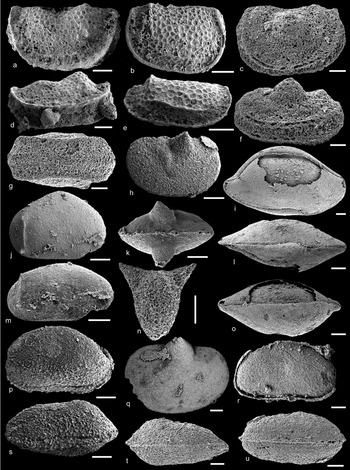
Based on their soft-part anatomy, but also reflected in their carapace morphology, two subclasses of ostracods can be distinguished. These are the Myodocopa and the Podocopa. Using carapace morphology alone, all of the taxa described here are assigned to the Podocopa. At ordinal level, the ostracods include four beyrichiocopid and two podocopid species. Two poorly preserved, but possibly discrete species (Fig. 4p, r–u), are tentatively identified as cavellinid platycopids, based on their small size, their elongate carapace shape with an arched dorsal valve outline, their relatively straight, slightly convex ventral valve outline, and on evidence of strong ventral valve overlap. Some of Ishizaki's (Reference Ishizaki1968) ostracod taxa from the Carboniferous of northeastern Honshu might be related to these possible cavellinids from the Ichinotani Formation. Synonymy lists given below focus on instances where taxa have been figured. Our use of morphological terminology for Palaeozoic ostracods largely follows Vannier, Siveter & Schallreuter (Reference Vannier, Siveter and Schallreuter1989).
Ostracods from the Ichinotani Formation: (a, d) OUMNH EY.42, Kirkbya sarusawensis Ishizaki, Reference Ishizaki1968, lateral and oblique ventral views of right valve, (g) OUMNH EY.43, K. sarusawensis, ventral view of carapace. (b, e) OUMNH EY.44, Kirkbya nanatsumoriensis Ishizaki, Reference Ishizaki1968, lateral and oblique ventral views of left valve. (c, f) OUMNH EY.45, Amphissites centronotus (Ulrich & Bassler, Reference Ulrich and Bassler1906), lateral and oblique ventral views of left valve. (h, k, n) OUMNH EY.46, Aechmina akumame sp. nov., holotype, largely internal mould of carapace in right lateral, dorsal and posterior views; (q) OUMNH EY.47, internal mould of left valve in lateral view. (i, l, o) OUMNH EY.48, Bairdia cf. Bairdia nanbiancunensis Wang, Reference Wang and Yu1988, carapace in right lateral, ventral and dorsal views. (j, m) OUMNH EY.49, Healdia mizuboradanensis sp. nov., lateral and oblique ventral views of holotype right valve. (p, s) OUMNH EY.50, Cavellinid sp. indet., internal mould of carapace in left lateral and oblique ventral views; (t) OUMNH EY.51, dorsal view of internal mould of carapace. (r) OUMNH EY.52, Cavellinid sp. indet., internal mould of carapace (note impression of valve overlap), right lateral view; (u) OUMNH EY.53, ventral view of internal mould of carapace. (a, b, d, e, h, j, k, m, n, p, q, r, s) were recovered from nodule I-01; (g, t, u) from I-02; and (c, f, i, l, o) from K-01. All scale bars 100 µm in length. All images are scanning electron micrographs.

Class OSTRACODA Latreille, Reference Latreille1802
Subclass PODOCOPA Sars, Reference Sars1866
Order BEYRICHIOCOPIDA Pokorný, 1954
Suborder PALAEOCOPINA Henningsmoen, Reference Henningsmoen1953
Superfamily Kirkbyoidea Ulrich & Bassler, Reference Ulrich and Bassler1906
Family Kirkbyidae Ulrich & Bassler, Reference Ulrich and Bassler1906
Genus Kirkbya Jones, Reference Jones1859
Type species. Dithyrocaris permiana Jones, Reference Jones and King1850.
Kirkbya sarusawensis Ishizaki, Reference Ishizaki1968
Figure 4a, d, g
1968 Kirkbya sarusawensis Ishizaki, n. sp.; Ishizaki, p. 16, figs 4, 6
Material. Sixty-eight specimens represented by 7 carapaces and 59 valves: two are internal moulds and two are juveniles.
Description. Carapace small (average maximum length: 730 µm), valves amplete. Greatest valve height at one-third valve length from the posterior margin. Anterior cardinal angle a little greater than 90°; posterior cardinal angle less than 90°. In lateral view anterior valve outline is convex, curving inwards slightly towards the dorsal margin; posterior valve outline also gently convex; ventral outline convex. Valves bi-lobate, the lobes developed anterodorsally and posterodorsally. Round posterodorsal lobe significantly larger than anterodorsal lobe; broad weak sulcus defines area between lobes. Kirkbyan pit absent. Dorsal valve outline sinuous: a result of the slight dorsal protuberance of the anterior lobe, and strong dorsal protuberance of the posterior lobe, over the dorsal margin. Prominent ridge parallels the free margin on each valve; above this ridge is a distinctive velar ridge extending between the cardinal corners: this ridge reaches a maximum width of 50 µm posteroventrally. Valves reticulate; reticulae are 18 µm diameter and approximately circular.
Remarks. This material is considered conspecific with Kirkbya sarusawensis Ishizaki, Reference Ishizaki1968 from northeastern Honshu, in particular because of similarities in size, and lobal and velar morphology. Adachi (Reference Adachi1989) made thumbnail sketches of five supposed Kirkbya species from the Ichinotani Formation (Kirkbya sp. A to sp. E), but from his figures we are unable to recognize whether any of these can be referred to the Kirkbya species described here.
Kirkbya nanatsumoriensis Ishizaki, Reference Ishizaki1968
Figure 4b, e
1968 Kirkbya nanatsumoriensis Ishizaki, n. sp.; Ishizaki, p. 16, figs 4, 6
Material. Seventy-six specimens represented by 2 carapaces, 59 valves and 15 internal moulds. Fifteen are juveniles.
Description. Carapace small (average maximum length: 570 µm), valves weakly preplete. Greatest height one-third from anterior margin. Anterior and posterior cardinal angles a little greater than 90°. In lateral view, posterior lateral outline gently convex, weakly concave towards the posterodorsal corner. Anterior lateral outline rounded anteroventrally then straight towards the anterodorsal corner. Dorsal lateral outline straight to weakly convex in its posterior part. Ventral lateral outline weakly convex. Non-lobate valves, but with a prominent ridge oriented perpendicular to the dorsal margin, in the posterior quartile of the valve, and extending about half the valve height from the dorsal margin to midway through the valve. This ridge protrudes weakly above the dorsal margin; a second ridge is situated parallel to the ventral free margin about three-quarters of the valve height from the dorsal margin. Pronounced marginal ridge, separated from the valve surface by a distinct furrow: marginal ridge becomes most prominent towards the anterodorsal corner. Kirkbyan pit absent. Lateral valve surface entirely covered by polygonal reticulae: each reticulum is about 20 µm diameter.
Remarks. This material from the Fukuji district is considered conspecific with Kirkbya nanatsumoriensis Ishizaki, Reference Ishizaki1968 from the Visean to Moscovian Takezawa Formation of the South Kitakami Terrane, Iwate Prefecture, northeastern Honshu. Ishizaki (Reference Ishizaki1968) noted that this species is one of only two known to have a posterior vertical ridge, the other being Kirkbya heckeri (Pozner, Reference Pozner1951) from the Visean ‘Oka substage’ of the Borovichi region on the western flank of the Moscow Basin, Russia. In our material there is no evidence of a Kirkbyan pit, whereas Ishizaki (Reference Ishizaki1968) described it as ‘not large’.
Family Amphissitidae Knight, Reference Knight1928
Genus Amphissites Girty, Reference Girty1910
Type species. Amphissites rugosus Girty, Reference Girty1910
Amphissites centronotus (Ulrich & Bassler, Reference Ulrich and Bassler1906)
Figure 4c, f
1906 Kirkbya centronata Ulrich & Bassler, p. 159, pl. 11, figs 16, 17.
1936 Amphissites similaris Morey, n. sp.; Morey, p. 115, pl. 17, fig. 6.
1961 Amphissites centronotus (Ulrich & Bassler, Reference Ulrich and Bassler1906); Sohn, p. 163, pl. 7, figs 8–10.
1968 Amphissites similaris Morey; Ishizaki, p. 17, pl. 1, figs 1–4.
1982 Amphissites centronotus (Ulrich & Bassler); Shi, p. 315, figs 4–6.
1992 Amphissites (Amphissites) centronotus (Ulrich & Bassler, Reference Ulrich and Bassler1906); Becker & Wang, p. 12, pl. 1, fig. 4.
1997 Amphissites centronotus (Ulrich & Bassler, Reference Ulrich and Bassler1906); Crasquin-Soleau, p. 51, pl. 2, figs 9–17 (for full synonymy).
1999 Amphissites (Amphissites) centronotus (Ulrich & Bassler, Reference Ulrich and Bassler1906); Olempska, p. 407, fig. 14a, b
Material. Eight valves, including three juveniles.
Description. Carapace small (maximum length: up to 640 µm); subamplete to weakly preplete valves. Anterior and posterior cardinal angles a little greater than 90°. Anterior and posterior lateral outlines gently convex, curving slightly inwards towards the dorsal margin. Anterior and posterior lobes are relatively small and project just above the dorsal margin. Ventral lateral outline is gently convex, slightly more so towards the anterior in some specimens. The central lobe is prominent, its shape forming an inverted cone as it extends laterally from the lateral valve surface (see Fig. 4f) and has a circular shape in lateral view, below which there is a weakly developed elliptical ‘Kirkbyan pit’ (Fig. 4f). A single prominent velar ridge occurs about one-seventh of the valve height away from the valve margin and is almost continuous to where it reaches the dorsal margins where it is confluent with the anterior and posterior lobes. A marginal ridge is developed adjacent to the free margin. Valves weakly reticulate.
Remarks. The material from the Fukuji district is morphologically indistinguishable from specimens referred to Amphissites similaris Morey, Reference Morey1936 by Ishizaki (Reference Ishizaki1968) from northeastern Honshu, although it is smaller in average size. We concur with the taxonomic assignment of Ishizaki's material to A. similaris and follow Sohn (Reference Sohn1961) in regarding this species as a junior synonym of K. centronata. Adachi (Reference Adachi1989) made thumbnail sketches of three supposed Amphissites species from the Ichinotani Formation (Amphissites sp. A to sp. C), but from his figures we cannot recognize whether any of these can be referred to A. centronotus.
Occurrence. Aside from Japan, A. centronotus has recently been described from the lower Carboniferous Muhua Formation of Guizhou Province, South China (Olempska, Reference Olempska1999), and also from the lower Carboniferous of Nylam Xizang, Tibet (Shi, Reference Shi1982).
Suborder BINODICOPINA Schallreuter, Reference Schallreuter1972
Family Aechminidae Bouček, Reference Bouček1936
Genus Aechmina Jones & Holl, Reference Jones and Holl1869
Type species. Aechmina bovina Jones, Reference Jones1887
Aechmina akumame sp. nov.
Figure 4h, k, n, q
Holotype. Carapace (OUMNH EY.46); Figure 4h, k, n
Derivation of name. Named after the ‘devil's horn’-like appearance of its dorsal spines in anterior/posterior view (Japanese ‘akuma’, meaning devil), and its ‘bean-shaped’ overall appearance (Japanese ‘mame’, meaning bean).
Type locality and horizon. An allochthonous limestone block (nodule I-01) derived from the Ichinotani Formation, Mizuboradani Valley, Fukuji, central Honshu, Japan.
Material. Thirteen specimens: 11 are internal moulds, whilst 2 specimens are juveniles.
Diagnosis. Aechmina with distinctive short (average length in adults: 150 µm), straight, broad (average diameter at base in adult: 160 µm), dorsally acuminate spine overreaching the dorsal margin of each valve by circa one-third of its length, extending outwards dorsolaterally at a 45° angle. Small, shallow, narrow lobe situated posterior of spine, demarcated by a sulcus on both sides.
Description. Carapace small (average maximum length: 560 µm); amplete to slightly preplete in lateral view. Anterior and posterior cardinal angles rounded, slightly greater than 90°. Anterior and posterior lateral outlines gently convex. Dorsal valve outline sinuous in lateral view. Ventral lateral outline gently convex. Valves symmetrical about the hinge line in dorsal view. Carapace smooth. Distinctive broad dorsal spine on each valve, protruding over the dorsal margin by about 30 µm, and extending away from the dorsal lateral surface of the valves at an angle of 45° from the vertical. Spine morphology as described in diagnosis.
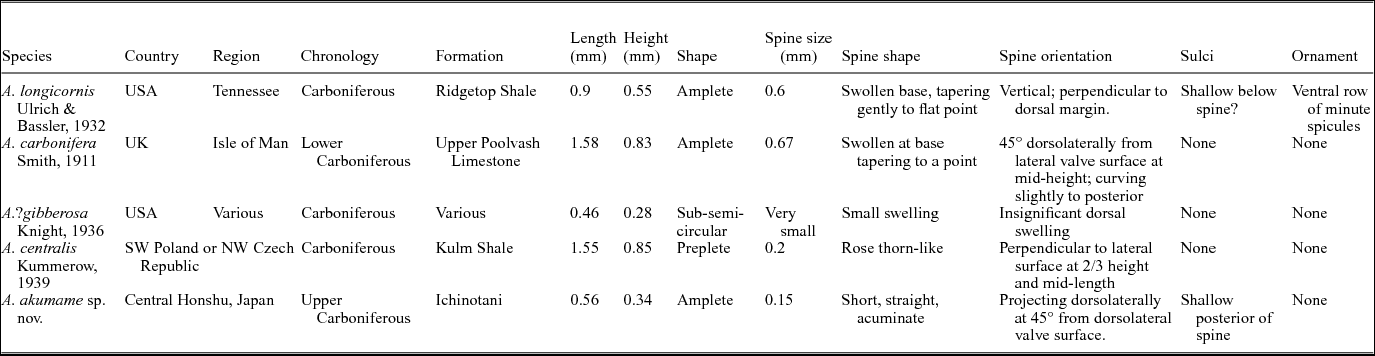
Remarks. For differences between A. akumame and other Carboniferous Aechmina species see Table 1. Aechmina appears to be an extraordinarily long-lived genus, with its origins in the Ordovician Period (e.g. Williams et al. Reference Williams, Stone, Siveter and Taylor2001 for a summary). A. akumame is amongst the youngest occurrences of species of this genus, which shows remarkable morphological stasis of carapace design over more than 100 million years. The wide distribution of Aechmina species has been used to infer a possible pelagic lifestyle (Siveter, Reference Siveter and Bassett1984), though in the Fukuji district – as in most of the occurrences of Aechmina species – it forms part of a typical benthic ostracod assemblage. Adachi (Reference Adachi1989) made thumbnail sketches of three supposed Aechmina species from the Ichinotani Formation (Aechmina sp. A to sp. C), but from his figures we cannot recognize whether any of these can be referred to A. akumame.
Morphological comparison of Carboniferous Aechmina species

Literature sources: Knight (Reference Knight1928); Bassler (Reference Bassler1932); Smith (Reference Smith1911); Kummerow (Reference Kummerow1939).
Order PODOCOPIDA Müller, Reference Müller1894
Suborder PODOCOPINA Sars, Reference Sars1866
Superfamily Bairdioidea Sars, Reference Sars1888
Family Bairdiidae Sars, Reference Sars1888
Genus Bairdia McCoy, Reference McCoy1844
Type species. Bairdia curta McCoy, Reference McCoy1844
Bairdia cf. Bairdia nanbiancunensis Wang, Reference Wang and Yu1988
Figure 4i, l, o
Material. Twenty-nine specimens in total, represented by 23 partial carapaces and 6 partial valves. Many specimens are partial internal moulds, most of which preserve the carapace shape and margin of the inner lamella. Seven specimens are juveniles.
Description. Carapace medium sized (up to 1145 µm long) and elongate sub-trapezoidal in lateral shape. Posterior lateral valve outline acuminate, anterior valve outline rounded. Dorsum short and situated between the elevated dorsal portions of the left and right valves such that it is epicline. The lateral valve outline between the dorsal and posterior valve margins forms a gentle sinusoid, whilst that between the dorsal and mid-anterior margins is gently concave. The right valve overlaps the left valve ventrally with a sinuous contact. Adductor muscle area represented by a cluster of five scars situated just under half the valve length from the anterior margin, and in line with the maximum valve width.
Remarks. In its lateral outline and relatively small size the material from the Fukuji district is similar to Bairdia nanbiancunensis Wang, Reference Wang and Yu1988, originally described from the Devonian–Carboniferous boundary succession in Nanbiancun, Guilin, China, and subsequently from the Tournaisian Muhua Formation, Guizhou, South China (Olempska, Reference Olempska1999). However, in the Chinese material there appears to be stronger overlap of the left valve by the right valve ventrally. Olempska (Reference Olempska1999) noted that B. nanbiancunensis had also been recorded from the Tournaisian Laurel Formation of the Canning Basin, Western Australia (Jones, unpub. data, fide Olempska Reference Olempska1999, p. 428). Coen (Reference Coen1989) reported Bairdia sp. from the Devonian–Carboniferous transition beds at Baihupo, Guizhou, China, which Olempska considered conspecific with B. nanbiancunensis. Ishizaki (Reference Ishizaki1963) described several species of Bairdia from the Carboniferous of northeastern Honshu, though the size range, and ontogenetic and morphological variation within his individual species needs further scrutiny. Of Ishizaki's taxa, the material from the Fukuji district most closely resembles Bairdia nagaiwensis Ishizaki, Reference Ishizaki1963 in overall lateral outline, although the posterior margin is much steeper in lateral outline for B. nagaiwensis. Another morphologically similar species in the East Asian region is B. garrisonensis Upson, Reference Upson1933, which has been described from both the upper Carboniferous Taiyuan Formation in Qiligou, Taiyuan City, Shanxi Province, China (Liu & Zhou, Reference Liu and Zhou1990) and the lower Carboniferous of Nylam Xizang, Tibet (Shi, Reference Shi1982). However, compared to the Bairdia material described herein, B. garrisonensis has a steeper anterior lateral valve outline and an almost straight ventral valve outline.
Suborder METACOPINA Sylvester-Bradley, Reference Sylvester-Bradley and Moore1961
Superfamily Healdioidea Harlton, Reference Harlton1933
Family Healdiidae Harlton, Reference Harlton1933
Genus Healdia Roundy, Reference Roundy1926
Type species. Healdia simplex Roundy, Reference Roundy1926.
Healdia mizuboradanensis sp. nov.
Figure 4j, m
Holotype. Right valve (OUMNH EY.49); Figure 4j, m
Derivation of name. After the Mizuboradani Valley where it was discovered.
Type locality and horizon. An allochthonous limestone block (I-01) derived from the Ichinotani Formation, Mizuboradani Valley, Fukuji, central Honshu, Japan.
Material. Twenty-five specimens represented by 3 carapaces, 21 single valves and 1 internal mould. Seven are juveniles.
Diagnosis. Sub-triangular Healdia with small straight excavate posterior costa that is oriented perpendicular to the ventral margin and terminates at both ends in very short straight spines.
Description. Carapace small (average maximum length 500 µm) and sub-triangular from a lateral perspective. Lateral valve outline distinctly triangular; highest point slightly anterior of valve mid-length. Anterodorsal valve outline forms a slope, which from a lateral aspect is slightly steeper than the posterodorsal outline. Ventral lateral outline straight, posterior and anterior lateral outlines gently convex. Straight ridge on the posterior part of the lateral surface is perpendicular to the ventral valve margin and produces short, straight spines before the ridge reaches the dorsal and ventral margins; ventral spine slightly longer, up to 25 µm. Carapace smooth.
Remarks. This species is much more rounded and symmetrical in its lateral shape than any other Healdia from the East Asian region. Olempska (Reference Olempska1999) described Healdia sp. from the Muhua Formation of Guizhou, but this is much more asymmetrical in its lateral shape than the material from the Ichinotani Formation. Of the ten species of Healdia described by Yuan & Hao (Reference Yuan and Hao1988) from the Western Border Area of the Ordos Basin, northern China, Healdia ordosensis Yuan & Hao, Reference Yuan and Hao1988 and Healdia leguminoidea Knight, Reference Knight1928 bear closest resemblance to the Ichinotani species, but H. ordosensis is more elongate and has more well-developed spines on the posterior ridge, whilst H. leguminoidea does not possess a ‘triangular’ shape to the dorsal lateral outline. Adachi (Reference Adachi1989) presented a thumbnail sketch of Healdia sp. A, from the Ichinotani Formation, but from his figure we cannot determine its affinity to H. mizuboradanensis.
6. Conclusions
Limestone nodules derived from the Ichinotani Formation have yielded the ostracod species Amphissites centronotus, Kirkbya sarusawensis, K. nanatsumoriensis, Bairdia cf. B. nanbiancunensis, Aechmina akumame and Healdia mizuboradanensis, and additional material of possible cavellinids.
The ostracod fauna from these nodules can be characterized as an ‘Eifelian mega-assemblage ecotype’ sensu Becker (Reference Becker1971), which was first described from Devonian strata, and which is typically indicative of shallow marine high-energy conditions of a mid Palaeozoic fore-reef to off-reef environment. Combined with data from the other fossil groups from the Ichinotani Formation, such as fusulinids, conodonts, corals and brachiopods, this endorses previous notions on the palaeoenvironmental signature of the limestones of the Ichinotani Formation.
Biogeographical links are demonstrated between the ostracod fauna of the Hida Gaien Terrane in central Honshu and the Carboniferous of the South Kitakami Terrane in northeastern Honshu, Japan, as well as with mainland China. However, additional material is needed to further test the palaeogeographical significance of such links.
Acknowledgements
We are grateful to The Leverhulme Trust (International Network Grant IN-2014-025, ‘Assembling the Early Palaeozoic terranes of Japan’) for funding our research. We thank Ewa Olempska (Warsaw) and Giles Miller (London) for their constructive reviews.