Introduction
Thallium is considered a rare chemical element in terms of its abundance in the Earth's crust: its average content in the upper continental crust is 0.9 μg g–1 (Rudnick and Gao, Reference Rudnick, Gao, Holland and Turekian2003). Despite minor amounts in Nature, thallium demonstrates a diverse mineralogy that is caused by its specific crystal chemical features that allow this element to concentrate in the crystal structures of many minerals, especially sulfosalts (Zemann, Reference Zemann1993). Eighty-two valid minerals with species-defining Tl are currently approved by the International Mineralogical Association (IMA), including 66 chalcogenides, mainly sulfosalts with As or/and Sb (57 species). Seven thallium minerals are oxysalts (five of which are sulfates), two species belong to oxides, six to halides (five chlorides and one iodide), and one to intermetallic compounds. Thallium minerals of different chemical classes have different genesis: chalcogenides and the intermetallic compound form in hydrothermal, typically low-temperature ore deposits with sulfide or selenide mineralisation; O-free halides are known only in volcanic fumaroles and oxygen compounds form in the oxidation zone of Tl-bearing ores or in fumaroles.
In this paper we describe a new hydrous chloride of potassium and trivalent thallium found in fumarolic deposits at the Tolbachik volcano, Kamchatka, Russia. Its name kalithallite (Russian Cyrillic: калиталлит) reflects the important crystal chemical feature: this is a kalium–thallium ordered compound (kalium, the Latin name of potassium is used for the name construction). Both the mineral and its name (symbol Kth) have been approved by the IMA Commission on New Minerals, Nomenclature and Classification (IMA2017–044, Pekov et al., Reference Pekov, Krzhizhanovskaya, Yapaskurt, Belakovskiy and Sidorov2017). Kalithallite became the third mineral with species-defining trivalent thallium, after avicennite Tl2O3 (Karpova et al., Reference Karpova, Kon'kova, Larkin and Savel'ev1958) and chrysothallite K6Cu6Tl3+Cl17(OH)4⋅H2O (Pekov et al., Reference Pekov, Zubkova, Belakovskiy, Yapaskurt, Vigasina, Lykova, Sidorov and Pushcharovsky2015c). Recently a fourth mineral with Tl3+ was discovered, amgaite Tl3+2Te6+O6 (Kasatkin et al., Reference Kasatkin, Anisimova, Nestola, Plášil, Sejkora, Škoda, Sokolov, Kondratieva and Kardashevskaia2022). All these four minerals are extremely rare in Nature due to the particular and unusual formation conditions, under very high oxidising potential necessary for the appearance of Tl3+; all other known minerals with species-defining Tl contain this element in univalent form.
Fumarolic thallium mineralisation is unique, endemic: Tl minerals belonging to this genetic type are unknown elsewhere. Three Tl+ minerals were first described in sublimates of fumaroles at the La Fossa crater, Vulcano island, Aeolian archipelago, Italy, namely lafossaite Tl(Cl,Br) (Roberts et al., Reference Roberts, Venance, Seward, Grice and Paar2006), hephaistosite TlPb2Cl5 (Campostrini et al., Reference Campostrini, Demartin and Gramaccioli2008), and steropesite Tl3BiCl6 (Demartin et al., Reference Demartin, Gramaccioli and Campostrini2009). At the Tolbachik volcano, besides chrysothallite and kalithallite containing Tl3+, three minerals with univalent thallium were discovered: markhininite TlBi(SO4)2, karpovite Tl2VO(SO4)2(H2O), and evdokimovite Tl4(VO)3(SO4)5(H2O)5 (Siidra et al., Reference Siidra, Vergasova, Krivovichev, Kretser, Zaitsev and Filatov2014a, Reference Siidra, Vergasova, Kretser, Polekhovsky, Filatov and Krivovichev2014b, Reference Siidra, Vergasova, Kretser, Polekhovsky, Filatov and Krivovichev2014c). Nataliyamalikite TlI was found in an active fumarole at the Avacha (Avachinskiy) volcano, Kamchatka, Russia (Okrugin et al., Reference Okrugin, Favero, Liu, Etschmann, Plutachina, Mills, Tomkins, Lukasheva, Kozlov, Moskaleva, Chubarov and Brugger2017).
The type specimen of kalithallite is deposited in the systematic collection of the Fersman Mineralogical Museum of the Russian Academy of Sciences, Moscow with the catalogue number 96192.
Occurrence
Kalithallite is a very rare mineral. It was found in only three specimens collected by us in July 2013 from an active fumarole belonging to the Northern fumarole field located at the northern slope of the crater of the First scoria cone of the Northern Breakthrough of the Great Tolbachik Fissure Eruption, Tolbachik volcano, Kamchatka Peninsula, Far-Eastern Region, Russia. This scoria cone, a monogenetic volcano ~300 m high and ~0.1 km3 in volume, was formed in 1975 (Fedotov and Markhinin, Reference Fedotov and Markhinin1983) and still demonstrates strong fumarolic activity: many gas vents with temperatures up to 350°C occur around and inside its crater.
At the Northern fumarole field, the majority of strongly mineralised fumarole chambers occur at depths from 0.1 to 0.3 m below the day surface. In July 2013, our measurements, carried out using a chromel–alumel thermocouple, showed temperatures 180–250°C. The volcanic gas here is enriched by HCl and HF (Zelenski and Taran, Reference Zelenski and Taran2012). The major minerals of sublimate incrustations, which partially or completely cover walls of the chambers, are sellaite, fluorite, halite and anhydrite. The elements present, which also determine the geochemical specialisation of these oxidising-type fumaroles are Zn, Pb, Mn, Se and Tl. Cotunnite PbCl2, sofiite Zn3(Se4+O3)Cl2 and flinteite, including its Tl-bearing variety (K,Tl)2ZnCl4, are common here. Minor minerals are chubarovite KZn2(BO3)Cl2, zincomenite ZnSeO3, anglesite, hollandite Ba(Mn4+6Mn3+2)O16, challacolloite KPb2Cl5, saltonseaite K3NaMnCl6, and sylvite, whereas olsacherite Pb2(Se6+O4)(SO4), bixbyite-(Mn) Mn2O3, jakobssonite CaAlF5, hieratite K2SiF6, hematite and baryte are very rare.
In the upper zone of the fumarole system (5–15 cm below the surface) our measurements showed the temperatures 30–100°C. Unlike the lower, hotter parts of the fumaroles in which only H-free minerals occur, in this upper zone we observe the associations of hydrous minerals. The major minerals present are gypsum, ‘ralstonite’ (hydrokenoralstonite) Na0.5(Al,Mg)2(F,OH)6⋅H2O, and opal. Subordinate minerals here are cryobostryxite KZnCl3⋅2H2O, vernadite (which forms pseudomorphs after saltonseaite) and secondary halite and sylvite. Leonardsenite MgAlF5⋅2H2O and kalithallite are found in minor amounts in small pockets in which the temperatures measured during the sampling were 70–100°C.
General appearance, physical properties and optical data
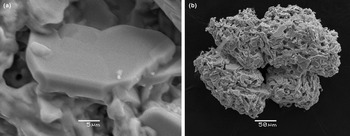
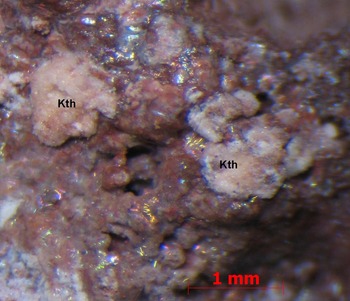
Kalithallite overgrows the surface of basalt scoria, altered by fumarolic gas, in association with cryobostryxite, halite, sylvite, opal and gypsum. The new mineral forms lamellar to tabular (flattened on [001]) crystals up to 5 × 30 × 40 μm, sometimes with a stepped surface (Fig. 1). The major crystal form is the pinacoid {001}; faces of the tetragonal prisms {100} and {010} were observed, as well as non-indexed dipyramidal faces. Kalithallite crystals are combined in open-work clusters or roundish aggregations up to 1 mm across (Figs 1b and 2).
Crystal (a) and open-work aggregate (b) of kalithallite. SEM images, secondary electron mode, holotype specimen #96192.

Roundish aggregates of kalithallite (Kth) on basalt scoria altered by fumarolic gas and partially covered by thin colourless, aqua to transparent lustrous halite–sylvite crust. FOV width: 3.7 mm. Photo: I.V. Pekov & A.V. Kasatkin, holotype specimen #96192.

Kalithallite is transparent, colourless in individuals, and white to pale cream-coloured or pale beige in aggregates. The streak is white. The lustre is vitreous. The mineral is brittle. Cleavage or parting were not observed, the fracture is uneven. Density calculated using the empirical formula is 3.01 g cm–3.
Kalithallite is optically uniaxial (–), ɛ = 1.656(3), and ω = 1.662(3) (589 nm). In transmitted light the mineral is colourless and non-pleochroic.
Chemical data
Chemical data for kalithallite were obtained using a Jeol JSM–6480LV scanning electron microscope (SEM) equipped with an INCA-Wave 500 wavelength-dispersive spectrometer (Laboratory of Analytical Techniques of High Spatial Resolution, Dept. of Petrology, Moscow State University), with an acceleration voltage of 20 kV, a beam current of 10 nA and a 5 μm beam diameter. The following standards were used: microcline (K), ZnSe (Zn), TlAsS2 (Tl) and NaCl (Cl). Contents of other elements with atomic numbers >4, except oxygen, are below detection limits.
The average (4 spot analyses) chemical composition of kalithallite (wt.%, ranges are in parentheses) is: K 17.72 (17.06–18.21), Zn 0.85 (0.76–0.98), Tl 38.76 (37.67–39.78), Cl 35.91 (35.09–36.47), H2Ocalc 5.99, total 99.23.
H2O was not analysed because of the paucity of pure material. It was calculated by stoichiometry; the value is compatible with the crystal structure data (see below) and the correctness of the calculation is indirectly confirmed by the analytical total close to 100 wt.%.
The empirical formula of kalithallite, calculated on the basis of K+Zn+Tl+Cl = 10 atoms per formula unit (apfu) with 2 H2O molecules pfu, is K2.72Zn0.06Tl1.14Cl6.08⋅2H2O. It is noteworthy that, if all Tl could be considered as Tl3+, then the total positive charge in this formula is +6.26 while the total negative charge is –6.08. This slight discrepancy could be caused by a general analytical error or due to the presence of a small part of the thallium in univalent form, which could substitute K+. The formal recalculation of the empirical formula above according to the charge balance requirement gives the following formula: K2.72Zn0.06Tl+0.09Tl3+1.05Cl6.08⋅2H2O.
The idealised formula of kalithallite is K3Tl3+Cl6⋅2H2O which requires K 20.56, Tl 35.83, Cl 37.29, H2O 6.32, total 100 wt.%.
X-ray crystallography and crystal structure determination
Attempts at single-crystal X-ray diffraction (XRD) studies of kalithallite were unsuccessful because of both the small size and imperfectness (probably due to a microblocky character) of crystals. The powder XRD data show that kalithallite is the natural counterpart of synthetic K3Tl3+Cl6⋅2H2O (tetragonal, I4/mmm, a = 15.873, c = 18.041 Å and V = 4545 Å3: Hoard and Goldstein, Reference Hoard and Goldstein1935). The crystal structure of the mineral was refined using the starting parameters of this synthetic compound.
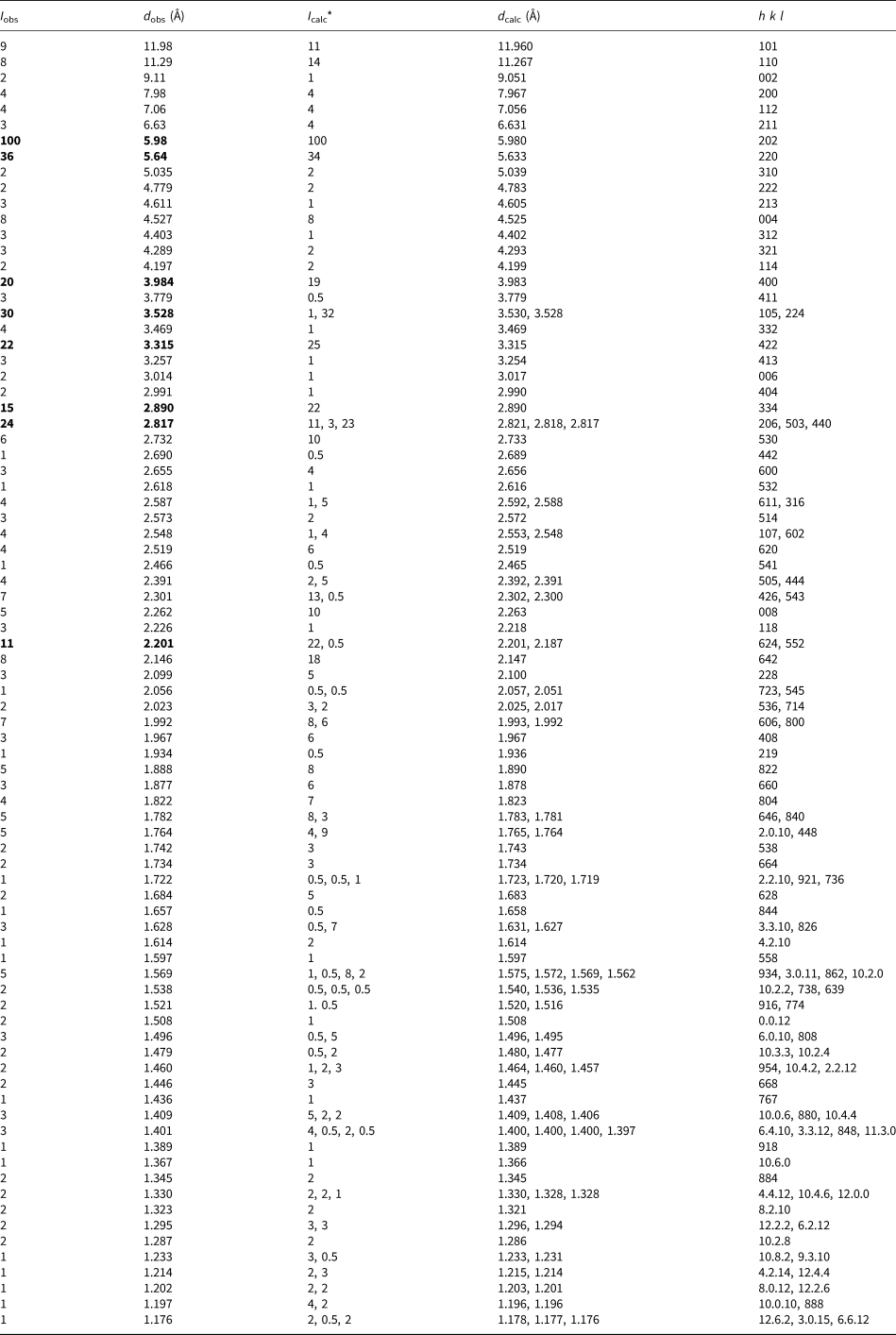
Powder XRD studies of kalithallite were performed on a Rigaku R-AXIS Rapid II single-crystal diffractometer equipped with a cylindrical image plate detector (radius 127.4 mm) using Debye-Scherrer geometry, CoKα radiation (rotating anode with VariMAX microfocus optics), 40 kV, 15 mA and an exposure time of 15 min. Angular resolution of the detector is 0.045°2θ (pixel size = 0.1 mm). The data were integrated using the software package Osc2Tab (Britvin et al., Reference Britvin, Dolivo-Dobrovolsky and Krzhizhanovskaya2017). Powder X-ray diffraction data of kalithallite are given in Table 1.
Powder X-ray diffraction data of kalithallite.

* Only reflections with I calc ≥0.5 are given; the strongest reflections are marked in bold type.
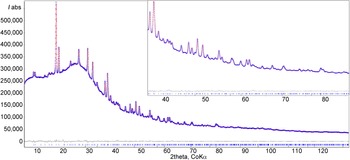
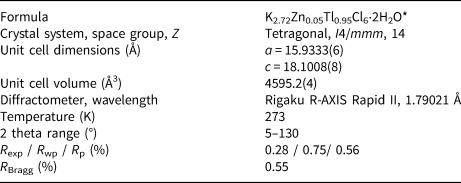
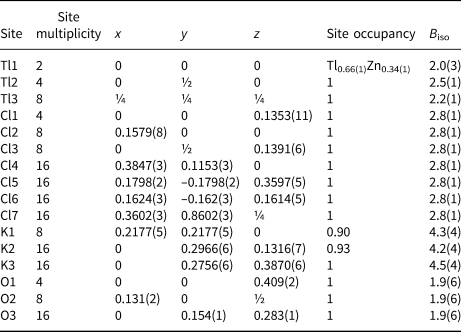
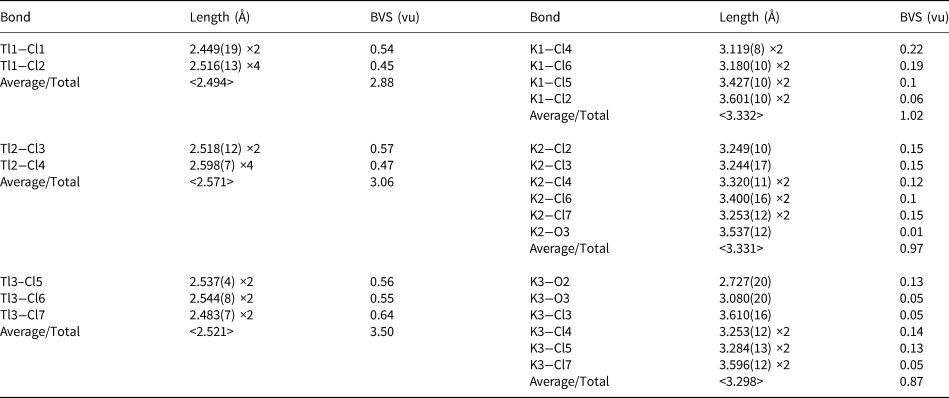
The crystal structure of kalithallite was refined from the powder XRD data using the Rietveld method. The crystal structure of synthetic K3Tl3+Cl6⋅2H2O (Hoard and Goldstein, Reference Hoard and Goldstein1935) was used as a structure model. Data treatment and the Rietveld structure analysis were carried out using the program package Topas 5.0 (Bruker, Reference Bruker2014). The powder sample studied contained ~6 wt.% of admixed sylvite. The peak profile was modelled using the Thompson-Cox-Hastings pseudo-Voigt profile function. Coordinates and thermal parameters of H atoms were not refined. The correctness of both model and structure refinement is confirmed by very low values of final agreement factors (R Bragg = 0.55%, R p = 0.56%, and R wp = 0.75% and R exp = 0.28%). The observed and calculated powder XRD patterns (final Rietveld refinement plot) are shown in Fig. 3. Crystal data and Rietveld refinement details are given in Table 2, atom coordinates and displacement parameters in Table 3 and selected interatomic distances in Table 4. The crystallographic information files is supplied in Supplementary materials (see below)
Final Rietveld refinement plot of kalithallite with enlarged high-angle fragment. The red solid line corresponds to calculated data, the blue circles correspond to the observed pattern and the blue vertical bars mark all possible Bragg reflections. The difference between the observed and calculated patterns is shown as a curve over the bars.

Crystal data and Rietveld refinement details for kalithallite.

* Slight charge disbalance in this formula is probably caused by the not very high quality of the experimental data.
Atomic positional coordinates and isotropic displacement parameters (B iso, Å2) of kalithallite.

Selected bond lengths (Å) and bond valence sums (BVS*, in valence units) in the structure of kalithallite.

* Bond-valence parameters were taken from Brese and O'Keeffe (Reference Brese and O`Keeffe1991).
Discussion
Crystal structure and comparative crystal chemistry
Kalithallite is a natural analogue of synthetic K3Tl3+Cl6⋅2H2O (Hoard and Goldstein, Reference Hoard and Goldstein1935). Despite the absence of single-crystal XRD data on the mineral, this analogy is confirmed unambiguously by the stoichiometry and a very good agreement between the measured powder XRD pattern of kalithallite and the calculated data from Rietveld refinement with the use of the synthetic K3Tl3+Cl6⋅2H2O crystal structure as the initial model (Table 1; Fig. 3).
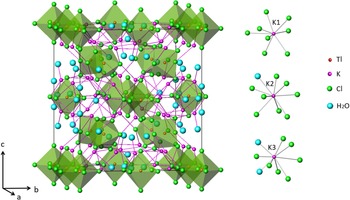
The crystal structure of kalithallite (Fig. 4) contains octahedra Tl3+Cl6 isolated from one another, with Tl–Cl distances varying between 2.45 and 2.60 Å (Table 4). Such distances are typical for trivalent thallium. In the synthetic analogue of kalithallite the distances Tl3+–Cl– vary from 2.55 to 2.56 Å (Hoard and Goldstein, Reference Hoard and Goldstein1935) and in other well-studied synthetic chlorides are as follows: KTl3+Cl4 2.42 (Glaser, Reference Glaser1980), Tl+Tl3+Cl4 2.42 (Thiele and Rink, Reference Thiele and Rink1975), Tl+3Tl3+Cl6 2.51–2.73 (Boehme et al., Reference Boehme, Rath, Grunwald and Thiele1980), K2Tl3+Cl5⋅2H2O 2.48–2.79 Å (Thiele and Grunwald, Reference Thiele and Grunwald1983). In contrast, the distances Tl+–Cl– in the same chlorides are as follows (for references see above): Tl+Tl3+Cl4 3.27–3.29 and Tl+3Tl3+Cl6 3.03–3.83 Å. In Tl+Cl the distances Tl+–Cl– vary between 3.15 and 3.72 Å (Ungelenk, Reference Ungelenk1962). Similar values were reported for natural Tl+ chlorides. In steropesite Tl3BiCl6 the distances Tl+–Cl– in twelve TlCl6 polyhedra vary between 3.27 and 3.28 Å (Demartin et al., Reference Demartin, Gramaccioli and Campostrini2009). In hephaistosite TlPb2Cl5, Tl+ is substituted by K+ for 14% and the mean (Tl,K)+–Cl– distance is 3.325 Å (Campostrini et al., Reference Campostrini, Demartin and Gramaccioli2008). Thus, the trivalent state of species-defining thallium in kalithallite is without doubt. One of three crystallographically independent thallium sites, Tl1 probably contains admixed Zn (Table 3), which is in agreement with electron microprobe data. The position Tl1 seems to be the most suitable for the location of admixed Zn because it has the smallest size of the three Tl positions. The bond valence sum calculations for all Tl sites (Table 4) confirm this.
The crystal structure of kalithallite and the potassium coordination polyhedra; Tl3+Cl6 octahedra are shown as semi-transparent. The unit cell is outlined.

Potassium cations in kalithallite are in the centre of three types of polyhedra: KCl8, KCl8(H2O), and KCl7(H2O)2 with average cation–anion distances 3.332, 3.331 and 3.298 Å, respectively (Table 4). The potassium sites K1 and K2 demonstrate incomplete occupancy (Table 3) that is in agreement with some deficiency of potassium found from electron microprobe data resulting in the empirical formula K2.72Zn0.06Tl1.14Cl6.08⋅2H2O. In the potassium arrangement, the mineral differs slightly from synthetic K3Tl3+Cl6⋅2H2O, which contains four independent K+ sites (Hoard and Goldstein, Reference Hoard and Goldstein1935): in kalithallite, one of them (2b: 0,0,0.5) is empty (or almost empty, it seems impossible to conclude exactly from only Rietveld refinement without single-crystal data) and thus is not included in Table 3.
Kalithallite and its synthetic end-member analogue K3Tl3+Cl6⋅2H2O are very close in terms of structure to two hydrous chlorides of K and In3+, namely K3InCl6⋅H2O (Wignacourt et al., Reference Wignacourt, Novogorocki, Mairesse and Barbier1980) and K3InCl6⋅1.57H2O (Knop et al., Reference Knop, Cameron, Adhikesavalu, Vincent and Jenkins1987). Both these K–In compounds adopt the tetragonal space group I4mm and are comparable in unit-cell dimensions to K3Tl3+Cl6⋅2H2O. A smaller ionic radius for In3+ in comparison with Tl3+ could be the cause of lower H2O content in these K–In chlorides in comparison to isotypic K–Tl chloride.
The trivalent state of thallium causes the K–Tl ordering in kalithallite which is the second mineral, after chrysothallite (Pekov et al., Reference Pekov, Zubkova, Belakovskiy, Yapaskurt, Vigasina, Lykova, Sidorov and Pushcharovsky2015c), with species-defining K and Tl3+ in different positions in the structure.
Some notes on genesis
Kalithallite was found in the upper part of an active fumarole where the temperatures measured during the collecting were 70–100°C. The presence of H2O in the mineral indicates that it was formed not as a result of direct deposition from volcanic gas at high temperatures (above 180–200°C), but as a secondary phase, a product of the reaction between sublimates, atmospheric water or water vapour and volcanic gas at relatively low temperatures, not higher than 100–150°C (for details see: Pekov et al., Reference Pekov, Agakhanov, Zubkova, Koshlyakova, Shchipalkina, Sandalov, Yapaskurt, Turchkova and Sidorov2020). In other words, kalithallite was formed as a result of the combination of endogene (fumarolic) and supergene processes.
The Tl-enriched variety of flinteite, (K,Tl+)2ZnCl4, which contains up to 27.7 wt.% Tl (Pekov et al., Reference Pekov, Zubkova, Yapaskurt, Britvin, Vigasina, Sidorov and Pushcharovsky2015a), is the most probable source of thallium for kalithallite. Flinteite, a common high-temperature mineral and the major concentrator of thallium in the primary assemblage of the fumaroles discussed here, is easily soluble in water and unstable in humid air. The close association of kalithallite with cryobostryxite KZnCl3⋅2H2O, the most typical product of low-temperature alteration of flinteite (Pekov et al., Reference Pekov, Zubkova, Britvin, Yapaskurt, Chukanov, Lykova, Sidorov and Pushcharovsky2015b), confirms that the Tl-bearing variety of the latter could be a ‘precursor’ for the formation of kalithallite.
The presence of Tl3+ in kalithallite clearly demonstrates strongly oxidising conditions of mineral formation. As a result of the reaction with heated atmospheric oxygen, Tl+ mobilised from flinteite could be oxidised to Tl3+. The evolution series ‘Tl-bearing flinteite (K,Tl+)2ZnCl4 → kalithallite K3Tl3+Cl6⋅2H2O + cryobostryxite KZnCl3⋅2H2O’ is a positive indicator of the significant increase of oxidising potential in this mineral-forming system from a high-temperature stage (>180–200°C), when minerals (including flinteite) deposit directly from hot fumarolic gas, to a relatively low-temperature stage (70–150°C) in which the complex interactions between volcanic gas, atmospheric agents and earlier formed sublimate minerals occur. It is noteworthy that chrysothallite K6Cu6Tl3+Cl17(OH)4⋅H2O crystallised at the same relatively low-temperature stage in Cu-enriched oxidising-type fumaroles on the Second scoria cone adjacent to the First scoria cone of the Northern Breakthrough of the Great Tolbachik Fissure Eruption (Pekov et al., Reference Pekov, Zubkova, Belakovskiy, Yapaskurt, Vigasina, Lykova, Sidorov and Pushcharovsky2015c).
Acknowledgements
We thank anonymous referees, Associate Editor Owen Missen and Principal Editor Stuart Mills for their valuable comments. The mineralogical study of kalithallite by IVP was supported by the Russian Science Foundation, grant no. 19-17-00050. The technical support by the SPbSU X-Ray Diffraction Resource is acknowledged.
Supplementary material
To view supplementary material for this article, please visit https://doi.org/10.1180/mgm.2022.124
Competing interests
The authors declare none.