


In parliamentary systems, an elected assembly holds the government to account. The quality of parliamentary democracies depends, to a large extent, on the accountability of the executive. Scholars highlight the parliament's role in making and breaking governments, focusing on the formation and dissolution of governments, the allocation of cabinet portfolios, and cabinet duration (see the reviews of Diermeier Reference Diermeier, Weingast and Wittman2006; Gallagher, Laver, and Mair Reference Gallagher, Laver and Mair2006; Gamm and Huber Reference Gamm, Huber, Katznelson and Milner2002; and Laver and Schofield Reference Laver and Schofield1998). But a parliament's job hardly terminates here. Even though few issues become so salient that they threaten cabinet survival, legislators do not renounce their influence over policymaking in the period between cabinet formations. Instead, a majority of parliamentarians maintains the political agreement that sustains the executive on a daily basis.
When do legislatures intervene in policymaking? What are the factors that obstruct or encourage parliamentary participation? Democratic accountability in parliamentary systems rests on the assumption that, for policymaking, the involvement of the legislature matters. Unfortunately, we lack empirical investigations covering a wide range of countries over long time periods and a wide spectrum of policy areas.
In this article, we focus on parliamentary involvement in the transposition of the directives of the European Union (EU).Footnote 1 EU legislators use directives to regulate the national implementation of common policies.Footnote 2 EU law defines transposition as a process by which member states give force to a directive by adopting implementation measures. We understand the national transposition of these directives as a process led by the minister under whose jurisdiction the measure falls (e.g., Steunenberg Reference Steunenberg2006). Parties in government can rely on parliamentary participation as a monitoring mechanism to limit the risk of ministerial drift (i.e., the implementation of a policy that differs from a government-agreed-upon compromise position) (Huber and Shipan Reference Huber and Shipan2002:183–7; Martin and Vanberg Reference Martin and Vanberg2004, Reference Martin and Vanberg2005). This risk emerges when the preferences of the minister responsible for implementing a directive diverge from those of her partners in government. Because ministers enjoy an informational advantage in their jurisdiction that renders the detection of this behavior particularly difficult inside the cabinet, legislative review becomes an attractive oversight mechanism.
We contribute to this perspective in three important ways. First, empirical evidence of legislative monitoring of ministerial drift is either limited to a single policy area, or restricted to a small number of countries. For instance, Huber and Shipan (Reference Huber and Shipan2002) cover more than four thousand statutes adopted in 19 parliamentary systems, but their study investigates only labor legislation. Martin and Vanberg (Reference Martin and Vanberg2005) examine the incidence of legislative amendments to 366 ministerial drafts, covering eight policy areas, but they limit their study to Germany and the Netherlands.
EU directives offer a unique opportunity to investigate how different national political systems respond to a common external stimulus, offering controls for the type of legislation, for a large number of countries across several policy areas over a long period of time. Existing studies do not contain these highly attractive features. Additionally, a directive is only binding as to the achieved result. Hence, it allows member states the choice of form and methods of national implementation. One member state may therefore transpose a directive using only executive measures, whereas another state may involve its national parliament. For instance, Italy, Greece, the Netherlands, and Portugal implemented Council directive 90/220 regulating the sale and release into the environment of products containing genetically modified organisms with executive measures only; whereas all other countries involved their national parliaments. We investigate which factors influence parliamentary involvement in the national implementation of EU directives. This allows us to evaluate the role of legislative institutions in managing agency problems in parliamentary systems.Footnote 3
Second, understood as an external monitoring mechanism, parliamentary involvement may give the impression of an executive that passively accepts the interference of the legislature. Here, a parliament's ability to exercise control over policy implementation appears to be affected only by system-wide or executive-level variables; such as the federal structure of the state, the expected level of cabinet instability, and the presence of watchdog junior ministers (Huber and Shipan Reference Huber and Shipan2002; Martin and Vanberg Reference Martin and Vanberg2004, Reference Martin and Vanberg2005). This neglects the prerogatives at the disposal of the executive inside the parliament for influencing legislative proceedings (e.g., Döring Reference Döring and Döring1995c; Heller Reference Heller2001a; Huber Reference Huber1996b; Tsebelis and Money Reference Tsebelis and Money1997). Because the executive anticipates the involvement of the legislature when drawing up legislation, empirical evaluations of the effect of these institutions may suffer from observational equivalence. Not surprisingly, such studies remain rare (for a notable exception, see Döring Reference Döring and Döring1995a, Reference Döring and Döring1995b). We show that parliamentary involvement increases as conflict between the responsible minister and her coalition partners intensifies. However, parliamentary involvement decreases as the government's institutional advantage over the legislature increases, especially if intracoalitional conflict deepens. In particular, the greater the government's control of the agenda, the stronger the government's prerogatives in offering amendments toward the end of the legislative process, and the more easily the government can invoke and carry motions of confidence, the less parliamentary involvement occurs, especially in settings with a high level of conflict inside the governing coalition.
Finally, the possibility of drift rests on the assumption of ministerial autonomy. Ministers control the formulation and implementation of the policies under their jurisdiction. The use of directives allows us to explicitly control for the degree of formal autonomy enjoyed by the national minister in charge of transposition. We show that the impact of intracoalitional conflict on parliamentary participation becomes more pronounced when the relevant directive provides a broader scope for implementation. In other words, legislative involvement becomes more likely when a minister with a motive for drifting is given the opportunity to do so by the directive.
Our analysis offers important implications for the understanding of the role of national parliaments in the EU. By transferring policy competences to the supranational level, regional integration appears to have eroded the lawmaking powers of parliaments for the benefit of national executives (Andersen and Burns Reference Andersen, Burns, Andersen and Eliassen1996; Raunio Reference Raunio1999) and reduced the democratic quality of EU decision-making (e.g., FØllesdal and Hix Reference FØllesdal and Hix2006).Footnote 4 Nevertheless, hardly any research on the involvement of national parliaments in the implementation of EU measures exists. What factors influence the implementation of EU directives? Why is parliamentary involvement more likely in some member states and in some policy areas than in others? The answers to these questions will allow us to evaluate the relevance of national parliaments in EU politics.
Next, we draw on the literature on parliamentary systems and on implementation of directives to formulate two expectations on the factors influencing legislative participation in the transposition of an EU measure. We then describe the data we used to evaluate these expectations. In the presentation of our results we discuss the effect of discretionary scope and institutional arrangements on legislative involvement conditional on conflict within the government.
EXECUTIVE–LEGISLATIVE RELATIONS IN PARLIAMENTARY SYSTEMS AND THE TRANSPOSITION OF DIRECTIVES
The executive holds a privileged position in parliamentary policymaking. Legislative activity revolves around government bills and the responsibility for complying with EU directives lies with the government (Andeweg and Nijzink Reference Andeweg, Nijzink and Döring1995: 171; Gamm and Huber Reference Gamm, Huber, Katznelson and Milner2002: 323; Pappas Reference Pappas1995; Siedentopf and Ziller Reference Siedentopf and Ziller1988). Inside the executive, a division of labor takes place within the small and overburdened cabinet. Individual ministers and their staff draft new legislative proposals. Ministers therefore enjoy “a near monopoly on policy initiation” within their jurisdiction (Gallagher, Laver, and Mair Reference Gallagher, Laver and Mair2006: 43) and have several means at their disposal for steering the implementation of their policies (Huber and Shipan Reference Huber and Shipan2002: 28–32, 183–84; Laver and Shepsle Reference Laver and Shepsle1996). This extensive policy autonomy reduces government workload, enhances efficiency, and facilitates reliance on the resources and expertise residing in the bureaucracy. However, as ministers may have policy objectives that differ from those of their coalition partners, they may attempt to use their autonomy to adopt measures and draft new initiatives to shift the policy away from the government-agreed-upon platform, possibly inflicting costs on some cabinet colleagues and their constituencies (Huber and Shipan Reference Huber and Shipan2002: 185; Martin and Vanberg Reference Martin and Vanberg2004: 15–16, Reference Martin and Vanberg2005: 94). This risk of ministerial drift is exacerbated in coalition governments by higher levels of intracabinet conflict; and in minority governments because the parliamentary support coalition for the government is not fully represented in the executive.Footnote 5
Furthermore, norms of ministerial responsibility and noninterference discourage other cabinet ministers from detecting and correcting ministerial drift. Information asymmetries may also hamper a minister's involvement. A minister cannot easily evaluate the feasibility and the effect of a given measure in a policy area outside her responsibility (Martin and Vanberg Reference Martin and Vanberg2004: 15).Footnote 6 Hence, ministerial government, where cabinet ministers solely determine the outcomes of the policies under their jurisdiction, may be the end result (Laver and Shepsle Reference Laver and Shepsle1996). Alas, this policy outcome may be Pareto-inferior to a negotiated compromise between cabinet members across policies (Thies Reference Thies2001). But such compromise requires monitoring.
Given the difficulty of intracabinet ministerial monitoring, Martin and Vanberg (Reference Martin and Vanberg2004, Reference Martin and Vanberg2005) consider the legislative process a powerful control mechanism, in particular in legislatures equipped with strong standing committees with broad information-gathering tools capable of neutralizing the information advantage enjoyed by a minister.Footnote 7 Parliamentary scrutiny therefore operates as an intracoalitional monitoring device and “can play a central role in allowing coalition members to counteract the principal-agent problem posed by ministerial autonomy” (Martin and Vanberg Reference Martin and Vanberg2004: 17). Along similar lines, Huber and Shipan (Reference Huber and Shipan2002: 208) demonstrate the importance of the wording of the legislation as a tool used by governing parties to control each other. Footnote 8
Delegation within the cabinet and control through the legislative process extend to EU affairs. The minister under whose jurisdiction a directive falls enjoys the prerogative to initiate transposition, sometimes coordinating with other cabinet members (e.g., Mastenbroek Reference Mastenbroek2003; Steunenberg Reference Steunenberg2006). This minister may also have been involved in drafting, negotiating, and approving the measure within the EU Council of Ministers. Her informational advantage is further enhanced by temporary assignments of civil servants to those EU-level committees that gather information and draw up reports to support the European Commission in drafting legislative proposals, and by the extensive networks operating between national officials and the permanent representatives working within the EU Council administration.
These officials and their cabinet minister enjoy an advantaged position for interpreting the provisions set in EU law, within the margins of autonomy formally delimited by each directive. In effect, these measures differ substantially in the implementing discretion that they grant to states. Highly prescriptive directives limit the room of maneuver for national implementation. Other measures confer considerably more latitude.Footnote 9
In short, the responsibility for implementing an EU directive falls upon the minister under whose jurisdiction the measure falls, following the standard division of labor operating inside cabinets. If a directive does not leave much room for maneuvering in the implementation process, ministerial autonomy is narrowly circumscribed and other actors have few incentives to be involved because the prospective policy gain is limited. Measures that grant more discretion to national authorities offer the responsible minister a larger set of feasible actions and more opportunities to shape the final policy output. Ideologically divided cabinets and those relying on the support of parties not represented in the executive have a higher risk of ministerial decisions hurting the interests of coalition partners. Given the difficulty of intracabinet monitoring, we expect such governments to experience greater parliamentary involvement in transposition. We formulate a testable prediction as follows.Footnote 10
Hypothesis 1. The presence of a directive that grants extensive implementing discretion to the member state has a more positive effect on the likelihood of parliamentary involvement in the implementation process when conflict between the minister in charge of transposition and the coalition partners increases.
The executive does not passively accept parliamentary scrutiny and can rely on several governmental prerogatives to exercise control over the proceedings of the legislature. A government may have institutional tools at its disposal to shape the legislative agenda (Döring Reference Döring and Döring1995c), it may enjoy a privileged position for introducing amendments (Heller Reference Heller2001a), and it may attach a motion of confidence to the issue debated in the legislature (e.g., Baron Reference Baron1998; Diermeier and Feddersen Reference Diermeier and Feddersen1998; Huber Reference Huber1996b). The ability of the government to influence legislative outcomes may also depend on the presence of a powerful upper chamber.
Scholars concur that these parliamentary institutions could strengthen the role of the government. Unfortunately, empirical research on their impact on legislative activity across several countries remains rare. Aside from intracoalitional conflict, the only theoretically relevant variables that find empirical support are executive-level factors such as watchdog junior ministers (Martin and Vanberg Reference Martin and Vanberg2005) and cabinet turnover (Huber and Shipan Reference Huber and Shipan2002), and systemwide features such as federalism, corporatism, and legal structures (Huber and Shipan Reference Huber and Shipan2002). In a notable exception, Döring (Reference Döring and Döring1995a, Reference Döring and Döring1995b) shows that an executive enjoying extensive control over the legislative agenda tends to reduce legislative output. He then speculates that only the more conflictual proposals go through parliament in these circumstances. Döring (Reference Döring and Döring1995c) sees the relation between the executive and the legislature as one of mutual control. Unfortunately, he does not offer a systematic investigation of how the institutional advantages of the executive operate at different levels of conflict among coalition partners.
We assume that the legislature only gets involved if the payoff outweighs the cost. The payoff for the legislature from investing time and resources in the transposition process equals the policy gain that it would forego by leaving the executive solely responsible for implementation. If the minister in charge of implementing a directive shares the views of her coalition partners, the policy gain of legislative involvement will be limited. Regardless of the institutional rules governing executive–legislative relations, the legislature is better off delegating implementation to the executive, as this allows it to direct its resources to other, politically more rewarding activities. But if these views diverge, the legislature stands to benefit significantly from parliamentary involvement because it would prevent the risk of executive bias in the implementation process. All other things equal, government prerogatives shift the policy outcome toward the executive or ministerial position. Strong institutional tools at the minister's disposal dampen the incentives for parliamentary involvement because fewer policy gains can be captured. We formulate this prediction as follows.
Hypothesis 2. In the presence of conflict between the minister in charge of transposing a directive and the coalition partners, the stronger the government's tools to control legislative proceedings, the less likely parliamentary involvement in the implementation process becomes.
DATA AND METHODS
This section describes the data we rely on to test the two hypotheses. We collected information on the implementing measures of 821 randomly selected directives adopted in 15 member statesFootnote 11 between December 1978 and February 2004 from the CELEX database of the European Union.Footnote 12 We classified the implementing measures according to whether they have been adopted by national parliaments, by the cabinet or other executive institutions, such as ministries or national agencies, or by subnational authorities. We disregarded the latter, as they fall outside the scope of our study. Focusing on national transposition, we excluded measures that had been adopted before the date of adoption of the directive. For a given member state, we dropped directives adopted prior to that state's enlargement and observations missing the date of adoption. The final dataset consists of 6,089 directive–state level observations on a total of 724 different directives.
The dependent variable, Parliamentary involvement, takes the value one if at least one national instrument of implementation has been adopted by the parliament in the process of transposition of a given directive in a given member state.Footnote 13 National parliaments are on average involved in the implementation of one in every seven directives. We find the highest levels of parliamentary participation in Austria, Germany, and Finland. These countries involve the legislature in the implementation of between one-third and one-fourth of all directives. Britain, Ireland, and Portugal involve the parliament less often. Parliamentary participation does not exceed 5% in any of these countries. Parliamentary involvement also varies across policy areas. Whereas legislative involvement in the implementation process reaches 50% in the areas of home affairs and taxation, it stays at 5% in the field of agriculture.
Implementation Discretion Granted to National Authorities
We argue that parliamentary participation is conditional on the degree of formal autonomy that directives give to ministers in implementation. We employ several measures for discretion.
First, directives are adopted either by the Council, sometimes in conjunction with the Parliament, or by the Commission alone. We expect that Commission directives will offer less national executive discretion than Council (and Parliament) measures. EU legislators—ministers of the Council and members of the European Parliament—are significantly more likely to rely on national administrations than the Commission for the implementation of a policy. When the Commission is delegated powers to adopt directives, its latitude is tightly regulated (Franchino Reference Franchino2007: 293; Moravcsik Reference Moravcsik1998: 488; Pollack Reference Pollack2003: 379–80). Furthermore, Commission measures concern very narrow policy decisions that leave national authorities limited margins for maneuver. Additionally, in its directives, the Commission is likely to value pan-European harmonization and standardization more than national policy autonomy. More prescriptive legislation facilitates the Commission's task of overseeing national compliance by giving national authorities less discretion in the interpretation of EU laws (Thomson, Torenvlied, and Arregui Reference Thomson, Torenvlied and Arregui2007: 706). One would therefore expect less discretionary scope in Commission directives than in Council directives. At the risk of oversimplification, we only distinguish between Commission and Council directives. The variable Council takes the value one if the Council is involved in the legislative process.Footnote 14
Second, a central reason for granting policymaking autonomy is the need for technical expertise (see the reviews in Epstein and O'Halloran Reference Epstein and O'Halloran1999: 29–33; Huber and Shipan Reference Huber and Shipan2002: 18–22). EU legislators may therefore offer national authorities greater autonomy when implementation requires extensive technical and politically relevant information. Measures that cut across several issues may be more complicated, requiring greater technical and political expertise, and EU legislators may therefore provide for greater national executive discretion. We employ the variable Complexity, which records the number of different topics covered by a directive.Footnote 15
Our third measure of discretion takes into account the temporal dimension of the process of national implementation. Directives usually set a 12-month time period for national transposition. However, this deadline may be extended to several years. In other cases, it may be shortened to a few days. Member states that fail to comply in time could be subject to an infringement procedure, a Court judgment, and a penalty payment. Time limits are administrative rules used to constrain executive action (Epstein and O'Halloran Reference Epstein and O'Halloran1999: 277; Franchino Reference Franchino2007: 92). Longer deadlines give greater room for maneuver to national authorities and more time for parliamentary involvement. We measure this implementation time (Deadline length) on an annual basis.Footnote 16
Finally, according to Huber and Shipan (Reference Huber and Shipan2002: 77), “the length of a law serves as a useful, appropriate proxy for the extent to which it constraints agency policymaking. Simply put, longer statutes provide more detailed instructions, and hence provide greater constraints on the actions of bureaucrats and other political actors.” Directives are published in a standardized format in the L series of the Official Journal of the European Union. However, the average page length varies considerable across policy areas and between Commission and Council directives. We therefore standardize Page length by policy area and type of directive.Footnote 17 It ranges from zero to one. If Huber and Shipan are correct, we should expect longer directives to constrain more national policy making and provide fewer incentives for parliamentary involvement.
Conflict between Minister and Coalition Partners
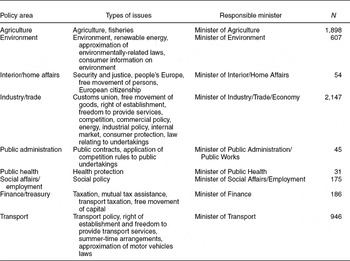
We took the following steps to measure the intensity of conflict between the minister and the coalition partners. First, we assigned each directive to one (and only one) policy area, following the classification headings of EUR-Lex. We then allocated a responsible minister to each policy area, as illustrated in Table 1. This is the minister who is formally in charge of the transposition of the directive.Footnote 18
Policy Areas and Responsible Ministers

Note. Grouping broadly follows EUR-Lex classification headings. Directive-state level N = 6,089.
Having identified the party of the responsible minister at the time of adoption of each national measure implementing a given directive, we recorded the left–right positions of the parties in government, using the Ray–Marks–Steenbergen dataset, which collates data from five expert surveys (Ray Reference Ray1999; Steenbergen and Marks Reference Steenbergen and Marks2007).Footnote 19 The absolute difference between the position of this minister and that of the farthest coalition party on the left–right scale measures the intensity of conflict underpinning the adoption on this measure. Where more than one implementing instrument has been adopted, Conflict takes the mean value across the national transposition measures of the directive.
For government coalitions and portfolio allocations, we relied on data from Müller and Strøm (Reference Müller and Strøm2000), complemented by and updated with data from Woldendorp, Keman, and Budge (Reference Woldendorp, Keman and Budge2000) and the political data yearbooks of the European Journal of Political Research. For minority governments, we computed the level of conflict on the basis of the parliamentary support coalition for the government, following Laver (Reference Laver, Weingast and Wittman2006: 128).Footnote 20
Conflict between the minister in charge of transposition and the coalition partners should increase the likelihood of parliamentary participation, if the directive provides for extensive implementing discretion. Complex directives adopted by the Council with generous transposition deadlines should therefore increase the likelihood of parliamentary involvement as the executive becomes more heterogeneous. Longer laws should instead decrease the likelihood of parliamentary involvement.
Parliamentary Institutions
We consider four sets of parliamentary institutions: the legislative agenda, the amendment prerogatives of the government, the vote of confidence procedure, and bicameralism.
Government control of the legislative agenda varies considerably across European democracies. Consider the British Parliament. Its plenary agenda is set by the government. Its committees play a secondary role and their amendments are attached to the original government bill without rewriting. The government also controls the committee agenda as well as the debates. An unadopted bill dies at the end of session. Hence, its lifespan cannot exceed one year. Contrast this with the Dutch Parliament. The plenary and the committees determine their own agenda. There is neither advance limitation nor possibility of closure of debate. A bill never dies.
Seven core parliamentary institutions determine the relative importance of the parliament and the government in controlling the legislative agenda: the rules to determine the agenda of the plenary; the degree of restrictions imposed on the legislature for proposing money bills; the timing of committee versus plenary involvement in the decision-making process; the power of committees to rewrite government bills; the rules governing the timetable of committee proceedings; the rules curtailing the debate before the final vote in the plenary; and the maximum lifespan of a bill pending approval. Döring (Reference Döring and Döring1995c) has produced, for each of these variables, a score for eighteen Western European democracies. From his data, we created an index of agenda control using factor analysis and weighting the variables by the first factor loading, normalized by the weighted sum.Footnote 21 We excluded rules on money bills because the vast majority of EU legislation is regulatory in nature. Agenda control is an index of the relative institutional power of the parliament and the government in controlling the policy agenda. It ranges from zero to one, with higher values measuring greater government control. When the opinions of the minister and her coalition parties diverge, greater governmental control of the parliamentary agenda should dampen the incentives for these parties to intervene in the policy process. The interaction between Agenda control and Conflict should therefore be negative, reducing parliamentary involvement.
A minister in whose jurisdiction a bill falls can also benefit from the possibility of offering amendments toward the end of the legislative process (Heller Reference Heller2001a). This procedural tool may be used to punish recalcitrant coalition partners. Relying on Heller (Reference Heller2001a: 783), we developed an index of government amendment prerogatives. Amendment prerogatives takes the value one if there is no formal government advantage on amendments (Austria, Belgium, Finland, Luxembourg, and Britain), two if there are some government prerogatives on amendments (Germany, Ireland, and Portugal), and three if the government has last offer authority or gatekeeping power on amendments (for the remaining seven countries). Greater government powers at the end of the legislative process are likely to dissuade coalition partners from pressing for legislative policymaking. The interaction between government Amendment prerogatives and Conflict should be negative, reducing the likelihood of parliamentary involvement.
The vote of confidence is the most fundamental “procedural peak” of parliamentary government. It has been subject to theoretical (Baron Reference Baron1998; Diermeier and Feddersen Reference Diermeier and Feddersen1998; Huber Reference Huber1996b) and empirical scrutiny (Huber Reference Huber1996a; Huber and McCarty Reference Huber and McCarty2001). We consider the vote of confidence procedure that is used after government formation. Here, a motion is attached to specific policy issues in the context of legislative debates. We use the information from Huber (Reference Huber1996b: 271), complemented with our data for Austria and Greece, and assign scores to the countries according to the easiness of winning a motion of confidence. Confidence vote ranges from one to seven. Member states with less demanding voting rules for carrying the motion and without prerequisites for invoking the procedure receive higher values.Footnote 22 Formal models investigate how this procedure allows the executive to exercise control over policy outcomes and increase intracoalition cohesiveness (Baron Reference Baron1998; Diermeier and Feddersen Reference Diermeier and Feddersen1998; Huber Reference Huber1996b). The government's ease of invoking and carrying confidence motions may therefore strengthen the government's control over the parliamentary proceedings. Following this logic, the interaction between Confidence vote and Conflict should be negative. Parliamentary involvement should be lower the larger the government advantage in the vote of confidence procedure.
The policy effects of bicameralism have been well documented (e.g. Bräuninger and König Reference Bräuninger and König1999; Heller Reference Heller1997, Reference Heller2001b; Tsebelis and Money Reference Tsebelis and Money1997), but the question as to whether a more powerful upper chamber increases the likelihood of legislative involvement has not been systematically addressed.Footnote 23 We employ Lijphart's (Reference Lijphart1999: 212) index of Bicameralism. It ranks democracies according to the degree of symmetry and congruency (i.e., similarity of composition). Countries with symmetrical and incongruent upper chambers top the ranking, whereas those with unicameral parliaments are at the bottom. Because governments in parliamentary systems with strong bicameral features have weaker control over legislative proceedings, the interaction between Bicameralism and Conflict should be positive, increasing the likelihood of parliamentary involvement.
Control Variables
A minister, with the aid of civil servants, drafts the national measures implementing the directive, but cabinet instability may weaken the legislative capacity of an executive. Huber and Shipan (Reference Huber and Shipan2002: 187–90) show that legislatures supporting governments with higher expected cabinet turnover write significantly fewer policy details into their statutes. Effectively, they exercise less control over policy implementation. Cabinets with diminished legislative capacity therefore represent a disincentive to parliamentary participation in transposition. It is the expectation of instability that makes it harder to oversee policy implementation. We use the variable Cabinet turnover developed by Huber and Shipan (Reference Huber and Shipan2002: 196). It is an average of the yearly scores of individual portfolio volatility for the 1984–98 period.Footnote 24Cabinet turnover should reduce the likelihood of parliamentary involvement.
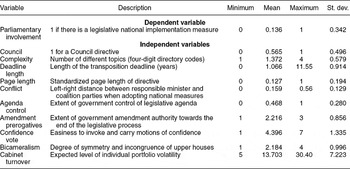
Each directive has also been assigned to one, and only one, of the nine policy areas listed in Table 1. We include eight policy dummies, with agriculture as the reference category. Table 2 provides descriptive statistics for our dependent and independent variables, except for the policy dummies.
Descriptive Statistics

Methods
Directives are adopted at the EU level and transposed by member states. We have two levels of analysis, countries and directives. The first one is nested in the second, but we do not necessarily have data on the implementation history of all directives in all countries. The implementation route for each directive varies across countries as a function of the level of conflict within the government, as well as the institutional rules guiding legislative–executive relations. The level of conflict varies by directive and between countries, while the latter set of effects varies only by country.
A two-level random effects ANOVA model shows that the coefficient of the variance component of the directive level is 1.045 (standard error 0.1, Wald-test statistic = 110.2). A significant proportion of the variance in the probability of parliamentary involvement is therefore attributable to differences between directives. We therefore need to account for the multilevel structure in the data.Footnote 25 Ignoring the multilevel structure of a dataset could cause artificially small standard errors, thereby leading us to incorrect rejection of the null hypotheses (Steenbergen and Jones Reference Steenbergen and Jones2002: 219–20). The likelihood of parliamentary involvement in the transposition of a given directive is positively correlated across member states. Cluster correlation violates the assumption of independence of observations required by a standard probit regression model. We hence estimate two multilevel models with a random intercept on each directive.Footnote 26 In Model 1, the discretion and institutional variables interact with Conflict. In Model 2, we drop Page length. The country level is modeled by the institutional variables. We also use country-clustered robust standard errors to account for within-country correlation.
RESULTS
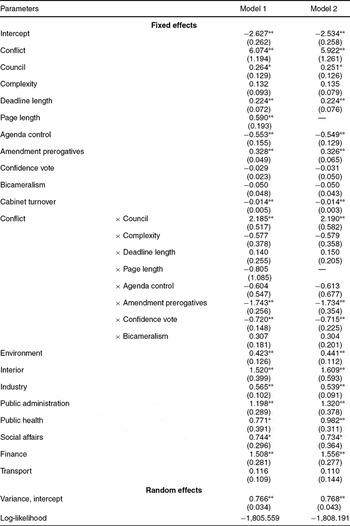
Table 3 presents the results. We find support for both hypotheses. Parliamentary involvement increases with conflict between the responsible minister and coalition partners. The effect increases with discretion over implementation. Council directives see more parliamentary involvement than Commission directives. National parliaments are more likely to get involved in the implementation process when directives have longer transposition deadlines. However, legislative participation does not increase significantly in the case of more complex directives. Additionally, parliaments are more likely to intervene in the transposition of longer directives (the effect diminishes as conflict intensifies). This goes against the theoretical expectation. We thus drop Page length in Model 2, with no consequences for the other results.
Discretion, Conflict, Institutions and Parliamentary Involvement

Notes. Dependent variable is parliamentary involvement. Probit models with random intercept on directive level and robust standard errors clustered on country level. N = 6,089 (directive-level N = 724). Maximum likelihood estimates.
**p < .01.
*p < .05.
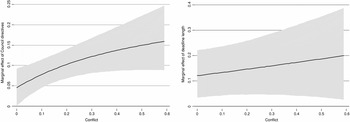
To emphasize the substantive effects rather than merely their statistical significance, we focus our discussion on the marginal effects of the interactions between the key variables of interest. Figure 1 (left panel) presents the estimated marginal effect of implementing a Council rather than a Commission directive on the likelihood of legislative involvement, as conflict varies across the observable range of values. These effects are calculated on the basis of Model 2 in Table 3 and a directive on industrial and trade policy, the most important policy area of the EU. The gray area covers the 95% confidence interval.Footnote 27
The Impact of Council Directives and of an Increase in Deadline Length on Parliamentary Involvement at Different Levels of Conflict

With a single-party majority government, a Spanish parliament is 5.9% more likely to intervene in the transposition of a Council than a Commission directive. A Greek parliament is 4.8% more likely to be involved. These values are much larger in case of heterogeneous multiparty coalitions. The probability of involvement increases by 17.9% in Belgium and by a considerable 50.1% in Finland.
Longer deadlines for transposition also encourage parliamentary involvement. The right-hand panel of Figure 1 shows the effect of a two-year extension in this deadline, at different levels of conflict. This effect is, however, only marginally more pronounced in more divided governments. In homogeneous two-party German coalitions, the likelihood of parliamentary involvement increases by 15.9%. In more divided Finnish coalitions, it increases by 22.3%.
The cumulative effect of discretion and conflict on parliamentary participation is large. Consider a Spanish minority government implementing a Council directive with a three-year deadline. Contrast this with a single-party majority government transposing, in the same country, a Commission directive with a one-year deadline. Legislative involvement is 82.6% more likely in the former circumstances.
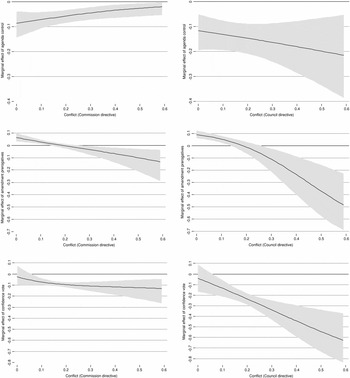
We also find support for the second expectation. This hypothesis tests whether the formal rules structuring legislative–executive relations influence the likelihood of parliamentary involvement, given conflict between the responsible minister and coalition partners. Our results show that government agenda-setting power and, for sufficiently high levels of conflict, government amendment power and government advantage in the vote of confidence procedure decrease the likelihood of legislative involvement. We do not find an effect for bicameralism.
Figure 2 presents the marginal effects of different institutional arrangements on the likelihood of legislative involvement, conditional on conflict.Footnote 28 The plots are ordered by the level of discretionary scope. On the left-hand side, we find Commission directives (low scope), and, on the right-hand side, Council directives (high scope). A striking aspect of these six panels is that the effect is substantively much weaker for Commission than for Council directives, reflecting the higher likelihood of involvement in the latter measures.
The Impact of Institutional Arrangements on Parliamentary Involvement for Commission and Council Directives at Different Levels of Conflict

Consider the marginal effect of agenda control, illustrated in the top row of the figure. More agenda control dampens legislative activity, as argued by Döring (Reference Döring and Döring1995b), but the effect is inflated with discretionary scope and conflict. From the left-hand side, we see that it is small and decreasing when the scope is low. But on the right-hand side, where discretion is higher, the effect is clearly larger and increasing with conflict. Contrast France with Denmark. The French executive has considerable more control over legislative proceedings than its Danish counterpart (the other institutional arrangements—except bicameralism—are similar). For a Commission directive, the French parliament is only 2.1% less likely to be involved in transposition than the Danish Folketing. But if a Council directive with a three-year deadline is transposed, greater agenda control in France reduces the likelihood of parliamentary involvement by 20.8%.Footnote 29
Now consider the marginal effect of amendment prerogatives, presented in the middle row of Figure 2. Again, the effect is smaller for Commission directives. The marginal effect of amendment prerogatives is positive for a low level of conflict, under both types of measures. This result is driven by Britain, Ireland, and Portugal. These countries display limited parliamentary involvement and have weak amendment prerogatives. However, as the level of conflict increases, the marginal effect becomes negative. More amendment power discourages legislative involvement. The effect is substantial for Council directives. Compare Italy and Finland. These two countries have similar rules on agenda and confidence vote, but the Italian executive enjoys stronger amendment prerogatives. The Italian parliament is 58.3% less likely to participate in the transposition of a Council directive—with a three-year deadline—than the Finnish Eduskunta. Heller (Reference Heller2001a: 791–92) finds that government amendment power is stronger in countries with a high incidence of minority governments. We show that this institutional arrangement is valuable to these governments which must rely on heterogeneous legislative coalitions, because it limits parliamentary activism.
Finally, consider the marginal effect of the vote of confidence presented in the bottom row of Figure 2. It is negative and clearly distinguishable from zero for all but the lowest levels of conflict on both types of measures. In the case of Council directives, the size of the effect is substantively larger. The government's advantage in the vote-of-confidence procedure deters coalition partners from using parliamentary involvement to limit ministerial drift in case of conflict. For instance, Belgium and Finland have similar agenda and amendment rules but, in Belgium, a motion of confidence is easier to carry. Here, legislative participation in the implementation of a Council directive is 54.5% less likely.Footnote 30
We conclude with an examination of the effects of the other variables. As expected, higher cabinet instability discourages parliamentary involvement. Italy and the Netherlands display similar institutional features and levels of conflict, but ministerial turnover in Italian cabinets is more than four times higher than in Dutch governments. The Italian parliament is therefore 12.5% less likely to be involved in the transposition of Council directives than its Dutch counterpart.
Legislative involvement varies significantly across policy areas. Compared to agricultural policy, parliamentary participation increases by 44% in case of transposition of Council directives on home affairs, 41.9% for taxation measures, 32.7% for public administration directives, and 20.7% and 13.4% respectively for public health and social policy measures. The effect is smaller, but still significantly greater than zero, in the remaining two policy areas (8.6% and 6.6% for industrial and environmental policy directives, respectively). The volume of supranational output in policies with low parliamentary involvement (agricultural, transport, environmental, and industrial policy) is much higher than in the other policies (see Table 1). It appears that areas that are intensively Europeanized dampen the incentives for parliamentary participation, possibly because national legislators see fewer opportunities for shaping policy outcomes.
CONCLUSIONS
Our findings have important implications for the study of executive–legislative relations in parliamentary systems. First, we provide empirical evidence of the role of the legislature in managing intracoalitional disagreement for a larger set of countries and/or policies than covered in previous studies (e.g., Huber and Shipan Reference Huber and Shipan2002; Martin and Vanberg Reference Martin and Vanberg2005).
Second, and more importantly, we have shown the conditional impact of conflict on parliamentary involvement. Legislative review is more likely when intense conflict is associated with broader ministerial autonomy. The use of directives has allowed us to employ a more fine-grained measurement of this autonomy, recorded for each measure implemented, rather than other, possibly more impressionistic assessments (cf. Heller Reference Heller2001a: 793).
Finally, the impact of conflict is also conditional on the rules structuring executive–legislative relations. The executive clearly does not accept legislative review passively. It actually enjoys important institutional prerogatives for influencing legislative decision-making. We have shown that the government's control of the legislative agenda, its advantage in scheduling parliamentary amendments, and the ease with which it can pass a motion of confidence decrease the involvement of parliament in policy making, especially when it matters most, that is, when intracoalitional disagreement is most intense. This result refines Döring's findings on the impact of agenda control on legislative output and adds empirical evidence to the theoretical importance of amendment rules and confidence vote attributed by Diermeier and Feddersen (Reference Diermeier and Feddersen1998), Heller (Reference Heller2001a), and Huber (Reference Huber1996b). However, bicameralism does not seem to matter, which reinforces Cutrone and McCarty's (Reference Cutrone, McCarty, Weingast and Wittman2006) conclusions. These findings suggest that researchers interested in legislative politics should pay particular attention to the ordering of proposals when analyzing voting behavior in parliaments (see Clinton Reference Clinton2007).
In conclusion, far from being irrelevant, national parliaments are appreciably involved in the transposition of directives. More importantly, such an involvement occurs when it matters most: when the minister in charge of implementation has an incentive to exploit the opportunity for drift offered by a measure. Whether this redresses a deficiency in democracy in the EU political system remains an open question, but parliamentary participation takes place according to nationally agreed rules that balance the power of the legislative and executive branches.



Comments
No Comments have been published for this article.