


INTRODUCTION
Children with early unilateral brain injury, even those whose lesions involve language areas in the left hemisphere, show remarkable plasticity for early language learning. They do not exhibit aphasic symptoms that are common when the same lesions are incurred during adulthood (e.g. Bates et al., Reference Bates, Reilly, Wulfeck, Druonkers, Opie, Fenson, Kriz, Jeffries, Miller and Herbst2001). Rather, they utilize intact brain regions to acquire language functions that would normally have involved the damaged regions of their brains, exhibiting only mild delays in language acquisition (e.g. Raja-Beharelle et al., Reference Raja Beharelle, Dick, Goulven, Solodkin, Huttenlocher, Levine and Small2010; Booth, MacWhinney, Thulborn, Sacco, Voyvodic & Feldman Reference Booth, MacWhinney, Thulborn, Sacco, Voyvodic and Feldman2000; Feldman, Reference Feldman2005; Staudt, Lidzba, Grodd, Wildgruber, Erb & Krägeloh-Mann, Reference Staudt, Lidzba, Grodd, Wildgruber, Erb and Krägeloh-Mann2002; Stiles, Reilly, Paul & Moses, Reference Stiles, Reilly, Paul and Moses2005). Although children with pre- or perinatal unilateral brain injury (children with PL) develop language using different neural substrates than those engaged when children acquire language with intact brains, the same processes might still govern how they learn language. We explore this possibility here by examining the relation between early speech and gesture. We ask whether gesture serves as a precursor to early sentence formation in children with PL, just as it does in typically developing (TD) children (Goldin-Meadow & Butcher, Reference Goldin-Meadow, Butcher and Kita2003; Iverson & Goldin-Meadow, Reference Iverson and Goldin-Meadow2005; Özçalışkan & Goldin-Meadow, Reference Özçalışkan and Goldin-Meadow2005a).
Gesture signals oncoming changes in typically developing children's speech
Research from a number of laboratories indicates that TD children communicate using gestures before they are able to speak (Acredolo & Goodwyn, Reference Acredolo and Goodwyn1989; Bates, Benigni, Bretherton, Camaioni & Volterra, Reference Bates, Benigni, Bretherton, Camanioni and Volterra1979). They use deictic gestures to identify objects in their immediate environment (e.g. pointing at a dog to indicate a ‘dog’) and iconic gestures to convey information about the actions or attributes associated with an object (e.g. flapping arms to convey ‘flying’, pinching fingers to indicate ‘small’) before they use words to convey these meanings.
Even after they begin to produce their first words, TD children continue to use gesture, frequently combining their gestures with words to support and extend their linguistic capacities. Initially, children produce gestures that convey the same information as the accompanying speech, e.g. cookie + point at cookie (Butcher & Goldin-Meadow, Reference Butcher, Goldin-Meadow and McNeill2000; Greenfield & Smith, Reference Greenfield and Smith1976). The semantic relation between gesture and speech becomes more complex over development, and children begin to produce gesture–speech combinations in which gesture supplements the information conveyed in speech (Butcher & Goldin-Meadow, Reference Butcher, Goldin-Meadow and McNeill2000; Greenfield & Smith, Reference Greenfield and Smith1976; Özçalışkan & Goldin-Meadow, Reference Özçalışkan and Goldin-Meadow2005b). In these supplementary combinations, unlike earlier ones, gesture adds a new semantic element to the meaning of the spoken word; for example, an action (hair + move hands over head to indicate ‘wash’), an object (bite + point at toast), or an attribute (person + hold hand above head to indicate ‘big size’).
Supplementary combinations provide children with a tool to communicate sentence-like meanings, with one sentential element expressed in speech and the other in gesture, before they are able to convey these meanings entirely in speech (e.g. ‘wash hair’, ‘bite toast’, ‘big person’). There is, in fact, evidence that the age at which TD children first produce gesture–speech combinations conveying sentence-like information predicts the age at which they first begin to produce two-word sentences (Goldin-Meadow & Butcher, Reference Goldin-Meadow, Butcher and Kita2003; Iverson & Goldin-Meadow, Reference Iverson and Goldin-Meadow2005). Moreover, TD children produce supplementary gesture–speech combinations conveying different sentence-like meanings before they produce each of these meanings entirely in speech (Özçalışkan & Goldin-Meadow, Reference Özçalışkan and Goldin-Meadow2005a; Reference Özçalışkan and Goldin-Meadow2010). Thus, in TD children, gesture and speech begin to form a semantically integrated system at an early age, and children rely on this system to take their initial steps into sentence production.
Does gesture signal oncoming changes for children with early unilateral brain injury?
In this article, we examine whether gesture and speech also form an integrated system for children with early unilateral brain lesions. Specifically, we ask whether supplementary gesture–speech combinations herald the onset of first sentences in speech for children with PL, just as they do for TD children.
Previous research on adults with brain injury suggests a tight link between gesture and speech production (e.g. Cicone, Wapner, Foldi, Zurif & Gardner, Reference Cicone, Wapner, Foldi, Zurif and Gardner1979; Glosser, Wiener & Kaplan, Reference Glosser, Wiener and Kaplan1986; Pickett, Reference Pickett1974). For example, Cicone et al. (Reference Cicone, Wapner, Foldi, Zurif and Gardner1979), in their study of spontaneous co-speech gestures produced by four adult patients, two with Broca's and two with Wernicke's aphasia, found close parallels between the quality and quantity of the patients' spoken and gestural communications. A similar relation also was found for the level of verbal skill and incidence of complex gestures (i.e. gestures that convey relational information); adult aphasics who have greater linguistic facility also produce more complex co-speech gestures in a task involving face-to-face interaction (Glosser et al., Reference Glosser, Wiener and Kaplan1986). Finally, the same positive relation was found between verbal ability and gestures that are produced without speech (i.e. pantomimes); aphasics who showed better verbal production and/or verbal comprehension abilities were also better at recognizing and producing pantomimes (Duffy, Duffy & Pearson, Reference Duffy, Duffy and Pearson1975; Varney, Reference Varney1978). These studies also showed that aphasics – compared to typical adult controls – were impaired both in their production and comprehension of gestures (e.g. Duffy & Duffy, Reference Duffy and Duffy1981; Goodglass & Kaplan, Reference Goodglass and Kaplan1963; Pickett, Reference Pickett1974; see Peterson & Kirshner, Reference Peterson and Kirshner1981, for a review).
In contrast to the considerable amount of research on speech and gesture production in adults with brain injury, very little is known about the effect of early brain lesions on the development of communicative gesture in children with PL and its role in language acquisition. Most of the earlier work, which relied on parental checklists to assess the gestural abilities of children with PL, showed delays in gesture production (Marchman, Miller & Bates, Reference Marchman, Miller and Bates1991), particularly in children with right hemisphere lesions (Bates et al., Reference Bates, Thal, Trauner, Fenson, Aram, Eisele and Nass1997). Gesture delays in children with PL could stem from the hemiparesis that typically accompanies lesions of this type and affects motor functioning of the hand contralateral to the lesion.
Given the delays that children with PL appear to exhibit in both their gesture and speech production, we ask whether the pattern of gesture–speech combinations leading the way to early sentence production is disrupted, or whether this language-learning process is so robust that children with PL, like their typically developing peers, initially rely on gesture and speech together to convey sentence-like meanings. A close examination of the nature of the gesture–speech relationship in children with PL can tell us whether and how gesture might contribute to the plasticity observed in the spoken language development of children with early unilateral brain injuries. Furthermore, in cases where we observe closely timed delays in both gesture and speech, we can identify the particular kinds of gesture that might play a role in getting different aspects of language learning off the ground.
If the link between early gesture–speech combinations and later language development remains intact in the communications of children with PL, we might expect to see precursors of sentence-like meanings in these children's early gesture–speech combinations. Gesture provides children with a tool not only to point out objects, but also to make comments about or requests for those objects. For example, in his quest for more cookies, a child could point at a cookie while uttering the word me to convey two arguments of a transfer relation, the patient (in gesture) and the recipient (in speech). Similarly, to express a desire to act on an object, a child could produce the iconic gesture ‘eat’ while saying the word cookie, thus conveying the predicate action (in gesture) and one of its arguments, the patient (in speech). Indeed, a child can even express two propositions within the bounds of a single communication (akin to a complex sentence) using gesture and speech. For example, the child could produce the iconic gesture ‘eat’ while saying I like it, thus conveying one predicate in speech (‘like’) and one in gesture (‘eat’). If the gesture–speech system is a robust feature of the early language-learning process, we should see constructions of this type in gesture–speech combinations produced by children with PL, and we should see them in gesture + speech before they appear entirely in speech. If, on the other hand, the link between early gesture–speech combinations and later language development does not remain intact for simple and/or complex sentence types in the communications of children with PL, we should fail to observe precursors of such sentence types in these children's gesture–speech combinations. Moreover, if gesture plays a facilitating role in learning different sentence constructions in speech, we should also see significant delays in the onset of parallel sentence types in the speech of children who do not express particular sentence constructions via gesture–speech combinations.
To examine the role that gesture–speech combinations play in language learning in children with early brain injury, we observed eleven children with unilateral prenatal or perinatal brain injury as they progressed from one-word to multi-word speech. We asked whether the children expressed different sentence constructions first in gesture–speech combinations and only later entirely in speech, and whether expressing sentence-like meanings in gesture predicted expressing the same sentence-like meanings in speech.
METHODS
Sample
Children with PL
Eleven children (8 girls, 3 boys) with unilateral pre- or perinatal brain injuries were included in the study. Eight of the children had left hemisphere lesions and three had right hemisphere lesions. Children with bilateral lesions were excluded from the study. The lesions were acquired either pre- or perinatally for all children with PL. The lesion characteristics were determined on the basis of magnetic resonance imaging (MRI) scans for ten of the children and on the basis of detailed medical notes from previous computerized tomography (CT) and MRI scans for the remaining child (see Table 1 for lesion characteristics of each child with PL). Each lesion was a result of either a cerebral infarct of the middle cerebral artery territory or a periventricular bleed, and typically involved one or more brain regions, including the frontal, temporal, parietal or occipital lobes, along with various subcortical areas (thalamus, basil ganglia and medial temporal lobe). All children with PL had motor deficits, which involved hemiparesis of the side of the body contralateral to the lesion (i.e. right side for children with left hemisphere injury, left side for children with right hemisphere injury). All children were mobile, but rarely used the hand contralateral to the lesion when communicating non-verbally. We categorized lesion size based on the following criteria: small lesions involved damage to one of the lobes, along with one or more of the subcortical areas, and were periventricular in nature; medium lesions affected more than one lobe and extended to several subcortical areas; large lesions typically involved damage to three or four lobes and some of the subcortical areas and the thalamus, and were all cerebral infarcts. Following these criteria, we classified four children with small lesions, one with a medium lesion, and six with large lesions. Based on our preliminary work with a larger group of children with PL showing no differences between children with small and medium lesions in overall rates of gesture and speech production (Brasky, Nikolas, Meanwell, Levine & Goldin-Meadow, Reference Brasky, Nikolas, Meanwell, Levine and Goldin-Meadow2005), we further collapsed children with small and medium lesions into a single group, resulting in two subgroups of PL children: six with large lesions and five with small or medium lesions. For brevity, we will use the term ‘small lesion’ in the remainder of the text to include both the four children with small lesions and one with a medium lesion. A small minority of the children in our study had right hemisphere lesions (N = 3 out of 11), which are less common in general (Levine, Huttenlocher, Banich & Duda, Reference Levine, Huttenlocher, Banich and Duda1987).
Characteristics of children with PL and children with TD

notes: F = Frontal, T = Temporal, P = Parietal, O = Occipital, Subcortical = Subcortical areas
PPVT data were collected from 24 of the 30 TD children and all of the PL children at child age 2;6; WPPSI data were collected from 23 of the 30
TD children and all of the PL children at age 4;6.
TD children
To situate the gesture and speech development of children with PL within a normative sample, we included thirty typically developing (TD) children, twenty girls and ten boys, as a comparison group. The thirty TD children came from a larger sample of children, collected as part of a longitudinal project on language development (Özçalışkan & Goldin-Meadow, Reference Özçalışkan and Goldin-Meadow2005a; Reference Özçalışkan and Goldin-Meadow2005b; Reference Özçalışkan and Goldin-Meadow2009), and were matched to the eleven PL children in their productive vocabulary (i.e. word types). To maximize the similarity between the language profiles of the two groups of children, we included data from a younger group of TD children, with first observation at age 1;2, to compare to our children with PL, with first observation at age 1;6. We followed each child for four consecutive observations up until age 2;2 for the TD children and 2;6 for children with PL.
The two groups of children were matched in terms of their expressive vocabulary – as assessed by the number of different words they produced in the first observation session, which occurred at child age 1;2 for the TD children and 1;6 for children with PL (MTD word type = 14·27 [SD = 12·28] vs. MPL word type = 15·36 [SD = 14·63], F(1, 39) = 0·6, p = ·81; range = 1–36). In both groups, roughly half of the children (45–47%) were at the low vocabulary level (fewer than 10 word types), one-third of the children were at the medium vocabulary level (10–30 word types), and the remaining 15% were at the high vocabulary level (more than 30 word types). The two groups were also comparable in overall word production (i.e. word tokens) at the initial observation session (MTD word token = 56·63 [SD = 55·51] vs. MPL word token = 68·18 [SD = 61·78], F(1, 39) = 0·33, p = ·57) (also see Table 1, last two columns for standardized PPVT scores at age 2;6 and scores on the WPPSI Matrix Reasoning subtest at age 4;6 for each child with PL, compared to the TD group).
The TD sample was recruited via direct mailings to roughly 5,000 families in targeted zip codes and an advertisement in a free monthly parents' magazine. Due to the low incidence of early brain lesions, which is estimated to be approximately 1 in 4,000 births (Lynch & Nelson, Reference Lynch and Nelson2001), and the associated difficulty of finding these children at the early ages, children with PL were recruited via contacts with pediatric neurologists and through parent support groups in the greater Chicago area and the neighboring states. All children in both groups were being raised as monolingual English speakers.
Data collection
Children in both groups were followed longitudinally – from 1;6 to 2;6 for the PL children and from 1;2 to 2;2 for the TD children. All children were observed in their homes every four months and were videotaped for 90 minutes while interacting with their primary caregivers. We missed only one data collection session for one of the TD children, at 2;2. We chose productive language-matched TD controls rather than age-matched controls, because we wanted to determine whether children with PL would follow a similar course of language learning trajectory – from gesture + speech combinations to speech-only expressions – as their TD peers who were at the same level of speech production at the initial observation session.
Observation sessions typically involved free play with toys, book reading with the caregiver, and a meal or snack time, but varied depending on the caregiver and child – parents were simply told to engage in their normal activities. The TD children's families constituted a heterogeneous mix in terms of family income and ethnicity; their annual income levels ranged from $15,000 to $100,000 or more. The families of the children with PL were more homogeneous, consisting of middle- to upper-middle-class Caucasian families, with incomes ranging from $35,000 to $100,000 or more.
Data analysis
Coding words and gestures
All communicative and intelligible words and gestures produced by children during the observations were transcribed using Microsoft Excel and Quick Time; subsequently the Excel files were transformed into text files for token and type counts of gesture and speech. The criterion for coding a gesture or a word as communicative was clear behavioral evidence that the child meant to engage the listener. Sounds that were used reliably to refer to entities, properties or events (doggie, nice, broken), along with onomatopoeic sounds (e.g. meow, choo-choo) and conventionalized evaluative sounds (e.g. oopsie, uh-oh), were counted as words.
Hand movements that were used to communicate were considered gestures and were classified into one of three types: (1) conventional gestures were gestures whose forms and meanings are prescribed by the culture (e.g. nodding the head to mean ‘yes’, extending an open palm next to a desired object to mean ‘give’); (2) deictic gestures were gestures that indicated concrete objects, persons or locations, which we classified as the referents of these gestures (e.g. pointing to a dog to refer to a ‘dog’, holding up a bottle to refer to a ‘bottle’); (3) iconic gestures were gestures that depicted the attributes or actions associated with an object via hand or body movements (e.g. moving the index finger in circles to convey a ball's ‘rolling’). Ritualized games (e.g. patty cake) and functional acts performed on objects (e.g. reaching for a book, offering a doll by extending the doll towards caregiver, hitting a peg with a toy hammer) were not coded as gestures and thus were not included in the counts. These acts involved manipulation of real or pretend objects; as such they were considered functional acts, rather than symbolic gestures. The only exception was when the child held up an object to bring it to another's attention; these acts served the same function as the pointing gesture and thus were treated as deictic gestures.
Coding communicative acts
We divided all gestures and speech into communicative acts. A communicative act was defined as a word or gesture – alone or in combination – that was preceded and followed by a pause, a change in conversational turn, or a change in intonational pattern. Communicative acts were categorized into three types: (1) gesture only acts were gestures produced without speech, either singly (e.g. point at cookie) or in combination (e.g. point at cookie + shake head; point at cookie + point at empty jar); (2) speech only acts were words produced without gesture, either singly (e.g. cookie) or in combination (mommy cookie); (3) gesture–speech combinations were acts containing both gesture and speech (e.g. me cookie + point at cookie; cookie + ‘eat’ gesture).
Coding gesture + speech combinations
We further categorized gesture– speech combinations into three types according to the relation between the information conveyed in gesture and speech: (1) a reinforcing relation was coded when gesture conveyed the same information as speech (e.g. mommy + point at mother; cuppie + hold-up milk cup); (2) a disambiguating relation was coded when gesture clarified the referent of a deictic word in speech, including personal pronouns (e.g. she + point at sister), demonstrative pronouns (e.g. this + point at doll), and spatial deictic words (e.g. there + point at couch); (3) a supplementary relation was coded when gesture added semantic information to the message conveyed in speech (e.g. open + point to jar with lid on; mommy water + hold up empty cup).
Coding semantic relations
Supplementary gesture–speech combinations and multi-word combinations were then categorized into three types according to the semantic elements conveyed (see examples in Table 2): (1) multiple arguments without a predicate; (2) a predicate with at least one argument; and (3) multiple predicates with or without arguments. Following earlier work (Özçalışkan & Goldin-Meadow, Reference Özçalışkan and Goldin-Meadow2005a; Reference Özçalışkan, Goldin-Meadow, Gale Stam and Mika Ishino2011; Özçalışkan, Gentner & Goldin-Meadow, Reference Özçalışkan, Gentner and Goldin-Meadow2012), deictic gestures were assumed to convey arguments (e.g. point at a ball = ‘ball’; hold up a cup = ‘cup’), and iconic gestures that are dynamic in form were assumed to convey predicates (e.g. moving hand to mouth repeatedly = ‘eat’). Conventional gestures could also convey predicate meanings (e.g. extending an open palm next to a desired object = ‘give’), but never arguments. Gesture–gesture combinations were rare in our data and thus were not included in the analysis.
Examples of the types of semantic relations children conveyed in multi-word speech combinations and in supplementary gesture–speech combinationsa

notes:a The age at which each example was produced, is given in brackets after the example. Children with PL = children with early unilateral brain injury, TD children = typically developing children.
b The speech is in italic, the meaning gloss for the gestures is in single quotes, and the type of gesture (point, iconic) is indicated in parentheses following the gesture gloss. We did not code the order in which gesture and speech were produced in gesture–speech combinations; the word is arbitrarily listed first and the gesture second in each example.
c The child is asking for the experimenter (Carrie) to put milk in her cup.
d The child is asking her mother to brush the child's hair.
e The child wants her mother to fill her empty cup with coke.
f The child finished with her food and wants her mother to give her more food.
g The child wants her mother to give her the soap bubbles so that she can hold them.
h The child is asking for a crayon so that she can paint.
Children with PL and TD children both produced a small number of adjective + argument combinations (little bubble; icky + point to diaper bag), which were excluded from the analyses; if these combinations are included as predicate + argument constructions, the patterns described in the text and tables do not change. In addition, combinations containing fillers (e.g. filler + argument: hi baby, please + point at cookie; or filler + predicate: please help, please + ‘give’ gesture) were excluded from the analyses because they do not constitute sentential constructions (although they too appeared in gesture + speech before speech alone). There were a few TD children who combined want with another verb (N = 7, e.g. I want see baby) or a predicate gesture (N = 4, I want vitamin + ‘give’ gesture) at age 1;10, and a few children with PL who combined want with another verb (N = 2, e.g. I want play trains) or predicate gesture (N = 1, e.g. I want that + ‘give’ gesture) at age 2;2. We were not convinced that want was functioning as a second predicate in these early combinations; it may instead have been serving as a quasi-modal. Indeed, for many of the children, want was the only verb used as a second predicate, suggesting that, at this time, the predicate + predicate construction was not productive for them. To be conservative, we did not count want as a second predicate in either speech-only or gesture + speech combinations; if, however, want is treated as a second predicate, the patterns described in the text do not change. The only exception we made was when the subject of the verb want and the subject of the second predicate were different (e.g. Iwant mommyto bake me cookies, Iwant baby + ‘sleep’ gesture); these combinations were classified as predicate + predicate constructions. Because our study involved data collection every four months, we can only present the onset of different sentence constructions at 4-month intervals. However, it should be noted that language development is a continuous process, and the actual onset of producing each sentence type could be anywhere within the 4-month gap between data collection points.
Coding reliability
We assessed coding reliability at several different levels. The first level involved identifying gestures (i.e. presence or absence of gesture) and assigning meaning glosses to each gesture. For this level of coding, two trained coders transcribed and coded two randomly chosen 90-minute observation session, one per group. Agreement between coders was 88% (k = 0·76; N = 763) for identifying gestures (i.e. presence or absence of gesture), 91% (k = 0·86; N = 375) for assigning meaning glosses to each gesture, and 94% (k = 0·89; N = 247) for classifying gesture–speech combinations into types (reinforcing, disambiguating, supplementary). For the second level of coding, two trained coders assigned semantic constructions to a randomly chosen segment of the data, accounting for 20% of the data used in the study. Agreement between coders was 99% (k = 0·98; N = 482) and 96% (k = 0·93; N = 179) for assigning sentence construction types to multi-word S + S combinations and to supplementary G + S combinations, respectively.
Statistical analysis
Data were analyzed using one-way ANOVAs with group (TD, PL) as a between-subject factor, and either age or modality (gesture + speech, speech-only) as a within-subject factor, and with two-way ANOVAs with age as the within-subject factor and lesion size (large, small) as the between-subject factor, along with chi-squares. We did not include laterality as a third factor in our mixed ANOVA comparisons (size×age) of children with PL because only three of the eleven children with PL in our study had right hemisphere lesions. We avoid making any quantitative or qualitative comparisons based on lesion laterality because of the unequal numbers of children with left vs. right hemisphere lesions in our sample. We also did not include lesion type as a variable in our analysis because this contrast (periventricular vs. cerebral infarct) mapped almost perfectly onto lesion size (small, large); the injury of all but one child with a small lesion was due to periventricular bleed and the injuries of all children with large lesions were caused by cerebral infarcts. We tested for homogeneity of variance for comparisons involving multiple groups (TD vs. PL, PL with small lesion vs. PL with large lesion) using Levene's test of equality of error variances, and found no significant differences in variance in any of the ANOVA comparisons.
RESULTS
The results section is divided into four sections: speech, gesture, gesture–speech combinations, and types of sentence constructions. In each section, we first present the results on children with PL, followed by results on TD children; we end with a comparison of the two groups. We also report differences based on lesion size for overall patterns of speech, gesture and gesture + speech production for children with PL (small vs. large lesion) and compare each subgroup to TD children. The effect sizes are computed by using partial eta-squared (hereafter pη2) for parametric comparisons (i.e. ANOVAs) and odds ratio (hereafter R) for non-parametric comparisons (i.e. Chi-squares).
Children's early speech production
Children with PL (both with large and small lesions) produced more communicative acts containing speech (F(3, 27) = 18·98, p < ·001, pη2 = ·68), more word types (F(3, 27) = 40·06, p < ·001, pη2 = ·82), and more word tokens (F(3, 27) = 16·90, p < ·001, pη2 = ·65) with increasing age (see Table 3, upper half). The speech production of children with PL did not differ reliably based on lesion size for communicative acts with speech (F(1, 9) = 0·76, p = ·41), word types (F(1, 9) = 3·45, p = ·10), or word tokens (F(1, 9) = 0·74, p = ·41). Nonetheless, across the different age groups, children with small lesions tended to produce more speech than children with large lesions, using not only more communicative acts containing speech, but also more word types and word tokens in their communications (see Table 3, upper half, for differences in speech production based on lesion size at each age).
Summary of children's speech productiona notes:a SD = standard deviation, TD children = typically developing children, Children with PL = children with prenatal/perinatal brain injury; the numbers are rounded up to the closest whole number. b Communicative acts with speech include all speech utterances, including the ones with gesture.

Like children with PL, TD children produced more communicative acts containing speech (F(3, 84) = 61·06, p < ·001, pη2 = ·69), more word types (F(3, 84) = 94·30, p < ·001, pη2 = ·77), and more words overall (i.e. tokens, F(3, 84) = 56·72, p < ·001, pη2 = ·67) with increasing age (see Table 3, lower half). All TD children and all children with PL were producing single words at ages 1;2 and 1;6, respectively.
Children with PL, considered as a group, did not differ from TD children in their total speech use combined across the four sessions (i.e. 1;2–2;2 for TD children, 1;6–2;6 for children with PL). TD and PL children produced similar numbers of communicative acts with speech (MTD = 305·87 [SD = 129·10] vs. MPL = 300·36 [SD = 165·35], F(1, 39) = 0·01, p = ·91), word types (MTD = 83·26 [SD = 38·34] vs. MPL = 93·71 [SD = 44·30], F(1, 39) = 0·55, p = ·46), and word tokens (MTD = 491·78 [SD = 262·19] vs. MPL = 510·32 [SD = 358·55], F(1, 39) = 0·03, p = ·86). Further comparison of TD children to the two subgroups of children with small vs. large lesions showed the same pattern: overall, compared to TD children, children with small lesions produced similar numbers of communicative acts with speech (F(1, 33) = 0·43, p = ·52), word types (F(1, 33) = 3·25, p = 0·08), and word tokens (F(1, 33) = 0·83, p = ·37), as did children with large lesions (communicative acts with speech: F(1, 34) = 0·58, p = ·45; word types: F(1, 34) = 0·35, p = ·56; word tokens: F(1, 34) = 0·293, p = ·59).
Children's gesture production
Children with PL increased their gesture production over time. As can be seen in Table 4 (upper half), children with PL (both with large and small lesions) produced more communicative acts with gesture (F(3, 27) = 3·70, p = ·02, pη2 = ·29), more gesture tokens (F(3, 27) = 4·90, p < ·01, pη2 = ·35), and more gesture–speech combinations (F(3, 27) = 13·89, p < ·001, pη2 = ·61) with increasing age. The gesture production of children with PL also varied by lesion size. Across the different ages, children with small lesions produced significantly more communicative acts with gesture (F(1, 9) = 5·53, p = ·04, pη2 = ·38), more gesture tokens (F(1, 9) = 5·92, p = ·04, pη2 = ·40), and more gesture–speech combinations (F(1, 9) = 7·95, p = ·02, pη2 = ·47) than children with large lesions. Table 4 (upper half) presents differences in gesture production based on lesion size at each observation session.
Summary of children's gesture productiona notes:a SD = standard deviation, TD children = typically developing children, children with PL = children with prenatal/perinatal brain injury; the numbers are round up to the closest whole number. b Communicative acts with gesture include all utterances with gesture – including both gesture-only utterances and gesture + speech combinations.

Like children with PL, TD children also increased their gesture production over time. As can be seen in Table 4 (lower half), they produced more communicative acts with gesture (F(3, 84) = 12·14, p < ·001, pη2 = ·30), more gesture tokens (F(3, 84) = 12·77, p < ·001, pη2 = ·31), and more gesture–speech combinations (F(3, 84) = 40·34, p < ·001, pη2 = ·59) with increasing age.
Children with PL, as a group, did not differ from TD children in the total number of gestures they produced, producing comparable numbers of communicative acts with gesture (MTD = 98·71 [SD = 41·71] vs. MPL = 81·39 [SD = 42·31], F(1, 39) = 1·38, p = ·25), gesture tokens (MTD = 101·18 [SD = 43·23] vs. MPL = 79·77 [SD = 42·90], F(1, 39) = 1·98, p = ·17), and gesture–speech combinations (MTD = 53·13 [SD = 29·23] vs. MPL = 44·30 [SD = 33·63], F(1, 39) = 0·68, p = ·42) as TD children. However, further comparisons showed differences in gesture production between the TD group and the PL subgroup with large lesions, but not the PL subgroup with small lesions. Overall, TD children and children in the PL group who had small lesions were comparable in their production of communicative acts with gesture (F(1, 33) = 0·26, p = ·61), gesture tokens (F(1, 33) = 0·11, p = ·74), and gesture–speech combinations (F(1, 33) = 0·29, p = ·29). In contrast, TD children produced more communicative acts with gesture (F(1, 34) = 4·68, p = ·04, pη2 = ·12), more gesture tokens (F(1, 34) = 5·56, p = 0·02, pη2 = ·14), and more gesture–speech combinations (F(1, 34) = 5·26, p = ·03, pη2 = ·13) than children in the PL group with large lesions.
Types of gesture–speech combinations
Children in both groups (TD and PL) produced three distinct types of gesture–speech combinations, combinations in which gesture reinforced (cookie+ point to cookie), disambiguated (look it + point to cookie), or supplemented (eat + point to cookie) the information conveyed in speech. As can be seen in Figure 1, children with PL increased their production of each of these combination types over time (reinforcing: F(3, 27) = 8·14, p = ·001, pη2 = ·48; disambiguating: F(3, 27) = 13·63, p < ·001, pη2 = ·60; and supplementary: F(3, 27) = 6·15, p = ·003, pη2 = ·41). The frequency of each combination type that children with PL produced varied by lesion size. Across the different ages, children with small lesions produced significantly more reinforcing (Msmall = 32·85 [SD = 16·56] vs. Mlarge = 12·46 [SD = 11·64], F(1, 9) = 5·75, p = ·04, pη2 = ·39), more disambiguating (Msmall = 14·0 [SD = 7·51] vs. Mlarge = 4·13 [SD = 4·04], F(1, 9) = 7·78, p = ·02, pη2 = ·46), and more supplementary (Msmall = 20·60 [SD = 8·26] vs. Mlarge = 7·17 [SD = 5·76], F(1, 9) = 10·10, p = ·01, pη2 = ·53) gesture + speech combinations than children with large lesions.
Types of reinforcing (1a), disambiguating (1b) and supplementary (1c) gesture–speech combinations produced by typically developing children (TD children, dark solid lines), children with small early brain injury (children with PL-small lesion, light dashed lines), and children with large early brain injury (children with PL-large lesion, dark dashed lines). Time-1 corresponds to age 1;2 for TD children and 1;6 for children with PL, with each additional time corresponding to four-month increments.

Like children with PL, TD children also increased their production of each of these combination types over time (reinforcing: F(3, 84) = 22·73, p < ·001, pη2 = ·45; disambiguating: F(3, 84) = 22·31, p < ·001, pη2 = ·44; and supplementary: F(3,84) = 21·41, p < ·001, pη2 = ·43).
Interestingly, TD children and children with small lesions did not differ in their overall production of each of these gesture–speech combinations, producing reinforcing (MTD = 24·87 [SD = 15·96] vs. MPL-small = 32·85 [SD = 16·56], F(1, 33) = 1·06, p = ·31), disambiguating (MTD = 8·53 [SD = 7·75] vs. MPL-small = 14·0 [SD = 7·51], F(1, 33) = 2·15, p = ·15), and supplementary (MTD = 16·72 [SD = 8·64] vs. MPL-small = 20·60 [SD = 8·26], F(1, 33) = 0·87, p = ·36) combinations at roughly comparable rates. In contrast, children with large lesions tended to produce fewer reinforcing (MTD = 24·87 [SD = 15·96] vs. MPL-large = 12·46 [SD = 11·64], F(1, 34) = 3·25, p = ·08), and disambiguating (MTD = 8·53 [SD = 7·75] vs. MPL-large = 4·13 [SD = 4·04], F(1, 34) = 1·81, p = ·19) combinations than TD children, and this difference was significant for supplementary gesture–speech combinations (MTD = 16·72 [SD = 8·64] vs. MPL-large = 7·17 [SD = 5·75], F(1, 34) = 6·64, p = ·01, pη2 = ·16).
In summary, both children with PL and TD children increased their production of speech, gesture, and gesture + speech combinations over time. Lesion size also had an effect on production, particularly for gesture. Children with large lesions produced fewer gestures and gesture + speech combinations than children with small lesions. Children with large lesions – but not with small lesions – also differed significantly from TD children in their overall production of speech, gesture, and gesture + speech combinations.
Types of semantic relations in children's gesture–speech combinations and multi-word speech
Among the three types of gesture–speech combinations children produced, supplementary combinations stand out as the most interesting because it is in these combinations that children produce different pieces of semantic information (one in speech, the other in gesture), thus conveying sentence-like meanings. We asked whether children with PL produced supplementary gesture–speech combinations that convey particular sentence-like meanings, and whether those combinations presage oncoming changes in their speech, as has been shown in TD children (Özçalışkan & Goldin-Meadow, Reference Özçalışkan and Goldin-Meadow2005a).
Figure 2 displays the percentage of children with PL (upper panel) and TD children (lower panel) who produced at least one instance of each of the three construction types, argument + argument, predicate + argument, and predicate + predicate, either in a gesture–speech combination (gesture + speech) or in a multi-word utterance (speech-only) at each age. We next compare the onset of each construction type in the speech and the gesture–speech combinations of children with PL to the onset times of these constructions in TD children's communications.
Percentage of children with early brain injury (PL, upper panel) and typically developing children (TD, lower panel) who produced utterances with two or more arguments (2a), utterances with a predicate and at least one argument (2b), or utterances with two predicates (2c) in a gesture–speech combination (black bars) or entirely in speech (grey bars).

Argument + argument constructions
At age 1;6, only two of the eleven children with PL produced the argument + argument construction and both used gesture–speech combinations. By age 1;10, eight of the eleven children with PL were producing argument + argument constructions in gesture + speech, compared to three who produced the construction entirely in speech (χ2(1) = 4·55, p = ·03, odds ratio(R) = 7·11). The three children who expressed the construction in speech also expressed it in gesture + speech in the same session. Thus, there were no children at this age who produced an argument + argument construction in speech who did not also produce it in gesture + speech. Moreover, at 1;10, children with PL produced significantly more instances of the argument + argument construction in gesture + speech than in speech-only (Mgesture + speech = 4·27 [SD = 4·27] vs. Mspeech = 0·55 [SD = 1·04], F(1, 10) = 8·98, p = ·01, pη2 = ·47).
Similarly, TD children also produced argument + argument constructions in gesture–speech combinations before expressing them entirely in speech. At age 1;2 only five TD children produced the argument + argument construction, and almost all (4 out of 5) used gesture–speech combinations to do so. At 1;6, seventeen TD children produced the construction in gesture + speech, compared to five in speech (χ2(1) = 10·3, p = ·001, R = 6·54); these children also produced significantly more of these constructions in gesture + speech (Mgesture + speech = 2·4 [SD = 3·57]) than in speech-only (Mspeech = 0·53 [SD = 1·48], F(1, 29) = 6·84, p = ·01, pη2 = ·19) at 1;6.
Children with PL began producing argument + argument combinations in gesture + speech reliably later than TD children (MPL = 22·0 [SD = 2·86] vs. MTD = 18·8 [SD = 2·67] months, F(1, 38) = 9·70, p = ·003, pη2 = ·20). If gesture is a harbinger of a child's next linguistic step, the delay displayed by children with PL in gesture–speech combinations ought to be accompanied by a comparable delay in producing this kind of construction in speech – and it was. Children with PL also produced argument + argument constructions in speech-only reliably later than TD children (MPL = 26·36 [SD = 4·0] vs. MTD = 22·93 [SD = 3·88] months, F(1, 38) = 6·73, p = ·01, pη2 = ·15). Children with PL began producing argument + argument constructions in speech at age 2;2 (Mspeech = 4·91 [SD = 5·52]) and, by 2;6, were producing significantly more instances of the construction in speech-only than in gesture + speech (Mspeech = 16·64 [SD = 19·74] vs. Mgesture + speech = 2·55 [SD = 3·53], F(1, 10) = 5·79, p = ·04, pη2 = ·37). In contrast, TD children frequently began to express argument + argument constructions in speech at 1;10 (Mspeech = 5·67 [SD = 8·16]), several months earlier than children with PL and, already at 2;2, were producing significantly more instances of the argument + argument construction in speech-only than in gesture + speech (Mspeech = 12·10 [SD = 11·28] vs. Mgesture + speech = 4·17 [SD = 4·84], F(1, 29) = 11·42, p = ·002, pη2 = ·28).
Our analyses show that children in both groups produced argument + argument constructions in gesture–speech combinations before producing them entirely in speech. We next examine whether this developmental pattern characterized individual children as well as the group as a whole. To answer this question, we classified children according to whether they produced the construction in one format (either gesture + speech or speech-only) or in both formats (both gesture + speech and speech-only) over the four observation sessions. Children who produced the construction in both formats were further classified as to whether they produced the construction first in gesture + speech, first in speech, or in both formats during the same observation session (see Table 5).
Percentage of children who produced the three construction types in only one format (gesture + speech or speech-only) or in both formats classified according to the format used firsta
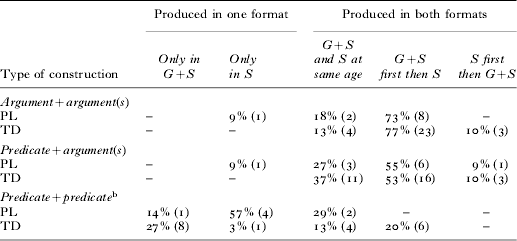
notes:a G + S=gesture + speech; S = speech only; TD = typically developing children, PL = children with early brain injury; number of children who produced a particular construction is indicated in parentheses.
b Eleven of the typical children (37%) and four of the children with PL (36%) never produced the predicate + predicate construction in either gesture + speech or speech-only.
We found that only one of the eleven children with PL (9%) and none of the TD children produced the construction in speech-only and not in gesture + speech. Among the children who produced the construction in both formats, some produced them in the same observation session (2 children with PL, and 4 TD children); these children neither support nor fail to support our hypothesis as we do not have any evidence as to which modality the child used first. Of the children who produced the argument + argument construction in both formats but in different observation sessions, significantly more produced the construction in gesture + speech first than in speech-only in both children with PL, eight vs. none (χ2(1) = 12·57, p < 0·001, R = 55·86), and TD children, twenty-three vs. three (χ2(1) = 27·15, p < ·001, R = 29·57). Thus, children with PL and TD children – as a group and individually – produced the argument + argument construction in gesture–speech combinations before expressing it entirely in speech. The one PL child who violated the predicted path (she produced the construction in speech-only but not in gesture + speech) had a large left hemisphere lesion.
Predicate + argument constructions
Turning next to the predicate + argument construction, we found that five of the eleven children with PL produced the construction at age 1;6, and all but one of these children expressed it in gesture + speech. By 1;10, eight of the children with PL produced predicate + argument constructions in gesture + speech, compared to five who expressed it in speech-only; the numbers of predicate + argument constructions they produced in gesture + speech and in speech-only during this time did not reliably differ (Mgesture + speech = 3·55 [SD = 5·80] vs. Mspeech only = 6·27 [SD = 12·94], F(1, 10) = 1·30, p = ·28).
TD children showed a similar pattern: at age 1;2, nine TD children produced predicate + argument constructions, and almost all (8 out of 9) produced it in gesture + speech. By 1;6, fifteen TD children produced the predicate + argument construction in gesture + speech, compared to seven in speech-only (χ2(1) = 4·59, p = ·03, R = 3·29). At 1;6, TD children also produced significantly more instances of this construction in gesture + speech than in speech-only (Mgesture + speech = 3·83 [SD = 4·37] vs. Mspeech = 1·67 [SD = 3·79], F(1, 29) = 4·86, p = ·04, pη2 = ·14). Thus, children with PL and TD children show the same pattern of producing predicate + argument contructions earlier in gesture + speech than in speech, although this pattern was stronger in the TD group.
Here again children with PL began producing predicate + argument combinations in gesture + speech several months later than TD children (MPL = 21·60 [SD = 3·97] vs. MTD = 18·0 [SD = 3·15] months, F(1, 38) = 8·58, p = ·006, pη2 = ·18). This delay in gesture–speech combinations was also accompanied by a comparable delay in the onset of these constructions in speech (MPL = 23·46 [SD = 3·70] vs. MTD = 20·67 [SD = 3·98] months, F(1, 39) = 4·10, p = ·05, pη2 = ·10). Children with PL produced predicate + argument constructions frequently in speech at age 2;2, and produced significantly more instances of the construction in speech-only than in gesture + speech (Mspeech = 52·09 [SD = 66·17] vs. Mgesture + speech = 4·82 [SD = 5·21], F(1,10) = 6·51, p = ·03, pη2 = ·39) at this time. In contrast, TD children produced predicate + argument constructions frequently in speech at 1;10, four months earlier than children with PL, and already, at 1;10, produced significantly more instances of the construction in speech-only than in gesture + speech (Mspeech = 38·57 [SD = 67·65] vs. Mgesture + speech = 6·63 [SD = 6·20], F(1, 29) = 7·09, p = ·01, pη2 = ·20).
The predicate + argument construction appeared in gesture + speech before speech not only for the two groups as a whole, but also for individual children within each group. As shown in Table 5, only one of the eleven children with PL (9%) and none of the TD children produced the predicate + argument construction in speech-only and not in gesture + speech. Among the children who produced the predicate + argument construction in gesture + speech and speech-only but at different observation sessions, significantly more produced the construction first in a gesture–speech combination than first in speech-only among children with PL, six vs. one (χ2(1) = 5·24, p = ·02, R = 12·0) and TD children, sixteen vs. three (χ2(1) = 13·02, p < ·001, R = 10·29).
Thus, children with PL and TD children, as a group and individually, produced the predicate + argument construction in gesture–speech combinations before expressing it entirely in speech. The majority of the predicate + argument constructions children produced in gesture–speech combinations contained the predicate conveyed through speech and the argument expressed in gesture (e.g. eat + point at cookie), for both children with PL (79%) and TD children (58%). The two children in the PL group who violated the predicted path (producing the construction first in speech or only in speech) had large lesions, one to the left and the other to the right hemisphere, and one of these two children was the same child who violated the predicted path for the argument + argument construction.
Predicate + predicate constructions
Unlike the other two constructions, the development of predicate + predicate constructions was different in PL and TD children. None of the children with PL produced the predicate + predicate construction at age 1;6, one produced it at 1;10, and two at 2;2. It was not until 2;6 that the majority of the children with PL began producing predicate + predicate constructions, at which point they expressed most of them entirely in speech; at 2;6, six children expressed the construction in speech-only, compared to one who expressed it in gesture + speech (χ2(1) = 5·24, p = ·02, R = 12). During this session, children with PL also produced significantly more instances of the predicate + predicate construction in speech-only than in gesture + speech (Mspeech = 1·45 [SD = 1·75] vs. Mgesture + peech = 0·09 [SD = 0·30], F(1, 10) = 7·71, p = ·02, pη2 = ·44).
In contrast to the children with PL, TD children produced the predicate + predicate construction first in gesture–speech combinations. At age 1;6 only three TD children produced the predicate + predicate construction, all using gesture + speech combinations. At 1;10, eight TD children produced predicate + predicate combinations in gesture + speech, compared to only two in speech-only (χ2(1) = 4·32, p = ·04, R = 5·09); during this time they also produced significantly more instances of this construction in gesture–speech combinations than in speech-only (Mgesture + speech = 0·43 [SD = 0·86] vs. Mspeech = 0·07 [SD = 0·25], F(1, 29) = 5·58, p = ·03, pη2 = ·16). By 2;2, TD children produced about the same number of predicate + predicate constructions in speech-only and in gesture–speech combinations (N = 7, Mspeech = 1·30 [SD = 2·07] vs. N = 9, Mgesture + speech = 1·86 [SD = 4·50], respectively; F(1, 29) = 0·46, p = ·50). On average, TD children also produced the predicate + predicate construction in speech-only reliably earlier than children with PL (MPL = 28·67 [SD = 2·06] vs. MTD = 25·27 [SD = 1·62] months, F(1, 15) = 14·11, p = ·002, pη2 = ·49).
These divergent developmental patterns not only characterized the PL and TD groups as a whole, but also individual children within each group (Table 5). The majority of the children with PL who produced the predicate + predicate construction produced it in speech-only and never in gesture + speech (4 out of 7, 57%); all four of these children had large left hemisphere lesions, and one of them was the same child who violated the predicted path for the earlier two constructions. The remaining three children (one produced the predicate + predicate construction only in gesture + speech and the other two produced it in gesture + speech and in speech in the same session) had small lesions either to the left (N = 2) or to the right hemisphere (N = 1). In contrast, only one of the TD children who produced the predicate + predicate construction in speech-only had not also produced it in gesture + speech (1 out of 30, 3%). None of the children with PL produced the predicate + predicate construction in both modalities and in different sessions, but six TD children did. Of these six TD children, all six produced the construction first in gesture + speech, six vs. none (χ2(1) = 6·67, p = ·001, R = 16·18). Thus, TD children overwhelmingly conveyed predicate + predicate constructions initially in gesture + speech rather than speech-only, whereas children with PL did not.
We next asked why children with PL were less likely than TD children to produce predicate + predicate constructions in gesture + speech. We do this by examining the types of gestures children in the two groups produce and whether the nature of their predicate + predicate constructions differ. We also ask whether the violation of the predicted path from gesture–speech combinations to speech-only expressions has any bearing on the production of predicate + predicate constructions in speech.
To examine these questions, we first looked at the types of gestures children produced with and without speech, and found differences as well as similarities between the two groups. Table 6 shows children's overall production of deictic gestures conveying arguments, and conventional and iconic gestures conveying predicates. Children in both groups produced many deictic gestures and at roughly comparable rates across sessions (MPL = 60·41 [SD = 34·42] vs. MTD = 73·47 [SD = 35·80], F(1, 39) = 1·09, p = ·30). In contrast, although conventional and iconic gestures constituted a small fraction of the gestures produced by children in both groups, children with PL produced fewer conventional and iconic gestures conveying predicates than TD children. This difference was significant for children with large lesions (MPL-large = 4·25 [SD = 2·57] vs. MTD = 12·20 [SD = 8·35], F(1, 34) = 5·23, p = ·03, pη2 = ·13), but not for children with small lesions (MPL-small = 5·8 [SD = 4·17] vs. MTD = 12·20 [SD = 8·35], F(1, 33) = 2·77, p = ·11).
Types of gestures produced by children with early brain injury and typically developing childrena

notes: a SD = standard deviation, Children with PL = children with early unilateral brain injury, TD children = typically developing children. Each child – either with PL or TD – was observed for approximately 90 minutes at each observation session
The difference between TD children and children with PL was even more pronounced for the diversity of predicate meanings that the children conveyed in their early conventional and iconic gestures. Children in both groups initially relied on a limited set of conventional gestures to convey actions: (1) extending an open palm toward a desired object to convey ‘give’; (2) curling fingers of an extended palm inward to convey ‘come’; (3) raising both arms above the head to convey ‘pick-up’; and (4) flipping both hands in the air to convey ‘all gone’. Across sessions, children with PL only used the first two of these conventional gestures in their predicate + predicate constructions, either combining a ‘give’ gesture with a verb (e.g. All done + ‘give’) or a ‘come’ gesture with a verb (I got to get her + ‘come’; 12 instances [SD = 2·21]). TD children, on the other hand, used all four conventional gestures along with spoken verbs to create their early predicate + predicate constructions (70 instances [SD = 4·92]). In addition to conventional gestures, TD children also produced spontaneous iconic gestures that mapped onto a range of predicate meanings (e.g. moving the hand forcefully forward to convey ‘throw’, moving cupped hands slowly upward to convey ‘climb’), beginning at age 2;2. In contrast, children with PL continued to rely on the same two conventional gestures (‘give’, ‘come’) to convey predicate meanings through 2;6. The only exception was a single instance of a predicate + predicate construction containing an iconic gesture (I got to do it daddy + ‘wind-up’ gesture conveying the act of winding up a mechanical toy), produced by a child with PL at 2;6. Thus, children with PL were not only limited in the number of predicate-conveying gestures they produced, but they also conveyed a narrower range of predicate meanings in the action gestures that they did produce. This restricted range had a clear impact on the types of predicate + predicate combinations the children with PL could produce in gesture + speech.
Next we asked whether the lack of predicate + predicate constructions in gesture + speech combinations was also evident in the production of predicate + predicate constructions produced entirely in speech for children with PL, and found that it was. Children with PL produced substantially fewer predicate + predicate constructions in speech at age 2;6 than TD children at 2;2 (PL: 16 instances [SD = 1·75] vs. TD: 39 instances [SD = 2·05]). But, more to the point, children with PL relied on a more limited set of syntactic frames to convey predicate + predicate combinations in speech than TD children. TD children used seven different syntactic frames in their predicate + predicate speech combinations: (1) verb1 + conjunction + verb2 construction (e.g. Put it back and hide in there); (2) let me + verb2 construction (e.g. Let me see the toys); (3) want/make/need/help someone to + verb2 construction (e.g. I want my baby to cry mom); (4) see/look + verb2 construction (e.g. Look at the baby jumping); (5) think/know/wish + verb2 construction (e.g. I think this does a ride in the tractor); (6) say/tell/ask + verb2 construction (e.g. Tell me how do this mom); and (7) a few other embedded multi-predicate constructions that did not fit into any of the above categories (e.g. He opened the door for me to come in). In contrast, the children with PL used only the first four of these sentence frames (verb1 + conjunction + verb2, let me + verb2, want/make/need/help someone to + verb2, and see/look + verb2), never using the other three during our observation sessions. Thus the conservatism evident in the predicate + predicate constructions children with PL produced in gesture + speech was mirrored in their limited range of predicate + predicate constructions in speech as well.
DISCUSSION
Children with PL displayed many similarities with TD children in their use of gesture: both groups steadily increased their production of gestures over time; both groups used gesture to convey information not found in the accompanying speech, that is, supplementary gesture–speech combinations; both groups used their supplementary combinations to convey particular sentence meanings before conveying the same meanings entirely in speech. In fact, children with small lesions used gesture at the same rate as TD children, suggesting striking plasticity for the process of language acquisition in the face of early unilateral brain lesions.
Previous research with typically developing children has shown that gesture offers insight into children's earliest abilities in sentence construction (Goldin-Meadow & Butcher, Reference Goldin-Meadow, Butcher and Kita2003; Iverson & Goldin-Meadow, Reference Iverson and Goldin-Meadow2005: Özçalışkan & Goldin-Meadow, Reference Özçalışkan and Goldin-Meadow2005a). In this article, we explored whether gesture plays a similar role in children with early unilateral brain injuries. We focused on three types of linguistic constructions: multiple arguments (e.g. mommy + point gesture at cup), single predicates with at least one argument (e.g. baby + ‘eat’ gesture), and multiple predicates with or without arguments (e.g. Me try it + ‘give’ gesture). We found that children with PL produced argument + argument and predicate + argument constructions in gesture + speech several months before they produced these constructions entirely in speech, as did TD children. However, compared to TD children, children with PL were delayed in their production of each of the constructions in both gesture + speech and in speech alone, suggesting a more extended timeline for the achievement of these language milestones. These findings hint at a distinctive role for gesture in young language learners taking their first steps into sentence production. At a point when children are unable to communicate semantically complex information using words alone, gesture offers an additional tool. And children – both PL and TD – use this tool to extend their repertoire to include argument + argument and predicate + argument constructions. Producing these constructions across gesture and speech might then pave the way for the constructions to appear entirely within speech.
In addition to these similarities between children with PL and TD children, we also found differences between the two groups. Unlike TD children who conveyed predicate + predicate combinations in gesture + speech several months prior to producing the combination entirely in speech, the children with PL did not. Their first production of predicate + predicate combinations in speech alone came several months after TD children first began to produce the construction entirely in speech. But the interesting difference between the two groups was that (unlike the TD children) the children with PL did not produce the predicate + predicate construction in gesture + speech before producing it entirely in speech. Moreover, the predicate + predicate constructions that the PL children produced in gesture + speech were far less diverse than the comparable constructions produced by TD children. The delay in the onset of predicate + predicate constructions in gesture + speech in children with PL, along with the restricted range of predicate + predicate relations they expressed, raises several possibilities. First, not producing a particular construction in gesture + speech might have an impact on the production of the same sentence type entirely in speech. Second, the delay in producing predicate + predicate construction in gesture + speech as well as in speech alone may reflect an underlying conceptual problem that affects the production of complex sentence structures. We explore each of these possibilities in turn.
Why do children take their first step into sentence production by making use of gesture? One possibility is that conveying information in the manual modality is easier than conveying the same information in the spoken modality, either because the child has not yet mastered the complex articulation mechanisms necessary to produce a string of spoken words, or because gestures are easier to remember than words. We know from earlier work that gesture provides children with a particularly accessible tool to refer to objects and to communicate about actions or attributes related to objects (e.g. Bates et al., Reference Bates, Benigni, Bretherton, Camanioni and Volterra1979) and, not surprisingly, children use gesture in word-like ways several months before they use sounds for the same functions (e.g. Acredolo & Goodwyn, Reference Acredolo and Goodwyn1989; Iverson & Goldin-Meadow, Reference Iverson and Goldin-Meadow2005). Gesture also may place fewer demands on the child's working memory than words. Unlike words, the form of a pointing gesture does not vary as a function of its referent, making both its production and its recall relatively easy. Similarly, the form of an iconic gesture can be created on the spot with whatever knowledge the child might have about an object or an action – it does not have to be recalled from a store of lexical items. Thus, at the early stages of language learning, gesture offers children a relatively non-demanding vehicle for expressing an idea.
Moreover, producing gesture along with talk may increase a child's cognitive resources. Speakers, both children and adults, when asked to remember a list of unrelated items while explaining their solutions to a math problem, remember more of those items if they gesture during their explanations than if they do not gesture (Goldin-Meadow, Nusbaum, Kelly & Wagner, Reference Goldin-Meadow, Nusbaum, Kelly and Wagner2001). Gesture might be serving the same function in language use by easing the process of speech production, namely by providing speakers – including young speakers at the early stages of language learning – with extra cognitive resources that could enable them to produce more complex constructions that they would otherwise be unable to produce.
Our finding that gesture + speech combinations predict the child's first foray into sentence production raises the possibility that these combinations may also be instrumental in bringing about developmental change. There is, in fact, a growing body of work suggesting that sensorimotor experience is an important ingredient in forming knowledge representations and that linguistic meaning is grounded in bodily action (Barsalou, Reference Barsalou1999; Glenberg & Kaschak, Reference Glenberg and Kaschak2002; Lakoff, Reference Lakoff1987). Gesture constitutes one such sensorimotor experience in the sense that it uses the body to do its representational work (Goldin-Meadow, Reference Goldin-Meadow2003; Goldin-Meadow & Beilock, Reference Goldin-Meadow and Beilock2010; McNeill, Reference McNeill1992). Speakers who activate this sensorimotor experience via gesture may represent information differently from those who do not. Our predicate + predicate findings lend weight to this possibility. Children use deictic gestures to indicate objects, people and places (e.g. point at baby, hold-up empty cup) and conventional and iconic gestures to convey actions (e.g. extending an open palm to convey ‘give’, moving fist to mouth repeatedly to convey ‘eat’). They therefore use deictic gestures to convey arguments in gesture + speech constructions and conventional and iconic gestures to convey predicates. Producing an iconic or a conventional gesture typically requires more complex motor coordination than producing a deictic gesture, which is a simple extension of the hand or index finger. In fact, some conventional and iconic gestures are typically produced with two hands (e.g. flapping both arms in air to convey ‘fly’, raising both arms above head to convey ‘pick-up’), imposing additional difficulties on a child with PL who has hemiparesis and therefore can only use one hand efficiently (the hand ipsilateral to the child's lesion). Children with PL, perhaps due to their motor deficits, were less likely than TD children to produce iconic and conventional gestures conveying predicates. The smaller number and range of iconic and conventional gestures that the children with PL produced compared to TD children may explain why they did not initially use gesture and speech together to convey multiple predicates.
We suggest that this difficulty in producing predicate–predicate combinations in gesture + speech, in turn, may have led to the particularly delayed onset of multi-predicate constructions in the speech of children with PL. Given that gestures are self-produced actions occurring in a linguistic context, these findings are consistent with the hypothesis that bodily activity can have an impact on cognitive processes and cognitive development. Indeed, there is evidence in older children showing that encouraging children to gesture during a lesson on mathematical equivalence problems facilitates their learning the task, compared to children told not to gesture (Broaders, Cook, Mitchell & Goldin-Meadow, Reference Broaders, Cook, Mitchell and Goldin-Meadow2007; Cook, Mitchell & Goldin-Meadow, Reference Cook, Mitchell and Goldin-Meadow2008; Goldin-Meadow, Cook & Mitchell, Reference Goldin-Meadow, Cook and Mitchell2009). Children who have difficulty producing certain kinds of gestures because of hand–motor problems associated with early brain injury may be slower at learning certain tasks simply because they do not have full use of their hands. Thus, the difficulty that children with PL had in producing predicate-conveying gestures may have led to the small number (and late onset) of predicate + predicate constructions the children produced in gesture + speech. This, in turn, may have contributed to the small number, late onset, and restricted range of predicate + predicate constructions they produced in speech.
Alternatively, it is possible that the child's difficulty conceptualizing predicate–predicate meanings limits the production of these meanings both in gesture + speech and speech alone. Existing work on children with specific language impairment (SLI) suggests that children with SLI do relatively well with nouns and noun morphology, but have difficulties with verbs, verb morphology and verb complementation (e.g. Bedore & Leonard, Reference Bedore and Leonard1998; Hadley, Reference Hadley1998; Leonard, Reference Leonard1989; Rice, Reference Rice, Watkins and Rice1994). Similar difficulties with verb morphology and complex syntax have been reported for children with large left hemisphere injuries, particularly to the temporal areas (Bates et al., Reference Bates, Reilly, Wulfeck, Druonkers, Opie, Fenson, Kriz, Jeffries, Miller and Herbst2001; Stiles et al., Reference Stiles, Reilly, Paul and Moses2005). Compared to nouns, verbs present a bigger challenge to young children simply because they convey relational meanings, which are more difficult to learn (Gentner, Reference Gentner and Kuczaj1982; Gleitman, Cassidy, Nappa, Papafragou & Trueswell, Reference Gleitman, Cassidy, Nappa, Papafragou and Trueswell2005). We know from previous work that TD children typically produce their first nouns before producing their first verbs, and nouns predominate over verbs in early production and comprehension of English (Gentner, Reference Gentner and Kuczaj1982; Huttenlocher & Smiley, Reference Huttenlocher and Smiley1987; Nelson, Reference Nelson1973). As a result, verbs, particularly verb + verb constructions, might present a challenge for children with PL. We also know from previous work with children with PL that deficits in language abilities tend to arise when tasks become more difficult (Feldman, Reference Feldman2005; Levine, Kraus, Alexander, Suriyakham & Huttenlocher, Reference Levine, Kraus, Alexander, Suriyakham and Huttenlocher2005; MacWhinney, Feldman, Sacco & Valdes-Perez, Reference MacWhinney, Feldman, Sacco and Valdes-Perez2000; Stiles et al., Reference Stiles, Reilly, Paul and Moses2005; Weckerly, Wulfeck & Reilly, Reference Weckerly, Wulfeck and Reilly2004), and the predicate + predicate combination is a difficult construction for young children.
But why do some children – even if only a few – not follow the predicted path and produce a sentence construction only in speech or first in speech? We found that a small number of TD children did not produce the argument + argument (N = 3), predicate + argument (N = 3) and predicate + predicate (N = 1) constructions first in gesture + speech. One likely explanation for this violation is that the lengthy interval between observation sessions (four months) caused us to miss the onset of these constructions in gesture + speech. In fact, all of the TD children who violated the predicted path were already conveying argument + argument and predicate + argument constructions in speech in either their first or second observation session.
We found that a small number of children with PL also did not produce the argument + argument (N = 1), predicate + argument (N = 2) and predicate + predicate (N = 4) constructions first in gesture + speech. Of these children, all had large lesions, all but one had left hemisphere lesions, and all but one produced each construction relatively late, namely at age 2;6. Interestingly, the one child who had a large lesion in the right hemisphere produced the predicate + argument construction in speech early, at the first observation session (age 1;6), thus raising the possibility that we might have missed the onset of this construction in gesture + speech, as our observations of this child started at 1;6. It will be important in future work to observe a larger sample of children with left and right hemisphere lesions that vary in extent in order to determine whether large left hemisphere lesions, in particular, are associated with a disruption of the pattern we have identified here – gesture + speech combinations preceding speech alone combinations – in constructions that do and do not involve predicates conveyed in gesture.
In our data, lesion size was related not only to the onset of different sentence constructions, but also to overall rates of speech and gesture production. Children with large lesions produced lower rates of speech and gesture than children with small lesions; this difference was particularly pronounced for gestures. One likely explanation for the significant difference between the groups in gesture production could be the higher degree of hemiparesis associated with larger lesions (Levine et al., Reference Levine, Huttenlocher, Banich and Duda1987) and the effect that this motor impairment might have on the production of gestures. Children with large lesions also differed reliably from TD children in their production of speech and gesture, whereas children with small lesions were comparable to TD children in their use of both speech and gesture.
These findings present an interesting contrast to the findings on other language-impaired populations. For example, children with Down syndrome have been found to produce gestures at higher rates than language-matched TD children (Caselli, Vicari, Longobardi, Lami, Pizzoli & Stella, Reference Caselli, Vicari, Longobardi, Lami, Pizzoli and Stella1998; Franco & Wishart, Reference Franco and Wishart1995), a pattern that also has been reported in children with expressive language delays (Thal & Tobias, Reference Thal and Tobias1992). In a related vein, children with SLI express more information uniquely in gesture than mental age matched TD children (Evans, Alibali & McNeil, Reference Evans, Alibali and McNeil2001). Children with PL differ from these other groups in at least one important way – they have motor impairments associated with the use of the contralesional hand. Previous work on adults with brain injury shows left hemisphere dominance for motor learning and motor movements (Kimura & Archibald, Reference Kimura and Archibald1974; Geshwind, Reference Geshwind1975), with the left hemisphere constituting the “major repository” for learned motor behaviors (Geshwind, Reference Geshwind1975: 191). For example, left hemisphere lesions in adults result not only in motor impairments in the use of the right hand that is contraletaral to lesion, but also in increased motor difficulties in the use of the left hand to relearn a complex motor skill that was previously carried out by the right hand (e.g. learning to write with the left hand) – a pattern that is not observed as strongly if it is the right hemisphere that is affected by an injury. These findings thus raise the possibility that children with left hemisphere lesions (the majority of the PL children in our study) might have particular difficulty producing gestures that are motorically demanding.
Our findings also have several important clinical implications. Our study shows that gesture is an integral part of the language learning process in children with PL as well as TD children, signaling oncoming changes in their spoken language abilities in sentence construction. These early gesture + speech combinations may reflect the child's readiness to produce a particular sentence type. The combinations might also alert listeners to the fact that the child is ready to learn a particular construction; listeners might then alter their talk to the child, providing just the right input to help the child learn the construction. We know from previous work that mothers often translate their children's gestures into words (Golinkoff, Reference Golinkoff1986) and gesture + speech combinations into sentences (Goldin-Meadow, Goodrich, Sauer & Iverson, Reference Goldin-Meadow, Goodrich, Sauer and Iverson2007). Like parents, teachers also glean information from the gestures their students produce and, in turn, target their teaching strategy to the child's knowledge state (Goldin-Meadow, Kim & Singer, Reference Goldin-Meadow, Kim and Singer1999; Goldin-Meadow & Singer, Reference Goldin-Meadow, Butcher and Kita2003). Not surprisingly, children benefit from this targeted instruction, showing earlier mastery of the linguistic and/or cognitive skills than if not given the targeted instruction (Goldin-Meadow et al., Reference Goldin-Meadow, Goodrich, Sauer and Iverson2007). We suggest that it may be beneficial for parents, teachers and clinicians to pay attention to the gesture + speech combinations that children with PL produce, and use those combinations as a basis for the linguistic input that they offer to the children.
Our findings also highlight linguistic domains where children with PL show particular difficulties, namely the production of complex sentences that involve relations between actions. Our analysis of predicate–predicate constructions indicates that the development of more complex language abilities may be disrupted by motor difficulties. The motor difficulties prevent the child from producing iconic and conventional gestures, which, in turn, can lead to prolonged language delays. Thus, gesture may not only predict the child's first expressive foray into different sentence types, but may even play an instrumental role in bringing about linguistic change. Our findings raise the possibility that teaching children with PL gestures that are less motorically demanding (e.g. producing the gesture for ‘fly’ with one hand) could promote the development of complex sentence production, first, in gesture + speech and, later, in speech-only. In this study, our focus was on sentence production, not comprehension; and it is yet unknown whether gesture's facilitative role is restricted to expressive language, or operates more broadly in language comprehension as well. Future work examining the role of gesture in sentence comprehension in children with PL at even younger ages will be able to tell us whether gesture provides a helping hand in children's understanding of increasingly complex sentence constructions, which may predict children's later language and literacy skills (Huttenlocher, Vasilyeva, Cymerman & Levine, Reference Huttenlocher, Vasilyeva, Cymerman and Levine2002).
Previous work has shown strong evidence of plasticity in the language system following early brain injury. In addition to supporting this earlier work, our findings, particularly for argument + argument and predicate + argument sentence constructions, suggest that the gesture–speech system constitutes a robust feature of early language learning and serves as a harbinger of change in the developing language system in children with early unilateral brain injuries, as well as in typically developing children. Our findings also show that the role of gesture is disrupted for predicate + predicate constructions, perhaps due to the motoric demands of producing conventional and iconic gestures, with concomitant delays in producing these constructions in speech. Our findings thus lend support to the hypothesis that producing particular gesture–speech combinations may not only predict the emergence of parallel constructions in speech, but may also help children take their first steps into these constructions.



