


Introduction
Plant available phosphorus (P) typically is deficient on organic farms across Canada (Knight et al., Reference Knight, Buhler, Leeson and Shirtliffe2010). Managing P in organic production is challenging because of the limited selection of organically certified soil amendments that supply plant-available forms of P (CGSB 2006a, 2006b). Instead, nutrient management is accomplished through crop selection and rotation sequences, crop residue and animal waste management. While animal manures are rich sources of nutrients, North American farmers typically specialize in either grain or livestock production (Russelle et al., Reference Russelle, Entz and Franzluebbers2007) resulting in a disconnection between where nutrients are produced and where they are most needed. The problem is exacerbated in the Canadian prairie provinces where the large size of grain farms places a strong demand for manures (Knight et al., Reference Knight, Buhler, Leeson and Shirtliffe2010). In a survey of 60 organically managed producer fields in Saskatchewan, Canada, only six had received a manure application once during the 6 years of the survey (Knight et al., Reference Knight, Buhler, Leeson and Shirtliffe2010).
Two fungal inoculants are commercially available in Canada for enhancing P uptake by plants. The inoculant organisms, arbuscular mycorrhizal fungi (AMF) and Penicillium bilaiae, affect plant P uptake through different mechanisms. Arbuscular mycorrhizal fungi colonize the roots of host plants utilizing host-supplied carbon and energy to grow and complete their life cycle and in return facilitate access to soil mineral nutrients and water through the extensive extraradical hyphal network that develops (Smith and Read, Reference Smith and Read2008). While access to a range of mineral nutrients has been documented for AMF, enhanced P uptake is frequently the major response (Harley and Smith, Reference Harley and Smith1983). In contrast, P. bilaiae solubilizes inorganic forms of P in the soil by excreting acids from the mycelia (Asea et al., Reference Asea, Kucey and Stewart1988). Hydrogen ions serve to solubilize P, and citric and oxalic acids chelate with cations bound to insoluble P forms in the soil, releasing phosphates into solution (Jones, Reference Jones1998). While there is evidence that P. bilaiae can promote plant growth under different soil conditions (Harvey et al., Reference Harvey, Warren and Wakelin2009), it is not clear if the growth promotion is a direct result of enhanced P solubilization and hence P uptake or from other mechanisms. Considerable research has focused on the effectiveness of the two groups of fungi in isolation but little work has been done investigating the interaction of the two fungi. A 30-year-old study suggests that in sterilized soil, the introduction of both P. bilaiae and AMF are necessary to maximize P uptake (Kucey, Reference Kucey1987). Comparable experiments were not performed in non-sterile soils.
A common question from producers is whether the biological inoculants have to be re-applied every year. Certainly, with Rhizobium inoculants for legumes, there are reports of no yield response to inoculant applications (e.g. Thilakarathna and Raizada, Reference Thilakarathna and Raizada2017). Whether this is due to a carryover of the introduced organism into subsequent years, indigenous rhizobia outcompeting and negating the effect of the introduced organism, site-specific environmental factors impacting survival and/or effectiveness of the introduced organism or other factors or combinations of factors is not clear. Considering the ubiquitous nature of AMF and P. bilaiae in western Canadian soils (Kucey, Reference Kucey1983), survival and carryover of introduced organisms from the application year to the next crop in the rotation is a possibility.
Given the typically low P fertility status on organic farms in Canada, it was hypothesized that AMF and P. bilaiae inoculants will be more effective in enhancing P uptake and increasing yield in crops grown in organically managed soils than in crops grown in conventionally managed soils. The objectives of this study were to evaluate: (1) the effectiveness of introduced AMF and P. bilaiae inoculants, alone and in combination, on productivity and P uptake in wheat, lentil and flax grown in soils that had been under organic or conventional management and; (2) if the effects of the inoculants carry over to a succeeding crop after a period of soil freezing.
Materials and methods
Soil characterization
Soils were collected from two fields with different management backgrounds; one field had been organically managed for 20 years; another field had been managed using conventional methods, including fertilizer and herbicide applications. The organically managed field was tilled in the spring and fall of each year. Additional weed control was accomplished as needed, using a tine harrow. The conventionally managed field was converted to reduced-tillage management in 1999, with crops direct-seeded into standing stubble and annual chemical weed control applied. Both soils were Chernozemic soils with a loam texture, located in the Dark Brown soil zone in Saskatchewan, Canada. Topsoil to a depth of 15 cm was excavated from each field and the individual soils homogenized in a small cement mixer for use in controlled environment studies. A subsample of each soil was sieved (2 mm sieve) and the field moist soil was used to analyse the initial soil characteristics. The analyses for this initial characterization were not replicated with the exception of the bioassay for enumerating initial AMF propogules and most-probable number protocol for enumerating P-solubilizing microorganisms (details below). Soils were characterized (Table 1) initially for pH and EC (1:2 soil:water extract), levels of plant-available K and P (modified Kelowna extraction, Qian et al., Reference Qian, Schoenau and Karamanos1994), S (0.01 M CaCl2 extraction, Tabatabai, Reference Tabatabai, Page, Miller and Keeney1982), N (2 M KCl extraction, Maynard et al., Reference Maynard, Kalra, Crumbaugh, Carter and Gregorich2008) and organic matter (OM) (Skjemstad and Baldock, Reference Skjemstad, Baldock, Carter and Gregorich2008). Potassium and S were quantified by atomic adsorption spectroscopy and P and N quantified colorimetrically on a SmartChem® 170 Discrete Analyzer (Unity Scientific, Milford, MA, USA).
Initial characteristics of the soils with different management histories used in growth chamber experiments

a 1:2 soil:water extract.
b Bioassay conducted using spring wheat.
c From most probable number assay (Kucey, Reference Kucey1983).
Soils were evaluated for initial AMF propagules by growing spring wheat (Triticum aestivum L. cv. AAC Brandon) in the soils and examining the degree of root colonization by AMF (Table 1). Wheat provided a common crop for evaluating viable, infective AMF propogules in the soils prior to the application of any treatment. A subsample of each of the soils was air-dried, sieved through a 4-mm mesh and packed into five replicate 15-cm diameter pots per soil. The pots were watered to field capacity and equilibrated at room temperature for 7 d. Four wheat seeds were sown per pot. The wheat was grown for 40 d in a growth chamber with a 16 h photoperiod and 22/18°C day/night temperatures. Pots were watered as needed. Plants were harvested at heading (Zadoks stage 53; Zadoks et al., Reference Zadoks, Chang and Konzak1974), roots separated from shoots and washed free of soil. A subsample of roots was stained for AMF (Vierheilig et al., Reference Vierheilig, Coughlan, Wyss and Piche1998) and colonization quantified using the line-intercept method (Giovannetti and Mosse, Reference Giovannetti and Mosse1980). Percentage of wheat roots colonized by AMF was 86% in the organically managed soil, higher than the 67% of wheat roots colonized in the conventionally managed soil (Student's t-test, P < 0.05).
A most probable number (MPN) protocol was used to quantify the numbers of P-solubilizing microorganisms in the initial soils (Table 1) (Kucey, Reference Kucey1983). The protocol is not specific to P. bilaiae but gives a general indication of the group of fungi responsible for P solubilization. Precipitated phosphate rose bengal potato dextrose yeast agar (ppRBA) was the selective medium (Kucey, Reference Kucey1983). Calcium phosphate was precipitated onto the plates immediately prior to inoculation with a soil suspension (Katznelson and Bose, Reference Katznelson and Bose1959). A serial dilution series (10−1 to 10−7) was prepared from a suspension of 1 g soil in 10 mL 0.89% (w/v) NaCl. A 100 μL aliquot of the 10−5, 10−6, 10−7 dilutions was plated in triplicate onto the ppRBA plates. Plates were scored as growth or no growth and the results were applied to MPN tables to estimate the numbers of P-solubilizing organisms in the soils. Numbers of P-solubilizing organisms in the soils were 5.36 × 10³ MPN g soil−1 in the organically managed soil and 5.40 × 10³ MPN g soil−1 in the conventionally managed soil (Student's t-test, P > 0.05).
For studies comparing organic management systems to conventional management systems, it is not possible to find soils that are identical other than the application of the management system. The goal of this study was to find soils that were similar but with different initial AMF and/or other P-solubilizing organism loads and different initial fertility levels. As such the soils used in this study were from a common soil zone, were of similar texture, pH, EC, available K and S levels and had similar population numbers of P-solubilizing microorganisms. The soils differed in initial AMF colonization potential and available P and N levels and OM content.
Experimental setup
Four cropping sequences were investigated: wheat-lentil (Lens culinaris Medikus cv. CDC maxim); lentil-wheat; flax (Linum usitatissimum L. cv. AAC Bravo)-lentil; flax-wheat. Ideally, flax should have been included as a second phase crop grown after wheat and lentil but was not because of space limitations. In phase 1, the seed was inoculated with the inoculant treatments, grown for 110 days and shoots harvested. After a period of freezing, the soil (with the root residues intact) was reseeded to a phase 2 crop. Only the phase 1 crops were inoculated to evaluate carry-over of the product to the phase 2 crop.
Phase 1
Each crop was evaluated in a separate experiment. The experimental design was a two-factor factorial with four inoculation treatments and two soil managements, arranged in a completely randomized design with five replicates. For each phase 1 crop 10 replicate 20-cm diameter pots were filled with air-dried, sieved (4 mm) soil (organically or conventionally managed) that was wetted and maintained at field capacity for 7 d prior to planting. Five of the pots were used to evaluate productivity and P uptake; the remaining five were used to evaluate AMF colonization, P solubilizing organisms and root nodulation in lentil. Inoculation treatments included: (1) uninoculated controls, (2) AMF, (3) P. bilaiae and (4) P. bilaiae + AMF. Penicillium bilaiae was applied as JumpStart wettable powder (Monsanto BioAg, Saskatoon, SK, Canada) at a rate of ca. 5 × 10⁸ colony forming units (cfu) per pot. The AMF treatment was applied as Myke Pro WP (Premier Tech Biotechnologies, Riviere-du-Loup, QC, Canada) at a rate of 100 ± 5 spores per pot. The species of AMF in Myke Pro WP is Rhizophagus irregularis. Both products were applied by excavating 2.5 cm of soil from the surface, evenly applying the inoculant and reapplying the excavated soil over top of the inoculant. Wheat and flax were seeded at a density of 20 seeds per pot, and lentil at a density of 10 seeds per pot. Lentil seed was inoculated with a Rhizobium leguminosarum inoculant (Cell-Tech®; Monsanto BioAg, Saskatoon, SK, Canada) according to the manufacturer's directions. Prior to seeding, all seed was checked for germination percentages. Germination of all crops was >95%.
Plants were grown in a growth chamber under a 16 h photoperiod and a 21/18°C diurnal cycle. Lighting was provided by T5 high output fluorescent lamps (T5/835/Ho/Alto, Philips Canada, Markham, ON, Canada). Placement of the pots was random and pots were rerandomized weekly. Pots were watered to 80% of field capacity (by weight) every 1–3 days, depending on water usage. Wheat and flax were thinned to four plants per pot on day 14. Lentil was thinned to two plants per pot on day 21. Plant emergence was recorded 11 days after planting (DAP).
All plants were harvested 110 DAP. Five of the 10 replicate pots were harvested for productivity and P uptake assessments. Shoots were cut at soil level, oven-dried (65°C) to constant weight and ground (<2 mm) for acid digestion (Thomas et al., Reference Thomas, Sheard and Moyer1967). Phosphorus and N concentrations in the digests were quantified using a SmartChem® 170 Discrete Analyzer. Soil with intact roots was sealed in a plastic bag and frozen (−20°C) for 8 wks.
The remaining five replicates were used for quantifying AMF and P-solubilizing organisms, and nodulation in lentil. Soil with the intact roots was transferred to a sealed plastic bag and stored at 4°C for a maximum of 1 week until the roots could be extracted. A subsample of moist, root-free bulk soil was retained for evaluating P-solubilizing microorganisms. Roots were wrapped in 2-mm nylon mesh and washed free of soil under running tap water. For the lentil roots, nodules were excised from roots and combined with any dislodged nodules caught in the mesh. Nodules were counted and oven-dried (65°C) to constant weight. Roots from all crops were cleared, stained and examined for AMF colonization as described above. Soils were assayed for P-solubilizing microorganisms as described above.
Phase 2
After 8 weeks at −20°C, frozen soils with intact roots were thawed at room temperature for 24 h, watered to field capacity and equilibrated for 7 d before seeding the phase 2 crop. Treatments were: wheat followed by lentil; lentil followed by wheat; flax 1followed by wheat; and flax 2 followed by lentil. Twenty wheat seeds or 10 lentil seeds were seeded per pot. Lentil seed was inoculated with a Rhizobium leguminosarum inoculant (Cell-Tech®; Monsanto BioAg, Saskatoon, SK, Canada) according to the manufacturer's directions. Pots were randomly placed in a growth chamber with a 16 h photoperiod and 25/18°C diurnal cycle. Pots were rerandomized weekly. Pots were rewatered to 80% of field capacity (by weight) as needed. Wheat was thinned to four plants per pot on day 14 and lentil was thinned to two plants per pot on day 21. Plant emergence was recorded 11 DAP.
Plants were grown 110 DAP and harvested by excising the shoots at soil level. Soil with the intact root system was stored at 4°C in a sealed plastic bag until the roots or soil could be processed for enumerating AMF colonization, P-solubilizing fungi and assessing nodulation in lentil. Shoot samples were ground, acid digested and analysed for P content. The protocols followed for all of the analyses of the phase 2 plants were the same as those for the phase 1 crops.
Statistical analyses
Data for each phase 1 crop were analysed separately as a two-factor completely randomized design with five replicates. Factors were soil management history (two levels) and inoculation treatment (four levels). Each phase 2 experiment was analysed as a two-factor completely randomized design with five replicates. Factors were soil management history (two levels) and previous inoculation treatment (four levels). Analysis of variance was conducted using R 3.2.4 (R Core Team, 2016). Means comparisons were conducted using Tukey's honest significant differences (hsd). All analyses were conducted at α = 0.05.
Variances of all data were homogeneous (Levene's test, P > 0.05) and except AMF colonization and percent emergence, residuals were normally distributed (Kolmogorov–Smirnoff test, P > 0.05). Arbuscular mycorrhizal fungi colonization and emergence data were log-transformed for statistical analysis and back-transformed for presentation.
Results
Phase 1
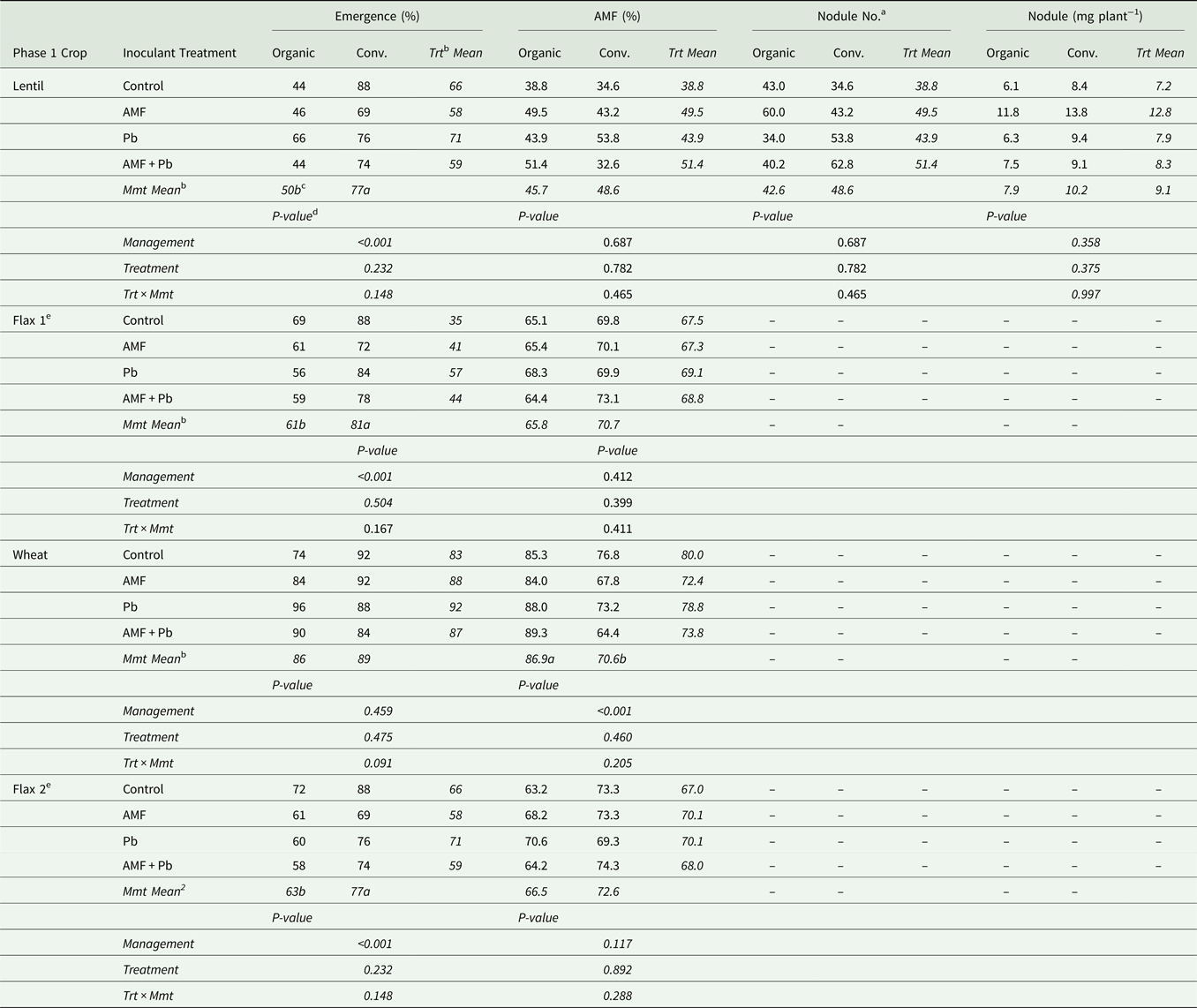
Inoculant treatment had no influence on plant emergence 11 DAP (Table 2). Lentil and flax emergence was higher in the soil with conventional management history than the soil with organic management history. There was no difference in wheat emergence between the two soils.
Emergence, arbuscular mycorrhizal fungal colonization (AMF) and nodulation (lentil only) by crops grown in soil with a history of organic management or a history of conventional (Conv.) management and inoculated with AMF and/or Penicillium bilaiae (Pb)

a Lentil was the only legume test crop, hence the only crop that forms nodules.
b Mean of main effects; Mmt, management; Trt, treatment.
c Within a phase 1 crop, inoculant treatment and management means for the measured variables followed by different italicized letters are different according to Tukey's HSD (P < 0.05). If the interaction term (Trt × Mmt) is significant, different non-italicized letters indicate that the interaction means are different according to Tukey's HSD (P < 0.05). Where values are not followed by letters, the mean values are not different.
d Probability from ANOVA for main effects (Management and Treatment) and interactions of the variable reported above.
e Flax was used as a Phase 1 crop followed by wheat (Flax 1) and followed by lentil (Flax 2) as Phase 2 crops.
Wheat was the only crop to exhibit differences in AMF colonization (Table 2). Wheat in the organically managed soil had higher colonization percentages than wheat grown in the conventionally managed soil. Colonization was comparable to the values obtained in the initial characterization of the soils (i.e., 86% initial vs 86.9% conventional soil; 67% initial vs 70.7% organic soil). Arbuscular mycorrhizal fungi colonization was not affected by inoculant treatment. Similarly, neither soil management history nor inoculant treatment affected the nodulation of lentil (Table 2) despite large differences in available N between the two soils (Table 1).
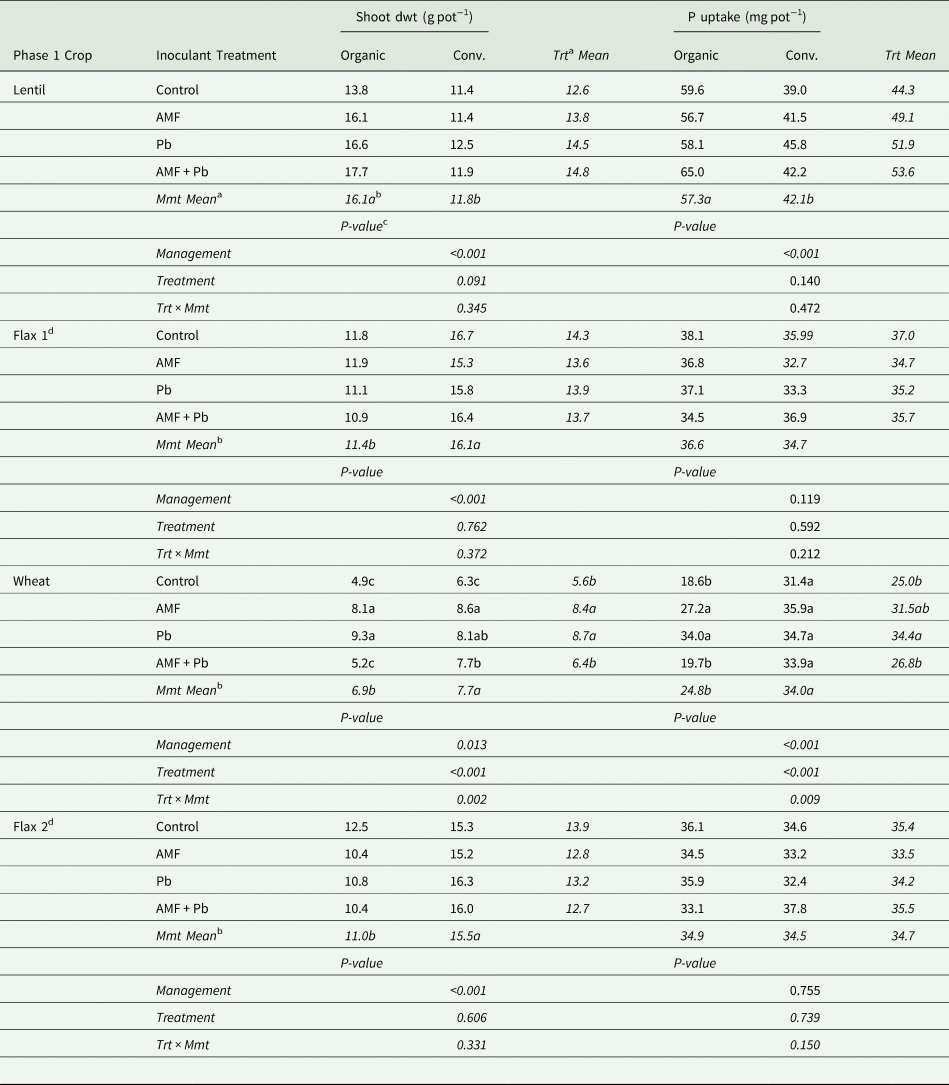
Lentil produced more biomass and took up more P when grown in the organically managed soil compared to the conventionally managed soil (Table 3). Phosphorus uptake was 36% more in lentil grown in the organically managed soil, contributing to the 36% higher shoot biomass in this soil compared to the conventionally managed soil. Flax produced 41% more biomass but P uptake was not different (Table 3).
Dry matter production and nutrient uptake by crops grown in soil with a history of organic management or a history of conventional (Conv.) management and inoculated with arbuscular mycorrhizal fungi (AMF) and/or Penicillium bilaiae (Pb).

a Mean of main effects; Mmt, management; Trt, treatment.
b Within a phase 1 crop, inoculant treatment and management means for the measured variables followed by different italicized letters are different according to Tukey's HSD (P < 0.05). If the interaction term (Trt × Mmt) is significant, different non-italicized letters indicate that the interaction means are different according to Tukey's HSD (P < 0.05). Where values are not followed by letters, the mean values are not different.
c Probability from ANOVA for main effects (Management and Treatment) and interactions of the variable reported above.
d Flax was used as a Phase 1 crop followed by wheat (Flax 1) and followed by lentil (Flax 2) as Phase 2 crops
Wheat was the only crop to exhibit differences in shoot biomass and P uptake when inoculated with the different treatments and response to inoculation treatment differed between the two soils (Table 3). Application of the single inoculants (AMF or Pb) increased shoot biomass and P uptake in wheat grown in the organically managed soil, but only increased wheat shoot biomass in the conventionally managed soil; P uptake was unaffected. Application of the inoculants together (AMF + Pb) was ineffective on shoot biomass and P uptake in wheat grown in the organically managed soil, but increased shoot biomass compared to the control in the conventionally managed soil, but not to the level of the AMF applied alone (Table 3).
Phase 2
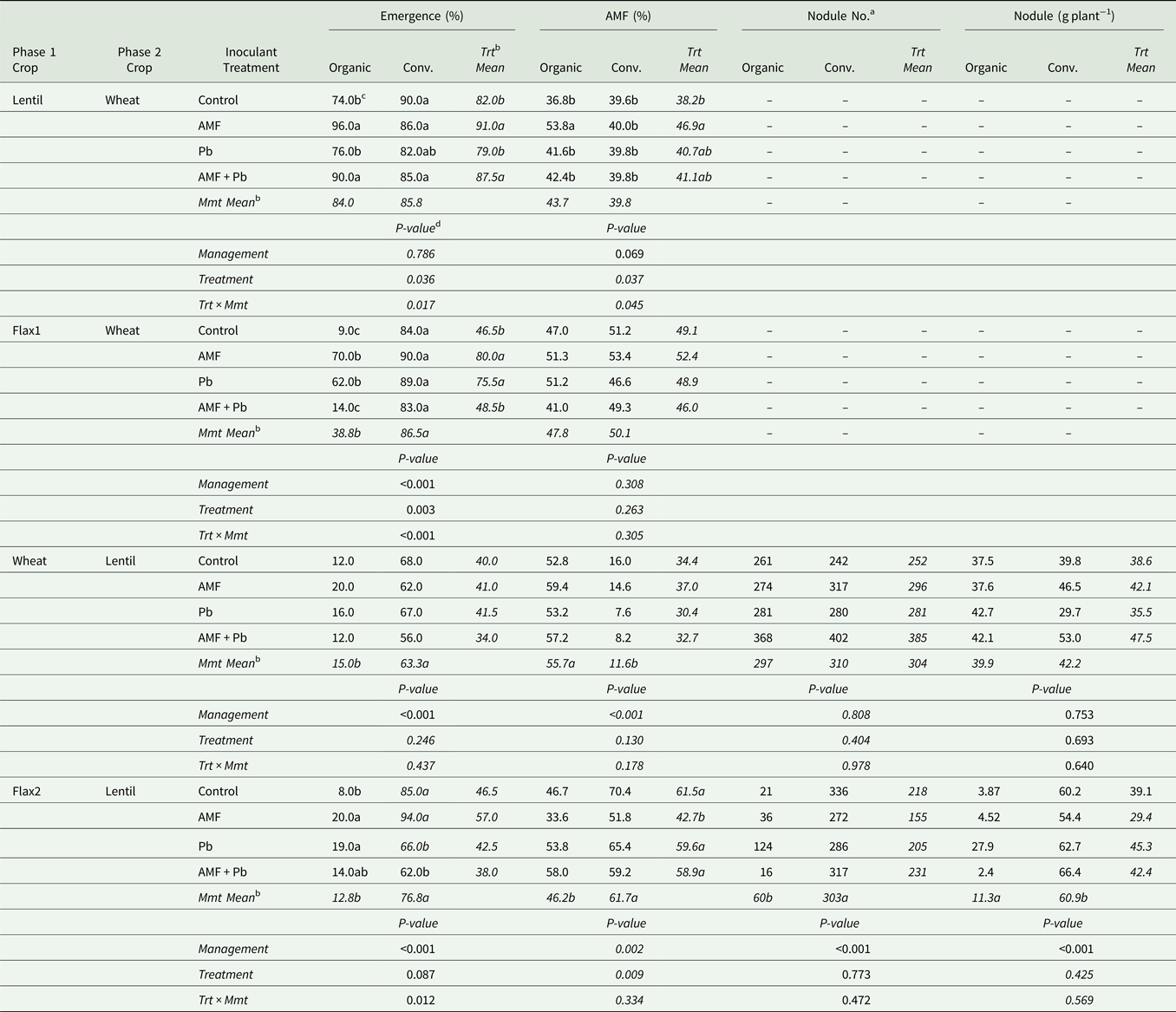
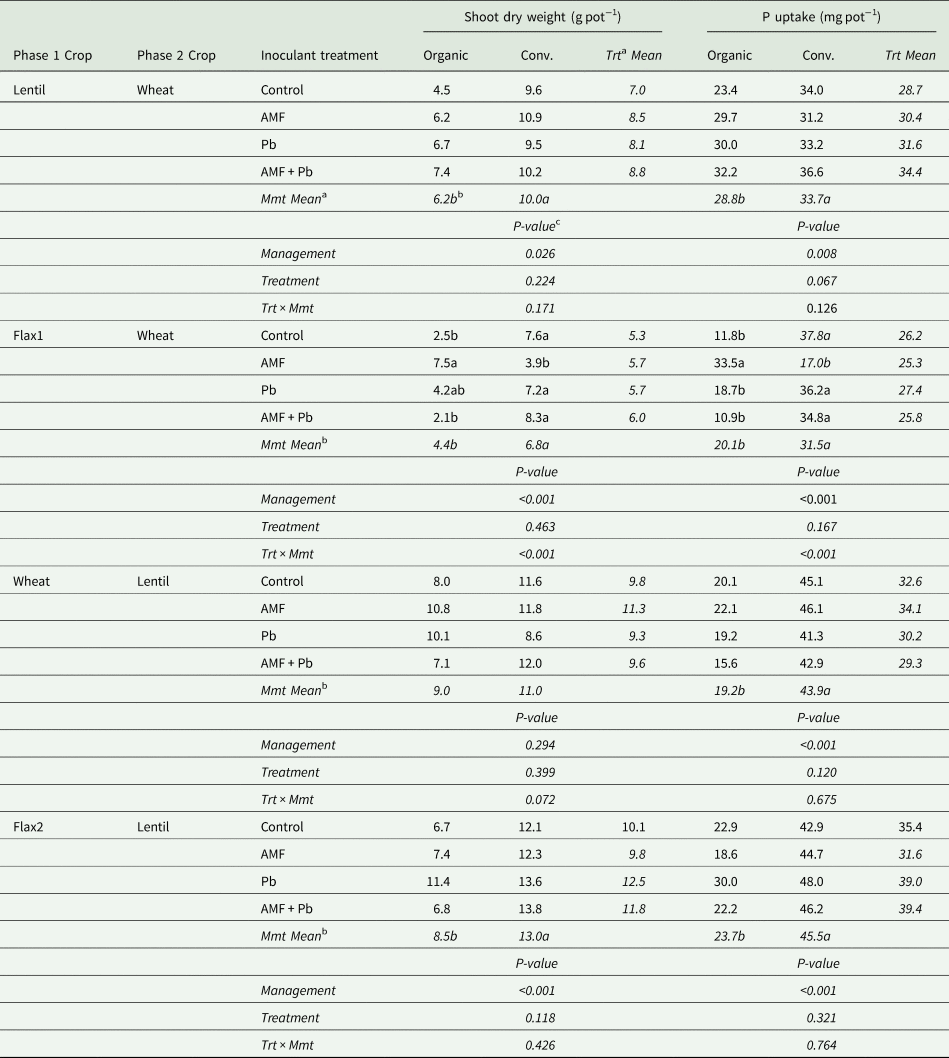
Wheat grown as a phase 2 crop performed differently when grown after lentil than when it was grown after flax (Tables 4 and 5). In the organic soil, emergence and AMF colonization of wheat grown after lentil was stimulated by the phase 1 AMF treatment (Table 4). Wheat grown in the conventionally managed soil did not show a response to phase 1 inoculation treatments (Table 4). Emergence of wheat grown after flax was stimulated, relative to the control, by the application of AMF and P. bilaiae applied as single inoculants but in contrast to wheat grown after lentil, wheat grown after flax did not have different AMF colonization associated with the different inoculant treatments (Table 4). None of the inoculant treatments affected shoot biomass production nor P uptake by wheat in the lentil-wheat sequence (Table 5), whereas growth and P uptake of wheat grown in the flax-wheat sequence responded to inoculant treatment, and responded differently depending on soil management history (Table 5). Inoculation of phase 1 flax with AMF in the organically managed soil, resulted in phase 2 wheat producing more biomass and taking up more N and P than controls the other treatments. In the conventionally managed soil the opposite was observed, phase 2 wheat following phase 1 flax that was inoculated with AMF had the lowest biomass production and N and P uptake (Table 5).
Emergence, arbuscular mycorrhizal fungi (AMF) colonization and nodulation (lentil only) by crops (phase 2) grown after crops (phase 1) that were inoculated with AMF and/or Penicillium bilaiae (Pb) and grown in soil with a history of organic management or a history of conventional management. Soils were frozen for 8 weeks after phase 1 crops were harvested and phase 2 crops sown

a Lentil is the only legume test crop, hence the only crop that forms nodules.
b Mean of main effects; Mmt, management; Trt, treatment.
c Within a crop sequence, inoculant treatment and management mean for the measured variables followed by different italicized letters are different according to Tukey's HSD (P < 0.05). If the interaction term (Trt × Mmt) is significant, different non-italicized letters indicate that the interaction means are different according to Tukey's HSD (P < 0.05). Where values are not followed by letters, the mean values are not different.
d Probability from ANOVA for main effects (Management and Treatment) and interactions of the variable reported above.
Dry matter production and phosphorus uptake by crops (phase 2) grown after crops (phase 1) that were inoculated with AMF and/or Penicillium bilaiae (Pb) and grown in soil with a history of organic management or a history of conventional management. Soils were frozen for 8 weeks after phase 1 crops were harvested and phase 2 crops sown.

a Mean of main effects; Mmt, management; Trt, treatment.
b Within a crop treatment, inoculant treatment and management mean for the measured variables followed by different italicized letters are different according to Tukey's HSD (P < 0.05). If the interaction term (Trt × Mmt) is significant, different non-italicized letters indicate that the interaction means are different according to Tukey's HSD (P < 0.05). Where values are not followed by letters, the mean values are not different.
c Probability from ANOVA for main effects (Management and Treatment) and interactions of the variable reported above.
Despite lentil growing better in the organically managed soil than the conventionally managed soil, wheat grown as the phase 2 crop after lentil grew better in the conventionally managed soil (Table 5).
In contrast to flax grown as a phase 1 crop where inoculant treatment did not affect emergence, when lentil was grown after flax, the single applications of AMF and P. bilaiae increased lentil emergence above that of the control in the organic soil. However, inoculation with P. bilaiae either alone or combined with AMF decreased lentil emergence in the conventionally managed soil (Table 4). Furthermore, regardless of soil management history, the AMF inoculant applied to phase 1 flax (flax 2) reduced AMF colonization in lentil grown after it (Table 4). Lentil nodule number and biomass were only affected by soil management history, not inoculation treatment (Table 4). Lentil grown after flax in the organically managed soil had approximately five times fewer nodules compared to lentil grown after flax in the conventionally managed soil.
Lentil grown after wheat showed no indication of inoculant carryover for any of the variables measured (Tables 4 and 5). Lentil emergence 11 DAP in the wheat-lentil sequence was four times lower in the organically managed soil than the conventionally managed soil, but AMF colonization was five times higher in the organically managed soil than the conventionally managed soil (Table 5).
Neither soil management nor inoculant treatment affected P-solubilizing organisms in any of the crop sequences tested (P > 0.05; data not shown).
Discussion
Response of phase 1 crops to inoculation treatment
In reviewing the potential for breeding for enhanced effectiveness of host/microbe symbiosis Rengel (Reference Rengel2002) identified two scenarios where improving the symbiosis might prove effective, namely in P-sorbing soils where fertilizer P is sorbed and complexed, and in low-input farming; both conditions apply to organic production in Saskatchewan, Canada. The neutral to alkaline soils typically found in Saskatchewan combined with the high calcium contents in the soils contribute to strong complexation of P in these soils. While the conventionally managed soils could also have been P limiting because of their high P sorption capacity, at the onset of the study available, P levels were more than 10 times higher in the conventionally managed soils than the organically managed soils.
Wheat was the only crop affected by inoculation with AMF and P. bilaiae, and only when the inoculants were applied as single organism inoculants, not combined. Application of either inoculant increased wheat shoot biomass in both soils, but the relative proportion of the increase was higher in the soil with the organic management history than in the soil with the conventional management history. Inoculation with AMF increased shoot biomass 65% in the organically managed soil, relative to 37% in the conventionally managed soil; the proportional increases for P. bilaiae inoculation were 89 and 27%. Amounts of available N and P in the organically managed soil at the initiation of the experiment are considered deficient based on critical limits for a cereal crop grown with average moisture (Knight et al., Reference Knight, Buhler, Leeson and Shirtliffe2010). Using the same criteria, amounts of available N and P in the conventionally managed soil were at optimal levels. The larger response by wheat in the organically managed soil to AMF and P. bilaiae inoculation presumably reflects the greater deficiency of this soil for supporting wheat growth.
Wheat also was the only crop to exhibit a difference in AMF colonization between the two soils. The initial AMF status of the soils differed at the onset of the experiment with the inherent AMF population in the organically managed soil infecting more wheat roots than the inherent population in the conventionally managed soil (86 vs 67%). Considering the high initial amounts of P in the conventionally managed soil, this moderately high rate of infection was surprising. Also, despite the high inherent AMF inoculum in the organically managed soil, wheat that was inoculated with AMF in this soil had increased shoot biomass and N and P uptake compared to the controls. It appears that the introduced AMF formed superior associations compared to the native AMF and that the introduced AMF may have outcompeted some or all of the native AMF. The growth stimulation of wheat in the conventionally managed soil from introduced AMF and P. bilaiae was not reflected in increased uptake of P. The enhanced growth may have been the result of AMF improving uptake of other nutrients like Zn, Cu or N (Clark and Zeto, Reference Clark and Zeto2000). Arbuscular mycorrhizal fungi are inhibited by high levels of inorganic P in soils (Smith et al., Reference Smith, Gianinazzi-Pearson, Koide and Cairney1994) and P. bilaiae is reportedly only effective on ‘P-responsive’ soils; in other words, soils that support increased yields of crops when fertilizer P is applied (Hnatowich et al., Reference Hnatowich, Gleddie and Polonenko1990; Gleddie et al., Reference Gleddie, Hnatowich and Polonenko1991). Karamanos et al. (Reference Karamanos, Flore and Harapiak2010) attributed the response of wheat to P. bilaiae treatment to random events that could not be explained by any of the parameters measured in the experiments evaluated in their meta-analysis.
Lentil was expected to be the most colonized because of its shorter, thicker roots compared to wheat and flax but was observed to be the least colonized. Plants with short thick roots, like lentil, generally gain relatively more access to P (and other nutrients) when associated with mycorrhizal fungi than plants with extensive, fine, fibrous root networks like flax and wheat. In a meta-analysis, mycorrhizal dependency, measured as growth response due to mycorrhizal association, was negatively correlated with root length, dry weight, root hair length and density (Tawaraya, Reference Tawaraya2003). In a direct comparison of ten crops ranging from tap-rooted carrot to coarse-rooted pea and bean, to fibrous-rooted wheat, carrot was the most reliant on the mycorrhizal association whereas wheat was not reliant at all and pea was intermediate but considered highly dependent (Montesinos-Navarro et al., Reference Montesinos-Navarro, Segarra-Moragues, Valiente-Banuet and Verdu2012). Annual legume crops like pea (Pisum sativum L.), faba bean or broadbean (Vicia faba L.) and common bean (Phaseolus vulgaris L.) all had mycorrhizal dependencies of 94–99%, meaning that growth was nearly double in AMF colonized plants relative to those not colonized (Tawaraya, Reference Tawaraya2003). In a field study in Saskatchewan, Canada, 77–88% of lentil were colonized by AMF (Baird et al., Reference Baird, Walley and Shirtliffe2010). However, the root structure is not the only determinant of mycorrhizal dependency and in other studies, no relationship between root architecture and mycorrhizal dependency was observed (Maherali, Reference Maherali2014). Despite its fibrous root system, flax appears to have a relatively high mycorrhizal dependency when soil P levels are <40 mg kg−1 (Thingstrup et al., Reference Thingstrup, Rubæk, Sibbesen and Jakobsen1998).
Johnson et al. (Reference Johnson, Graham and Smith1997) proposed that mycorrhizal associations function along a parasitism-mutualism continuum and that interactions between a specific host-AMF association and environmental conditions can affect where on the continuum the association sits. Eo and Eom (Reference Eo and Eom2009) tested the reliance of nine plant species on mycorrhizal associations for optimal biomass production. The extent of plant responses to AMF inoculation ranged from highly positive to highly negative, with five of the nine species showing no significant response to mycorrhizal inoculation. Growth of two of the three legumes tested was strongly enhanced by mycorrhizal inoculation, but soybean (Glycine max) was not affected (Eo and Eom, Reference Eo and Eom2009), in contrast to other reports of mycorrhizal inoculation enhancing yield in soybean (e.g. Cely et al., Reference Cely, de Oliveira, de Freitas, de Luca, Barazetti, dos Santos, Gionco, Garcia, Prete and Andrade2016). Eo and Eom (Reference Eo and Eom2009) attribute the lack of soybean response to the AMF community composition of the soil, but in line with Johnson et al. (Reference Johnson, Graham and Smith1997) other, as yet unknown interacting factors, could also affect these associations. For example, changes in root exudate composition and other components of the microbial community have been reported in response to AMF inoculation (Scervino et al., Reference Scervino, Ponce, Erra-Bassells, Vierheilig, Ocampo and Godeas2005).
Even though there was no difference in percent colonization of lentil by AMF in the soils with the different management histories, the species of native AMF probably differed between the two soils resulting in different access to soil nutrients. Oliveira et al. (Reference Oliveira, Vosátka, Dodd and Castro2005) reported that native AMF isolates were more effective than non-native isolates in promoting plant establishment and growth. Although AMF do not exhibit host-specificity, per se, they can exhibit different degrees of compatibility with host plants (Van der Heijden et al., Reference Van Der Heijden, Klironomos, Ursic, Moutoglis, Streitwolf-Engel, Boller, Wiemken and Sanders1998; Smith et al., Reference Smith, Jakobsen and Smith2000) and there is considerable functional variability among distinct AMF species and lineages of the same species (Smith et al., Reference Smith, Jakobsen and Smith2000; Klironomos, Reference Klironomos2003). Jin et al. (Reference Jin, Germida and Walley2013) concluded that the influence of AMF inoculants is likely species-dependent. Furthermore, changes in land use can modify AMF community structure (Strumer and Siqueira, Reference Strumer and Siqueira2011) suggesting that organically managed soils could/would support different AMF communities than conventionally managed soils. This would require further experimentation to test.
There appears to be some unidentified attribute of the organic soil that negatively affected the emergence of lentil and to lesser extent flax. Eleven days after planting, lentil emergence was only 50% in the organically managed soil compared to 77% in the conventionally managed soil. The same seed lot used in the experiments and germination tests indicated that more than 95% of the seed germinated. In other field trials performed on organic farms in Saskatchewan, the trials were seeded with the goal of achieving a target density of plants emerging and establishing. However, even though germination percentages of the seed lot tested in the lab were near 100%, much lower numbers of plants typically emerged and established (S. Shirtliffe pers.commun.).
It was hypothesized that co-application of the AMF and P. bilaiae would have an additive effect on P uptake and growth in the organically managed soil with low available P because of the different mechanisms by which they aid the plant to access P. In a sterilized soil co-application of the two organisms maximized P uptake from added rock phosphate (Kucey, Reference Kucey1987). However, in the present study inoculation with the treatment containing the two organisms was never superior to inoculation with a single organism. Interactions between Glomus mosseae and different Penicillium species have been positive, neutral and negative. Penicillium oxalicum enhanced AMF growth when the two organisms were grown together in a petri dish and when co-applied they increased growth of geranium (Haggag and Abd-Ellatif, Reference Haggag and Abd-Ellatif2001); P. simplicissimum had no effect on G. mosseae colonization and growth of cucumber (Chandanie et al., Reference Chandanie, Kubota and Hyakumachi2006), and P. decumbens inhibited spore germination of G. moseae (Calvet et al., Reference Calvet, Barea and Pera1992).
Carryover of inoculants to phase 2 crops
Only in a few specific crop sequences was there any evidence of carryover of the inoculant treatments into the second phase of the experiment but considering the general lack of response to the treatments by the phase 1 crops, any responses due to carryover are surprising. Lentil planted as the second crop after wheat and flax in the organically managed soil emerged poorly, reinforcing the observation in phase 1 lentil that some unidentified attribute of the organic soil was inhibiting lentil emergence. It is not known conclusively if the seeds germinated but failed to emerge, possibly because of a soil-borne disease, but the fact that by 21 days after planting when the lentil plants were thinned to two plants there generally were at least two plants per pot indicates that germination and/or emergence was delayed not stopped entirely. Furthermore, lentil grown after flax had fivefold fewer nodules in the organically managed soil compared to the conventionally managed soil, but nodulation was not different between lentil grown after wheat in the two soils. Flax is not reported to have allelopathic characteristics and has been intercropped with lentil with no negative effects (Cowell et al., Reference Cowell, Bremer and van Kessel1989).
The only carry-over effects of the inoculant treatments were observed for wheat. In the organically managed soils inoculation tended to enhance seedling emergence. Wheat grown after flax that was inoculated with AMF had higher N and P uptake and higher shoot biomass compared to the other treatments, but the reverse occurred when wheat was grown after flax in the conventionally managed soil. The faster emergence could give plants an advantage for outcompeting weeds in organic systems where chemical herbicide use is prohibited. Considering the inoculants target improving P availability and uptake, very young seedlings of wheat may have had better access to P in the early stages of growth when access to P is critical for the early growth of roots (Grant et al., Reference Grant, Flaten, Tomasiewicz and Sheppard2001). In the conventionally managed soil, P is probably not limiting and emergence was overall very good in this soil. Penicillium bilaiae inoculation increased the percentage of field pea roots producing root hairs and produced longer root hairs that led to increased concentrations of P in shoot tissues (Gulden and Vessey, Reference Gulden and Vessey2000).
In summary, application of AMF or P. bilaiae inoculants for improving P uptake by a variety of crops was not consistently effective in either soil. Available P status of the soil did not determine the response of a crop to inoculation with AMF or P. bilaiae inoculants: the inoculants were not consistently more effective when applied to crops grown in the low P, organically-managed soil compared to the high P, conventionally-managed soil. Similarly, the initial AMF infectivity of the soil did not determine the response of the crop to inoculation with AMF. Furthermore, there was minimal evidence of carry-over of the inoculant applied to the first crop in a sequence to a subsequent crop.
Acknowledgements
This work was supported by The Saskatchewan Ministry of Agriculture, Agriculture Development Fund under Grant No. 20070039-000605. The technical assistance of D. Richman and J. Foley is greatly appreciated.