I. Introduction
DOES the presence of former authoritarian elites in the institutions of a new regime harm a new democracy’s prospects for consolidation? On the one hand, former authoritarian elites can sabotage the transition by using their expertise to capture resources previously controlled by the authoritarian state.Footnote 1 On the other hand, alienating these elites may drive them to act against the new democratic regime, including becoming involved with criminal organizations that threaten it, presenting a challenge to it.Footnote 2 Given these contrasting potential consequences, it is not surprising that most empirical research finds ambiguous effects of personnel transitional justice—policies dealing with former autocrats and their collaborators in the aftermath of transition.
This article addresses the relationship between personnel transitional justice and the quality of democracy, focusing on the hidden dynamics between politicians and former authoritarian elites after transition. We begin by acknowledging that not all participants and collaborators of the former authoritarian regime are equally threatening to democratic life, and that secret collaborators of the authoritarian regime are particularly destabilizing for democratic representation. To extract policy concessions after transition, former authoritarian elites can blackmail former collaborators, who have since been elected to office, by threatening to reveal information about their involvement with the ousted regime. We show that implementing personnel transitional justice, specifically lustration policies, can reduce this detrimental effect. Lustration, the vetting of candidates for public office for ties to the former authoritarian regime’s secret police, weakens the ability of former authoritarian elites to leverage secret information assembled under their tenure. Our explanation suggests that bringing the politicians’ past to light can contribute to higher quality democratic representation.
Transitional justice comprises the “formal and informal procedures implemented by a group or institution of accepted legitimacy around the time of transition out of an oppressive or violent social order, for rendering justice to perpetrators, and their collaborators, as well as victims.”Footnote 3 It is built on four pillars: truth commissions, trials, victim compensation, and lustration. Lustration, among other things, opens the archives of the former regime and uncovers those who collaborated with the secret police. Those who are proved to have been collaborators are then either explicitly banned from holding office or revealed to voters, who subsequently decide whether to cast their votes for the compromised politicians.
Lustration policies are frequently supported using arguments that are backward-looking. For example, some hold that victims of the old regime’s espionage have the right to know who informed on themFootnote 4 and others emphasize the importance of prohibiting former spies and their leading officers from playing key roles in public service.Footnote 5 Despite the preponderance of such backward-looking arguments in the literature, we develop and present evidence for a forward-looking argument. We suggest that revealing evidence of collaboration with the ancien régime prevents former authoritarian elites from influencing policy once transition has occurred. Without lustration, former authoritarian elites could pressure politicians to make concessions by threatening to reveal information that could destroy the politicians’ careers. If such blackmail is effective, we argue, politicians can lose their ability to represent voters. In this way, our theory formalizes a mechanism by which lustration can improve the quality of democratic representation after transition from authoritarian rule.
As a motivating illustration of this mechanism, consider the following anecdote from Poland. In February 2016, the widow of Czesław Kiszczak, a former prime minister who earlier had served as chief of the communist secret police, discovered a thick, secret police file containing evidence that Lech Wałęsa, the former Polish president, Nobel Peace Prize laureate, and anticommunist dissident leader, had served as a secret police collaborator between 1970 and 1976. Wałęsa was elected president in 1990 to a five-year term that ended before Poland implemented a lustration program that would have vetted him for connections to the communist secret police. Although Wałęsa’s collaboration preceded his career as a dissident and trade union organizer, it is conceivable that Kiszczak might have pressured him to avoid implementing certain policies by threatening to release the compromising file. The revelation of the file led many to question the quality of Wałęsa’s presidency and the extent to which he represented interests of the electorate over those of the former secret police, and left others wondering about the prevalence of blackmail.
The anecdote suggests that former authoritarian elites can indeed leverage secret information from politicians’ pasts to blackmail them. We argue that such blackmail hinders the quality of representation because compromised politicians might implement the policies desired by the former elites instead of the ones preferred by voters or the ones they offered in their campaign. Lustration, when implemented thoroughly, ought to enhance democratic representation by making blackmail more difficult. Our work investigates a forward-looking argument: by uncovering the secrets that former autocrats could use as blackmail, lustration improves the quality of representation.Footnote 6
We use a game theoretic model of incomplete information to reconstruct the blackmail mechanism. The model formalizes the way in which lustration limits the potential to blackmail former collaborators. A key strength of our model is that it isolates blackmail, or the potential for blackmail, as the only element that can impede the implementation of policies preferred by the politician. Since the politician is an elected representative, any deviation from his or her preferred policy is interpreted as hindering the quality of political representation. Hence, our game theoretic model captures the pathologies in representation that can only be due to blackmail and it connects variation in the prevalence of blackmail to lack of (or poorly implemented) lustration policies. In this way, we contribute to the growing literature of transitional justice and democratization by providing a theory of the effects of lustration on the quality of representation.
Our argument also contributes to the literature on the linkages between citizens and political parties—a critical aspect of democratic stability.Footnote 7 Scholars note that parties in newer democracies rely on strategies that range from programmatic party platforms to charismatic candidates or clientelism as ways to build linkages with citizens.Footnote 8 Scott Mainwaring argues that underinstitutionalized party systems, systems in which parties are poorly organized and fragmented and electorates are volatile, can result in populist political elites who engage in clientelist practices.Footnote 9 In young democracies, politicians may be more convincing when promising targeted benefits than when pushing policy, and thereby create clientelist ties to votersFootnote 10 that further hinder the establishment of programmatic parties. Political elites might also hold a monopoly on goods or services that the electorate wants to access, which also undermines representativeness, for example, by reducing the competitiveness of the elections.Footnote 11 Our argument contributes to this literature by identifying another mechanism that prevents the establishment of programmatic platforms in recently transitioned democracies—the blackmail of politicians by members of the previous authoritarian regime. To the extent that programmatic representation involves delivering policies that represent the broad wishes of the electorate, our theory makes predictions about how transitional justice enables such representation by eliminating the possibility of blackmail.
This article also makes an empirical contribution. Despite a growing number of empirical studies examining the effect of lustration and transitional justice on democratic stability and peace,Footnote 12 there is a knowledge gap pertaining to the impact of personnel transitional justice policies, such as lustration, on the long-term quality of democratic representation. The first generation of empirically oriented research on this topic concentrated on transitional justice as an outcome to be explained,Footnote 13 and scholars have only recently begun to investigate it as an independent variable. Among these recent contributions, research by Cynthia HorneFootnote 14 and Tricia OlsenFootnote 15 is noteworthy because of its focus on lustration policies, although the data used are somewhat limited. Olsen aggregates all lustration activity into a dichotomous variable indicating the presence or absence of lustration, and Horne includes only postcommunist countries.Footnote 16
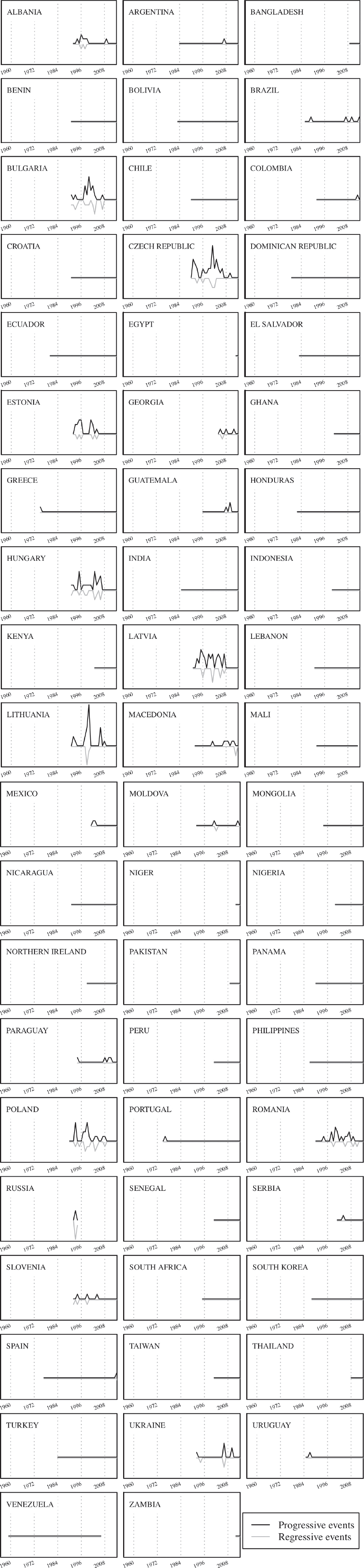
Our work addresses these limitations by substantiating the theory using the Global Transitional Justice Dataset, a novel, time series crosssection data set of personnel transitional justice events in postauthoritarian and postconflict states. The data set acknowledges and uses variation of lustration-related activity across time within each country. It enables us to capture the rich variation in implementation of transitional justice broadly and of lustration policy specifically; for example, whereas in some countries the bulk of lustration activity occurs in the immediate aftermath of transition (Kenya and Ghana), in others, the process is far more protracted (most East European countries). Furthermore, transitional justice legislation seems to prevail in certain countries (Czech Republic and for a long time, the Philippines), whereas in others it is accompanied by reversals (Indonesia).Footnote 17 As discussed at length in Section III, our approach leverages variation in the severity of lustration policy as a way to provide a more valid measure of the phenomenon in question.
II. The Formal Model
Can lustration improve the quality of representation by eliminating the effectiveness of blackmail that uses dark authoritarian secrets? Our model of incomplete information reconstructs the mechanism through which blackmail interferes with politicians’ ability to represent faithfully the policy preferences of constituents. This model allows us to examine the extent to which personnel transitional justice indeed reduces the dependence of politicians on their former leading officers.
Formal modeling has scarcely been used to address questions involving transitional justiceFootnote 18 and, to the best of our knowledge, it has not been used to predict the effect of personnel transitional justice mechanisms on the long-term quality of democracy. Our model is set following a transition to democracy. It features a former collaborator, who is elected to public office (the politician), and his or her former officer, who demands a policy concession and threatens to reveal compromising information about the politician unless the latter provides that concession (what we understand as blackmail).
We assume that barring blackmail, politicians would implement the policy preferences of their constituents. By making this assumption we are not claiming that politicians always follow voter preferences, but the assumption is instrumental to isolating the effect of lustration that we seek to identify. The quality of representation suffers when the politician is vulnerable to extortion and implements policy preferred by a former secret police officer instead of policy preferred by voters. Lustration should make it more difficult if not impossible to blackmail these politicians.
The key tension in our model derives from the officer knowing whether he or she possesses the evidence he or she threatens to release while the politician does not know. The more stringent the lustration law, the less likely it is that the officer possesses incriminating evidence. Therefore, the severity of lustration is represented by the probability that evidence of the politician’s collaboration remains in the possession of the officer. Restated in terms of the example above, if harsh lustration had been implemented in Poland before Wałęsa served as president, the secret police chief would not have been able to use the files against him.
The model we propose uncovers circumstances under which lustration improves the ability of politicians to represent their constituents. Previewing the results, our model shows that ideological polarization between the blackmailing officer and the politician decreases the quality of representation. The finding that politicians give in to blackmail more frequently when asked to deviate more is intuitive.Footnote 19 The model also indicates that the quality of representation increases with the severity of lustration and that high-quality representation is easier to achieve as the price of having compromising information revealed decreases. Thus, our model shows that the greater the public’s emphasis on former collaborators being excluded from politics, the more influence authoritarian elites have via this blackmail mechanism.
Sequence of Play
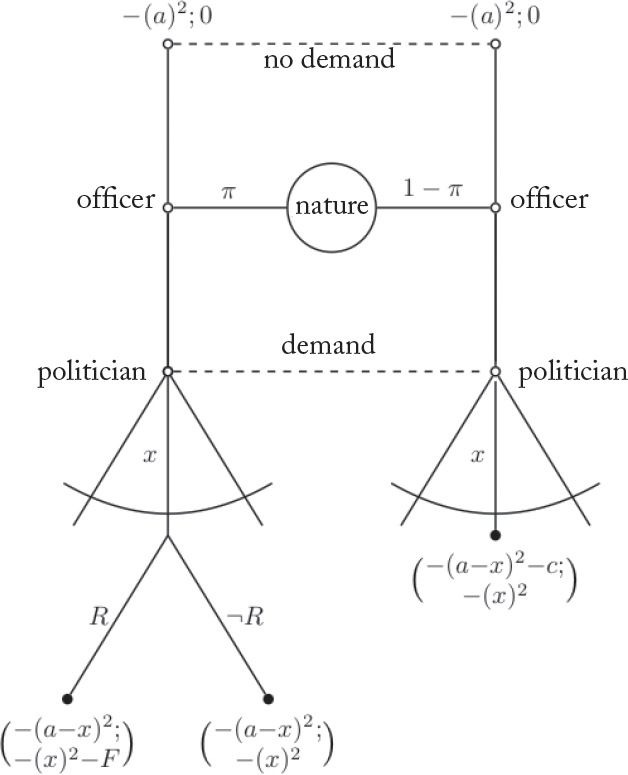
The game starts with a move of nature, which determines with probability π ∈ (0,1) that the officer has evidence against the politician and with probability 1–π that the officer does not have it. In this model, π represents the exogenously given severity of lustration; the more severe lustration, the less likely that unearthed evidence of collaboration remains in the hands of the officer. The politician, P, knows the value of π, but not its specific realization. In the second stage of the game, the officer, O, decides whether to make a policy demand of the politician. We represent this decision by one of two actions {demand, no demand}. If no demand is made, the game ends and the politician implements the policy corresponding to his or her ideal point.
For simplicity, we assume that the politician’s ideal point is given by p = 0 and the officer’s ideal point is represented by a > 0. Thus, a captures the ideological distance between the politician and the officer. P observes whether a demand has been made, but not whether evidence against him or her exists (the realization of π). In the third stage, P decides whether to make a policy concession in response to O’s demand and how big the concession should be. We model this concession as proposing a policy, x ∈ [0,a]. If evidence against the politician does not exist, the game ends and the officer pays the cost of bluffing, c > 0. The bluffing cost, c, is the price associated with the officer’s pretending to possess evidence. This may be easier where media scrutiny is low and merely claiming that a politician was a collaborator does not require credible evidence to become news. But where there is free media, a story exposing such fake news would be quickly revealed for what it is. Consequently, one can think of the cost of bluffing as lower where fake news can get traction and pass for truth longer before it is exposed as fake. The cost to the officer authoring such fake news is that no further attempt to blackmail would be credible.
If evidence does exist and the officer possesses it, the officer decides whether to reveal it (R or ¬R). The revelation is interpreted as the officer exercising the threat to reveal the skeletons in the politician’s closet. If evidence is revealed, the politician pays the cost of having compromising evidence revealed (which may include being fired), F.
Preferences
The payoffs are a quadratic function of the euclidean distance between the players’ respective ideal points and implemented policy, as well as the two types of costs characterized above: the cost to the politician of being fired as a result of having compromising information revealed and the cost of bluffing incurred by the officer if he or she makes an empty threat. The utilities, along with the entire game tree, are presented in Figure 1.
Lustration Blackmail Game

Strategies and Beliefs
The politician’s strategy set can be defined as Sp = {x (d):D → [0,a]}. In other words, a strategy for the politician is a proposal, x ∈ [0,a], which P makes in the event that O makes a policy demand. Note that O can simply ignore the demand if he or she chooses x = 0.Footnote 20 The strategy for the officer can be written as σo : T → D × {r,x}, where T = {Evidence, ¬Evidence}, D = {demand, ¬demand} and r (x) ∈ {Reject, ¬Reject}; r (x) denotes the action taken by O following P’s counteroffer x. This part of O’s strategy can best be represented as a rejection region R = {x: x ∈ R → O reveals}.
This structure resembles that of a signaling game in which O is the sender of the message and P is the receiver. In line with these types of games, the politician may have a chance to update his or her prior belief about the type of officer he or she is facing—whether the officer is equipped with evidence of collaboration or not—after observing the officer’s action. Depending on the relative magnitudes of a, c, and F, this might be either a signaling game or a cheap talk game. The solution concept we use is Perfect Bayesian Equilibrium (pbe). In pbe, strategies must be best responses to each other, we must specify the politician’s beliefs, and those beliefs must be consistent with what is observed in equilibrium play.
A possible criticism of how well our model matches the empirical interpretation of blackmail that uses secret police files is that if someone never consciously collaborated with the secret police, surely he or she could be certain that no evidence of collaboration exists. Consequently, bluffing with secret police files would be limited to politicians who collaborated with the secret police; those who are innocent of such collaboration would not be affected. In response, we point to the extensive literature indicating that secret police agents routinely falsified evidence of collaboration to improve the appearance of their performance or to pocket compensation intended for collaborators in exchange for information.Footnote 21 Frequently, informal conversations were recorded as “reports.” The victims of such falsified evidence can therefore never be certain if evidence of their “collaboration” exists.Footnote 22 Thus, because instances of un-intentional collaboration exist, we assume that theoretically, bluffing is always possible.
Results and Discussion
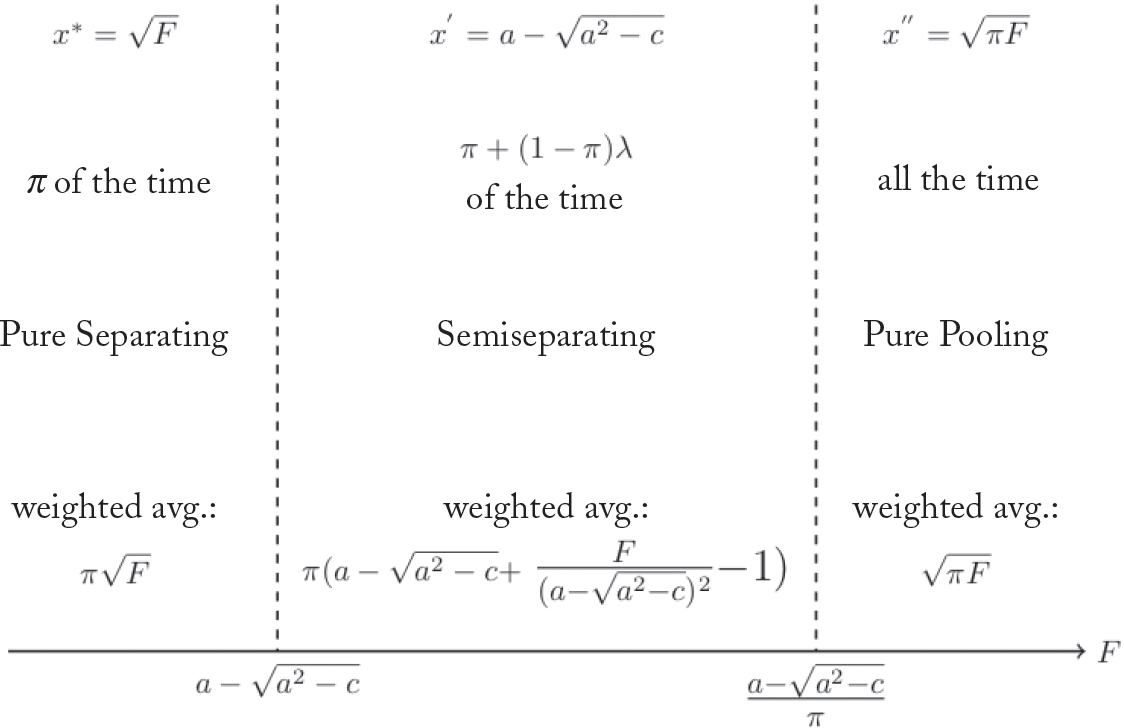
We solve the model for separating, semiseparating, and pooling equilibria in the supplementary material.Footnote 23 Proposition 1 summarizes these equilibria and Figure 2 presents them as a function of F, the politician’s cost of having skeletons in the closet revealed. The set of conditions for the pooling equilibria is distinct from the set of conditions defining the separating and semipooling equilibria, with the critical element being the magnitude of F relative to the cost of bluffing, c, the polarization between the officer and the politician and the probability that evidence against the politician exists, π.
Equilibria

Proposition 1. Suppose  $$F \lt a - \sqrt {a^2 - c}$$. There is a pure separating pbe in which the officer makes a demand if and only if evidence exists, and in response, the politician makes a counteroffer,
 $$x^* \equiv \sqrt F$$. The officer’s rejection region in this equilibrium is defined by
 $$R^* \equiv \left( {0,\sqrt F } \right)$$, so the officer accepts the counteroffer and does not reveal the evidence in his or her possession. The posterior beliefs of P are described by Pr(E|no demand) = 0,Pr(¬E|no demand) = 1,Pr (E|no demand) = 1,Pr (¬E|no demand) = 0.
Suppose  $$F \gt {{a - \sqrt {a^2 - c} } \over \pi }$$. There is a pure pooling pbe in which the officer always makes a demand, and the politician responds with a counteroffer,
 $$x'' \equiv \sqrt {\pi F}$$. The officer’s rejection region in this equilibrium is defined by
 $$R'' \equiv \left( {0,\sqrt {\pi F} } \right)$$, thus, the officer accepts the counteroffer and does not reveal the evidence in his or her possession. The posterior beliefs of P are described by Pr(E|demand) = π, Pr(¬E|demand) = 1 − π.
Suppose a  $$a - \sqrt {a^2 - c} \le F \le {{a - \sqrt {a^2 - c} } \over \pi }$$. There is a semiseparating pbe in which the officer always places a demand when evidence exists, but if evidence does not exist, the officer places a demand with probability λ* and refrains from placing a demand with probability 1 − λ*. In response to the demand, the politician makes a counteroffer,
 $$x' \equiv a - \sqrt {a^2 - c}$$, and since the officer’s rejection region is defined by
 $$R' \equiv \left( {0a - \sqrt {a^2 - c} } \right)$$, the officer accepts the counteroffer and does not reveal the evidence in his or her possession. The posterior beliefs of P are described by Pr(E|no demand) = 0, Pr(¬E|no demand) = λ*, Pr(E|demand) = 1, Pr(¬E|demand) = 1 − λ*, where
 $$\lambda^* \equiv {{\pi \left( {F - \left( {a - \sqrt {a^2 - c} } \right)} \right)} \over {\left( {1 - \pi } \right)c}}$$.
Informally, first, Proposition 1 states that for very low costs of revealing skeletons in the closet relative to polarization and the costs of bluffing, there is a separating equilibrium where the officer only makes a demand if evidence exists and the politician makes a counteroffer,  $$x^* = \sqrt F$$. Second, it states that if the costs of revealing skeletons are very high relative to the costs of bluffing, there is a pooling equilibrium in which the officer always makes a demand, irrespective of whether evidence exists, and the politician makes a counteroffer,
 $$x'' \equiv \sqrt {\pi F}$$. Third, for moderate costs of revealing skeletons in the closet, there is a semipooling equilibrium where the officer sometimes bluffs (makes a demand even when he or she has no evidence) and the politician responds with a counteroffer,
 $$x' = a - \sqrt {a^2 - c}$$. In all equilibria, the counteroffer is accepted.
For the given set of parameters, all the equilibria are unique, provided two plausible refinements. The first is that neither type plays a weakly dominated strategy.Footnote 24 The second is that rejection regions that would not be credible for the officer to play cannot be part of an equilibrium profile.Footnote 25
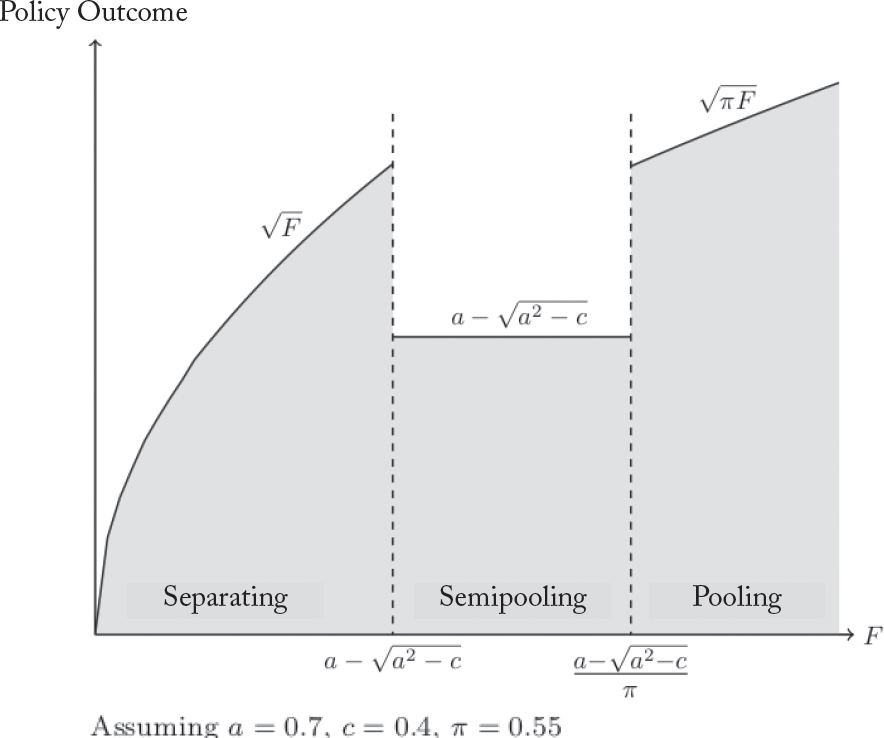
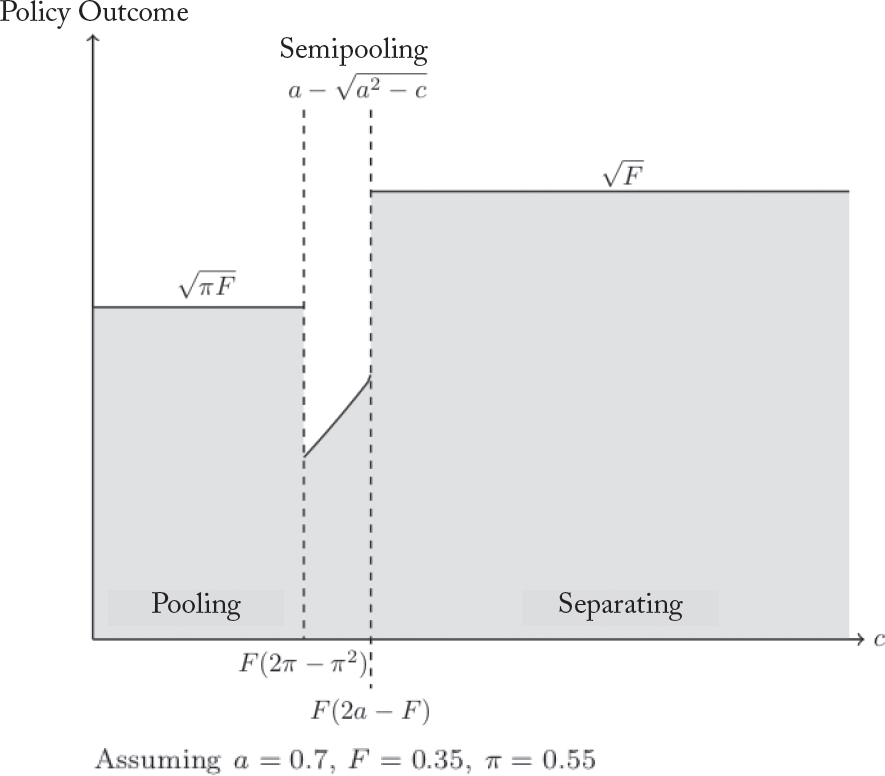
The first implication from this set of propositions is that the quality of representation decreases with a, the distance between the officer and the politician. Intuitively, the greater the preference divergence between the two, the more the politician must concede to keep the compromising information from coming out (Figure 3).Footnote 26 The second is that the quality of representation is decreasing in π. This is intuitive because a higher probability that evidence does not exist induces the politician to make a counteroffer closer to his or her ideal point. The third implication is that the quality of representation is highest under the pure separating equilibrium and lowest under the pure pooling equilibrium, indicating that it decreases with the cost of firing. Similarly, a decrease in c, the cost of bluffing, leads to more misrepresentation (Figure 4).
Misrepresentation as a Function of Cost of Revealing Skeletons, F

Misrepresentation as a Function of Cost of Bluffing, c a

These results are what we would expect from a model of blackmail. But the calculation of the separating, pooling, and semiseparating equilibria provide additional insights that allow us to evaluate the forward-looking argument for lustration. First, note that lustration works as it ought to only under the pure separating equilibrium where it prevents blackmail entirely: only officers with evidence will succeed at making effective demands. Under the pure separating equilibrium, bluffing never occurs and the amount of misrepresentation tracks the amount of evidence left in the officer’s possession so it is directly responsive to the severity of lustration. But both the semiseparating equilibrium and especially the pooling equilibrium allow blackmail to take place even after lustration has been implemented. The conditions for the pooling equilibrium vis-à-vis the semipooling equilibrium and the semipooling equilibrium vis-à-vis the separating equilibrium are easier to satisfy as the cost of bluffing decreases because for higher values of c, it is easier for F to exceed  $$a - \sqrt {a^2 - c}$$ and
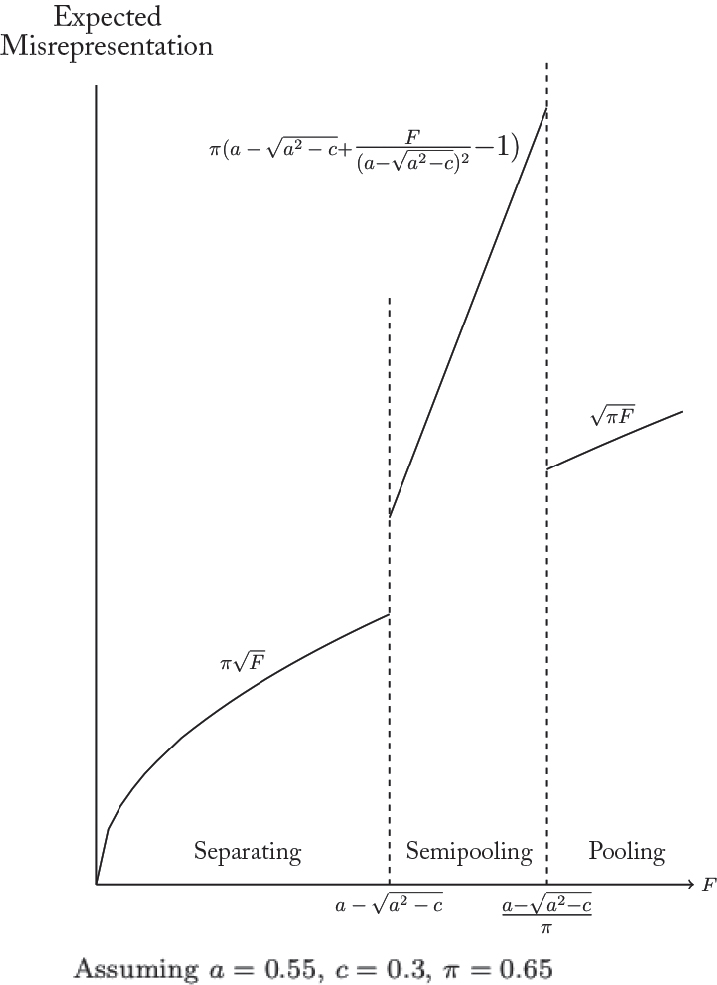
 $${{a - \sqrt {a^2 - c} } \over \pi }$$, respectively. Figures 2 and 5 capture these intuitions graphically by calculating (at the bottom of Figure 2), for all three equilibria, the expected amount of misrepresentation.
Expected Misrepresentation as a Function of F

As explained above, in the separating equilibrium blackmail is restricted to cases beyond the reach of lustration because evidence is left in the hands of former secret police officers. The more severe the lustration policy, the less blackmail: π of the time, the misrepresentation is  $$\sqrt F$$. The expected misrepresentation is then
 $$\pi \sqrt F$$. But in the pooling equilibrium, bluffing occurs every time evidence does not exist, regardless of how much evidence transitional justice has left in the hands of former officers. The frequency of blackmail is completely orthogonal to the actual existence of evidence of collaboration. Under this equilibrium, the extent to which lustration has successfully eliminated evidence of collaboration has no bearing on the effectiveness of blackmail. The expected misrepresentation here is
 $$\sqrt {\pi F}$$.
Additionally, in the semipooling equilibrium, the officer always makes a demand when the evidence exists and makes it with probability λ* when evidence does not exist. The key feature of the semipooling equilibrium is that when it is played, the officer extracts policy concessions (undermining representation) even when evidence does not exist, with probability λ*. Misrepresentation does not exactly track transitional justice, but at least in 1 – λ* of the cases, when the transitional justice process has swept evidence, bluffing does not take place. We can calculate the expected departure from perfect representation in this equilibrium. It is given by  $$\pi \left( {a - \sqrt {a^2 - c} } \right) + \left( {1 - \pi } \right){{\pi \left( {F - \left( {a - \sqrt {a^2 - c} } \right)^2 } \right)} \over {\left( {1 - \pi } \right)\left( {a - \sqrt {a^2 - c} } \right)^2 }}$$, which simplifies to
 $$\pi \left( {a - \sqrt {a^2 - c} } \right) + {F \over {\left( {a - \sqrt {a^2 - c} } \right)}} - 1$$. Figure 5 summarizes this argument graphically for π = 0.65, a = 0.55, and c = 0.3.
In this section, we identify conditions under which lustration works as it ought to according to the forward-looking argument—preventing blackmail that uses secret police files. We also identify conditions for the pooling and semiseparating equilibria where lustration is compatible with bluffing and thus does not prevent departures from democratic representation. Under all three equilibria, the total expected amount of misrepresentation decreases with lustration. Even when the mechanism through which lustration affects the quality of representation is somewhat different from that which proponents of the forward-looking argument maintain, lustration still decreases departures from the politician’s ideal point toward the blackmailing officer. Indeed, a somewhat counterintuitive result is that in terms of F, the cost of having skeletons in the closet revealed, the lowest level of policy concessions occurs in the pooling equilibrium. Recall that this is the instance where lustration works nothing like the proponents of the forward-looking argument expect it to, as blackmail occurs regardless of whether evidence exists. This result is intriguing. The intuition behind it is that because the politician knows that the chance that evidence against him or her exists is merely π, the politician is not willing to put up with the kind of high concessions an officer with evidence would demand (for example, the demand in the separating equilibrium where there is 100 percent certainty that insubordination would result in revealing compromising information). The fascinating thing about this equilibrium is what keeps the officer from extracting more than  $$\sqrt {{\rm{\pi F}}}$$: the politician is willing to risk exposure rather than put up with an excessively high concession. After accounting for the frequency with which these concessions occur, it becomes apparent that the separating equilibria, in expectation, lead to the highest quality representation.
The next section derives this observation and other empirical implications from our model and illustrates these expectations with original data from the Global Transitional Justice Dataset.
III. Empirical Analysis
The game theoretic model presented above represents the dynamic between individual politicians and former officers of authoritarian regimes. The main implication drawn from the model is that lustration prevents blackmail and thus curbs departures from policies that are desirable to the electorate. Put differently, we argue that in a perfect representative democracy, the politician’s ideal point would correspond to policies that the voters want implemented. Because the outcome of interest is the distance between the politician’s ideal point and the policy that is ultimately implemented, the model predicts individual departures from such perfect representation. Of course, obtaining the necessary evidence to document these departures would require careful analysis of the preferences of individual politicians and former authoritarian elites, a task that would be hard at best and almost impossible for a large number of countries. Hence, we opt to test the model’s implication using a combination of party-level data on ideological positions and quality of representation and country-level data on lustration policies.
We operationalize our outcome of interest, quality of representation, using a measure that captures both the cohesion within a party and the salience of the policies that the parties represent. The ideological cohesion of a party relies on its members sharing the same ideological platform and supporting policies that advance that platform.Footnote 27 If one of the members were blackmailed into making policy concessions to a former agent, the departure from the shared platform would decrease party cohesion. Hence, we can rely on data aggregated at the party level to pick up irregularities in individual behavior.
To measure quality of representation at the party level, we build on the measure CoSalPo constructed by Herbert Kitschelt and colleagues.Footnote 28 The original measure draws on a large-scale survey of experts in eighty-eight countries and condenses information on three key components of 506 political parties: cohesion, salience, and polarization.Footnote 29 We use a similar measure but leave out questions pertaining to polarization because it is conceptually close to the distance between the ideal point of the politician and the officer, a key parameter of interest in our model. The result is a score between 0 and 1 that captures the cohesion and salience of each party in the countries of interest. The new proposed measure (CoSal_3), we argue, accurately captures the quality of representation that we refer to in the formal model.Footnote 30
The model’s first implication suggests that the probability of the existence of secret evidence against the politician (parameter π in the model) decreases the quality of representation because it enables blackmail. Throughout this article, we contend that lustration publicizes evidence of covert collaboration so the probability of evidence remaining secret and susceptible to being used as blackmail decreases. Therefore, we operationalize the probability of secret evidence of collaboration (π) with country data on lustration policies.
Although most cross-national empirical analyses of transitional justice rely on dichotomous variables to indicate lustration,Footnote 31 we argue that indicator variables fail to distinguish between countries with limited lustration policies (for example, screening only politicians running for elected top-level positions) and countries with comprehensive lustration policies that screen candidates for all elected positions. Yet it is more likely that secret information would be left undisturbed and ready for use as blackmail under a limited lustration policy than under a comprehensive one. An adequate measure should reflect the variation on lustration policies across countries.
To capture this variation, we rely on the Global Transitional Justice Dataset.Footnote 32 To construct it, we started by building chronologies of personnel transitional justice events. For each country, we recorded each nudgeFootnote 33 in the direction of promoting or restricting lustration, and coded such events as progressive or regressive, respectively. Progressive events introduce new legislation or broaden the existing one, whereas regressive events, such as the constitutional court voting down or vetoing lustration provisions, attempt to constrain lustration. Submitting a lustration proposal to the floor of the legislature, passing or upholding lustration legislation, or overturning a presidential veto against such legislation are all examples of progressive events, whereas amendments decreasing the set of offices subject to lustration are coded as regressive events.Footnote 34 The events we analyze are only those that deal with uncovering secret collaboration with the authoritarian regime. Although this is a narrower definition of lustration than that used by other scholars,Footnote 35 it is an excellent empirical match for our model, which entails revealing information that no one except the officer knows.
Figure 6 summarizes these data and shows that there is empirical variation in the lustration policies implemented by each country (fifty-nine).Footnote 36 Each panel in the figure depicts lustration events in a given country after transition. The horizontal axis indicates the calendar year and the vertical axis indicates the frequency of events in that year: black, upward lines mark progressive events, and gray, downward lines mark regressive events. Taken together, the panels show that in many countries, lustration was not implemented at a single point in time and was allowed to persist. Rather, among proposed lustration bills, some were passed via the legislature, whereas others failed or were eventually overturned (by an executive, an upper chamber, or a constitutional court) or survived one term and were struck down by a subsequent government. Figure 6 also suggests that lustration is popular beyond postcommunist Europe, contrary to what the concentration of work on lustration in postcommunist Europe may imply.
Summary of Regressive and Progressive Lustration Events

To maximize the richness of the lustration trajectories presented here, we propose a score that captures the severity of lustration. This score is defined as the total number of progressive lustration events divided by the total number of lustration events plus one,Footnote 37 taking the value of 0 when country k did not move lustration forward, and approaching 1 when the number of progressive events is closer to the total number of events.Footnote 38 We add 1 to the denominator to ensure that this score is defined for countries that have had no lustration events. Importantly, the severity variable is observed at the country level, whereas the dependent variable, quality of representation, is measured at the party level.
We believe that the events-based severity score is an improvement over existing measurement, although it is far from ideal. First, our measure of severity is time invariant, which means that it cannot explain variation in the quality of democracy over time.Footnote 39 Second, our measure could improve if it accounted for how many past and current positions were subject to vetting, how severe the sanctions for collaboration were, or how many individuals were exonerated given the number of people investigated. Such detailed information, although clearly superior, would require meticulous data on policy implementation. Although collecting it might be feasible for a handful of cases, it is prohibitively costly for the entire sample that we present here. Given our resources, we opted to focus on the theoretical drivers of politicians’ behavior. In our model, this behavior is driven by the politician’s beliefs about how likely it is that blackmail will occur. The higher the proportion of progressive lustration events, as reflected in our measure of severity, the more likely it is that politicians will not be blackmailed with secret police files. With this in mind, we state our first hypothesis:
—H1. All else constant, the quality of representation should increase as the severity of lustration increases.
A second empirical implication of the model is that the quality of representation decreases as the cost of having compromising information revealed increases (parameter F in the model). We operationalize it as the electoral costs associated with revealing skeletons in the closet. We argue that in democracies recovering from authoritarian rule, voters care about keeping former secret collaborators out of office, but that the saliency of this issue diminishes over timeFootnote 40 when holding lustration constant. This claim is supported by the literature on historical memoryFootnote 41 and is also associated with the fact that more voters in a young democracy will have experienced (and remember) life under autocracyFootnote 42 than voters in a seasoned democracy. Hence, we operationalize F as the years elapsed since transition,Footnote 43 and propose that the longer the democratic experience of a country, the less attentive voters will be to the fact that their politicians collaborated with the authoritarian regime. When voters pay less attention to collaboration, publicizing such skeletons becomes less costly and politicians will give in to blackmail less frequently, regardless of the lustration policies implemented in that country. Formally:
—H2. All else constant, as the time elapsed since the transition to democracy increases, the quality of representation should increase.
It is important to note that this operationalization is somewhat coarse because the cost of revealing collaboration is not only a function of the how voters react to such allegations, but also of other institutional features. For example, revelations about collaboration could be costlier in electoral systems with the personal vote, such as single member districts or open list proportional representation, than in systems in which voters cannot directly specify which candidate is elected into office.Footnote 44 Similarly, voters in some countries could be more interested in elections than those in other countries, in which case revelations would be mediated by an overall interest in electoral participation or turnout. Nevertheless, we believe that the political cost of revealing skeletons in a politician’s closet should be higher, on average, in recently transitioned countries than in countries that transitioned a long time ago.
The third implication of our theory is that the ideological distance between politicians and officers negatively impacts the quality of democracy. Like the dependent variable, quality of representation, our operationalization of distance relies on the Democratic Accountability and Linkages Project (dalp) survey and is also measured at the party level. Specifically, we take advantage of the fact that dalp reports average ideological placements of political parties in countries from our sample. Furthermore, since some of these parties are successor authoritarian parties, we use their placement to proxy the ideological placement of officers. Therefore, for each nonsuccessor party p in country k, we define party distance as the absolute difference in left-right placement between party p and the placement of the country’s successor authoritarian party in country k. We state our third hypothesis:
—H3. As the distance between a country’s successor authoritarian party and nonsuccessor parties increases, the quality of representation should decrease.
It is important to note that some countries in our sample do not have a party that is a successor to the authoritarian regime. For these countries, we replaced the missing distance with the average distance between successor and authoritarian party across all remaining countries and we included an indicator variable to account for these cases.Footnote 45
We operationalize parameter c, the cost of bluffing, with the freedom of the press index as reported by Reporters Without Borders.Footnote 46 Our logic is that when an officer of the authoritarian regime tries to bluff a politician into thinking that he or she is in possession of evidence against the politician, such a bluff can be easily exposed in an environment with free media. Put differently, claims regarding the collaboration between a politician and the former secret police will likely be reported, and if the press is free, claims eventually will be investigated and denounced if found to be false. A wide literature discusses how thorough journalists are when it comes to revealing evidence of former secret police conduct.Footnote 47 Although the scrutiny offered by journalists is not perfect, the higher the degree of media independence, the more likely an officer’s bluff will be called.
Our model predicts that an increase in the costs of bluffing increases the chances of an equilibrium with no bluffing, that is, an equilibrium in which only politicians with skeletons in their closets are blackmailed. Therefore, holding the severity of lustration constant, an increase in media freedom should increase the quality of representation because it decreases (or eliminates altogether) the amount of bluffing. Put differently, our model implies that severe lustration directly improves the quality of representation by decreasing the pool of politicians who could be subject to blackmail or bluffing (Hypothesis 1), but even for two countries with equal lustration policies, the country with greater media freedom will have an added positive effect on the quality of representation by eliminating bluffing. Thus, we hypothesize:
—H4. All else constant, higher freedom of the media should be associated with higher quality of representation.
Our hypotheses can be translated to the following linear specification:Footnote 48
 $$\eqalign{ quality \, of \, representation_{p,k} = & {\text{ }}\beta_k + \beta_a^* party \, distance_{p,k} \cr & + {\text{ }}\beta \cr _s^* severity_k \cr & + \beta_n^* years \, since \, transition_k \cr & + \beta \cr _c^* press \, freedom_k \cr & + \beta_x^* \sum X_k \cr & + e_{p,k} + u_k , \cr} $$
where quality of representation is operationalized using the measure of programmaticness (CoSal_3) for party p in country k. In addition to the main variables of interest described above, the model incorporates a series of country-level control variables (ΣXk), as well as a series of country-specific intercepts (βk).
As implied by the equation above, the outcome of interest (quality of representation) and one regressor (party distance) are party-level attributes, while the remaining variables are measured at the country-level. To account for this structure, we use a multilevel regression. Given that parties are nested within countries, estimating this model using an ordinary least squares regression would risk biased and inefficient results because characteristics of parties within the same country are not independent of one another.Footnote 49 Multilevel regression can be thought of as a compromise between assuming that all parties are independent of each other and assuming that all variation across parties can be explained by the country in which they exist. A multilevel approach will structure the variation in the dependent variable according to party-level and country-level characteristics. Specifically, we estimate the model above with a series of country-level coefficients (βk) that share an underlying distribution with a global mean (μβk) and standard deviation (σβk).Footnote 50 This equation, we argue, is the best way to model the outcome of interest given the data available.
Before we present and discuss the results, we address the concern that countries where lustration is successfully implemented also have parties that are better at representing voters. If this were the case, there would be a risk of overestimating the relationship between lustration severity and quality of representation, but such overestimation would be captured by the country-level intercepts. Put differently, if countries that implemented transitional justice were indeed the same ones whose parties offer higher quality representation, then all parties in that country should be affected. This effect, in turn, would be captured by the country-specific estimates.
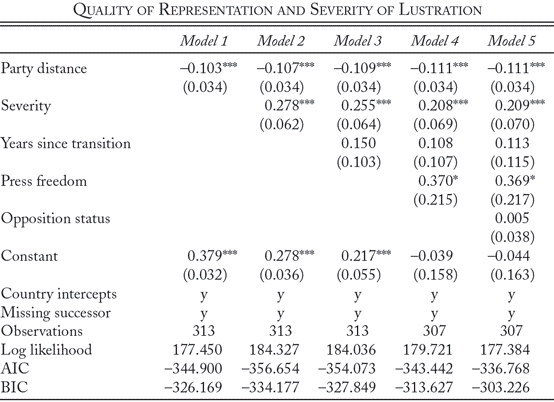
The results of our estimations are shown in Table 1. For ease of interpretation, all variables have been linearly transformed to range between 0 and 1. All models presented here include country-level intercepts (estimations for βk) and an indicator variable controlling for missing successor parties, both of which are omitted from the table due to space considerations. The table reports the average change in quality of representation of a nonsuccessor party that is associated with an increase of one unit in the covariate of interest.
Quality of Representation and Severity of Lustration

*p <0.1, **p <0.05, ***p <0.01
The resulting estimations are generally consistent with the implications of our theoretical model. Most important, they show that higher scores of lustration severity are on average associated with more programmatic parties. The effect is statistically significant at the 0.05 percent confidence level and robust to the inclusion of country-specific intercepts and other relevant covariates. In addition, its average effect is quite substantial: the difference between a country that did not attempt lustration (severity score of 0) and a country with the highest lustration (severity score of 0.82) is 0.17 points, according to the point estimate of model 4. Since the variable quality of representation ranges from 0 to 1, this average effect accounts for one-fifth of the possible range of our outcome of interest.
The models reported are static, meaning that they take a snapshot of a country, and thus cannot produce evidence of changing quality of representation over time. Nevertheless, they have many redeeming features. First, dalp extends to over eighty democracies and exhibits almost precise overlap with the set of countries included in our database. No competing data sets (ches [Chapel Hill expert surveys] and the Manifesto Project) allow us to measure quality of representation for even half the countries in the Global Transitional Justice Dataset.
We find a negative and statistically significant effect for the ideological distance between each party and its successor (party distance). This finding is consistent with Hypothesis 3, which states that as the distance between each party and the successor party increases, the quality of representation should decrease. This result is robust to several specifications, most notably using only countries with successor parties (see the supplementary material).Footnote 51
But this result could be driven by preexisting dynamics between the opposition and authoritarian parties. Suppose, for instance, that parties that existed during the authoritarian period share some ideological characteristics that made their members more likely to be blackmailed. We control for this possible confounder using a measure of how active the opposition was in representative state institutions during the authoritarian era. José Cheibub, Jennifer Gandhi, and James VreelandFootnote 52 report data on the status of the opposition in authoritarian legislatures.Footnote 53 In our sample, only two authoritarian regimes had no legislature at all, so we transformed the variable opposition status into an indicator taking the value of 1 when there were multiple parties represented in the legislature, and 0 otherwise. As can be seen in model 5, the inclusion of this variable does not change our results.
Models 3–5 include the variable years since transition, which captures time since transition to democracy as a proxy for the cost of having skeletons revealed (F). We hypothesize (Hypothesis 2) that over time, politicians pay a lower cost for having been exposed as collaborators of the former authoritarian regime. As a result, they should be less prone to blackmail and the quality of representation should increase. But the coefficient associated with years since transition is not significant, which means that we find no evidence to support Hypothesis 2. We attribute this lack of support to the coarse measure of the costs of firing used in our analysis.
Models 4 and 5 also include the variable press freedom, which is how we operationalize the cost of bluffing. We find that the variable is positively related to the quality of representation, although this association is significant at the 90 percent level. We also find that it does not change the estimated effects of the rest of the theoretically relevant regressors, which we take as evidence supporting our previous findings. Interestingly, the constant term is no longer statistically significant when press freedom is included, and we interpret this as a type of omitted variable bias; in models 1–3, the average effect of a free press and time since transition is encapsulated by this constant.
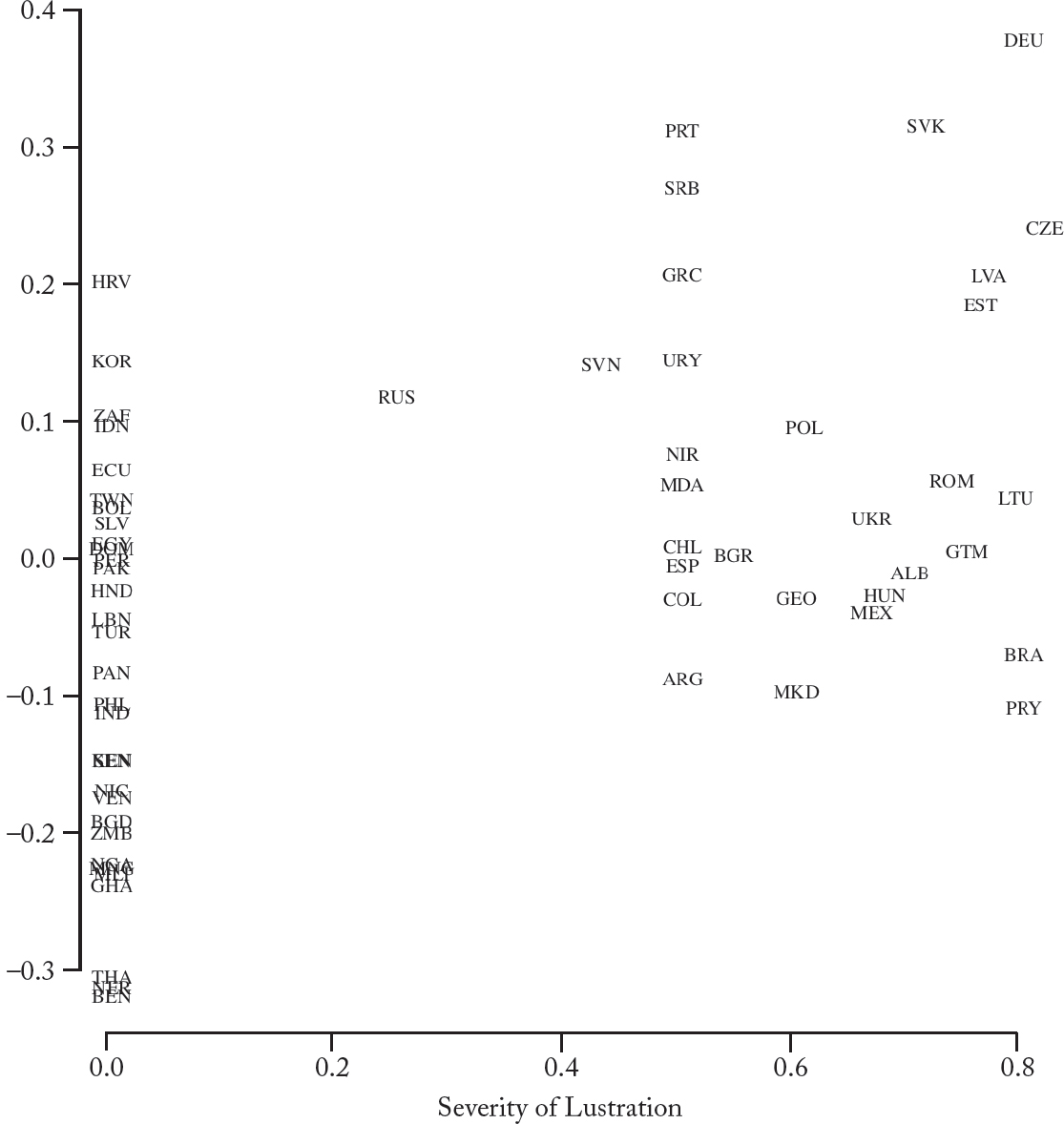
Figure 7 shows our main relationship of interest, the one between quality of representation and severity of lustration. The figure shows the severity score on the horizontal axis, and the average country effects estimated in model 1 on the vertical axis. Model 1 includes only the regressor that was measured at the party level—party distance—and estimates a series of country-specific intercepts that capture the average country-level quality of representation. Figure 7 suggests a positive relationship between these two variables. The pattern seems to be much clearer for the observations that fall in the right half of the panel, that is, for the countries that implemented more severe lustration policies. This latter point supports our decision to operationalize lustration as a process rather than as a dichotomous measure.
Severity of Lustration and Average Quality of Representation: Intercepts by Country

In addition, the evidence shows that the severity of lustration is positively related to the quality of representation. This result is promising insofar as it suggests that lustration severity contributes to higher quality representation. But the theoretical model also shows that lustration by itself does not prevent the blackmailing of former dissidents turned politicians. To function properly, lustration policies require an accompanying free press to prevent former authoritarian elites from bluffing.
IV. Conclusion
This article investigates how lustration, understood as the policy that reveals information about prior collaboration with former authoritarian elites, influences the quality of representation. We use formal theory to model a situation in which officers of the former authoritarian regime use secret police files to blackmail new democratic elites. In our model, such blackmail aims at forcing the democratic elites to implement policies that are amenable to the former authoritarian elites and not to voters. Theoretically, we find that former authoritarian elites’ ability to shape policy is higher when transitional justice is legislated less frequently and that their influence decreases with decreased voter concern about the skeletons of the authoritarian past in their representatives’ closets. In addition, the ideological distance between the former autocrats and the new democratic elites increases the ability of former autocrats to extract concessions via blackmail.
Our work makes a significant contribution to the study of democratic representation. It does so by linking transitional justice to secret authoritarian legacies. Specifically, it finds that lustration decreases the amount of potentially embarrassing information that remains hidden and useful for blackmail and thus prevents blackmail of current politicians by former authoritarian elites. We test and confirm this implication empirically using an original data set of all lustration events in former authoritarian regimes.
Our argument has important implications for normative transitional justice, in that it contributes to the understanding of the relationship between transitional justice, rule of law, and the quality of representation in new democracies. Key for this contribution is showing that transitional justice can enhance representation without jeopardizing the rule of law because effective lustration means revealing skeletons in the closet, not necessarily banning former collaborators from running for office or criminalizing their former behavior. Many normative transitional justice scholars argue that transitional justice is retroactive because it undermines the legal principle of “no punishment without a crime.” These skeptics argue that lustration cannot possibly offer a legal foundation in new democratic states because it criminalizes acts that were not only deemed legal under the former authoritarian regime, but indeed were encouraged. Gábor Halmai argues, “Living well is the best form of revenge.”Footnote 54 Other scholars advocate the so-called “Spanish Model of Transitional Justice.”Footnote 55 These authors use Spain’s most benign way of dealing with former authoritarian collaborators (sealing the archives of Franco’s secret police) to build their case that “doing nothing” is the best approach for new democracies to deal with past authoritarian regimes.Footnote 56 Misuses of lustration, decommunization, and debaathification corroborate this endorsement of the Spanish model.Footnote 57
We note that although following the Spanish model and doing nothing need not produce immediate negative consequences, it may strengthen the power of authoritarian networks. If democracy survives, damaging information collected by the former authoritarian secret police for the benefit of authoritarian elites may turn elected politicians into clients of agents who threaten to reveal their past collaboration.Footnote 58 Forgiving and forgetting may sabotage the capacity for elected politicians to represent voters, a phenomenon that is hard for studies focusing on the immediate aftermath of transition to pick up on. Thus, even if one agrees with the arguments of Jon Elster and Stephen Holmes that question the validity of the backward-looking arguments for lustration, it may still be the case that when appropriately designed and implemented, lustration laws can undercut the growth of authoritarian networks by exposing the files and secrets of the former authoritarian police. As such, our argument bears similarity to other formal models showing that legislation with strong normative components, such as human rights protections and legal limits on executive behavior, can be self-enforcing.Footnote 59
Our contributions speak to the effects of transparency policies on the long-term quality of representation in new democracies, an area that has sparked relatively little scholarly attention. With a few exceptions,Footnote 60 the use of secrets and blackmail to affect policy has not received much scrutiny from political scientists. Yet, in 2017, the term kompromat made front-page news as it was used to describe Russia’s attempts to intervene in the US elections. Generally, kompromat (compromising materials) refers to either embarrassing information or evidence of a person’s illegal activity that could damage that person’s career or open him or her up to prosecution should it be revealed. As Keith Darden points out, this kind of data was routinely collected by authoritarian secret services in the Soviet era and used to control people through blackmail by threatening the compromised with the release of damaging information to the public—or worse, to prosecutors.Footnote 61 But such embarrassing or damaging information, even if collected by authoritarian security forces, may be put to use long after the authoritarian regime itself has expired.
This article shows that lustration does not always prevent blackmail. We find that holding all else constant, lack of a free press can sabotage lustration efforts. Allegations of collaboration need to be investigated and verified. In a liberal democracy, these tasks are often performed by the free press. In the absence of independent media, blackmail occurs through bluffing: threatening to accuse current politicians of having ties with the former authoritarian regime even when no evidence exists.
Supplementary Material
Supplementary material for this article can be found at https://doi.org/10.1017/S0043887119000066.
Data
Replication data for this article can be found at https://doi.org/10.7910/DVN/XC4E1I.
Acknowledgements
The authors are grateful to Jaimie Bleck, Anna Grzymala-Busse, Karrie Koessel, Sue Stokes, Susanne Wengle, and three anonymous reviewers of World Politics for their comments. We also thank Tiberiu Dragu, John Patty, and Scott Tyson for advice on the formal model. Participants of the Visions in Methodology Work-shop in 2016 at the University of California, Davis, provided priceless comments and advice. Genevieve Bates, Ipek Cinar, Ji Xue, Viivi Jarvi, Evgenia Olimpieva, Alexa Rosario, and Yonatan Litwin contributed stellar research assistance. All mistakes are the authors’ responsibility.
Funding
This research was supported by the National Science Foundation (award no. 1658170) and a Center for International Social Science Research Faculty Grant.
Authors
Milena Ang is a Harper-Schmitt Fellow in the Society of Fellows at the University of Chicago. Her research interests include democratization, corruption, criminal justice, transitional justice, and Mexican politics. She can be reached at milenaang@uchicago.edu.
Monika Nalepa is an associate professor of political science at the University of Chicago. Her research interests include transitional justice, parties and legislatures, and game-theoretic approaches to comparative politics, with a focus on postcommunist Europe. Her current work centers on how transitional justice mechanisms contribute to the quality of democracy, and she is a cocreator, with Genevieve Bates and Ipek Cinar, of the Global Transitional Justice Dataset. Nalepa is completing a book manuscript, “Can Transitional Justice Save Democracy? Dismantling Clandestine Networks and Purging the Authoritarian State.” She can be reached at mnalepa@uchicago.edu.