

Introduction
The relevance of this study is conditioned by the features of the functioning of legal systems, in particular, in Ukraine and the European Union (EU). In an environment where expert opinions and special knowledge are increasingly relied on in criminal proceedings, the issue of guaranteeing the protection of the rights of experts and specialists is of particular importance. This is emphasized by the need to increase the level of integrity and transparency of the judicial system, in particular, considering the specifics of the difficulties of martial law in Ukraine (including prosecution for committing international crimes in the context of armed conflict in the state). Ensuring procedural rights for experts and specialists not only protects their rights but also contributes to strengthening the legality and fairness of the criminal process. This, in turn, is the key to public trust and respect for the principles of the rule of law.
Kaluzhna and Shunevych (Reference Kaluzhna and Shunevych2022) examined the activities of forensic experts in the context of the International Criminal Court and its jurisdiction in cases of war crimes in Ukraine. The researchers concluded that forensic examinations play a crucial role in establishing evidence related to war crimes, in particular, establishing the cause of death and torture, and also noting the need to involve Ukrainian forensic experts in criminal proceedings in the International Criminal Court. The study highlighted the need for independent investigations by experts to bring to justice those responsible for crimes committed during a military conflict. It was also noted that despite the limited direct involvement of foreign experts in the legislation of Ukraine, interaction with international forensic experts will be useful.
Bovnegra (Reference Bovnegra2024) considered the place and role of experts in criminal proceedings; in particular, the importance of their involvement in ensuring a fair trial was noted. The researcher noted that the participation of experts is extremely important in terms of solving complex issues and providing the court with reliable evidence. Bovnegra (Reference Bovnegra2024) also stressed the need for interaction between experts and lawyers, which will contribute to the effective defence and implementation by the defence party of its arguments in court proceedings. In general, the researcher noted that the involvement of experts is essential for ensuring justice throughout the legal system.
Chornous and Leliuk (2023) investigated the importance of organizational and legal measures in conducting forensic expertise in criminal proceedings. The researchers found that proper organizational activities for conducting such examinations are important for strengthening the overall effectiveness of criminal investigations. The study emphasized that in order to achieve prompt and reasonable results in criminal proceedings, clear coordination between the investigating authorities, the prosecutor’s office and experts is necessary. In addition, the researchers noted the need to improve the practice and legislative framework to ensure the effectiveness of forensic expertise in Ukraine.
In turn, Kuvshynov (Reference Kuvshynov2023) in his study considered the issue of attracting specialists in criminal proceedings, based on the experience of the United States of America (US) and EU member states. The researcher found that effective integration of specialists significantly increases the effectiveness of the investigation process since it allows obtaining of the necessary technical knowledge and contributes to improving the quality of evidence collection. The study emphasized the importance of establishing a clear legal framework and a well-established practice of attracting specialists to ensure the reliability of evidence. In addition, Kuvshynov (Reference Kuvshynov2023) focused on the need for legislative improvement to improve the regulation of specialists’ activities in the criminal justice system of Ukraine.
Alishaev (Reference Alishaev2023) analysed the procedure for preparing a criminal case for trial, paying special attention to the role of expert opinions and expert testimony. The researcher noted the significant contribution of expert conclusions to the formation of a court decision, using practical examples (the case of a road accident) to demonstrate their significance. During the study, the researcher identified gaps and contradictions in criminal cases, which can be eliminated with the help of expert opinions. He also identified the main tasks and problems faced by the parties in the process of proof according to the Criminal Procedure Code of Uzbekistan (1995) (in particular, this applies to the side of evidence, coordination of witnesses). In addition, Alishaev (Reference Alishaev2023) proposed measures that will increase the effectiveness of involving experts in the judicial process (for example, unification of expert procedures, development of clear principles for ensuring impartiality, etc.).
There are significant gaps in previous studies on the procedural rights granted to experts and specialists at the legislative level. Although many studies have been conducted on general procedural guarantees in criminal proceedings, analysis focused on the specifics of legal protection of experts and specialists, particularly in the collection and use of documents as evidence, remains limited. This study aimed to analyse the current legislation of Ukraine and relevant EU legal norms to determine the procedural rights of experts and specialists in Ukraine.
The purpose of this study was to determine the procedural rights of experts and specialists, in particular, in the conditions of collecting and using documents as sources of evidence in criminal proceedings, through the analysis of laws and regulations in Ukraine and the EU. The main objectives of this study were:
-
• To define the concept and role of an expert and specialist in criminal proceedings;
-
• To investigate the definition of evidence in criminal proceedings and distinguish between the concepts of “expert” and “specialist”;
-
• To analyse the laws and regulations in Ukraine and the EU on issues related to the activities of specialists and experts, and on ensuring their procedural rights during the investigation (including during proof).
Materials and Methods
The following laws and regulations of Ukraine and the EU played an important role in the study of procedural guarantees of an expert and a specialist, in particular when collecting and using documents as sources of evidence in criminal proceedings:
-
1. The Criminal Procedure Code of Ukraine (2013) establishes procedures that regulate the conduct of criminal investigations and judicial proceedings in Ukraine. The Criminal Procedure Code of Ukraine (2013) defines the rights and obligations of experts and specialists, in particular regarding the use of their conclusions as sources of evidence. In particular, the regulations detail the requirements for expert opinions (admissibility) and procedural guarantees.
-
2. Law of Ukraine No. 4038-XII “On Forensic Examination” (1994) defines the legal basis of forensic expertise in the judicial system of Ukraine. The law establishes qualification requirements for forensic experts and specifies the procedures that they must follow when conducting expert examinations.
-
3. The Charter of Fundamental Rights of the European Union (European Union 2012) contains fundamental rights that apply in all EU member states, in particular, rights related to legal proceedings. The Charter sets out criteria for evaluating the guarantees provided to experts and specialists, with an emphasis on the principles of fairness, access to justice and the right to a fair trial.
-
4. Guidelines on the Role of Court-Appointed Experts in Judicial Proceedings of the Council of Europe’s Member States (European Commission for the Efficiency of Justice 2014) which have created a framework for involving court-appointed experts in trials across Europe. The document presents best practices for ensuring the reliability of expert opinions and protecting the rights of experts during court proceedings.
To conduct the research, various scientific methods, including terminological, hermeneutical, comparative and historical, were used. Thus, the hermeneutical method was correctly and clearly used to analyse and interpret the laws and regulations of Ukraine and the EU. This method was important in the study of the rights of experts and specialists. While using the terminological method, the concept and essence of criminal proceedings, the parties to the prosecution, an expert, a specialist, evidence and documents were studied. The establishment of clear terminology allowed for further analysis based on a complete understanding of these fundamental terms. This, in turn, contributed to a coordinated consideration of their significance within the legal environment of Ukraine and the EU.
It was important to use general theoretical methods and techniques of research, in particular the comparative method. Thus, during the study of laws and regulations of Ukraine and the EU, they were compared with each other. The legislation of this country was chosen to conduct a more in-depth analysis of the rights of experts and specialists in criminal proceedings, and the special attitude of Ukraine and the EU (the integration process) was taken into account. Using the historical method, the path of establishing a regulatory framework for the procedural rights of experts and specialists in criminal proceedings was traced. In addition, this method allowed us to study not only changes in legislation but also to identify the conditions under which these changes occurred.
Results
Legal Analysis of the Expert’s Powers and Role in Criminal Proceedings Following the Legislation of Ukraine
Criminal proceedings are procedural actions that occur as a result of the commission of a criminal offence and provide for bringing the offender to justice. Thus, this type of proceedings provides for pre-trial investigation and direct judicial proceedings that ensure the effective implementation of justice in the state (provided for in Paragraph 10 of Part 1 of Article 3 of the Criminal Procedure Code of Ukraine 2013).
In general, criminal proceedings contain a fairly large number of participants in the process, which are divided into separate subgroups. In particular, the parties to the prosecution are: the prosecutor; pre-trial investigation bodies (investigative units (security agencies), control units of the National Anti-Corruption Bureau of Ukraine and detective units (detective units of the Bureau of Economic Security of Ukraine)); operational units; and the Inquirer (Section 1 of Chapter 3 of Paragraph 2). An important role in criminal proceedings is played by the defence parties, directly responsible for the function of protecting the rights of the parties, in particular: the suspect and defendant; their representatives; the acquitted and convicted person; and the defence lawyer (lawyer) (Section 1 of Chapter 3 of Paragraph 3). The parties of the injured person and their representative are the injured person and their representative (Section 1 of Chapter 3 of Paragraph 4). However, an important role in bringing an offender to criminal responsibility belongs to the category of other participants in the proceedings, namely: the civil plaintiff and the defendant; their representative; the applicant; the representative of the legal entity in respect of which the proceedings were opened; the third person in respect of whose property the issue of arrest is being resolved; the witness; the interpreter; the representative of the staff of the probation authority; the secretary of the court session; and the court administrator (Section 1 of Chapter 3 of Paragraph 5). However, in this study, special attention was paid to this category of other participants in criminal proceedings, including experts and specialists.
Thus, according to Part 1 of Article 69, in criminal proceedings, an expert acts as an individual who has the necessary technical, scientific and other professional knowledge. In particular, the expert must be authorized to conduct an expert examination following the procedure provided for by Law of Ukraine No. 4038-XII “On Forensic Examination” (1994). Its main task is to study phenomena, processes and objects, especially those related to the circumstances of committing a criminal offence, and to form conclusions about problems that arise in criminal proceedings and are related to the volume of its knowledge. In particular, Part 2 of the Criminal Procedure Code of Ukraine (2013) provides for a ban on the acquisition of expert status for persons who, in one way or another (for example, in the professional aspect), are dependent on the parties to criminal proceedings (including the injured person) (Levin Reference Levin2021).
Thus, according to the legislation of Ukraine, the expert is endowed with important functions that help in the implementation of justice, in particular during pre-trial investigation and criminal proceedings in general. Due to the participation of experts, it is possible to achieve an accurate understanding of complex scientific and technical aspects by specialists in the field of law and the court. One of the most important functions of an expert is to conduct a forensic examination – research with the help of scientific knowledge of certain processes, phenomena and objects, to prepare an opinion on the subject of judicial proceedings (Article 1 of Law of Ukraine No. 4038-XII “On Forensic Examination” 1994). In turn, this includes examining physical evidence, including fingerprints, analysing DNA samples, traces, etc. (Coulthard Reference Coulthard, Coulthard, May and Sousa-Silva2020). The examination of the said physical evidence is crucial for the clear establishment of various aspects of the offence, from the place of its commission, the determination of the motives of the offence, the identification of the victim, to the determination of the offender (Ingram Reference Ingram2021; Signorelli Reference Signorelli2023).
Forensic examination of documents consists of checking and analysing documentation of various types to determine its authenticity and integrity. Experts examine signatures, handwriting and any modifications that help establish the presence of falsification or illegal changes to the original document. Using state-of-the-art techniques, experts study paper, ink and printing technologies to understand how the document was created. This approach helps to identify the connection between the identified suspects and criminal offences by refuting or confirming the information contained in official documents. In addition, such an examination facilitates the presentation before the court of only legitimate evidence, which ensures a fair hearing of criminal cases before the court (Torbas, Stepanenko, and Murzanovskaya Reference Torbas, Stepanenko and Murzanovskaya2022).
Another equally important type of examination is the conduct of digital criminalistics, which involves the collection of evidence through the analysis of electronic data (in electronic devices, telephones, computers, etc.) relevant to a criminal offence (Klasén, Fock, and Forchheimer Reference Klasén, Fock and Forchheimer2024). Using special technologies, experts can recover deleted data, crack passwords, gain access to personal data and investigate information structures. The results of digital forensic investigations are crucial for establishing the chronology of events and determining the relationship between the defendants in the case and the offences committed (Khashashneh et al. Reference Khashashneh, Al-Billeh, Al-Hammouri and Belghit2023). In general, the purpose of conducting such examinations is to provide evidence to the court in an acceptable form to ensure compliance with the principle of integrity in the judicial process (Angel et al. Reference Angel, Mercedes, Elisa, Joaquin, Giovanna and Beatriz2024; Singh et al. Reference Singh, Singh, Singh and Nayak2023).
The next function of the expert is to provide conclusions based on a preliminary forensic examination (Article 101 of the Criminal Procedure Code of Ukraine 2013). In order to ensure a clear and understandable perception of the information presented in the conclusion for judges and jurors, experts should formulate conclusions and the methodology of the conducted research on the merits of the case. Disclosure of the methods used is essential for building trust in the expert and their conclusions. In addition, a crucial aspect is to conduct a thorough study of evidence, as this directly concerns the reliability of the conclusions drawn (Centre for Economic and Legal Research 2023). Thus, a well-developed expert opinion can significantly influence the decision of a court case because it contains an assessment of the presented evidence in terms of its reliability (Khosha Reference Khosha2023; Makarova Reference Makarova2024). In particular, the expert report allows filling in existing gaps and contradictions arising in the course of criminal proceedings, and also acts as additional evidence of the testimony of persons involved in the investigation (Ruzimurodova and Mamatov Reference Ruzimurodova and Mamatov2021).
In addition, experts actively contribute to the activities of law enforcement agencies, in particular giving advice on the collection and storage of evidence, ensuring their integrity for further investigation. They can also train police and investigative officers in identifying evidence that requires special expertise. In the course of criminal proceedings, experts interact with other specialists from various industries to obtain a comprehensive understanding of the solution to the tasks set. Moreover, specialists participate in preparatory pre-trial consultations, where they help lawyers to develop strategies based on their conclusions. They are also involved in the review of the case file to identify potential areas in which expert analysis can help (Habernal et al. Reference Habernal, Faber, Recchia, Bretthauer, Gurevych, Döhmann and Burchard2024).
Ultimately, experts are approached to present their findings in open forums or in educational institutions, which contributes to a broader perception of forensic expertise and its role in the justice system (Nestor and Baulin Reference Nestor and Baulin2022). In criminal proceedings in Ukraine, experts are assigned a rather important role, which implies not only rights but also obligations that guarantee the effectiveness of their activities and the reliability of expert opinions. The experience of experts helps not only to establish the facts, but also contributes to the strengthening of justice and improving the effectiveness of the judicial process as a whole.
Legislative Consolidation of the Concept and Role of a Specialist in Criminal Proceedings
A special role in criminal proceedings belongs to specialists who are endowed with professional knowledge and skills. According to Part 1 of Article 71 of the Criminal Procedure Code of Ukraine (2013), the main tasks of a specialist are to provide conclusions, consultations, references, explanations and other documents in the process of pre-trial investigation, or during court proceedings to resolve issues that require special abilities. In particular, Part 2 of Article 71 provides for the possibility of involving a specialist for direct implementation of technical assistance, including drawings, drawing up plans, photographing, sampling for examination and providing a variety of documentation (conclusions, references), etc. This activity is carried out by a specialist at the stage of pre-trial investigation and during the proceedings as a whole. Thus, based on the provisions of Article 71, a specialist is addressed in the following cases:
-
• Need for direct technical assistance (development of plans, photographing, etc.);
-
• Implementation of a pre-trial investigation into a criminal offence;
-
• Existence of grounds stipulated in Part 3 of Article 214, in particular: in order to establish the circumstances of the commission of a criminal offence, it is possible to involve a specialist before entering data in the Unified Register of pre-trial investigations.
The specialist, in turn, must provide a conclusion and record indicators on technical devices that perform the functions of video recording, photography, filming, or photograph- and film-recording tools (Shablystyi et al. Reference Shablystyi, Prymachenko, Filipp, Doroshenko and Burbyka2019; Tonkonozhko Reference Tonkonozhko2021).
In general, one of the main functions of a specialist’s activity in the process of criminal proceedings is the advisory function. They are contacted at the investigation stages by representatives of law enforcement agencies for advice on specific scientific and technical aspects related to the case. Such advisory services include providing advice on the collection of evidence, primarily to assist investigators in the proper collection and storage of evidence relevant to the specialist’s competence. They also interpret complex information, such as forensic evidence, digital evidence or financial statements, to ensure that it is accessible to lawyers and judges (Antoshchuk Reference Antoshchuk2024).
Focusing the attention of the parties to criminal proceedings on circumstances that affect the course of the case, in particular, concerning evidence, is another function. For this purpose, individuals who are not interested in the investigation and have a special higher education are involved in dealing with issues that require more thorough analysis (Kovalev Reference Kovalev2024). This is followed by the preparation of appropriate reports by a specialist, which should contain the results of the methodology and conclusions obtained. These aspects should be clear and understandable because such documents are an integral part of criminal proceedings (Rohatynska and Pidhorodetska Reference Rohatynska and Pidhorodetska2022).
An important role in the process of criminal proceedings is played by the testimony of a specialist, who provides a compiled report in court that briefly highlights key conclusions and interprets complex concepts for persons who do not have special knowledge. In particular, experts should always be prepared to defend their conclusions during cross-examination. This, in turn, requires the preparation of answers to all questions related to the use of the methodology, the reliability of the research conducted and potential bias.
The procedure for attracting a specialist to obtain an opinion within the framework of establishing the circumstances of a criminal offence is initiated at the request of an authorized official. Such an official may be a representative of state bodies, including security bodies, tax service bodies, investigation units of the National Police, the State Bureau of Investigation, the National Anti-Corruption Bureau of Ukraine, etc. In addition, authorized representatives of other structural divisions of these departments who have the right to conduct a pre-trial investigation (for example, an investigator or prosecutor) can submit such requests. This approach ensures systematic receipt of expert opinions and their coordination with the legal framework regulating criminal proceedings. In addition, a specialist is important for clarifying complex issues that require special skills and knowledge. This, in turn, facilitates the process of making more informed decisions during criminal proceedings.
The main difference between a specialist and an expert is that the specialist does not conduct an independent investigation of a criminal case; their key role is to advise and interpret unclear aspects of the case. In particular, their reports are based on logical conclusions that arise solely in connection with special professional knowledge. While experts exercise their powers by directly investigating the circumstances of the case (performing DNA analysis, traces, etc.), they also draw conclusions based on their research findings.
Procedural Guarantees of the Rights of an Expert and Specialist when Collecting and Using Documents as Sources of Evidence in Criminal Proceedings by the Legislation of Ukraine and the EU
Article 84 of the Criminal Procedure Code of Ukraine (2013) establishes that evidence in criminal proceedings is recognized as obtained data, with the help of which, by the procedure established by law, the prosecutor, the investigating judge, the court and the investigator determine the existence of certain circumstances and facts related to the investigation and must be proved. In particular, this study defines the procedural sources of evidence, which include documents, physical evidence, expert opinions and testimony. For this study, it is important to accurately define the concept of documents, as provided in Article 99 – this is a material object that is specially designed to store information that is recorded using images, sound or written signs. Such information is used in the course of criminal investigation to prove the actual events and circumstances of the case (Nagel and Norton Reference Nagel and Norton2024).
Sezonov and Piddybna (Reference Sezonov and Piddybna2021) separated the concept of “documents as physical evidence” from “documents as sources of evidence” and established differences between these concepts. Thus, a document as material evidence has an irreplaceable character and is unique. It acts as important evidence in a criminal case and may contain certain traces left by the offender, which will help in the search. A significant difference between this concept is that the key role for research is not played so much by the content of the document, but by its appearance. At the same time, the document as a source of evidence is quite replaceable, because its content is important. Thus, it can be scanned or copied, and this will not affect the course of the investigation; in particular, such a document will not lose its status as a source of evidence. In this case, the appearance of the document will be of secondary importance and will not have much impact on the investigation.
According to Article 93 of the Criminal Procedure Code of Ukraine (2013), evidence (in particular, documents as sources of evidence) is collected by conducting investigative and secret search actions, being requested and received from state bodies, enterprises, organizations, local self-government bodies and employees. Evidence can be documents, information, expert opinions, audit reports and other acts of inspection, including the implementation of other procedural actions provided for by the code. However, the main importance in the course of the proof procedure is the relevance and admissibility of evidence, which are provided for in Articles 85 and 86, respectively.
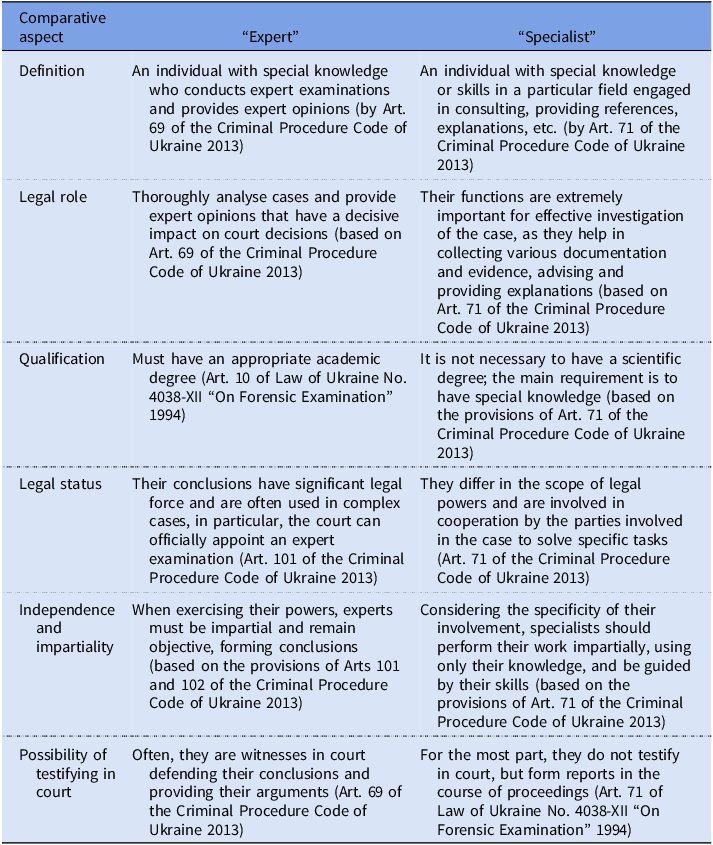
To clearly understand the difference between experts and specialists, it is important to understand their roles in criminal proceedings (see Table 1). Both experts and specialists play a key role: if experts provide detailed analysis and provide conclusions, then specialists are responsible for the proper application of knowledge in technical aspects in the process of investigative actions. The result of their interaction is to ensure the objectivity and thoroughness of criminal proceedings and judicial proceedings, which ultimately helps the administration of justice.
Comparison of the concepts of “expert” and “specialist” in criminal proceedings

Source: created by the authors based on the Criminal Procedure Code of Ukraine (2013) and Law of Ukraine No. 4038-XII “On Forensic Examination” (1994).
To ensure the protection of the legal personality of experts and specialists in the course of criminal proceedings, procedural guarantees of their rights are established, which are consolidated in the legislation of Ukraine, in particular the Criminal Procedure Code of Ukraine (2013). Thus, Part 3 of Article 69 defines the following rights of an expert during the exercise of his powers, including during the collection and use of documents as sources of evidence:
-
• To become acquainted with information on the criminal investigation concerning its subject;
-
• To ask questions about the objects and subject of research;
-
• To be present during the execution of all procedural measures concerning the objects and subjects of research;
-
• To submit a request for obtaining additional materials necessary for the examination and to carry out other measures aimed at ensuring the examination;
-
• To indicate in conclusion about the circumstances established by the expert examination, which are essential about the criminal;
-
• To apply for security measures, if necessary;
-
To receive remuneration and reimbursement of expenses caused by the performance of the expert examination and involvement in the judicial process to provide explanations or evidence, except in cases where the performance of the expert examination is not part of the official powers of the person involved as an expert;
-
• To exercise other rights provided for by the Law of Ukraine “On Forensic Examination”.
In addition, Article 6 of Law of Ukraine No. 4038-XII “On Forensic Examination” (1994) establishes the right of an expert to unhindered access to the object under study and proper working conditions, in the case of conducting an expert examination at the place of commission of an offence or the location of the object of the offence. In particular, Article 13 assigns additional rights to the expert: to challenge the actions of the person conducting the proceedings in the case of violation of the rights of the expert by such actions; and to conduct expert research based on a contract with legal entities and individuals on issues in which they are interested, in compliance with the restrictions provided for by law.
While the procedural guarantees of the rights of specialists are enshrined in Part 4 of Article 71 of the Criminal Procedure Code of Ukraine (2013), the specialist has the right:
-
• To use the necessary technical devices and special equipment during the proceedings;
-
• With the permission of the party in the criminal proceedings that attracted the specialist, or the court, to ask questions to the parties to the proceedings;
-
• To focus special attention on specific circumstances or features of things and documents;
-
• To indicate information related to criminal proceedings, and in respect of which no questions were raised. However, the expert’s conclusion must not be evidence in a court case (Babikov Reference Babikov2024; Shablystyi and Anisimov Reference Shablystyi and Anisimov2021);
-
• To get acquainted with the protocols of investigative actions in which they participated, and make comments and additions to them;
-
• When conducting a pre-trial investigation of a criminal offence, provide conclusions within their competence;
-
• To provide certificates and conclusions within the limits of their powers to establish the identity, ammunition, weapons, explosive devices and substances found as a result of an explosion or traces of gunpowder, as well as psychotropic and narcotic substances, their analogues and strong medicines;
-
• To apply for the establishment of security measures;
-
• To receive pay for the work performed and for reimbursement of the costs of research (Shramko Reference Shramko2024);
-
• To provide information on issues within their area of expertise in cases provided for in Part Three of Article 245-1 of the Code.
These procedural rights have a direct guarantee of access to the collection and use of documents as sources by experts and specialists. Most important, however, is that they have the right of access to any documents and materials related to the conduct of the study. However, experts are given more access to this, which applies to the study of original documents, since the expert directly conducts an independent study to obtain new evidence. This access is key to authenticating and performing correct analysis. In addition, experts and specialists have access to electronic evidence, which enables the collection of information from various electronic sources. This includes using social media, email and other online platforms if they comply with legal standards regarding evidence collection (Ukrainian Judiciary 2022).
Guarantees of ensuring the availability of evidence and the collection and use of documents as sources of evidence by experts and specialists in criminal proceedings in Ukraine are aimed at preserving the integrity of the judicial system and simultaneously guaranteeing the effectiveness and reliability of expert and specialist conclusions. In general, the procedural rights guaranteed to experts and specialists in criminal proceedings are designed to ensure proper access to evidence, independence and respect for professional integrity.
Speaking about ensuring the procedural rights of experts and specialists in EU law, Article 47 of the Charter of Fundamental Rights of the European Union (European Union 2012) stipulates that everyone has the right to obtain an effective remedy in court proceedings, including legal advice. In particular, the consideration of the case should be open and fair. The Article highlights the importance of ensuring full legal protection, which includes the involvement of experts and specialists who play a key role in criminal proceedings since these specialists are endowed with special knowledge and skills that help them in establishing new circumstances in the case.
However, unlike the legislation of Ukraine, some EU member states do not distinguish between the concepts of “expert” and “specialist”, but use these terms as synonyms. For example, there is no official definition of “expert” in Dutch criminal law, but a judge can invite any person with a deeper knowledge of a particular topic as an expert. This confirms the lack of distinction between specialists and experts. There is a similar situation with differentiation in Belgium; in particular, if there is a need for a special examination, a specialist can be involved, without clearly defining the differences between a specialist and an expert. In particular, experts may be appointed by the court based on their qualifications and experience in the relevant field. In addition, French legislation also does not have such a distinction, and, if necessary, an expert acts as a person with special knowledge (European Criminal Bar Association 2024). Thus, such a lack of differentiation between specialists and experts in different EU states indicates a pragmatic approach to legal proceedings. In particular, it simplifies the involvement of specialists in criminal proceedings because, in such legal systems, any highly qualified person with relevant knowledge has the right to be an expert (Christensen Reference Christensen2023).
The main legal act of the EU that establishes and protects the procedural rights of experts is the Guidelines on the Role of Court-Appointed Experts in Judicial Proceedings of the Council of Europe’s Member States (European Commission for the Efficiency of Justice 2014). Thus, according to Article 109, an expert has the right to expect to receive instructions on how to draw up an expert opinion. They can also receive information and recommendations regarding the expert’s personal and procedural powers. It is important that, if necessary and at the request of the expert, the judge should help them to obtain more accurate conclusions about the investigation.
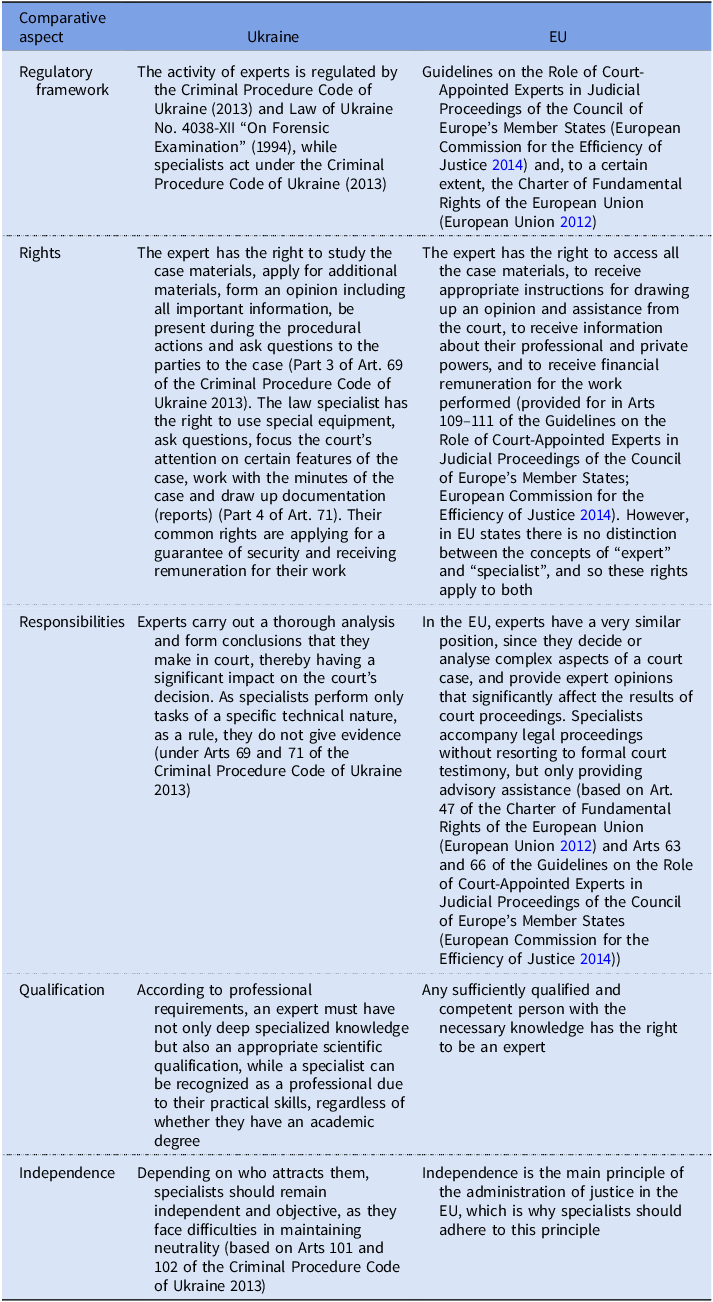
Article 110 of the Guidelines, in turn, establishes the full accessibility of the expert regarding the materials of criminal proceedings, and their access to the subject and object of the case, and the place of commission of the offence, which requires expert research. Thus, the expert has the right to receive a copy of the original resolution on requesting evidence or a power of attorney to conduct an expert examination. If the expert is not allowed to review this document, they may be unable to provide an expert opinion. Furthermore, Article 111 sets out a recommendation that the court send a copy of the decision on the case to the expert who was directly involved, to establish feedback. In general, the legislative consolidation of the activities of experts (specialists) in criminal proceedings in the EU demonstrates an integrated approach aimed at ensuring effective compliance with the law and guaranteeing the protection of fundamental human rights (in particular, the right to a fair trial). Key regulations establish rules on the use and admissibility of expert opinions (Table 2).
Comparison of legal regulation of rights and requirements for experts and specialists in Ukraine and the European Union (EU)

Source: created by the authors based on the Criminal Procedure Code of Ukraine (2013), Law of Ukraine No. 4038-XII “On Forensic Examination” (1994), Charter of Fundamental Rights of the European Union (European Union 2012) and Guidelines on the Role of Court-Appointed Experts in Judicial Proceedings of Council of Europe’s Member States (European Commission for the Efficiency of Justice 2014).
The results of the comparative analysis show that, although both Ukraine and the EU recognize the importance of experts and specialists in criminal proceedings, there are significant differences in their regulatory frameworks, rights and obligations, and functioning. In particular, the Criminal Procedure Code of Ukraine (2013) regulates their functional duties and rights within the framework of Ukrainian legislation. Meanwhile, the EU relies on a set of relevant legislation that allows member states to exercise flexibility in dealing with these issues.
Discussion
Procedural support of the rights of experts and specialists in the collection and use of documents as sources of evidence in criminal proceedings is becoming increasingly important in the current legal discourse, particularly in Ukraine. The need to comply with the norms of Ukrainian legislation and EU standards determines the need to form a reliable regulatory framework that ensures the effective involvement of experts and specialists in the proof process. The current research highlights various challenges facing the defence, including restrictions on attracting experts and gaining access to the necessary documents. This, in turn, violates the principle of the adversarial nature of the parties in criminal proceedings. Although the Criminal Procedure Code of Ukraine (2013) establishes equal rights for all parties, in practice, there are often obstacles that limit the ability of the defence party to enjoy these rights fully. Moreover, the lack of a clear interpretation of the concept of “special knowledge” in the legislation of Ukraine also makes it difficult to attract experts and specialists. Ultimately, such a definition does not properly take into account the importance of their role in establishing a reasonable position on the case.
Rohatynska and Pidhorodetska (Reference Rohatynska and Pidhorodetska2022) considered the position of specialists in criminal proceedings, with an emphasis on their role and rights in the legislation of Ukraine. The researchers examined the procedural guarantees provided for specialists, pointing out the importance of ensuring a fair trial and the effectiveness of involving specialists in the judicial process. The researchers found that although specialists play an important role in criminal proceedings, their powers and legal status are not clearly defined in the current legislation. This leads to potential problems that prevent the effective involvement of specialists in procedural actions. The researchers highlighted the need for clearer legislative provisions to strengthen the protection of specialists’ rights and improve the overall integrity of criminal proceedings.
Nevertheless, the current study was devoted to procedural guarantees that directly relate to the rights of experts and specialists when collecting documents and using them as evidence in criminal proceedings. In both the current study and that of Rohatynska and Pidhorodetska (Reference Rohatynska and Pidhorodetska2022), the importance of procedural rights was noted, but Rohatynska and Pidhorodetska (Reference Rohatynska and Pidhorodetska2022) primarily focused on determining the status and authority of specialists. However, in the current study, emphasis was placed on the procedural aspects that regulate the rights of specialists in handling evidence. The main similarity of research is the recognition of the key role of a specialist in the judicial investigation process, since it is with the help of a specialist that it is possible to find out new circumstances of the case and its features. However, the current study examined in more detail the consequences of procedural actions and the specifics of the legal framework regulating the activities of experts, among other things. This allows us to obtain a more complete picture of the rights of both experts and specialists in criminal proceedings.
Lukyanchikov, Lukyanchikov, and Mykytenko (Reference Lukyanchikov, Lukyanchikov and Mykytenko2023) considered the relationship between expert opinions and specialist opinions in criminal proceedings. The researchers analysed the procedural regulatory framework governing the use of special knowledge in investigations, considering the development of such practices during historical periods. They noted differences in the qualification requirements for experts and specialists and concluded that, although their conclusions may be consistent under certain conditions, they cannot be identified due to differences in regulatory requirements. The researchers proposed amendments to the current legislation to improve the reliability of evidence obtained through expert conclusions in criminal cases. Both the current study and Lukyanchikov et al. (Reference Lukyanchikov, Lukyanchikov and Mykytenko2023) highlighted the crucial role of the use of special knowledge and skills in criminal proceedings, and also stressed the importance of clear procedural rules for protecting the rights of involved participants in the process (expert and specialist). While the study by Lukyanchikov et al. (Reference Lukyanchikov, Lukyanchikov and Mykytenko2023) was devoted to the comparative analysis of the activities of an expert and a specialist, the current study examined in more detail the procedural guarantees concerning the collection of documents and their use in proof. The current study is consistent with the findings of Lukyanchikov et al. (Reference Lukyanchikov, Lukyanchikov and Mykytenko2023), particularly in establishing legal clarity. However, the current study defines a broader context, since it contains an analysis of the provisions of not only Ukraine but also EU legislation, which makes it possible to obtain a more complete picture of procedural rights in criminal proceedings.
Gillett and Fan (Reference Gillett and Fan2023) studied the introduction of electronic information from open resources as a form of expert evidence in court proceedings. The researchers considered problematic issues and opportunities that arise in connection with the use of this type of expert evidence, primarily regarding their reliability and admissibility in court. The researchers found that despite the possibility of expanding the scope of evidence through the use of digital data from open sources, it is necessary to provide strict procedural guarantees to ensure their reliability and proper use in legal proceedings. Comparing the current study and that of Gillett and Fan (Reference Gillett and Fan2023) revealed several common features and differences. Thus, they both emphasize the importance of ensuring the rights of experts and the reliability of evidence. However, the research by Gillett and Fan (Reference Gillett and Fan2023) focused specifically on information from electronic open sources, while the current study included a wider range of types of evidence in Ukrainian legislation (in particular, documents as sources of evidence). In addition, the study by Gillett and Fan (Reference Gillett and Fan2023) highlighted international best practices in the integration of electronic evidence, while the current study examined the specific legal provisions of Ukraine and the EU regulating the rights of experts and specialists in criminal proceedings. Consistency between the two studies highlights the need to establish a solid legal framework to ensure the integrity of expert opinions in a legal context.
Makarova (Reference Makarova2024) conducted a comprehensive analysis of international experience in the use of expert opinions in criminal proceedings. Based on the analysis of legal norms and court cases, the researcher identified the most effective methods for integrating expert opinions into the judicial process. The study emphasized the particular importance of procedural safeguards to ensure the reliability of expert opinions. In addition, the researcher stressed the need for clear guidelines governing the role of criminal experts, especially concerning the rights of the accused and the integrity of the judicial system. For comparison, the current study focused on procedural guarantees for experts and specialists during the collection of evidence in the criminal process of Ukraine. Both the current study and that of Makarova (Reference Makarova2024) recognized the critical role of expert opinions in improving the evidence base presented in court. However, while Makarova (Reference Makarova2024) focused on international practice, the current study examined the legislative context in Ukraine and its approximation to European standards. The emphasis on the procedural rights of experts in the current study was consistent with the findings of Makarova (Reference Makarova2024) on the need to protect expert integrity and respect for the principles of a fair trial.
Mamatkulova (Reference Mamatkulova2023) investigated the fundamental principles and characteristics of proof in criminal proceedings. The researcher considered mechanisms for ensuring the rights of parties, paying special attention to how these mechanisms contribute to the collection and evaluation of evidence. The researcher concluded that a strong legal system for providing procedural guarantees is a necessary condition for respecting the rights of all parties involved in criminal proceedings. When comparing this study with the current research on procedural guarantees for experts and specialists in Ukraine, several similarities and differences were identified. Both the current study and that of Mamatkulova (Reference Mamatkulova2023) emphasized the importance of respecting individual rights in criminal proceedings in the context of their protection. However, unlike the study by Mamatkulova (Reference Mamatkulova2023), which mainly concerned the basic principles of proof, the current study specifically focused on the rights of experts and specialists in the collection of evidence. The current study is consistent with the findings of Mamatkulova (Reference Mamatkulova2023) because it confirms the importance of legal protection to ensure proper treatment and ensure justice during criminal investigations.
In general, the analysis of the above-mentioned research helped to establish general aspects on ensuring the procedural rights of experts and specialists, in particular when collecting and using documents as sources of evidence in criminal proceedings, and the need to comply with these rights. Especially, the key role of participation of experts and specialists in criminal proceedings was established due to the specifics of their knowledge and ability to determine new circumstances of the case. The research also focused on the need to improve the regulatory framework of Ukraine to ensure better protection of the rights of specialists and experts in the exercise of their powers.
Conclusions
Procedural guarantees of experts and specialists are crucial in the process of deciding on criminal proceedings. Thus, an expert is a person who is endowed with professional knowledge and is authorized to conduct a forensic examination in a criminal investigation. In contrast, a specialist is also a person who has special knowledge, which should be applied mainly to clarify the course of the investigation. This is the key difference between their roles and functions – the expert is directly involved in the production and conducts their own, independent investigation, and the specialist helps the investigation by providing special knowledge.
In criminal proceedings in Ukraine, experts have the right to conduct independent investigations and present their conclusions as evidence. They have access to all necessary materials and documents related to the examination to ensure the effective performance of their powers. According to the Criminal Procedure Code of Ukraine (2013), experts are involved in the proof process, which allows them to provide conclusions at the court session. In addition, they have the right to receive remuneration for their services provided, which is necessary to ensure the integrity of their work. Expert opinions are recognized as separate sources of evidence, which significantly affects the course of criminal proceedings.
Unlike experts, specialists have a more limited role in criminal proceedings, since in most cases they apply their professional knowledge and skills instead of conducting independent investigations. They are allowed to participate in the collection and analysis of evidence, but do not have the authority to provide independent opinions (they are additional). Specialists are required to cooperate with investigators and prosecutors, advising them based on their own experience and knowledge. Their involvement is key to clarifying the technical aspects of the case, ensuring that the evidence is correctly interpreted. Although specialists have valuable knowledge, they must act within the limits established by law and cannot act independently as experts.
This study can make a significant contribution to further enquiry of the issue of procedural guarantees of the rights of an expert and specialist in the collection and use of documents as sources of evidence in criminal research. In particular, this study has identified the basic rights of an expert and a specialist that should be protected during the exercise of their powers in the course of criminal proceedings.
The limitation of this study was the analysis of legislation on the protection of the rights of experts and specialists in criminal research only in Ukraine and the EU. Prospects for further research are to analyse the experience of more countries, in particular the United Kingdom, the US and China, which are the world’s leading countries.
Competing interests
The authors declare that there are no conflicts of interest.
Viktor Sezonov is a Deputy Head and a PhD at the Department of Forensic Processing of Vehicles and Maintenance of Register, Kharkiv Scientific Research Forensic Center of the Ministry of Internal Affairs of Ukraine.
Oleksandr Yukhno is a Professor and a full doctor at the Department of Criminal Procedure, Forensics and Expertology, Kharkiv National University of Internal Affairs.
Alina Poddubna is an Associate Professor and a PhD at the Department of Criminal Procedure and Organization of Pre-trial Investigation, Kharkiv National University of Internal Affairs.
Oleksandr Voronyi is an Associate Professor and a PhD at the Department of Criminal and Legal Disciplines, Dnipro State University of Internal Affairs.
Olena Shablysta is a postgraduate student at the Department of Criminal Law and Criminology, Dnipro State University of Internal Affairs.