Introduction
As highlighted in the recently published fourth Edition of the National Consensus Project Guidelines for Quality Palliative Care (National Consensus Project for Quality Palliative Care, 2018), family caregivers represent a central consumer of palliative and hospice care services alongside patients. Due in part to the critical roles they play in performing daily healthcare and other tasks for individuals with serious illness from diagnosis to end of life (Dionne-Odom et al., Reference Dionne-Odom, Hooker and Bekelman2017; National Alliance for Caregiving, 2016), family caregivers can experience strain from the burden of caring for someone highly dependent on their support (National Academies of Sciences, 2016; National Alliance for Caregiving and AARP Public Policy Institute, 2015; Ornstein et al., Reference Ornstein, Kelley and Bollens-Lund2017). Thus, family caregivers are in need of specialized palliative and hospice care support.
Despite palliative care's rapid growth, access to palliative care has still not met the need for services by both patients and their family caregivers. Over the past two decades, the use of specialty palliative care has been endorsed by numerous organizations (Ferrell et al., Reference Ferrell, Temel and Temin2017; Mularski et al., Reference Mularski, Reinke and Carrieri-Kohlman2013; National Academy of Medicine, 2016) and has proliferated in U.S. hospitals (Center to Advance Palliative Care, 2015; Dumanovsky et al., Reference Dumanovsky, Augustin and Rogers2016), long-term care (Miller et al., Reference Miller, Lima and Intrator2016), and community-based settings (Lustbader et al., Reference Lustbader, Mudra and Romano2016). Yet, the Center to Advance Palliative Care's 2015 State-by-State Report Card (2015) shows there are large sections of the United States that do not have access to palliative care services. Reported barriers to palliative care access and delivery have included an inadequate workforce with expertise in palliative care (Kamal et al., Reference Kamal, Bull and Swetz2017), heterogeneity in what kinds of palliative care services are available in different localities (Ahmed et al., Reference Ahmed, Bestall and Ahmedzai2004), and misaligned financial incentives (National Academy of Medicine, 2016). Another potential barrier to poor penetration of palliative care into the greater U.S. population includes a lack of awareness and education about access and benefits of palliative care among patients and their families (Ahmed et al., Reference Ahmed, Bestall and Ahmedzai2004; Center to Advance Palliative Care, 2011; Koffman et al., Reference Koffman, Burke and Dias2007; Manu et al., Reference Manu, Mack-Biggs and Vitale2013; Ornstein et al., Reference Ornstein, Schulz and Meier2017). A 2011 national telephone public opinion survey found that 70% of 800 respondents had no knowledge of palliative care (Center to Advance Palliative Care, 2011). Patients and their families who have never heard of palliative care services may be less likely to request such services from providers. Conversely, providers offering palliative care may be met with reservation by patients and families who are unfamiliar with what the service offers.
Prior research on palliative care public awareness has largely focused on the general lay public, clinicians, and patients (Center to Advance Palliative Care, 2011; Koffman et al., Reference Koffman, Burke and Dias2007; Kozlov et al., Reference Kozlov, Reid and Carpenter2017, Reference Kozlov, McDarby and Reid2018). However, little is known about how much family caregivers of adults with serious illnesses are aware of these services and what their perceptions are of what palliative care offers. Understanding palliative care from this perspective is critical because family caregivers are often involved in patient medical decisions throughout the course of serious illness, including decisions about treatments and services (Garvelink et al., Reference Garvelink, Ngangue and Adekpedjou2016; Lamore et al., Reference Lamore, Montalescot and Untas2017). A better understanding of caregiver perception of palliative care could prove useful to ongoing efforts to monitor and improve access and quality of hospice and palliative care. To address this gap, we performed the first analysis of population-based U.S. data to describe the awareness of family caregivers about palliative care.
Methods
We used 2018 population-based data collected by the National Cancer Institute Health Information National Trends Survey (HINTS) (Hesse et al., Reference Hesse, Greenberg and Peterson2017). This survey has been conducted annually since 2001 to ascertain the cancer communication and information finding habits of the U.S. population; in 2018, HINTS included questionnaire modules that asked about family caregiving and awareness and perceptions of palliative care. Using these data, we addressed the following research questions:
1. What proportion of U.S. family caregivers are aware of “palliative care”?
2. Are there sociodemographic groups of family caregivers who are less likely to have heard of “palliative care”?
3. What are family caregivers’ perceptions of common beliefs about palliative care (e.g., “Palliative care is the same as hospice,” “When I think of palliative care, I automatically think of death”)?
Caregivers were identified as those individuals who endorsed “caring for or making health care decisions for someone with a medical, behavioral, disability, or other condition” who was an adult. Individuals who claimed to be professionally employed caregivers were further excluded, for a total sample of 311 respondents. Additional information about the survey design and administration, the complete questionnaire, and publicly accessible complete data sets can be found at https://hints.cancer.gov/.
Measures
Outcome variables
Awareness of palliative care was measured using the single item: “How would you describe your level of knowledge about palliative care?” Response options included: “I've never heard of it,” “I know a little bit about palliative care,” and “I know what palliative care is and could explain it to someone else.” Respondents who stated they had heard of palliative care (regardless of their level of knowledge) (n = 138) were subsequently asked five items asking about perceptions of palliative care: 1) “Accepting palliative care means giving up”; 2) “It is a doctor's obligation to inform all patients with cancer about the option of palliative care”; 3) “If you accept palliative care, you must stop other treatments”; 4) “Palliative care is the same as hospice”; and 5) “When I think of ‘palliative care,’ I automatically think of death”. Response options included: strongly agree, somewhat agree, somewhat disagree, strongly disagree, and don't know. Survey items on perceptions of palliative care were adapted from other previous surveys administered in multiple countries (Claxton-Oldfield et al., Reference Claxton-Oldfield, Claxton-Oldfield and Rishchynski2004; Hesse et al., Reference Hesse, Greenberg and Peterson2017; Higginson et al., Reference Higginson, Gomes and Calanzani2014; Hirai et al., Reference Hirai, Kudo and Akiyama2011; Shimizu et al., Reference Shimizu, Nishimura and Ishii2016). Items were refined based on cognitive testing with caregivers and noncaregivers before final survey administration (Hesse et al., Reference Hesse, Greenberg and Peterson2017; National Cancer Institute, 2018).
Sociodemographic predictor variables
Respondents reported basic demographic and social characteristics including age, gender, race, education, rural/urban residence, household income, employment status, marital status, care recipient condition (i.e., “Select all that apply: cancer, Alzheimer's/dementia, orthopedic/musculoskeletal issues, mental health and substance abuse issues, chronic conditions, neurologic/development injuries, acute conditions, age related health issues, other”), caregiving hours/week, and caregiving duration. Urban/rural status was determined from Rural Urban Commuting Area codes based on respondent residential address.
Statistical analysis
The dataset contained sample weights that consist of household-level base weights, adjust for household nonresponse, and include and calibrate for person-level weights to population counts for population-level point estimates (National Cancer Institute, 2018). Descriptive statistics were tabulated for demographics using these analytic weights to calculate population estimates. Univariate logistic regression was used to examine individual demographic characteristics associated with palliative care awareness. Next, we ran an adjusted logistic regression models were used to regress palliative care awareness (dichotomized as never having heard vs. having heard of palliative) on select sociodemographic predictor variables based on the literature (gender, race, education, urban/rural residence, caregiver-patient relationship, and hours/week caregiving). All analyses adjusted for HINTS survey weights. All analyses accounted for complex survey design and were completed using SAS, version 9.4 (SAS Institute, Cary, NC), and SAS-callable SUDAAN, version 11.0.0 (RTI International, Research Triangle Park, NC).
Results
Demographics
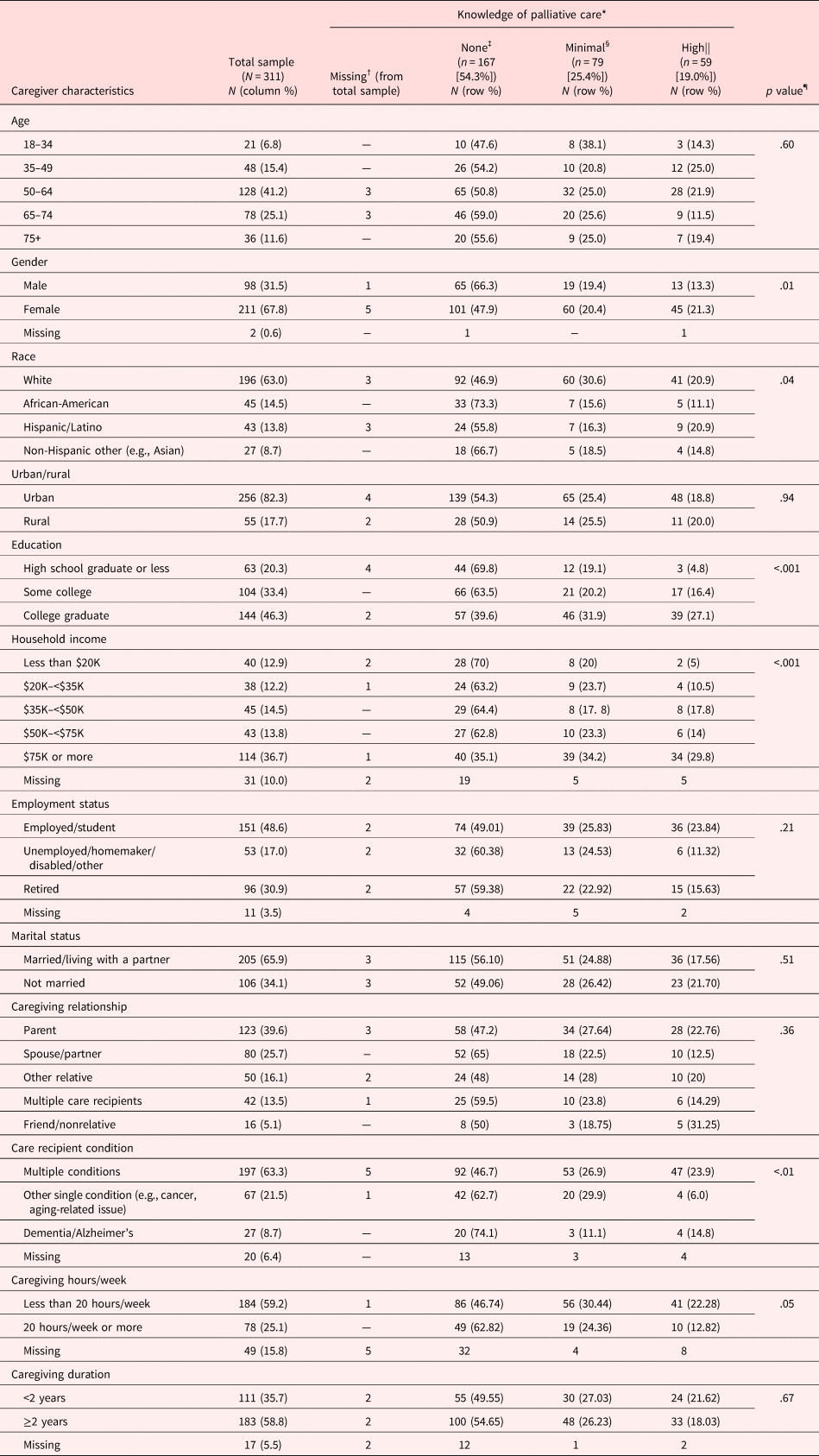
The demographics of the sample are shown in Table 1. Using weighted estimates, family caregiver respondents (N = 311) represented approximately 22,669,529 individuals nationally in 2018. The majority were age 50+ (77.9%), female (68%), white (63%), college graduates (46%), married/living with a partner and caring for individuals with multiple serious health conditions (63%). Approximately one-quarter of caregivers provided support >20 hours/week and nearly 60% had been caregiving for more than two years (58.8%).
Family caregivers’ demographics and knowledge of palliative care

* Verbatim survey item: “How would you describe your level of knowledge about palliative care?”
† In the vertical “Missing” column, there were 6 total missing caregiver respondents who did not respond to any items about their knowledge of palliative care. The horizontal “Missing” rows denote individuals who may have responded to knowledge of palliative care items but who did not respond to the particular demographic item. The exception is if they both did not respond to the demographic item and also did not respond to the palliative care knowledge item (denoted where the “Missing” column and row intersect).
‡ Verbatim survey item: “I've never heard of it.”
§ Verbatim survey item: “I know a little bit about palliative care.”
|| Verbatim survey item: “I know what palliative care is and could explain it to someone else.”
¶ Fisher's exact or Pearson's chi-square test.
Differences in awareness of palliative care
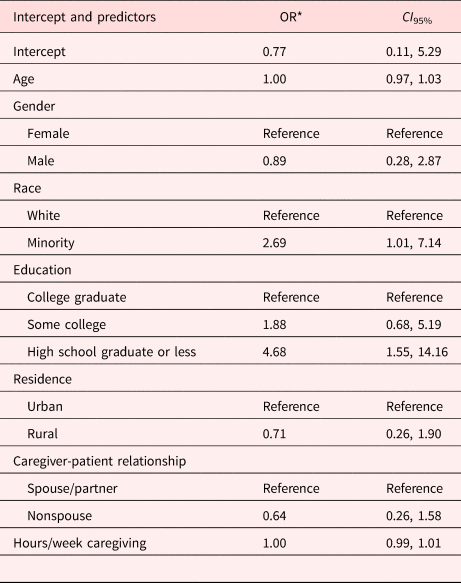
The majority of caregivers (54.3%) had never heard of palliative care (Table 1). Bivariate analyses of sociodemographic characteristics showed statistically significant differences in having heard of palliative care by gender, race, education, household income, and care recipient condition (all p < 0.05). Higher proportions of males (66.3%), minorities (55.8–73.3%), those with some college or less of education (63.5–69.8%), those making $75K or less in income (62.8–70%), and those caring for individuals with a single health condition (62.7–74.1%) endorsed never having heard of palliative care. As shown in Table 2, a multivariable logistic model that included age, gender, race, education, residence, and caregiver-patient relationship found that being non-white (vs. being white) and having a high school education or less (vs. being a college graduate) were significantly more likely to have never heard of palliative care.
Family caregiver demographic predicting never having heard of palliative care

OR, odds ratio; CI 95%, 95% confidence interval.
* Adjusted OR are from fully adjusted models (all covariates in the table included), R 2 = .11.
Differences in perceptions of palliative care
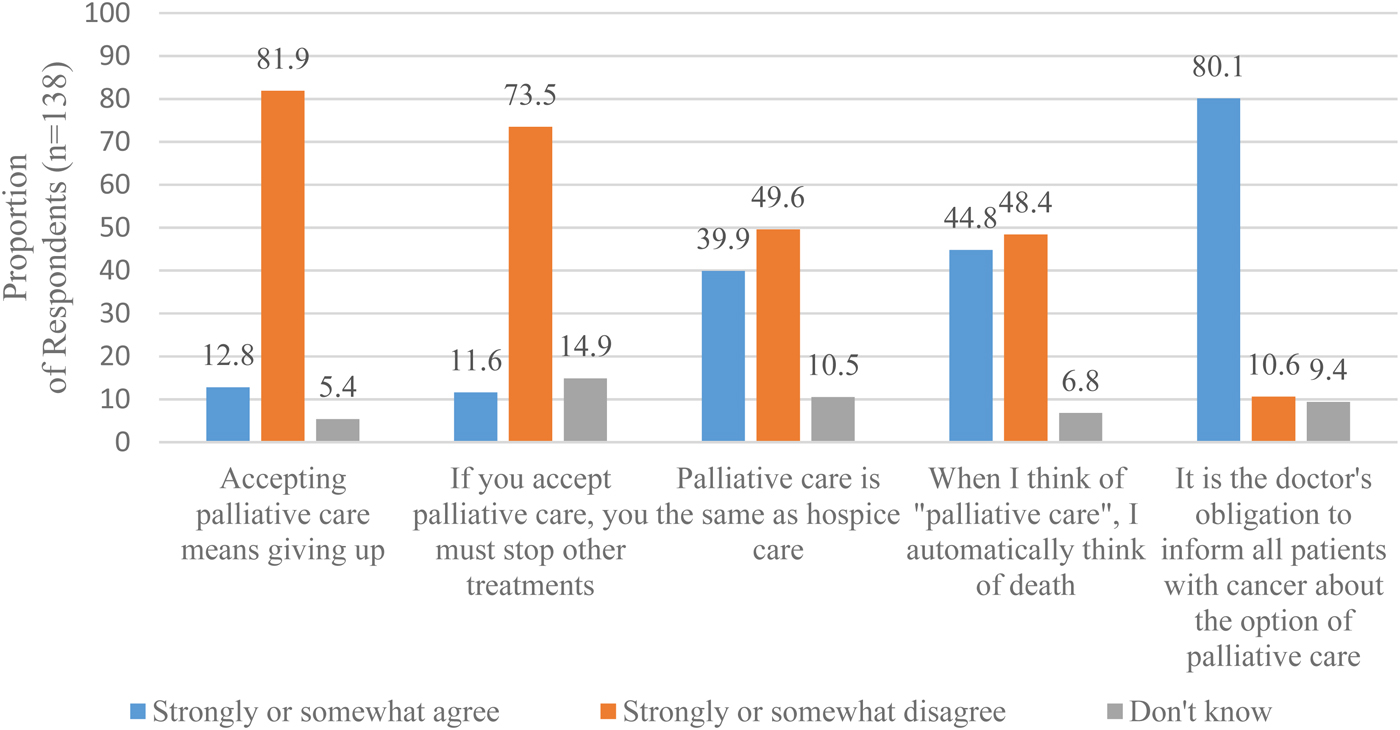
Differences in perceptions of palliative care among those having heard of palliative care (n = 138) are shown in Figure 1. More than 80% (81.9%) of those who had heard of palliative care (n = 138) somewhat or strongly disagreed with the statement, “Accepting palliative care means giving up.” A similar proportion (73.5%) somewhat or strongly disagreed with the statement, “If you accept palliative care, you must stop all treatments.” Nearly one-half (49.6%) of respondents somewhat or strongly disagreed that “Palliative care is the same as hospice care”; however, nearly 40% (39.9%) somewhat or strongly agreed with this statement and 10.5% didn't know. More than 40% (44.8%) somewhat or strongly agreed with the statement: “When I think of ‘palliative care’, I automatically think of death.” Most respondents strongly or somewhat agreed (80.1%) that “It is the doctor's obligation to inform all patients with cancer about the option of palliative care.”
U.S. family caregiver perceptions of palliative care (among those “having heard of palliative care”).

Discussion
Using data from the National Cancer Institute's 2018 HINTS population-based survey, we report for the first time the proportion of U.S. family caregivers who are aware of palliative care, highlighting some key pervasive misperceptions about palliative care. In a sample representing 22,669,529 U.S. family caregivers of adult care recipients, we found that more than one-half of family caregivers in 2018 had never heard of palliative care, and this was more likely for African-Americans, Hispanic/Latinos, and other racial minorities and those with less than a college education. We also found that among those aware of palliative care, many endorse misperceptions of its role, such as equating it with hospice care. These findings are consistent with prior studies focusing on patients (Center to Advance Palliative Care, 2011; Kozlov et al., Reference Kozlov, Reid and Carpenter2017, Reference Kozlov, McDarby and Reid2018), which find a general lack of palliative care understanding among patients and the general lay public. Our work expands upon this research by finding this lack of awareness extending to family caregivers who are often the most diligently involved in the day-to-day care and healthcare decision-making of the seriously ill.
Lack of awareness of palliative care may not be surprising among caregivers who have only had a brief tenure in the role. Just over one-third of the sample had been serving as a caregiver less than two years and nearly 60% reported providing care for less than 20 hours per week. To put this caregiving intensity into perspective, the National Alliance for Caregiving reported the average caregiving duration in 2015 to be 4.6 years and 24.4 hours week (National Alliance for Caregiving and AARP Public Policy Institute, 2015). Furthermore, these caregivers are identified via a national sample and may not be caring for patients with life-threatening or advanced illness requiring palliative care. We do not know what opportunity these caregivers have had to interact with their healthcare systems and learn about palliative care across settings. The HINTS survey did not capture detailed data about patient diagnoses or illness severity, and hence, we cannot examine the impact of care recipient illness severity on caregiver perceptions of palliative care. However, given that palliative care services are “appropriate at any age and stage of illness” (National Consensus Project for Quality Palliative Care, 2018), we believe concerted efforts are nonetheless warranted to increase public awareness of its services.
In our multivariable analysis, palliative care awareness was lower among caregivers who were African-American and who had less than a college education. Studies have consistently observed lower utilization of palliative care services among these demographic groups (Faigle et al., Reference Faigle, Ziai and Urrutia2017; Johnson, Reference Johnson2013; Rizzuto & Aldridge, Reference Rizzuto and Aldridge2018) and, when accessed, it is often in the last weeks to days of life (Sharma et al., Reference Sharma, Cameron and Chmiel2015). Furthermore, African-Americans and other racial minorities and those with less education receive more aggressive curative treatments and intensive hospital-based care at end of life (Barnato et al., Reference Barnato, Berhane and Weissfeld2006, Reference Barnato, Anthony and Skinner2009; Brown et al., Reference Brown, Engelberg and Sharma2018; Johnson, Reference Johnson2013; Johnson et al., Reference Johnson, Kuchibhatla and Tulsky2008, Reference Johnson, Kuchibhatla and Payne2013), which are trends that are less likely when palliative care services are involved earlier in the illness trajectory (Scibetta et al., Reference Scibetta, Kerr and Mcguire2016). We believe our results raise the possibility that part of the reason racial minorities and those with less educational attainment do not avail themselves of palliative care services are that family caregivers and the patients they support have simply not been informed about them. Future work is needed to clarify why these demographic groups are less aware of palliative care. Furthermore, clinicians should consider higher vigilance to introduce the term “palliative care” and the services it affords when patients and their families are initially diagnosed with a new advanced serious illness.
Among those family caregivers who had heard of palliative care, there were several perceptions of palliative care that most respondents appeared to have understandings consistent with professional consensus: >80% disagreed that “Accepting palliative care means giving up”, ~74% understood that accepting palliative does not mean that other treatments have to be stopped, and ~80% believed that the doctor has an obligation to inform patients about palliative care. However, there were some statements in which much larger proportions of caregivers appeared to have misperceptions. About one-half of respondents either agreed or did not know whether palliative care was the same as hospice. Roughly the same proportions thought about death when they thought about palliative care. One potential explanation for this is that it is possible that many caregivers in this sample may have only been exposed to palliative care in the form of hospice services, wherein curative treatments are typically not covered by the Medicare hospice benefit. Regardless, continued messaging efforts are needed that clarify the distinction between palliative care and hospice care and that do so earlier in the illness trajectory.
Leading this effort in the United States include palliative care advocacy organizations, most notably the Center to Advance Palliative Care (www.capc.org), which has conducted marketing research to develop messaging efforts that effectively convey what palliative care is and what its services entail, thereby broadening the scope of palliative care from end-of-life care to serious illness care. In addition, there is growing research suggesting that simple education appears to enhance understanding about and desire for palliative care. A randomized intervention trial by Kozlov et al. (Reference Kozlov, Reid and Carpenter2017) of 152 adult laypersons found that a brief 3-minute video or an information sheet about palliative care significantly improved knowledge of palliative care compared with controls. A prepost between-group randomized web-based experiment with 598 cancer patients led by Hoerger et al. (Reference Hoerger, Perry and Gramling2017) found that presenting a brief graphical and plain-language summary of an early palliative care study (Temel et al., Reference Temel, Greer and Muzikansky2010) resulted in intervention group participants having a higher preference for early, outpatient palliative care. Further work is needed to test these types of brief awareness raising and knowledge enhancing interventions with family caregivers and to further examine if such interventions ultimately lead to higher and earlier palliative care service utilization.
There are several limitations to note for this study. We do not know to what degree participants already had actual exposure to palliative and/or hospice care services. We also have limited information about the care recipient's medical condition and illness severity and hence we are unable to ascertain what differences there may be in palliative care awareness and knowledge by disease type. We combined the groups who had “minimal” and “high” levels of knowledge about palliative care despite it being unclear how respondents were interpreting these items. Ultimately, we do not know what people's level of knowledge was about palliative care and its services. Relatedly, several of the statement prompts about palliative care perceptions, despite being subject to cognitive testing, may be open to wide interpretation and thus the reader is cautioned about over-extrapolating popular perceptions of palliative care (Willis & Artino, Reference Willis and Artino2013).
In conclusion, this study is the first to provide a representative snapshot of how aware and how knowledgeable family caregivers are of palliative care. Our results suggest that half of U.S. family caregivers have never heard of palliative care and for those that have, many have misperceptions that equate it with hospice and death and dying. Family caregiver awareness and perceptions of palliative care may help increase acceptance and access to timely palliative care by patients; conversely, lack of awareness and misperceptions may prove to be a barrier for patients receiving palliative care until the final weeks and days of life. Given the potential role family caregivers may play in decisions to access palliative care, renewed public messaging efforts are needed to clarify palliative care services using a patient- and family-centered approach.
Author ORCIDs
J. Nicholas Dionne-Odom, 0000-0001-6764-0254; Erin E. Kent, 0000-0003-2503-2191.
Acknowledgments
Dr. Dionne-Odom is funded by the National Institute of Nursing Research (R00NR015903) and by the National Cancer Institute (R01CA229197). Dr. Ornstein is funded by the National Institute on Aging (K01AG047923 and R01AG060967) and the National Palliative Care Research Center.
Disclaimer
The findings and conclusions in this report are those of the authors and do not necessarily represent the official position of the National Cancer Institute, the National Institutes for Health, or the US Department of Health and Human Services.