Introduction
Although smoking prevalence has steadily declined in the United Kingdom (UK), approximately 21% of adults currently smoke (Lader, Reference Lader2009) and marked differences according to level of deprivation persist with 32% of men and 27% of women estimated to smoke in routine and manual occupations compared with 17% of men and 14% of women in managerial and professional groups (Lader, Reference Lader2009). Smoking therefore remains a significant contributor to health inequalities; for example, it is the main factor associated with higher death rates in manual compared to non-manual occupation groups (Roddy, Antoniak, Britton, Molyneux, & Lewis, Reference Roddy, Antoniak, Britton, Molyneux and Lewis2006). Smoking cessation interventions comprised of specialist behavioural support from trained advisors (one-to-one or group support) and pharmacotherapy treatment (such as nicotine replacement therapy [NRT]) are effective (Bauld, Bell, McCullough, Richardson, & Greaves, Reference Bauld, Bell, McCullough, Richardson and Greaves2010; West, McNeill, & Raw, Reference West, McNeill and Raw2000), and are proven to be one of the most cost-effective medical interventions (Parrott, Reference Parrott2004; Tengs et al., Reference Tengs, Adams, Pliskin, Safran, Siegel and Weinstein1995), with chances of quitting increased up to fourfold (West et al., Reference West, McNeill and Raw2000). However, just 8% of all smokers utilise stop smoking services (SSS), such as those operated by the National Health Service (NHS) in the UK offering such specialist support (Lader, Reference Lader2009). With relatively few smokers making use of existing SSS, more innovative approaches are required to reach and engage smokers (Murray, Bauld, Hackshaw, & McNeill, Reference Murray, Bauld, Hackshaw and McNeill2009); this is particularly pertinent for smokers from socioeconomically disadvantaged groups for whom SSS support might be especially helpful given their higher levels of nicotine dependence (Siahpush, McNeill, Borland, & Fong, Reference Siahpush, McNeill, Borland and Fong2006).
Several barriers which prevent smokers from accessing SSS, including fear of failure, fear of being judged and lack of knowledge about services and what they involve have been identified within the literature (Roddy et al., Reference Roddy, Antoniak, Britton, Molyneux and Lewis2006). Despite such findings, efforts to explore these barriers further and address them appear to be limited (Murray et al., Reference Murray, Bauld, Hackshaw and McNeill2009). For instance, one study of SSS managers showed that although they suggested ways to attract socioeconomically disadvantaged smokers, such as locating services in primary care settings and using non-health settings in deprived areas, few examples of how such strategies were being implemented were provided (Pound, Coleman, Adams, Bauld, & Ferguson, Reference Pound, Coleman, Adams, Bauld and Ferguson2005). There is some evidence, albeit limited, that adapting SSS may increase recruitment and even cessation, with smokers finding services that operate from community-based settings, offer a drop-in service and which utilise lay advisors appealing (Owens & Springett, Reference Owens and Springett2006; Springett, Owens, & Callaghan, Reference Springett, Owens and Callaghan2007; West & Raw, Reference West and Raw2003). Recent research by the authors explored smokers’ views of a mobile SSS (MSSS) that was sited in community-based settings such as supermarket and leisure centre car parks in socioeconomically disadvantaged areas of Nottingham, over a four-week pilot period. Smokers were interviewed just once, soon after registering with the MSSS. We found that the MSSS appeared to trigger quit attempts, some of which were unplanned. In addition, the drop-in format was reported to be more appealing than making an appointment. Finally, for individuals with previous experience of accessing standard clinics held by the local National Health Service stop smoking service, the MSSS was viewed as more accessible (standard clinics were at fixed locations, typically in a healthcare setting, although a number of standard clinics were based in community locations such as community centres) (Bains, Venn, Murray, McNeill, & Jones, Reference Bains, Venn, Murray, McNeill and Jones2011). This pilot was followed by a main six month study phase which provided an opportunity for further qualitative research to explore the factors that attract smokers into a MSSS, and by including a longitudinal component, to investigate their experiences of the service over time.
Methods
The MSSS
The MSSS was a drop-in service run between April and October 2011, in collaboration with Nottingham City's existing NHS SSS, New Leaf, and which followed the same protocols and guidance as this service. The one-to-one service ran from an exhibition trailer that was staffed by two trained smoking cessation advisors and a support worker who served as a first point of contact for information outside the trailer. In short, during the initial consultation, clients were supported by an advisor to either quit immediately or agree on a future quit date. Behavioural support and pharmacotherapy treatment (NRT, varenicline or buproprion) was provided, and clients were encouraged to attend weekly follow-up either at the MSSS or at a standard clinic. The MSSS was sited at seven regular locations (supermarket car parks, leisure/community centre car parks and industrial estates), returning on the same day each week. More detailed information about the nature of the service is reported elsewhere (Bains et al., Reference Bains, Venn, Murray, McNeill and Jones2011).
Study design and participants
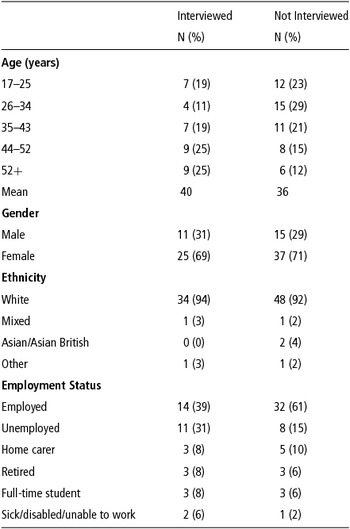
Smokers who registered with the MSSS between August and October 2011 (allowing the service to be embedded in the community) were invited to take part in up to two telephone interviews. The initial interview was conducted soon after smokers had their first consultation with a smoking cessation advisor. Smokers who set a quit date were eligible to take part in a follow-up interview four to six weeks after this date. Ninety-six out of 245 smokers who registered with the MSSS during the study period provided consent to be interviewed, and were informed by the advisor that the interviewer would attempt to contact them to conduct the interview within a week of their initial consultation. Four individuals provided invalid contact details, and four others asked to be withdrawn when contacted by the interviewer. The interviewer attempted to contact the remaining 88 individuals on at least four occasions, unless they specifically requested to be called back at another time. Thirty-six participants (41%) were interviewed, and because data saturation had been attained, no further attempts were made to reach the remaining 52 individuals. When comparing participants interviewed with those who consented to be interviewed but were not, mean age was similar (40 years vs. 36 years); however, distribution of gender (male = 43% vs. 57%) and employment status (employed = 30% vs. 70%) differed (Table 1). Of the 36 individuals who participated in the initial cross-sectional interview, 27 set a quit date either during their initial consultation or within two weeks of this (if a quit date had not been set at time of interview, the interviewer called a week later to see if a date had been set in the interim) and were therefore eligible to take part in a follow-up interview four to six weeks after this quit date; a similar protocol was followed with up to four attempts made to contact those eligible. Eleven (41%) individuals completed follow-up interviews.
Summary characteristics of interviewed versus not interviewed.

Interviews
Two semi-structured interview guides were developed; one for the initial and the other for follow-up interviews. Initial interviews explored clients’ views of the trailer, reasons for accessing the MSSS, thoughts about the consultation and whether they set a quit date, and progress since the initial consultation which included intentions to attend follow-up support sessions. Follow-up interviews explored how clients had progressed with their quit attempt and whether they had attended follow-up sessions either at the MSSS or a standard clinic, and thoughts about the follow-up experience. For those attending follow-up at the MSSS, the prospect of being referred to another clinic because the service was coming to an end was also explored. The interviewer informed participants that data would be treated in confidence, and that they were free to withdraw at any time. Telephone interviews were carried out in a private room at Nottingham City Hospital, were digitally audio-recorded and lasted 15 minutes on average (range = 9 to 24 minutes).
Data analysis
Prior to transcription, participants’ audio files were assigned a unique study code that identified the date they consented, the location they were recruited from, their gender and age. Audio files were then transcribed verbatim by an external specialist transcription company. Following receipt of the transcripts, the interviewer ensured all personal identifiers were removed and that transcripts were accurate. Data were analysed using the framework approach (Ritchie & Lewis, Reference Ritchie and Lewis2003). This approach allowed the research team to understand differences between clients according to familiarity with the local SSS, how they accessed the MSSS, and where they planned to attend follow-up sessions. As an initial step and to aid familiarisation, data for the 25 participants who completed initial interviews only were summarised into a framework matrix (using Microsoft Excel™) that provided a visual representation of the dataset. Transcripts were then read several times and were annotated where emerging themes and sub-themes were identified, resulting in an analytical framework of key themes and sub-themes. Themes and sub-themes were discussed between the interviewer and a second researcher (LLJ), allowing clarification of the final framework. Data were then charted according to each theme to synthesise the data and aid interpretation, where extracts were included in the charts. Data from the remaining 11 participants who completed both interviews were then analysed to assess whether the coding framework derived from the 25 participants who took part in only the initial interviews could be applied to this dataset. Data from the follow-up interviews represented and built on the themes derived following the cross-sectional data analysis. Therefore, the results are presented combining both sets of data, where similarities and differences according to time point are identified and highlighted.
Ethical Approval
Ethical approval was sought and gained from the Leicestershire, Northamptonshire and Rutland Research Ethics Committee 2 (10/H0402/35) and from the Research and Development department at Nottinghamshire County Primary Care Trust.
Results
Three core themes emerged from the data: (1) quit intentions and pathways into the service, (2) the importance of convenience and instant accessibility and (3) progress, follow-up experience and disengagement.
Quit intentions and pathways into the service
Participants commonly indicated that quitting had been on their minds before they had knowledge of, or were exposed to the MSSS, mainly because of health problems (Figure 1, 1a); many had attempted to quit previously, often on more than one occasion. Many of these individuals acknowledged that they had to be in ‘the right frame of mind’ before embarking on a quit attempt (1b); stress-related factors such as health problems, financial concerns or familial and community issues were reported as barriers that had prevented some participants getting in touch with a SSS or their GP, prior to accessing the MSSS. Some participants had made plans about when to quit, prior to seeing the MSSS. For instance, several female participants wished to lose weight before attempting to stop smoking, where two had lost extra weight to compensate for the expected weight gain when they quit (1c). The MSSS did appear to trigger quit attempts for some participants; however, further discussions revealed that a few of these individuals had already had underlying thoughts about quitting relating to the cost of tobacco, or that they had been urged by family to quit (1d). Irrespective of whether participants considered quitting, pathways into accessing the MSSS varied. Whilst some participants accessed the MSSS the first time they came across it, for most, accessing the MSSS took some time. Some participants were unable to access the service straight away because they did not have enough time, were unwell or had children with them. However, for others who took up to several weeks to access, there appeared to be more planning involved; several participants indicated that they had approached the MSSS to find out details about what was being offered and for how long the service would be available and returned at a later date (1e).
Quit intentions and pathways into the service

The importance of convenience and instant accessibility
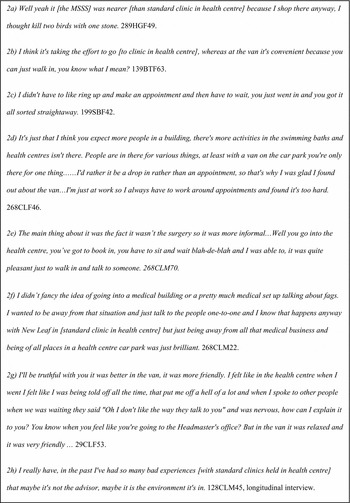
The most appealing aspect of the MSSS was that smokers did not appear to have to go out of their way to access the service. Most participants described the MSSS as being convenient for them, with a few individuals commenting that the location was in close proximity to where they lived, worked or shopped (Figure 2, 2a). Therefore, accessing the MSSS appeared to fit into many participants’ routines without undue disruption; for instance, the MSSS was available on the day and in the area where they normally shopped. Instant accessibility was important, with many participants highlighting that they could drop-in when it suited them and that an appointment was not required (2b). The importance of perceived convenience and accessibility was further emphasised by several individuals who had attempted to access standard clinics run by New Leaf, but reported that they were unsuccessful due to factors such as having to arrange appointments, clinic times being incompatible with working hours or because clinics were full. Moreover, many participants seemed reluctant to arrange appointments at standard clinic locations, or to get in touch with their GP to discuss quitting because it took too much time, resulting in quit attempts being delayed when intention to quit was greatest (2c). Furthermore, many participants seemed to favour the MSSS over standard clinics, particularly those held in health settings, where a degree of formality was associated with the latter. Several participants stated that they disliked attending health settings because there were a lot of people there for numerous reasons (2d), and this created barriers, such as having to book in and wait; whereas the MSSS was an open, specialist unit that was hassle-free (2e). Other participants however, particularly those who had previously accessed SSS in health settings had more pressing concerns, with the medical nature associated with health settings deemed as being intimidating. As a result, these participants felt this was an inappropriate environment to discuss smoking because they were uncomfortable (2f); where a few participants either likened such settings to being in a headmaster's office or felt unable to ask questions (2g). However, a couple of these instances could be attributed to participants’ previous negative experiences that seemed to be related to staff rather than the SSS itself. Nonetheless, for a few participants it was apparent that negative views about, or experiences of SSS held in health settings were barriers to previously accessing the service, even though they desired to quit. Longitudinal data showed that participants’ negative perceptions about health settings and SSS held in such settings were still inherent and had in fact been strengthened following additional visits to the MSSS, mainly because they perceived the MSSS as being more accessible, informal and the staff friendly (2h).
The importance of convenience and instant accessibility

Progress, follow-up experience and disengagement
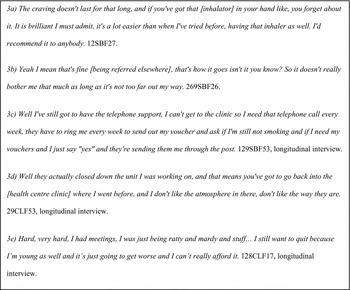
Regarding participants who set a quit date during their initial consultation, most were not smoking at the time of the follow-up interview; although a few admitted that they had lapsed due to stress, but most overcame this and continued with their quit attempt. Generally, participants who were abstinent were pleased with their progress, with several participants reporting that changing their routines helped; whilst others reported that NRT had been particularly useful during difficult times (Figure 3, 3a). Most participants planned to attend the MSSS for as long as the service was available rather than standard clinics, due to the timings, convenience and perceived informality of the MSSS or because they disliked health settings. However, further discussions revealed that the prospect of being referred elsewhere once the MSSS ceased was not an issue for most participants (3b); although participants underscored the importance of being able to drop in rather than having to make an appointment. The lack of issue around referral elsewhere was corroborated by the longitudinal data; these participants had attended at least several weeks follow-up at the MSSS, and some stated that taking a step back in the quitting process due to the prospect of being referred elsewhere would be pointless. However, participants who were further into their quit attempt favoured telephone follow-up rather than referral to another clinic, because they returned to the MSSS primarily for NRT rather than for behavioural support, and they reported being happy to receive vouchers via the post which could then be exchanged for NRT (3c). In contrast, a minority of participants were unwilling to attend follow-up elsewhere, due to previous negative experiences with clinics they were likely to be referred to (3d). A small number of participants had already relapsed when the first interview was conducted, usually within a few days of their quit date and therefore had not, or had no intention of returning to the MSSS. Reasons for relapse were attributed to finding it difficult to stop, feeling irritable due to cravings, feeling stressed, experiencing difficulties with NRT or that a partner or family member who had quit at a similar time had relapsed. Longitudinal data suggests that these factors also appeared to contribute to some people relapsing four to eight weeks later after their quit date (3e). Most of the participants who had relapsed appeared to be disappointed, irrespective of period of abstinence, and the desire to quit was still apparent (3e).
Progress, follow-up experience and disengagement

Discussion
This study shows that MSSS taken directly to smokers in familiar community-based settings could facilitate access, particularly in areas of socioeconomic disadvantage. Convenience of the MSSS resulted in favourable perceptions of accessibility, which, coupled with the drop-in format, meant that the service was instantly accessible. We found that the MSSS reached smokers who had plans to quit and those who did not; although we identified that some of the latter showed that underlying thoughts about quitting were in fact present. The need to offer SSS in alternative settings is substantiated by our finding that standard clinics such as those located in health centres were deemed to be intimidating surroundings to visit in general, and as a result some individuals were uncomfortable discussing smoking or their cessation attempt in such settings. In contrast, the MSSS was viewed as a specialist unit that appeared to be successful in achieving an appropriate balance in terms of convenience, accessibility and informality smokers found appealing, suggesting that this may serve as a suitable model when attempting to develop and enhance the reach of SSS.
Even though standard clinic locations are increasingly adopting drop-in formats (Owens & Springett, Reference Owens and Springett2006), our findings suggest that more can be done to improve the reach of SSS. We identified that locating services in convenient settings within smokers’ communities, such as in close proximity to shopping areas is worthy of consideration. We found that the most appealing aspects of the MSSS were that it was a convenient and instantly accessible service. These factors enabled smokers to plan when to register according to when they were ready and around their existing routines. As a result, the MSSS reached not only those smokers who had quitting on their minds (planned) but also those who did not (spontaneous/unplanned); although further discussions revealed some of the latter had underlying thoughts about quitting. In comparison, traditional SSS due to their very nature rely on smokers getting in touch to find out about availability and timings, suggesting inherent planning. It is acknowledged, however, that notions of the MSSS triggering spontaneous/unplanned quit attempts seen in our previous research (Bains et al., Reference Bains, Venn, Murray, McNeill and Jones2011) was not so evident in this study; though this may well be due to the fact that the MSSS had already been running for three months prior to the qualitative research starting and thus awareness of its existence had increased.
Our longitudinal data suggests that the importance of having SSS that are convenient and accessible is also significant when considering follow-up attendance; service users mentioned that they attended the MSSS for follow-up support on the same day that they were engaged in other activities in the area, such as shopping. However, whether convenience of settings is of similar or greater importance than being able to drop in requires further consideration, particularly because the importance of being able to attend on a drop-in basis is a recurrent theme in the literature (Bains et al., Reference Bains, Venn, Murray, McNeill and Jones2011; Owens & Springett, Reference Owens and Springett2006). Based upon our findings it is argued that the importance of the convenience of setting and accessibility (drop-in format) amongst new service users is more equally balanced compared with those who have been in the service for some time for whom being able to drop in or having access to telephone support seemed more important; perhaps because they appeared to attend follow-up mainly for NRT rather than for behavioural support. For instance, initial interviews showed that when service users first registered with the MSSS they also expressed a desire to attend follow-up at the MSSS due to the convenience and accessibility. However, longitudinal interviews revealed that this altered over time and most of the service users were happy to be referred to a standard clinic because the MSSS was coming to an end; although this finding may also be due to these individuals having no choice than to be referred elsewhere because the MSSS was ending. Nonetheless, these service users still underscored the importance of being able to drop-in. Hence, once smokers are in the service perhaps the actual setting becomes less important, suggesting that at the very least, MSSS may be an effective way of raising the profile of SSS, particularly in areas defined as hard to reach where prevalence and dependence is greater (Siahpush et al., Reference Siahpush, McNeill, Borland and Fong2006).
Using a MSSS for one-off events to promote SSS may also be a more cost-effective approach, which is a matter that requires further consideration. Clearly there is a need to identify and explore alternative locations from which SSS could be provided, particularly because we found that settings may be a barrier in themselves; thus adding to the existing literature that has identified that fear of failure, fear of being judged and lack of knowledge about SSS are barriers preventing smokers engaging with services (Roddy et al., Reference Roddy, Antoniak, Britton, Molyneux and Lewis2006). Broadly speaking, we found visiting health settings seems to be an intimidating or problematic prospect for some individuals both in general and specifically to attend standard clinic SSS held in health centres, for example. Existing findings drawn from the wider health literature offers some possible reasons for this, namely that a degree of formality is associated with these settings, perhaps because an appointment is often required (Lacy, Paulman, Reuter, & Lovejoy, Reference Lacy, Paulman, Reuter and Lovejoy2004; Pesata, Pallija, & Webb, Reference Pesata, Pallija and Webb1999). However, the features of SSS and how these interrelate to influence smokers’ perceptions of services seems more complex in nature. Fortunately our sample comprised of smokers who had previously attended standard clinics and when comparing experiences with the MSSS, many preferred the latter, due to perceived convenience, accessibility and informality and these views strengthened over time; suggesting that a good fit between these features is required. Therefore, the MSSS may serve as an advantageous model that appears to go some way in breaking down some of the previously identified barriers preventing smokers from engaging with SSS (Roddy et al., Reference Roddy, Antoniak, Britton, Molyneux and Lewis2006). However, we acknowledge that prior unsuccessful attempts may have resulted in these individuals with prior experience of the local SSS attributing their failures to the environment, rather than to themselves and therefore this could explain why these individuals did not wish to be referred back to a clinic when the MSSS was going to end. Research needs to consider this and the role of SSS staff (cessation advisors), such as considering how staff are perceived in clinics held in health settings versus community-based settings, and the way setting, format (appointment versus drop-in) and staff may interact and subsequently impact why smokers choose to attend/not attend SSS. Studying views of staff would also help to identify whether work demands differ according to the setting, and whether this impacts the way smokers perceive SSS.
Limitations
Whilst our findings provide a novel account of the features of MSSS that appeal to smokers, this study is not without limitations. The MSSS was only delivered in socioeconomically disadvantaged areas in Nottingham and was based on the city's single SSS, New Leaf; therefore these service users’ views may not be reflective of SSS users in general. Additionally, the sample of smokers we interviewed was not ethnically diverse and mostly comprised of females. Not having the views of smokers who initially expressed interest in the MSSS but did not register is another limitation, particularly because this group may have provided alternative views on the perceived accessibility of the service. However, engaging such groups in research is a challenge (Bains et al., Reference Bains, Venn, Murray, McNeill and Jones2011). Whether the MSSS reached smokers from socioeconomically disadvantaged groups is also difficult to determine because accurate data regarding type of employment, income and housing for those interviewed were unavailable. However, we interviewed a greater proportion of individuals who were either unemployed, home carers or unable to work compared with those in employment, suggesting that the MSSS was likely to engage those defined as hard to reach (Bauld, Judge, & Pratt, Reference Bauld, Judge and Platt2007; Roddy et al., Reference Roddy, Antoniak, Britton, Molyneux and Lewis2006). Moreover, from our results it is appropriate to make the broader suggestion that MSSS taken directly to smokers residing in areas of socioeconomic disadvantage are likely to be perceived and received in a positive manner. Further to this, although we were unsuccessful in conducting longitudinal interviews with all those that were eligible (41%), the data showed that views were consistently held over time among service users who attended the MSSS for follow-up support, indicating that the convenience and perceived accessibility of the service may have been important in retaining service users.
Conclusions
Understanding the features that attract smokers into SSS is important in helping to improve the development of these services. Indeed we highlighted that the relationship between setting and format, particularly the convenience, accessibility and degree of formality associated with these is much more complex than previously understood. In this instance, MSSS taken directly to smokers within their own communities appears to appeal to them because of the instant accessibility and convenience characterised by a drop-in format and a familiar, informal setting which did not necessitate smokers to have to go out of their way to access was important. Hence, these factors should be considered in future endeavours especially when exploring alternative settings, as they may facilitate access by both smokers who are less likely to engage with SSS or those who have been unsuccessful previously.
Acknowledgements
We would like to thank the smoking cessation advisors (Jacqueline Purdy, Jodie Roberts, Rachael Tennant, Alexandra Larwood) and research staff (Anne Dickinson) who facilitated recruitment into the study and Nottingham City New Leaf.
Financial Support
This article presents independent research funded by the National Institute for Health Research (NIHR) under its Programme Grants for Applied Research funding scheme (RP-PG-0608–10020). The views expressed in this report are those of the author(s) and not necessarily those of the NHS, the NIHR or the Department of Health.
Conflict of Interest
None.
Ethical Standards
The authors assert that all procedures contributing to this work comply with the ethical standards of the relevant national and institutional committees on human experimentation and with the Helsinki Declaration of 1975, as revised in 2008.