Introduction
Damage to the facial nerve results in facial paralysis, with recovery being dependent on the severity of axonal damage. Close monitoring of patients in a specialised facial nerve rehabilitation clinic helps to encourage normal patterns of facial movement, to detect early signs of abnormal patterns, and to manage the disabilities and complications (intra-oral and other) associated with severe facial palsy.
During this early stage of monitoring, the authors observed facial muscle contraction in response to manual stretch, in otherwise flaccid, denervated facial muscles.
This paper presents four case studies which demonstrate the effects of passive stretch of the facial muscles following facial nerve injury. We also discuss the likely mechanism of this response, and its relevance to the management of patients with facial paralysis.
Pattern of recovery
The pattern of facial motor recovery after VIIth nerve damage in most cases is similar. Flaccidity of the face is followed by an improvement in resting facial symmetry. Voluntary movement returns over weeks to months, but recovery is sometimes incomplete. The individual may be left with residual weakness and, in some cases, increased muscle tone and abnormal, synkinetic patterns of movement. In those with complete facial nerve lesions, various nerve grafts (e.g. hypoglossal anastomosis) may be performed; good results (i.e. a House–Brackmann grade 4) have been reported in 63 per cent of patients.Reference Iseli, Harris, Dean, Iseli and Rosenthal1
After facial nerve recovery through nerve regrowth, abnormal co-contractions of different facial muscles, known as synkinesis, frequently occur.Reference May, Schaitkin, May and Schaitkin2, Reference Beurskens, Oosterhof and Nijhuis van der Sanden3 The mechanism for this is unclear, but is indicative of prior facial nerve degeneration.Reference Husseman and Metha4 Possible causes are aberrant nerve regeneration, interneuronal ephaptic transmission and nuclear hyperexcitability, or a combination of these.Reference May, May and Schaitkin5
Physical management focuses on the facilitation of desired movements and the reduction of any synkinetic patterns.Reference Brach, VanSwearingen, Lenert and Johnson6–Reference VanSwearingen8 Oral hygiene is also important; patients are taught to ‘sweep’ inside the weak cheek with their index finger to prevent food debris being left inside the mouth following eating. To do this, the therapist places a gloved finger inside the patient's cheek to demonstrate the technique, and also to assess whether there has been any improvement in facial motor tone.
It was during this manoeuvre that one of the authors (LC) noticed that some patients showed prolonged facial contraction after palpation and stretch of the cheek on the affected side. Anecdotal observation suggested that if such a contraction was seen, then recovery was associated with increased tone and a synkinetic pattern of facial movement. We present four such cases, in which systematic examination was undertaken.
Case reports
Case one
A 66-year-old woman with right-sided facial weakness (House–BrackmannReference House and Brackmann9 grade 6) due to Ramsay–Hunt syndrome was referred to the facial rehabilitation clinic.
At eight weeks post-onset, there was no movement and the cheek was flaccid.
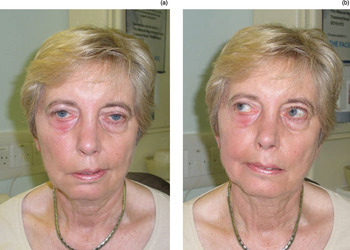
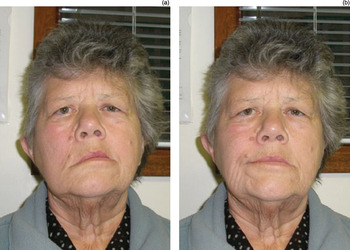
However, there was a marked response to a finger sweep inside the right cheek. The muscles were felt to contract, which resulted in elevation of the right side of the mouth for several seconds (Figure 1).
Case one, eight weeks after onset of facial palsy: (a) before finger sweep; (b) after finger sweep. Published with permission.

Reassurance was given that activity was returning, although it was realised that, given the delay in recovery, the observed muscle contraction was more likely to be associated with synkinesis.
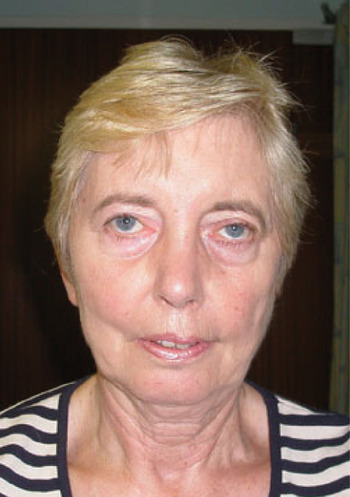
At 20 weeks post-onset (Figure 2), there was evidence of voluntary and spontaneous facial activity, with a House–Brackmann grade of 3 and some hypertonicity in the right cheek which was impeding lip closure.
Case one, 20 weeks after onset of facial palsy, showing hypertonicity in the right cheek. Published with permission.

In this case, the marked response to sweeping the cheek appeared to be associated with the subsequent development of hypertonicity and synkinesis.
Case two
A 56-year-old-woman underwent removal of a large, right-sided acoustic neuroma, during which her facial nerve was sacrificed. Four hours post-operatively, the right cheek was completely flaccid. There was no response to stretching the right cheek, and the House–Brackmann grade was 6.
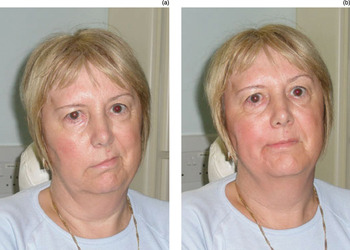
Seven weeks post-transection, the patient's cheek remained flaccid (Figure 3a). When the inside of the mouth was examined to check for trauma, stretching of the right cheek led to a motor contraction which resulted in elevation of the corner of the mouth on that side (Figure 3b). This occurred 2–3 seconds after the finger sweep and lasted many seconds, before the muscles returned to their original resting position. This muscle contraction was associated with marked facial flushing restricted to, but present diffusely over, the cheek on that side.
Case two, seven weeks after facial nerve transection: (a) before finger sweep; (b) after finger sweep. Published with permission.

Electromyography examination of the orbicularis oris muscle was performed one week later. This showed complete denervation, with fibrillation at rest. No motor units appeared to be under voluntary control. Stretching the inside of the cheek resulted in a marked increase of fibrillation potentials, which were profuse and lasted approximately 30 seconds.
When examined at five and seven months after nerve transection, the patient still showed a marked response to passive stretching of the right cheek.
This patient subsequently underwent a facial reanimation procedure using a facial hypoglossal nerve anastomosis.
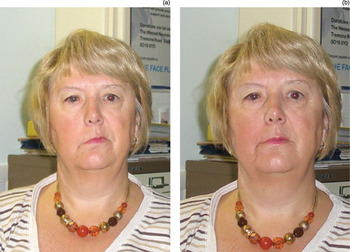
Eleven months after the nerve transection (and six months after the anastomosis procedure), there was evidence of improvement in the resting tone of the cheek (Figure 4a). The patient was able to produce a voluntary smile by using tongue pressure (Figure 4b).
Case two, 11 months after facial nerve transection (and six months after anastomosis procedure): (a) at rest; (b) voluntary smile (using tongue pressure). Published with permission.

With partial recovery of voluntary activity, the response to finger sweep of the cheek was reduced, and only a small lift of the corner of the mouth was seen (Figure 5).
Case two, 11 months after facial nerve transection, following finger sweep. Published with permission.

Case three
This 67-year-old woman underwent excision of a right acoustic neuroma, during which the facial nerve was sacrificed and repaired using a greater auricular nerve graft.
Immediately after surgery, the patient had complete right facial weakness. On palpation and cheek sweep, the cheek was flaccid with no response to stretch.
Three months after surgery, there had been no change in facial function, and the House–Brackmann grade was 6. However, on cheek sweep there was marked contraction of the lower facial muscles, which took several seconds to relax (Figure 6).
Case three, three months after surgery: (a) before finger sweep; (b) after finger sweep. Published with permission.

Electrical stimulation of the nerve produced no response. Electromyography of the right orbicularis oris muscle revealed no spontaneous activity at rest. Following manual examination of the cheek, profuse fibrillations were observed which lasted several seconds.
Case four
This 62-year-old man sustained a crush injury to the skull resulting in bilateral skull base fractures. He had bilateral facial weakness and bilateral VIth nerve palsies.
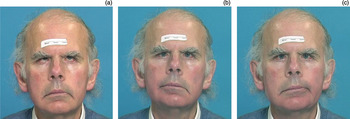
Eight weeks after injury, the patient's House–Brackmann score was 6. His face was flaccid and he had bilateral Bell's phenomena. However, he demonstrated a marked response to stretching of each cheek. The facial muscles took approximately 30 seconds to relax, and there was accompanying facial flushing (Figure 7).
Case four, eight weeks after injury: (a) at rest; (b) after right cheek sweep; (c) after left cheek sweep. Published with permission.

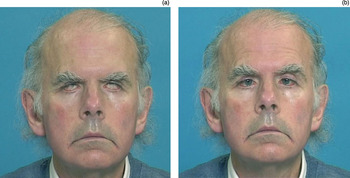
In addition, massage of the frontalis muscle resulted in bilateral elevation of the eyebrows which, again, took many seconds to relax (Figure 8).
Case four, eight weeks after injury: (a) at rest; (b) after massaging the forehead. Published with permission.

No response was recordable upon stimulating each facial nerve. Electromyography demonstrated no volitional motor unit activity, but recorded some fibrillation potentials. Stretching of each cheek resulted in profuse fibrillation potentials, which persisted along with sustained facial muscle contraction.
Discussion
Following known or presumed complete damage to the facial nerve, the above patients all demonstrated marked contraction of the facial muscles on the affected side in response to direct passive stretch using a gloved finger inside the cheek. This response was not seen immediately after the injury or surgery, but took a minimum of six to seven weeks to manifest, and was persistently reproducible up to seven months following nerve damage.
Electromyography derived neurophysiological findings indicated that this stretch-induced contraction occurred in muscles which were completely denervated. During muscle spasm, fibrillation potentials, the hallmark of denervation, increased in all cases. The mechanism for this is unclear. It seems unlikely that this is a direct response of muscle contractile elements to stretch, such as occurs in cardiac muscle, not least because it is associated with fibrillation potentials from the cell membrane. This suggests that the phenomenon reflects excitation–contraction coupling, and that the denervated cell membrane responds to stretch by depolarisation. There are known to be stretch-activated channels on the surface of muscle cells, which become more sensitive after denervation, although their role is unclear.Reference Francini and Squecco10
• Following facial nerve damage (including complete transection), the facial muscles demonstrate sustained contraction on the affected side in response to direct, passive stretch
• The presence of this response to stretch provides evidence of severe or complete denervation with some preservation of the facial muscle excitatory–contractile apparatus
• The clinical significance of this sign in patients with severe facial nerve palsy requires further investigation; it may be an important prognostic indicator regarding recovery and/or the success of facial nerve graft repair
This finding, which we suggest be named Clapham's sign, may provide evidence of severe or complete denervation with preservation of some activity in the facial muscle's excitatory–contractile apparatus. We anticipated that spasm would disappear with reinnervation, and this was seen in our second patient. The disappearance of Clapham's sign in those with complete facial nerve palsies without reinnervation may reflect degeneration of either the excitation or contraction mechanism, and may indicate a poor prognosis for any subsequent anastomosis surgery.
We are currently investigating the clinical significance of Clapham's sign in patients with severe facial nerve palsy. We are considering, for example, whether this sign can be used as an early predicator of the development of synkinesis and, if so, whether it might enable management of synkinesis at an earlier stage. In patients awaiting nerve reconstruction procedures, the Clapham's sign stretch response, eliciting muscle contraction, may be useful to maintain muscle metabolism and/or prevent muscle degeneration and atrophy.
Acknowledgements
We would like to thank the patients who kindly gave their permission for their photographs to appear in this paper. We also thank the learning media photographic team at Southampton University Hospital Trust for their advice and support regarding the illustrations.