INTRODUCTION
On September 13, 1984, New York Governor Mario Cuomo delivered the John A. O'Brien Lecture to the University of Norte Dame's Department of Theology. In his talk, Cuomo was asked to reflect on some “hard questions,” as he put it: “what is the relationship of my Catholicism to my politics?” (University of Norte Dame 1984). Inexorably, Cuomo was drawn to the issue of abortion. Cuomo testified to the importance of faith in his own life, defining himself as “An old-fashioned Catholic who sins, regrets, struggles, worries, gets confused and most of the time feels better after confession.” However, he also asked, “I accept the Church's teaching on abortion. Must I insist you do?”
Ultimately, Cuomo decided the answer to this question was no. “My church and my conscience require me to believe certain things about divorce, birth control and abortion. My church does not order me — under pain of sin or expulsion — to pursue my salvific mission according to a precisely defined political plan.” He instead called for Catholics to follow their own teachings and set a good example for the rest of the public about the sanctity of human life. Cuomo concluded by urging Catholic activists to think beyond abortion and consider the importance of social justice issues like homelessness and unemployment because “Approval or rejection of legal restrictions on abortion should not be the exclusive litmus test of Catholic loyalty.”
Cuomo's address is an uncommonly thoughtful account of how one man tried to find a way to be a good Catholic and a good public official. Cuomo's tortured phrasing also introduces the central puzzle of this article: what factors explain the different ways in which Catholic members of Congress communicate their positions on abortion, if they choose to speak about it at all? We attempt to shed light on this question through an analysis of public statements about abortion made by the 149 Catholic representatives and senators who served in the 108th Congress (2003–2004). Abortion was a highly salient issue during this time period as these years were highlighted by the debate over the Partial-Birth Abortion Ban (PBAB) Act of 2003, and by attempts by Catholic priests to deny communion to pro-choice politicians in 2004. We conduct a two-part analysis, first analyzing which Catholic officials made a public comment about abortion, and then using automated text analysis via the Linguistic Inquiry and Word Count (LIWC) program to measure key aspects of those statements.
Ultimately, we offer several conclusions regarding which Catholic legislators speak about abortion, and which Catholic legislators make arguments that mirror the kind of language used by church leaders. Catholics serving in the House, Hispanic Catholics, and Catholics who won their last election with a larger share of the vote are less likely to comment on abortion, while Catholics representing states with higher levels of religiosity are more likely to comment. Interactions between Catholic legislators’ positions on abortion and the size of their Catholic constituencies shape their framing of the issue. Specifically, pro-choice Catholics representing states with large Catholic populations are less certain when discussing abortion, while pro-life Catholics frame abortion in moral terms when their state's Catholic population increases. Furthermore, Hispanic Catholic legislators are less likely to reference religion when discussing abortion and female Catholic legislators are less likely to discuss abortion in moral terms.
Overall, these findings suggest that Catholic members of Congress (MCs) are careful and strategic when they speak about abortion. The patterns in these statements indicate that Catholic MCs’ choice of words may be as much a response to external pressures like party and constituency preferences as they are based on personal religious beliefs. In the following section, we discuss how internal and external pressures shape MCs’ behavior in office and introduce the relationship between these forces and legislators’ discussions of abortion.
RELIGION, REPRESENTATION, AND HOW CATHOLICS DISCUSS ABORTION
It can be tempting to explain Congressional behavior by looking exclusively to external factors like public opinion, pressure from party leaders, or interest group demands. Constituency characteristics, in particular, are of significant importance. For example, the size of the African-American population in a member's district is related to the likelihood that a member votes in support of African-American interests (Grose Reference Grose2005; Hutchings, McClerking, and Charles Reference Hutchings, McClerking and Charles2004). Similarly, if a member's district is experiencing high unemployment, he or she is more likely to support social welfare programs (Barrett and Cook Reference Barrett and Cook1991). Local church membership has been shown to have a similar style of influence (Green and Guth Reference Green and Guth1991; Oldmixon Reference Oldmixon2005). However, external factors cannot fully explain how a member behaves. As Jane Mansbridge (Reference Mansbridge1999, 644–645) observed, United States legislators have more autonomy than elected officials in other governments. As a result, America's lawmakers often act on the basis of what Mansbridge called “introspective representation” where they look inward, not outward, when making decisions.
Barry Burden's (Reference Burden2007) Personal Roots of Representation further conceptualizes this aspect of representation. Burden opens with a comparison of Pennsylvania's senators Rick Santorum and Arlen Specter (Idem, 1–5). External factors suggest that both men should have legislated in a similar fashion. Both came from the same party (Republican) and represented the same constituency (the entire state of Pennsylvania). However, by many measures the two men could not have been more different. Santorum was a pro-life culture warrior, Specter a centrist who was mostly pro-choice. Given these differences, the behavior of each senator must reflect to some degree their own personal experiences, interests, and values.
Indeed, Burden shows how members of Congress who smoke are more likely to oppose measures that would regulate tobacco use, and how members who have children in public school are less likely to support school voucher programs. We can rely on similar logic to understand the well-documented connection between descriptive and substantive representation and why, for instance, legislatures with more LGBT (lesbian, gay, bisexual, and transgender) members consider and pass more pro-LGBT legislation (Haider-Markel Reference Haider-Markel2007). Personal lives and identities clearly matter when it comes to understanding why members of Congress act as they do.
Scholars are more frequently recognizing that a legislator's faith is also an important predictor of their behavior. Religious affiliation can explain how consistently members vote on culture war issues (McTague and Pearson-Merkowitz Reference McTague and Pearson-Merkowitz2015), how often senator support the agenda of the Family Research Council (Smith, Olson, and Fine Reference Smith, Olson and Fine2010), and how frequently a member supports Catholic social teaching (Oldmixon and Hudson Reference Oldmixon and Hudson2008). Religious affiliation can also explain votes on more specific issues — like abortion — where religious doctrines have obvious relevance (Daynes and Tatalovich Reference Daynes and Tatalovich1984; Richardson and Fox Reference Richardson and Fox1972; Witt and Moncrief Reference Witt and Moncrief1993). Collectively, this body of work demonstrates that religion compares favorably to more recognized predictors of Congressional voting, and suggests that any model that does not incorporate some measure of religion may be underspecified (Fastnow, Grant, and Rudolph Reference Fastnow Chris, Grant and Rudolph1999).
Yet, if scholars want to understand fully how religion influences legislative behavior, focusing exclusively on roll call votes is not enough. Burden (Reference Burden2007, 47–48) also shows that personal experiences and interests are most important during the early stages of the legislative process. Each member can vote just a single time. Hence, individuals who feel strongly about an issue can only act on those feelings by becoming involved in pre-vote deliberations. For example, Burden finds that legislators from the smallest religious denominations were more likely to speak about 1993's Religious Freedom Restoration Act, presumably due to their own experiences living as a religious minority (Idem, 122–123). Though some other work demonstrates how differences in speech participation can be shaped by religious affiliation (Blackstone and Oldmixon Reference Blackstone and Oldmixon2015), work on how Catholic legislators’ religious experiences influence their behavior outside of roll-call voting is mostly lacking.
In this study, we not only seek to understand the impact of religion on Congressional behavior by examining which Catholics speak, we also consider what those Catholics say. Studying the ways Catholic MCs discuss abortion provides an opportunity to examine the complex interplay of internal factors like religious beliefs, and external factors like party identity and constituency. A Catholic representative's faith is likely quite important to them. Research shows that members of Congress are more religiously involved than the general public, and that a clear majority of Catholic members, in particular, are religiously active (Guth and Kellstedt Reference Guth, Kellstedt and Smidt2001, 220–221). As such, Catholic MCs face a unique array of cross-pressures when talking about abortion as an issue and as policy.
Imagine a pro-choice Catholic. For centuries, his or her church has taken an unequivocal stance against abortion (Young Reference Young2016). The Catholic Church has opposed abortion since at least the first century AD, when the practice was denounced in the Diadache, an important early guide to Christian ritual and belief. Over subsequent generations, women and doctors who participated in an abortion were threatened with excommunication. Despite the liberalizing tendencies of the gathering as a whole, the landmark Second Vatican Council reaffirmed the church's opposition to abortion, labeling it an “abominable crime.” In reality, there would be no organized pro-life movement in America without the leadership of the Catholic Church, which has spurred the creation of major groups like The National Right to Life Committee (Sammon Reference Sammon, Heyer, Rozell and Genovese2008; Wald and Calhoun-Brown Reference Wald and Calhoun-Brown2011, 250–259). For a pro-choice Catholic politician, the Church's insistent opposition to abortion is a difficult reality of their lives, and a reality that their patterns of speech could reflect.
However, abortion is not necessarily an easy issue for pro-life Catholic officials, either. Though they agree with their Church's position, eliminating this potential source of unease, these Catholics can be cross-pressured in other ways. Pro-life Catholic Democrats are in a particularly difficult position because of the Democratic Party's commitment to a pro-choice agenda. Historically, both parties contained healthy numbers of pro-choice and pro-life members. Yet over the course of the 1980s, the parties rapidly became more internally cohesive when it came to abortion. By the mid-1990s almost all members of Congress were voting the same position on abortion related issues over 90% of the time; pro-choice votes for the Democrats, pro-life votes for the Republicans (Adams Reference Adams1997). What this development ultimately means is that pro-life Catholic Democrats are likely to find their views marginalized inside their own party.
These conflicts may cause Catholic Democrats to behave in unexpected ways, befitting people who still feel the pull of their faith. According to one analysis, Catholic Democratic Senator Joe Biden had one of the least consistent records on abortion in the entire Senate between 1976–2004 (McTague and Pearson-Merkowitz Reference McTague and Pearson-Merkowitz2015, 434). Meanwhile, the member of Congress who sponsored the highest number of pro-life Constitutional amendments between the 93rd and 108th Congresses was also a Catholic Democrat, Minnesota's Representative James Oberstar (Ainsworth and Hall Reference Ainsworth and Hall2011, 125). Given this conflict between the internal influence of personal religious values and the external force applied by their political party, it will be useful to examine whether Catholic Democrats speak about abortion in a distinctive way.
Regardless of party affiliation, pro-life Catholic politicians face another obstacle when it comes to articulating their position on abortion: while their views may align with the expectations of their faith, those views may oppose their constituents’ preferences. Public opinion on the legality of abortion has been remarkably stable since Roe v. Wade (Jelen and Wilcox Reference Jelen and Wilcox2003, 490–491). Around a two-thirds majority have consistently supported abortion rights, though with broad qualifications and support for a series of regulations. In the words of a few scholars of abortion opinion, American citizens should best be classified as “pro-choice, buts” (Fiorina, Abrams, and Pope Reference Fiorina, Abrams and Pope2006, 79–108). Catholics are no different from the rest of the country; polls have shown no statistical difference between Catholics and the wider American public when it comes to the moral acceptability of abortion (Gallup 2009b). Thus, the rhetoric of pro-life Catholics might reflect the external influence of their constituencies.
This much is clear: abortion is difficult for Catholics in public life to discuss. Pro-choice Catholics must publicly work through the implications of disagreeing with their church. Pro-life Catholics may need to speak carefully to avoid offending members of their political party, and also need to avoid upsetting a public generally supportive of some degree of abortion rights. Given these competing pressures, which Catholic members of Congress choose to participate in abortion debates? When these select Catholics do speak up, what factors shape the kind of language they use?
DATA COLLECTION
Data for this article were collected for the 149 Catholic representatives and senators serving in the 108th Congress, which convened from 2003–2004. This time period was chosen for several reasons. Although abortion policy has been primarily decided at the state level (New Reference New2011), during these years attention shifted to Washington. The agenda was set in February 2003 when Senator Santorum introduced the PBAB Act of 2003. The PBAB was a major piece of legislation that marked the first time in history Congress had moved to ban a specific abortion procedure (Ainsworth and Hall Reference Ainsworth and Hall2011, 108). Following a contentious debate, on November 5, 2003, President Bush signed the act into law. In addition to the PBAB, the 108th Congress debated a number of other significant legislative measures related to abortion, including an amendment to change the policies at military hospitals to allow privately funded abortions, a proposed act which would have modified federal law to allow an unborn fetus to be an independent victim of a crime, and the nominations of several lower court judges with controversial records on abortion.
The presidential election also elevated the topic of abortion to a national level in 2003–2004. In 2004, the Democratic nominee for president was Senator John Kerry, a pro-choice Catholic from Massachusetts. Kerry's position on abortion triggered the ire of many Catholic leaders, including Archbishop Raymond Burke, who at the start of 2004 warned Kerry that he would not receive communion if he attended Mass in one of the Archbishop's parishes in St. Louis. A May 2004 survey by Catholics for a Free Choice found that four bishops backed Burke in addition to 17 others who urged pro-choice politicians to voluntarily refuse to present themselves for communion (Wakin Reference Wakin2004).
Given the attention these actions received, it is no surprise that the bishops’ activism personally affected pro-choice politicians beyond Kerry. In April, for example, the local priest of Senator Richard Durbin's home church in Springfield, Illinois announced that Durbin could no longer receive communion there due to his position on abortion (Hofstetter, Ayers, and Perry Reference Hofstetter, Ayers and Perry2008, 441). As such, 2003 and 2004 provide a fitting window to evaluate how national Catholic policymakers discuss abortion. During this time, Congress considered historic abortion legislation and the actions of Catholic leaders put meaningful pressure on many Catholic politicians to address publicly the relationship between their faith and their position on abortion.
We assembled our dataset of public comments based on two sources: the Congressional Record and a Lexis-Nexis search of United States newspapers between January 1, 2003 and December 31, 2004. Comments from the floor of Congress were identified by searching for all transcripts where the specific Catholic member spoke and where the word “abortion” appeared at least once in the transcript. Importantly, the Catholic member did not have to use the word “abortion” him or herself in order for the transcript to be reviewed. Next, we read each member’s comments, and determined whether they were relevant to a discussion of abortion. If members mentioned abortion as part of a larger sequence of remarks, we excerpted only the abortion-specific commentary. For example, during tributes to President Reagan following his death, many members applauded his stance on abortion in the midst of other commentary on foreign policy and spending; only the abortion-specific commentary was included. We also omitted all outside material (e.g., newspaper articles, legal documents, or constituent letters) read into the Congressional Record by a member and all quotes by other speakers that were longer than three sentences.
Comments appearing in newspapers were identified via a Lexis-Nexis search for newspaper articles that included both the member's name and the word “abortion.” Only the words of the member, and not the surrounding text from a reporter, were included in our dataset. When a story quoted a member multiple times, all the quotes were merged into a single text file. If the quotes were the member's words from the floor of Congress, these remarks were omitted to avoid double counting the same language. Representative Nancy Pelosi's remarks as quoted in the San Bernardino Sun on May 9, 2004 serve as an example:
“I believe that my position on choice is one that is consistent with my Catholic upbringing, which said that every person has a free will and has the responsibility to live their own lives in a way that they would have to account for in the end.”
In total, our dataset consists of 446 text files representing 72 of the 149 Catholic members of Congress serving from 2003–2004.
TEXT ANALYSIS AND DEPENDENT VARIABLES
To analyze legislators’ floor and media statements regarding abortion, we use the automated text analysis program Linguistic Inquiry and Word Count. LIWC processes a text by matching individual words to words that have been sorted into pre-defined categories ranging from designations as simple as “Verbs” or “Adjectives” to more complex concepts such as “Anger” or “Sadness.”Footnote 1 Within a single text file, which can be as short as a sentence and as long as a novel, LIWC identifies the proportion of various word-types that comprise the corpus of the text.
For example, the “Anger” category includes words such as “abuse,” “argue,” and “assault.” LIWC searches a body of text for words contained in this category, counts the total number of words in the text falling under the “Anger” category, and divides the number of “Anger” words by the total number of words in the text. If LIWC coded the sentence “The man argued with his friend,” it would find that approximately 17% of the sentence was comprised of “Anger” related words (“argued” being one out of six total words in the sentence, 1/6 = ~ 0.17).
For the purposes of our analysis, we use three dependent variables that measure certain, religious, and moral language. All three of these attributes serve as measures of the degree to which Catholic ideas influence the comments of Catholic officials. Catholic religious leaders are typically quite certain in the way they discuss abortion. As mentioned before, the Catholic Church's teachings about abortion have been roughly the same for nearly two millennia. Whenever a Catholic religious leader speaks publicly about abortion — whether the Pope, a cardinal, a bishop, or a priest — naturally they will use religious and moral arguments as their position on abortion is fundamentally a product of their religious and moral beliefs. Hence, a member whose language about abortion is highly certain, full of religious references, and very moral is a member who “sounds” like their Church. That kind of member is the opposite of Governor Cuomo; their remarks would show no evidence of internal conflict or external political pressure when discussing abortion.
To create these dependent variables, we use LIWC's 2015 master dictionary categories for “Certain” (e.g., “absolutely,” “definite”) and “Religion” (e.g., “sin,” “faith”) to measure Catholic legislators’ levels of Certainty and Religious references in their discussions of abortion. We modified the “Religion” category to remove words that would not be relevant to our analysis (e.g., “Allah”) and added words that were more specific to the Catholic faith (e.g., “Archbishop”). We consulted the Association of Religion Data Archives, a research arm housed at the Pennsylvania State University (www.thearda.com), as we edited these dictionaries. We also used a “Morality” category developed by a group of social and cultural psychologists who study variation in morality across cultures (www.moralfoundations.org). This dictionary has been the basis for scholarly analysis published in a range of social scientific disciplines, including political science (Clifford Reference Clifford2016; Clifford and Jerit Reference Clifford and Jerit2013). Though the original “Morality” category contained 11 sub-topics, we condensed these into a single dimension removing words that would not apply to our study (e.g., “bourgeoisie”) and adding others that might reflect the types of moral references legislators would make regarding abortion. Table A3 in the appendix contains the full dictionary for all three word-type categories.
INDEPENDENT VARIABLES AND HYPOTHESESFootnote 2
Party
Our first independent variable captures whether a member is a Republican (1) or Democrat (0). Given the differences in the parties’ positions on abortion, it is natural to expect that party would influence the way Catholic members of Congress discuss the issue. In particular, we would expect that Republican Catholics would be more likely to use certain, religious, and moral language. There is a high likelihood that any Republican Catholic is pro-life. In the 108th Congress, of the 86 Catholic legislators that supported the pro-life position more than half the time in their roll call votes, 63 identified as Republican. Given that the internal demands of their faith and the external demands of their party are in alignment, we expect to see less equivocation in their position taking.
Hypothesis 1:
Republican Catholic legislators will be more certain and more likely to use religious and moral terms when discussing abortion (+).
National Abortion Rights Action League (NARAL) × State Catholic Population
We include in the models an interactive term measuring the relationship between legislators’ NARAL Score and the Catholic Population in the state they represent. NARAL issues annual scores for members of Congress based on their votes on a given number of bills tracked by the organization. Legislators’ scores range from 0 to 100, with a score of 100 indicating that the legislator voted in agreement with NARAL's position on each bill that year. As we examine the 108th Congress, we average legislators’ NARAL scores for 2003 and 2004 to obtain a single score for each legislator with an average score of 39 for the sample as a whole. Some liberal Catholic legislators, like John Kerry and Barbara Mikulski, had average NARAL scores of 100, while more conservative Catholic legislators, like Rick Santorum and Sam Brownback, had scores of zero.
In addition, we include data on the Catholic Population for each legislator's state from Pew's Religious Landscape Study in 2007, the closest year of available data.Footnote 3 We expect to find an interactive relationship between legislators’ NARAL score and the size of the Catholic population in that legislator's state. Specifically, we expect pro-life Catholic legislators with high numbers of Catholics in their state to be more certain in their discussions of abortion, to use more moral language, and to make more frequent references to religion. Conversely, pro-choice Catholic legislators representing states with small Catholic populations may also be more certain in their discussions of abortion. Both kinds of members face reduced conflict between their internal beliefs and external constituency pressures. Ultimately, we expect the sign of the interaction term to be positive, indicating that NARAL Score exacerbates the effect of State Catholic Population (and vice versa) on Catholic legislators’ discussions of abortion.
Hypothesis 2:
The effect of NARAL Score on legislators’ framing of abortion will be strengthened by State Catholic Population (+) and vice versa.
Hispanic
Our models also include a dummy variable indicating whether a member was identified as HispanicFootnote 4 in the Almanac of American Politics. We expect Hispanic Catholics to be less certain, less religious, and less moral when explaining their positions on abortion. Most Latino Catholics are devout (Putnam and Campbell Reference Putnam and Campbell2010, 285–307). By a margin of 81 to 64%, Latino Catholics outpace white Catholics when asked whether “religion is somewhat or very important for personal decisions.” Accordingly, Latino Catholics are much more likely to adopt the political positions of their church. When compared with white Catholics, Latino Catholics are significantly more likely to think divorce is always wrong, to oppose the death penalty, and to oppose same-sex marriage. On the specific issue of abortion, there is almost a 20-point gap between white Catholics and Latino Catholics, with Latino Catholics being more likely to agree that “abortion should never be permitted.”
However, data suggest that Hispanic Catholics in Congress frequently have different religious experiences than are typical for a person who shares their ethno-religious identity. Research has shown that minority Catholics in Congress have some of the lowest levels of religious commitment (Guth and Kellstedt Reference Guth, Kellstedt and Smidt2001, 221). Additionally, these Hispanic Catholics also face strong external pressure because the majority identify as Democrats. In the 108th Congress, of 23 Hispanic Catholic members, 18 were Democrats.
Thus, Hispanic Catholic members likely experience a high degree of conflict when speaking about abortion, which should be visible in their remarks. On the one hand, they have chosen to join the Catholic Church, and so they feel compelled to present its pro-life position. However, their religious commitment is likely weak, and they simultaneously feel pressure to distance themselves from their church's teachings due to their partisan affiliation.
Hypothesis 3:
Hispanic Catholic legislators will be less certain and less likely to use religious and moral terms when discussing abortion (-).
Female
Our models include a second dummy variable for the sex of the Catholic member of Congress. On the one hand, women are generally more religious than men (Pew Research Center 2015b). However, female members of Congress are distinctive. Interviews reveal that women lawmakers are more likely to express their commitment to women's concerns and to feel personally responsible for addressing them (Reingold Reference Reingold1992). As a consequence, female legislators develop much more consistently pro-choice voting records than their male colleagues (Tatalovich and Schier Reference Tatalovich and Schier1993), and gender is most determinative when it comes to specific votes on abortion (Swers Reference Swers1998). As a female California state representative explained, “On the issue of choice … most men have a different perspective because they've never physically been in a position where they actually had to make a personal choice themselves” (Reingold Reference Reingold1992, 527).
Ultimately, we expect that the personal experiences of female Catholic Congresswomen as women will be more important to understanding their choice of words than their personal experiences as Catholics. They will therefore be unlikely to “sound” like their church, and more likely to frame abortion as a difficult and personal choice.
Hypothesis 4:
Female Catholic legislators will be less certain and less likely to use religious and moral terms when discussing abortion (-).
CONTROL VARIABLES
We include in our models a number of control variables that could shape legislators’ discussions of abortion. First, we include a series of binary variables for legislators’ Region (Northeast, South, Midwest) with West serving as the reference category. We account for the number of Terms a legislator has served in office as well as the Vote Proportion from the legislator's most recent election. We also control for whether the legislator serves in the House (1) or Senate (0). Finally, we include a measure of Religiosity in the state based on Gallup poll data from 2008 measuring the proportion of people in each state who view religion as “an important part of their daily lives.”
ANALYSIS: WHO SPEAKS ABOUT ABORTION
Prior to examining the content of Catholic legislators’ comments on abortion, it is important to consider which Catholic legislators speak on the topic at all. Though the primary focus of this article is on the content of legislative speech rather than the act of speaking, learning who speaks about abortion provides additional context for our main analysis. Out of the 149 Catholic legislators in the 108th Congress, almost half (72) made a comment about abortion on the floor or to the media. Just as importantly, more than half of the Catholic members of the 108th Congress chose not to publicly address the topic of abortion. What might explain these decisions?
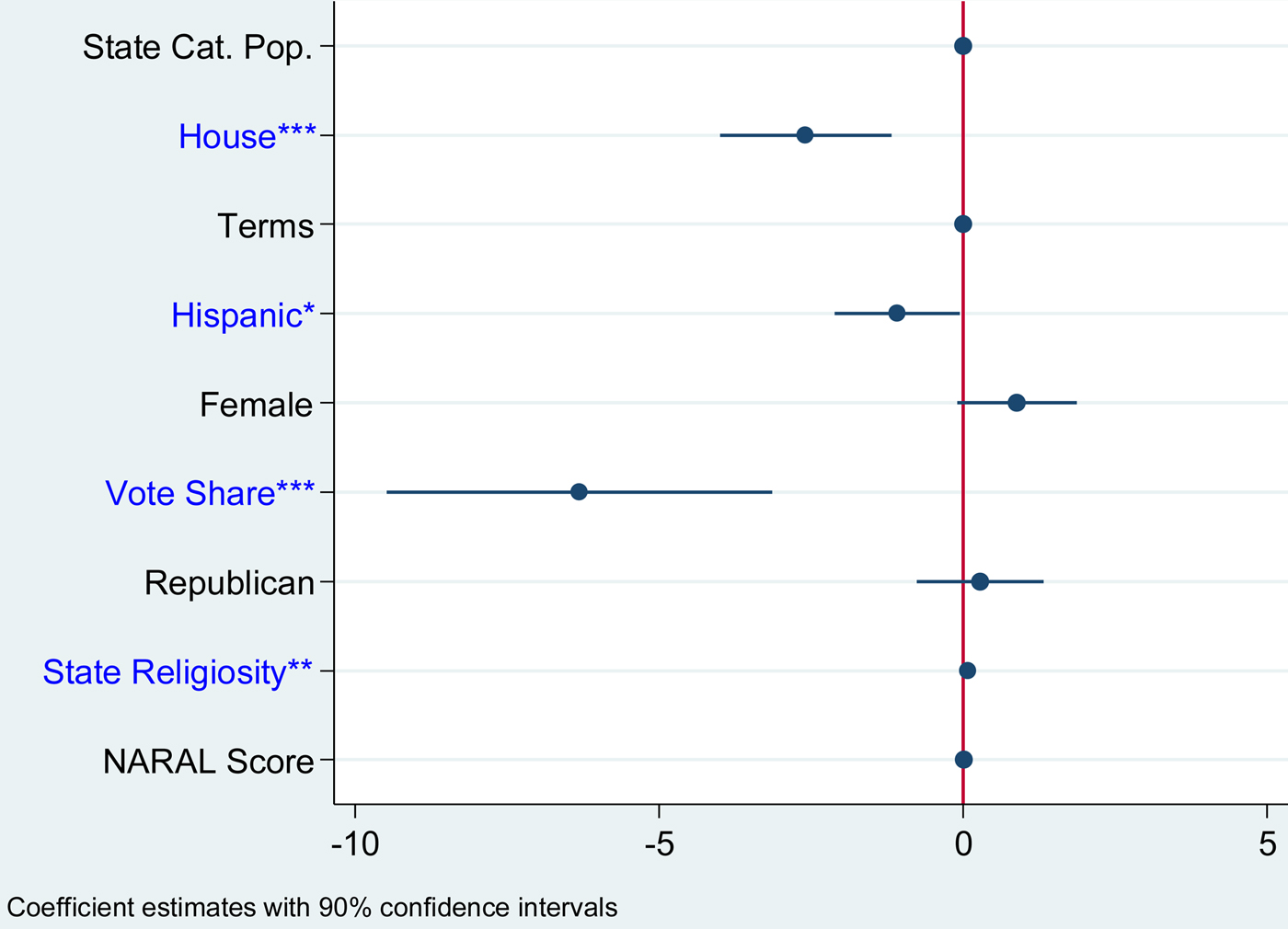
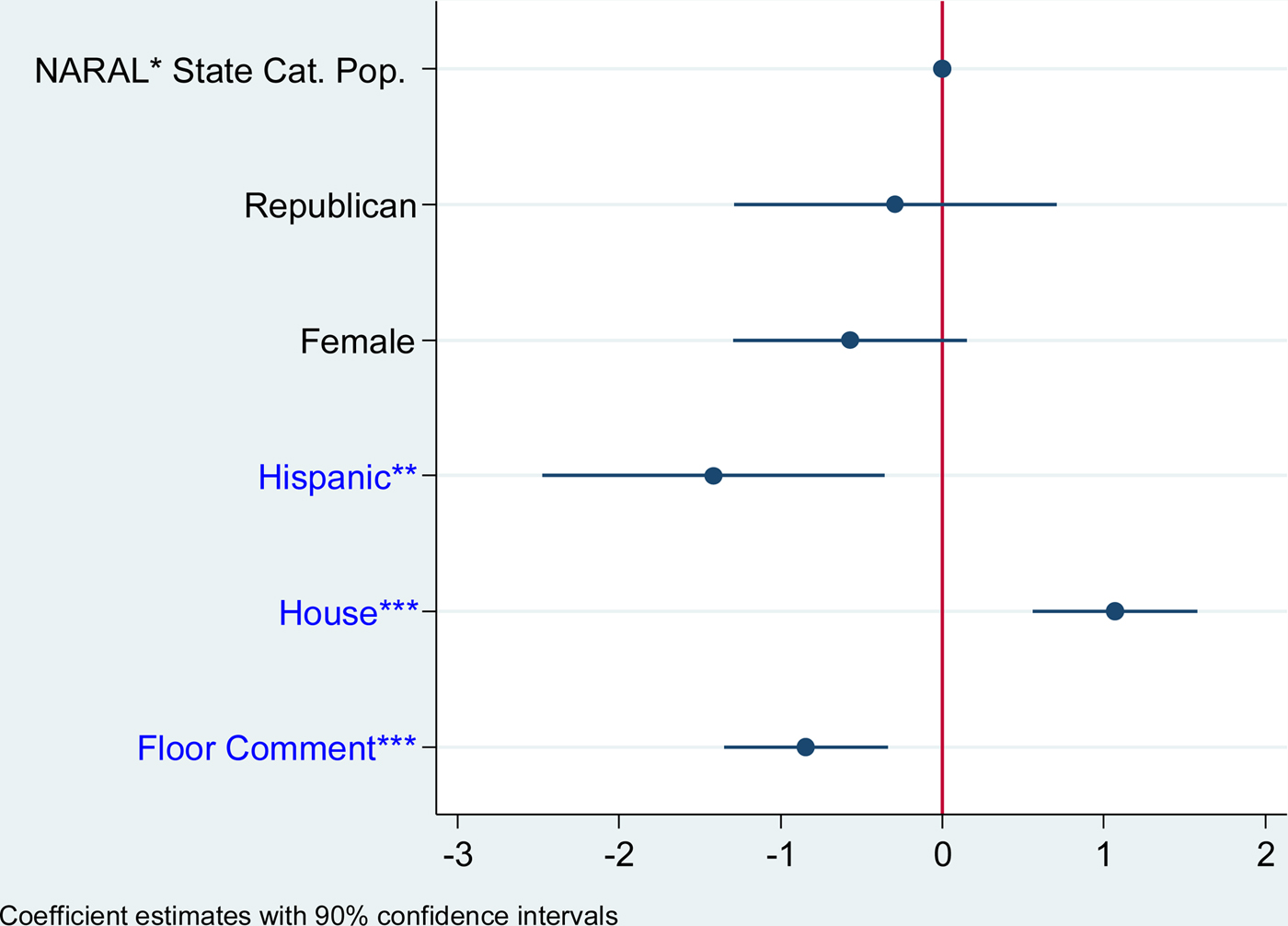
In our models of “who speaks,” we control for a number of factors that could influence a Catholic legislator's decision to comment on abortion: whether they are in the House or Senate, their number of Terms in office, whether the legislator is Hispanic and/or Female, the legislator's Vote Share in the previous election, the legislator's Party, the degree of Religiosity and size of the Catholic Population within a legislator's state, and the legislator's NARAL Score. Figure 1 depicts coefficient estimates from a mixed effects logistic regression of who speaks with a full table of results included in Table A1 in the appendix. As the confidence intervals for some very small coefficient estimates appear to cross the zero line, all results significant at p < 0.10 or less are denoted by asterisks and colored in blue.
(Color online) Who speaks about abortion?

First, Catholic legislators in the House are less likely than their colleagues in the Senate to comment on abortion (p < 0.01). Scholars have noted that the Senate has become more open over time with a greater allowance for issue advocacy and deliberation (Osborn and Morehouse Mendez Reference Osborn and Mendez2010). Given the Senate's history of unlimited debate, senators have comparatively more opportunities than members of the House to make floor comments regarding abortion. Meanwhile, Hispanic legislators are less likely to comment relative to non-Hispanic Catholics (p < 0.10). High levels of Catholicism among Hispanics in the general population combined with strong Democratic Party identity among Hispanic Catholics likely explain why Hispanic Catholics had a lower likelihood of commenting on abortion. Similar to our expectations regarding content in Hypothesis 4, Hispanic Catholic legislators whose party position on abortion differs from that of the Catholic Church may avoid addressing the topic in public forums so as not to create tension between constituent and party positions on abortion.
In addition, the safeness of a legislator's seat as measured by their Vote Share in the previous election decreased their likelihood of commenting on abortion (p < 0.01) while higher levels of State Religiosity increased the chances that a Catholic legislator commented on the issue (p < 0.05). Both of these findings suggest that Catholic legislators comment on abortion strategically depending on their levels of seat security and the importance of religion to their constituents. The decision to comment on a high-profile issue like abortion may serve as a signaling mechanism that would be more important to electorally vulnerable legislators with smaller vote margins (Hill and Hurley Reference Hill and Hurley2002). Therefore, the likelihood of speaking publicly about abortion would decrease as a legislator's vote margin increases. On the other hand, State Religiosity, measured as the proportion of a state's population saying that they view religion as “an important part of their daily life,” serves as a measure of religious salience among legislators’ constituents. Catholic legislators representing states with high levels of religious salience may feel pressure to clarify their stance on abortion.
Meanwhile, gender, the size of Catholic population within a state, party identity, and NARAL scores did not significantly affect whether a Catholic legislator commented on abortion. These findings are surprising given our expectations regarding the effect of party and gender on the content of legislators’ comments on abortion. In terms of Party identity, Republicans controlled both houses in the 108th Congress, which may have provided Republican Catholic legislators with more opportunities for comment on a range of issues, including abortion. However, previous research provides mixed evidence regarding how majority party status shapes speaking patterns in legislative bodies (Osborn and Morehouse Mendez Reference Osborn and Mendez2010; Maltzman and Sigelman Reference Maltzman and Sigelman1996). Though we found no gender differences in Catholic legislators’ decisions to speak about abortion, our later finding that gender shapes the content of Catholic legislators’ speech on abortion lends credence to the idea that deciding when and how to speak are distinct processes with different explanatory factors. Finally, the fact that junior and senior Catholic legislators were equally likely to offer comments on abortion is in keeping with previously mixed findings regarding the effect of seniority on legislative speaking (Hill and Hurley Reference Hill and Hurley2002; Morris Reference Morris2001).
ANALYSIS: CONTENT OF ABORTION COMMENTS
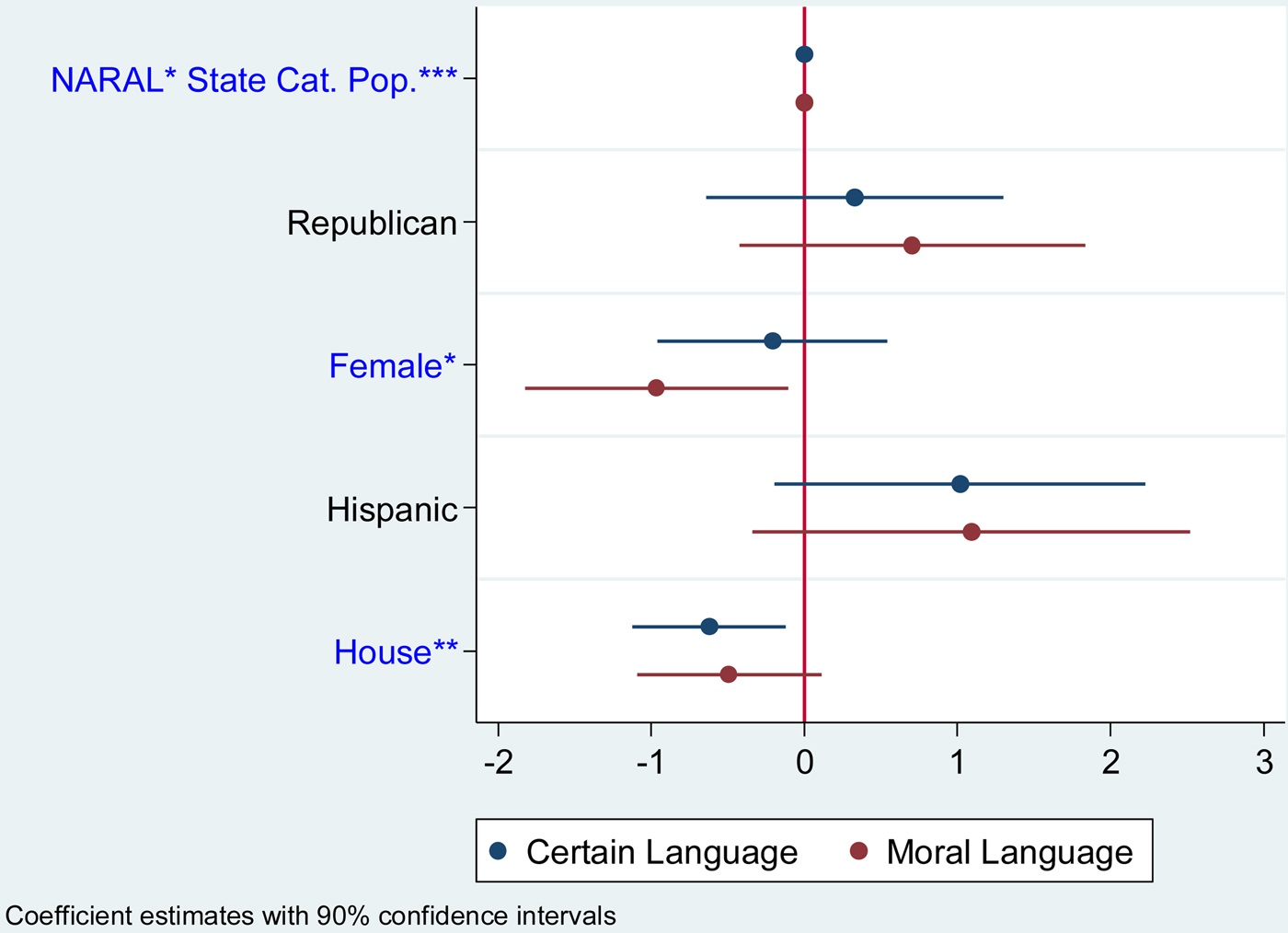
As our independent and control variables are measured at both the individual and state level, we employ a mixed effects generalized linear model with individual legislators specified as level one and the state specified as level two.Footnote 5 Given that our dependent variables are the proportion of legislators’ statements comprised of certain, moral, or religious language, we use fractional logistic regression to account for the continuous nature of our dependent variable and its boundaries of zero and one.Footnote 6 Figures 2 and 5Footnote 7 display coefficient estimates from models of Catholic legislators’ use of Certain, Moral, and Religious language. Numerical results for these figures are located in Table A2 in the appendix. In some cases, marginal effects holding all covariates at their respective medians/means were calculated for the fixed portion of the modelFootnote 8 and are included in our discussion of results.
(Color online) Catholic legislators’ use of certain and moral language.

Our expectations regarding partisan differences in abortion comments are not borne out in multivariate analysis. Catholic Republicans are not more likely than Catholic Democrats to use certain, moral, or religious language. This finding is particularly surprising given party identity's predictive power in explaining political behavior both inside and outside of government. What might explain party's insignificance in terms of Catholic legislators’ comments on abortion? Catholic Republicans may be responding to constituency pressures by moderating the language that their faith and their party might suggest to them. As aforementioned, the public is conflicted on abortion, supporting abortion rights but only under certain conditions. As such, lawmakers of both parties must be careful in their discussions of an issue that the public sees in shades of gray. This would be in keeping with Ainsworth and Hall's (Reference Ainsworth and Hall2011) findings regarding pro-life legislators’ moderation of abortion policy proposals over time. Similar to their abandonment of controversial Constitutional amendments in favor of achievable legislative goals, pro-life (mostly Republican) legislators may also have learned to dial down their rhetoric and focus on speaking about abortion in more popularly accepted terms.
One could respond that Republican partisans are much more opposed to abortion than the general public and these are the constituents to which Catholic Republicans would be most responsive. However, at the time of the 108th Congress, only about 20–25% of Republican identifiers believed abortion should be “illegal in all circumstances” (Fiorina, Abrams, and Pope Reference Fiorina, Abrams and Pope2006, 90–91). Many Republican voters support abortion in some circumstances and even Catholic Republican MCs seem sensitive to this fact. Additionally, compared to today's polarized political climate, the ideological distance between the parties in 2003 and 2004 was much smaller. The presence of moderately conservative Democrats and relatively liberal Republicans during the time period of study may have brought members of both parties closer together on the topic of abortion. Ultimately, this null finding provides an opportunity for future research on partisan differences among Catholic MC's with respect to abortion politics.
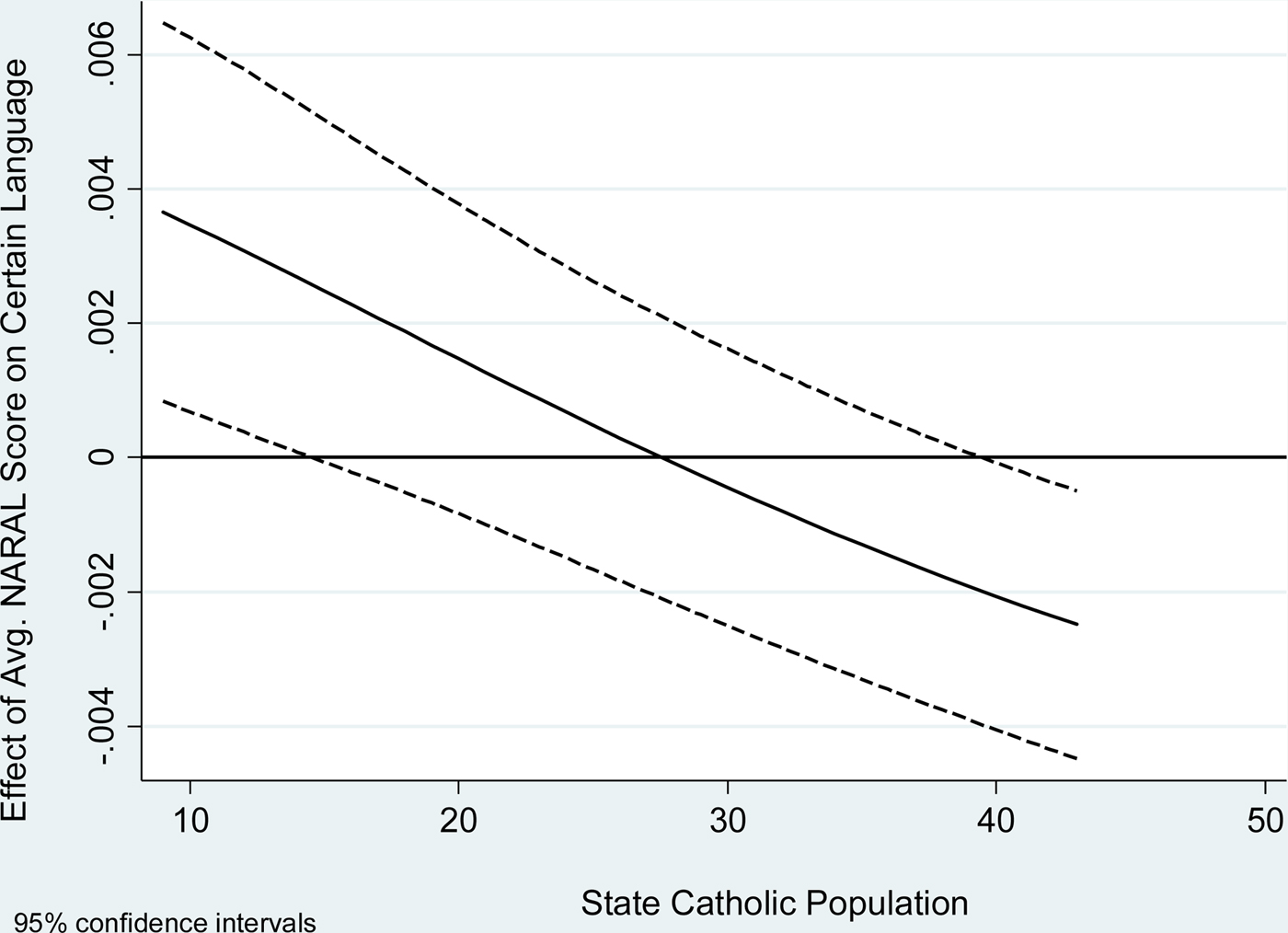
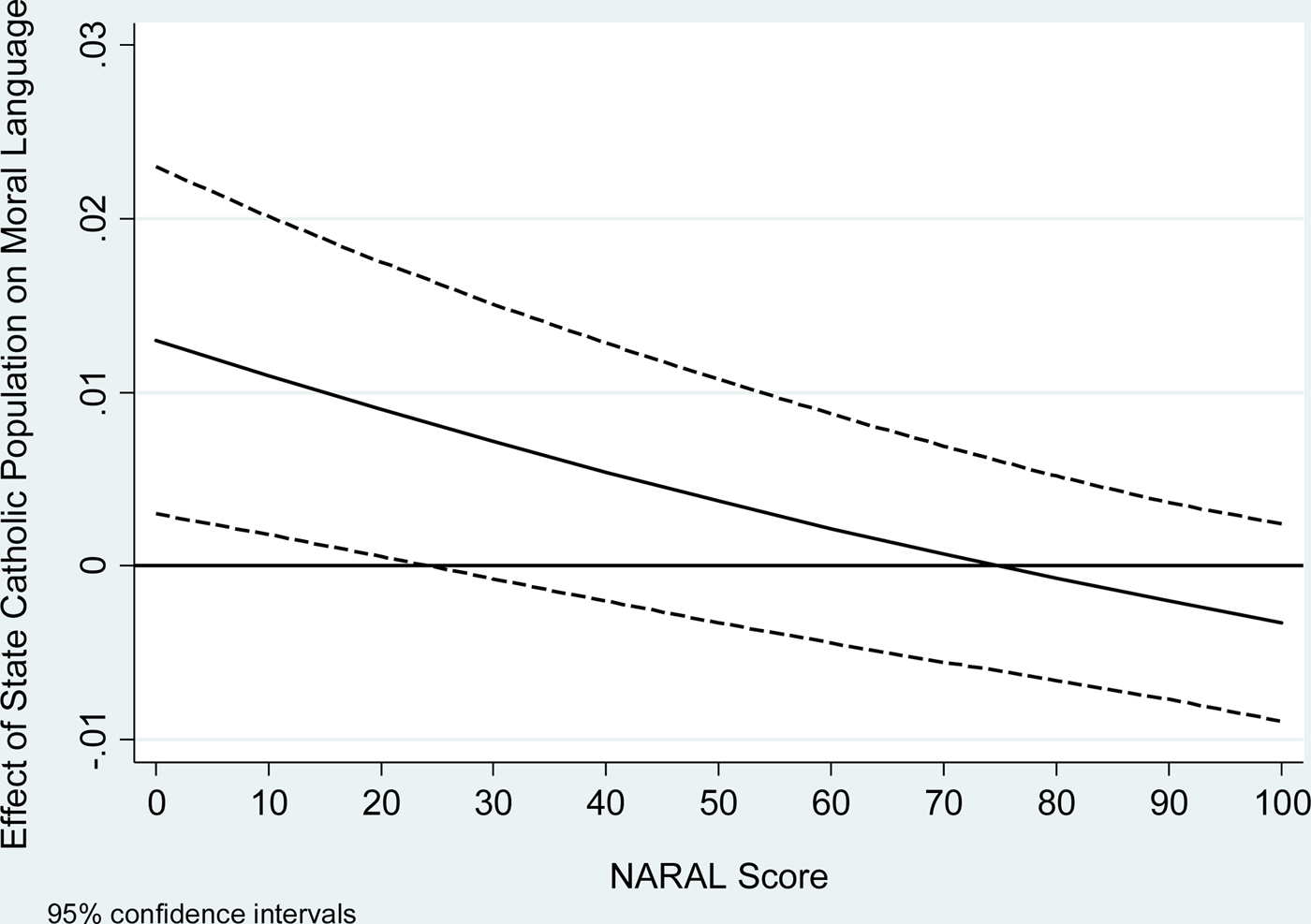
We find partial support for Hypotheses 2, 3, and 4. State Catholic Population moderates the effect of NARAL Scores (and vice versa) in terms of the Certainty with which legislators discuss abortion as well as Catholic legislators’ use of Moral language (p < 0.01 in both cases). These findings provide support for Hypothesis 2 in two out of our three main predictive models. However, the negative and significant sign for the interaction between NARAL Score and State Catholic Population indicates that rather than one variable strengthening the effect of the other, the effect is one of attenuation. For example, as NARAL Score increases (indicating a more pro-choice position) it decreases the positive effect of State Catholic Population on Catholic legislators’ framing of abortion. This interactive relationship is best demonstrated graphically and is depicted in Figures 3 and 4.
(Color online) Marginal effect of NARAL score on certainty across range of state Catholic population.

(Color online) Marginal effect of state Catholic population on moral language across range of NARAL scores.

Figure 3 graphs the marginal effect of NARAL Score on a legislator's level of Certainty when discussing abortion over the range of State Catholic Population. In states with few Catholics (zero to 10% of the state population), the effect of NARAL Score on Certainty is statistically significant and positive indicating that pro-choice Catholic legislators are significantly more certain in their discussions of abortion when representing small populations of Catholics. As State Catholic Population increases to moderate levels, the positive effect of NARAL Score on a Catholic legislator's use of certain language decreases in magnitude and becomes insignificant. However, as we see on the right-hand side of Figure 3, pro-choice Catholic legislators representing states with very high numbers of Catholics (approximately 32% or above) become significantly less Certain in their framing of abortion.
These findings suggest that pro-choice Catholic legislators experience conflict on the issue of abortion when representing states with very large Catholic populations but exhibit more certainty when populations of Catholics are low. Given the conflict between their personal position on abortion and the teachings of the Catholic church, pro-choice Catholic legislators who represent large numbers of Catholic constituents are less likely to confidently frame the issue when discussing it publicly.
When we consider the effect of State Catholic Population on legislators’ Moral language over the range of their NARAL Scores (Figure 4), we find a positive effect among pro-life legislators. When legislators’ NARAL scores are low (indicating a pro-life position), increases in State Catholic Population positively affect their use of Moral language. However, this relationship becomes and remains insignificant for legislators whose NARAL scores are over 33, which corresponds to cases where a legislator voted with NARAL's position at least three out of every 10 times. Though the sign of the interaction term is not as expected, our expectations regarding the interactive effect of NARAL Scores and State Catholic Population are supported in models determining legislators’ use of certain and moral language, but not with respect to their use of religious language.
Catholic legislators’ descriptive identities as women and Hispanics also shape the ways in which they discuss abortion. The negative and significant (p < 0.05) sign for Hispanic in Figure 5 indicates that Hispanic Catholic legislators are less likely than non-Hispanic Catholic legislators to reference Religion in their discussions of abortion. More specifically, the proportion of a statement comprised of religious references decreases by about 36 percentage points when a Catholic legislator is Hispanic as compared to non-Hispanic. This finding offers partial support for Hypothesis 3 that Hispanic Catholic MCs will be less likely to use religious language when discussing abortion.
(Color online) Catholic legislators’ use of religious language.

Against our expectations, we find no significant differences between Hispanic and non-Hispanic Catholic legislators in terms of their levels of Certainty and references to Morality when discussing abortion. These null effects suggest that religious cross-pressures are the most salient for Hispanic Catholics in Congress and result in both a hesitancy to speak about abortion and an avoidance of religious references in their commentary. The combination of infrequent references to abortion among all Hispanic Catholic legislators (as shown in our model of who speaks) and the frequency of Democratic Party identification among Hispanic Catholic legislators who addressed the issue may explain Hispanic Catholic legislators’ lower rates of religious references.
Hypothesis 4, that women Catholic legislators will be less likely than their male colleagues to discuss abortion with certainty and in moral and religious terms, receives partial support in terms of Moral language. Figure 2 shows that compared to male Catholic legislators, Catholic women in Congress are less likely to use moral language when discussing abortion (p < 0.10); the marginal effect of being female decreases the proportion of moral language in a legislator's comment by approximately 11 percentage points. Against our expectations in Hypothesis 4, men and women Catholic legislators’ levels of Certainty when discussing abortion do not differ and they are equally likely to reference Religion in their comments. Catholic women legislators face religious and partisan cross-pressures that are similar to their male colleagues, which may result in their relatively equal levels of Certainty and use of Religious language in abortion comments.
Though we held no formal expectations regarding chamber-based differences in the content of abortion comments, senators and representatives do differ in the way they discuss abortion. The significant coefficient for House in Figures 2 (p < 0.05) and 5 (p < 0.01) indicates that though senators are more Certain than representatives in their discussion of abortion, members of the House are more likely than their colleagues in the Senate to use Religious language. One possible explanation for these findings is that senators’ longer terms and comparatively diverse constituencies provide them with more leeway regarding their positions on abortion, thus allowing them to discuss the issue in more certain terms. As Richard Fenno's (Reference Fenno1982) interviews with sitting senators revealed, senators describe their time in office as “four years as a statesman and two years as a politician.” Additionally, the history of unlimited debate in the Senate may affect the certainty of their speech as senators more frequently engage in dialogue about a range of issues and are more likely than their colleagues in the House to comment on abortion in the first place.
However, when examining more closely the top 25 comments comprised of Religious language, one sees that many comments were offered by House Democrats with a history of pro-choice voting (as per their NARAL Scores). In addition, with the exception of two Senate floor comments from Senator Rick Santorum in 2003, all of the comments in the top 25 for Religious language were made to the media in 2004. It was during this time that Catholic priests attempted to deny communion to pro-choice politicians, and pro-choice Catholic legislators felt compelled to explain their seemingly contradictory identities.
For example, Representative Bill Pascrell (D-NJ-9th District) succinctly defended his position as a pro-choice Catholic to the Philadelphia Inquirer on May 9, 2004: “I will continue receiving Communion — not in defiance but out of conscience. I have nothing to apologize for.” Additionally, these unique circumstances created a link between comment type (to the media vs. Floor Statement) and Religious language that does not emerge for Certain or Moral language. Notably, legislators made more frequent religious references in statements to the media than they did on the floor of the House or Senate. We believe that the cross-pressures felt by pro-choice Catholic representatives motivated them to clarify their identities to the media (and, by extension, their home districts) after priests highlighted the contradictory nature of their faith and positions on abortion.
CONCLUSION
After examining an original dataset of statements made on the chamber floor and to the media during the 108th Congress, we find that several factors produce differences between Catholic legislators in how they do, or do not, discuss abortion. Catholics serving in the House, Hispanic Catholics, and Catholics who won their last election with a larger share of the vote had lower likelihoods of commenting on abortion. Catholics representing states with higher levels of religiosity were more likely to comment on the issue. In terms of how Catholic legislators discuss abortion, we find interactive effects between Catholic legislators’ NARAL scores and the size of the Catholic population in a legislator's state. In addition, Hispanic Catholic legislators are less likely than non-Hispanic Catholic MCs to reference religion when discussing abortion, and female Catholic lawmakers are less likely than their male colleagues to discuss abortion in moral terms. Finally, we find that Catholic senators are more certain when they discuss abortion, while Catholic representatives are more likely to use religious language.
Ultimately, Catholic members of Congress choose their words about abortion carefully and strategically. It is clear that MCs’ other internal characteristics and experiences besides religion, as well as external constituency pressures, have a role in shaping the way abortion is discussed. Female Catholics avoid moral language, which is similar to what we would expect to find among the non-Catholic female members of Congress who are mostly pro-choice and feel a shared responsibility to advance the interests of women in government. Thus, the personal experience of a woman Catholic as a woman, rather than as a Catholic, may shape their choice to avoid discussing abortion in moral terms. Hispanic Catholics are unlikely to speak about abortion and when they do, they are less likely to use religious language. These results suggest the linguistic choices of Hispanic Catholics may not be a product of their religious beliefs, so much as they are a product of external cross-pressures of party and constituency. Hispanic Catholics are mostly Democrats (a pro-choice party), but they are coming from very devout ethno-religious communities where Latino Catholics are more likely than non-Latino Catholics to follow church teachings on abortion. Far better for those Hispanic representatives and senators to downplay abortion by not addressing it and keeping religion off the table rather than risk angering either their party or the faithful Latino Catholics who support them.
Similarly, our finding that increasingly pro-choice Catholic legislators representing states with larger Catholic populations use less certain language shows that these officials are also sensitive to their constituencies. Pro-choice members with large Catholic constituencies may present abortion as a difficult choice because more people in their districts could be upset by the contradiction between their political positions and the position of their church. Alternatively, pro-life legislators are more likely to frame abortion in moral terms as the Catholic population in their state increases signaling a possible base of support among pro-life, Catholic constituents. As non-Catholics are not included in our analysis, and given that there is at least some variation in Catholic theology, we cannot go as far as to say that religious faith does not shape how a Catholic MC discusses abortion. However, we do feel certain that the language of these Catholic MCs is a product of far more than their personal religious values alone.
We recognize that our work is only a start. This research creates promising avenues for additional studies of the relationship between legislators’ religious identities and their behavior in office. For instance, it would be worth replicating this analysis for other points in time. The politics of abortion have shifted over the last decades, becoming much more partisan in the process. It remains an open question whether one would observe similar patterns of speech from Catholics who served in an earlier time. Similarly, it would be useful to compare and contrast the language Catholic officials use to discuss abortion with the kind of language members of other faith traditions use.
For example, Jews are strong supporters of the separation of church and state, and overwhelmingly identify as liberal Democrats (Wald and Calhoun-Brown Reference Wald and Calhoun-Brown2011, 266–273). Although complicated, Jewish tradition allows for abortion in some cases and abortion is legal in Israel (Ainsworth and Hall Reference Ainsworth and Hall2011, 137). Given this constellation of internal and external forces, one might expect Jews in Congress to use more certain, but less religious, language when talking about abortion. Jews might use more certain language because they face less internal/external conflict, but they might avoid religious language because of their commitment to the separation of church and state. Meanwhile, evangelicals overwhelmingly identify as Republican and their churches are predominantly pro-life (Wald and Calhoun-Brown Reference Wald and Calhoun-Brown2011). They are also more likely to represent citizens from Southern states where opposition to legal abortion runs higher (Pew Research Center 2013). As such, evangelical Protestants in Congress, similar to Jewish members, face reduced internal/external conflict, and might be likely to use very certain, religious, and moral language when discussing abortion. These are relationships worth exploring.
Most Catholic politics research has sought to explain how Catholicism factors into an individual's vote choice or partisan identification (Gray, Perl, and Bendyna Reference Gray, Perl and Bendyna2006; McDermott Reference McDermott2007; Mockabee Reference Mockabee and Wilson2007; Prendergast Reference Prendergast1999). Relatively fewer scholars have focused on the actions of Catholic public officials, with the bulk of this work considering how Catholic identification affects roll call voting. Thirty-one percent of the current membership of Congress identifies as Catholic — more than double the number of members who identify with any other religious denomination (Pew Research Center 2015a). As such, there is a need for more work focusing on this elite group of Catholics, particularly research that explores more than just how these legislators vote. Our study of public comments is a critical step in this direction.
SUPPLEMENTARY MATERIALS
To view supplementary material for this article, please visit https://doi.org/10.1017/S1755048317000530.