Diplomacy, while often devolving into war, has involved forms of negotiation and compromise that have resulted in ‘dividing up the pie’, leading to agreements to give and take land or resources in a mutually acceptable way. This has often been at the expense of smaller nations. Poland has frequently been a victim of these compromises, carved up by Germany, Austria and Russia at several points in time, and, in the aftermath of the Cold War, its loss of sovereignty was accepted as a part of a grand compromise (see Bernstein, this volume) at Yalta. In the early decades of the twentieth century, Africa was carved up by the great powers; going back much further, nations from Ireland to Asia were caught up in the grab for land.
Many of the violent conflicts of the Cold War and post-Cold War period have involved peoples whose sovereignty had earlier fallen through the cracks of interstate politics. There are two elements that make compromise highly problematic in contexts of this kind. The first is a tendency of sovereign powers to attach the label ‘terrorism’ to acts of resistance. One should not, in conventional wisdom, talk, negotiate or compromise with terrorists as this represents recognition of them as political actors. The second element is the tendency of the resistance to claim an experience of injustice which makes compromise difficult if not impossible in so far as it relates to the dignity and autonomy of a community. Terrorism and injustice may be two sides of the same interpretive coin; sovereign actors refer to the resistance of those lacking sovereignty as a form of terrorism, while the latter claim that their actions arise from an experience of injustice.
‘Terrorism’ and ‘injustice’ tend to be thought of as two different types of context rather than two sides of the same coin. Any acknowledgement of claims about injustice by those who use violence – and particularly violence that is considered terrorist (that is, indiscriminate, targeted at civilians) – is said to be equivalent to condoning the activity. The focus of this analysis is not terrorism generally, but rather situations involving a loss of sovereignty and autonomy, where agents, from this position, have fought back. The focus is less a question about the rightness of this resistance than an empirical observation that people in this position often do fight back, in a variety of ways. The main problem that I explore is how, given a situation where compromise is seen by actors on both sides to be impossible, either because they understand resisters to be ‘terrorists’ or the resisters understand themselves to be victims of injustice, agents would move towards a new game in which both sides are recognized as political subjects capable of engaging in compromise and negotiation. How would anything other than what Avishai Margalit refers to as a ‘rotten compromise’, an agreement which subjects the weaker party to a regime of cruelty and humiliation, be possible.Footnote 1 In particular, I analyse the role of political self-sacrifice in the transition, raising a question about the extent to which this sacrifice is attached to violence on the part of the agent.
This requires a theoretical reconceptualization of the notion of a game that shifts away from the individualist ontology of game theory to a more social ontology focused on the underlying rules. I turn the common game metaphor, the Prisoner's Dilemma, on its head, developing a framework called the Warden's Dilemma which highlights the hierarchical structure of the prison and the strategic dynamics of asymmetrical conflict in a context of this kind. This framework is then put to use in the empirical exploration of two historical cases: the hunger strikes in Northern Ireland in 1980–81 and the martyrdom of Polish Solidarity's priest, Jerzy Popieluszko, a few years later.
CHANGING GAMES
Game theory revolves around units that are understood to be self-interested utility maximizers. The focus is on decision-making that will at best maximize interest and at worst cut one's losses. The problem in a situation of asymmetrical conflict is that the players are not like actors: for instance, one is usually a state actor and the other is a non-state actor, as in the cases to be explored here. There is still, however, a sense in which their actions can be understood to be game-like, or resting on rules that constitute not only who they are but the meaning of what they do and the context in which this doing takes place. Indeed, as the following analysis will demonstrate, the identity of the agent of self-sacrifice is at the centre of contestation, as is the legitimacy of different modes of action. The outcome, including whether some kind of dialogue or compromise are thinkable, is in large part a function of how this contestation is resolved. It is not only that the two players play by different rules, but that the objective of the player with a weaker hand is to change the rules of the dominant game. Given their position outside the dominant game, and thus outside politics, often defined as criminals or terrorists, such a change is necessary in order to be constituted as political subjects, capable of engaging in dialogue over the conditions in which they live.
The notion of a game that changes rests on different methodological assumptions from those of game theory. First, the focus is less on rational self-interest than on the underlying rules that define the context of action. This represents a shift from an individual ontology to a social ontology which acknowledges the importance of language. The second contrast with game theory, following from the last, regards the shift from a focus on the self interest of the primary agents to the analysis of ‘meaning in use’ particularly as it involves the contestation surrounding an act of self-sacrifice. Third, the focus is not on a single game but how two actors, who begin playing by different rules, might move toward a position where interaction as relative equals becomes possible.
The contestation regards the identity of the bodies of resistance and whether they are legitimate political subjects. From this perspective, as noted by Margalit, a ‘sanguine compromise’ involves movement toward a position where the ‘other’ is recognized as capable of engaging in negotiation, which involves movement away from two distinct games towards one in which both are recognized as potential players.Footnote 2 In the initial set-up, the language game of the resistance highlights its political subjectivity and gives meaning to acts of political self-sacrifice as ‘martyrdom’. The martyr is a witness to injustice, which in both cases refers to the humiliation of a population vis-à-vis what is defined as an occupying power, as distinguished from the historical but oppressed nation or community whose dignity the resistance seeks to restore. The martyr sacrifices on behalf of a community, which politicizes the suffering or dead body and plays a role in constituting the nation of resistance. By contrast, the language game of the sovereign power depoliticizes by identifying the agent of resistance as a criminal or terrorist.Footnote 3 The naming of the criminal or terrorist is part of a securitizing move that identifies an existential threat to the state, which links to a larger international discourse of sovereignty and justifies punishment or elimination of this extremist element. Which set of rules one draws on for making sense of the act of self-sacrifice is largely a function of one's position vis-à-vis the object of contestation, and the naming in either case has resonance with particular audiences, both domestic and international.
While some rational-choice theorists have claimed that self-sacrifice can be considered a form of altruistic self-interest,Footnote 4 the attempt to place the act within an individual ontology misses the point. While an actor may have an altruistic interest in acting on behalf of a community to the point of suffering and possibly death, this formulation is in many respects nonsensical since the agent of self-interest potentially ceases to exist as a result. The rules of the game within which the act has meaning are social, that is, the structure of meaning is shared by others within a community and the objective is not an individual objective. A notion of sacrifice extends beyond the individual to those for whom the sacrifice is made and who will continue and, it is hoped, flourish as a result.
THE WARDEN'S DILEMMA
The Prisoner's Dilemma is a popular framework for thinking about the problem of self-interest. The sub-optimal choice, which brings partial punishment, is considered most rational because it avoids the most risky, and thus potentially costly, penalty. Political self-sacrifice potentially involves the ultimate loss of value – the loss of one's life. The utility that is potentially maximized as a result is the social utility of a community that hopes to regain its political subjectivity. The focus is not on individual rational utility within a game but rather on the potential transition from one set of rules to another.
A prison is populated by entities whose sovereignty has been taken away, if temporarily, and a moral order that assumes some form of ‘correction’ is taking place. The emphasis here is on the problem faced by peoples whose political sovereignty has been constrained or taken away and where populations to various degrees have been constituted as subordinates no longer able to define the rules by which they live, and subjected to cruelty and humiliation. What I refer to as the Warden's Dilemma is a model for approaching the dilemma from a different angle, in order to illustrate the dynamics of a hierarchical power configuration and the potential transition to a new game. The limitation of the model as far as the more contextualized cases are concerned is that creation of a choice structure for both the warden and the agents of resistance does not on the surface appear to go beyond the individual ontology of rational choice. Having said this, it is important to clarify that the carriers of choice are less the specific individuals than the context itself and the possible moves available to agents given an existing structural position and resistance to it. The context, which is defined by a lack of sovereignty for one party, limits the expression of agency or autonomy to a refusal to conform to the dominant rules of the game, while acting as if a different game is in place, the result of which may be a self-sacrifice.
The goal here is to examine the dynamics of a particular type of interaction and its transformation over time. The objective of the stronger party is to maintain the dominant game, which constitutes their power and legitimacy. The objective of the weaker party is to change the underlying rules of the dominant game such that they are recognized as subjects capable of engaging in dialogue over the conditions in which they live. The warden is the keeper of the rules and the Other is expected to conform to the rules. When the prisoner refuses to conform, this results in contestation over the rules that will govern interactions within this structure.
Prisoners are generally expected to cooperate with the rules established by the prison regime and are thus not sovereign in making decisions. In this situation, there are three choices, which are shaped by an assumption that imprisonment is first and foremost for political reasons. The first is to accept one's status as criminal and conform to the rules, in the hope of an early release for good behaviour, which is an abdication of one's sovereignty, at least temporarily. The second is to respond with violence, for example, with a prison riot. This choice is likely to justify a harsh clampdown and reinforce the image of the prisoners as dangerous criminals. The third is to refuse to conform to the rules, for example by refusing to wear the prison uniform, which is a symbol of criminal status; that is, to recognize one's own political subjectivity, even while this is denied by the more powerful actor.
Kohn argues that a signal whose effect is to advertise an individual's strength and size should be strong and sustained in the way that only a strong or large individual can produce.Footnote 5 The prisoner in this situation does not possess strength of this kind, but is pitted against an institution that is backed by the power of the law and physical force. The choice of violence reinforces the prisoner's status as dangerous criminal. The prisoner is unable to overpower the prison system physically. His use of violence only strengthens the legitimacy of that system.
It is this legitimacy that must be drawn into question for there to be a change of game. The third choice involves not only a refusal to conform to the rules but also a decision to accept any resulting punishment without retaliation. The decision thus potentially results in harm to the self rather than maximization of self-interest. As in the first scenario, the prisoner refuses to conform with the rules of the prison and has a reason for doing so: he feels his non-cooperation with an unjust rule or law is justified. Thus, for example, political prisoners should not be forced to wear the uniform of the criminal. As above, the warden reciprocates with punishment, but this time the prisoner continues to refuse to conform but also suffers the consequences of his non-cooperation, for example by clothing himself only in blankets. This interaction progresses through repeated rounds. The prisoner refuses to conform; the prison warden punishes the prisoner; and the prisoner, rather than retaliating, accepts his worsening condition while still refusing to conform, again and again. When this repeated interaction reaches its culmination, such that the only further form of non-cooperation available is the refusal to take food, the costs of non-cooperation, and the reliability of the demand attached to it, have reached their ultimate expression. The cost of one's life is presented as of less value than the ultimate goal of changing the rules of the game, which would replace prisoners' conformity with an open-ended negotiation over the conditions in which they live.
At this point, the warden is faced with a dilemma. The prisoner is clearly not acting within a Prisoner's Dilemma game, where realizing his self-interest in the shortest sentence possible is the ultimate objective. A consistent pattern of non-cooperation has led to a point where the prisoner's life is at stake and he has already decided that he is more prepared to give up his life than to conform to the rules of the dominant structure, which he sees as unjust, and which would substantiate the power of the regime. The warden, having punished the prisoner repeatedly, must now decide whether his self-interest in appearing to run a humane prison is maximized by continuing the punishment or by recognizing him or her as a political agent. At this point, the emphasis on appearance suggests that the interaction is not purely internal to the prison and the choice is part of the management of public perceptions and image. The reputational effects of allowing a prisoner to die in this way provides an incentive to think carefully about the choice since the warden does value his relationship to others, both inside and outside the prison, who might react negatively. The legitimacy of the structure would be called into question if it appeared that the warden was humiliating and abusing political prisoners who were acting non-violently.
The act of sacrifice is part of an effort to communicate to an audience the humiliation and injustice that is experienced by the social group which he or she embodies. The self-sacrifice is part of a contestation in which the agent of self-sacrifice seeks to change the rules of the game such that the community he or she identifies with can act as sovereign agents, negotiating over the conditions in which they live. They thus seek to move out of the category of the criminal, who lacks agency, to be recognized as political subjects who act on behalf of a body politic.
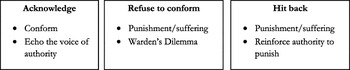
The agent's response to the experience of humiliation is the core of this dynamic. In his research into ‘total’ institutions, such as asylums and prisons, Goffman highlighted the extent to which the curtailment of the ‘self’ is part of the socialization of the inmate through procedures of debasement, degradation and humiliation, often involving an ‘obedience test’.Footnote 6 Those aspects by which a person has control over his world, that is, self-determination, autonomy and freedom of action, are denied. But, as Margalit points out, the relationship between the humiliator and the humiliated is paradoxical.Footnote 7 The humiliating act is intended to lower the value of the object; however, in order for the humiliation to be effective, the humiliated has to retain sufficient agency to recognize and acknowledge that they have been humiliated. As illustrated in Figure 1, it is this acknowledgement that substantiates the power of the prison regime (whether actual or metaphorical). The acknowledgement doubles the voice of the authority in so far as their power is substantiated by the conformity of those who consent. The act of political self-sacrifice reverses the relationship. This reversal was captured by Padraig O'Malley in his depiction of the non-cooperation of the ‘blanket men’ in the Long Kesh Prison in Northern Ireland. He said that, for every hardship inflicted on them:
Humiliation

they were prepared to inflict a hardship of at least equal severity on themselves, thus devaluing the system's power to intimidate them. Their willingness to deprive themselves undermined the authority of the regime to do so. Whatever debasement or humiliation the regime might impose on them in the form of punishment was nothing compared to what they were prepared to impose on themselves in the form of protest.Footnote 8
The logic of political self-sacrifice is one of accepting harm to the body as punishment for refusing to cooperate with the existing rules of the game. This requires a form of agency, in so far as it clearly goes against the grain of the dominant structure and ultimately risks death. This form of agency is distinct from the other two choices presented in the Warden's Dilemma model, that is, compliance with the rules of the dominant game, which doubles the voice of the regime, or violent retaliation against them, which may, given this hierarchy, reinforce one's status as abject other outside the boundaries of the dominant game.
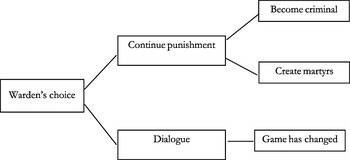
Figure 2 is a depiction of the choices that arise out of the dilemma posed to the warden by the continuing refusal of the prisoners to conform after repeated attempts to punish them, based on a contrast between a case that was purely non-violent and one where the self-sacrifice was non-violent but associated with a violent campaign outside the prison. In both cases, the martyrdom resulted in questions about the criminal nature of the government.Footnote 9 In the Polish case, following the martyrdom of Popieluszko, there was no choice other than to recognize the opposition and to engage with them in dialogue. In the Northern Irish case, the result was a stalemate, where the British government under Prime Minister Margaret Thatcher remained inflexible, and the Irish Republican Army (IRA) outside the prison escalated its violent campaign. The key distinction, I would argue, regards the clarity surrounding the assignment of culpability for the deaths, the significance of which will become clearer from the cases.
The Warden's Dilemma

The legitimacy to rule is at the heart of the Warden's Dilemma. The prison is a correctional institution for deviant behaviour that is supported by a legitimate monopoly on the use of force. Its legitimacy rests on a clear distinction between the moral authority of the state and the criminal nature of the deviants. The warden faces a dilemma when the force required to enforce conformity with the dominant rules appears disproportionate to a larger audience in light of the unwillingness of the agent to hit back. In this case, the category of criminal is destabilized, opening a discussion of whether the criminal label more accurately applies to the warden rather than to those who refuse to conform. The game thus shifts from a focus on the identity of the agent of political self-sacrifice to questions about the criminality of the regime. The dilemma for the warden is then whether to continue the punishment, realizing that this may lead to a further loss of legitimacy, or to enter into dialogue with the subordinate party, at which point the game has changed. The prisoner is no longer a criminal outside politics but a recognized subject with whom there is an obligation to engage.
THE NORTHERN IRISH PRISON
On Bloody Sunday, January 1972, 13 unarmed civil rights protesters were shot dead by British paratroopers, which signalled the end of the non-violent civil rights campaign in Northern Ireland and an increase in support for the IRA. The increase in IRA activity took place against the backdrop of internment, in which thousands of Irish Catholics were rounded up and imprisoned under emergency measures. The 25-year campaign of political violence that followed was interrupted in the mid-1970s by a Republican campaign of non-cooperation in the Long Kesh Prison, culminating in the hunger strikes of 1980–81. The context of this prison battle mirrors most directly the metaphor of the Warden's Dilemma discussed in the previous section.
The struggle in the Long Kesh Prison revolved around a contestation over the identity of the Republican prisoners, who claimed to be ‘prisoners of war’. POWs are entitled to certain rights, such as wearing their own prison clothing and engaging in negotiation with prison authorities. ‘Special category status’, which was interpreted by the IRA as a type of political status, had initially been granted to those who were imprisoned under internment. The policy was, however, reversed in 1976, after which Republican prisoners would be treated like any other criminal. Republican prisoners, in response, went ‘on the blanket’, refusing to wear prison uniforms or to do prison work, on the grounds that they were political prisoners, not criminals. The campaign later escalated to a ‘dirty protest’, in which prisoners smeared their own excrement on the walls of their cells, and culminated after nearly five years of non-cooperation in the hunger strikes. The Thatcher government referred to the Republican prisoners as criminals like any other inmates, who should conform to the rules of the prison and wear the prison uniform.Footnote 10 The position of the Thatcher government was one of unwillingness to make concessions or to bend, with depiction of its position ranging from inflexible in the more mainstream press, to intransigent in Republican media.Footnote 11 The government argued that the prison provided humane conditions, and that the prisoners willingly inflicted suffering on themselves and, by their own decision, lived in conditions ‘which must be offensive to all civilized people’.Footnote 12
The struggle was not only about the prison and the refusal to conform to specific practices within it. The day-to-day practice of wearing prison clothes, and the regulation of bodily functions were symbolic of consent to the authority and rules of what was claimed to be an illegitimate ‘occupying power’.Footnote 13 The unwillingness to conform was also a response to inhumane treatment, including constant and unprovoked beatings, restriction of food, hosing down, humiliating and pornographic mirror searches, and practices that were often referred to as ‘torture’.Footnote 14 The authorities wanted prisoners to conform to prison rules, and rewards and punishments were extended in response to compliance or non-compliance. As the prisoners refused to conform, they were faced with a progressive increase in the suffering and vulnerability to which their bodies were exposed, from the absence of clothing, to being surrounded by their own excrement, to the ultimate sacrifice of last resort, their lives.
The meaning of the hunger strikes became a subject of political contestation as the naked starving bodies of the prisoners were politicized. On the one hand, the prisoners' suffering was said to be ‘self-inflicted’ and the hunger strikes a ‘deliberate form of suicide’, linked to a ‘cruel and inhuman campaign of violence by the IRA’ and ‘stage managed’ as part of the IRA ‘propaganda machine’.Footnote 15 On the other hand, the hunger strikes gave rise to large street demonstrations, reminiscent of the civil rights campaign of the early 1970s, in which the participants' willingness to lay down their lives was presented as proof of the strength of their political convictions and the selflessness and justness of their cause, as well as the latest phase in the 800-year struggle by the Irish people against imperialism, exploitation and oppression.Footnote 16 The unexpected death of a nationalist MP in Fermanagh/South Tyrone was a turning point, after which Bobby Sands, the POW prisoner on hunger strike, was put forward for the seat, standing for the Republican political party Sinn Féin, and won it with over 30,000 votes. The victory, which was a massive show of support and sympathy by the nationalist population, destroyed the core mythology of the government's propaganda campaign, which was that the Republicans had no support.Footnote 17
The Warden's Dilemma
The refusal of the Thatcher administration to grant any concessions to the prisoners, even when Bobby Sands was on his deathbed, resulted in a global surge of sympathy for the hunger strikers following his death. Sands was proclaimed a ‘martyr’ worldwide, and many questioned whether the Thatcher administration was ‘criminal’, breaking its own laws in Northern Ireland.Footnote 18 Outside Northern Ireland, and particularly among the Irish diaspora in the United States, the hunger strikes and the election of POW MPs were interpreted by many as a form of political dissent by prisoners who had been sentenced by a juryless court within a system that encouraged inhuman treatment in an ‘occupied Ireland’.Footnote 19
While the deaths of the hunger strikers posed a dilemma for the Thatcher administration, making it appear at best heartless and at worst criminal, its room for compromise was constrained by a belief that any concession to the hunger strikers would be an acknowledgement of the legitimacy of IRA violence. For the IRA, this inflexibility became the basis for an argument that a continuation of the violence was necessary, although the tremendous success of the elections also led to recognition within the IRA of the importance of increasing Sinn Féin's political and electoral role.Footnote 20 While the contestation increased and shifted from a question of whether the prisoners were criminals or POWs to a question of whether the hunger strikers were martyrs and the Thatcher administration criminal, this represented a stalemate of sorts, in which each side could continue to claim that the violent nature of the other made any kind of dialogue or compromise impossible. Thatcher's refusal to engage was followed by an escalation of violence, although she did then quietly ease the conditions of the prisoners and a few years later signed the Anglo-Irish Agreement, which for the first time opened up consultative status with the South, thereby providing an Irish role in Northern Ireland.
THE POLISH PRISON
Communist Poland was not a divided society as Northern Ireland was, given that a majority of the population was Catholic, but transcending the divisions between workers, intellectuals and the Church, a stumbling block in earlier reform efforts, was crucial to building a widespread resistance. While communist Poland had its share of ‘Bloody Sundays’ it did not have or develop the equivalent of the Northern Irish paramilitaries; there were, however, outbursts of rioting followed by government repression during the communist period, as well as a longer history of armed resistance to occupation. Intellectuals such as Adam Michnik and Jacek Kuron, in analysing past reforms, had in the late 1970s argued that change needed to come from below, rather than relying on elites, who could be co-opted or removed from power.Footnote 21 The threat of an explosion of popular anger, in response to the economic crisis, also had to be redirected into a programme of social self-organization.
For social self-organization to be effective, people, on the one hand, had to overcome their fear of involvement. On the other hand, once involved, destructive emotions had to be kept at bay. In this respect, the role of the Catholic Church was crucial. The visit of the Polish-born Pope John Paul II to Poland in 1979 framed the context in which the struggle of the independent trade union movement would later grow.Footnote 22 The pope translated the Polish romantic tradition into a message of non-violence. He gave meaning to the day-to-day suffering of Poles, as well as the suffering or death that arose from resistance, and, in the process, constructed a link between past suffering of the Polish nation and present action. He further transformed the fear of the Polish people into courage and hope.Footnote 23
The widespread strikes by the trade union federation Solidarity in August 1980 led to negotiations with the government and a general agreement for a move towards an independent trade union. The government then reneged on the agreement and in December 1981 imposed martial law. Solidarity's leaders were criminalized and either arrested or driven underground, and Solidarity was securitized as an existential threat to the state.Footnote 24 Solidarity's actions were constrained by the imposition of martial law, at which point the Church became the key venue for keeping Solidarity alive. The priest who came to be perceived by the regime as the greatest threat was Father Jerzy Popieluszko of St Stanislaw Church in Warsaw. Popieluszko's monthly Masses of the Fatherland, which attracted tens of thousands of people, were significant not only because they kept the message of Solidarity alive; the Masses were also important because they framed the response of parishioners to the painful and humiliating circumstances they found themselves in. Letters from parishioners to Father Popieluszko repeatedly spoke of coming to St Stanislaw's filled with hatred and a desire for revenge, and the calming effect of his words.Footnote 25 Much as the pope had earlier translated the more violent history of Polish romanticism into a Christian message of non-violence, Popieluszko's Masses of the Fatherland had the effect of transforming people's hatred and desire for vengeance into a non-violent framework for understanding the suffering and humiliation they experienced.Footnote 26
Popieluszko's Masses of the Fatherland became a thorn in the side of the regime as he attracted larger and larger crowds. The official Soviet press, in the years following martial law, depicted the more outspoken Catholic priests in a manner similar to the earlier depiction of Solidarity activists.Footnote 27 In the case of Popieluszko, the Polish authorities went further, planting actual weapons and subversive literature in his apartment and then arresting him. The official press tried to portray him as a terrorist; when this failed, someone in the secret service adopted the same logic that is often used in relation to terrorists: eliminate him and the problem will disappear.
The Warden's Dilemma
Prior to the kidnapping of Popieluszko, the Polish regime faced the dilemma of what to do about a priest who, despite efforts to humiliate and harass him, was continuing to fan the spirit of solidarity. This gave rise to a choice: ignore him or eliminate him. The kidnapping went ahead and, following the discovery of Popieluszko's body, the communist regime under Wojciech Jaruzelski immediately distanced itself from the murder,Footnote 28 attributing it to a few bad apples in the secret service who were subsequently arrested and subjected to a public trial, which was unprecedented in the Eastern Bloc. At this point, the opposition could have plunged into more direct action, or even violence, as Solidarity leaders debated the wisdom of a general strike versus remaining calm and engaging in dialogue with the government. Co-founder of Solidarity, Lech Walesa, who represented the latter view,Footnote 29 appeared in public for the first time since the imposition of martial law and, speaking at the funeral of Popieluszko, said that he had died ‘so that Solidarity could live’, invoking a resurrection metaphor.Footnote 30 The estimate of numbers attending the funeral at St Stanislaw's ranged from 250,000 to a million. Popieluszko was hailed worldwide as a martyr.Footnote 31
The second dilemma was that the Polish human rights campaign (KOS) had long pointed to the lawlessness of the regime; the government was now in the dock for having gone too far and perceived the need to prove to the world that it was in fact guided by the rule of law. Even if responsibility for the crime itself did not go all the way to the top, there was a huge tear, visible to the entire world, in the veneer of communist unity and morality if socialist humanism could give rise to this kind of ‘terrorism’. After several years of trying to impose conformity on Polish society, the warden faced the dilemma that the use of force against a population that refused to hit back or conform, was destroying its legitimacy, giving the regime the appearance of being criminal – particularly after the kidnapping and death of Popieluszko. At this point, the regime became trapped by its own language.
The Polish government, in trying to distance itself from the killers, had to emphasize the rule of law and the importance of justice being done in Poland. Terrorism, it argued, undermined negotiations and provided an opening for the enemies of Poland to make emotional use of the crime to disrupt peace and stability.Footnote 32 For the opposition, the kidnapping was an act of political terror and a violation of human rights that challenged the constitutional foundation of the state, which they defined as freedom.Footnote 33 Popieluszko's martyrdom resurrected Solidarity and made negotiation possible. Solidarity was above ground and no longer the criminal; the government – with criminals in its ranks – had to change games and negotiate with Solidarity. It was the opening to dialogue presented by Popieluszko's martyrdom and the willingness of Solidarity to pursue dialogue with the communists, during martial law and after, that eventually led to the historic round table in 1989.Footnote 34
CONCLUSIONS
This article began with a question of how, in an asymmetrical relationship where compromise is viewed by both parties to be impossible – because one side sees only terrorism and the other side sees only injustice – parties could move towards a new game in which the opposition was understood to be capable of negotiation and compromise. In order to conceptualize this asymmetrical context, I approached the common game metaphor of a prison from a different angle, shifting from a focus on individual ontology and self-interest to a social ontology and rules, and explored the significance of this shift in relation to two empirical contexts involving political self-sacrifice. In both contexts, the political contestation over the meaning of self-sacrifice revolved around the naming of the suffering body as a martyr, on the part of the resistance, while the government in each case attempted to securitize and criminalize the resistance. The refusal to conform with the dominant game corresponded with acting as if a different game was in place. The hunger strikers in Northern Ireland acted as if they were POWs in a structure that defined them as terrorists; the resistance in Poland acted as if they lived in a free Poland. Punishment was inflicted and resulted in greater suffering for the agent, which culminated in the death of ‘martyrs’. At this point the contestation over meaning expanded into a global space, and the warden was confronted with a dilemma of whether to continue the punishment, and lose further legitimacy, or to engage in dialogue, which represented an acknowledgement of the political subjectivity of the opposition.
While authorities in both contexts faced a dilemma, their room for manoeuvre was shaped by the degree to which they came to be identified as the sole agent of violence. As such, based on these two cases, movement towards political recognition of the opposition and the possibility of negotiation and compromise, which was more than a ‘rotten’ compromise, was a function of the degree to which the dominant party was shamed because it became identified as the source of violence. This shaming provided an incentive to make conciliatory gestures towards dialogue. The extent to which the deaths of the ‘martyrs’ could be attributed to the regime, as opposed to the agents themselves, defined the extent to which compromise became possible. Both the violent strategy of the IRA outside the prison and the prisoners' decision to abstain from food led to contestation over the meaning of their death as ‘suicide’ or ‘martyrdom’, which contributed to the ongoing contestation regarding the labelling of the criminal. The consistent non-violence of Solidarity and the violence by the state resulting in the death of Popieluszko, the martyr, placed the onus of responsibility for the death on the regime, even while it may have arisen only from a few ‘bad apples’ within it.
In Northern Ireland, as Sands and other hunger strikers began to die and were named as martyrs, Prime Minister Thatcher was accused by many of being a criminal. She said that she could not compromise with the hunger strikers because this would condone Republican violence outside the prison. The identification of the prisoners with both self-inflicted violence – that is, refusing to eat – and IRA violence outside the prison limited the space for dialogue or compromise. The authorities assumed the deaths would lead to renewed IRA violence, and the IRA used the inflexibility of the Thatcher administration towards the hunger strikers as an argument for an escalation of violence. The huge political momentum generated by the hunger strikes did, however, destroy the myth that the Republicans had no support and gave rise to a compromise within the Republican movement regarding the need to expand the political and electoral role of Sinn Féin, without abandoning the violence, that is, the strategy of armelite and ballot box, which established a foundation for the political dialogue and compromises that emerged a decade later, when the context was ripe for a change.
In Poland, following the kidnapping and death of Father Popieluszko, the government acted quickly to create the appearance of a legitimate legal process by bringing the suspects to a public trial. During the trial, an attempt was made to make the victim responsible for his suffering, but this could not withstand the discrepancy between the violence of the kidnapping and murder of Popieluszko and the widespread public perception of him as the person who calmed people's desires for revenge and his status as a symbol of free Poland. Given the presence of ‘terrorists’ in its own midst, the only possibility for the government to regain its legitimacy before a domestic and international audience was to engage in dialogue with Solidarity, which was facilitated by Lech Walesa's efforts to calm the public. The subsequent loss of legitimacy by the government provided the foundation for compromise on both sides. Shortly after the trial, Mikhail Gorbachev stepped onto the stage as head of state of the Soviet Union and introduced his new thinking, which was followed a few years later not only by formal negotiations in Poland but by non-violent revolution across all of the former Warsaw Pact countries, with the exception of Romania.
Both cases involved agency, expressed through refusing to cooperate with the dominant rules of the game, and acting as if a different game were in place. This agency brought punishment from the authorities, which led to greater suffering and in the end death. The crucial act that transformed the relationship from one of humiliation to one of political agency was the refusal to echo the voice of the regime. If acknowledgement is the condition for the removal of pain, along with acknowledgement that humiliation has taken place, the withdrawal of consent logically entails an acceptance of continuing pain and an unwillingness to acknowledge the superior power. The willingness of the agent to accept suffering without hitting back increased the perception of disproportionality between the official use of force and the recipients of that force, who remained non-violent while refusing to conform.
At stake in these battles was a question of whose voice would be heard, that is, whether the humiliated party, through an act of acknowledgement, substantiates the voice of the powerful or whether they assert their own voice through an act of resistance, which is potentially doubled in the face of martyrdom. The act of resistance is part of a struggle over the meaning to be inscribed on the subject's body, that is, whether they are constituted as a deviant, who is depoliticized and delegitimized, or a political agent engaged in legitimate resistance. It is the meaning attached to the martyred body that is significant and the extent to which it ‘speaks’ to the dignity of the community, not the self-interest of the agent. Indeed, for Popieluszko the sacrifice was a by-product and consequence of acting as if Poland was free rather than a decision to die. For Bobby Sands and the other hunger strikers in Northern Ireland, the decision to undertake a hunger strike was more deliberate, which resulted in questions about whether the hunger strikers were committing suicide, an immoral act in Catholicism, or were martyrs who had sacrificed their life on behalf of a united Ireland.Footnote 35 In both cases, the contestation shifted over time from the identity of the agent of political self-sacrifice to a question about the criminality of the regimes. Movement towards negotiation and compromise in the Polish case was facilitated by an identification of the government as the source of violence.