2.1 Introduction
From the very beginning, Plato’s dialogues have served as a source of inspiration for lively philosophical discussions among his students. This is particularly evident in the case of the Timaeus.Footnote 1 There is evidence that, immediately after Plato’s death, the circle of Platonists associated with the Academy was already debating important portions of the text. In an effort to clarify the meaning of Plato’s words and respond to alternative readings proposed by competing schools, early Platonists put forward their own interpretations of crucial passages, such as the account of the generation of the soul.Footnote 2
While scholarly debates on early responses to texts such as the Timaeus and the Parmenides in the Academy have been central to the academic discourse over the past century,Footnote 3 recent scholarship is increasingly exploring the role that other dialogues may also have played in shaping the doctrinal views of Plato’s students.Footnote 4 An important contribution to this discussion has been made by Sedley (Reference Sedley, Erler, Heßler and Petrucci2021). In line with Dillon’s (Reference Dillon2003, Reference Dillon2019) position, which sees Xenocrates’ philosophy as a crucial effort to systematise Platonism, Sedley has argued that Xenocrates was responsible for selecting only a few dialogues from Plato’s corpus and for systematising a canon of Platonic doctrines, primarily inspired by the Phaedrus and the Timaeus. Overall, I take Sedley’s suggestion that Xenocrates selected a very narrow canon of Platonic dialogues to be in need of further complement.Footnote 5 A recent proposal to complement this picture has been put forward by Tarrant, who argues that the first circle of Platonists in the Academy worked with a broader canon of Platonic dialogues, all from the ‘later’ period, and that this canon most likely included the Sophist.Footnote 6 Ultimately, as Granieri has also emphasised, there is evidence that the Sophist played a role in Early Academic discussions on the classification of beings and that Xenocrates himself actively participated in these debates.Footnote 7
Building on Granieri’s findings and against the backdrop of his conclusions, this chapter seeks to contribute to the scholarly conversation on the reception of the Sophist in the Early Academy from a slightly different perspective. My aim is to offer some preliminary reflections on how Plato’s dialogues were used in the Academy and, more specifically, on the kinds of issues raised in the Sophist that Early Academic philosophers seemed most engaged with.
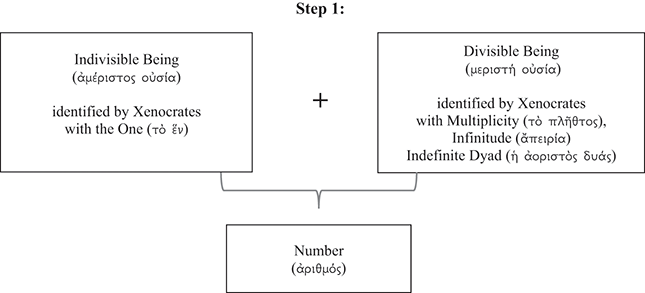
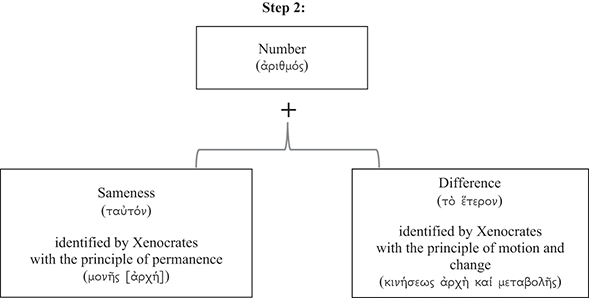
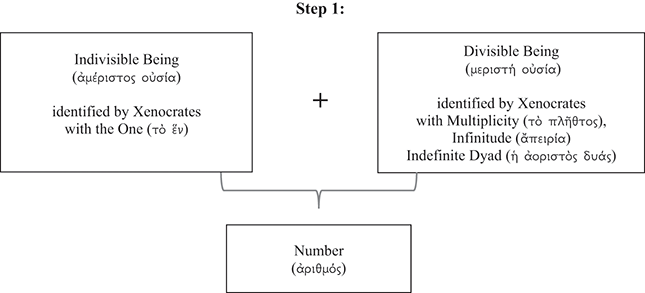
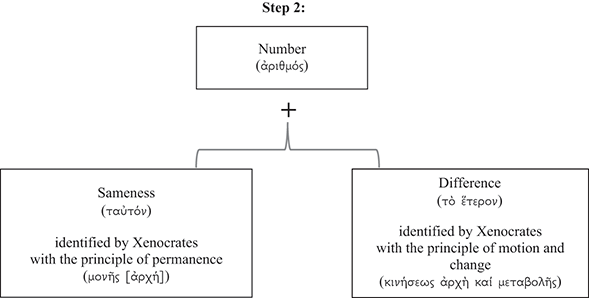
My test case for this analysis will be Xenocrates’ description of the generation of the soul, as preserved by Plutarch in the De animae procreatione in Timaeo, the most extended testimony on Xenocrates’ cosmological and psychological commitments.Footnote 8 In this account, the generation of the soul is presented as a two-step process. First, the ontological mixture that constitutes the soul is described as a blend of Indivisible and Divisible Being (μίξις τῆς ἀμερίστου καὶ μεριστῆς οὐσίας), which Xenocrates identifies with the One and the Indefinite Dyad, respectively. This initial combination produces Number. Next, Number is further commingled with Sameness and Difference (τοῦ δὲ ταὐτοῦ καὶ τοῦ ἑτέρου συμμιγέντων), the latter being identified by Xenocrates as the principle of motion and change, while the former as that of rest. At this stage, the mixture is complete, as this final addition grants Number the capacity both to move and be moved, as well as to bring to a stop and to be at rest – two missing aspects that complete the ontological composition of the soul.
At this point, the soul fully meets Xenocrates’ definition and can be said to be a number that, itself, is moved by itself (ἀριθμὸν αὐτὸν ὑφ’ ἑαυτοῦ κινούμενον). As is immediately apparent, Timaeus 35a provided Xenocrates with an opportunity to elaborate on the composition of his World-Soul by reference to its fundamental constituents. Through this approach, Xenocrates clarifies the role each of these components plays within the ontological mixture of the soul and the specific characteristics each contributes to its nature.
As is well known, the Timaeus has long posed a challenge for modern scholars in determining its relationship to the Sophist. Given that the constituents of the soul in the Timaeus include three of the five megista genē introduced in the Sophist, the question of whether the discussion in the Sophist should be considered a constitutive background for the Timaeus has sparked animated debate regarding the order and internal relationships of Plato’s dialogues. Since Timaeus 35a served as the essential background for Xenocrates’ interpretation of the generation of the soul, similar discussions about the role of the Sophist have at times been extended to Xenocrates’ account. Indeed, given that:
(1) Xenocrates employed the Sophist in contexts related to the classification of beings;
(2) the Sophist appears to have stimulated Early Academic debates on categorial schemes;
(3) in Xenocrates’ account of the soul, Sameness and Difference, two of the greatest kinds postulated in the Sophist, are said to contribute to the ontological mixture of the soul as causes of motion and rest (which themselves correspond to two of the megista genē in the Sophist);
(4) Plutarch criticises Xenocrates’ account by drawing on the text of the Sophist;
scholars sometimes concluded that the Sophist contributed to inspiring some of Xenocrates’ innovations in psychology.Footnote 9 On this view, Xenocrates’ description of the generation of the soul is best understood as an attempt to harmonise or accommodate the cosmological framework of the Timaeus with the account of the megista genē in the Sophist. In this chapter, however, I aim to offer some cautious considerations as to why we may not want to think that this is the case.
Overall, I will argue that the evidence supporting the claim that the Sophist contributed to shaping Xenocrates’ account of the generation of the soul is inconclusive and that nothing in the account preserved by Plutarch allows us to establish that Xenocrates did, in fact, rely on this dialogue to advance his psychological innovations.
To substantiate this view, this chapter will be structured as follows. I will begin by examining circumstantial evidence that might be thought to support the idea that Sophist should be taken into account when analysing Xenocrates’ philosophy (points 1 and 2 in the preceding paragraphs). I will then consider the reasons scholars have put forward for suggesting that the Sophist played a role in Xenocrates’ psychology and the arguments advanced in favour of this view. Finally, I will take a closer look at Plutarch’s text, highlighting that neither the vocabulary nor the content of the passage provides ground for maintaining that Xenocrates used the Sophist to complement the cosmological picture of the Timaeus (points 3 and 4). The cumulative consideration of these aspects will clarify why we should be cautious in assuming that, simply because a particular dialogue exerted influence in a given context, discussions concerning that text can be readily extended to inform other contexts as well.
Before proceeding, a clarification is in order. With this analysis, I do not intend to deny the importance of the Sophist for Academic circles in absolute terms. As mentioned, there is evidence that Early Academic authors, including Xenocrates, were familiar with and made us of material from the Sophist, and that this text informed some of their discussions. Rather, the aim of this chapter is to take a first step towards clarifying which Platonic texts were used by Early Academics, in what contexts, and for what purposes.
Accordingly, if there is any basis for generalising the conclusions of this chapter, my tentative claim is that it is safer to assume that the Sophist was not employed to complement the cosmological and psychological accounts that Early Academics developed by drawing inspiration from Timaeus 35a. Instead, given the evidence at our disposal, it appears that, when used, the Sophist served as a crucial reference point for Academic discussions in contexts concerned with divisions and classifications of beings, as well as in debates on species and genera.
2.2 Why the Sophist? Circumstantial Evidence from Discussions in the Academy
Let us begin by examining some indirect evidence that may encourage us to view the Sophist as a crucial reference text for Xenocrates more generally. The first reason for this view is circumstantial: several elements in the sources attesting to Xenocrates’ philosophy appear to suggest a connection between his doctrine and that of the Sophist. Most notably:
In book 4 of the Lives (D. L. iv.12.94), Diogenes Laertius attributes to Xenocrates a work entitled On Being (περὶ τοῦ ὄντος). Given that this was also the ancient subtitle associated with the Sophist in antiquity,Footnote 10 this may suggest that Xenocrates engaged extensively with the dialogue.
Beyond Diogenes’ attribution, other aspects of Xenocrates’ doctrines have been defended as arguably relating to the Sophist. One example is the well-known two-category scheme for the classification of beings,Footnote 11 which Simplicius attributes to Xenocrates and Andronicus. Another is Xenocrates’ thesis that the relationship between a species and a genus should be understood as that between a part and a whole (Pines Reference Pines1961, 7 ff.).
We could add that, in addition to the doctrines specifically ascribed to Xenocrates, certain views held by other members of the Academy also seem to reflect discussions rooted in the Sophist. Indeed, Xenocrates’ two-category scheme appears to be part of a broader debate involving various disciples of Plato in the Academy. For instance, we may think of Hermodorus’ division of beings and other classificatory exercises preserved in the Divisiones Aristoteleae.Footnote 12 Similar connections may also be traced in theses developed by Speusippus.Footnote 13
Of course, given that (a) Xenocrates is credited with a work whose title recalls the ancient subtitle of the Sophist, (b) there is evidence that some of his doctrines were inspired by or at least connected to the framework of the Sophist, and (c) such discussions appear to have engaged a large number of Early Academic philosophers, one might readily conclude that the Sophist played an important role for Xenocrates’ doctrine more broadly and, consequently, that he likely engaged with the dialogue in developing his account of the soul as well. Yet, the following mitigating considerations can be advanced.
First, as one might expect, Xenocrates is not the only figure credited with a work entitled On Being (περὶ τοῦ ὄντος).Footnote 14 Similar titles are attributed to Protagoras, Simon the Cobbler, Strato of Lampsacus, and (ps.-)Archytas. Although little can be said about these texts – some of which survive only by title – discussions about their content may provide contextual evidence for the kind of subject matter that works entitled On Being may have addressed.
For instance, we know that Protagoras’ On Being likely contained arguments against those who claimed that being is one (πρὸς τοὺς ἕν τὸ ὄν εἰσάγοντας), that is, Parmenides and the Eleatic philosophers. The precise nature of these arguments remains unclear. Lee (Reference Lee2005) hypothesises that if Protagoras employed the argument that ‘it is impossible to contradict’ – as appears to be the case from Plato’s Euthydemus – then one possibility is that he used this argument to demonstrate to the Eleatics that their own claim, namely that ‘it is not possible to speak of “what is not”, leads to the conclusion that no one ever has a false belief or judgement’ and, consequently, that ‘all beliefs are true’. If this were the case, the content of Protagoras’ On Being would appear to be, at least in part, in line with that of the surviving On Being attributed to Archytas,Footnote 15 whose extant sixteen lines focus on the impossibility of two opposite assertions both being true. We know even less about Simon the Cobbler’s On Being, of which Diogenes Laertius preserves only the title. However, it is noteworthy that in his translation of the Dissoi Logoi, Teichmüller (Reference Teichmüller1884, 112) identified the lost On Being by Simon the Cobbler with chapter 5 of the Dissoi Logoi (the section following the chapter on truth and falsehood, περὶ ἀλαθείας καὶ ψεύδους), on the basis of its concluding reflections on whether things can be said to be and not be at the same time. The content of Strato of Lampsacus’ On Being is equally obscure. The only information available comes from Proclus, who, in his commentary on the Timaeus, criticises Strato for holding that being (τὸ ὄν) is the cause of the permanence of beings (τὸ τῆς διαμονῆς αἴτιον [τῶν ὄντων]; fr. 24 Sharples Reference Sharples, Desclos and Fortenbaugh2011, 68). Proclus and Damascius object that this doctrine fails to recognise that being is said in many ways. However, neither appears to have direct knowledge of Strato’s doctrine beyond this brief reference.Footnote 16 Of course, this overview provides only circumstantial evidence regarding the possible content of these texts. Given the limited material available, any conjecture about the kinds of discussions found in works titled On Being and roughly datable around the period of Xenocrates’ scolarchate in the Academy must remain speculative.Footnote 17 Yet, the surviving evidence does not suggest that these texts dealt primarily with cosmological issues.Footnote 18
Naturally, such conjectures cannot hold any probatory value; given the very limited information at our disposal, nothing rules out the possibility that these discussions were originally embedded in much broader frameworks that may have included cosmological considerations as well. This brings me to a second aspect. If we examine the kinds of theses – whether within the Academy more broadly or specifically attributed to Xenocrates – that scholarship has linked to the Sophist, we find, for the most part, discussions concerning the classification of beings and, possibly relatedly, divisions into genera and species. If we take this thematic convergence to be significant, we may note that, once again, none of the Early Academic doctrines that the literature associates with the Sophist attests to the use of the dialogue in cosmological or psychological contexts. Instead, the prominence of figures in the Academy engaging with divisions and classifications of beings and arguably drawing inspiration from the Sophist would suggest that, at least in its early reception within the Academy, the Sophist was employed primarily in logical and ontological discussions.
2.3 Why the Sophist? The Broader Context of a Long-Debated Discussion
As mentioned in Section 2.1, the fact that Plato’s Timaeus mentions three of the five megista genē as fundamental ontological components of the soul has sparked animated debate among scholars of Plato regarding whether the account in the Sophist should be considered part of the Timaeus’ conceptual background or not, and whether determining this aspect could help establish the order of Platonic dialogues. I will not delve into the details of this discussion, as it touches only tangentially upon the objectives of this chapter. What is relevant for our purposes, however, is that Plutarch’s testimony concerning Xenocrates (and Crantor) is frequently mentioned in these scholarly discussions, where it is used as evidence in support of one position or another.
In a well-known paper, while arguing against those who support the dependence of Timaeus 35a on the Sophist, Owen (Reference Owen1953, 88) mentions that, according to Cornford, ‘the Sophist (as the ancient critics saw) provides the sole clue to the sense of our passage’ (my emphasis). In his footnote to this claim, Xenocrates and Crantor become central. Although Cornford (Reference Cornford1935, 61–62) does not specify who these ‘ancient critics’ were, their identities can be easily inferred from his comments. Indeed, Cornford observes that ‘Proclus and other ancient and modern commentators’ had ‘illegitimately imported’ motion and rest into the interpretation of Timaeus 35a, ‘misled by the baseless notion that Motion and Rest together with Existence, Sameness, Difference are the five Platonic “categories”’ (Reference Cornford1935, 62, n. 1). According to Cornford, then, Xenocrates’ reading of Sameness and Difference as the causes of motion and rest within the soul stemmed from his poor understanding of the Sophist.
Owen, by contrast, while defending the independence of the Timaeus from the Sophist, expresses the opposite view. He explicitly identifies the ‘ancient critics’ mentioned by Cornford as Xenocrates and Crantor and comments:
the parenthesis hardly deserves refutation. If such ‘ancient critics’ as Xenocrates and Crantor ever attended to the Sophist in constructing their divergent interpretations, it was notoriously not their ‘sole clue’: cf. Taylor …. Xenocrates’ importation of motion and rest was presumably grounded in the Tm. itself (57d–e).
Taylor’s position on Xenocrates’ engagement with the Sophist appears more nuanced than those of Cornford and Owen. While he acknowledges that Plutarch is ‘justified in his complaint (viz. against Xenocrates) of the use to which the Sophistes has been put’ (Reference Taylor1928, 114–115), he also cautions that ‘we have no right to assume that when Timaeus speaks of Same and Different he has the logical doctrines of the Sophistes in mind at all’ (1928, 115 n. 1).
More broadly, scholars’ views on Xenocrates’ use or non-use of the Sophist in his reading of Timaeus 35a tend to reflect their broader positions on the relationship between the two dialogues. For Owen, who defended the independence of the two texts and denied that the Timaeus preceded the Sophist, Xenocrates could have developed his doctrine solely on the basis of the Timaeus. For Cornford, who argued for the dependence of Timaeus 35a on the Sophist, Xenocrates and Crantor serve as evidence that the Timaeus was already perceived as resonating with the Sophist by its earliest interpreters.
The question of whether Xenocrates employed the Sophist to complement his reading of Timaeus 35a has remained largely unexplored in more recent literature and specialist articles on the Academy.Footnote 19 In both her 1982 edition and the revised 2012 edition of Xenocrates’ fragments, Isnardi Parente briefly dismisses the issue, remarking that ‘the question concerning the two concepts of ταὐτόν and θάτερον has been essentially discussed by Cherniss … with attention focused on the Platonic passages in the Sophist and Timaeus that may be the source of Xenocratean inferences’.Footnote 20 Yet, when one delves into Cherniss’ magisterial work in search of passages from the Sophist that may have influenced Xenocrates’ reading of Timaeus 35a,Footnote 21 expectations are likely to be disappointed. Cherniss resolutely and consistently maintains that the sole inspiration for Xenocrates’ interpretation is the text of the Timaeus itself.Footnote 22 However, given Cherniss’ commitment to the idea that Being, Same, and Difference in the Timaeus are indeed the same kinds that Plato identifies in the Sophist,Footnote 23 the question of whether Xenocrates shared this assumption remains open.
Accordingly, in order to determine whether anything in the passage provides a basis for resolving this issue conclusively, we must examine Plutarch’s text more closely.
2.4 Plutarch’s Testimony and the Criticism of Xenocrates’ Account
In the De animae procreatione in Timaeo, Plutarch describes Xenocrates’ account of the soul as follows:
Since, however, of the men most highly esteemed some were won over by Xenocrates, who declared the soul’s essence to be number itself being moved by itself and others adhered to Crantor of Soli, who makes the soul a mixture of the intelligible nature and of the opinable nature of perceptible things, I think that the clarification of these two when exposed will afford us something like a key-note. The former believes that nothing but the generation of number is signified by the mixture of the indivisible and divisible being, the one being indivisible and multiplicity divisible and number being the product of these when the one bounds multiplicity and inserts a limit in infinitude, which they call indefinite dyad too (οἱ μὲν γὰρ οὐδὲν ἢ γένεσιν ἀριθμοῦ δηλοῦσθαι νομίζουσι τῇ μίξει τῆς ἀμερίστου καὶ μεριστῆς οὐσίας· ἀμέριστον μὲν γὰρ εἶναι τὸ ἓν μεριστὸν δὲ τὸ πλῆθος, ἐκ δὲ τούτων γίγνεσθαι τὸν ἀριθμὸν τοῦ ἑνὸς ὁρίζοντος τὸ πλῆθος καὶ τῇ ἀπειρίᾳ πέρας ἐντιθέντος, ἣν καὶ δυάδα καλοῦσιν ἀόριστον) … But they believe that this number is not yet soul, for it lacks motivity and mobility but that after the commingling of sameness and difference, the latter of which is the principle of motion and change while the former is that of rest, then the product is soul, soul being a faculty of bringing to a stop and being at rest no less than of being in motion and setting in motion (τοῦτον δὲ μήπω ψυχὴν τὸν ἀριθμὸν εἶναι· τὸ γὰρ κινητικὸν καὶ τὸ κινητὸν ἐνδεῖν αὐτῷ. τοῦ δὲ ταὐτοῦ καὶ τοῦ ἑτέρου συμμιγέντων, ὧν τὸ μέν ἐστι κινήσεως ἀρχὴ καὶ μεταβολῆς τὸ δὲ μονῆς, ψυχὴν γεγονέναι, μηδὲν ἧττον τοῦ ἱστάναι καὶ ἵστασθαι δύναμιν ἢ τοῦ κινεῖσθαι καὶ κινεῖν οὖσαν).Footnote 24
Xenocrates’ description of the generation of the soul can be schematically summarised as in Figure 2.1 and Figure 2.2.Footnote 25
Step 1 of Xenocrates’ description of the two-step process of generation of the soul (according to Plutarch)
Step 2 of Xenocrates’ description of the two-step process of generation of the soul (according to Plutarch)
Several peculiar aspects of Xenocrates’ account of the soul, as reported by Plutarch here, merit attention.
Xenocrates describes the generation of the soul as a two-step process. Each step involves a mixture. The first consists of a blend of Indivisible and Divisible Being, the outcome of which is Number. In the second step, Number is further combined with two additional items: Sameness and Difference.Footnote 26 Given Xenocrates’ characteristic doctrine of Form-Numbers, the product of the first mixture (Number) would possibly be a Form. This aspect, however, is not spelt out explicitly by Plutarch.Footnote 27
Step 1 of the process consists of a blend of Indivisible and Divisible Being that Xenocrates identifies with his two first principles: the One and the Indefinite Dyad, respectively. In this passage, Xenocrates’ second principle is designated as Multiplicity (πλῆθος), a term more commonly associated with Speusippus’ second principle,Footnote 28 but also as Infinitude (ἀπειρία). Here, Plutarch attributes to Xenocrates a theory of Philolaic inspiration, in which the One imposes a limiting action on Multiplicity, which, once bounded in its infinitude, becomes Number. It remains difficult to determine how much of this description should be taken at face value, especially given that (i) Xenocrates’ second principle is typically referred to as the ‘Indefinite Dyad’, rather than ‘Multiplicity’ or ‘Infinitude’, and (ii) ancient sources frequently conflate Xenocrates’ views with Pythagorean doctrines,Footnote 29 likely because Xenocrates saw the roots of his theories as either in accordance with or emerging from Pythagorean theories.
If Step 1 mostly preserves a Pythagorising, or Academicising reading of the Timaeus, it is Step 2 that appears most likely to incorporate elements reminiscent of the Sophist. Indeed, in Step 2, Sameness and Difference are added to Number. Xenocrates identifies these with the principles of rest and motion, respectively. Of course, given that four of the five megista genē are involved in this process and, as we will see shortly, Plutarch himself encourages associating Xenocrates’ account and the megista genē, one might readily assume that the reference to the Sophist is evident. However, a closer examination of the details suggests that such a reference is not necessarily required. First,Footnote 30 it cannot be ruled out that Xenocrates developed his account solely on the basis of passages of the Timaeus, such as Timaeus 57e–58a,Footnote 31 where Plato asserts that rest (στάσις) must always be placed in uniformity (ὁμαλότης), and motion (κίνησις) in non-uniformity (ἀνωμαλότης). After all, in the Timaeus, Being, Sameness, and Difference are also listed among the components of the soul. Second, the vocabulary employed by Plutarch in describing Xenocrates’ account of the generation of the soul is also telling. In Plutarch’s testimony, Xenocrates is said to have identified Sameness as the principle of permanence (τὸ δὲ [ἀρχὴ] μονῆς), rather than as the principle of rest (στάσις). One might object that, although the term μονή does not appear in the Sophist, such a term is likewise absent from the Timaeus. Yet, if we consider Plato’s language of permanence and the employment of the verb μένω in his prose to signify rest and stability in contrast to motion and change, we find that its most conspicuous occurrences appear not in the Sophist but in the Laws (a dialogue in which Plato also presents the soul as a self-mover), and particularly in discussions distinguishing and classifying various kinds of motion.Footnote 32 Additionally, in this passage, Plutarch attests that Xenocrates identified Difference not merely as the principle of ‘motion’, but as the principle of ‘motion and change’. Although the terms κίνησις (motion) and μεταβολή (change) are often used by Plato interchangeably, at least insofar as the latter is considered to also be a form of motion, a direct parallel for this phrasing is once again found in Laws x 896a–b, immediately following Plato’s introduction of the definition of the soul as ‘motion capable of moving itself’:
K: Do you claim that the definition ‘to move itself’ holds for the same being which we all refer to by the name ‘soul’?
AS: I claim this. And if this is so, do we still regret that we have not sufficiently demonstrated that soul is the same being as the first generation and motion of what exists, what has come to be, and what will be, and further of all of their opposites (τὴν πρώτην γένεσιν καὶ κίνησιν τῶν τε ὄντων καὶ γεγονότων καὶ ἐσομένων καὶ πάντων αὖ τῶν ἐναντίων τούτοις), since it has been shown to be the cause of all change and of motion in all things (μεταβολῆς τε καὶ κινήσεως ἁπάσης αἰτία ἅπασιν)? (transl. Mayhew)
The parallel is significant in at least two respects: first, given the centrality of self-motion in both Xenocrates’ conception of the soul and in Laws x, this text could likely have served as a reference for Xenocrates.Footnote 33 Second, the claim that the soul is ‘the cause of all change and of motion in all things’ (896b1–2; 891e5–6) is unique to Laws x. Yet this claim appears to be entirely in line with the account of the soul here reported by Plutarch, in which motivity and mobility are the essential characteristics that Number lacks, and the soul is said to be the power (δύναμις) of bringing to a stop and being at rest no less than of being in motion and setting in motion (τὸ γὰρ κινητικὸν καὶ τὸ κινητὸν ἐνδεῖν αὐτῷ – [δύναμις] τοῦ ἱστάναι καὶ ἵστασθαι … ἢ τοῦ κινεῖσθαι καὶ κινεῖν). If the Laws is indeed a relevant reference, then the reason Xenocrates’ World-Soul is described as possessing both the capacity to set in motion and the capacity to bring to rest (rather than simply being in motion or being at rest) may be cosmologically significant, as it would emphasise a fundamental power that Number is explicitly said to lack.
Given these considerations, we can conclude that neither the vocabulary nor the content preserved by Plutarch provides any definitive grounds for maintaining that Xenocrates employed the Sophist to complement the cosmological picture he found in the Timaeus.
At this point, however, one final reason remains for considering the Sophist relevant: namely, the fact that it is Plutarch himself who draws this connection when criticising Xenocrates’ account. Let us now examine the text more closely.
It is manifest too that these interpreters have failed to understand the part about sameness and difference (ἐκφανῶς δὲ τούτοις ἠγνόηται τὸ περὶ τοῦ ταὐτοῦ καὶ τοῦ ἑτέρου), for they say that to the generation of the soul the former contributes the faculty of rest and the latter that of motion (ὡς τὸ μὲν στάσεως τὸ δὲ κινήσεως συμβάλλεται δύναμιν εἰς τὴν τῆς ψυχῆς γένεσιν), whereas by Plato himself in the Sophist existence and sameness and difference and besides these rest and motion are distinguished and set apart from one another as being five things different each from each (αὐτοῦ Πλάτωνος ἐν τῷ Σοφιστῇ τὸ ὂν καὶ τὸ ταὐτὸν καὶ τὸ ἕτερον, πρὸς δὲ τούτοις στάσιν καὶ κίνησιν, ὡς ἕκαστον ἑκάστου διαφέρον καὶ πέντε ὄντα χωρὶς ἀλλήλων τιθεμένου καὶ διορίζοντος).Footnote 34
In the passage, Plutarch criticises Xenocrates for seriously misinterpreting how Sameness and Difference contribute to the ontological mixture of the soul. While, as we have seen, Xenocrates relates the soul’s capacity for rest to Sameness and the soul’s capacity for motion to Difference, Plutarch points out that in the Sophist,Footnote 35 Plato clearly distinguishes these four kinds from one another. Given Plutarch’s reproach, one might conjecture that Plutarch invokes the Sophist against Xenocrates precisely because it was Xenocrates himself who, in the first place, drew upon the Sophist to develop his account of the generation of the soul. On this view, one could argue that, by associating rest and motion to Sameness and Difference, respectively, Xenocrates’ intention was to reduce the five megista genē of Plato’s Sophist to the three kinds mentioned in the Timaeus.
Yet, an alternative interpretative option is equally compelling. One could instead propose that Plutarch’s strategy is to challenge Xenocrates’ reading of the soul by demonstrating that his account openly contradicts Plato’s words in another dialogue, namely the Sophist.Footnote 36 If we apply a principle of interpretative economy, it becomes clear that Xenocrates was under no pressure to further refine his account by means of another Platonic text given that Sameness and Difference already play a fundamental role in the ontological composition of the soul in the Timaeus. Moreover, the impression that it is Plutarch – not Xenocrates – who introduces the Sophist into the discussion is reinforced by Plutarch’s own shift in vocabulary. As we have seen, when presenting Xenocrates’ account of the soul, Plutarch states that, for Xenocrates, Sameness is the principle of permanence (τὸ δὲ μονῆς [ἀρχή]). However, throughout his critique, even when referring to Xenocrates’ account, Plutarch consistently employs στάσις as the term for rest, instead of referring to μονή, a term that is entirely absent from his critique. If the shift in terminology is significant, it would suggest that it is Plutarch himself who is making an unjustified move, at least with respect to Xenocrates’ primary textual reference. Of course, one might object that Plato himself uses στάσις rather than μονή in both the Sophist and the Timaeus. Yet, the presence of the Timaeus as Xenocrates’ main background text is not in question. The burden of proof, therefore, lies with those who argue that the Sophist should also be considered part of the interpretative framework. And, at least in terms of the vocabulary of rest, the evidence does not appear to support this claim. This suggests that, rather than Xenocrates attempting to integrate the Sophist into his account, it is Plutarch who imposes this connection, likely as part of his broader critique of Early Academic interpretations of Plato.
2.5 Conclusions
In this chapter, I have examined the main reasons that may lead us to think that Xenocrates drew on the Sophist to complement his cosmological account of the soul. More specifically, I have taken into account: (i) circumstantial evidence related to the employment of the Sophist in the Academy in general and by Xenocrates more specifically; (ii) arguments concerning the relationship between the Timaeus and the Sophist put forward by scholars working on Plato’s dialogues; and (iii) textual evidence such as the content and vocabulary employed by Plutarch in his testimony of Xenocrates’ depiction of the generation of the soul, as well as the contextual evidence provided by Plutarch’s own criticism against such an account. Taken together, these considerations lead me to conclude that the evidence supporting the claim that Xenocrates drew on the Sophist in developing his account of the soul remains inconclusive.
In light of this conclusion, two further remarks on the use of Plato’s dialogues by the first circle of Plato’s students in the Academy are in order. First, if we set aside the possibility that Xenocrates developed his account of the soul by relying on the Sophist, most of the remaining evidence connected to the Sophist and related to Academic discussions appears to pertain specifically to a certain kind of inquiry (that is, discussions related to the classification of beings, divisions, and the articulation of genera and species). Although the available evidence does not allow us to determine conclusively whether this general trend was indeed the norm, it is a reasonable conjecture that Plato’s dialogues served specific purposes in the discussions taking place in the Academy. In other words, it is plausible that specific dialogues were primarily used to inform particular contexts, as the evidence connected to Academic discussions concerning the generation of the soul and rooted in the text of the Timaeus also attests. At the same time, however, this should not lead us to prematurely conclude that only individual dialogues were selected to represent the exclusive canon for specific contexts, as, for instance, the Timaeus for cosmology. In the end, we have seen that Xenocrates’ account of the soul points to possible references to the Laws, too. A more cautious suggestion would be that groups of dialogues such as the Timaeus, the Phaedrus, and the Laws (and possibly, others too) were all thought to contribute to outlining the main guidelines for cosmology and psychology, as the Sophist (and possibly other dialogues too) likely did for ontological classifications.
This brings me to my second remark, which serves as a final methodological warning. Although the state of the material at our disposal may sometimes tempt us to do so, we must be cautious when assuming that just because the influence of a specific Platonic dialogue is attested in determinate Academic discussions, information extrapolated from such a dialogue can be imported to inform other discussions and contexts too. For, whatever the reason (whether pedagogical, dialectical, or other), context-sensitivity in the use of Plato’s dialogues appears to have been in place in Academic discussions just as much as it would later become one of the guiding principles of Platonist exegesis of Plato’s text.