


I
On 12 August 1982, the Mexican authorities closed their foreign exchange market. The next day, the finance minister, Jesús (Chuco) Silva Herzog, arrived in Washington seeking immediate financial assistance from the US authorities and support from the international Monetary Fund (IMF). The Mexican weekend dates the start of the Latin American debt crisis. Argentina and Brazil soon followed Mexico to Washington.
Barry Eichengreen (Reference Eichengreen2020), Stiglitz and Rashid (Reference Stiglitz and Rashid2020), World Bank Group president David Malpass (Reference Malpass2021) and others have invoked the 1980s debt crisis as a cautionary tale about the adverse economic consequences of delay in writing down the external debts of vulnerable countries in the COVID pandemic. They urge debt relief to enable countries to devote scarce foreign exchange to cover imports of medical equipment and supplies and to cushion their economies in the economic and financial fallout from the pandemic. In the first two years of the pandemic action on debt has been limited.
In this article, I review the experience of the 1980s and its lessons for policymakers in the pandemic.
I draw two principal lessons from the 1980s:
(1) In the absence of an international bankruptcy coordinating mechanism, the management of external debt crises requires consensus within and among four groups: borrowing countries, their major creditors, authorities in countries host to the major creditors, and the international financial institutions, principally the IMF. Each group has an effective veto over the outcome of any negotiation.
(2) Once consensus is achieved, implementation will be case-by-case because of the differences in the political and economic circumstances of each country.
I first sketch the economic and financial context to the Latin American debt crisis. I next review the three phases of the 1980s debt crisis. After a brief assessment of the aftermath, I return to my lessons and their applicability today.
Global economic and financial conditions at the outbreak of the pandemic in 2020 differed from those in 1982. Nevertheless, the basic lessons of the 1980s apply. Consensus about debt relief for a broad group of countries has not been achieved. When and if it is, application will be case-by-case.
II
The Mexicans’ August 1982 visit to Washington to announce their crisis was not a surprise. Since March 1982, Silva Herzog and Bank of Mexico governor Miguel Mancera had visited monthly. The IMF already had a team in Mexico discussing a possible support program. The IMF, the Bank for International Settlements (BIS), and numerous officials and observers had been issuing warnings. The Bank of England conducted a series of Apocalypse Now studies starting in 1977 and presented one to the Euro-Currency Standing Committee at the BIS in November 1980 (Schenk Reference Schenk2021). Earlier in 1980, Federal Reserve chair Volcker (Reference Volcker1980) issued a public warning about the debt buildup. In May 1982, he told central bank governors at the BIS of an impending crisis in Mexico that would likely spread to the rest of Latin America. External financial crises were not new phenomena in the post-World War II era. Eight countries had initiated debt restructurings between 1975 and 1979. Moreover, 22 countries followed before August 1982 (Asonuma and Trebesch Reference Asonuma and Trebesch2016). But none of these cases threatened the stability of the international banking system and global economy.
The contributing causes to the debt crisis were:
(1) The sharp rise in US and international interest rates associated with the Federal Reserve's new operating procedure adopted in October 1979;
(2) The slowdown in global growth in 1980 and 1981 and recession in 1982;
(3) The collapse of commodity prices;
(4) The substantial widening of borrowers’ current account deficits;
(5) Their resulting build-up of external debt and of claims on them by bank lenders.
Between 1975 and 1978, the public and publicly guaranteed debt of developing countries as a group as well as for Latin American and Caribbean countries doubled. It increased by a further 77 and 86 percent respectively between 1978 and 1982 (World Bank 2021c).Footnote 1 Low interest rates allowed the borrowing countries to live beyond their ability to service their external debts on their original terms.
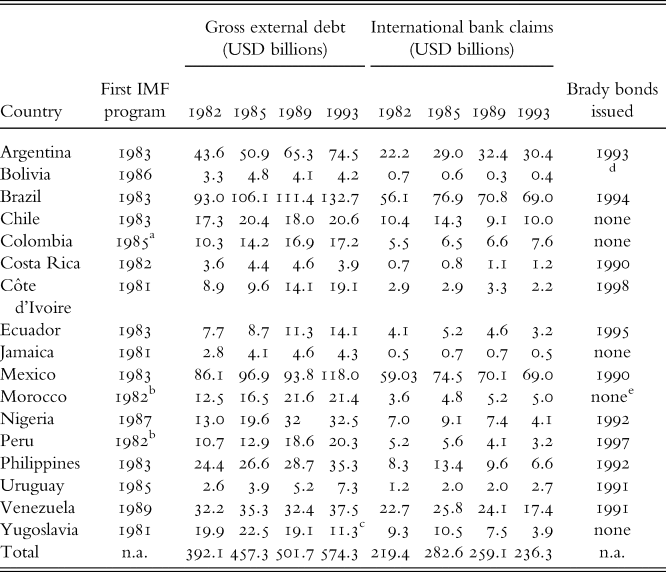
In 1982, the gross external public, publicly guaranteed and private debt of 33 developing countries was $647 billion. Seventeen counties accounted for $392 billion of that debt. Those countries owed 78 percent of the long-term bank claims on the larger group, and 78 percent of total US bank exposure (Cline Reference Cline1995, pp. 40, 61 and 73). These 17 counties were the focus of the plan proposed by the US Treasury secretary James A. Baker III in September 1985. Twelve were in Latin America.
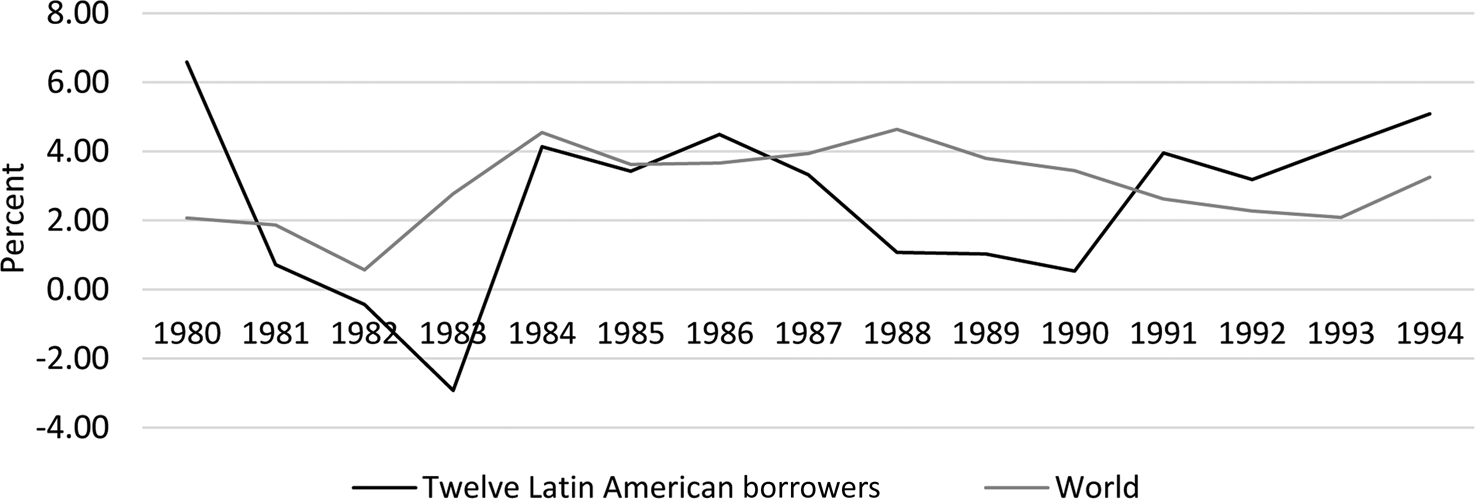
Table 1 presents the gross external debts of and international bank claims on the 17 borrowers, the year of each country's first IMF program, and the year in which it issued Brady bonds. Figure 1 displays economic growth during the period for the world and the dozen Latin American countries from 1980 to 1994. Figure 2 reports the high level of exposure to all 17 countries in 1980 relative to capital for all US banks and the nine largest banks and the decline over the decade.
Programs and debts of 17 heavily indebted countries

a Had a program with the World Bank that was monitored in part by the IMF.
b Programs approved before the Mexican weekend.
c Excludes Croatia, Macedonia and Slovenia.
d Had a debt buyback in 1988.
e Negotiated a Brady arrangement but did not meet the conditions for issuance.
Sources: International Monetary Fund, Transactions with the Fund, country pages; Boughton (Reference Boughton2012, pp. 414–15); Cline (Reference Cline1995, tables 2.1 and 2.8); and Das et al. (Reference DAS, PAPAIOANNOU and TREBESCH2012).
Growth of real GDP: 1980–94 (PPP weights, percent)
Source: IMF, World Economic Outlook Database, April 2021, and calculations by author.

US bank exposures to 17 heavily indebted countries
Source: Author's calculations based on Cline (Reference Cline1995) tables 2.10 and 2.11.

III
The Latin American debt crisis unfolded in three phases:
(1) Concerted Lending, August 1982 to September 1985;
(2) Baker Plan, September 1985 to March 1989;
(3) Brady Plan, March 1989 to mid 1990s.
Debt relief broadly defined was central to each phase. In the first phase, debts to international banks were rescheduled. In the major cases, banks were also required to make additional ‘new money’ loans to fill the financing gap in borrowers’ IMF-supported adjustment programs. Later, multi-year rescheduling agreements (MYRAs) were negotiated.
In the second, Baker-Plan phase, more countries negotiated MYRAs along with additional concerted lending. Starting in late 1987, borrowing countries began to employ a range of techniques such as buybacks at below par and debt–equity swaps at discounts. Thus, the face value of their debt to banks was reduced somewhat.
In the third, Brady-Plan phase, two items were added to the menu offered to bank creditors:
(1) Securitizing the written-down principal of debts while maintaining something close to a market interest rate (par bonds);
(2) Present-value-equivalent bonds in which the principal remained intact with the interest rate substantially below market (discount bonds).
Several commentators called for collective action to reduce the stock of debt at the start of the Latin American debt crisis, including Felix Rohatan (Reference Rohatan1982), Peter Kenen (Reference Kenen1983) and Harold Lever (Reference Lever1983). The principal parties had no appetite for such an approach.
The borrowing countries were wary of jeopardizing their access to bank financing, which they expected would resume quickly. In December 1982, Brazil's interim minister of economy, Carlos Viacava, commented to the US authorities that Brazil expected to be back in the market within a year.
The international commercial banks opposed reducing the principal amount of their claims, fearing a domino effect spreading to other borrowers that would substantially erode their already over-stretched capital; see Figure 2.
The home authorities of the major banks shared these concerns as did the IMF. At the start of the Mexican weekend, Jacques de Larosière (Reference De Larosière2018) convinced Silva Herzog that he should not declare a moratorium on debt service, effectively a default. Instead, de Larosière (Reference De Larosière2018) and Volcker advised the Mexicans to seek a ‘standstill’ from the banks. This sleight of phrase triggered an extra-legal process (Segard Reference Segard2016). Creditor banks did not head to the courthouses to enforce their repayment rights.
These shared concerns were instrumental in persuading the major central banks supported by their governments to support short-term bridge loans to several of the borrowing countries. Gordon Richardson, governor of the Bank of England, and Fritz Leutwiler, governor of the Swiss National Bank and president of the BIS, immediately understood the threat to the global banking system.
The concerted lending strategy was formulated by de Larosière and Volcker (Truman Reference Truman2020) in October 1982. Its basic components were:
(1) An IMF-supported adjustment program;
(2) A bridge loan, in some cases, starting with Hungary and Mexico in 1982 and often coordinated by the BIS, linked to that program;
(3) A commitment from creditor banks to reschedule debts coming due and sometimes the arrears that accumulated;
(4) New loans in support of the adjustment program.
Chairman Volcker drafted an outline of the plan and its application to Mexico, Argentina and Brazil, but also to the Philippines and (the former) Yugoslavia, countries of importance to Japan and Europe. The US Treasury and White House endorsed the approach despite their philosophical preference for relying on market mechanisms. In November Volcker (Reference Volcker1982) outlined the case-by-case strategy and, importantly, signaled supervisory forbearance, ‘where new loans facilitate the adjustment process and enable a country to strengthen its economy and service its international debt in an orderly manner, new credits should not be subject to supervisory criticism’.
The strategy was predicated on the view that the borrowing countries faced a liquidity crisis compounded by serious internal and external imbalances. The premise was that with appropriate policy adjustments, the borrowing countries would resume growth and regain access to international financial markets. Analysts, including some who later were critical of the strategy, emphasized that the revival of global growth would help the borrowing countries grow out of their crises (Cline Reference Cline1983; Dooley et al. Reference Dooley, Helkie, Tryon and Underwood1983; Cooper and Sachs Reference Cooper, Sachs, Smith and Cuddington1985; Krugman Reference Krugman, Smith and Cuddington1985).
Several countries had more than 500 foreign bank creditors. The central banks and finance ministries of the major countries in varying degrees exerted moral suasion to encourage participation in the strategy. The banks for their part insisted that the borrowing countries cover the obligations of their private sectors. Consequently, the share of public and publicly guaranteed debt in the gross external debt of the major borrowers rose from about 50 percent in 1982 to 80 percent by 1988 (World Bank 2021c).Footnote 2
New loans from banks were largely recycled to pay interest. For the three major Latin American borrowing countries (Argentina, Brazil and Mexico), new money loans totaled $12.7 billion in 1983. They covered about 70 percent of their interest payments due to banks that year and a similar amount in 1984 when the total amount of concerted lending was somewhat larger.Footnote 3 During the first two years, the interest margin on the new and rescheduled debt was increased. In late 1984, Mexico negotiated the first MYRA, stretching out maturities coming due over several years and lowering the interest rate on them. Previously, interest rates often were pegged to the US prime rate. The rates were repegged to the London Interbank Offer Rate (LIBOR) which was about 100 basis points lower, and the margin was reduced to 13/16th compared with previous margins of 150 basis points and higher.
IMF lending went primarily to cover current account deficits not to service bank debt. The combined current account deficit of 15 of the major borrowers (not including Uruguay and Yugoslavia) widened from $26 billion in 1980 to $53 billion the next year and $49 billion in 1982. In 1984, they had a combined current account surplus of $6 billion. External adjustment was rapid, but economic recovery was not. Quota resources of the IMF were augmented at the end of 1983. The capital positions of international banks improved.Footnote 4
Contrary to the assumption underlying the strategy, voluntary financing from banks did not resume. Concerted lending to Latin America was $13.3 billion in 1983, and $15.5 billion in 1984, while spontaneous lending declined from $1.9 billion in 1983 to $0.6 billion in 1984 (IMF 1990).
In January 1984, leaders of 26 Latin American and Caribbean countries met in Quito, Ecuador, and issued a statement rejecting a debt moratorium but also calling for priority to be given to economic development. In May, representatives of 11 countries met in Cartagena, Colombia, and declared their willingness to meet their debt obligations and at the same time called for recognition that their debts were a political problem. Subsequent meetings of this Cartagena Group never came up with a plan to address those perceived needs (Boughton Reference Boughton2001, p. 479). Kenen (Reference Kenen2003) notes that there was no official support for outright debt relief at the time even among the debtor countries.
In July 1985, Alan Garcia became president of Peru. He announced that Peru would devote no more than 10 percent of government revenues to debt service, giving priority to creditors that would lend Peru additional funds. Peru went into arrears with the IMF and, in August 1986, was declared ineligible to borrow from the Fund until it had cleared them. Peru defaulted but did not pursue an agreement to write down its debt.
Peru was not alone in beginning to build arrears to banks and other creditors. Meanwhile, the willingness of smaller banks to participate in new money loans declined. Debt fatigue had set in for many borrowers and lenders.
These developments motivated the Program for Sustained Growth – the Baker Plan. It was presented as a midcourse correction to the strategy. Baker emphasized the importance of reversing endemic capital flight and implementing structural change, for example liberalization of foreign investment regimes and privatization. Such structural changes along with macroeconomic policy reforms became known as the Washington Consensus (Williamson Reference Williamson and Williamson1989).
Baker set a target for banks to lend $20 billion to 17 identified countries over the next three years not necessarily linked to IMF programs but rather supported by enhanced IMF surveillance of their economic policies. The plan also called for increased lending of $10 billion by the World Bank and the Inter-American Development Bank to these countries over the same period. Cline (Reference Cline1995, p. 209) reports that these targets for the supply of external financing were substantially met.
However, in 1986 the price of oil collapsed, undermining Mexico's ability to develop a program to take advantage of the Baker Plan. Argentina and Brazil were wrapped in complex transitions to democracy with inflation in the triple-digits, which limited their scope to take advantage of the plan.
In 1985–6, none of the four principal parties to the strategy (borrowing countries, banks, creditor countries, or IMF) supported writing down the principal of bank claims. I summarized the US view on debt write-downs at the time (Truman Reference Truman1986):
(1) Writing down bank claims would delay countries’ return to the market and inhibit access by countries that were able to borrow;
(2) Enforcement of a write-down would be a challenge in part because each country was different.
I also observed that progress under the Baker Plan had been disappointing.
In June 1986, Jeffrey Sachs (Reference Sachs1986), an earlier supporter of the concerted lending strategy, advocated a new approach including a substantial debt write-down component. He articulated principles for selective relief limited to those countries most in need and linked to internationally supervised programs of policy reforms.
Later in 1986, the Organization for Economic Cooperation and Development (OECD) published a study of the prospects for developing countries (Saunders and Dean Reference Saunders. and Dean1986). It concluded that a return to growth would be at best gradual and would depend on much lower interest rates, more external financing, or accelerated growth in the OECD countries. A later OECD analysis (Dittus et al. Reference Dittus, O'Brien and Blommestein1991) investigated the narrow path that the major borrowing countries navigated and concluded that the external environment through 1986 had been more favorable on balance than earlier predicted but domestic policy shortfalls had pushed countries off the paths.
In January 1987, Jacques de Larosière was succeeded by Michel Camdessus as managing director of the IMF. On his departure, de Larosière suggested that a change in the strategy toward bank claims was needed (Boughton Reference Boughton2001, p. 481).
Thinking at the IMF began to change (Boughton Reference Boughton2001, p. 481). Dooley (Reference Dooley1986, Reference Dooley, Frenkel, Dooley and Wickham1989), another supporter of the initial debt strategy, wrote that the overhang of external debts with face values that substantially exceeded their secondary market prices was a disincentive to foreign and domestic investment in the borrowing countries and, therefore, their growth. Although the empirical foundation of his argument was weak (Cline Reference Cline1995, p. 173), the paper was very influential.
By the middle of 1986, my colleagues at the Federal Reserve Board had begun to analyze what we called Plan B and would involve debt reduction. We also actively considered a Plan C that would have drawn on Article VIII (2) b of the IMF charter as a mechanism by which the IMF could permit the imposition of controls on debt payments in support of a member that needed leverage over its bank creditors, including debt relief.
By 1987, much of the academic analysis of debt focused on incentives for the banks and the countries to cooperate on voluntary, market-based approaches to debt-stock reduction. Some emphasized the division between those banks that saw no future in pursuing their claims and wanted to get out and those that understood that if the first group reduced the face value of their claims, the remaining claims would become more valuable.
As the capital positions of the major banks improved (Figure 2), debt sales in secondary markets increased. Citibank grabbed headlines in May 1987 by announcing that it was adding $3 billion to its reserves against possible losses on its claims on developing countries.
Several small-scale initiatives reduced the principal amount of some countries’ debts. Bolivia in early 1988 retired about a third of its bank debt at 11 cents per dollar in a buyback. The official sector did not oppose this initiative. Nor did it oppose Mexico's offer to exchange up to $20 billion in face value of its debt for marketable bonds backed by 20-year zero-coupon US Treasury bonds. Banks with only $3.7 billion in claims took up the offer at a discount of 30 percent, compared with an expected 50 percent discount (Boughton Reference Boughton2001, pp. 490–1). Bulow and Rogoff (Reference Bulow and Rogoff1988) were critical of these operations as well as debt-for-equity swaps on the grounds that the borrowing country used scarce resources that would have been better deployed at a future date.
In the United States, Senator Bill Bradley (Reference Bradley1986) and Congressman John LaFalce (Reference Lafalce1987) made write-down proposals. They were in part motivated by the fact that slow growth in the borrowing countries was negatively impacting US exports.
In early 1988, the Japanese finance minister, Kiichi Miyazawa, proposed that an exit bond be included in the menu of options for banks in which the principal amount would be secured by a zero-coupon bond purchased by the borrower with the financial assistance of the official international financial institutions and a carrying a substantially reduced interest rate. At the IMF annual meeting in Berlin in September, Japan reiterated its support for this addition to the strategy (IMF 1988, pp. 37–43).
In response, US Treasury secretary Nicholas Brady, who had replaced Baker, expressed ‘skepticism [about] proposals that may appear to conform to the basic principles of the debt strategy, but which in practice produce only an illusion of progress. . .. [And build] political opposition among taxpayers in creditor countries’ (IMF 1988, pp. 43–7). He was specifically critical of the use of funds from international institutions to finance debt reduction activities and bailing out banks. Nineteen eighty-eight was a US presidential election year. The US administration wanted to distance itself from potential calls for use of official funds to finance debt forgiveness for domestic borrowers such as farmers and local governments.
Following the US presidential election, the US position changed. Secretary Brady proposed an amended strategy on 10 March 1989.
The elements of the plan were:
(1) A portion of IMF and World Bank loans was to be available to provide financial support for debt stock reduction through exit bonds collateralized with 30-year US Treasury zero-coupon bonds and carrying a partial interest guarantee;
(2) The loans also could be used to buy back debt at a discount;
(3) Commercial banks were to waive the sharing and negative pledge clauses in their agreements to permit debt reduction operations;
(4) The Fund was to modify its policy of not lending to members while they were in arrears to their bank creditors, reducing the leverage of banks in their negotiations with borrowers.
Brady stressed that the plan was a revitalization of the debt strategy that should continue to be anchored in policy reforms, implemented on a case-by-case basis, and use limited official resources.
The approach that Brady announced differed from the initial proposal of the US Treasury. It was modified following intensive debates within the US government and with the other G-7 countries. The first proposal minimized the role of the IMF and the World Bank and did not envision including the option of continuing to provide new money loans. The Brady Plan was immediately, publicly endorsed by Federal Reserve chair Alan Greenspan (Truman Reference Truman1989).
Despite US and IMF management support, the Brady Plan was not immediately embraced by all parties. Negotiations often dragged on for months. Agreements in principle were announced for Costa Rica, the Philippines, Mexico and Venezuela in 1989. However, Mexico only issued the first Brady bonds in January 1990. Cline (Reference Cline1995, p. 222) reports that in the Mexican package 22 percent of the banks by the face value of their claims chose new money while 47 percent chose par bonds (with a reduced interest rate) and 41 percent chose discount bonds (reduced principal with a market interest rate). In the 18 Brady packages that he reviews, Cline (Reference Cline1995, p. 233) reports that new money accounted for only 2 percent of exposures. However, only nine of the 17 major borrowing countries completed Brady packages over the next five years. (See last column of Table 1.)
In general, the gross reduction in countries’ debt stocks in Brady packages was in line with their prevailing secondary market prices during the period of negotiations with the banks. The net reductions were less because countries took on new debt to finance the guaranties. On the other hand, countries in effect locked in debt relief for a longer term than had been previously available.Footnote 5
Although the introduction of the Brady Plan is used to date the end of the Latin American debt crisis, the crisis dragged on. In 1991, growth picked up in the major Latin American borrowers on average (Figure 1). Investment's share of GDP picked up somewhat, but in 1991–5 on average only three of the 12 Latin American countries reached or exceeded their averages in 1980–1. This suggests that the debt overhang hypothesis that external debt was a drag on investment was not decisive. Kenen (Reference Kenen1989, Reference Kenen1990) argued that the debt reduction would not go far enough because it would be consensual between countries and their bank creditors rather than based on a realistic assessment of what the countries needed.
Countries gradually regained access to international financial markets. As anticipated by several observers (Terrell Reference Terrell1984), their access was no longer via syndicated loans from commercial banks but via the international bond market. That market had been eclipsed as a major source of international finance after World War II because of delays in curing defaults that occurred during the Great Depression (Cooper and Truman Reference Cooper and Truman1971).
Reduction of the principal value of international bank claims on borrowing countries became an accepted component of the debt strategy only when a substantial consensus on its desirability had been achieved among the four principal parties to the strategy's continued implementation. Borrowing countries began to press for options to reduce their stock of debt, and Mexico once again led the pack in applying for a Brady package. The balance sheets of international bank creditors had strengthened, and many were anxious to put the exposure to the borrowing countries behind them. The key international institution, the IMF, had revised its thinking. Finally, the United States embraced debt relief as a menu item in negotiations between debtor countries and their banks.
IV
The historical record does not offer much support for the view that a failure to address the stock of debt to international banks in 1982 along with IMF-required austerity programs was the principal cause of a ‘lost decade’ of Latin American growth. The record also does not support the view that the pick-up in growth after 1990 was triggered by the inclusion in the Brady Plan of debt stock reduction.
GDP per capita (on a purchasing power parity basis) of five of the 12 Latin American countries in the highly indebted 17 was higher in 1990 than in 1980 and higher for six of them than in 1982 (IMF 2021). As early as 1984, Cline (Reference Cline1984), who supported the initial debt strategy, concluded that Latin America would likely suffer a ‘lost decade’. His judgment was based in part on the fact that 10 of the 12 Latin American countries had already recorded declines in GDP per capita by 1982 before they approached the IMF.
As for the Brady Plan debt reduction promoting recovery, Chile and Colombia did not have Brady agreements. But Chile's compound growth in 1991–4 exceeded the four-year compound annual growth for every Latin American country that had an agreement in the four years after their bonds were issued. In 1988, the secondary market price of bank claims on Chile was the same as that for Uruguay, which had a Brady package (Dornbusch Reference Dornbusch1988). Similarly, growth in Colombia exceeded growth in five of the seven countries that had Brady arrangements; the exceptions were Costa Rica and Uruguay.
In commenting on the ‘lost decade’ theory that IMF-imposed fiscal austerity excessively reduced domestic demand in favor of exports, Jacques de Larosière (Reference De Larosière2018) emphasized that many of these countries needed to set their houses in order as part of the bargain for obtaining international support. As de Larosière argued, a dynamic process was needed to bring about the necessary domestic reforms while pragmatically handling the external debt of these countries. Time was also needed to repair the balance sheets of the overextended international banks. Viewed from the perspective of the global financial crisis of 2007–9, staving off a full-blown global financial crisis in 1982–4 benefitted the countries of both borrowers and lenders.
In the 1980s, many borrowing countries faced political economy challenges that limited their capacities to adopt policies to promote growth. It is possible that the lack of significant debt relief contributed to this situation, but policy reforms were crucial. Recent assessments conclude that on balance the set of reforms that became known as the Washington Consensus (Williamson Reference Williamson and Williamson1989) had a positive impact on economic growth in Latin America.Footnote 6
V
The first lesson from the 1980s about the burden of sovereign external debt is that a four-part consensus was needed to write it down. The borrowing countries, their foreign bank creditors, the countries in which those banks are chartered, and the international institutions, principally the IMF, had to support the initiative – or not actively oppose it. In the absence of a bankruptcy mechanism in which the debtor can initiate action and normally has considerable leverage, the four parties had to solve a coordination problem. Their consensus did not need to be complete, but it must include the key borrowing countries and receive political support from important creditor countries and institutions. In this regard, Harold James (Reference James1996, p. 349) is mistaken in attributing the seven-year delay in incorporating debt stock reduction into the debt strategy to the unwillingness of the banks alone to participate.
Writing down the value of international bank claims on borrowing countries became an accepted component of the debt strategy only when a substantial consensus on its desirability had been achieved among the four principal parties. Borrowing countries began to press for options to reduce their debts including, importantly, Mexico. The balance sheets of international bank creditors had strengthened, and many were anxious to put the exposure to the borrowing countries behind them. The key international institution, the IMF, revised its thinking to favor that form of debt relief. Finally, the United States embraced it as a menu item in negotiations between debtor countries and their banks, and supported financing from the international institutions to facilitate the process.
Would the leaders of Mexico and other major borrowing countries have welcomed debt stock relief earlier, for example, in 1985? No doubt some influential people in those countries would have. However, the inability of the Cartagena Group to reach consensus on modifying the debt strategy suggests that the borrowing countries lacked essential cohesion as a group until the late 1980s.
The need for consensus on debt reduction is illustrated by the incomplete initial international response to the economic and financial impact of the Coronavirus pandemic. In early 2020, later extended to the end of 2021, the IMF, World Bank and G20 formulated the Debt Service Suspension Initiative (DSSI) to reschedule debt payments coming due and divert the debt service to a trust fund to support its public health spending. However, the DSSI offered conditional debt relief only for two years. Under the DSSI, the present value of the debt was maintained, which generally entailed an increase in the total stock of debt.
The DSSI was limited to the low-income countries. The debt of DSSI-eligible countries is $21 billion in 2020. In 1982, the debt of the 17 highly indebted countries to commercial banks was $219 billion in 1982 dollars. Proposals to extend the scope of the DSSI or its successor, the Common Framework, beyond low-income countries failed. Moreover, some of the eligible countries did not take advantage of the program. As of early September 2021, only 46 of the 73 countries had participated, and seven of the 27 countries classified at high risk of debt distress had not done so (World Bank 2021a).
In contrast to DSSI, the Common Framework requires debtors to seek relief from private creditors comparable to that granted by official creditors. As of September 2021, only three countries had sought debt relief under the Common Framework: Chad, Ethiopia and Zambia. However, the external debt problems of all three countries pre-dated the Coronavirus pandemic, and only Chad had reached a partial agreement in principle with its external private creditors by that date.
The limited progress in addressing external debts in the wake of the pandemic reflects a lack of consensus, including on the part of borrowers, on involving the private sector. One reason for the reluctance of governments to approach private creditors for debt relief is that the rating agencies, which had no direct role during the 1980s global debt crisis, signaled that doing so would probably result in a downgrade for the country's marketable debt that would carry into the future.Footnote 7
Rating agency classifications and their use in financial markets today produce additional disincentives for countries to seek debt relief in any form until there is no other alternative (see G30 2021, box 1). A borrowing country must conclude that a small rescheduling or restructuring of its debts to foreign private creditors, together with an IMF program, would be in its medium-term interest. If it decides to tough it out and the tsunami hits, the economic and financial damage will be greater. These are not easy choices.
To build consensus, advocates of debt relief today also must take account of the diversity of borrowing countries and their crisis-response strategies. For example, Patrick Bolton et al. (Reference Bolton, Buchheit, Gourinchas, Gulati, Hsieh, Panizza and Weder di Mauro2020) identify Mexico as a potential beneficiary from debt relief such as under the DSSI. Mexico is a middle-income country and is not eligible for the DSSI. It also has a Flexible Credit Line (FCL) commitment from the IMF, recently renewed. Mexico has built its defenses already and would have little economic incentive to change its strategy. Apart from the FCL, after the Asian financial crises in the late 1990s, the strategy of several of the principal emerging market and developing countries has been to build their international reserve as insurance against future debt crises.
The fact that a larger number of countries have substantial amounts of debt today than in the early 1980s also complicates the prospects for building consensus behind a comprehensive approach to debt problems. Fourteen of the 17 highly indebted countries accounted for 57 percent of gross international debts of all emerging market and developing countries at the end of 1982. In 2019, their share was only 25 percent (World Bank 2021b).Footnote 8
Markets are deeper today, but the variety of countries’ international financial engagements is more wide-ranging. Holders of external claims on countries now include hedge funds, commodity trading companies and many other entities. Today's issuers of obligations are similarly more diverse: sovereign governments may not be the principal borrowers even when they effectively guarantee many of the external financial obligations of their agencies and private sector entities.
International banks are still important lenders but not as dominant as they were in the 1980s. At the end of 2019, BIS reporting banks’ claims on emerging market and developing economies were 33 percent of the total external debt of 122 developing countries covered by the World Bank's international debt statistics (BIS 2021; World Bank 2021b). At the end of 1982, the equivalent percentage for a smaller set of countries on both series was 63 percent. For 14 of the 17 highly indebted countries bank claims were 57 and 30 percent in the two years respectively.Footnote 9
The set of home countries to major bank creditors is also larger. In 1982, the major banks were chartered in the G5 countries plus Italy, Netherlands and Switzerland.Footnote 10 Those countries’ banks held 76 percent of total consolidated claims based on the location of banks (BIS 2021; World Bank 2021b). In March 2021, the same eight countries accounted for 65 percent of the claims. Banks of five other reporting jurisdictions held more than 2 percent each. Banks in China held 4 percent of claims on these countries, illustrating the importance of China in international finance and workout situations today compared with 40 years ago. Eleven of these 13 countries have at least one of the global systemically important banks (G-SIBs).Footnote 11 China has four of them and is also the dominant official bilateral lender.Footnote 12
In the 1980s, each country seeking a restructuring had a bank advisory committee, often with overlapping representation. Committee members had to balance the financial interests of their own institutions against the need to manage the crisis in the interests of all parties. Striking that balance was often contentious (Schenk Reference Schenk2020). With more major bank lenders today, leadership is more complex.
The IMF played the major role among international financial institutions in the 1980s and likely will do so in future external financial crises. But the IMF's role is limited primarily to prodding member countries to act and responding to initiatives by members.
Once consensus has been achieved, the IMF and the multilateral development banks need adequate financial resources to support initiatives. In August 1982, the IMF's resources were woefully insufficient. That was the situation again in 2007 at the outbreak of the global financial crisis. The Fund's resources were promptly augmented in both cases. Today, in contrast, the IMF is better positioned financially. As of early September 2021, IMF resources for new lending were $775 billion, including potential borrowed resources.
On the other hand, IMF lending did not increase as substantially in the first 18 months of the COVID crisis as it did in the first 18 months of the 1980s crisis. Between the end of February 2020 and August 2021, IMF credit outstanding increased by 10 percent of members’ quotas. In contrast, in 1982 and 1983 the increase was 22 percent of 1982 quotas and 15 percent of 1983 quotas.
These facts pose challenges to restructuring external financial obligations. However, they are not inherently unsolvable.
The second lesson from the 1980s debt crisis for today follows from the first. Debt relief in any form will be implemented case-by-case.
Each borrowing country's economic and financial circumstances differ. Equally important, each country's political circumstances differ. Countries going through political transformations, as was the case in Argentina and Brazil in the 1980s, will have reduced time and political space to devote to debt renegotiation. In other words, issues of political economy are crucial determinants of each borrowing country's approach.
Three features of the global economic and financial environment in 2020 do favor the facilitation of a systemic approach to debt reduction.
First, considerations of the financial stability of creditors and the financial systems of the home countries’ lenders are of much less of a concern today than in 1982. However, in the views of some, this factor may reduce the urgency of debt relief.
Second, borrowing countries face a common external shock on a larger scale and with a broader impact than during the 1980s. The external financial impacts of the Coronavirus pandemic differ across countries, but the pandemic has affected each one at roughly the same time. This should, in time, help to support a consensus about how best to respond to the potential need to restructure and possibly reduce the stocks of sovereign debt to private creditors. However, arriving at a comprehensive approach that is supported by a substantial number of creditors and achieves sufficient debt relief to restore economic growth will take time, and no two resolutions will be the same.
Third, global economic and financial conditions are more favorable than they were in 1982–3. Interest rates are low. Inflation rates are rising, not falling, reducing real interest rates now. Aided by macroeconomic policies, growth in the advanced countries has rebounded. Commodity prices have recovered as well. Some countries have regained market access.
Partly for these reasons, achieving debt relief that results in a substantial reduction in the present value of claims on a broad swath of emerging market and developing countries, middle-income as well as low-income, has a lower priority than in March 2020.
Nevertheless, these favorable trends may reverse. The leading alternative economic scenario posits that central banks in advanced countries will raise interest rates, dampen growth in their economies, and leave borrowing countries high and dry as liquidity is drained from the system (e.g. G30 2021). Other scenarios are not only possible but also plausibly would have greater adverse effects on many borrowing countries (e.g. Voltz et al. Reference Voltz, Akhtar, Gallagher, Griffith-Jones, Hass and Kraemer.2021). Only a fool would declare that external debt problems for a broad range of countries triggered by the pandemic are unlikely. Debt relief including write-downs could well again rise to the top of the global policy agenda, and policymakers, their advisers and analysts then should remember the lessons of the 1980s.