1. Introduction
Since the mid-1990s, European welfare policies in the domain of unemployment have undergone a major transformation, from mainly providing income for the jobless to actively stimulating them to (re-)enter the paid labour market (Taylor-Gooby, Reference Taylor-Gooby2008). These activation policies are considered to be part of the welfare state retrenchment trend that started in the late 1970s in western democracies (Seikel and Spannagel, Reference Seikel, Spannagel, Lohmann and Marx2018). The concept of ‘activation’ generally refers to a mix of enabling policy measures as well as demanding elements, and is grounded in the idea of enhancing individuals’ employability (Dingeldey, Reference Dingeldey2007; Eichhorst et al., Reference Eichhorst, Kaufmann, Konle-Seidl, Reinhard, Eichhorst, Kaufmann and Konle-Seidl2008). Over the last decades the demanding approach has achieved greater popularity among the European policy makers, who have increasingly implemented cuts of benefit levels and obligations for welfare recipients in order to receive their benefits (Dingeldey, Reference Dingeldey2007; Dwyer, Reference Dwyer2004; Eichhorst et al., Reference Eichhorst, Kaufmann, Konle-Seidl, Reinhard, Eichhorst, Kaufmann and Konle-Seidl2008; Knotz, Reference Knotz2018; Seikel and Spannagel, Reference Seikel, Spannagel, Lohmann and Marx2018). This rebalancing of rights and responsibilities for the benefit claimants (Giddens, Reference Giddens1998; Houtman, Reference Houtman1997) might be seen as a paradigm shift in the European welfare states.
Despite this overwhelming ‘activation turn’ (Bonoli, Reference Bonoli2010, p. 435), only little scholarly attention has been given to the popularity of these policy reforms among the public at large (Kootstra and Roosma, Reference Kootstra and Roosma2018; Roosma and Jeene, Reference Roosma, Jeene, van Oorschot, Roosma, Meuleman and Reeskens2017). The available research focuses on the ‘classical’ explanations used in the field of welfare support: namely, self-interest and ideological beliefs (Achterberg et al., Reference Achterberg, van der Veen and Raven2014; Buss, Reference Buss2018; Fossati, Reference Fossati2018; Kootstra and Roosma, Reference Kootstra and Roosma2018; Laenen and Meuleman, Reference Laenen and Meuleman2018). The first framework postulates that attitudes towards activation are rooted in self-interest motives (as indicated by social-structural characteristics). The second approach stresses that activation attitudes are informed by a broader ideological outlook, such as egalitarian values (Achterberg et al., Reference Achterberg, van der Veen and Raven2014; Laenen and Meuleman, Reference Laenen and Meuleman2018). Empirical research on attitudes towards demanding activation policies, however, fails to demonstrate an unequivocal effect of self-interest variables (Fossati, Reference Fossati2018). Several explanations are conceivable for the lack of confirmation of the self-interest hypothesis. One possibility is that welfare recipients do not perceive that activation policies affect their life chances. However, the conclusion that self-interest is not a relevant factor driving activation attitudes could be premature and misleading, as much of the existing research does not take into account that self-interest variables and ideological drivers of support for activation are potentially intertwined. In this regard, controlling for a wide array of relevant ideological dimensions that could potentially confound the relation between socio-economic variables and activation attitudes may offer more solid conclusions on the genesis of policy attitudes. By disentangling the driving mechanisms, this study provides relevant insights into why people support demanding activation policies, which are useful for current policymaking. Despite the fact that the European population is sceptic about welfare retrenchment, demanding activation policies might, indeed, attract broad support because they are perceived as effective to tackle welfare abuse (Kootstra and Roosma, Reference Kootstra and Roosma2018). The implementation of these policies might be hampered if the potential target groups are, at the same time, the major opponents of these policies.
Concretely, we answer the following research questions: (1) How are social-structural characteristics related to support for demanding activation policies? (2) How are relevant ideological factors – namely authoritarianism, work ethic, egalitarianism and left-right orientation – related to activation attitudes? (3) Are the effects of social-structural variables mediated through ideological factors or are they direct, as self-interest theory postulates? To answer these questions, we analyse data from the Belgian National Election Study (BNES) 2014 (Abts et al., Reference Abts, Swyngedouw, Meuleman, Baute, Galle and Gaasendam2015) by means of structural equation modeling. By doing so, we bring a threefold contribution to the field of public attitudes towards activation. First, we make use of an improved, multi-item instrument to measure support for the demanding side of activation policies. Second, compared to previous studies, we take a more comprehensive range of relevant ideological predictors into account, making it possible to distinguish between economic and cultural dimensions. Third, by including the ideological factors as mediators between individual social-structural position and activation attitudes, we can clearly disentangle self-interest and ideological mechanisms.
The article is organised as follows. In the next paragraph, a presentation of the policy context is provided. The second section presents some theoretical insights on attitudes towards demanding activation, followed by the formulation of a set of hypotheses regarding how ideological and self-interest mechanisms affect these attitudes. After introducing the data and the methodology used, we present the empirical findings of the structural equation model. The conclusion section discusses the implications for further research on welfare attitudes.
2. The ‘activating’ welfare state: between enabling and demanding policies
Despite tracing back to the 1950s, when they were introduced in Sweden, active labour market policies (ALMPs) started to be massively adopted by OECD countries in the mid-1990s (Bonoli, Reference Bonoli2010; Fossati, Reference Fossati2018). Welfare states have been discursively framed as too passive and potentially promoting public benefit dependency (Kymlicka and Norman, Reference Kymlicka and Norman1994), whereby ALMPs represented a feasible solution to proactively help jobless people to re-enter the labour market (Eichhorst et al., Reference Eichhorst, Kaufmann, Konle-Seidl, Reinhard, Eichhorst, Kaufmann and Konle-Seidl2008; Fossati, Reference Fossati2018; Seikel and Spannagel, Reference Seikel, Spannagel, Lohmann and Marx2018). This so-called ‘activation turn’ (Bonoli, Reference Bonoli2010, p. 435) shifts away from providing passive welfare benefits in terms of cash transfers to unemployed people and focuses on instruments and policies aimed at their work (re-)insertion. The concept of activation spans an array of diverse policies, ranging from creating opportunities for work-experience jobs and job-seek support, to stronger work-record requirements for access to benefits, and an extension and intensification of job seeking obligations for benefit claimants (Dean, Reference Dean2007; Gilbert, Reference Gilbert2002; Jørgensen, Reference Jørgensen, Lind, Knudsen and Jørgensen2004; Seikel and Spannagel, Reference Seikel, Spannagel, Lohmann and Marx2018). Activation refers, thus, to a mix of enabling policy measures and more demanding elements (conditionality of welfare benefits and recommodification of labour), grounded on the idea of increasing individuals’ employability (Dingeldey, Reference Dingeldey2007; Eichhorst et al., Reference Eichhorst, Kaufmann, Konle-Seidl, Reinhard, Eichhorst, Kaufmann and Konle-Seidl2008). This ‘Janus-faced character’ of activation (Bengtsson, Reference Bengtsson2014, p. S66), combining a prevention of negative consequences of unemployment and social exclusion through enhancing personal skills, with the restoration of civic duties and discipline to reduce the dependency on social transfers, becomes visible in the concrete policy measures implemented. The enabling approach, on the one hand, starts from a social investment perspective (Hemerijck, Reference Hemerijck2013): activation policy intends to improve human capital by the provision of work incentives, such as in-work benefits, and enable people to take active part in the job searching: for instance, through the expansion of training schemes and mobility grants. In this sense, it emphasises the development of skills by the expansion of labour opportunities aiming at social re-inclusion, not only into the paid labour market, but in the society (Eichhorst et al., Reference Eichhorst, Kaufmann, Konle-Seidl, Reinhard, Eichhorst, Kaufmann and Konle-Seidl2008). From this point of view, sanctions are interpreted mainly as behavioural incentives (Dingeldey, Reference Dingeldey2007).
The demanding approach, on the other hand, combines conditionality and recommodification, through benefit cuts, tighter criteria for the definition of available jobs, compulsory participation to labour market programmes and enforcing sanctions on those who do not meet these obligations (Dingeldey, Reference Dingeldey2007). The restrictive entitlement prescriptions and sanctions are intended to be repressive instruments (Eichhorst et al., Reference Eichhorst, Kaufmann, Konle-Seidl, Reinhard, Eichhorst, Kaufmann and Konle-Seidl2008). Despite variations in the level and severity of sanctions, the demanding approach has been brought forward in most of the European countries (Dingeldey, Reference Dingeldey2007; Knotz, Reference Knotz2018). A shared feature of the different activation programmes is the presence of sanctions for those who fail to attend the work-for-benefits and non-work placements (Trickey, Reference Trickey, Lødemel and Trickey2000).
2.1 Activation policies in Belgium
During the last decades, Belgium – the research site of this study – has also witnessed an increase in demanding measures, although the path towards activation has been ‘reluctant and erratic’ (Hemerijck and Marx, Reference Hemerijck, Marx and Palier2010, p. 139) compared to other continental welfare states such as the Netherlands, in which activation measures had been implemented earlier (van Oorschot, Reference van Oorschot2002). Internal fragmentation, both political and linguistic, have contributed to a likewise fragmented policy reform momentum (Hemerijck and Kersbergen, Reference Hemerijck and Kersbergen2019). From 2004 onwards the Belgian National Employment OfficeFootnote 1 has intensified controls and sanctions for unemployed people, and eligibility criteria for unemployment benefits have been tightened (IMF, 2015; Nicaise and Schepers, Reference Nicaise and Schepers2015). For instance, the ‘activation of job search’ procedure, an evaluation of the jobseeker’s behaviour through individual interviews, was introduced firstly for the young unemployed and gradually applied to the older ones (Van Lancker et al., Reference Van Lancker, Marchal, Schuerman, Van Mechelen and Van Kerm2015). Other concrete initiatives such as broadening the range for a suitable job (from 25 km to 60 km away) and a restriction on the period for finding the same kind of job (from six to five months – three for the younger unemployed) have been implemented during the period 2012-2015 (IMF, 2015), although these measures were still less strict compared to other European countries (Venn, Reference Venn2012). In case of refusal of a suitable job, sanctions might vary from a warning to an exclusion from the benefits of varying duration (between 4 and 52 weeks).
In addition to a relatively recent transformation to an active welfare state, regional differences between Flanders and Francophone Belgium in terms of ideologies, affluence and unemployment level (Billiet et al., Reference Billiet, Abts, Swyngedouw, Rihoux, Van Ingelgom and Defacqz2015), have contributed to create a potential cleavage in the support for these policies. The relatively recent policy evolutions combined with regional variation makes Belgium a suitable context for exploring individual-level mechanisms behind activation support.
3. Explaining support for demanding activation policies: Self-interest and ideological dispositions
Previous research on attitudes towards activation policies postulates that individuals’ attitudes are driven by two principal mechanisms, which are derived from the welfare state attitudes literature: ideological beliefs and self-interest (Achterberg et al., Reference Achterberg, van der Veen and Raven2014; Buss, Reference Buss2018; Fossati, Reference Fossati2018; Kootstra and Roosma, Reference Kootstra and Roosma2018). Below, we elaborate on both mechanisms and the linkage between them.
3.1 Ideological drivers of support for activation
The turn towards the demanding perspective has not happened in an ideological vacuum. Although activation policies were originally conceived as instruments to fight unemployment through boosting productivity (Weishaupt, Reference Weishaupt2011), the demanding side of activation policies is linked to the New Right perspective on social welfare citizenship (Dwyer, Reference Dwyer2004) and is based on the idea of a new balance of ‘rights and responsibilities’ (Giddens, Reference Giddens1998). This perspective coincides with an ideological convergence toward exacerbating individual responsibility and increasing benefit conditionality (Dwyer, Reference Dwyer2004; Seikel and Spannagel, Reference Seikel, Spannagel, Lohmann and Marx2018). Therefore, it is reasonable to assume that support for demanding activation is embedded in particular ideological dispositions.
The first ideological dimension potentially underpinning demanding activation is authoritarianism – a disposition characterized by outspoken in-group attachment, a strong need for order and social conformity, an adherence to traditional norms and social roles, and support for punishment of moral deviants (Adorno et al., Reference Adorno, Frenkel-Brunswik, Levinson and Sanford1950; Hetherington and Weiler, Reference Hetherington and Weiler2009). In its New Right approach to social welfare citizenship, demanding activation combines the traditions of both libertarian liberalism and social conservatism (Dwyer, Reference Dwyer2000). On the one hand, it emphasizes individual freedom, free market and a reduced role of government; on the other hand, it underlines the centrality of government in building and maintaining a ‘particular moral order (that emphasizes individual and familial duties)’ (Dwyer, Reference Dwyer2000, p. 62). The focus on moral discipline suggests an authoritarian backlash, with sanctions for those who do not comply with these norms. Given that demanding activation stresses the punitive role of the welfare state towards those who are not self-responsible, we hypothesise that the authoritarian emphasis on conformity to the community norms and intolerance regarding deviants are directed towards the welfare beneficiaries, who are considered as not conforming to the predominant norms of autonomy and self-responsibility (van Oorschot and Roosma, Reference van Oorschot, Roosma, van Oorschot, Roosma, Meuleman and Reeskens2017).
A second ideological foundation linked to the characterising aim of activation policies (that is, reducing the risk of welfare dependency through paid work) is work ethic. This concept captures the value people associate to work, conceived as a moral obligation and a reward for the individual and the society (Giorgi and Marsh, Reference Giorgi and Marsh1990; Stam et al., Reference Stam, Verbakel and de Graaf2014). With the dominance of the ‘activating’ welfare state, considerations on who is entitled to benefits are increasingly guided by the principles of individual responsibility, instead of that of need and entitlement (Dwyer, Reference Dwyer2004). Paid work is valued as guiding principle, presented as a moral duty and disciplinary instrument, and conceived as the best way to escape from poverty (Dwyer, Reference Dwyer2000; Serrano Pascual, Reference Serrano Pascual, Lind, Knudsen and Jørgensen2004). People are obliged to face risks actively: unemployment and poverty cannot be seen as external risks; consequently, those in this situation cannot wait for someone else to handle their situation (Wetherly, Reference Wetherly2001). In welfare attitudes research, a strong work ethic was found to be associated with lower levels of support for the welfare state (Hasenfeld and Rafferty, Reference Hasenfeld and Rafferty1989), lower levels of sympathy with the unemployed (Furnham, Reference Furnham1982) and with stronger support for welfare obligations (Laenen and Meuleman, Reference Laenen and Meuleman2018).
A third relevant ideological dimension is egalitarianism. Welfare attitudes research has frequently found that egalitarian views are positively associated to support for the welfare state (Feldman and Zaller, Reference Feldman and Zaller1992; Likki and Staerklé, Reference Likki and Staerklé2015). Believing in equality of outcomes, and in government intervention to reduce income inequalities, leads people to be more supportive of redistributive welfare policies (Hasenfeld and Rafferty, Reference Hasenfeld and Rafferty1989). The imposition of obligations typical of demanding activation policies can be seen as a violation of the welfare principle that guarantees a subsistence level also for those who do not work (Houtman, Reference Houtman1997). The concept of conditionality implied in activation policy thus challenges an egalitarian notion of justice (Watts and Fitzpatrick, Reference Watts and Fitzpatrick2018).
Another well-established dimension in welfare attitudes research is left-right ideology: left-oriented people are generally more supportive of social rights and redistribution, while support for benefit obligations is higher among right-leaning people (Fossati, Reference Fossati2018; Kootstra and Roosma, Reference Kootstra and Roosma2018; Laenen and Meuleman, Reference Laenen and Meuleman2018; Larsen, Reference Larsen2008; Roosma and Jeene, Reference Roosma, Jeene, van Oorschot, Roosma, Meuleman and Reeskens2017; Saunders, Reference Saunders2002). Particularly, two core aspects of demanding activation policies, the centrality of individual responsibility and the priority given to economic achievement, are more strongly endorsed by right-wing supporters than by leftists (Fossati, Reference Fossati2018).
3.2 The self-interest approach
Self-interest theory postulates that support for welfare policies is stronger among people in disadvantaged socio-economic positions because of their higher risk to become welfare dependent and, thus, their interest in generous benefit systems (Andreß and Heien, Reference Andreß and Heien2001; Hasenfeld and Rafferty, Reference Hasenfeld and Rafferty1989). In other words, rational actors are assumed to support policies if the personal gains of such policy outweigh the personal costs. This argumentation can be applied to explain attitudes towards social obligations for benefit claimants. Since the imposition of strict requirements for receiving benefits (such as obligations to accept any job) forms a restriction of social rights of the unemployed, people in unemployment or at risk of becoming unemployed are expected to oppose demanding ALMPs (Fossati, Reference Fossati2018). In addition to one’s experience of unemployment, also low income (Kootstra and Roosma, Reference Kootstra and Roosma2018; Roosma and Jeene, Reference Roosma, Jeene, van Oorschot, Roosma, Meuleman and Reeskens2017) is found to have a negative effect on support for demanding activation policies. Importantly, self-interest theory implies that the mechanism behind these socio-economic indicators is rational cost-benefit calculation. Therefore, the effects of socio-economic variables should be direct, i.e. independent from ideological motives.
3.3 The interplay between interest and ideology: Mediation effects
Social-structural positions and ideological dispositions – as well as their effects on welfare attitudes – are not independent of each other. Social-structural positions play a crucial role in organizing individuals’ life chances and everyday experiences, by making certain experiences and outlooks more plausible than others (Svallfors, Reference Svallfors1991, p. 611). Social-structural characteristics are linked to particular ideological worldviews, as belonging to a certain occupational class, income group, or educational background promotes socialization into specific ideological preferences (and/or vice versa: ideological dispositions lead people to choices that self-select them into certain social categories). These ideological dispositions, in turn, shape support for particular policies (Hasenfeld and Rafferty, Reference Hasenfeld and Rafferty1989). The interpretation of the gross (or total) effects of socio-economic characteristics on policy support can be misleading if they are interpreted as pure self-interest mechanisms, since support might derive from a rational calculation of the policy benefits, but also from the ideological proximity of the policy to one’s worldview. At the same time, people might select themselves in specific socio-economic categories, a fact which contributes to add more complexity to the mechanisms for policy support. Regarding activation policies, Achterberg and colleagues (Reference Achterberg, van der Veen and Raven2014) argue that there may be different explanatory paths from socio-economic characteristics to demanding activation support. On the one hand, lower social classes – characterised by a lower income or insecure job positions – are more likely to hold egalitarian views, which in turn would lead them to be more supportive of a redistributive welfare state and less in favour of welfare state reforms that impose benefit restrictions and sanctioning. On the other hand, those with lower educational levels may embrace authoritarian values (Lipset, Reference Lipset1959), which would make them more supportive of demanding activation policies. In previous studies among the Dutch population, Achterberg and colleagues (Reference Achterberg, van der Veen and Raven2014; also Houtman, Reference Houtman1997) did not find a significant effect of education and income on support for activation and disciplining measures towards the unemployed when controlled for authoritarian and economic egalitarian ideologies. If we want to investigate through which path socio-economic variables are related to attitudes, we need to introduce mediation mechanisms in studying this relation; particularly, we claim that occupational status and education are crucial in defining individuals’ worldviews.
3.4 Hypotheses
Our theoretical arguments can be summarized into the following hypotheses. On the basis of the ideological frameworks, we expect that support for demanding activation is higher among people with higher levels of authoritarianism (H1), with stronger work ethic (H2) and right-wing oriented (H3). Individuals with strong egalitarian values are expected to be less supportive of demanding activation policies (H4).
Regarding the link between socio-economic characteristics, direct as well as indirect effects are expected. First, we hypothesise that, as a result of self-interest mechanisms, individuals’ structural characteristics have a direct effect on activation attitudes (that is, net of one’s ideological preferences). More specifically, people with low education (H5a), the unemployed (H5b) and with low income (H5c), as well as those having experienced unemployment (H5d), will oppose demanding activation policy measures. Second, besides these direct effects, we expect that the effect of socio-economic characteristics on demanding ALMPs attitudes is mediated by the adherence to specific ideologies. Specifically, we hypothesise that people in occupational statuses more at risk (i.e. the unemployed) and with lower educational levels have stronger authoritarian values, which bring them to be more in favour of activation (H6a). At the same time, they are expected to show less support for demanding activation because they have lower work ethic (H6b) and more egalitarian values (H6c).
4. Data and methodology
4.1 Dataset
To test the hypotheses, we use data from the 2014 Belgian National Election Study (BNES), a post-electoral survey conducted among a probability sample of Belgian residents entitled to vote (Abts et al., Reference Abts, Swyngedouw, Meuleman, Baute, Galle and Gaasendam2015). The two-stage random probability sampling includes in total 1901 individuals (response rate: 47.5%), and data were collected by means of computer assisted personal interviews (CAPI). To correct for non-response bias, post-stratification weight coefficients are applied, based on the population distribution regarding age, gender and educational level.
4.2 Variables
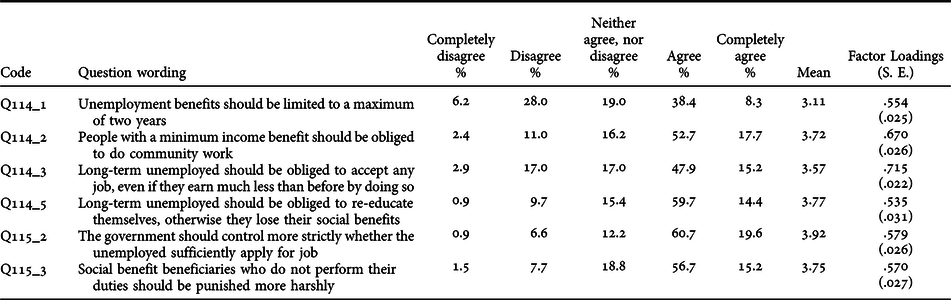
Attitudes towards demanding activation are operationalized by a multi-item instrument consisting of six 5-point (1: strongly disagree – 5: strongly agree) Likert-type items referring to obligations that the unemployed and social assistance beneficiaries should fulfil, and to the responsibility of the government in controlling these activities (see Table 1 for the exact question wording and frequency distributions). Confirmatory Factor Analysis (CFA) shows that a one-factor model does fit the data sufficiently, although the modification indices suggest to add an error correlation (r = .334) between two related items (strictness of government in relation to social benefit recipients who do not perform their duties and the unemployed who do not sufficiently apply for jobs).Footnote 2 The model has a good fit (χ2 = 10.938; df = 8; RMSEA = .015; CFI = .998; TLI = .996; SRMR = .012). The factor loadings are all sufficiently strong – namely above 0.50 (Harrington, Reference Harrington2009) – indicating that the five items can be considered as sufficiently valid and reliable indicators of support for demanding activation policies.
Frequency distributions and measurement parameters for attitudes towards demanding activation

Note: N = 1737; Estimator = MLR; χ² = 10.938; df = 8; RMSEA = .015; CFI = .998; TLI = .996; SRMR = .012. The model contains error correlation between Q115_3 and Q115_2 (r = .334).
Three of the ideological beliefs are operationalized as latent constructs measured by multiple items. Authoritarianism is measured by three Likert-type items asking respondents to express their agreement with the importance of obedience and respect for authority, implementing stricter laws and getting rid of the immoral people as a solution to social problems. Egalitarianism is also based on three items referring to opinions on income inequalities and social redistribution, and the role of government to reduce economic inequalities. To measure work ethic, four items form a latent factor capturing the importance individuals attribute to working hard and having a paid job as a moral duty (complete question wording is reported in Appendix 1). CFA demonstrates that a measurement model with three factors describes the correlations between the manifest items adequately (χ² = 113.625; df = 32; RMSEA = .038 ; CFI = .958; TLI = .941; SRMR = .030; – see Appendix 1 for factor loadings). Higher scores on the three factors represent, respectively, that respondents endorse more authoritarian, egalitarian and work ethic beliefs. As a fourth ideological factor, we also look at the effect of political orientation, measured by a single item consisting of an 11-point self-placement scale ranging from very left- (0) to very right-wing (10).
To test the effect of self-interest, the model includes several individual socio-economic characteristics. Educational level is divided in three categories (lower secondary, higher secondary and tertiary education). Occupational status is categorized in six groups: white-collar workers, blue-collar, self-employed, pensioners, unemployed, others (including students, housewives and disabled). Income is measured as the net equivalised household income, divided into quartiles. Experience of unemployment measures whether the respondent has been unemployed in the last five year. We also control for age (years), gender (ref. male) and respondent’s region of residence (Flanders or Francophone Belgium). Appendix 2 reports the descriptive information of these variables.
4.3 Statistical modelling
To test the mediation mechanism with latent variables, we make use of structural equation modeling (SEM). Based on the measurement models (CFA) shown in the previous section, we estimate a mediation model explaining support for demanding activation policies. In this structural equation model, ideological constructs are included as mediating variables between socio-economic individual position and support for activation. This approach allows to test the total, direct and indirect effects through mediators on the dependent variable (Cheong and MacKinnon, Reference Cheong, MacKinnon and Hoyle2012).
The analysis is performed using Mplus Version 8 (Muthén and Muthén, Reference Muthén and Muthén2017). We make use of bootstrapping to estimate the standard errors. This approach does not rely on distributional assumptions (that are often violated when indirect effects are estimated) and therefore yields more accurate standard errors and unbiased statistical inference (MacKinnon et al., Reference MacKinnon, Lockwood and Williams2004). All reported parameters below are standardised, apart from the effects of the dummy variables (for gender, education, occupational status, income, region and experience of unemployment), which are semi-standardised. As a result, the effects of dummy variables refer to the difference with the reference category in terms of standard deviations on the dependent variable. Cases with missing values on all the items forming the latent factor or on at least one independent variable are not included, resulting in a sample of 1737 people.
5. Results
5.1 Support for demanding activation among Belgians: descriptive findings
As Table 1 shows, imposing obligations and sanctions on welfare recipients is supported by a considerable majority of Belgians. Around 70% of respondents are in favour of obliging persons on social assistance to perform community service. A large majority of the respondents (strongly) agree that long-term unemployed should be obliged to accept any job offer (63%) or to re-educate themselves (74%). Four out of five respondents furthermore call for a stricter control of unemployed persons’ effort to apply for jobs and 72% favour harsher punishment of welfare recipients who do not fulfil the necessary requirements. This quite strong support for tough conditions confirms previous findings from research in other countries (Houtman, Reference Houtman1997; Larsen, Reference Larsen2008; Roosma and Jeene, Reference Roosma, Jeene, van Oorschot, Roosma, Meuleman and Reeskens2017; Saunders, Reference Saunders2002). At the same time, however, the group supporting a limitation of the duration of unemployment benefits to two years is considerably smaller (46%): this might be a policy feedback effect (Pierson, Reference Pierson1993) linked to the peculiarity of the Belgian unemployment benefits, which are – in principle – unlimited in time (Van Lancker et al., Reference Van Lancker, Marchal, Schuerman, Van Mechelen and Van Kerm2015).
5.2 Explaining support for demanding activation: the role of self-interest and ideologies
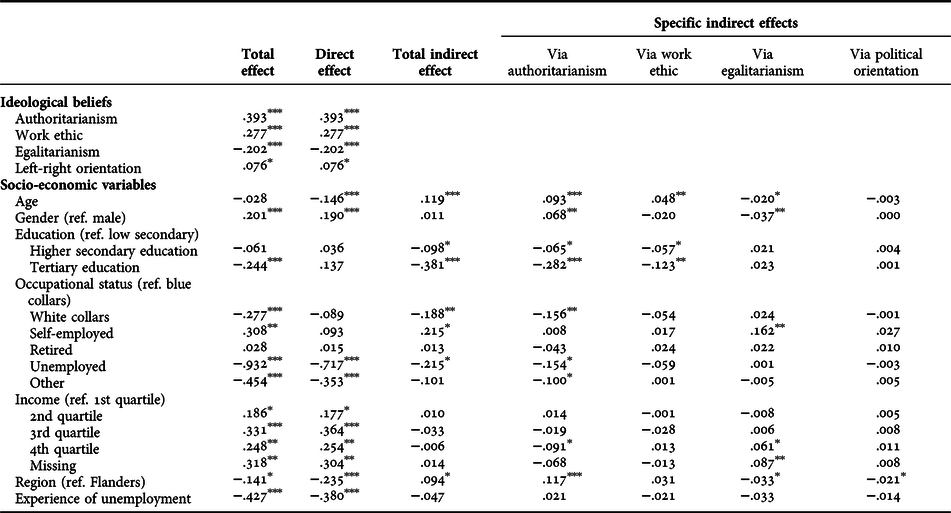
The (semi-)standardised total, direct and indirect effects of the mediation SEM are presented in Table 2. The direct effects represent the effect of the independent variables (both socio-economic characteristics and ideological beliefs) on attitudes towards demanding activation, controlling for all the other variables in the model. The total effects of the structural variables represent the relation between the socio-economic variables and support for activation, without controlling for the mediators (authoritarianism, work ethic, egalitarianism, left-right self-placement). This total effect is the sum of the direct and the indirect effects (that is, the part of the effect that is mediated by the ideological variables). While direct effects of socio-economic characteristics point towards self-interest mechanisms, indirect effects reveal which ideological dispositions underlie the differences between social categories regarding the support for demanding activation, distinguishing the indirect effect for each of the mediators separately. In case of the ideological dimensions, there is no indirect effect and, by consequence, the total effect equals the direct effect.
Structural equation model explaining attitudes towards demanding activation policies

Note: N = 1737; SRMR = .029; Explained variance (R2): .516; *** p < .001; ** p < .01; * p < .05.
Since the bootstrap procedure does not calculate other fit indices, the following are taken from the model using MLR estimator: χ2 = 841.158; df = 289; RMSEA = .033; CFI = .905; TLI = .871. N. of bootstrap draws: 1000.
Firstly, our results confirm the importance of the hypothesised ideological roots of support for demanding activation. Among the ideological beliefs significantly linked to attitudes towards demanding activation, authoritarianism has the strongest effect. In line with hypothesis H1 and with previous findings (Achterberg et al., Reference Achterberg, van der Veen and Raven2014), holding stronger authoritarian values leads people to be more in favour of tougher sanctions and punitive policy measures for welfare recipients. This effect derives from one of the ideological foundations of demanding activation: namely, that individuals failing to fulfil the conditions for receiving benefits need to be punished with sanctions and benefit cuts. Authoritarian values bring people to advocate this punitive aspect of activation policies. Moreover, adherence to a strong work ethic stimulates people to endorse demanding activation policies, in line with the expectation of hypothesis H2. Individuals who give priority to a job in their life – who see it as a means to develop talent and as an obligation towards the society – are more in favour of measures that attempt to prevent welfare dependency through enhancing individual responsibility. The effect of political self-placement, albeit small, indicates that the strongest support for demanding activation is found among right-wing oriented individuals, in line with previous studies (Fossati, Reference Fossati2018; Kootstra and Roosma, Reference Kootstra and Roosma2018) and with H3. This illustrates how demanding activation fits within the New Right perspective of social welfare citizenship. Finally, adherence to egalitarian values is negatively related to support for demanding activation, thereby confirming H4. Advocates of the principles of economic equality and government intervention to reduce income differentials are found to be more critical of demanding activation policies. Taken together, the effects of the four ideological dimensions indicate that support for demanding policies is rooted in a coherent ideological outlook that combines authoritarian values, a strong work ethic, anti-egalitarianism and rightist orientations.Footnote 3
To fully understand the influence of socio-economic variables on support for activation, it is warranted to decompose the total effects into its direct and indirect components. First, we observe that individuals who completed tertiary education are significantly less supportive of demanding activation policies than those with a lower secondary degree at most (the difference between the two groups equals .244 standard deviations). However, because the direct effect is statistically insignificant (and even slightly positive), the opposition to demanding activation among the higher educated cannot be understood from a self-interest perspective (H5a is not confirmed), but it needs to be attributed to their ideological profile. The higher educated score lower on authoritarianism and work ethic, which results indirectly in lower levels of support for demanding activation (the indirect effects via egalitarianism and left-right placement are insignificant). This finding shows that education functions as an indicator of cultural preferences rather than of socio-economic position (Achterberg et al., Reference Achterberg, van der Veen and Raven2014). We find confirmation for H6a, inasmuch as the lower educated have stronger authoritarian values, but not for H6b nor for H6c: the lower educated have a stronger work ethic, contrary to what was hypothesised, and there is no significant difference in their egalitarian values compared to the higher educated.
Also the effect of occupational status provides support to the idea that individuals’ social-structural positions and life experiences are linked to ideological preferences. Compared to blue-collar workers (reference category), white-collar workers and the unemployed show a relatively stronger opposition to demanding activation policies, while the self-employed are more supportive. This opposition, however, is driven by different mechanisms. In the case of white-collar workers, the negative effect is fully mediated by authoritarianism. Similarly as with the higher educated, the relatively low support for activation among white collars is mainly driven by the low level of authoritarianism among this group. The divergent policy preferences between blue and white collars are the results of the authoritarian outlook of these groups rather than self-interest, work ethic or egalitarian values. The strong support of demanding activation among the self-employed stems from ideological motives as well, yet here the effect is mediated by egalitarianism: the self-employed endorse demanding activation because they show greater opposition to egalitarianism.Footnote 4 The strong negative effect of being unemployed, conversely, is in the first place a direct one. Controlling for their ideological profile, the unemployed are less in favour of demanding activation, which confirms the self-interest logic (H5b), and the recurrent finding in previous research that the jobless are against policies imposing severe restrictions on their benefits (Buss, Reference Buss2018; Carriero and Filandri, Reference Carriero and Filandri2018; Fossati, Reference Fossati2018; Houtman, Reference Houtman1997). A small negative indirect effect of being unemployed runs via authoritarianism, meaning that this category scores lower on authoritarian values. Thus, H6a is partly confirmed (i.e. confirmed only for the lower educated), while the indirect effects through work ethic and egalitarianism are not significant (disconfirming H6b-c).
Income has a direct effect on attitudes towards activation. Consistent with H5c, those in the higher quartiles of the distribution express more enthusiasm for demanding activation (compared to those in the first income quartile). The overall indirect effects for the income categories are insignificant, which suggests that the relation between income and support for demanding activation is driven by self-interest. In line with the idea that people in a more ‘risky’ position are driven by their self-interest (H5d), we also observe a negative and significant direct effect of unemployment experience, and this effect does not run through ideologies (the total indirect effect is insignificant).
The effects of the control variables give additional examples of the interplay between self-interest motives and ideological beliefs in shaping activation attitudes. Interestingly, the direct and indirect effects of age run in opposite directions – self-interest thus cancels out the ideological differences. Women are more supportive of demanding activation, confirming previous findings (Larsen, Reference Larsen2008; Saunders, Reference Saunders2002), however being somewhat at odds with the stronger welfare support found among women in traditional welfare attitudes research (Hasenfeld and Rafferty, Reference Hasenfeld and Rafferty1989). Regarding regional differences, Flemish residents are more in favour of demanding activation, which might be linked to the more prosperous economic conditions of this region. However, there is also a small indirect effect, mainly driven by the fact that Francophone Belgians score higher on the authoritarian scale (Abts et al., Reference Abts, Swyngedouw, Meuleman, Baute, Galle and Gaasendam2015).
Previous investigation of attitudes towards social obligations had already suggested that the effect of socio-economic position on support for welfare rights and obligations might be mediated by ideological beliefs (Hasenfeld and Rafferty, Reference Hasenfeld and Rafferty1989; Laenen and Meuleman, Reference Laenen and Meuleman2018). Our results offer a more precise measure of the extent to which support for demanding activation is rooted in one’s socio-economic position and ideological preferences. Moreover, the findings emphasize the importance of taking the mediating role of ideologies into account and reveal that not all the socio-economic characteristics can be considered as credible indicators of self-interest motives. While personal experience of unemployment, income and, to some extent, occupational status exert a direct effect on attitudes even controlling for ideological mediators, educational level is not directly related to the dependent variable. Education seems to be a significant predictor for individuals’ development of specific ideological dispositions, and it is this socialization into certain worldviews that drives the process of attitudes formation.
6. Conclusion
The shift towards an ‘activating’ type of welfare state has raised the question to what extent people support activation policies that discourage welfare dependency through benefit cuts, restrictive eligibility criteria and sanctions in case of noncompliance. The recurrent finding that opposition against demanding ALMPs is strongest among the actual or potential targets of these policies is mainly interpreted in terms of self-interest (Fossati, Reference Fossati2018; Laenen and Meuleman, Reference Laenen and Meuleman2018). This study sheds new light on the explanatory mechanisms of public support for demanding activation by simultaneously analysing the social-structural and ideological drivers of support for demanding ALMPs in Belgium. We demonstrate the importance of a wide range of ideological beliefs that are linked to the principles underpinning the activation turn, and that lead individuals to be in favour or against these policies. Using a structural equation model, we uncover the pathways through which social-structural variables influence activation attitudes, and we disentangle self-interest and ideological mechanisms. Our results confirm the role of socio-economic position in shaping attitudes towards demanding activation – however, the effects of social structure are the result of a mixture of self-interest and ideological considerations. On the one hand, those who are currently unemployed, or who have a previous experience of unemployment, as well as those with a lower income, are more likely to oppose demanding ALMPs and these effects are directly related to self-interest. On the other hand, the opposition to demanding activation among the higher educated and white-collar workers should be understood in terms of their particular ideological dispositions – namely, being less authoritarian and less supporting traditional work ethic – rather than by their personal interest in not having obligations attached to welfare benefits.
These findings have relevant implications not merely for attitudinal research on support for activation policies, but also for the broader field of public opinion towards the welfare state. The interpretation of the effect of education and occupational status per se might be misleading if we do not take into account that these indicators capture socialization into or adherence to a particular ideological outlook. This should warn scholars to carefully consider the mechanisms underlying the effects of these social-structural variables on welfare attitudes. Our findings make clear to consider socio-economic variables not as univocal indicators of self-interest, and pinpoint the importance of including ideological dispositions as explicit mediators between socio-economic characteristics and policy attitudes. Support for demanding activation policies seems to follow the logic of ‘first the grub, then the morals’Footnote 5 : not in the sense that effects of self-interest (the grub) trump ideological motives (the morals), but rather in the sense that social-structural characteristics, and particularly education and occupation, precede and shape individuals’ worldviews, which in turn drive the development of people’s policy attitudes.
These conclusions give rise to new questions. First, the question arises to what extent our findings travel beyond the particular context of demanding activation in Belgium. Since ALMPs were, compared to some other European countries, implemented later and in a less strict manner, it is likely that the level of support for demanding activation in Belgium is relatively low. However, we see no apparent reason why the results concerning the link between ‘interests’ and ‘ideological dispositions’ – after all, two important pillars of welfare attitudes research (Andreß and Heien, Reference Andreß and Heien2001; Hasenfeld and Rafferty, Reference Hasenfeld and Rafferty1989) – on activation policy attitudes could not be generalized to other European countries. General mechanisms in regard to habitus construction and the socialization to particular ideologies through education and one’s occupation go beyond the particularities of the Belgian case, but are related to contemporary Western societies in general. The effect of institutional context – the third mainstay –should be investigated, however, within a comparative approach. Further research is needed to test whether the effects of self-interest, ideological dispositions and their interrelation hold across contexts with different ALMPs legacies. Second, it is not known whether the mechanisms uncovered for demanding activation can be extended indistinctively to support for enabling ALMPs. In line with previous suggestions (Fossati, Reference Fossati2018), further insights on the theoretical mechanisms for welfare attitudes might derive from the analysis of public opinion towards enabling policies, such as tailor-made training programs or incentives to accept low-paid jobs. In this case, activation policies might be interpreted by their beneficiaries as positive instruments promoting their re-insertion in the labour market, instead of as punitive measures. It is conceivable that rational self-interest would bring unemployed people, or people more at risk of unemployment, to support this type of policies. The current non-availability of survey data on these activation measures, however, prevents welfare scholars from investigating the specific attitudinal support of this type of activation. Third, it is possible that, besides mediation, also interaction effects exist and that the various individual characteristics reinforce or temper each other’s influence on support for demanding ALMPs. It is not unlikely, for example, that the strength of the impact of work ethics varies with political ideology. Our study was not able to answer these questions, but hopefully paves the way for future research in the field of policy attitudes.
Acknowledgments
This study was made possible by the support of the KU Leuven Research council (OT/13/30), the National Science Foundation – FWO-Vlaanderen (Grant Number: G068816N) and the Belgian National Lottery.
Supplementary material
To view supplementary material for this article, please visit https://doi.org/10.1017/S0047279420000197