INTRODUCTION
Seas surrounding the more than 7000 islands of the Philippine archipelago host the highest biodiversity of marine fauna in the world, including the teleost fish (Tittensor et al., Reference Tittensor, Mora, Jetz, Lotze, Ricard, Vanden Berge and Worm2010). For decades, the Philippine marine fish have been intensively studied covering topics such as taxonomy and distribution (e.g. Herre, Reference Herre1953), populations dynamics in Marine Protected Areas (MPAs) (e.g. Russ & Alcala, Reference Russ and Alcala1996) and biodiversity (e.g. Carpenter & Springer, Reference Carpenter and Springer2005; Bos, Reference Bos2011). However, the vast majority of ichthyological studies were conducted in the northern (Luzon) and central seas (Visayas) of the country, which form the epicentre of marine species diversity within the Coral Triangle (Hoeksema, Reference Hoeksema and Renema2007; Sanciangco et al., Reference Sanciangco, Carpenter, Etnoyer and Moretzsohn2013). A much lower number of studies has been carried out in the southern Island of Mindanao (especially along the western and southern shores), as this region has suffered under scenes of political unrest. For that reason, the development of a research infrastructure has been hampered and knowledge about Mindanao's natural resources is limited.
The Davao Gulf, a large bay located in south-eastern Mindanao bordering the Celebes Sea, is one area of which little biological information is known. Therefore, it may not be surprising that recent studies have revealed unique ecological phenomena (Bos et al., Reference Bos, Gumanao and Salac2008a; Bos, Reference Bos2012) as well as first records (Bos & Smits, Reference Bos and Smits2013) and new taxonomic descriptions of fish species (Motomura et al., Reference Motomura, Okamoto and Iwatsuki2001). The chance of observing first records or discovering new species is thus relatively high along the coasts of Mindanao as earlier predicted by Carpenter & Springer (Reference Carpenter and Springer2005).
Networks of MPAs have been created to conserve species diversity, but knowledge of spatial distributions of many species remains incomplete (Dalleau et al., Reference Dalleau, Andrefouet, Wabnitz, Payri, Wantiez, Pichon, Friedman, Vigliola and Benzoni2010; Weeks et al., Reference Weeks, Russ, Alcala and White2010). Furthermore, climate change impacts marine biodiversity through changes in species distributions (e.g. extinctions or invasions; Cheung et al., Reference Cheung, Lam, Sarmiento, Kearney, Watson and Pauly2009). For these reasons, it is of utmost importance that new records of fish species, contributing to expanding geographical distributions, are reported. The present study describes new records of fish found in a local market on Samal Island and discusses their specific range extensions. It further provides morphometric data and describes, when appropriate, length–weight relationships and the seasonality of occurrence.
MATERIALS AND METHODS
All fish were found at the local fish market in Peña Plata on Samal Island, which is located in the Davao Gulf, the Philippines (see figure 1 in Bos et al., Reference Bos, Gumanao, Alipoyo and Cardona2008b; Bos et al., Reference Bos, Gumanao, Mueller and Saceda-Cardoza2013). Peña Plata market is the main fish market on Samal Island, where artisanal fishermen sell their catches. Freezing capacity at Peña Plata market is very limited assuring that the majority of fish are sold within 24 hours. Furthermore, fish found on Peña Plata market were considered to originate from waters surrounding Samal Island, as deliveries from other areas rarely occurred (Bos & Gumanao, Reference Bos and Gumanao2012).
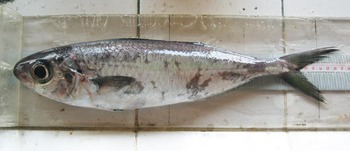
Ariomma brevimanum (Ariommatidae) found at the Peña Plata market, Samal Island, Philippines on 5 March 2010 (photograph: A.R. Bos).

The Peña Plata market was frequently visited (N = 139) at irregular intervals between 4 March 2009 and 25 May 2011. Species identification was usually done on the spot, but representatives of unidentified species were photographed to support later identification. Additional photographs were made of fins and other conspicuous characteristics. High-resolution photographs were used to count spines, rays, scales, etc. allowing identification with data provided in FishBase (Froese & Pauly, Reference Froese and Pauly2012). Specialized literature (given in each section below) and/or expert opinions (see Acknowledgements) were used to confirm the identifications.
Standard length (SL), total length (TL) and, when appropriate, fork length (FL) were measured at 5 mm accuracy. Specimens with a SL <100 mm were measured at 1 mm accuracy. Specimens were weighed on a digital scale at 1 g accuracy. Length–weight relationships (W = a · L b ; where a is the incept and b the slope of the log-transformed data) were calculated if more than ten specimens per species were found.
RESULTS
SYSTEMATICS
ARIOMMATIDAE
Ariomma brevimanum (Klunzinger, 1884)
Driftfish (Figure 1)
MATERIAL EXAMINED
Specimens of Ariomma brevimanum were regularly encountered on the Peña Plata market. Measurements were conducted during 7.9% of all visits, but vendors indicated that this species was available on the market more frequently. Specimens (37 in total) were measured on 2 July 2009 (3 specimens), 5 October 2009 (1), 10 February 2010 (11), 19 February 2010 (2), 26 February 2010 (5), 5 March 2010 (2), 16 April 2010 (4), 3 September 2010 (3), 1 December 2010 (2), 14 December 2010 (3) and 18 May 2011 (1). Standard length of the specimens ranged from 115 to 475 mm, FL ranged from 130 to 510 mm, TL ranged from 145 to 590 mm and the weight ranged from 37 to 1756 g.
DIAGNOSIS
The anterior dorsal fin had 11–12 slender spines; the first 3–5 spines were black, whereas the remaining fin had a grey colour. The posterior dorsal fin had 15 soft rays and a grey colour. The caudal fin was generally grey, had a dark edge and the tips of both lobes were black. The dorsal and caudal fins had a light yellow shine in some specimens. The anal fin had two spines, 14–15 rays and was white in colour. The pectoral fins had 23 rays, were black, but became gradually white toward their ventral sites. The pelvic fins had one spine, five rays and were white. 52–53 scales were counted along the lateral line. Larger specimens had a dark edge at the dorsal posterior end of the operculum. The body was elongated and rounded with a general silver appearance. The nape and the dorsal areas were darkened. Most specimens had a black marking at the posterior, dorsal edge of the eye.
REMARKS
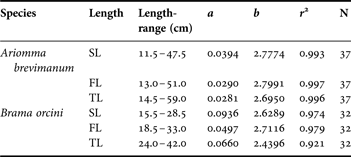
Ariomma brevimanum is known from Japan, Guam, Indonesia, Fiji, Hawaii, Tuvalu, the Ryukyu Islands and the Red Sea (Froese & Pauly, Reference Froese and Pauly2012). In January 2012, this species was observed in Hurghada, Egypt, which also constituted a new national record (A.R. Bos, personal observation). Parameters of the length–weight relationships for SL, FL and TL are given in Table 1. This species grows to a maximum of 800 mm TL (Masuda et al., Reference Masuda, Amaoka, Araga, Uyeno and Yoshino1984).
Ariomma brevimanum (Ariommatidae) and Brama orcini (Bramidae): parameters of the length–weight relationships for standard length (SL), fork length (FL) and total length (TL) are shown. Intercept a, slope b, correlation coefficient r 2 and the total numbers of observations (N) are provided per species.

BRAMIDAE
Brama orcini Cuvier, 1831
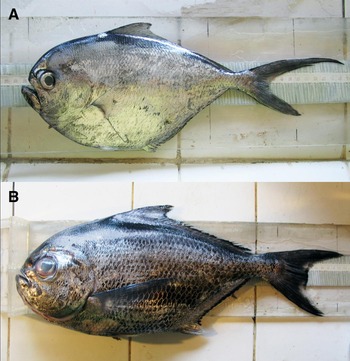
Bigtooth or bigbelly pomfret (Figure 2A)
Brama orcini (A) and Eumegistus illustris (B) of the Bramidae found at the Peña Plata market, Samal Island, Philippines on 11 February 2011 and 16 May 2011 respectively (photographs: A.R. Bos).

MATERIAL EXAMINED
A total of 32 specimens of Brama orcini were found on the Peña Plata market during 7.2% of all visits. Specimens were measured on 30 October 2009 (7 specimens), 19 February 2010 (3), 7 June 2010 (2), 29 June 2010 (1), 26 August 2010 (2), 12 October 2010 (3), 23 November 2010 (3), 26 November 2010 (1), 11 February 2011 (6) and 27 April 2011 (4). Standard length of the specimens ranged from 155 to 285 mm, FL ranged from 185 to 330 mm, TL ranged from 240 to 420 mm and the weight ranged from 126 to 663 g.
DIAGNOSIS
Dorsal fin rays 0 + 33–36; anal fin rays 0 + 28–30; pectoral fin rays 20–22; lateral line scales 52–54. Scales without spines. Body silvery white in colour. A black band along the back from above the eye to the caudal peduncle. Most specimens had a bright white spot at the anterior base of the dorsal fin (Figure 2A); a characteristic not found in earlier descriptions. Dorsal and caudal fins dark. Anal fin silvery white as body; fin base covered with scales. Pectoral and pelvic fins translucent.
REMARKS
Brama orcini is known as an epipelagic species and generally found at depths ranging from 1 m to 100 m (Last & Moteki, Reference Last, Moteki, Carpenter and Niem2001). Mundy (Reference Mundy2005) reported specimens as deep as 1229 m. Brama orcini is known from tropical and sub-tropical seas in the Indo-Pacific with records from Japan, Papua New Guinea, Hawaii, the Maldives and Australia (Froese & Pauly, Reference Froese and Pauly2012). Parameters of the length–weight relationships for this species are presented in Table 1.
BRAMIDAE
Eumegistus illustris Jordan & Jordan, 1922
Brillant pomfret (Figure 2B)
MATERIAL EXAMINED
Two specimens of Eumegistus illustris were found at the Peña Plata market on 28 September 2010 (415 mm SL, 510 mm FL, 600 mm TL and a weight of 2593 g) and 16 May 2011 (370 mm SL, 445 mm FL, 510 mm TL and a weight of 1784 g).
DIAGNOSIS
Dorsal fin rays 0 + 33; anal fin rays 0 + 23–24; pectoral 1 fin rays 20; lateral line scales 50. Body colour dark brown. Dorsal and anal fins with black margin. Forked caudal fin with interrupted black margin.
REMARKS
Eumegistus illustris is known to live in relatively deep water up to 520 m (Mundy, Reference Mundy2005) like most other representatives of the Bramidae (Carvalho-Filho et al., Reference Carvalho-Filho, Marcovaldi, Sampaio, Paiva and Duarte2009). It is mainly known from the Pacific Ocean with records from Japan, Taiwan, Hawaii, Fiji, China, Réunion, Australia, Ryukyu and Tuvalu (Froese & Pauly, Reference Froese and Pauly2012). The maximum length for this species is 550 mm SL (Last & Moteki, Reference Last, Moteki, Carpenter and Niem2001).
LUTJANIDAE
Paracaesio kusakarii Abe, Reference Abe1960
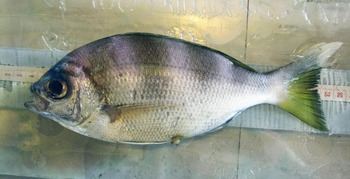
Saddleback snapper (Figure 3)
Paracaesio kusakarii (Lutjanidae) found at the Peña Plata market, Samal Island, Philippines on 25 March 2010 (photograph: A.R. Bos).

MATERIAL EXAMINED
One specimen of Paracaesio kusakarii was found at the Peña Plata market on 25 March 2010 with a SL of 180 mm, a FL of 210 mm, a TL of 240 mm and a weight of 221 g.
DIAGNOSIS
Dorsal fin rays X + 10; anal fins rays III + 8; pectoral fin rays 16; lateral line scales 49. Body silvery with four brown almost vertical bands and dark brown on the dorsal side of the head (Abe, Reference Abe1960). Dark-tipped scales form longitudinal lines, especially below the lateral line. The fins are grey to whitish; the margin of the dorsal fin yellow. Most of the caudal fin yellow, but upper seven fin rays of dorsal lobe white.
REMARKS
Paracaesio kusakarii is found at depths ranging from 100 to 310 m (Anderson & Allen, Reference Anderson, Allen, Carpenter and Niem2001), but is usually found at 125 to 250 m (Froese & Pauly, Reference Froese and Pauly2012). Paracaesio kusakarii is known from the western Pacific (Ryukyu Islands to north-eastern Australia and east to Samoa). The maximum length for this species is 600 mm SL (Anderson & Allen, Reference Anderson, Allen, Carpenter and Niem2001).
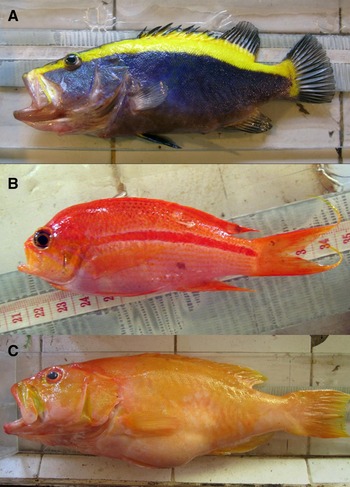
SERRANIDAE
Aulacocephalus temminckii Bleeker, 1854
Goldribbon soapfish (Figure 4A)
Aulacocephalus temminckii (A), Pseudanthias fasciatus (B) and Saloptia powelli (C) of the Serranidae found at the Peña Plata market, Samal Island, Philippines on 16 May 2011, 10 February 2010 and 12 April 2011 respectively (photographs: A.R. Bos).

MATERIAL EXAMINED
One specimen of Aulacocephalus temminckii was found at the Peña Plata market on 16 May 2011 with a SL of 230, a TL of 265 mm and a weight of 236 g.
DIAGNOSIS
Dorsal fin rays IX + 12; anal fin rays III + 9; pectoral fin rays 14; pelvic fin rays I + 5; lateral line scales 79. Colour of the body dark blue with a bright yellow band from snout, through the eye, along the back to the caudal fin. Proximal end of dorsal fins bright yellow being part of the band. Caudal fin base bright yellow. Proximal end of first rays of pelvic fin yellow. Thin yellow line along the margin of the maxilla. Fin rays (except in pectoral fins) dark blue and tissue translucent to grey.
REMARKS
Aulacocephalus temminckii is an inhabitant of coral reefs with a depth distribution of 20–350 m. It is widely distributed in the Indo-Pacific from the Red Sea and South Africa to New Zealand and Japan, and further east to French Polynesia (Khalaf & Zajonz, Reference Khalaf and Zajonz2007). The maximum length known for this species is 400 mm TL (Lieske & Myers, Reference Lieske and Myers2002).
SERRANIDAE
Pseudanthias fasciatus (Kamohara, 1954)
Striped anthias or one-stripe anthias (Figure 4B)
MATERIAL EXAMINED
One specimen of Pseudanthias fasciatus was found at the Peña Plata market on 10 February 2010 with a SL of 87 mm, a FL of 103 mm, a TL of 144 mm and a weight of 25 g.
DIAGNOSIS
Dorsal fin rays X + 16; anal fin rays III + 7; pectoral fin rays 17; lateral line scales 44. Body brightly orange with a red stripe (and white margins) from the opercular flap to the caudal fin base. Scales have dark spots dorsal of the red stripe, whereas scales ventral to the red stripe have orange spots forming narrow lines. The fins are orange in colour.
REMARKS
Pseudanthias fasciatus is typically found in coral reef habitats, but may reach depths up to 150 m (Myers, Reference Myers1999). This species is known from the Red Sea to southern Japan and the Great Barrier Reef. Recently it was reported from Tonga (Randall et al., Reference Randall, Williams, Smith, Kulbicki, Tham, Labrosse, Kronen, Clua and Mann2004). The maximum length known for this species is 210 mm TL (Randall et al., Reference Randall, Allen and Steene1996).
SERRANIDAE
Saloptia powelli Smith, 1964
Golden grouper (Figure 4C)
MATERIAL EXAMINED
One specimen of Saloptia powelli was found at the Peña Plata market on 12 April 2011 with a SL of 390 mm, a FL of 460 mm, a TL of 480 mm and a weight of 1691 g.
DIAGNOSIS
Doral fin rays VIII + 11; anal fin rays III + 8; pectoral fin rays 14; lateral line scales 76. Body generally yellow. Dorsal side lighter in colour with some areas turning rose (Figure 4C). Some reddish blotches/blushes on the head and above the eye. Fins yellow.
REMARKS
This species is known to inhabit depths in the range of 140–367 m (Heemstra & Randall, Reference Heemstra, Randall, Carpenter and Niem2001). It is found from the Ryukyu Islands to the Great Barrier Reef, east to the Mariana Islands and Society Islands, and west to Taiwan (Heemstra & Randall, Reference Heemstra, Randall, Carpenter and Niem2001). The maximum length known for this species is 500 mm TL (Heemstra & Randall, Reference Heemstra, Randall, Carpenter and Niem2001).
DISCUSSION
Ariomma brevimanum, a representative of the Ariommatidae, is generally considered a rare species, but has been locally caught in large quantities in Japan (Last, Reference Last, Carpenter and Niem2001). During the present study many specimens were observed, but their occurrence did not follow a seasonal pattern. Vendors indicated that specimens of A. brevimanum are available on the market relatively frequently and that we only measured a small fraction during our visits. This means that A. brevimanum is an important food fish in Samal Island and that there must be, similarly as in Japan (Last, Reference Last, Carpenter and Niem2001), a large population that supports its fishery in the Davao Gulf. The specimens measured on the Peña Plata market were of moderate size (Masuda et al., Reference Masuda, Amaoka, Araga, Uyeno and Yoshino1984) and constitute the first record of A. brevimanum in the Philippine seas. This observation confirms its Indo-Pacific-wide distribution and may suggest that other localized populations of this species support subsistence fisheries. Brama orcini, one of the two representatives of the Bramidae found on the fish market in Peña Plata, also has an Indo-Pacific-wide distribution. The 32 specimens constitute the first record of Brama orcini in the Philippines and provide a new maximum size of 420 mm TL. The maximum length known for this species was 350 mm TL (Eschmeyer et al., Reference Eschmeyer, Herald and Hammann1983). The observations of B. orcini at the Peña Plata market do not suggest a seasonal pattern of occurrence in the Davao Gulf. According to the vendors, this species is regularly sold on the market and should be considered a food fish for this region. The two specimens of Eumegistus illustris (Bramidae) found in Samal Island constitute the first record of this species in the Philippines and further expand its distribution area in western direction. According to the vendors, this species, as well as the following species to be discussed, are very uncommon in the Peña Plata market and do not play an important role in the local fishery. Last & Moteki (Reference Last, Moteki, Carpenter and Niem2001) questioned an earlier observation of E. illustris in Guam, but considering the relative nearness of Guam to the Philippines that observation may be valid. The specimens observed in Samal Island were relatively large considering the maximum known size of 550 mm SL (Last & Moteki, Reference Last, Moteki, Carpenter and Niem2001).
A medium-sized specimen of Paracaesio kusakarii (Lutjanidae), found during the present study, constitutes the first record in the Philippines. Paracaesio kusakarii was thought to be distributed east of the axis formed by southern Japan and north-east Australia. However, one single observation from Singapore had already suggested a distribution in western direction (Anderson & Allen, Reference Anderson, Allen, Carpenter and Niem2001), which is confirmed by the present record.
The two serranids Aulacocephalus temminckii and Pseudanthias fasciatus are widely distributed in the Indo-Pacific region (Froese & Pauly, Reference Froese and Pauly2012), but had never been recorded in the Philippines. Both species were represented by only one specimen of moderate size (Lieske & Myers, Reference Lieske and Myers2002). One moderate-sized specimen of Saloptia powelli, the third representative of the Serranidae, constitutes another first record in the Philippine seas. This is the most western record at the latitude of the Davao Gulf (Heemstra & Randall, Reference Heemstra, Randall, Carpenter and Niem2001) further expanding the distribution area of this species.
The seven newly recorded fish that are presented in this study provide new knowledge about their specific distributions and give an indication about their original distributions or possible range extensions. In either case, this information is important when it comes to conservation efforts for the species in question or, in a broader sense, for the entire Indo-Pacific biodiversity. The marine biodiversity of the Philippine archipelago increases with every new record and may be much higher than previously assumed. Past predictions had already indicated that the core of Indo-Pacific marine biodiversity must be in the Philippines (Hoeksema, Reference Hoeksema and Renema2007; Sanciangco et al., Reference Sanciangco, Carpenter, Etnoyer and Moretzsohn2013). The present study and other recently described species and new records from the Philippines (e.g. Randall & Allen, Reference Randall and Allen2010; Uiblein & McGrouther, Reference Uiblein and McGrouther2012; Bos & Smits, Reference Bos and Smits2013) underline the importance of the Philippine fauna as part of the marine biodiversity within the larger Coral Triangle. Therefore, it must be emphasized that increased efforts are needed to help conserve the abundance of marine life in the Philippines.
ACKNOWLEDGEMENTS
We thank B. Mueller, S. Nitza, M. Saceda-Cardoza and the vendors of the Peña Plata market for supporting the fieldwork. We further acknowledge K. Carpenter (Old Dominion University), J. Randall (Bernice Pauahi Bishop Museum), S. Kuang-Tsao and L. Yun-Chih (Academia Sinica), who confirmed some identifications, and M. Madison (National Conservation Training Center), who provided a copy of Herre (Reference Herre1953). This research received no specific grant from any funding agency, commercial or not-for-profit sectors.