Introduction
If the ideal artistic collaboration is one of shared vision, open communication, and exquisite professionalism, then Martha Graham and Carlos Chávez strayed far from it in the making of Dark Meadow.Footnote 1 As this article documents, their relationship was full of antagonism, misunderstanding, disdainful gossip, and regret on both sides. Graham began complaining to their patron, Elizabeth Sprague Coolidge, in January 1944 about the quality and quantity of Chávez's work. Graham feared that Chávez was going through ‘a period of dearth’,Footnote 2 and urged continued influence on the composer for more music. The resultant pressure from the Music Division of the Library of Congress, which planned to host the premiere, elicited a burst of temper from Chávez:
Last Thursday I received your letter dated March 7th. I am a bit surprised at the contents and at the tone of it. … If the Division cannot wait to get a good piece of music, or, else, if the Division would be happy to have any piece of music on condition that it is delivered promptly, then I shall have to disagree with the Division of Music.Footnote 3
Neither Graham's complaining nor Chávez's temper was entirely out of character, so it is easy to see such a disagreement as merely a clash of strong personalities. This article seeks to probe more deeply by investigating the cultural context for their collaborative frustrations. Three impediments receive particular attention here:
1. A misunderstanding between the two collaborators on the meaning and utility of Greek allusions in art created conflicting aesthetic expectations for a dance with a plot derived from Greek mythology.
2. Both artists defied the modernist community's expectations about how each of them should perform their gender identity as artists. In particular, Chávez was unable to anticipate Graham's eagerness to display her female characters’ emotional range on stage, which stunted his ability to respond to her innovations.
3. Similarly, the press's consistent Othering of Chávez in racist, nationalist terms was contagious, influencing Graham's beliefs about what Mexican music could or should be, and preventing her from accurately imagining Chávez's sonic depictions.
Despite these significant obstacles, Chávez and Graham produced a work that illustrates the depth of meaning possible in the neoclassical frame and continues to represent the mid-century Modernist aesthetic.
The barriers previously listed were not separate issues faced in turn by Graham and then Chávez; rather, like all cultural biases, they hummed in the background of all their interactions, sometimes louder and sometimes softer, with no coordination and little predictability. Although these factors certainly intertwined in everyday interactions, in order to tell this story, I have separated them out somewhat. Much of the article narrates the collaboration in loose chronological order. Along the way, the reader is asked to observe references to Greek mythology and their reinterpretation as proto-feminist urtexts in the case of Graham and as inspiration for Stravinskian Neoclassicism for Chávez. Occasionally, I tighten the analysis on the race and gender factors at play, using Leonora Saavedra's account of Othering in Chávez's career and Judith Butler's interpretations of Greek heroines as animating texts.
In attempting to surface obstacles to collaboration, I aim to elicit empathy for Chávez's and Graham's respective situations and for the difficulty of their collective effort. At the same time, I hope to imbue the artistic results with greater subtlety and grace, allowing us to read emotion between the neoclassical lines of Chávez's music, and self-knowledge in the roiling drama of Graham's choreography. Awareness of these difficulties makes the resulting art all the more magnificent, because Graham and Chávez produced beauty and inspired contemplation, despite working through a tangled, conflictive collaborative process.
Regardless of one's valuation of the work itself, studying it in this multifaceted way allows us to re-examine the larger movements to which each artist belonged and to contemplate the inter-relationship between these large movements and the identity politics of those participating in them. Most pointedly, the discourses around and through Modernism and NeoclassicismFootnote 4 and Americanism opened some avenues and closed others, with different individuals perceiving different options. Just as Graham and Chávez worked to hold to their aesthetic ideals while simultaneously currying favour with donors, press, and public, so every artist of their generation was engaged in serving multiple masters. If this was a necessary condition of employment for artists working in a market economy, it provides all the more reason to deeply interrogate each individual's possibilities, as I attempt to do here.
Owing to my purpose in examining the effect that gender and cultural constraints have on the collaborative process, I am careful to weight Chávez and Graham equally in my study. To do that, I rely on a wide range of sources and methodologies, most of them drawn from music and dance histories. Throughout, I remain close to the primary source materials, including letters and music found at the Archivo General de la Nación (AGN), the New York Public Library (NYPL), and the Library of Congress (LOC).
Graham and Medea
The climax of Samuel Barber's score for Martha Graham's Cave of the Heart coincides with the moment that the central character, Medea, decides to enact her revenge on her husband's new lover (who happens to be a princess). As the strings swirl with motion, the chromatic melody and dissonant harmony intensify; meanwhile, Medea bares her writhing, anger-fuelled ego on the stage. This ‘Dance of Vengence’ matches Graham's choreography and Barber's sonic realization so perfectly that, having seen them together, one finds it hard to think of either as a separate entity. For example, there is extraordinary rhythmic precision to the tableaus, which pause movement exactly at the musical climaxes. The chordal dissonance of the score is in concert with the dancer's building anger, shown through sharp, violent movements. And the use of the Middle Eastern scale is echoed in the dancer's writhing.Footnote 5
Despite the seeming organicism of the ‘Dance of Vengence’, the process of choreographing Medea was difficult and occupied Graham over a period of several years. The idea was first presented not to Barber, but to Aaron Copland in a letter dated 17 February 1941:
I write to you, knowing that you may be busy, or not interested with the subject, or many things – but I would forgive you anything because you are a great composer – but I hope you are interested. I want to do a ‘Medea’ – not with words or voice – not following the intention of the play – but rather as a study of ‘Medea’ as an essential type, an archetype.Footnote 6
A full script followed, fleshed out with characters, plot, and emotional motivation, along with the occasional indication of steps or visual representation. As Graham's letter suggests, the script dispenses with the early ‘heroic’ part of the Medea/Jason story. The focus of Graham's script, as suggested by the previous Barber excerpt, is the aftermath – the moment when Jason spurns Medea and their children in order to start a new life and a new access to power through the Princess of Corinth. Understandably furious, Medea re-directs her sorcery against the new couple, sending her rival a fatally poisoned crown as a wedding present.
The tale of Jason and Medea could be interpreted as a morality tale on the danger of empowered women, but it becomes clear that when Graham referred to Medea as an ‘archetype’ in her letter to Copland, this was not the reading she had in mind. Rather, Graham wanted to explore the psychological roots of Medea's rage, writing, ‘It is, as you see, not the drama “Medea”, the play, I would do – but rather the drama of Medea's mind at work upon the idea of revenge, the questioning, planning, desires.’
Graham did write and send a scenario. It features the main characters that dominate Cave of the Heart: ‘The Woman, Her Fury, The Man, His Muse’, with the clear implication that the Man is loosely analogous to Jason, the Princess serves as Muse, the Woman as Medea, and the Fury as Medea's inner animalism. In the scenario Graham refined the musical ideas somewhat, describing the form as ‘the recurrence of a rondo’ with ‘a scene that is dramatic and then an ode that is more lyrical’. When describing the instrumentation, she expressed a degree of specificity surprising for work so early in gestation:
I find it hard to see it on piano and yet it must be possible to tour. Would it be possible to use winds, brass, and percussion? I feel that the percussion should not be used as primitive instruments but rather as delicate instruments of the nerves. I feel that even a Mexican water drum might be used to make hidden areas of feeling objective, rather than as excitements, or accents. Also I should like to use the Voice as an instrument without words. It should have the unhuman quality that certain Negro, Indian, or gypsy voices have at times of great emotional stress, when it becomes an abstract of sensation. Only the Fury uses the voice.Footnote 7
The racial stereotyping found in this quote, including the idea of a voice with ‘the unhuman quality that certain Negro, Indian, or gypsy voices have at times of great emotional stress’, pervades Graham's early correspondence with Copland. In fact, as explored later in the article, it was one reason Copland guided Graham away from a Medea plot. The only thing retained from the scenario was the setting of a ‘New England House’; instead, Copland's collaboration with Graham became something quite different – Appalachian Spring (1944). With Copland's blessing, the script for the Medea scenario went on to Carlos Chávez, the other composer commissioned by the Elizabeth Sprague Coolidge Foundation in 1942 to write a dance for Graham. The Chávez music, which became Graham's Dark Meadow and Chávez's La hija de Cólquide (a reference to Graham's script title, ‘The Daughter of Colchis’), is the oft-forgotten middle sibling in the trio of Medea offshoots.
Antígona and Dark Meadow
The project began in earnest with Graham's letter to Chávez dated 7 November 1942. Like the letter to Copland, it began with a heavy dose of flattery – the sort of softening that probably motivated Graham's famous response to accusations of feminism, ‘I had no affiliation with it, and I always got whatever I wanted from men without asking.’Footnote 8 Her letter to Chávez began:
I am so happy to hear that you may accept the commission from Mrs. Coolidge and that I may have the privilege of collaborating with you on a work. It hardly seems possible because I have hoped for such an opportunity for so long as you know. I have played the ‘Antigone’ over and over, always to my joy and my despair that I had no opportunity to work with a large orchestra as it demanded. … I hope that the work can be serious and dramatic and because it is for the stage highly theatrical in the best sense of that much mis-used word. The script I will send you deals with the emotional experiences but it is not a play and could only be done by dancers, I feel.Footnote 9
The mention of Chávez's Sinfonía Antígona (1933) in this letter may have been a pro forma compliment on Graham's part; she tried a similar technique in one of her letters to Copland, making reference to his Lincoln Portrait (1942).Footnote 10 Yet for Chávez, Antígona existed within a referential web that would have an indelible effect on his concept for La hija de Cólquide/Dark Meadow. Although presented in the United States first as a symphonic work, the music for Chávez's Antígona was first created as incidental music for a staging of Sophocles's play as ‘made new’ by Jean Cocteau. Then the music was reworked into a one-movement symphony performed first in Mexico and then widely in the United States where it was commonly paired as the counterpoint to one of Chávez's more Mexicanist pieces such as H.P. or Sinfonía india.
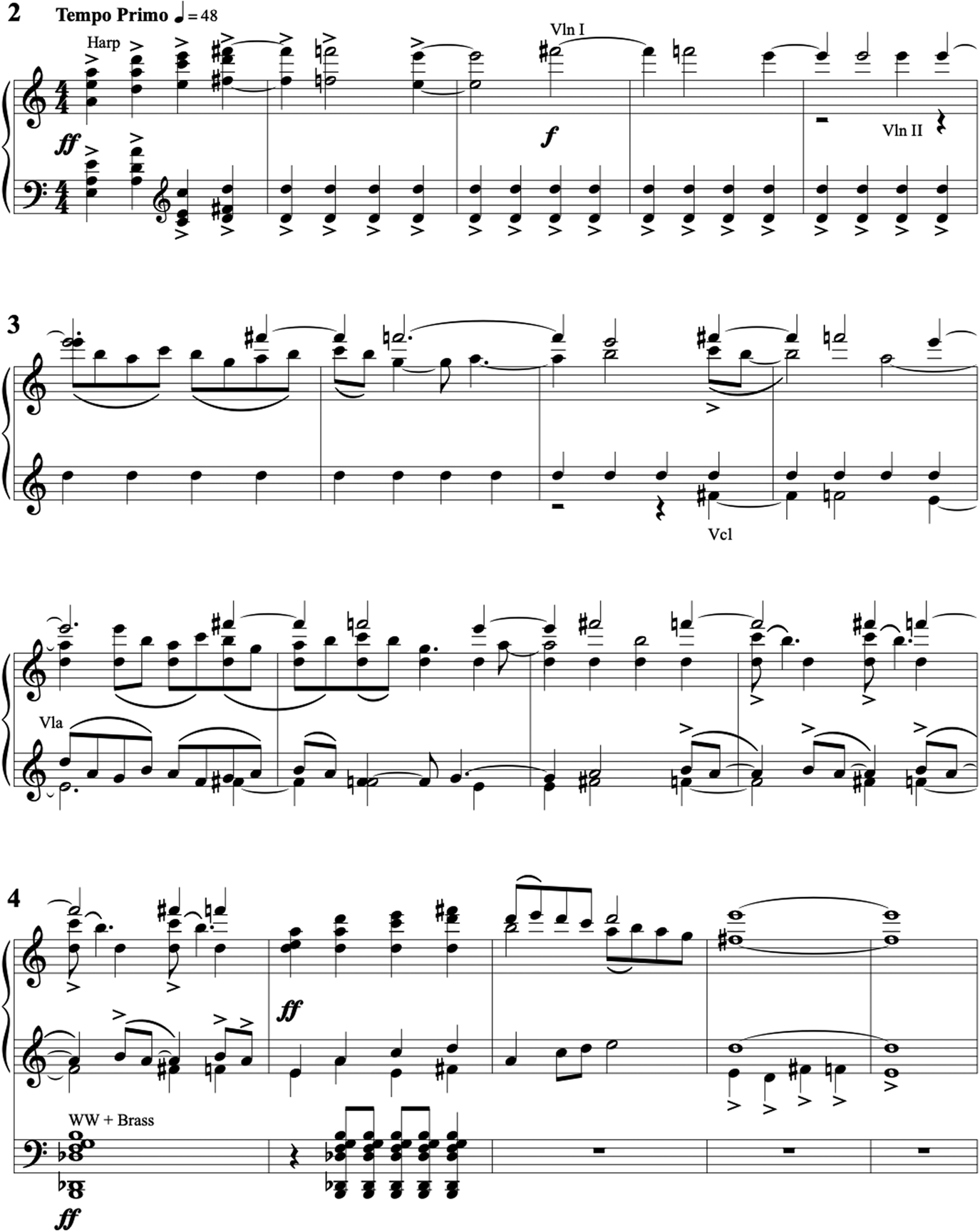
The score for Antígona may be regarded as Chávez's first to attempt Stravinskian Neoclassicism (Example 1). Like Stravinsky's Oedipus Rex (1927), it works against the Cocteau text to provide a multivalent reading of the mythic.Footnote 11 Where Cocteau's version emphasizes the disaster of hurried decision making in the public sphere, Chávez's score revels in tension and sadness, relentlessly foreshadowing the tragic ending. Furthermore, it is Baroque in its static emotional tenor and descending tetrachords while still reflecting some of the style markers familiar from other Chávez works of the period – intense rhythmic drive, dissonance, and pentatonicism – here signifying ancient Greece rather than ancient Mexico.
In this excerpt one can observe the post-Stravinsky Neoclassicism in the abrasive bi-tonality. Here a descending chromatic scale stands in for the lamenting descending tetrachords seen elsewhere in the score. Chávez, Sinfonía Antígona, bb. 13–30. Reduction and transcription by Brian Rice.

On 11 February 1943, Graham confirmed Chávez's neoclassical expectations by sending him a script about Medea, another Greek mythic heroine, telling the composer in an accompanying note that she wanted to make it ‘as theatric as possible’.Footnote 12 Perhaps intensifying Chávez's association of Antígona with Graham's style of movement, Graham's former student Anna Sokolow created new choreography to the work in her premiere performance with the Paloma Azul dance company in Mexico City (October 1940).Footnote 13 The entire event was controversial, attracting much commentary in the Mexico City press, precisely because it aligned both Sokolow and Chávez with the post-Stravinsky neoclassical aesthetic then popular among the Spanish expatriate composers living and working in Mexico at the time. Works such as Antígona suggest that his attraction to the neoclassical aesthetic was genuine, and, because Chávez had embraced aesthetic scandals his entire career, such attention was probably encouraging. In any case, Graham professed to have few requirements for the music: ‘I have such a desire to dance to your music and I will do all I can to co-operate with you. Above all please feel perfectly free.’Footnote 14
First Interactions
If the Graham–Chávez project was fraught, it was not because the collaborators were unacquainted with each other. Graham's initial interactions with Chávez derived from their mutual interest in Mabel Dodge Luhan and the modernist community in and around New York. Graham's initial letter begins, ‘I learned from Henry Cowell that I might yet find you in Taos.’ She continues, referencing Leopold Stokowski, Chávez's works for ballet, and some of the smaller chamber pieces that had been presented in New York. She is especially fond of Energía (1925) and the sonatinas for violincello and piano, violin and piano, and solo piano from 1924. ‘I like them very much’, she writes, ‘and I have been anxious either to have one of your existing compositions, or else to make plans with you for a new composition. Of course the latter is much more desirable.’ The letter is warm and lengthy, but it is obvious that the purpose is singular: to persuade Chávez to write a composition for Graham to perform.Footnote 15 The composer replied a few weeks later requesting a scenario, so that he could ‘understand your wishes … In any case, I think it would be convenient if we exchange impressions in person, and that could be in January or February of next year, when I will be in New York.’Footnote 16
It is unclear if they met in New York, but Graham won a Guggenheim grant to visit Mexico just one year later, and they did meet then. Although the stated raison d’être for the grant was to study the primitive dances of Mexico, recent research on Graham's activity in Mexico reveals little investigation or even curiosity about native dance.Footnote 17 Graham's initial interest in Mexico and Mexican dance might be explained by a sort of cultural Monroe Doctrine, as is her willingness to take what she found useful and leave the rest. But the level of disinterest in the appearance, mechanics, sound, or specificity of Mexican dance practice might be more precisely captured by the collapsing of separate ‘primitive’ identities within the Ur-Classical rubric.Footnote 18 Whatever the content of her application packet to the Guggenheim Foundation, Graham may have believed that having experienced some form of native dance during her childhood in California and her visits to the Luhan salon in New Mexico, she was free to sightsee and network in Mexico as she liked, without purposely investigating particular genres, tribes, or cultures. Such an impression is reinforced by the recognition that, upon her return to the United States, the idea of Mexico was frequently featured in her publicity and in reviews of her work.Footnote 19
The most important moment from the Guggenheim trip for the purposes of this article was Graham's much-anticipated meeting with Chávez, which took place during a tea party.Footnote 20 No transcript occurs from that meeting, but we know that at some point during her trip Graham acquired a Chávez score, 36. Like the ballet H.P., with which it is sometimes confused, certain sections of the music are fast-moving, repetitive, dissonant machine imitations. In 1930 it was printed and distributed by Cowell's New Music Editions; the first record of a public performance of 36 in the United States is Oscar Zeigler's at the New School of Social Research in 1931.Footnote 21 We also know that Chávez performed the piece under the title ‘Four Mexican Pieces’ at social gatherings – possibly Graham first heard it during the aforementioned tea party.
In keeping with Chávez's own loose definition of Mexican-ness, or rather his wilful emphasis of the modern in the face of extraordinary pressure to compose Mexican, Graham forewent any obvious allusions to Mexico in her choreography. As Russell Rhodes wrote in the New York Telegraph:
Those who expected Miss Graham to dance in buckskin and feathers or with war whoop and tomahawk as a result of her recent studies must have been greatly disappointed, for this slim young woman of the sensitive face and a body like tempered steel brought back movement and rhythm that was all her own, though based, doubtless, on archaic ritual and primitive joy or sorrow, sometimes as abstract as a circle in desert sand, sometimes as significant as any sacrifice, where a pulsating human heart was ripped from a breast still warm and held aloft in ecstatic worship of the Sun God. Indeed, there was a note of this ecstasy in her ‘Prelude’ to music by Carlos Chávez and the ‘Morning Song’ and ‘Song of Rapture’ to a drum and chant in ‘Dance Songs’ by Imre Weisshaus.Footnote 22
John Martin reviewed the dance thus: ‘Extremely simple in composition, it is largely a rhythmic march, its regularity broken just often enough to emphasize its essential character.’Footnote 23 Such descriptions indicate that the choreography did not capitalize on the work's machine-like sound world, nor did Graham exploit Chávez's Mexicanist reputation. Instead she formed her own response, and her vaguely neoclassical approach to Chávez's score was an early indication of her proclivities towards his work.
When Graham and Chávez met during her 1932 trip, Graham was in the midst of her American period, of which Appalachian Spring would become the culminating work. As Mark Franko has described, the scripts, music, and dancing of this period emphasized Graham's opposition to Fascism and embrace of freedoms available in the United States through evocations of the American landscape.Footnote 24 Because European Fascism of the Second World War dealt so heavily in mythic identity, Graham, like other artists of the period, steered away from overt mythic or biblical subjects such as Jocasta, Clytemnestra, or Medea – those heroines emerged in her work during the post-war period. Yet Graham's impulse towards utopian narrative was hardly quiet during the ‘American’ period, and it extended beyond anti-Fascism towards a unified counter-narrative that privileged primitive wisdom. Thus ‘American Document’ co-existed with ‘Primitive Mysteries’ and ‘Lamentations’.
There was also a strain of Neoclassicism in Graham's work of the period, particularly in her frequent use of seventeenth- and eighteenth-century dance music and in her discourse about technique rather than emotion. It was this later element that most strongly influenced criticism about her performances. Many champions of her work in the press, such as Martin of the New York Times, celebrated her technique at the expense of exploration of the plots, feelings, and motivations behind Graham's movement choices. Meanwhile, detractors such as Edna Ocko searched in vain for political meaning in Graham's dances, especially of a communist or ‘socially engaged’ nature.Footnote 25 Such critical stances evaded both the complexity and the changeability of her messaging. Although Graham appears to have encouraged a technique-focused evaluation, her notebooks and scripts suggest the ideas behind her choreography were crucial to her process and mutual understanding of them to her ability to collaborate.
When Graham did turn towards the mythic, she did so in the midst of three overlapping and related trends within Western art: 1) the re-examination of Greek and Roman mythology within modernist culture; 2) the height of Stravinsky-influenced Neoclassicism; and 3) a building acknowledgement and investigation of the Freudian subconscious in the United States. The unification of ancient figures, neoclassical techniques, and Freudian ideas was not uncommon at the time, but each artist's prioritization and emphasis differed from every other's, adding to the already confused terminology and agenda around Neoclassicism. As a result, critics blithely categorized both Chávez's Antígona and Graham's Transitions (1934) as evocative of both the seventeenth/eighteenth century and the ancient past without interrogating the significance of these references. It was precisely around this issue that the interpretation of the mythic heroine seemed to disintegrate in the Graham–Chávez collaboration.Footnote 26
Returning to the Script
As Graham edited the scenario first intended for Copland in order to send it to Chávez, she made several changes reflecting her understanding of the Mexican composer and his aesthetic. The script sent to Chávez contained the same plot, but it was different in several respects; most critically, it did not contain the extensive notes on Graham's musical expectations, excepting the reference to rondo form and the identification of scene IV as a sort of climax and return. Instead she called it a ‘Greek play’ and noted that it could be ‘tragic without being sad’. Graham admitted that she had envisioned the scenes as taking place in New England, ‘But that is not necessary for you as composer to observe because this is in no sense regional or folk. There is a barbaric splendor in some areas of New England life.’Footnote 27
More information was provided in the cover letter, in which Graham described her work as ‘psychological’ and this work in particular as having ‘a certain perversity and violence’. As for instrumentation, ‘I can see it with some of the percussive things you do so magically. For me percussion is not only ritualistic or primitive or abstract. It is also possible to use it to give the emotional undertone or overtone, the hidden world of a person's thoughts and impulses. It can in some way link him with the deep past.’Footnote 28
She excised from her account to Chávez the line about the ‘Voice’ representing an ‘unhuman quality that certain Negro, Indian, or gypsy voices have at times of great emotional stress’ that she included in her letter to Copland. Perhaps Graham perceived that such a line might be offensive. When explaining why she was contemplating giving the scenario to Chávez, Graham offered a rationale for her choice of composer and aesthetic:
Naturally I would not consider doing a Mexican theme as that would be sheer presumption on my part. Also after seeing ‘Don Domingo’ I feel quite strongly about such a situation. I am certain I should be furious if I were Mexican. But I thought I could submit this with the undercurrent of the barbaric in it, I mean the Daughter.Footnote 29
Don Domingo was a ballet by Leonide Massine using a plot from Juan Ruíz de Alarcón's Don Domingo de Don Blas and music from several of Silvestre Revueltas's scores. The work had been performed in New York in October 1942 and would have been fresh in Graham's mind. Her impressions of Don Domingo solidified her instinct to veer away from a ‘Mexican’ work, nonetheless, this letter indicates that Graham hoped that Chávez (presumably by virtue of his mexicanidad) would connect to the ‘barbaric’ themes it presented. To judge by the written correspondence, Graham exhibited comparatively more reticence in communication with Chávez than with Copland. Furthermore, Chávez relied much more heavily on letters and telegrams, as he spent most of the year away from New York and without access to in-person conversation.
Race and Expectation
By February 1943, Graham and Chávez had been corresponding on and off for a decade and were finally approaching the active stage of collaboration. The years of correspondence created sets of assumptions that would continue to ripple through their creative process. Throughout that period, Graham performed an accommodating role, one traditionally associated with women. She peppered her letters with flattery, making clear her desire to collaborate, and suggesting that Chávez should feel ‘perfectly free’ to shape the music according to his taste.Footnote 30
Meanwhile she dropped several clues about the reasons she had selected Chávez for this commission, and the aesthetic she expected from such a composer. In her script for the Medea work that she sent to Chávez, Graham used the word ‘barbaric’ to describe the characters and setting, and she specifically connected the portrayal of barbarism with ‘percussive things you do so magically’ and a ‘deep past’.Footnote 31
As Chávez was aware, all these phrases had strong racialized undertones. It was precisely a barbaric, percussive, deep past that the composer had presented in Los cuatro soles and El fuego nuevo, dances that depict ancient Aztec myths. Chávez promoted those works heavily in the United States during the late 1920s and early 1930s, hoping to have them performed in New York City.Footnote 32 To Chávez, the Native bodies represented in El fuego nuevo (1925) and Los cuatro soles (1921) were ‘Other’, as they were distinct from the criollo racial identity he occupied in Mexico. Nonetheless, as Leonora Saavedra's work establishes, Chávez was aware that in the United States the composer himself was ‘Other’. Chávez embraced and disdained such portrayals strategically, depending on the moment. Several of the works he composed in a nationalist style between 1930 and 1941 (e.g., H.P., Xochipilli) could be interpreted on multiple levels, allowing the composer to adapt his performance of Otherness for a variety of audiences within a single composition.Footnote 33 Rhodes's review of Graham's ‘Prelude’ (danced to Chávez's 36) conveys the racialized expectations about ‘Mexican-ness’. Phrases such as ‘war whoop’, ‘tomahawk’, ‘archaic ritual’, and ‘ecstatic worship’ are commonplace in the critical reception of Chávez.Footnote 34 Crucially, the review alludes to the audience's disappointment at failing to find obvious portrayals of Mexico in Graham's performance. Graham's letter to Copland indicates that as late as 1942 she continued to understand the ‘sheer presumption’ of dancing on a ‘Mexican theme’ to Chávez's music.Footnote 35
One of the slippery things about the racialized language in and around Chávez's work in the United States is the way in which critics and artists welcomed the ‘deep’ or ‘archaic’ past as part of their own history and identity. As in Chávez's own embrace of an Otherizing nationalist discourse, among US critics there was broad cultural ambivalence about the meaning and utility of an invented Native past like that found in Chávez's early music. Paul Rosenfeld's writings best demonstrate a widespread tendency to collapse Native culture of various regions and periods. For example, in response to a train trip into the southwestern United States, Rosenfeld wrote that the desert held ‘the secret essence of America’.Footnote 36 As Neoclassicism became a dominant aesthetic choice, Rosenfeld looked to Chávez's music for ‘Ur-Classicism’.Footnote 37 That is, he enfolded an invented ancient past based on Native culture in the Americas into the broader exploration of ancient culture apparent in Greek and Roman plots.Footnote 38 All this work pushed against European musical hegemony and towards a pan-American counterweight.Footnote 39
Graham's dance themes followed along the ‘Ur-Classical’ track. Like Rosenfeld, she drew upon her understanding of the southwest United States, including experiences from her California childhood and her later visits to New Mexico. That vision emerged in dances evoking the ancient past such as ‘Primitive Mysteries’. Just as Paul Strand and D. H. Lawrence migrated from Taos to Mexico in both their life and their art, Graham went to the southwest United States then to Mexico. The resulting work collapsed the relevant semiotic markers – a necessity given her lack of engagement with Mexican dance. Because of Rosenfeld's tireless promotion on behalf of Chávez and his music during the late 1920s and early 1930s, Graham's own version of ‘Ur-Classicism’ must have struck the composer as familiar and full of the same potential and limitation.
It is impossible to know Chávez's exact frame of mind, but we might surmise that he faced conflicting and confusing information about how Graham anticipated Chávez's ‘Mexican-ness’ to surface. On one side, there was her embrace of ‘barbarism’ and pan-American ‘Ur-Classicism’, and on the other her stated preference for Antigóna, and all that the work implied for the composer. Armed with that information, Chávez made an interesting choice: he ran towards the Neoclassicism of Antígona and away from the multivalent exoticism present in earlier works. At least part of this decision was an aesthetic one, but not all of it. Neoclassicism itself was a political statement within the context of Mexican musical culture, since the Spanish expatriates who promoted it were controversial outsiders. Chávez's history playing the strategic ‘Other’ in the United States was another likely factor; perhaps he was exhausted with the constant code-switching. Nonetheless, in many ways he knowingly performed against script, betting on Graham's accommodationist stance. That proved to be a mistake.
The Art of Collaboration
Chávez and Graham did not know each other's working styles, and the assumptions they made about how the collaborative experience was supposed to go nearly ended the project. Graham was accustomed to a close collaborative relationship. Louis Horst had been Graham's music director since her earliest days as a solo dancer and at the helm of her own studio/company. Many of those dances were written to pre-existing music, but that music would be played, explained, and sometimes edited or arranged by Horst, who worked through them with Graham in her studio. In other instances, Horst wrote new music for her, often after she had already come up with the movement. As described in Horst's biography and Graham's autobiography, their collaboration was one that relied on near-constant planning and exchange.Footnote 40
In asking Chávez to write a piece for her, Graham ran the real risk of disrupting this working pattern. Already Horst had left her company, probably because of tensions with Erick Hawkins, spurring the request for commissions. As Graham knew, Chávez spent only a small part of the year in New York; the rest of the time he lived in Mexico City where he was engaged in a busy performing career as director of the Orquesta Sinfónica Mexicana. In the initial correspondence, Graham seems at peace with this possibility, describing to Harold Spivacke, Music Librarian at the Library of Congress, the ways in which she has guarded against the ‘matters of distance and the difficulty of relying upon correspondence’.Footnote 41 The commissions would be such a boon to the company and the musical material so exciting that a change in working style was worthwhile.Footnote 42
What it appears Graham did not know was that Chávez was habitually late meeting his deadlines. Coolidge had issued the commissions to Copland and to Chávez during the summer of 1942. By the autumn of 1943, Copland had nearly completed his contribution, while Chávez continued to send little bits of music with long excuses and requests for more time. As a result, plans to perform the works had been made and unmade several times over, and there would continue to be extensive negotiations between Graham, Coolidge, and the Library of Congress (represented in correspondence by Harold Spivacke) over the location, timing, and circumstances of the performances.Footnote 43 Over the months, Graham's communications with Chávez, Coolidge, and Spivacke became increasingly panicked as she contemplated the deadlines in front of her; finally postponement or cancellation had to be considered: ‘I had so hoped that it could go through as scheduled. But I do know that it would be almost impossible to get it finished in time even though the score arrived from Mexico at once.’Footnote 44
Although he would spend weeks and months without communicating, Chávez finally responded to the pressure and changed plans with the flash of temper recounted in the introduction: ‘If the Division cannot wait to get a good piece of music, or, else, if the Division would be happy to have any piece of music on condition that it is delivered promptly, then I shall have to disagree with the Division of Music.’Footnote 45 In the end, Chávez's piece was removed from the double premiere with Copland and replaced with commissions by Hindemith and Milhaud. Dark Meadow was premiered almost two full years later in a concert in New York. The existence of these delays is not in question, nor is Chávez's participation in them. Yet to regard both the procrastination and the frustration as simply a personality flaw or time-management issue is to misapprehend the complexity of this commission and Chávez's role in it.
One factor underlying Chávez's anxiety about the missed deadlines and potentially withdrawn commission may have been a certain degree of ignorance about the collaborative process. Chávez had spent many years anticipating and advocating for full productions of his stage works including El fuego nuevo, Los cuatro soles, H.P., and several other projects that never reached completion.Footnote 46 In many respects those projects were in the Ballets Russes mould with a central idea realized by two or three creators working together. His collaborators during the early stages included literary and visual artists, but never choreographers. As most of those works had never been staged, the movement remained purely theoretical in nature.
The one staged Chávez ballet had been H.P., which was a complete disaster in terms of the dance collaboration. As in the other ballets, the choreography had not been contemplated as integral to the score. When it came time to stage the work, the selected choreographer was Catherine Littlefield, who brought some cache as a former Ziegfield dancer. She was a novice choreographer, however, and entirely unversed in Mexican dance. She had no way to access the multiple folk genres alluded to in Chávez's score – apparently he taught her the basic dance moves, but he was untrained in either dance or ethnography. As a result, Chávez and his collaborator, artist Diego Rivera, blamed Littlefield for the mixed reception of the work, although, as established elsewhere, one could find blame in all the participants.Footnote 47
The only additional dances made to Chávez scores during this period are the aforementioned performances by Sokolow and Graham. Significantly, neither of those dances grew out of collaborations; in both cases the music pre-existed the dance and had been conceived without it in mind. A working method like that with which Graham was accustomed, where choreography was an integral part of the score because of close exchange and joint composition rehearsals, was entirely beyond Chávez's experience.
Despite Graham's willingness to embark on a new working method for the Coolidge commissions, this particular scenario required especially clear communication, for, as the first of her mythic works, it represented a shift in approach. A comparison of her work with Copland on Appalachian Spring illustrates the pitfalls of La hija de Cólquide/Dark Meadow. Not only did Copland reject the Medea scenario, but it is also clear from the correspondence that he guided the creative process a great deal, including encouraging the idea of ‘Americana’ and excising insensitive portrayals of race and gender by rejecting first the Medea script and then an ‘Uncle Tom's Cabin scene’ and a presentation of an ‘Indian Girl’.Footnote 48 Cumulatively, these suggestions guided Graham back towards the American vein of work most familiar to Copland and her audiences. Copland's daybooks indicate a number of meetings and phone calls in addition to the relatively frequent letters.Footnote 49
Such exchanges do not indicate a working relationship as close as that which Graham had adopted with Horst, but they exceeded the communication with Chávez, who spent most of the creative period in Mexico. In her correspondence with Coolidge, Graham mentions one in-person meeting with Chávez during the early stages of their collaboration. Whatever was said eventually exacerbated the existing misunderstandings about the nature of a work featuring a mythic female protagonist, for it was this meeting that led Graham to remark to Coolidge that Chávez must have been going through ‘a period of dearth’.Footnote 50
The Music and the Dance
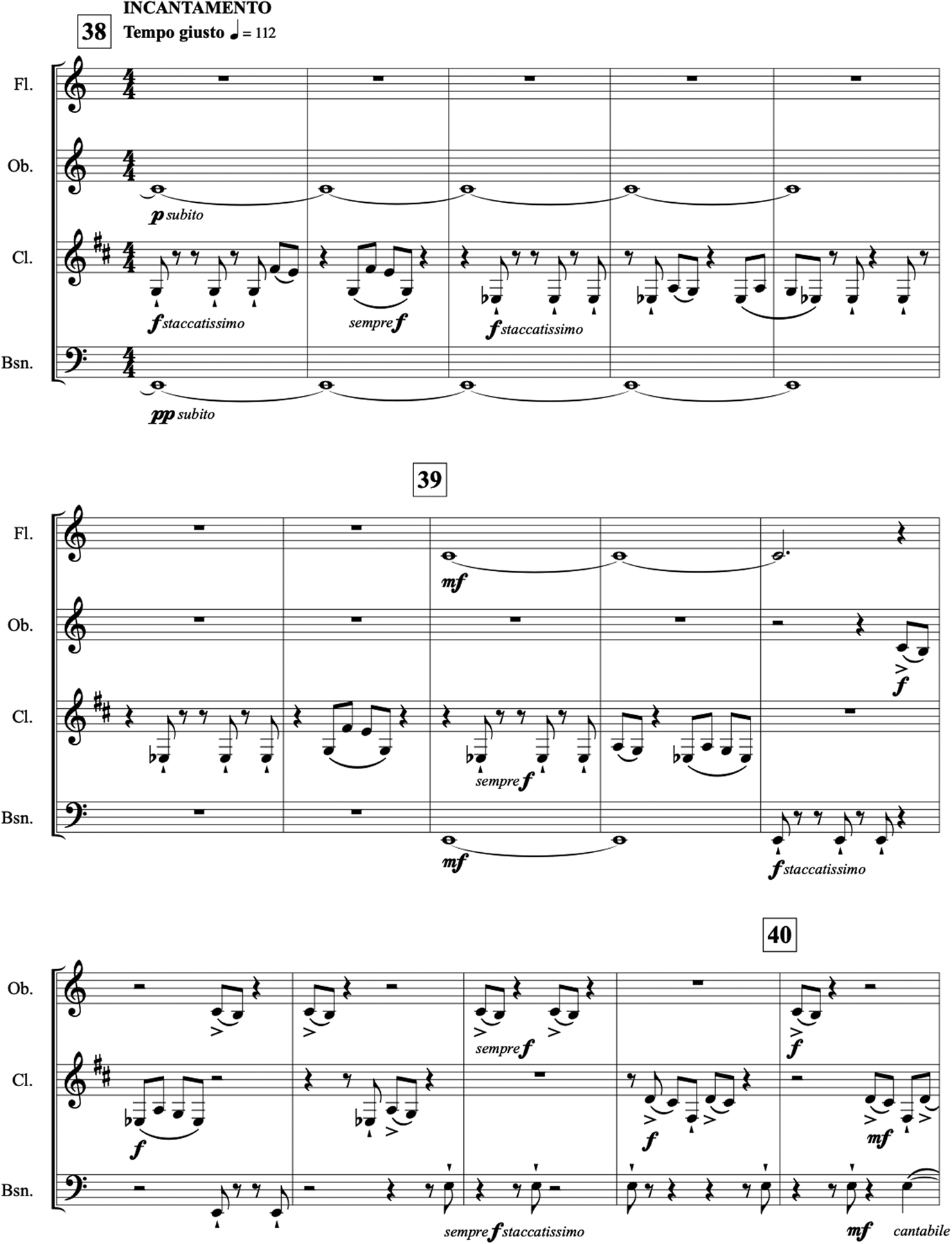
By the time he sent the score to Graham and Spivacke, Chávez had exhibited extraordinary displays of procrastination and temper, but he also submitted something he regarded as a ‘good piece of music’ fitting what he understood to be the requirements of the commission.Footnote 51 He sent Graham a double quartet (winds and strings) organized in a loose dance suite. There are many allusions to Stravinsky's compositional tastes, including an extensive opening oboe solo that recalls the bassoon of Rite of Spring, leading into a wind-dominated score combining modern tonal sensibilities, with allusions to eighteenth-century musical practice. In this way it extends Antígona's Neoclassicism. There are structural similarities to a dance suite: an opening prelude, a closing postlude, and both a zarabanda (saraband) and a fugue pointedly included in the middle. In addition, there is a clear texture, descending chromaticisms, and Baroque-like syncopations. Its differences from Antígona are ones in keeping with Stravinskian Neoclassicism as a movement: there is more emotional distance and refinement and less visible tragedy, although there is a climax of sorts, and one tied to the plot of Graham's scenario. Chávez calls it the ‘encantamiento’. Here he dramatizes Medea's spell with a quick shift of style (Example 2).
Although Chávez called Dark Meadow a double quartet (strings and winds), long passages feature the wind instruments exclusively, including this climactic moment at the beginning of the ‘encantamiento’. Notice the contrapuntal exchanges in modern musical language, such as that from Fig. 44 to Fig. 46. Chávez, Suite for Double Quartet, bb. 220–54. Transcription by Brian Rice.

Graham's complaints about the score, which emerged in letters to both Coolidge and Spivacke, centred on its lack of ‘theatricality’. That criticism was almost always paired with one about Chávez's ‘lack of awareness’ about dance, and Graham's specific valuation of a quartet as unsuitable because of its abstract qualities.Footnote 52 Judging by the other scores of the period with which Graham was more satisfied, one root of Graham's discomfort was the degree to which Chávez's score allowed for both climax and stasis. Despite her attraction towards quasi-tonal scores with neoclassical elements, Graham liked music with moments of drama to add intensity to her dance. Building on the modern dance styles inherited most immediately from Ted Shawn and more distantly from Isadora Duncan, Graham also inserted held tableaus into her dances. Despite its static emotional range, Chávez's La hija de Cólquide worked against both tendencies with its motoric rhythms, unfolding melodies, and single moment of plot-driven drama. In these ways the collaborators’ understandings of ‘neoclassical’ were misaligned.
Yet, as I have hinted earlier, the missed deadlines, opposing collaborative methods, and stylistic differences are not the only problems plaguing La hija de Cólquide. As noted previously, the ‘barbaric’, ‘theatrical’, and ‘rhythmic’ qualities that Graham asked Chávez to include are not readily apparent in this score, signalling Chávez's exhaustion with the process of Ur-Classical Othering. That weariness led Chávez to invest in a radically different idea from Graham about who Medea was and how she could be expressed. Chávez composes for his subjects a tragic bind – one that intensified in La hija de Cólquide. The scores to both works Antígona and La hija de Cólquide are relentlessly sad, and the stasis that might be seen in one context as characteristically Baroque might, in another, be seen as expressive of helpless depression.
Graham's post-Freudian interpretations of female-centred myths were entirely oppositional. Her heroines are roiled with emotion manifested through action, and if those actions are sometimes morally reprehensible, they are also comprehensible and in keeping with the terrible situations in which the heroines find themselves. As Victoria Thoms observes:
Throughout much of the approximately 150 works she danced in and created … Graham fashioned for herself the central protagonist's role whose characteristics included being strong willed, commanding, sexually potent, and actively desiring – as opposed to the static, sexually available object of desire.Footnote 53
It is precisely these elements that led critics and historians to consistently label Graham as a ‘feminist’ despite her repeated protestations.Footnote 54 In fairness to Chávez, Graham's general attitude towards mythic women is obvious only in retrospect; when working with Chávez, she had not yet characterized Jocasta, Clytemnestra, or even Medea. But it was the pivot of agency and action that made La hija de Cólquide undanceable as Graham had conceived of it, forcing her to create what she would term a ‘dance counterpoint’ to the work.Footnote 55
Graham's distress upon receipt of the score is evident in her archives held in the Library of Congress. There we find boxes of steno-pad notebooks full of scrawled quotes, thoughts, and preliminary choreography. From this evidence we can see that it was part of Graham's process to brainstorm ideas after receiving a new score. Most dances occupy a single steno pad (or less). The Dark Meadow file contains thirty-five pages of typed notes in addition to the handwritten ones in the steno pad. Those notes reveal a particularly scattered and vacillating process. The literary references range from Virgil and Ovid through Virginia Woolf and Carl Jung. The subject matter considered includes the myth of Persephone and Demeter, an imagined ancient ritual at the temple of Tenochtitlán, mention of Tristan and Orpheus, and an ‘invader-conqueror’.
By the end, Graham had settled on a cast of characters: She of the Ground, He Who Summons, They Who Dance Together, and One Who Seeks. More than any plot or scenario, it seems that it is these characters – and their relation to one another – that guide the choreography of the work, as Graham's initial programme note indicates: ‘The action of Dark Meadow is concerned with the adventure of seeking. This dance is the re-enactment of the Mysteries which attend that adventure: Remembrance of the ancestral footsteps, terror of loss, Ceaselessness of love, Recurring ecstasy of the flowering branch.’Footnote 56 Although the four characters echo those presented in the Medea script, for Graham the affiliation with that myth ended upon receipt of the score. In some reviews and notes there are references to Persephone but the connection to that myth is also indefinite; it would be more accurate to describe the final concept of Dark Meadow as an amalgam or abstract of several mythic ideas. By contrast, Chávez continued to think of his work as intimately linked to Medea, as conveyed by his attachment to the original title, La hija de Cólquide.
The four sections she alludes to in the programme do not correlate to the movements of Chávez's music, although it is clear from her notes that she intends particular gestures and ideas to match with certain sections of music. In keeping with her style, moments of dramatic tension and Grecian frieze are created on stage, but often without any overt signal in the score. The distance between this dance–music relationship and the one Graham had envisioned is most obvious by contrasting the choreography to this score with the choreography shaped in response to Samuel Barber's score. There, the tension around the moment of enchantment is strikingly obvious, even in the music, and it is followed by silence, giving the Medea figure time to depict her triumph, and the audience time to absorb it.
The Reception
The bruised egos and struggles for controlling authorship continued to affect the performance of Dark Meadow. Because it was submitted so late, Dark Meadow was not presented in the same 30 October 1944, Library of Congress performance that featured Appalachian Spring. Dark Meadow was first performed on 26 January 1946, in New York's Plymouth Theatre. In an exchange of letters during autumn 1945, Chávez indicated that the score should be closely followed:
I would not like ever my music to be played in any other ensemble of instruments except as it has been originally written, for a double quartet. … The score is indicated in detail in regard to expression marks and tempi. I beg you to ask your musical director to follow all the expression marks very carefully and thoroughly.Footnote 57
Such instructions were entirely in keeping with post-Stravinsky Neoclassicism, but they also seem to reflect the dynamic between Graham and Chávez, emphasizing his right to control the work while also hoping that she would perform it frequently and with much acclaim. Nonetheless, Graham did adapt the work to her style, as one would expect of any choreographer. The ‘dance counterpoint’ approach freed her from reflecting Chávez's rhythm and tempi in her choreography. In addition, perhaps for reasons of style or timing, she cut most of the Postlude from the performance score.
Interviews with the participants years later continued to reflect some of this tension. In 1954, John Paddock noted that Chávez ‘appears somewhat distressed by its strange fate, but at the same time determined to be utterly tolerant of Graham's feelings about the music’.Footnote 58 In 1982, Graham told David Sears that ‘a string quartet is almost the purest kind of thing that you can shape and form. It isn't to be danced. It's complete in itself. It's its own … Well, I did it. But I took great violations.’Footnote 59
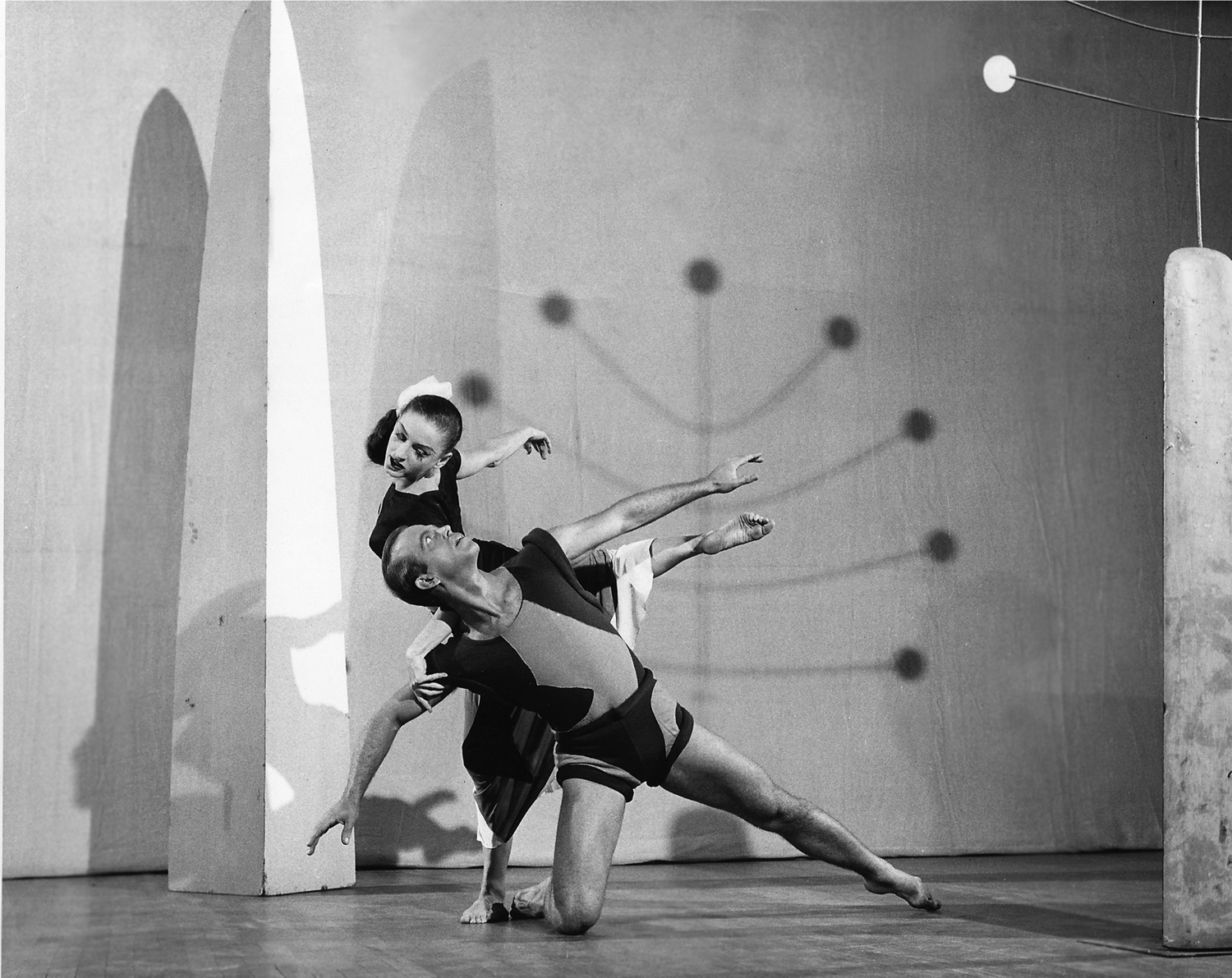
Although set designer Isamu Noguchi was not involved in the Graham–Chávez relationship, and thus is not central to the story I tell here, his imagining of the music certainly influenced early critics and audiences. The most prominent feature of his concept was four phallic ‘primordial shapes’ that for Noguchi represented the ‘continuity of time’ (Figure 1). Although Noguchi, like Graham, had spent time in Mexico during the 1930s,Footnote 60 no direct reference was made to Mexico in any of the elements of the dance, including the set, but Noguchi also saw his creation as Mexican in some integral way: ‘It's very beautiful music and is my interpretation of a meadow with certain overtones of Mexico in it.’Footnote 61
Isamu Noguchi's abstract set for Dark Meadow included phallic ‘primordial shapes’ that represented the ‘continuity of time’. Helen McGehee and David Wood in Dark Meadow, choreography by Martha Graham. Courtesy of Martha Graham Resources.

The tensions between the artists even affected the reception of the work. Martin, an ardent admirer of Graham's work, had one of the most positive and detailed reactions to the dance:
There is very little chance that [Dark Meadow] will ever be the most popular, however. Nevertheless, it is a miracle of sheer creativeness … Its music by Carlos Chávez, to be sure, is a heavy burden to carry, for it is lacking in all impulse towards movement and any hint of theatre quality. And this makes Miss Graham's achievement even more notable.Footnote 62
Martin's reading of Chávez's contribution to the collaboration is strikingly similar to that expressed by Graham in her letter to Spivacke, suggesting that Graham had spoken to Martin in advance of the review. His willingness to dismiss Chávez's contribution might also have been coloured by his coverage of the H.P. premiere over a decade earlier, in which he expressed ebullience about the concept and disappointment about the result. If Graham had not followed the public interaction between Chávez and Littlefield, Martin had certainly done so and would have wanted to protect one of his favourite choreographers from a similar fate.Footnote 63 And yet Graham continued to programme Dark Meadow, and Martin continued to review it. Months and even years later, he was still lauding both the dance and its choreographer. His opinions about the score vacillated, but as time passed, he began to regard it as ‘an integral part of the whole, and, indeed, an effective part’.Footnote 64
Martin's initial review was prescient; Graham's Dark Meadow remains a respected work in her company's repertoire, but it never became the most popular or well known of her dances. Similarly, Chávez's score is spare and melodic with an unflinching approach towards harmonic and rhythmic tension. In recent decades, recordings by the Cuarteto Latinoamericano and the Southwest Chamber Ensemble have included versions of La hija de Cólquide,Footnote 65 but compared with his best-known works, Sinfonía India, Xochipilli, Sinfonía Antígona, Chapultepec, and H.P., La hija de Cólquide is a mystery. It has been heard infrequently and analysed even less.
Despite the animus apparent in the exchanges circulating during the collaborative experience, the relationship between the two artists mellowed during the ensuing decades. The promised royalties from Graham's continued performances of Dark Meadow never materialized. Inquiries from Chávez's office resulted in a lengthy apologetic letter, explaining the financial straits of Graham's company; in response, Chávez, like many of the other composers, forgave the debts and allowed the company to use the work for free. As noted previously, when asked directly, Graham remained irritated with the score, but in her autobiography, Blood Memory, she was discreet about her collaborations with composers, including Chávez, avoiding the sort of aspersions found in some of her interviews.
Gender in Dark Meadow
Already we have observed the ways in which Graham's and Chávez's expectations may have been shaped by racialized Othering in US culture as manifested in the local and national press. We can sense the influence on Graham by observing her language in correspondence, the quoted reviews of her dance performances and Chávez's compositions, and the wilful ignorance Graham displayed during her research visit to Mexico. Naturally these experiences shaped the creators’ aesthetics and working styles, complicating their ability to work together. To someone familiar with literature on Latin American music during this period, a colonialist reading might seem both obvious and accessible; following Leonora Saavedra's groundbreaking work, such reasoning has become commonplace in the literature, especially that about Chávez, who was so anxiously engaged in navigating his critical reception in the United States.
Gender analysis has been left out of most career analyses of straight male composers in the United States, including Chávez, but it has followed Graham through the scholarly literature. Just as we can observe a racialized Otherizing process emerging from Graham's language about Chávez, we can notice a gendered Otherizing in Chávez's responses to Graham and gendered expectations at work on both sides of the collaboration. Like the racial suppositions chronicled previously, the gendered ones exist as part of a larger cultural dynamic, which serves to both bolster and hide them.
Reviews of Chávez's music, like those of other male modernists, were unabashedly masculine, frequently invoking words such as ‘vitality’, ‘energetic’, and ‘hard charm’.Footnote 66 Admiring critics were at pains to establish that the composer's Mexican-ness was of a gendered sort. Rosenfeld opened his profile for Modern Music with the following line: ‘Chávez's music is a dance of the male on the American soil … It runs, robust and decisive.’Footnote 67 Those who disliked his music often implied that the masculine/modern elements ungraciously overwhelmed his Mexican-ness, which was culturally assumed to be feminine in nature. Marc Blitzstein's withering review of H.P. is a classic example: ‘Since Chávez's music is hard, not soft, literal, brutal, and unperfumed, we were offered the paradox of a “Southern” composer dealing most successfully with the “Northern” aspects of his theme.’Footnote 68 Similarly, comments from colleagues about Chávez's personality at times dealt with the contradiction between his heterosexual proclivities and his sociability – his ‘hard charm’.Footnote 69
Hidden far beneath this voiced balancing was the unvoiced assumption that Mexico offered a sort of sexual freedom unavailable in the United States, and association with Chávez offered an invitation to explore both the country and the relaxed code it represented. So many of Chávez's closest friendships in the United States arose out of the expectation of illicit romantic escape. Paul Strand travelled to Mexico at Chávez's behest to escape a failing marriage; Copland spent summers sprawled on the beach with Victor Kraft; Colin McPhee ran from the intertwining pressures of depression and sexual confusion.Footnote 70 Even Martha Graham may have had such an idea in mind when she applied for a Guggenheim to collect dances in Mexico in 1932; at that time Louis Horst was her lover and travelling companion, a situation that required some delicacy at home, where Horst was known to be married to someone else.Footnote 71
For all these reasons, Chávez operated with ease between and among factions of the New York Modernist community often thought to be divided by gender identity. In a recent exploration of queerness in modernist US circles, Nadine Hubbs concludes, ‘the ideology of the time linked tonality – particularly of the neoclassical and (beginning in the late thirties) Coplandian strains – with homosexuality, and defined it by contrast to nontonality or atonality – especially of dissonant and serial leanings – and masculine heterosexuality’.Footnote 72 Chávez's tonal music and heterosexual orientation forms one of the obvious exceptions to this general dividing line. He was performed, admired, and included by the ‘hard’ ultra-modernists and the ‘charming’ post-tonalists alike with each faction looking towards his music as a blend of traits from both camps. Such unusual and repeated migrations were enabled by both his personal characteristics and his Mexican identity.
Recent scholarship has demonstrated that the same type of gendered language and social expectation that shaped Chávez's career were also influential in Graham's but differed in effect because of differences in field, gender, and ethnicity. Both Mark Franko and Victoria Thoms have demonstrated Graham's ambivalent and paradoxical relationship with feminism.Footnote 73 In his most recent book on Graham, Franko evades the term ‘feminism’, instead quoting from Ramsay Burt, ‘Graham enjoyed unprecedented autonomy as a cultural producer and was thus able to articulate a feminine point of view that was inconceivable at that time in most other fields’.Footnote 74 Franko proceeds to demonstrate the contradictory image Graham fostered in the public starting in the 1940s. Through her advertising gigs, press releases, and the related visual imagery, she portrayed a glamorous, beautiful star in the Hollywood mould, but undergirding that surface was an intense, moody intellectual.Footnote 75 This strategic double-ness echoes Chávez's own positioning around his mexicanidad.Footnote 76
Like so many women, Graham may have acknowledged certain barriers around her gender and taken advantage of the ambiguities they afforded her without embracing the term ‘feminist’. As Thoms writes, ‘There is then no so-called “smoking gun” where Graham's feminism is concerned … One cannot simply say that Graham's work was not feminist because she did not see herself as feminist.’Footnote 77 In some senses, her feelings may have reflected the realities of dance where, unlike painting, literature, or music, women dominated the Modernist scene – at least the public, staged scene.Footnote 78
One could argue that such a gender role reversal was merely superficial, for the lead dancers’ activity was governed by the male gaze even (or especially) when the performer was female. Certainly in Graham's case, the shared power between her and the most significant men in her life, Louis Horst and Erick Hawkins, was complex. Graham's talent and market appeal was central to each relationship; nonetheless, in many ways Graham acquiesced to traditional roles. To the much older Horst, Graham played student to his teacher, allowing him to shape her influences and creative process to an extraordinary degree.Footnote 79 With Hawkins, who was more of a generational and artistic peer (although Graham was the more commercially successful artist), Graham ceded complete control of her finances and managerial power.Footnote 80 It was Hawkins who sent the initial correspondence to Coolidge about the commissions. Later, it was Hawkins who wrote to beg forgiveness for the company's inability to pay Chávez's royalties.Footnote 81 Both exchanges characterize his offstage work on Graham's behalf.
In addition, Graham had to respond to expectations about her gender and its performance, for the history of dance, much like that of opera, specialized in female stereotype, from the youthful innocence and ease of Cinderella to the seductions and depravity of Salomé's veils. Graham had witnessed the distance between ‘performed’ and ‘experienced’ gender first hand during her tenure in the Denishawn dance troop; Ruth St Denis and Ted Shawn made great display of their stable heterosexual marriage for the press while that image was belied by their public dances and their private affairs.Footnote 82 Both St Denis and Shawn made a point of teaching their protégés the arts of promotion and performance alongside those of dance technique. Such lessons were influential; Graham remained acutely aware of the public zeitgeist.
One point she did not cede was her rejection of the traditional trappings of mature sexuality of her day – marriage and children – partly because she wished to stay engaged in her career and partly because such a formulation conflicted with the philosophies on open relationships that she inherited from Horst. In 1948 she married Erick Hawkins at his request after a long-term affair. The marriage proved disastrous, something Graham later attributed to Hawkins's insistence on commitment; other factors may have included Hawkins's exploration of a gay/queer sexuality and identity during the time, and Graham's struggles with alcohol abuse.Footnote 83
What we would now recognize as feminist re-interpretations of Greek mythology stem from Graham's association with Joseph Campbell and were then strengthened when her troubled relationship with Hawkins led her to talk therapy.Footnote 84 Graham's personal exploration of mythic psychoanalysis coincided with a broad cultural embrace of post-Freudian ideas.Footnote 85 Although it is impossible to describe the brainstorming list for Dark Meadow as organized, knowledge of Graham's personal troubles, her methods for dealing with them, and the turning point they provoked in her professional career does seem to explain the variety of sources listed. Each source, no matter how distant from the one named before or after, speaks to one of the varying threads at work in her mind: myth, Freud/Jung, gender, Mexico.
As this was her first work to traffic in this new area, it makes sense that the work required to process and combine such disparate material was enormous. It also makes sense that, although we have no reason to question the unhappy surprise that Graham expressed upon receipt of Chávez's score, her ultimate rejection of the Medea scenario for this score was rooted in several motives, only some of them overtly expressed and understood. In its ultimate realization, Dark Meadow is full of sexual tension and innuendo, as the original scenario implies it would be. Set designer Isamu Noguchi's ‘primordial shapes’ are usually interpreted as phallic. Similarly, the ‘searching’ and ‘summoning’ mentioned in Graham's scenario are generally thought to allude to the negotiation of romantic intrigue. But Dark Meadow is not an overt work, and in that respect it does not express the channelling of female power to as great a degree as some of Graham's later mythic works.
Critics viewed Dark Meadow as opaque, even if they did not understand why. Writing for the Dance News, Anatole Chujoy noted that Dark Meadow was ‘more obscure than most of [Graham's] compositions’.Footnote 86 Miles Kastendieck in the Brooklyn Eagle proclaimed it Graham's ‘most baffling abstraction’.Footnote 87 Even positive reviewers noted that Dark Meadow was ‘explorative’ or ‘genuine abstract theatre’.Footnote 88 By 1949, Margaret Lloyd had identified the dance as about, ‘the recurring mystery of sex’, and signalled that the work was influenced by Graham's reading of Carl Jung, but she did not explore the locus of sexual agency and anger on stage.Footnote 89
If the Dark Meadow scenario and choreography are vague as to the amount of female sexuality and strength represented on stage, the Barber collaboration, Cave of the Heart, is not. As the ever vigilant Martin noted, ‘[Cave of the Heart] is a fairly direct narrative, simple and transparent in form, with little of the subjective comment that we have become accustomed to in her works’.Footnote 90 In Barber's ‘Dance of Vengence’, the Medea figure literally writhes with emotion as she concocts her plan, concluding her dance with a heavy-handed self-imprisonment in Noguchi's metallic tree. Barber's music and that point in Graham's process colluded to produce a visible meditation on the meaning and purpose of female power within personal relationships.
The theme of female power as embodied in mythic figures such as Antigone and Medea is commonplace today. In July 2020, Madeline Miller's Circe had been at the top of the New York Times bestseller list for eleven weeks.Footnote 91 Just a few months earlier an updated staging of Euripides's Medea played at the Brooklyn Academy of Music from 12 January to 8 March.Footnote 92 Such popular renditions follow upon decades of analysis about the gendered motivations behind Greek heroines. In contemporary intellectual life the search for female empowerment through Greek mythology is so commonplace, Judith Butler advises readers not to over-valorize female power at the expense of the recognition of systemic limitation.Footnote 93
This was not the case during the 1940s. Jean Cocteau's re-imagination of Sophocles's Antigone, the text that first drew Chávez towards the neoclassical aesthetic, is the perfect example of the type of reading most common during the period. Cocteau's Antigone emphasizes the circumstances and temperaments that most easily override the fear of tragic consequences, thus enabling brave (perhaps imprudent) political action. It is innovative in its ideas about how single actors can influence democracy, but it does not contemplate Antigone's gender as a factor in her behaviour.Footnote 94
Similarly, the theme of female strength as exhibited in Graham's dances was invisible to her critics. It is absent from early analyses of Cave of the Heart and the reception of Dark Meadow. Critics might note a work's Freudian elements or refer to one work or the other as psychological in nature. To my knowledge, however, not one observed that the rage, frustration, and triumph expressed in both dances were gendered. That is, what remains of the Medea tale in both dances is the expression of sexuality from a female point of view, and Graham is frank about her sexual explicitness in her autobiography, Blood Memory.Footnote 95 If modern dance was one of the few realms where women stood as standard-bearers for the avant-garde, it was also true that certain cultural barriers and taboos remained; as female Modernists, women were not permitted to author their own sexual experience.Footnote 96 Given the silence around female empowerment in Graham's mythic works after their performances, it is hardly surprising that Chávez failed to see this direction during the planning stages of Dark Meadow.
Butler's writings explain how this happens, indicating the ways in which women are commonly erased from their own performances. In Bodies that Matter, she contemplates the invisible hegemonic force of heteronormativity on the performance of gender, extending earlier work about Antigone using Foucault's discourse on power. Butler provides a framework for examining the absent descriptions of Graham's sexuality in the press as more than just polite evasions. In particular, she reminds us that ‘the construction of gender operates through exclusionary means, such that the human is not only produced over and against the unhuman, but through a set of foreclosures, radical erasures, that are, strictly speaking, refused the possibility of cultural articulation’.Footnote 97
As Butler sees it, the definition of heteronormativity is created in opposition to, and thus constituent upon, the bodies it seeks to regulate. Using Butler's reasoning then, both Chávez and the critics may have been playing their appointed role in the heteronormative system when they suppressed Graham's expression of sexuality. But why? After all, Medea's sexual proclivities matched cultural expectations of her gender. There are at least two apparent rationales to be derived from Butler: 1) Medea's performance denied the necessary ‘reiteration of hegemonic norms’ in its depiction of female power and rage; and 2) in reaching back towards a foundational myth to express this power and rage, Graham disrupted what Butler would call the heteronormative discourse's ‘infinite deferral of authority to an irrecoverable past’, substituting another, radical myth for the familiar narrative of female containment.Footnote 98 Thus, to understand Medea as a distant neoclassical ideal, like Chávez, or to understand Graham's dance as a display of technical brilliance on the usual Freudian themes, such as Martin, or to search in vain for communist political engagement, such as Ocko, is to evade the questions raised by Graham's performances.
Conclusions
Study of the Graham–Chávez collaboration does not quiet discomfort with the neoclassical category; it remains difficult to describe, define, and apply. It does, however, point to some of the barriers and intricacies in examining neoclassical works. At the outermost level is the real possibility that the claim to Neoclassicism is a red herring because the indebtedness to the past is so endemic to the larger modernist ethos. This is an especially potent line of reasoning when we consider the ways in which the ancient past and the early Enlightenment were collapsed together in many manifestations of the neoclassical aesthetic. Because in such contexts the ‘ancient’ and the ‘enlightened’ relied on each other for signification, it becomes nearly impossible to tease them apart, as separate referential trends sometimes combine in a single work.
Given that the neoclassical label continues to be used, however, other levels of inquiry are warranted, and the Dark Meadow case study proves useful here as well. We learn, for example, that despite claims to universalism in certain contexts, it is culturally specific, and its meaning and force change depending on time and place. Therefore, while the formal emotional reserve of Stravinsky's Symphony of Psalms can be found in Chávez's La hija de Cólquide, the work did hold specific personal meaning because of its association with Antígona. In Graham's case, the neoclassical ideal was filled with the ancient/eighteenth-century references and was technically exacting, but also roiling with unacknowledged emotion and power.
The emotion and power of Graham's dances was gendered, bringing us to the final point about the neoclassical category: its claim to universalism and emotional distance was a flimsy mask to disguise the guiding force of the relevant identity constructs. Here the source materials demonstrate that both the racial and the gender identities of the collaborators shaped the creation, reception, and meaning(s) of Dark Meadow. Especially hidden from view are the gendered press readings that invariably guided the creators’ performances for each other and for the public. Seeing the gendered nature of the Graham–Chávez interaction and observing the ways in which it colludes and collides with the technical readings common to its own moment, and the cultural readings more frequent in our own, allows us to acknowledge the multifaceted nature of the creative experience here and elsewhere.
Classifying Dark Meadow as a collaboration is a trickier matter, for if the goal of collaboration is to fully understand and interpret one's partner, this was not a true collaboration. Yet the cultural barriers established here are such that to define success in that way is to foreclose it entirely. Instead, it was a collection of individual triumphs. For Graham, it is the beginning of a female-centred mythic style that would serve her for the next ten or fifteen years. For Chávez, La hija de Cólquide represents the culmination of his neoclassical style. The story of its creation and performance can be an avenue to deeper exploration of the ways in which identity simultaneously enables and prevents communication, both between collaborators and among critics and audiences.