Implications
Diet is one of the most important factors influencing fat content and fatty acid composition in beef. Pasture-fed beef offers lean meat with a more desirable fatty acid composition for human consumption (n-3, conjugated linoleic acids (CLAs)). However, extensive feeding can be quite compromising in double-muscled animals due to their inherent low fat content. In order to deposit some carcass and intramuscular fat, these animals are typically finished on concentrate for few months before slaughter. However, results indicate that finishing has a major impact on the quality and the content of trans-18:1 and CLA isomer composition, which was negatively affected mainly with a longer period (2 months) of concentrate finishing.
Introduction
Beef fat content and composition depend primarily on breed and feeding (Rule et al., Reference Rule, Smith and Romans1995; Aldai et al., Reference Aldai, Murray, Oliván, Martínez, Troy, Osoro and Nájera2006). For instance, in the ‘Asturiana de los Valles’ breed from northern Spain, the frequency of animals exhibiting doubled muscling has increased over the last decade to the point now where most of the animals of this breed are genetically homozygous (mh/mh) or heterozygous (mh/+) for the gene responsible for muscular hypertrophy (Grobet et al., Reference Grobet, Poncelet, Royo, Brouwers, Pirottin, Michaux, Ménissier, Zanotti, Dunner and Georges1998; Pérez, Reference Pérez2005). Consequently, the beef obtained is very lean and the fatty acids profile can be affected (Aldai et al., Reference Aldai, Nájera, Dugan, Celaya and Osoro2007a and Reference Aldai, Nájera, Martínez, Celaya and Osoro2007b). A high fat content in muscle is associated with increased neutral lipids (triacylglycerides), whereas phospholipid levels remained relatively constant (Rule et al., Reference Rule, Smith and Romans1995).
Grain-based diets contain relatively high levels of linoleic acid, which can lead to unfavourable n-6/n-3 ratios (Aldai et al., Reference Aldai, Dugan, Kramer, Mir and McAllister2008b) and trans-18:1 profiles (Aldai et al., Reference Aldai, Dugan, Kramer, Mir and McAllister2008b; Kraft et al., Reference Kraft, Kramer, Schoene, Chambers and Jahreis2008) in beef. The 10trans (t)-18:1 accumulates in intensively or concentrate-finished beef (Purchas et al., Reference Purchas, Knight and Busboom2005; Leheska et al., Reference Leheska, Thompson, Howe, Hentges, Boyce, Brooks, Shriver, Hoover and Miller2008) and this has been associated with increased atherogenicity in animal models (Bauchart et al., Reference Bauchart, Roy, Lorenz, Chardigny, Ferlay, Gruffat, Sébédio, Chilliard and Durand2007; Roy et al., Reference Roy, Chardigny, Bauchart, Ferlay, Lorenz, Durand, Gruffat, Faulconnier, Sébédio and Chilliard2007). Forages are good sources of linolenic acid that leads to an enhanced n-3 polyunsaturated fatty acid (PUFA) content in beef products with a more desirable fatty acid composition for human health (Gleissman et al., Reference Gleissman, Yang, Martinod, Lindskog, Serhan, Johnsen and Kogner2010). Moreover, rumenic acid (RA, 9cis (c), 11t-18:2) and its precursor vaccenic acid (VA, 11t-18:1) have been found to accumulate in forage-finished ruminants (Dugan et al., Reference Dugan, Kramer, Robertson, Meadus, Aldai and Rolland2007; Kraft et al., Reference Kraft, Kramer, Schoene, Chambers and Jahreis2008; Alfaia et al., Reference Alfaia, Alves, Martins, Costa, Fontes, Lemos, Bessa and Prates2009) and their consumption has been linked to a number of potential health benefits (Bauchart et al., Reference Bauchart, Roy, Lorenz, Chardigny, Ferlay, Gruffat, Sébédio, Chilliard and Durand2007; Field et al., Reference Field, Blewett, Proctor and Vine2009; Bassett et al., Reference Bassett, Edel, Patenaude, McCullough, Blackwood, Chouinard, Paquin, Lamarche and Pierce2010).
Designing diets and production systems for lean breeds (i.e. double-muscle animals) poses a challenge in terms of their fat content and composition. Extensive production systems (i.e. forage feeding) can be positive for beef fatty acid composition, but a low fat level can lead to a negative classification of carcasses based on the European carcass classification system (Commission Regulation, 1981; Council Regulation, 1981). Therefore, it is necessary for cattle with high lean growth potential (see review by Arthur, Reference Arthur1995) to be fattened on high-energy concentrate diets in order to deposit sufficient carcass and marbling fat (Nuernberg et al., Reference Nuernberg, Dannenberger, Nuernberg, Ender, Voigt, Scollan, Wood, Nute and Richardson2005; Martínez et al., Reference Martínez, Aldai, Celaya and Osoro2010). Thus, the objective of the present study was to evaluate the length of intensive concentrate finishing (0, 1 or 2 months) that should be combined with forage feeding to produce a carcass with sufficient fat to pass the European classification rating and still retain a fatty acid profile with a positive health image.
Material and methods
Animals and management
Twenty-four spring-born suckling male calves from ‘Asturiana de los Valles’ Spanish beef breed, heterozygous for the gene responsible for muscular hypertrophy (mh/+; Grobet et al., Reference Grobet, Poncelet, Royo, Brouwers, Pirottin, Michaux, Ménissier, Zanotti, Dunner and Georges1998), were reared with their mothers under grazing conditions until weaning in November. The average live weight of calves at weaning was 254 ± 9.5 kg and they were reared extensively until they reached 472 ± 13 kg. Pastures were mainly composed of ryegrass (Lolium perenne) and clover (Trifolium repens), and during winter when grass availability was low, animals were confined and fed hay. From mid-May, some bulls continued under extensive management (pasture grazing without concentrate; control, n = 7), whereas the remaining bulls were finished on a barley-based concentrate for either one (1 mo; n = 10) or 2 months (2 mo; n = 7) in the housing facilities of the SERIDA Research Institute (Asturias, northern Spain). The transition from grass to concentrate was performed over a 4 to 5-week period after which concentrate (84% barley meal, 10% soya meal, 3% vegetable oil and 3% supplement composed of a mineral/vitamin/oligoelement premix) and barley straw were fed ad libitum. The 4 to 5-week transition period from grass to concentrate was introduced to extend the production system per se as the main objective was to maximize the utilization of natural resources. During this transition period, animals were provided with 1.5 to 2 kg of concentrate per head per day. The proximate chemical and fatty acid composition of the concentrate was previously reported by Aldai et al. (Reference Aldai, Nájera, Martínez, Celaya and Osoro2007b), and grass composition was indicative of its good quality (22.9% protein, 27.2% ADF, 38.3% NDF and 2.47 Mcal/kg of metabolizable energy on dry matter basis).
Yearling bulls were slaughtered commercially at an average live weight of 516 ± 9.8 kg.
Sample collection
Grass and concentrate were sampled every 2 months and 3 weeks, respectively. Samples were freeze-dried and ground through a 1 mm screen. Fatty acid methyl esters (FAMEs) were prepared according to Sukhija and Palmquist (Reference Sukhija and Palmquist1988) and analysed according to Dugan et al. (Reference Dugan, Kramer, Robertson, Meadus, Aldai and Rolland2007).
After slaughter, carcasses were chilled for 24 h at 3°C and left rib joints from the sixth to the ninth ribs were removed and transported to the laboratory. A longissimus thoracis steak was dissected from the eighth rib, vacuum packed and frozen at −80°C for subsequent fatty acid analyses.
Fatty acid composition of muscle
Lipids were extracted from 1 g of freeze-dried muscle using a mixture of chloroform–methanol (1:1, v/v) (Kramer et al., Reference Kramer, Sehat, Dugan, Mossoba, Yurawecz, Roach, Eulitz, Aalhus, Schaefer and Ku1998). Lipid aliquots (10 mg) from each muscle sample were methylated separately using acidic (methanolic HCl) and basic (sodium methoxide) reagents (Kramer et al., Reference Kramer, Hernandez, Cruz-Hernandez, Kraft and Dugan2008). Internal standard (1 ml of 1 mg 23:0 methyl ester per mL toluene) was added before the addition of the methylating reagent. The FAMEs were analysed using GLC and Ag+-HPLC equipment and methods outlined by Cruz-Hernandez et al. (Reference Cruz-Hernandez, Deng, Zhou, Hill, Yurawecz, Delmonte, Mossoba, Dugan and Kramer2004). Trans-18:1 isomers were analysed using two complementary GLC temperature programmes (Kramer et al., Reference Kramer, Hernandez, Cruz-Hernandez, Kraft and Dugan2008). In representative samples, silver-ion solid phase extraction (Ag+-SPE) cartridges were used to separate fractions of saturated FAMEs, mono-trans FAMEs plus the t/t isomers of conjugated linoleic acid (CLA), mono-cis FAMEs plus the c/t isomers of CLA, dienoic FAMEs, trienoic FAMEs and tetraenoic FAMEs to confirm peak identification (Kramer et al., Reference Kramer, Hernandez, Cruz-Hernandez, Kraft and Dugan2008). Reference standards 463, 603 and U-59 from Nu-Chek Prep Inc. (Elysian, MN, USA) were used. Phytanic acid was obtained from Matreya Inc. (Pleasant Gap, PA, USA). The UC-59 standard contained all possible geometric and positional isomers of 8,10-CLA, 9,11-CLA, 10,12-CLA and 11,13-CLA. Branched-chain fatty acids (BCFA) were identified using GLC reference standard BC-Mix1, purchased from Applied Science (State College, PA, USA). The trans-18:1, CLA and other diene isomers not included in standard mixtures were identified by their retention times and elution orders as reported elsewhere (Cruz-Hernandez et al., Reference Cruz-Hernandez, Deng, Zhou, Hill, Yurawecz, Delmonte, Mossoba, Dugan and Kramer2004 and Reference Cruz-Hernandez, Kramer, Kraft, Santercole, Or-Rashid, Deng, Dugan, Delmonte and Yurawecz2006; Kramer et al., Reference Kramer, Hernandez, Cruz-Hernandez, Kraft and Dugan2008; Rego et al., Reference Rego, Alves, Antunes, Rosa, Alfaia, Prates, Cabrita, Fonseca and Bessa2009). The FAMEs were quantified using chromatographic peak area and internal standard (23:0 ME)-based calculations. The contents of FAME were expressed on an mg per 100 g of fresh meat and on the % of total FAME basis.
Statistical analysis
Individual, groups and ratios of FAME from longissimus thoracis muscle were analysed as a one-way ANOVA using the PROC MIXED procedure of SAS (SAS Institute, 2001) with concentrate finishing (0, 1 or 2 months) as the main effect. The LSMEANS and PDIFF options were used to generate least square means and to compare treatments (F-test protected least significant difference). Significance was declared at P < 0.05.
Results
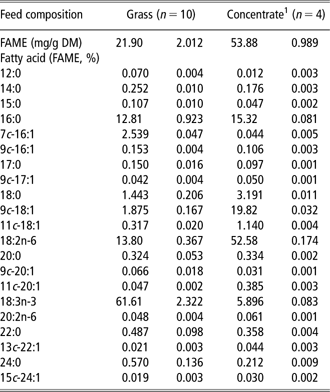
The lipid content (measured as total FAME) of the two feedstuffs utilized in the present study were 21.9 and 53.9 mg/g of dry matter for grass and concentrate, respectively (Table 1). In both, major fatty acids representing >90% of the total FAME included palmitic (16:0), stearic (18:0), oleic (9c-18:1), linoleic (18:2n-6) and linolenic (18:3n-3) acids. The percentage of 16:0 was similar in grass and concentrate. Grass samples were lower in 18:0, 9c-18:1 and 18:2n-6, but clearly higher in 18:3n-3.
Total FAME and fatty acid composition (mean and standard error of the mean) of grass and concentrate samples
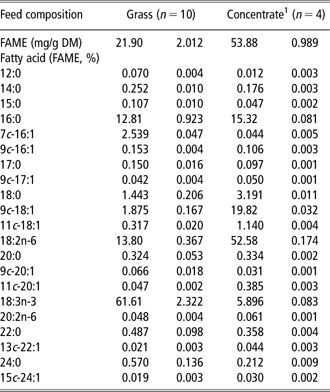
FAME = fatty acid methyl ester; DM = dry matter.
FAME > 0.02% was reported.
1The barley-based concentrate consisted of 84% barley meal, 10% soya meal, 3% fat and 3% supplement composed of a mineral/vitamin/oligoelement premix.
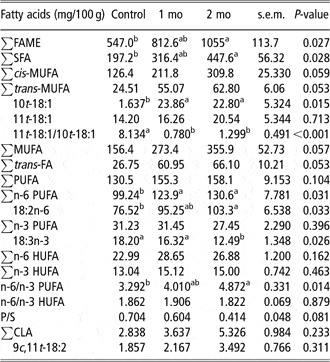
Longissimus muscle from bulls fed grass only had lower total FAME contents than from bulls finished on concentrate for 2 months (0.5% and 1.0%, respectively; P < 0.05), whereas bulls finished on concentrate for 1 month had intermediate FAME levels (0.8%; Table 2).
Total FAME content (mg/100 g meat) and summary of fatty acids of nutritional interest (mg/100 g meat) and ratios of essential fatty acids from longissimus thoracis of bulls fed concentrate-finishing diets for 0 (control), 1 or 2 months (mo) after pasture grazing

FAME = fatty acid methyl ester; SFA = saturated fatty acid; MUFA = monounsaturated fatty acid; PUFA = polyunsaturated fatty acid; HUFA = highly unsaturated fatty acid; P/S = polysaturated/saturated; CLA = conjugated linoleic acid.
Within a row, means without a common superscript differ (P < 0.05).
Saturated and BCFA, and plasmalogenic lipids
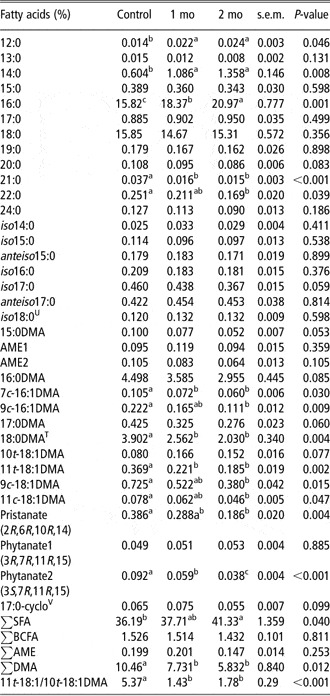
Muscle from bulls finished on concentrate for 2 months had the highest total saturated fatty acid (SFA) content (448 mg/100 g of meat; P < 0.05; see summary Table 2). Bulls finished for 1 month on concentrate had an intermediate level (316 mg/100 g of meat), whereas bulls finished on grass had the lowest content (197 mg/100 g of meat). On a percentage basis, the trend was similar (P < 0.05) with 41% SFA after 2 months, 38% after 1 month and 36% when pasture fed (Table 3). With regard to individual SFAs, percentages of 12:0, 14:0 and 16:0 were higher (P < 0.05) in meat from concentrate-finished bulls, whereas longer chain SFAs (21:0, 22:0) were higher (P < 0.05) in grass-finished bulls. Finishing strategy did not influence the percentage of BCFA (individual or total; P > 0.05).
SFA and DMA composition (percentages) of longissimus thoracis from bulls fed concentrate-finishing diets for 0 (control), 1 or 2 months (mo) after pasture grazing

SFA = saturated fatty acid; BCFA = branched-chain fatty acid; AME = alk-1-enyl methyl ethers; DMA = dimethyl acetal.
Within a row, means without a common superscript differ (P < 0.05).
TCoelution with 13c-16:1.
UCoelution with 9t-18:1DMA.
VCyclohexylundecanoic acid.
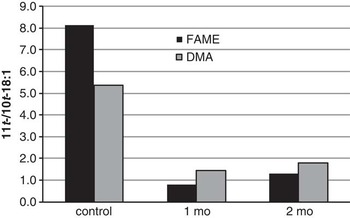
Finishing affected the percentages of plasmalogenic lipids, identified as their dimethylacetals (DMA) after methylation, and their fragmentation products produced during GLC analysis (alk-1-enyl methyl ethers, AME). Plasmalogenic lipids were greater in grass-finished beef (10.5%; P < 0.05) and lowest in beef finished on concentrate for 2 months (5.8%), whereas the meat from animals finished on concentrate for 1 month had intermediate values (7.7%). The two major trans-18:1 DMA moieties in meat lipids were 10t-18:1 and 11t-18:1DMA, with 10t-18:1 increasing significantly in its relative percentage with increased length of feeding concentrate, whereas 11t-18:1 decreased significantly. The 11t-18:1/10t-18:1DMA ratio significantly decreased from approximately 5.4 to 1.5 with the feeding of concentrate (Table 3).
Significantly higher percentages of pristanic acid (2,6,10,14-tetramethylpentadecanoic acid) were found in meat from grass-fed bulls compared with concentrate-fed bulls and the same trend (P < 0.001) was observed for the phytanic acid isomer (3S,7R,11R,15-tetramethylhexadecanoic acid), whereas no differences were detected for the 3R,7R,11R,15 isomer (Table 3).
Cis-monounsaturated fatty acids
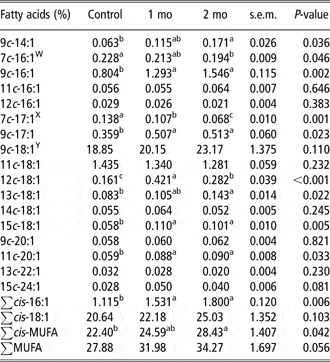
Total cis-monounsaturated fatty acids (MUFA) tended to be higher in meat from concentrate-finished than in grass-finished bulls (310 mg/100 g meat or 28% for 2 months concentrate finished; 212 mg/100 g of meat or 25% in 1 month concentrate finished; 126 mg/100 g of meat or 22% in grass finished; P = 0.06; Tables 2 and 4). On a percentage basis, 9c-16:1, 9c-18:1, and several other minor cis-MUFA isomers appeared to be higher in meat of animals fed concentrate.
Cis-MUFA composition (percentages) of longissimus thoracis from bulls fed concentrate-finishing diets for 0 (control), 1 or 2 months (mo) after pasture grazing

MUFA = monounsaturated fatty acid; DMA = dimethyl acetal.
Within a row, means without a common superscript differ (P < 0.05).
WCoelution with 9c-17:1DMA.
XCoelution with 6c/7c/8c-18:1DMA.
YCoelution with 10c-18:1.
Trans-monounsaturated fatty acids
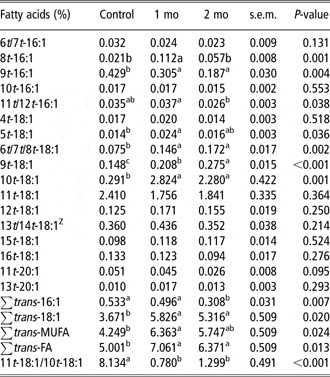
Total trans-MUFA (mg/100 g meat) tended to be higher (P = 0.053; Table 2) in concentrate-fed bulls and this was due to higher levels of several individual trans-18:1 isomers of which 10t-18:1 predominated. The second most abundant trans-18:1 isomer was VA, but it was not found to be different across treatments. On a percentage basis, total trans-MUFA and total trans-18:1 levels were significantly higher in meat from concentrate compared with grass-finished bulls (Table 5), although there was no apparent trend related to the length of concentrate feeding. The percentage of total trans-16:1 decreased with concentrate finishing.
Trans-MUFA composition (percentages) of longissimus thoracis from bulls fed concentrate-finishing diets for 0 (control), 1 or 2 months (mo) after pasture grazing

MUFA = monounsaturated fatty acids; CLA = conjugated linoleic acid.
Within a row, means without a common superscript differ (P < 0.05).
trans-FA: trans-MUFA + c,c-dienes/trienes and c,t-dienes/trienes, but not CLA.
ZCoelution with 6-8c-18:1.
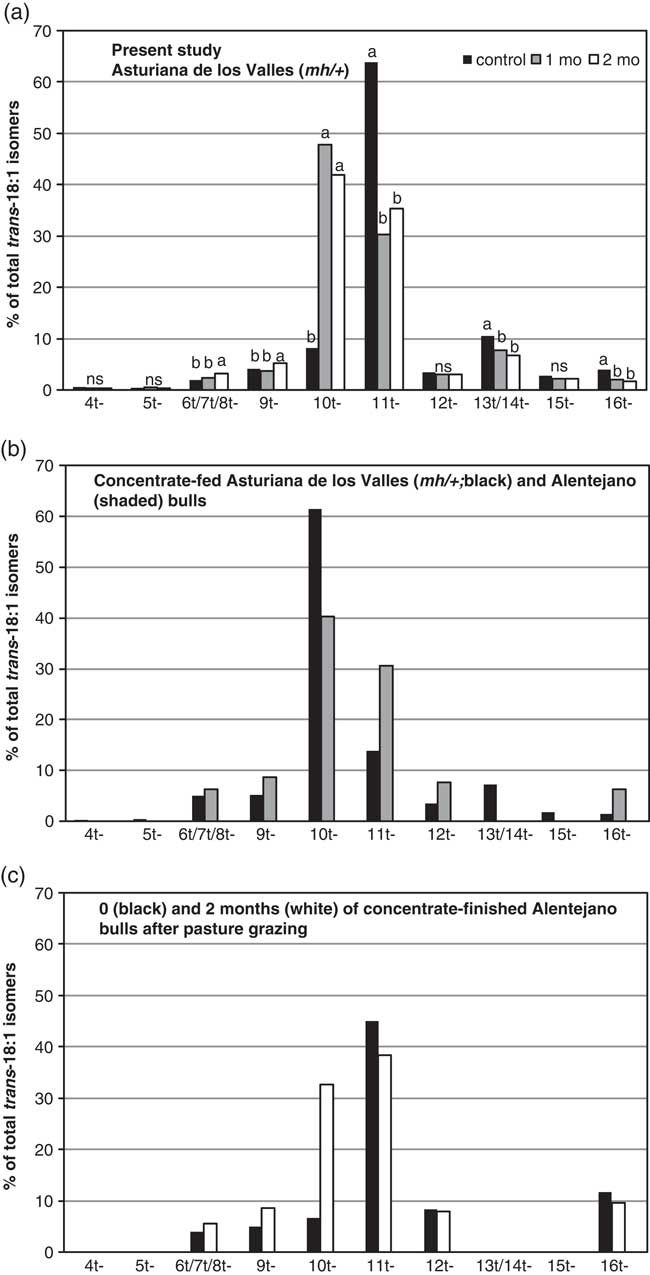
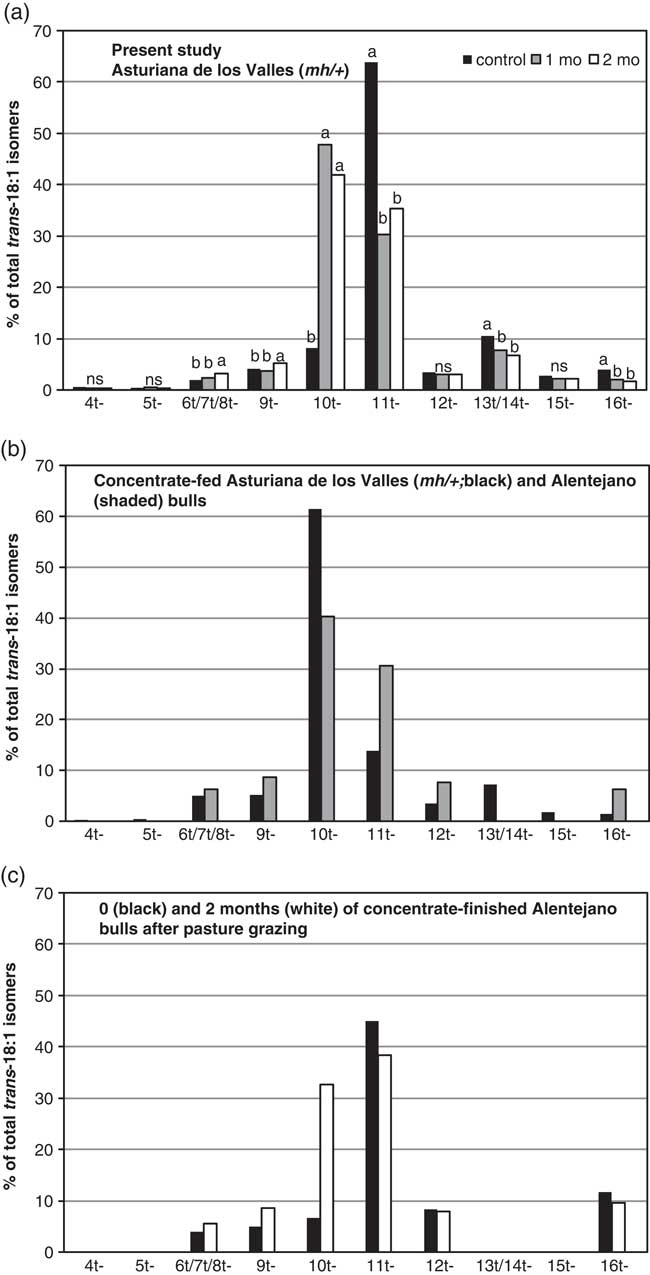
With regard to individual trans-18:1 isomers, 10t-18:1 and 11t-18:1 together represented 76% of total trans-18:1 content. The longissimus muscle from bulls finished on grass had a significantly higher 11t-18:1/10t-18:1 ratio (8.13, P < 0.001) compared with concentrate-finished bulls (1.04). When the amounts of the individual trans-18:1 isomers were presented as a relative percentage of the total trans-18:1 content (Figure 1a), significantly higher relative proportions of 11t-18:1, 13t/14t-18:1 and 16t-18:1 were observed in grass-finished compared with concentrate-finished beef. In contrast, higher relative proportions of 10t-18:1 were consistently observed in concentrate-finished beef and this was accompanied with higher levels of 6t/7t/8t-18:1 and 9t-18:1.
Relative isomeric distribution of individual trans-18:1 isomers of longissimus muscle from (a) the present study; 0 (control), 1 and 2 months of concentrate finishing after grazing, (b) concentrate-fed ‘Asturiana de los Valles’ (Aldai et al., Reference Aldai, Dugan, Juárez, Martínez and Osoro2010a) and Alentejano purebred bulls (Alfaia et al., Reference Alfaia, Alves, Martins, Costa, Fontes, Lemos, Bessa and Prates2009) and (c) 0 and 2 months of concentrate-finished Alentejano purebred bulls after pasture grazing (Alfaia et al., Reference Alfaia, Alves, Martins, Costa, Fontes, Lemos, Bessa and Prates2009). Columns without a common superscript differ (P < 0.05).
PUFAs and other dienes
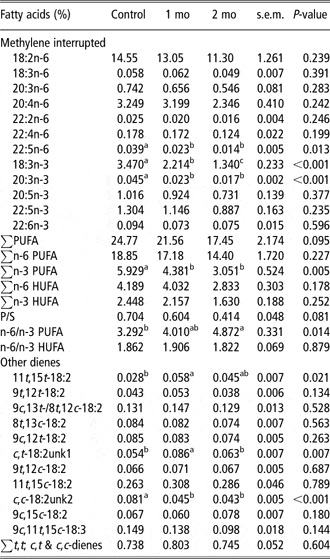
Linoleic acid was the major n-6 PUFA, and it was higher in concentrate-finished beef, especially in meat from animals fed concentrate for 2 months (103 mg/100 g of meat, P < 0.05; Table 2) compared with grass-finished beef (76.5 mg/100 g of meat). However, in general, the increased 18:2n-6 content did not result in the accumulation of elongation and desaturation products of 18:2n-6 (n-6 highly unsaturated fatty acid (HUFA)). When the data were expressed on a percentage basis, no significant differences were observed between these feeding strategies (Table 6).
PUFA composition (percentages) of longissimus thoracis from bulls fed concentrate-finishing diets for 0 (control), 1 or 2 months (mo) after pasture grazing

PUFA = polyunsaturated fatty acid; HUFA = highly unsaturated fatty acids; P/s = polysaturated/saturated; unk = unknown position of double bonds.
Within a row, means without a common superscript differ (P < 0.05).
n-6 HUFA: sum of 20:3n-6, 20:4n-6, 22:4n-6 and 22:5n-6.
n-3 HUFA: sum of 20:3n-3, 20:5n-3, 22:5n-3 and 22:6n-3.
Meat from bulls finished on grass or on 1 month of concentrate finishing showed the highest absolute contents of linolenic acid (17.3 mg/100 g of meat, P < 0.05) compared with bulls finished on concentrate for 2 months (12.5 mg/100 g of meat; Table 2). But again, the increased dietary content of 18:3n-3 did not result in increased levels of n-3 HUFA metabolites. On a percentage basis, 18:3n-3 (P < 0.001) and total n-3 PUFA (P < 0.01) were significantly higher in grass-finished beef, but did not result in increased levels of n-3 HUFA metabolites (Table 6). As expected, concentrate finishing resulted in a higher n-6/n-3 ratio (P < 0.05) compared with grass-finished beef, but this difference was mainly due to the diet differences in the precursor essential fatty acids, 18:2n-6 and 18:3n-3. When these were excluded the n-6 to n-3 HUFA ratio showed no differences among the feeding strategies.
A number of t/t-18:2, c/t-18:2 and c/c-18:2 isomers derived either from 18:3n-3 (11t,15t-18:2, 11t,15c-18:2, 9c,13t-18:2 and 9c,15c-18:2) or from 18:2n-6 (9t,12t-18:2, 9c,12t-18:2 and 9t,12c-18:2), which elute between 19:0 and 20:0 during GLC analysis, were observed but very few differences were observed on a percentage basis (Table 6).
CLAs
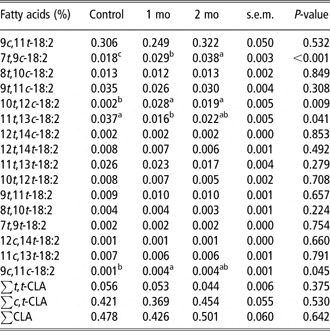
RA (9c,11t-18:2) was the major CLA isomer with an average content of 2.5 mg/100 g of meat across treatments (Table 2) and represented 60% of the total CLA. Most of the remaining 40% was made up of 7t,9c-18:2, 9t,11c-18:2 and 11t,13c-18:2 (Table 7).
CLA composition (percentages) of longissimus thoracis from bulls fed concentrate-finishing diets for 0 (control), 1 or 2 months (mo) after pasture grazing

CLA = conjugated linoleic acid.
Within a row, means without a common superscript differ (P < 0.05).
Concentrate-finished beef had significantly higher percentages of 7t,9c-18:2 (P < 0.001), 10t,12c-18:2 (P < 0.01) and 9c,11c-18:2 (P < 0.05), whereas grass-finished beef had higher percentages of 11t,13c-18:2 (P < 0.05). When individual CLA isomers were presented on a relative percent basis, the total CLA content of 7t,9c-18:2, 10t,12c-18:2 and 9c,11c-18:2 represented significantly higher proportions in concentrate-finished beef, whereas 11t,13c-18:2, 12t,14t-18:2 and 11t,13t-18:2 represented significantly higher proportions in grass-finished beef (data not shown).
Discussion
The type of animals used in the present study (‘Asturiana de los Valles’) were very lean as previously reported (Aldai et al., Reference Aldai, Nájera, Dugan, Celaya and Osoro2007a; Martínez et al., Reference Martínez, Aldai, Celaya and Osoro2010). This cattle breed has a mutation in the bovine myostatin gene that is responsible for the double-muscling phenotype (Grobet et al., Reference Grobet, Poncelet, Royo, Brouwers, Pirottin, Michaux, Ménissier, Zanotti, Dunner and Georges1998), and animals used in this study were all heterozygous for the presence of the mh allele (mh/+). The double-muscled syndrome is an inherited condition, and is found in many breeds of cattle. It is also associated with many physical, physiological and histological characteristics, and meat obtained from these animals is reported to be leaner (see review by Arthur, Reference Arthur1995).
The intramuscular fat content was shown to be directly related to the extent of the concentrate-finishing period as reviewed by Wood et al. (Reference Wood, Enser, Fisher, Nute, Sheard, Richardson, Hughes and Whittington2008). The accretion of fat in beef animals was reported to be mainly due to increased triacylglycerol, not phospholipids, which would result in higher percentages of SFA and MUFA relative to PUFA in the finished beef (Rule et al., Reference Rule, Smith and Romans1995). The higher percentages of long-chain SFA observed in grass-finished beef (Table 3) are consistent with previous reports of ruminants (Dugan et al., Reference Dugan, Kramer, Robertson, Meadus, Aldai and Rolland2007) suggesting that long-chain SFA are associated with higher intake of grass/pasture that is known to contain waxy cuticle rich in long-chain esters compared with grain-based concentrates (Post-Beittenmiller, Reference Post-Beittenmiller1996). Concentrate diets provide, in general, increased availability of oleic and linoleic acids that are major fatty acids in cereal grains (Table 1), which results in more linoleic acid on an absolute basis in the meat from concentrate-finished bulls. In addition, higher contents of metabolites derived from 18:2n-6, such as the methylene-interrupted 18:2 (9t,12t-18:2, 9t,12c-18:2), CLA (10t,12c-18:2) and 18:1 (10t-18:1) isomers, were also observed. On the other hand, as noted by Enser et al. (Reference Enser, Hallett, Hewett, Fursey, Wood and Harrington1998), pastures are a good source of linolenic acid (18:3n-3; Table 1), which explains the inverse relationship between concentrate-finishing time and muscle levels of 18:3n-3. Recognized metabolites of 18:3n-3, including trienes (9c,11t,15c-18:3), dienes (11t,15c-18:2, 9c,13t-18:2 and 9c,15c-18:2), CLA (11t,13c-18:2, 11t,13t-18:2 and 12t,14t-18:2) and monoenes (13t- to 16t-18:1), were not different across finishing strategies. These rumen metabolites of PUFA were previously identified in a number of studies (Kraft et al., Reference Kraft, Collomb, Möckel, Sieber and Jahreis2003; Cruz-Hernandez et al., Reference Cruz-Hernandez, Deng, Zhou, Hill, Yurawecz, Delmonte, Mossoba, Dugan and Kramer2004 and Reference Cruz-Hernandez, Kramer, Kraft, Santercole, Or-Rashid, Deng, Dugan, Delmonte and Yurawecz2006; Destaillats et al., Reference Destaillats, Trottier, Galvez and Angers2005; Bessa et al., Reference Bessa, Alves, Jerónimo, Alfaia, Prates and Santos-Silva2007; Gomez-Cortes et al., Reference Gomez-Cortes, Tyburczy, Brenna, Juarez and De La Fuente2009).
Trans-MUFA, and particularly the trans-18:1 isomers, are the major intermediates which accumulate during biohydrogenation of PUFA (i.e. 18:2n-6, 18:3n-3; Bessa et al., Reference Bessa, Santos-Silva, Ribeiro and Portugal2000). The significantly higher absolute and relative contents of trans-18:1 found in concentrate-finished beef compared with grass-finished beef were mainly due to higher contents of 6t/7t/8t-18:1, 9t-18:1 and 10t-18:1 as observed by Alfaia et al. (Reference Alfaia, Alves, Martins, Costa, Fontes, Lemos, Bessa and Prates2009) and Leheska et al. (Reference Leheska, Thompson, Howe, Hentges, Boyce, Brooks, Shriver, Hoover and Miller2008). High contents of 10t-18:1 have been observed in tissues of concentrate-fed ruminants (Aldai et al., Reference Aldai, Dugan, Kramer, Mir and McAllister2008b and Reference Aldai, Dugan, Kramer, Robertson, Juárez and Aalhus2010b), whereas 11t-18:1 has been consistently associated with forage feeding in beef (Bessa et al., Reference Bessa, Alves, Figueiredo, Teixeira, Rodrigues, Janeiro, Costa, Santos-Silva and Prates2006; Dugan et al., Reference Dugan, Rolland, Aalhus, Aldai and Kramer2008; Kraft et al., Reference Kraft, Kramer, Schoene, Chambers and Jahreis2008; Alfaia et al., Reference Alfaia, Alves, Martins, Costa, Fontes, Lemos, Bessa and Prates2009; Figure 1). In Figure 1b, the trans-18:1 profile of concentrate-fed bulls from two studies (Alfaia et al., Reference Alfaia, Alves, Martins, Costa, Fontes, Lemos, Bessa and Prates2009; Aldai et al., Reference Aldai, Dugan, Juárez, Martínez and Osoro2010a) using different breeds are presented for comparison purposes. In both studies, 10t-18:1 was clearly the major isomer. In Figure 1c, the trans-18:1 profile of beef from bulls concentrate-finished for 0 and 2 months after pasture grazing is presented (Alfaia et al., Reference Alfaia, Alves, Martins, Costa, Fontes, Lemos, Bessa and Prates2009).
As observed in Table 5, with the exception of 9t-18:1, there were no significant differences in trans isomers in the meat lipids when comparing concentrate-finished animals (i.e. 1 month compared with 2 months). These results show that certain changes in meat lipid composition were evidently complete after 1 month of feeding. The reason for the increased content of 10t-18:1 could be related to a decrease in rumen pH and associated bacteria changes (Harfoot and Hazlewood, Reference Harfoot and Hazlewood1997), whereas ruminal vitamin E content associated with the grass intake could have also been a potential reason for the improvement of the 11t-18:1/10t-18:1 ratio (Pottier et al., Reference Pottier, Focant, Debier, De Buysser, Goffe, Mignolet, Froidmont and Larondelle2006; Juárez et al., Reference Juárez, Dugan, Aalhus, Aldai, Basarab, Baron and McAllister2010).
The n-3 content in the meat of grass-fed animals in this study was high in comparison with others (Ponnampalam et al., Reference Ponnampalam, Mann and Sinclair2006; Kraft et al., Reference Kraft, Kramer, Schoene, Chambers and Jahreis2008), whereas the n-6/n-3 was also higher (3.3) than reported by Enser et al. (Reference Enser, Hallett, Hewett, Fursey, Wood and Harrington1998; 2.0 to 2.3 for British cattle), Nuernberg et al. (Reference Nuernberg, Nuernberg, Ender, Lorenz, Winkler, Rickert and Steinhart2002; 1.3 for German Simmental bulls and Holstein steers) and Alfaia et al. (Reference Alfaia, Alves, Martins, Costa, Fontes, Lemos, Bessa and Prates2009; 1.8 for Alentejano purebred). These differences could be in part explained by differences in breed (Raes et al., Reference Raes, De Smet, Balcaen, Claeys and Demeyer2003; Aldai et al., Reference Aldai, Nájera, Martínez, Celaya and Osoro2007b; Kraft et al., Reference Kraft, Kramer, Schoene, Chambers and Jahreis2008), forage species (Collomb et al., Reference Collomb, Bütikofer, Sieber, Jeangros and Bosset2002; Fraser et al., Reference Fraser, Davies, Vale, Nute, Hallett, Richardson and Wright2009) and/or stage of pasture maturity (Dewhurst et al., Reference Dewhurst, Scollan, Youell, Tweed and Humphreys2001; Vanhatalo et al., Reference Vanhatalo, Kuoppala, Toivonen and Shingfield2007), or the relatively high content of 18:2n-6 in the concentrate. The lack of increased desaturation and elongation metabolites from 18:2n-6 (substrate) and 18:3n-3 (competition) in this breed of cattle was surprising. However, it has been recently demonstrated that the expression of some of the genes involved in lipid metabolism is inhibited in the mh/mh genotype of ‘Asturiana de los Valles’ (Perez et al., Reference Perez, Cañón and Dunner2010), which might also apply to the mh/+ genotype. The lack of response could also be due to the limited length of feeding (60 days in this study). Duckett et al. (Reference Duckett, Wagner, Yates, Dolezal and May1993) started to observe changes in meat lipids of Angus × Hereford steers after 56 days of concentrate feeding. Furthermore, an alternate explanation could reflect low enzyme activity (Δ9-desaturase and elongase enzymes) in this particular genotype supported by previous observations of Aldai et al. (Reference Aldai, Dugan, Nájera and Osoro2008a). Similar results of decreased desaturation and elongation of the essential fatty acids were observed in the Limousine breed fed concentrate diets for a much longer period (Kraft et al., Reference Kraft, Kramer, Schoene, Chambers and Jahreis2008). The overall low CLA content is also evidence of low Δ9-desaturase activity within the muscle. Across treatments, there were slight differences in some of the individual CLA isomers, similar to those observed by Dannenberger et al. (Reference Dannenberger, Nuernberg, Nuernberg, Scollan, Steinhart and Ender2005) in beef and Dugan et al. (Reference Dugan, Kramer, Robertson, Meadus, Aldai and Rolland2007) in muskox, where 11t,13c-18:2 was the second most abundant isomer in grass-finished, and 9t,11c-18:2 and 10t,12c-18:2 in concentrate-fed animals. The 11t,13c-18:2 isomer is a metabolite of 18:3n-3, which has been linked to the isomerization of 11t,15c-18:2 (Fukuda et al., Reference Fukuda, Nakanishi, Chikayama, Ohno, Hino and Kikuchi2009).
The plasmalogens in the beef intramuscular fat are seldom discussed, mainly because total beef lipids are methylated either using base catalysts to avoid isomerization of CLA (Kramer et al., Reference Kramer, Fellner, Dugan, Sauer, Mossoba and Yurawecz1997) that does not break the alk-1-enyl bond or using acid catalysts, but the DMAs formed are generally not reported (Cruz-Hernandez et al., Reference Cruz-Hernandez, Kramer, Kraft, Santercole, Or-Rashid, Deng, Dugan, Delmonte and Yurawecz2006). The current results show an increased content of plasmalogens in pasture-fed compared with concentrate-fed beef, which is in agreement with two other studies showing that pasture feeding results in increased amounts of plasmalogens in muscle lipids of beef (Dannenberger et al., Reference Dannenberger, Nuernberg, Nuernberg, Scollan, Steinhart and Ender2005; Kraft et al., Reference Kraft, Kramer, Schoene, Chambers and Jahreis2008). The fact that the plasmalogenic content can also be affected by breed (Kraft et al., Reference Kraft, Kramer, Schoene, Chambers and Jahreis2008) makes it difficult to compare results between studies and the question of which factors affect the plasmalogenic content in muscle is difficult to assess. Concentrate finishing, which increases the dietary fat content, did not affect the absolute amount of plasmalogenic lipids in muscle, but did significantly reduce the relative abundance (P < 0.05). This is understandable as increased levels of fat in muscle tissue are mainly associated with triacylglycerols and not phospholipids, and plasmalogens being phospholipids would thus not be affected. We also considered whether different dietary fatty acids, such as 18:2n-6 and 18:3n-3, could affect the plasmalogenic content in muscle tissue, even though these unsaturated fatty acids are not incorporated into plasmalogenic lipids (Horrocks, Reference Horrocks1972; Wolff, Reference Wolff2002). It would appear, however, that increased dietary 18:3n-3 is generally associated with higher levels of plasmalogens, but this should be confirmed by comparing appropriate diets using the same breed. The results of this study clearly showed that the trans fatty acid metabolites formed by rumen bacteria were incorporated into plasmalogenic lipids (Table 3), as was previously demonstrated by Wolff (Reference Wolff2002). The ratio of the 11t-18:1/10t-18:1 FAME and DMA moieties are shown in Tables 2 and 3, respectively, and are presented for comparison in Figure 2. VA (11t-18:1) predominated over 10t-18:1 in muscle tissue from pasture-fed beef when expressed as mg/100 g or as relative %; the ratio was higher for FAMEs (about 8) than for DMAs (about 5). On the other hand, the 11t-18:1/10t-18:1 ratio was similar (about 1) for both FAMEs and DMAs whether expressed as mg/100 g or relative %, and were not significantly different between 1 and 2 months of feeding the concentrate.
Fatty acid methyl ester and dimethylacetal 11t-18:1/10t-18:1 ratio of longissimus thoracis from bulls with 0 (control), 1 or 2 months (mo) of concentrate finishing after pasture grazing.

Phytanic acid is a multibranched-chain fatty acid (MBCFA) originating from the phytol side-chain of chlorophyll, which is hydrolized and oxidized by ruminal bacteria (Patton and Benson, Reference Patton and Benson1966). It is a normal constituent of the tissues, milk and plasma of ruminants (Lough, Reference Lough1977). In cattle, the proportion of phytanic acid has been found to vary widely depending on the composition of the feed ingested (Lough, Reference Lough1977). Pristanic acid is also an MBCFA derived from the α-oxidation of phytanic acid and it also accumulates in tissues (Ferdinandusse et al., Reference Ferdinandusse, Rusch, van Lint, Dacremont, Wanders and Vreken2002). Even though MBCFAs are related to higher grass intake (i.e. leafy chlorophyll-rich material), and has been associated with prostate cancer risk (Xu et al., Reference Xu, Thornburg, Turner, Vitolins, Case, Shadle, Hinson, Sun, Liu, Chang, Adams, Zheng and Torti2005), we did not find any differences in MBCFA on an absolute basis.
Overall, the beef intramuscular fat content was very low and it could in fact be classified as ‘lean meat’ (<5%). If we compare the profile against nutritional recommendations, all finishing strategies were close to or above 0.45 for the polysaturated/saturated (P/S) ratio, whereas meat only from grass-finished or concentrate-finished bulls for 1 month achieved the recommended n-6/n-3 ratios of less than 4. In several countries such as Denmark, Canada and the United States, recommendations for human health have now come to include reduced trans fat (trans-FA) intake, as their consumption has been linked to health issues (Mensink et al., Reference Mensink, Zock, Kester and Katan2003; Odegaard and Pereira, Reference Odegaard and Pereira2006). On the other hand, ruminant fats are exempt from trans labelling requirements because these sources are considered to be ‘natural’ and therefore assumed to be ‘healthy’ (mainly VA and RA; Ratnayake and Zehaluk, Reference Ratnayake and Zehaluk2005). For regulatory purposes, trans-FAs are defined as trans monoenes plus other fatty acids containing isolated trans double bonds, except trans-containing CLA. Any food containing less than 0.2 g trans-FA per serving (or 2% of total fat content) in Canada, and less than 0.5 g trans-FA per serving in the USA are considered free of trans-FA. The beef obtained in this study had a maximum content of 0.14 g trans-FA/100 g of meat that was well below the limit set either in Canada or in the USA.
Conclusions
The beef obtained from the studied finishing strategies was within or close to the recommended values for human consumption (i.e. P/S > 0.45, n-6/n-3 < 4.0), and the total trans-FA content was low. However, the results indicated that finishing had a major impact on trans-18:1 and CLA isomeric profile, with grass finishing judged to provide a healthier beef fatty acid profile, whereas 2 months of concentrate finishing negatively affected the trans-18:1 and CLA isomer composition. Overall, these results reinforce evidence that beef from pasture-fed animals had the highest nutritional quality, whereas 2 months of concentrate feeding produced a significant reduction in the desirable fatty acids such as VA and RA and gave rise to many undesirable trans-18:1, 18:2 and CLA isomers. However, when working with lean breeds an increased forage-to-concentrate ratio will likely be necessary to maintain high levels of desirable and low levels of undesirable fatty acids while achieving good production efficiencies (e.g. carcass fatness) and consumer acceptance (e.g. juiciness) of the final meat. It remains a challenge to sufficiently increase intramuscular fat in this extremely lean genotype to achieve consumer acceptance and to meet beef grade standards, and at the same time maintain or preferably increase the content of healthful fatty acids. The lack of response of increased levels of 18:2n-6 and 18:3n-3 to produce their long-chain PUFA metabolites in this breed is unique and indicates that a strategy to increase their content cannot be achieved through dietary increase of these essential fatty acids.
Acknowledgements
Funding for this research was provided by the Spanish National Institute for Agricultural Research (INIA). The authors thank the valuable assistance of the staff from Livestock Production area (SERIDA) on animal management, and D. Rolland from Lacombe Research Centre for assisting on sample analysis. This research was supported by a Marie Curie International Outgoing Fellowship (N. Aldai) within the 7th European community Framework Program (SPACANBEEF, PIOF-GA-2008-220730).