Introduction
The Cerrado is a Neotropical savanna composed of a mosaic of vegetation types where grasses are a major biomass component in all types (Ribeiro and Walter, Reference Ribeiro, Walter, Sano, Almeida and Ribeiro2008). Despite that, these species have been neglected in Cerrado studies and are particularly threatened by competition with invasive African grasses (Zenni and Ziller, Reference Zenni and Ziller2011; Aires et al., Reference Aires, Sato and Miranda2014; Musso et al., Reference Musso, de Macedo, Almeida, Rodrigues, Camargo, Pôrto and Miranda2019). Invasive species are widely used as pastures in the Cerrado (Zenni and Ziller, Reference Zenni and Ziller2011) and tend to show higher seed production and seed quality than the native species (Aires et al., Reference Aires, Sato and Miranda2014; Dantas-Junior et al., Reference Dantas-Junior, Musso and Miranda2018; Musso et al., Reference Musso, de Macedo, Almeida, Rodrigues, Camargo, Pôrto and Miranda2019). Therefore, invasive grasses have the potential to outcompete and displace native species. The persistence of native grasses relies also on a transient soil seed bank that is highly depleted when invasive species are present (Andrade and Miranda, Reference Andrade and Miranda2014; Musso et al., Reference Musso, de Macedo, Almeida, Rodrigues, Camargo, Pôrto and Miranda2019).
In the Cerrado, approximately 90% of the seeds in the seed bank are located in the first 10 mm of soil, and few are on the surface (Andrade and Miranda, Reference Andrade and Miranda2014). Grass seeds are normally small and light-weight (Carmona et al., Reference Carmona, Martins and Fávero1999; Aires et al., Reference Aires, Sato and Miranda2014; Fontenele et al., Reference Fontenele, Figueirôa, Pereira, do Nascimento, Musso and Miranda2020) and may have structures such as hygroscopic awns (Johnson and Baruch, Reference Johnson and Baruch2014). These are attributes that increase the chances of seed burial (Long et al., Reference Long, Gorecki, Renton, Scott, Colville, Goggin, Commander, Westcott, Cherry and Finch-Savage2015). Seeds in the soil seed bank may emerge if they are not deeply buried (Fontenele et al., Reference Fontenele, Figueirôa, Pereira, do Nascimento, Musso and Miranda2020), while seeds on the surface may be shaded by nearby adult plants. However, open vegetation gaps may provide the necessary conditions for seedling establishment, as competition is reduced and light is abundant.
The germination of Cerrado grasses is usually hindered by dormancy, low-quality seeds or poor seed viability (Carmona et al., Reference Carmona, Martins and Fávero1998, Reference Carmona, Martins and Fávero1999; Kolb et al., Reference Kolb, Pilon and Durigan2016; Fontenele et al., Reference Fontenele, Figueirôa, Pereira, do Nascimento, Musso and Miranda2020). Light and temperature regulate seed dormancy and germination (Adkins et al., Reference Adkins, Bellairs and Loch2002; Finch-Savage and Leubner-Metzger, Reference Finch-Savage and Leubner-Metzger2006; Long et al., Reference Long, Gorecki, Renton, Scott, Colville, Goggin, Commander, Westcott, Cherry and Finch-Savage2015), but the literature about the effects of light availability on the germination of Neotropical savanna grasses is scarce (Carmona et al., Reference Carmona, Camilo and Martins1997, Reference Carmona, Martins and Fávero1998; Kolb et al., Reference Kolb, Pilon and Durigan2016; Ramos et al., Reference Ramos, Valls, Borghetti and Ooi2019). Nevertheless, germination of grass seeds may lead to abnormal seedlings that develop only the root or the shoot (Kumar et al., Reference Kumar, Verma, Ram and Singh2012), preventing essential physiological processes. In the Cerrado, germination studies normally consider the geotropic curvature of the radicle or the presence of the shoot as an indication of germination (Carmona et al., Reference Carmona, Martins and Fávero1998; Aires et al., Reference Aires, Sato and Miranda2014; Ramos et al., Reference Ramos, Valls, Borghetti and Ooi2019); however, this criterion ignores that some seedlings may never be fully functional, overestimating the potential for seedling recruitment. Therefore, our study aimed to test the effects of light availability on the germination of native and invasive grasses addressing the production of normal and abnormal seedlings.
Methods
Species and seed collection
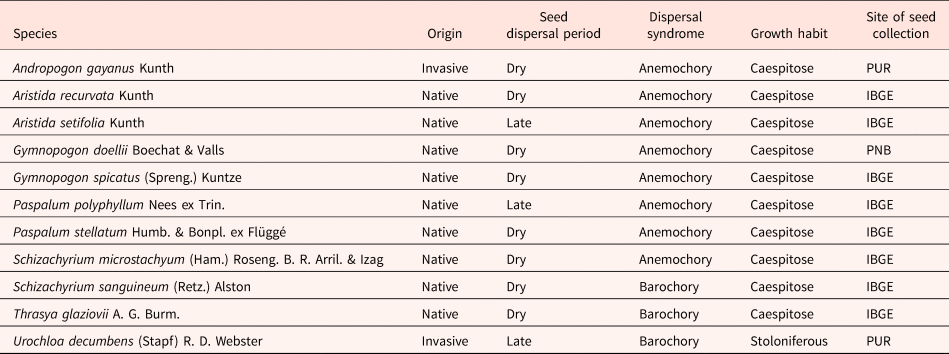
We tested the seeds of nine native and two exotic species (Table 1; Supplementary Fig. S1). All species are widespread perennial grasses found in the Neotropical savannas, except for Gymnopogon doellii that is endemic to patches of natural vegetation in the core region of the Cerrado. Mature seeds of the native species were harvested manually from February to June 2017 in two areas of Cerrado grasslands in Brasília, Brazil: Reserva Ecológica do IBGE (15°55′S, 47°52′W) and Parque Nacional de Brasília (15°41′S, 47°58′W). The seeds of Andropogon gayanus cv. Planaltina and Urochloa decumbens cv. Basilisk were purchased. These are aggressive invasive species widely used as pasture in the Cerrado (Zenni and Ziller, Reference Zenni and Ziller2011). All seeds were stored in paper bags at room temperature (approximately 25°C) and humidity (approximately 50%) until use in October 2018. Seed storage in these conditions for a period of up to 2 years does not reduce seed viability (Carmona et al., Reference Carmona, Martins and Fávero1998; Aires et al., Reference Aires, Sato and Miranda2014). Before use, seeds were sorted to ensure the presence of a caryopsis (fertile seeds) and structures enclosing the caryopsis were retained. No chemical or physical treatment was applied to the seeds to break dormancy or to prevent contamination by pathogens.
Main characteristics of the species used in the experiment

Period of seed dispersion: late in the wet season (February to April) and during the dry season (May to September); Site of seed collection: PNB (Parque Nacional de Brasília), IBGE (Reserva Ecológica do IBGE) and PUR (seeds were purchased). Seed dispersal syndrome was based on the presence of structures that facilitate wind dispersal such as winged bracts, hairs and awns.
Germination test
Germination was conducted in the absence or the presence of light (12 h photoperiod under white light). For each species, five replicates of 50 fertile seeds per treatment were used. The seeds were sown on filter paper moistened with distilled water in Petri dishes. The dishes were kept at room temperature (mean T min ~ 20°C; mean T max ~ 30°C) and humidity (approximately 60%) for 30 days. For the light treatment, the filter paper was moistened daily when germination was assessed, and counted seedlings were discarded. For the dark condition, we adopted the methodology used by Carmona et al. (Reference Carmona, Martins and Fávero1998) as follows. After the seeds were sown, dishes were sealed with a duct tape to avoid dehydration since moistening the filter paper could expose seeds to light. Then, each Petri dish was covered with two sheets of aluminium foil, ensuring complete darkness. These dishes were not opened within the observation period, and germinants were counted only at the end of the 30 days. Germination was defined as the sum of normal and abnormal seedlings. Germinants bearing both the geotropic curvature of the radical and the shoot ≥2 mm were considered normal seedlings. Any seedling that did not fit this criterion were considered abnormal. These were kept at the Petri dish and counted at the end of the experiment. Any remaining non-germinated seeds were tested for viability in a solution of 1% 2,3,5-triphenyl-tetrazolium chloride and considered viable if the caryopsis was stained red after 48 h at room temperature. For each species and treatment, we calculated the germination, the percentage of normal seedlings and final seed viability (number of viable non-germinated seeds plus germinated seeds).
Statistical analyses
To ensure the assumptions of normality were met, the data were analyzed after arcsin transformation. For each species and parameter, we carried two-sample t-tests for changes between treatments (α = 0.05). Also, for each species and treatment, we carried out two-sample t-tests for significant differences between the production of normal seedlings and the total germination. Analyses were carried out using the R software (R 3.6.3 for Windows; R Core Team, 2013); graphics were built using ggplot2 (version 3.3.0; Wickham, Reference Wickham2016).
Results
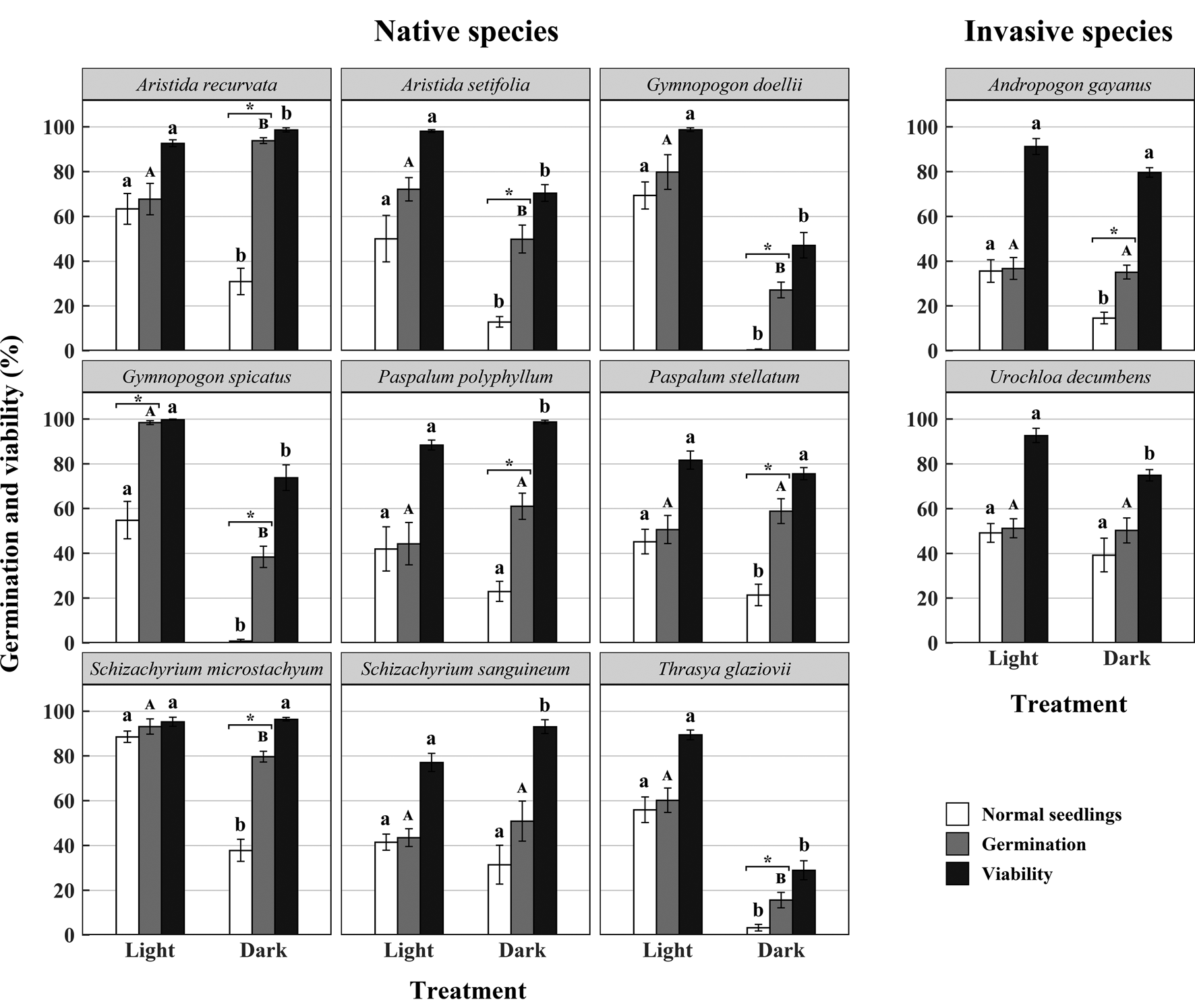
Germination was highly variable among species and treatments, ranging from 16 to 98% for native species and from 35 to 51% for invasive species (Fig. 1). The dark treatment showed no effect on the germination of the invasive species, but hindered the germination of five native species, and increased the germination of Aristida recurvata (t = −4.450, P = 0.006; Supplementary Table S1). Based on the results of the individual tests for the production of normal seedlings (Supplementary Table S1), species were classified according to their response. Only Paspalum polyphyllum, Schizachyrium sanguineum and U. decumbens were non-responsive to the dark treatment, showing no change in germination or production of normal seedlings. The other eight species were considered light-dependent as germination in the dark decreased the production of normal seedlings (Fig. 1). The native species G. doellii (t = 13.600, P = <0.001), Gymnopogon spicatus (t = 8.290, P < 0.001) and Thrasya glaziovii (t = 8.400, P < 0.001) showed strong light dependency, producing less than 3% of normal seedlings when germinated in the dark. The other species showed reductions ranging from 20 to 50% in the dark, and most abnormal seedlings produced in the dark did not develop a root system (Supplementary Table S2). The invasive species A. gayanus showed a response similar to native species while U. decumbens differed. Final viability differed significantly for eight species, ranging from 29 to 100% for the native species and between 75 and 95% for the invasive species (Fig. 1).
Germination and viability (±SE) of the seeds of Neotropical savanna grasses germinated in light and dark conditions. Letters indicate statistical differences within treatments for each parameter and asterisks indicate a significant difference between normal seedlings and total germination within a treatment (two-sample t-test, P < 0.05).

Discussion
In general, species were light-dependent, with darkness decreasing the germination percentage or the production of normal seedlings. In the Cerrado, reproduction via seeds for native grasses is often dependent on seeds found buried in the soil seed bank (Andrade and Miranda, Reference Andrade and Miranda2014; Ramos et al., Reference Ramos, Diniz, Ooi, Borghetti and Valls2017). Our results suggest that these seeds are likely to show reduced germination and develop abnormal seedlings, reinforcing a bottleneck for the recruitment of native grasses.
Light is a regulator of germination and may be tied to changes in dormancy (Adkins et al., Reference Adkins, Bellairs and Loch2002; Finch-Savage and Leubner-Metzger, Reference Finch-Savage and Leubner-Metzger2006). As the seeds of native grasses show mild physiological dormancy that is alleviated by a short post-dispersal period (Adkins et al., Reference Adkins, Bellairs and Loch2002; Ramos et al., Reference Ramos, Diniz, Ooi, Borghetti and Valls2017), light and temperature remain the main cues regulating the germination in a recruitment scenario (Adkins et al., Reference Adkins, Bellairs and Loch2002; Finch-Savage and Leubner-Metzger, Reference Finch-Savage and Leubner-Metzger2006; Long et al., Reference Long, Gorecki, Renton, Scott, Colville, Goggin, Commander, Westcott, Cherry and Finch-Savage2015). Our results confirm the general trend that light is a cue for the germination of native species (Fig. 1). Germination in light was similar to values reported in the literature (Carmona et al., Reference Carmona, Camilo and Martins1997, Reference Carmona, Martins and Fávero1998; Aires et al., Reference Aires, Sato and Miranda2014; Ramos et al., Reference Ramos, Diniz, Ooi, Borghetti and Valls2017). Five out of nine species showed decreased germination in the dark, while A. recurvata showed an increase in germination, similar to the findings reported in the previous literature on Cerrado grasses (Carmona et al., Reference Carmona, Camilo and Martins1997, Reference Carmona, Martins and Fávero1998; Kolb et al., Reference Kolb, Pilon and Durigan2016; Ramos et al., Reference Ramos, Valls, Borghetti and Ooi2019). Although Paspalum stellatum has been reported to decrease its germination in the dark (Carmona et al., Reference Carmona, Martins and Fávero1998), it did not show significant differences among treatments in our study. Interactions among temperature and light, as well as seed size and seed storage, could be responsible for variations in the light requirements and germination responses (Rees, Reference Rees1996; Adkins et al., Reference Adkins, Bellairs and Loch2002; Finch-Savage and Leubner-Metzger, Reference Finch-Savage and Leubner-Metzger2006; Long et al., Reference Long, Gorecki, Renton, Scott, Colville, Goggin, Commander, Westcott, Cherry and Finch-Savage2015). The species that were indifferent to light treatments (Fig. 1) are also the largest seeds in our experiment, and the species showing the highest germination reductions in the dark are the smaller seeded species (Supplementary Fig. S1 and Table S3).
The few studies reporting that the effects of light treatments on the germination of Neotropical savanna grasses do not address the production of normal seedlings (Carmona et al., Reference Carmona, Camilo and Martins1997, Reference Carmona, Martins and Fávero1998; Kolb et al., Reference Kolb, Pilon and Durigan2016; Ramos et al., Reference Ramos, Valls, Borghetti and Ooi2019). For grasses, germinants may develop only the root or the shoot (abnormal seedlings; Supplementary Table S2), which impedes nutrient absorption or photosynthesis, reducing the potential of seedling emergence from the soil seed bank. The high production of abnormal seedlings may also reinforce the recruitment bottleneck caused by low seed quality (Supplementary Table S3), low seedling emergence and seedling mortality at the onset of the rainy season (Frasier et al., Reference Frasier, Cox and Woolhiser1987; Silva et al., Reference Silva, Raventos and Caswell1990; Carmona et al., Reference Carmona, Martins and Fávero1998; Fontenele et al., Reference Fontenele, Figueirôa, Pereira, do Nascimento, Musso and Miranda2020). Our study shows that light availability had strong effects constraining the production of normal seedlings for native species (Fig. 1), indicating light as an essential resource for their successful recruitment. However, S. sanguineum and P. polyphyllum could have an advantage to their recruitment as they were non-responsive to the light treatments. Furthermore, the difference in seed viability among treatments for some species may have been caused by fungal contamination since no treatment was applied to prevent pathogen contamination.
Although germination remained unaffected for the invasive species, they differed in the production of normal seedlings. U. decumbens was non-responsive to the light treatment, suggesting that an advantage as both seeds buried in the soil seed bank or exposed in vegetation gaps may successfully contribute to the recruitment of new individuals. Even though A. gayanus showed a decrease in normal seedlings in the dark, this may be minimized by its high seed production and seed quality, given that reproduction via seeds is the main propagation strategy of this species (Bowden, Reference Bowden1964; Andrade et al., Reference Andrade, Thomas and Ferguson1983; Musso et al., Reference Musso, de Macedo, Almeida, Rodrigues, Camargo, Pôrto and Miranda2019). In summary, as the potential of seedling recruitment of invasive species is minimally reduced by light (Fig. 1) and burial depth (Dantas-Junior et al., Reference Dantas-Junior, Musso and Miranda2018; Musso et al., Reference Musso, de Macedo, Almeida, Rodrigues, Camargo, Pôrto and Miranda2019), their presence in the soil seed bank could outcompete native species whose seeds show high production of abnormal seedlings and low seedling emergence if buried (Fontenele et al., Reference Fontenele, Figueirôa, Pereira, do Nascimento, Musso and Miranda2020). Native species, however, may depend on seeds on the soil surface of open vegetation gaps to successfully recruit new individuals since their seeds are light-dependent.
Supplementary material
To view supplementary material for this article, please visit: https://doi.org/10.1017/S0960258520000355.
Acknowledgements
The authors gratefully acknowledge the staff of the Reserva Ecológica do IBGE for their authorization to collect seeds and the Department of Ecology of the Universidade de Brasília for providing technical support and laboratory facilities. The authors thank Carolina Musso for purchasing the seeds of invasive species and Carlos R. Martins for providing the seeds of Gymnopogon doellii. The authors also acknowledge Vinícius T. do Nascimento for his help with the experiment.