Carbon monoxide (CO) is an odorless, colorless gas, often produced by fossil fuel combustion. CO exposure can lead to severe illness and death. When power outages occur during disasters such as hurricanes or winter storms, elevated levels of CO can build up in enclosed structures (eg, the home or garage) through the use of alternative sources of fuel for electricity generation, heating, cooling, or cooking.Reference Hampson and Stock 1 - 3 The health effects of CO exposure can range from mild symptoms, such as headache, nausea, and dizziness, to more severe outcomes, including loss of consciousness, long-term neurologic damage, cardiac arrhythmias, respiratory failure, and death. CO exposure is preventable, but when it does occur, it can be treated effectively when identified in a timely manner. 4 , Reference Raub, Mathieu-Nolf, Hampson and Thom 5
On October 29, 2012, Hurricane Sandy, the largest Atlantic hurricane on record, moved ashore near Atlantic City, New Jersey, as a post-tropical cyclone with hurricane-force winds. Sandy killed at least 131 people in 8 states and caused an estimated $30 to $50 billion in damage. 6 , Reference Painter and Brown 7 There were over 8.5 million power outages across 21 states, with some areas remaining without power for more than 2 weeks. The combination of widespread power outages and low temperatures caused by the ensuing nor’easter led people to use alternate power sources, which placed many persons at risk for CO exposure. Despite extensive public health messaging about the hazards of CO exposure, a report published by the Centers for Disease Control and Prevention (CDC) during the incident identified 263 Hurricane Sandy–related CO exposures in the 8 days after the hurricane made landfall. 8
We examined Hurricane Sandy–related CO exposures from multiple sources to identify risk factors for CO exposure during Sandy and to develop strategies to prevent exposures during future disasters.
METHODS
This report combined data from 3 separate sources (health departments, poison centers, and public information officers at health departments, regional health commissions, and tribal organizations) to develop an overview of disaster-related CO exposure during Hurricane Sandy.
Syndromic Surveillance
We asked health departments for New York City and 9 states (Connecticut, Delaware, Maine, Maryland, New Jersey, New York, Pennsylvania, Virginia, and West Virginia) affected by Hurricane Sandy for CO exposures captured by syndromic surveillance. Health departments in New Jersey, Virginia, New York, and New York City provided data from their syndromic surveillance systems for October 28 through November 11, 2012, and where available, for the same period in 2010 and 2011. Syndromic surveillance cases were identified by emergency department or hospital chief complaints, depending on availability. Case definitions varied somewhat by state, and typically included chief complaints with terms such as “carbon monoxide,” “CO exposure,” or “poisoning.” The type of data provided also varied by state. Some states provided additional information such as whether CO levels were measured in the residence by a first responder. Others only provided summary counts and demographics (ie, age and sex) for the period of interest. We could not exclude intentional or fire-related exposures because most cases did not have this level of detail; however, if the case mentioned “suicide” or “fire,” the case was excluded by the state health department. Also, most states did not differentiate exposures as directly related or unrelated to Hurricane Sandy.
Poison Center Data
The National Poison Data System (NPDS) collects information from calls made to each of the 55 regional poison centers in the United States. Since 2001, the CDC has collaborated with the American Association of Poison Control Centers (AAPCC) to use the NPDS for surveillance of chemical exposures and poisonings. The CDC also uses the NPDS for post-disaster surveillance. During Hurricane Sandy, poison center staff members used a unique code to identify storm-related calls, which enabled the CDC and the AAPCC to track storm-related calls using the NPDS in near real-time during the response. We collected NPDS data from the 5 states with the most reported CO calls: New York, New Jersey, Pennsylvania, Connecticut, and West Virginia. We retrospectively queried NPDS data for calls from persons reporting an exposure to CO among the 7 poison centers in the 5 selected states for a 1-month period beginning on October 28, 2012 (1 day prior to the storm), and ending November 28, 2012. Only CO calls related to human exposures with documented health effects were included. Calls from people only requesting information on CO were excluded. CO exposures related to intentional injury (eg, suicide, abuse) were also excluded. We collected information on demographics, adverse health effects, exposure type, location of treatment and disposition, therapies recommended, illness severity, and route and source of exposure. Illness severity is categorized in NPDS as follows:
-
∙ Minor: exhibited some symptoms as a result of the exposure, but the symptoms were minimally bothersome.
-
∙ Moderate: exhibited symptoms as a result of the exposure that were more pronounced, more prolonged, or more of a systemic nature than minor symptoms.
-
∙ Major: exhibited symptoms as a result of the exposure that were life-threatening or resulted in significant residual disability or disfigurement.
-
∙ Death: died as a result of the exposure or as a direct complication of the exposure.
For each reported exposure, poison centers often include additional information in an open-text notes field that is not uploaded to NPDS. The 7 poison centers provided CDC with the open-text notes for the identified CO exposures that had documented adverse health effects. These de-identified notes were reviewed by 2 independent reviewers to extract additional data on source of exposure, presence or absence of CO detectors, and other contributing factors (eg, serum carboxyhemoglobin levels). A third epidemiologist reviewed and reconciled any discrepancies. Data were analyzed by use of Epi Info 7 (Center for Surveillance, Epidemiology & Laboratory Services, Division of Health Informatics & Surveillance, Atlanta, GA; https://www.cdc.gov/epiinfo/index.html).
Communications Survey
The National Public Health Information Coalition (NPHIC) sent a written survey about CO prevention messaging to 38 public information officers affected by Hurricane Sandy. These included state health departments, regional health commissions, and tribal organizations. The survey asked questions regarding types of media used for CO prevention messaging (eg, social media, print media, television), timing of the messaging with respect to storm, type of information included, translation of messaging into languages other than English, and source of the messaging content. For the questions on the type of information included in the messaging, we focused on proper placement of generator, use of a CO alarm with battery backup, and use of improper heating sources indoors. Information questions on the source of messaging content asked whether the material was designed in-house or by another agency such as CDC, the Federal Emergency Management Agency (FEMA), or poison centers. NPHIC also asked public information officers whether they thought their CO messaging was effective, what the challenges were to the CO message distribution, and for any other pertinent information to improve storm-related CO messaging. Descriptive statistics, including frequencies and percentages, were used to describe the results from the communication survey. We used MS Excel (Microsoft Corp, Redmond, WA) to analyze the data. Qualitative data were analyzed by using a thematic approach to identify challenges to and opportunities for communicating CO safety messages.
RESULTS
Syndromic Surveillance
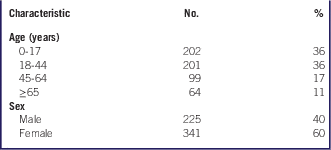
A total of 566 reported CO exposures were identified by syndromic surveillance for October 28 through November 15, 2012, from the New York State Department of Health (NYDOH; n=241), New York City Department of Health and Mental Hygiene (NYC DOHMH; n=88), New Jersey Department of Health (NJDOH; n=218), and Virginia Department of Health (VDH; n=9) (Table 1). Among the identified patients, 341 were female (60%) and the majority were under 45; 202 (36%) were younger than 18 years, 201 (36%) were aged 18-44 years. We compared syndromic surveillance data for the same period in 2010 and 2011 from the NYDOH and NYC DOHMH, which reported 331 CO exposures from October 28 to November 15, 2012. For the same 15-day period, there was an increase of 299% in exposures reported compared to 2011 (n=83) and a 513% increase in reported exposures compared to 2010 (n=54). Demographics were similar in all 3 years.
Carbon Monoxide Exposures Identified by Syndromic Surveillance Systems Among 4 Health Departments in 3 States, Hurricane Sandy, October 28–November 15, 2012Footnote a

a n=566. The majority of calls identified with the unique code were from New Jersey (n=350), followed by Connecticut (n=63) and Pennsylvania (n=58), West Virginia (n=29), Virginia (n=13), and New York (n=11).
Poison Center Data
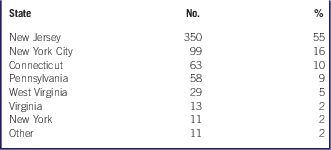
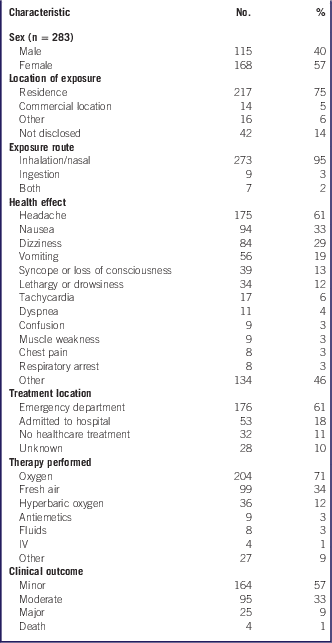
Between October 28, 2012, and November 28, 2012, a total of 535 calls to poison centers were identified by using the Hurricane Sandy unique code. The majority of calls identified with the unique code were from New Jersey (n=350), followed by Connecticut (n=63) and Pennsylvania (n=58). New York City identified an additional 99 calls without the use of the Hurricane Sandy unique code (Table 2). Of those calls, a total of 289 (46%) met our selection criteria. Among those calls, 168 (58%) were from females, and 217 (75%) were made from residences (Table 3). The most common health effects reported were headache (175 [61%]), nausea (94 [33%]), and dizziness (84 [29%]). A smaller proportion of patients also reported more severe symptoms. Those included vomiting (56 [19%]) and syncope or loss of consciousness (39 [13%]). Among the 289 patients, 176 (61%) were treated in emergency departments, 53 (18%) required admission to hospitals, and 32 (11%) did not require or receive treatment at a health care facility. For 36 (12%) patients, hyperbaric oxygen was administered. Among the 288 clinical outcomes classified in NPDS by trained specialists in poison information, 164 (57%) were minor, 95 (33%) were moderate, and 25 (9%) were major. Four deaths (1%) were documented.
Total Number of Carbon Monoxide Exposure Calls to Poison Centers, Hurricane Sandy, October 28–November 28, 2012Footnote a
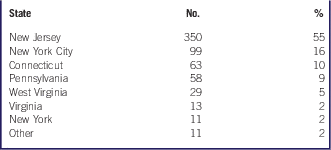
a n=634.
Unintentional Carbon Monoxide Exposures With Reported Health Effects Identified by 5 States, Hurricane Sandy, October 28–November 28, 2012Footnote a

a n=289. The 5 states were New York, New Jersey, Pennsylvania, Connecticut, and West Virginia.
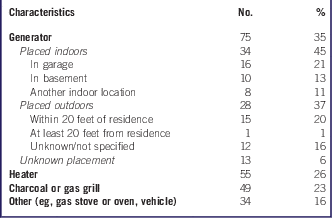
Data on exposure source were available for 213 (74%) of the 289 calls (Table 4). Generators were the most common source of exposure (75 [35%]), followed by heaters (55 [26%]) and charcoal or gas grills (49 [23%]). Of the 75 calls with generator-related exposures, 34 (45%) reported that the generator was improperly placed indoors (16 in a garage, 10 in a basement, and 8 in another indoor location). Of the 28 (37%) calls where generator placement was outdoors, 15 were improperly placed within 20 feet (6.1 m) of the residence and 12 did not specify distance. Only 1 generator was reported to be placed at the recommended distance of at least 20 feet.Reference Wang and Emmerich 9
Exposure Source of Unintentional Carbon Monoxide Exposures With Documented Health Effects Identified by 5 States, Hurricane Sandy and Nor’easter, October 28–November 28, 2012Footnote a

a n=213. The 5 states were New York, New Jersey, Pennsylvania, Connecticut, and West Virginia.
Communications Survey
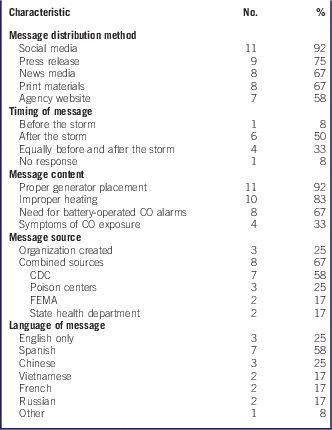
Twelve (32%) of the public information officers (8 state health departments, 3 local health departments, and 1 tribal association) responded to the survey about CO-related communications during Hurricane Sandy. Among the 12 officers, 11 used social media to distribute messages, 9 used press releases, and 8 used news media and print media (Table 5). Half of the officers distributed most of their messaging only after the hurricane. Only one officer reported distributing most of the CO messaging before the storm. Four reported equal distribution before and after Hurricane Sandy made landfall.
Carbon Monoxide-Related Messaging and Communications From 12 Public Information Officers During Hurricane SandyFootnote a

a Abbreviations: CO, carbon monoxide; FEMA, Federal Emergency Management Agency. Source: National Public Health Information Coalition.
Messages from 11 of the officers focused on proper generator placement; 10 warned about improper heating, such as using grills indoors; and 8 advised using battery-operated CO alarms. Eight of the officers reported using materials from other agencies, such as CDC, poison centers, FEMA, their state health department, and, where available, material designed by their organization. Three of the officers reported using only their materials. Overall, 10 (83%) of the public information officers thought their CO-related messaging during Hurricane Sandy was effective. Seven of the officers distributed messaging in other languages, along with English. All of those, 7 distributed materials in Spanish. Three also provided material in Chinese, 2 in Vietnamese, 2 in French, and 2 in Russian. One organization also reported translating material into Haitian Creole, Italian, Polish, and Portuguese.
Several themes were identified in the qualitative survey comments. Among the 12 officers who responded, half identified power outages after the storm as a challenge to effective delivery of CO-related messaging. Most identified the news media as helpful in distributing messaging, although one organization felt that the news media were unwilling to pick up CO-related messages until reported exposures started to occur. Eleven officers identified social media as an important messaging tool and would like more examples of social media messaging from federal and state authorities. Seven of the respondents used information designed by the federal government and 9 also used information designed by their own organization.
DISCUSSION
Disaster-related CO exposure remains a significant public health concern following storms and other disasters. The widespread power outages from Hurricane Sandy and low temperatures were associated with a surge in CO exposures reported through syndromic surveillance and the poison centers in the affected region. The number of CO exposures in the wake of Sandy was significantly greater than exposures in previous years. Consistent with previous reports, persons affected by storm-related CO exposure mostly included females and those in younger age categories. 3 , 4
Despite targeted messaging by state and local health departments, most CO exposures occurred from improper generator use. The data suggest the importance of providing CO prevention messaging, especially in the days leading up to the disaster, because power outages can interfere with the ability to provide any messaging during and after the storm. However, even with power outages, the poison centers in the region remained in service for calls throughout the disaster and potentially could be used to disseminate information for callers concerned with CO exposure.
Although syndromic surveillance and poison center data lack laboratory confirmation, the ability to use these systems during a disaster to track CO exposures can lead to quicker public health action during a response. Timely information is essential to a successful response, and these data sources can provide information quickly to decision-makers. Additionally, the details in poison center case notes can provide exposure scenario information that might be difficult to obtain through other means. The exposure information can be used to tailor public health messaging.
Limitations
The findings in this report are subject to several limitations, some of which may have led to an underestimation of Hurricane Sandy–related CO exposures. Syndromic surveillance data were only available for a small subset of states and did not provide a complete picture of the affected region. Because of the nonspecific nature of CO exposure symptoms, patients could be misdiagnosed or could go unrecognized by the syndromic surveillance system. NPDS relies on data voluntarily reported to poison centers by health care providers and the public; therefore, we likely did not capture all exposures. In addition, those with minor symptoms may not seek medical treatment or advice and therefore we are more likely to capture more severe exposures. Data surrounding the circumstance of CO exposure, such as the source of exposure and presence of a CO detector, were not reported for all calls. It is important that poison centers ask for these scenario-specific details related to the ongoing disaster, provided that it does not detract from the primary functions of remote triage and clinical consultation. These details can aid in identifying risk factors or exposures and allow for timely and targeted interventions. Another limitation was the low response rate to the communication survey, although we did receive responses from the states most impacted by the storm. Finally, because all data were de-identified to protect private health information, we were unable to compare the different datasets for overlapping cases, and therefore looked at our data sources separately.
CONCLUSION
This report characterizes suspected CO exposures during Hurricane Sandy identified through multiple data sources. These data identified common risk factors for disaster-related CO exposure (eg, improper heating source and generator placement), which can be used to inform prevention strategies and target public health interventions to help decrease the likelihood of CO exposure associated with future disasters. Our findings on risk factors are consistent with previous published reports, which suggest that the data sources used in our analysis are useful in providing information to help target persons most at risk. Despite limitations within each source of data, the sources provided distinct, useful, and complementary information that gave a more complete picture of reported CO exposures. Given the different approaches to data collection, the combined use of syndromic surveillance and poison center data for CO surveillance may allow public health to more broadly capture the affected populations during future events. Disaster plans should incorporate public health messaging about CO exposure risks, especially before a storm, so that people planning to remain in the area can better prepare. Because of power outages, messages solely distributed after the storm may reach fewer people who need the information. In addition to messaging, other prevention strategies can be considered. For example, health departments could collaborate with stores to provide point-of-sale information on safe generator use (eg, pamphlets on the shelf next to the generators), as well as a checklist of safety supplies, such as a battery-operated CO detector. Door-to-door outreach after a disaster, such as placing door hangers with generator safety messages at homes in the affected area, 10 is another approach; however, the success of these approaches has not been evaluated.
Our findings emphasize the continued importance of CO-related communication and ongoing surveillance of CO exposures to support public health response and prevention during and after natural disasters. During a disaster, regional poison centers can be a critical resource for potential on-site management, public health promotion, and disaster-related CO exposure surveillance. Reported CO exposure surveillance can provide vital information to disaster planners and health department epidemiologists.
Acknowledgments
We acknowledge the following partners and agencies who helped support this project. Our state partners who collaborated and shared their data: Kathryn Lane, Kathy Decker, Rebecca Leprell, Loretta Haddy, Patricia Przysiecki, Jerald Fagliano, Stella Tsai, Emily Knearl, Marjorie Shannon, Linda Popels. Our poison center partners from Connecticut Poison Control Center, New Jersey Poison Information and Education System, New York City Poison Control Center, Pittsburgh Poison Center, Poison Control Center at the Children’s Hospital of Philadelphia, Upstate New York Poison Center, and West Virginia Poison Center who compiled and de-identified the poison center case information. The following Centers for Disease Control and Prevention staff who provided support: Jacqueline Clower and Kristen Jarmen. Data collection on communication activities was not sponsored by CDC and was determined by CDC as non-research.
Disclaimer
The findings and conclusions in this report are those of the authors and do not necessarily represent the official position of the Centers for Disease Control and Prevention (CDC).