1 Introduction
When discussing the Middle English (ME) case system, the Southern dialects, particularly Kentish, are broadly characterized as the most morphologically conservative, as it is texts from this region which preserve the case distinctions longest, particularly those of the accusative and dative (Mustanoja Reference Mustanoja1960: 67; Allen Reference Allen2003: 3). However, the genitive system of the thirteenth-century Kentish Sermons (KS) is not conservative; the modern reader will find it quite familiar, particularly the widespread use of of. The modern reader will also find familiar the many French loanwords in this text; could French have been responsible for the changes both to the genitive system and to the vocabulary? With KS the possibility of French influence seems particularly strong: written in an area of early French settlement, KS is a translation of a French text by a scribe who was possibly bilingual. The Oxford English Dictionary (OED) ascribes the rise of of (s.v.) in the ME genitive system entirely to the influence of French models. Closer inspection reveals the situation to be more complex, and both Mustanoja (Reference Mustanoja1960: 78) and Mitchell (Reference Mitchell1985: 508) characterize the of-genitive as a native development, although the spread of the periphrastic genitive was encouraged by the influence of the French model. My goal in this article is twofold: (1) to describe the KS genitive system, its forms, functions and syntax; (2) to examine, through comparison with the French original, if and where that system shows evidence of having been directly affected by French models.
1.1 The manuscripts
KS is preserved in Bodley Library MS Laud Misc. 471, written in a single hand and dated to the second half of the thirteenth century (Laing Reference Laing1993: 137). The five sermons are a translation of homilies 2–6 from the homiletic series of Maurice de Sully, Bishop of Paris (d. 1196). Also included in the manuscript are a further 31 homilies written in Anglo-Norman (AN), possibly the work of the same scribe (Bennett & Smithers Reference Bennett and Smithers1966: 213). Maurice's work appears to have been popular in England: eleven manuscripts containing all or part of the homiletic cycle survive in that country, although, with the exception of KS, they are all written in French (Robson Reference Robson1952: 63–5). The five sermons have been edited by Morris (Reference Morris1872), whose edition I have used; for comparison I have also consulted the editions of Hall (Reference Hall1920) and Bennett & Smithers (Reference Bennett and Smithers1966) – this latter contains four of the five sermons, and has been normalized.
Maurice originally composed his cycle of 67 homilies between 1168 and 1175. For the French text, I use Robson's edition (1952) of the Sens Cathedral Chapter MS (c. 1230), written in the Picard-Francien dialect of Old French (OF), which was being used at the Paris court as early as 1170 (Robson Reference Robson1952: viii). This is the oldest surviving French manuscript, and the regular orthography of the MS may have been derived from Maurice's autograph (Robson Reference Robson1952: 59). The Sens MS was not the KS scribe's exemplar, although the scribe did use a French original (Laing Reference Laing1993: 137); time and intervening copyists will have introduced some differences, but on the whole the two texts are quite similar.Footnote 2
2 England in the thirteenth century
It will be useful to provide a brief background of the social and linguistic situation of England at the time the KS scribe was writing.
2.1 French settlement in Kent
Located in the extreme southeast of England, Kent was the first point of contact for the numerous French settlers who crossed the Channel in the wake of the Conquest. William's followers came predominantly from his domains in Normandy and Maine, but there were significant Breton and Flemish groups, and individuals from the rest of France and even beyond (Pope Reference Pope1966: 425–6; Barlow Reference Barlow1988: 78). Foreign men soon occupied high office, both secular and sacred: William's own half-brother Odo was made Earl of Kent in 1067, while in 1070 the see of Canterbury was filled by Lanfranc of Pavia, formerly abbot of Caen (Barlow Reference Barlow1988: 92–3). A household of lower-ranking settlers would have formed around the great lords, and the prospect of prosperity also attracted many from across the Channel. By the middle of the thirteenth century, bilingualism was relatively common (Barlow Reference Barlow1988: 133), and many English speakers had learned French and vice versa (Pope Reference Pope1966: 424; Baugh & Cable Reference Baugh and Cable2002: 135).
Although the settlers came from all levels of society, the French influence on the church is particularly important, as the church was the centre of learning and manuscript production. Along with areas such as law and courtly society, religion was one of the areas which saw a large number of lexical borrowings from French into English (Serjeantson Reference Serjeantson1935: 113; Burnley Reference Burnley and Blake1992: 423–5). As a result of the early influx of foreign clerics, bringing with them their own language and scribal traditions, thirteenth-century texts from Canterbury, such as KS, may be more likely to show the influence of language contact than contemporary texts from the West Midlands or the North, where French influence was less strong.
2.2 Multilingualism
In thirteenth-century England the ‘scribal traditions of three schools conflicted – English, French, and Latin’ (Pope Reference Pope1966: 455). Latin was a learned language for all scribes, but English and French were mother tongues; by the time of KS there would have been many bilingual speakers in England, possibly including the KS scribe (Bennett & Smithers Reference Bennett and Smithers1966: 213). Unlike Latin, with its relatively uniform written form, ME and OF consisted of overlapping regional varieties, in the written as well as spoken language. If the KS scribe was a native French speaker, he would probably have spoken the AN dialect which developed in England following the Conquest, rather than the Picard-Francien dialect of the Sens MS, which was used at the Paris court.
To further complicate the linguistic situation, AN, like ME, ‘was honey-combed with local divergences and was rapidly changing’ (Pope 1952: 426). AN, for example, saw a much earlier reduction of the case system than the Central dialects of OF, including the Picard-Francien dialect of Sens (Kibler Reference Kibler1984: 225), where the case system was maintained through most of the thirteenth century, at least in writing (Pope Reference Pope1966: 313). (Intriguingly, Pope attributes the accelerated decline of the AN case system to contact with English (1966: 424, 462).) The decline of the AN case system was advanced by the beginning of the thirteenth century; the collapse of the case system in AN means that even if the KS scribe did speak AN, the well-preserved case system of Central French may have been as unfamiliar to him as to a monolingual English speaker. (Although Kentish was conservative in preserving case categories, there was considerable syncretism of case forms (Allen Reference Allen1995: 205), a feature which was not shared by the nominal inflection system found in the Sens MS.)
As a translation of a French text, from the period in which the mixing of English- and French-speaking populations was well underway (Barlow Reference Barlow1988: 133; Baugh & Cable Reference Baugh and Cable2002: 120), the KS vocabulary has a noticeable French element. Despite the description of KS as a ‘close and rather stiff English rendering’ (Bennett & Smithers Reference Bennett and Smithers1966: 213) of Maurice, I would argue that it is an excellent translation, faithful to the original but also independent of it. Translations such as KS were an important part of the ME tradition and play an important role in understanding the structure of ME and the influence of OF: how a scribe maps a foreign expression onto his English grammar is a source of information which has not been fully exploited, and the investigation of the interaction between the two languages in the translation is a central issue in this article.
3 OE and OF genitive systems
Before discussing the KS genitive system, it will be useful to give a brief overview of two other genitive systems: the Old English (OE) parent system and the OF system with which it came into contact.
3.1 OE genitive
3.1.1 Forms
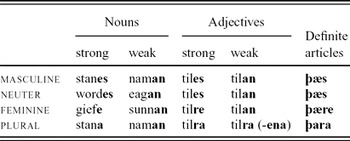
OE had a relatively rich inflectional system. Table 1 presents a simplified version of the OE genitive declension, showing the forms for nouns and adjectives, in strong and weak form (not represented are some of the minor noun classes, which had begun to be assimilated into the major classes even in the OE period). For nouns, the strong/weak status was an inherent property of each noun, determined by the form of the Germanic root. The choice of strong or weak adjective was instead determined by the structure of the entire noun phrase, with the weak adjective form generally used when a determiner was also present, and the strong form when the adjective was used alone. The definite article forms are shown in the third column.
OE genitive forms

(stan ‘stone’; word ‘word’; giefu ‘gift’; naman ‘name’; eage ‘eye’; sunne ‘sun’; til ‘good’) (Mitchell & Robinson Reference Mitchell and Robinson2007: 18–27)
Even this simplified version shows seven different endings and three article forms employed for the genitive case, which as we shall see contrasts greatly with the OF system. In OE, the genitive noun could precede or follow the head noun, although late in that period there is growing tendency to confine the genitive to pre-position, particularly with personal nouns (Mitchell Reference Mitchell1985: 549; Koike Reference Koike2006: 51).
3.1.2 Functions
The OE genitive inflection was used for a range of functions; many can still be expressed in ModE, although some are now only expressed with an of-genitive (Quirk Reference Quirk, Greenbaum, Leech and Svartviket al. 1985: 321–2). Below are listed the main functions of the OE genitive case (Mitchell & Robinson Reference Mitchell and Robinson2007: 105–6); a more detailed description of the genitive functions can be found in Mitchell (Reference Mitchell1985: 535–47). Such classifications are somewhat arbitrary, with some overlap between categories (Quirk Reference Quirk, Greenbaum, Leech and Svartviket al. 1985: 322); however, there is some difficulty, and little to be gained, in trying to define exact, exclusive functional categories (Mitchell Reference Mitchell1985: 535).
possessive: the case of possession, such as God's son
subjective: a subcategory in which the genitive noun can be interpreted as the subject: the king's command – the king commands
objective: a subcategory in which the genitive noun can be interpreted as the object: fear of God – we fear God
description: a genitive phrase which describes the head noun: a watch of gold
partitive: the genitive is used to express a part of the whole: one of the men
adverbial: in OE, certain adverbs were formed using the genitive case, such as dæges ‘by day’
with certain adjectives and verbs: certain adjectives and verbs require the genitive: afraid of death; OE fandian godes ‘to test God’
3.2 OF genitive
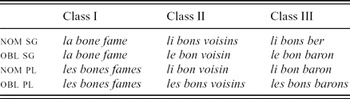
OF was characterized by a two-case system: nominative and oblique. The nominative case was used for subjects, and the oblique for all other functions, including the genitive. Table 2 represents the OF system as it was in the Francien (Paris) dialect in the twelfth century (Pope Reference Pope1966: 312–13; Kibler Reference Kibler1984: 23, 36); as in section 3.1.1 above, I have illustrated only the major noun classes. The entries are in the form article-adjective-noun; the adjective bon is one of a small class of adjectives which precede the noun, while the majority of OF adjectives follow the noun.
OF case system

(la fame: f, ‘the woman’; li voisins: m, ‘the neighbor’; li ber: m, ‘the baron’; bon: adj, ‘good’)
The oblique was used to express the genitive only when the possessor was a singular, personal noun, referred to by name, or by title indicating familial (father) or social status (king) (Kibler Reference Kibler1984: 141). This restriction of the inflected genitive meant that periphrastic genitives were routinely employed in OF, which had two such constructions, using the prepositions a and de. A was originally used when the possessor was a person, and de with animal and inanimate possessors; however, by the time of Maurice's writing de had become more widespread and is found in all contexts (Kibler Reference Kibler1984: 141). Although early in OF both genitive constructions could appear in pre-position, the standard order by the time of Maurice is for the genitive (of either type) to follow the head noun (Kibler Reference Kibler1984: 67).
The functions of the OF genitives are the same as those listed for the OE genitive, with the exception that OF lacked the adverbial genitive.
The OF genitive differed in certain key respects from the OE:
1. The unmarked word order for the OF inflectional genitive was for the genitive noun to follow its head; OE syntax was more flexible, but there was a growing tendency to place genitive nouns before the head.
2. The OF oblique was used for all non-subject functions, whereas OE had a specific genitive category (although there was some form overlap with other cases, particularly in the weak noun classes).
3. OF had not one but two periphrastic constructions; given the semantic restriction on the inflected genitive mentioned above, periphrasis was used more widely and earlier.
4. In OF a noun would have the same form regardless of whether it was in an inflected or periphrastic genitive.
4 KS genitive system
In this section I describe the genitive system found in KS. The KS genitive system included both inflected and periphrastic genitives, which are discussed below, with consideration of their forms, functions, syntax and semantic properties.
4.1 Inflected genitives
There are twenty inflected genitives in KS, eighteen singular and two plural. The singular ending is always -es, derived from the OE strong masculine form (see table 1). The lack of examples of the feminine genitive form may be a coincidence: all the nouns which appear with inflection were strong masculine or neuter in OE. (There is evidence in non-genitive phrases for the preservation of grammatical gender (Hall Reference Hall1920: 663; Bennett & Smithers Reference Bennett and Smithers1966: 392).)
The KS scribe's use of the genitive has become more restricted than in OE. Fifteen of the twenty examples are singular personal nouns with a possessive function (including the subjective and objective subcategories). The late OE tendency for inflected genitive in pre-position has become more pronounced; in nineteen of the twenty examples the genitive noun immediately precedes the head noun. A typical inflected genitive phrase is
(1) godes sune (29.8) ‘God's son’
There are five inflected genitives which are atypical in form or function, or both:
(2) mannes felarede (31.21) ‘the fellowship of man’ / ‘man's fellowship’
(3) domes dai (33.8) ‘Doomsday’
(4) Man may longe liues wene (36.5) ‘Man may hope for long life’
(5) here euerich (34.1) ‘each of them’
(6) men of xxxti wyntre (35.29) ‘men of thirty winters’
(2) is a genitive of description. This is the only example in KS of an inflected genitive of description; all other examples (I count 37) of this function use the periphrastic construction, as in folk of litle beliaue (32.19) ‘folk of little belief’. (2) shows some overlap between the descriptive and possessive functions: translated as ‘man's fellowship’, mannes answers the question whose fellowship, while ‘fellowship of man’ answers the question what kind of fellowship. (3), rather than a genitive of description, as in OE domes dæg ‘day of judgment’, may be a compound noun by this date, more like the ModE Doomsday. Bennett & Smithers take this approach, giving the form as Domesdai (l.171) in their edition and listing the noun as an independent entry rather than under dom in their glossary (Bennett & Smithers Reference Bennett and Smithers1966: 217, 468). Hall, like Morris, gives the expression as two separate words (l.192). The functional equivalence between the genitive and compound nouns was already a feature of OE (Mitchell Reference Mitchell1985: 565).
In (4) the genitive liues is the object of the verb wene ‘hope’. In OE, the object of a verb could sometimes take the genitive case; however, this was not a predominant function and was among the earliest losses of the genitive functions (Fischer Reference Fischer and Blake1992: 225), making its use at this date rather unusual. The Sens MS does not have a corresponding phrase, and within KS there are no other examples of the inflection used in this way. It is likely that this phrase was copied from the lyric Memento Mori, which is found in the same manuscript as KS and begins with the same phrase (Laing Reference Laing1993: 137). As this was a well-known lyric (Laing lists six other early medieval English versions (1993: 171)), it is likely that the KS scribe simply copied it into his text, regardless of the exact form. As a lyric, the forms might have been more archaic than those of a regular prose text. I think it unlikely that the KS scribe was actively using the genitive; most probably this was a fixed expression (Allen Reference Allen1995: 206), but one isolated example is not enough to make a firm conclusion about the use of the genitive as the object of a verb in this text.Footnote 3 It is worth noting that the genitive object was a lexically assigned case, selected by certain verbs; with the shift towards structural case assignment in early ME, lexically assigned genitive objects would have gradually become impossible (see Allen Reference Allen1995: 217–19).
(5) and (6) appear to contain an inflected plural genitive form; unlike the singular examples, where the possessive function dominates, neither is possessive. (5) shows the KS scribe using the genitive form of the personal pronoun for a partitive function, rather than limiting its use to the possessive (as in the fourteen other occurrences of the genitive plural pronoun). Such non-possessive use of the genitive pronoun, though typical of OE (Mitchell Reference Mitchell1985: 528), is on the decline; the two other pronominal partitive constructions have the periphrastic form: eueriche of hem ‘each of them’ and on of hem ‘one of them’. (The OF exemplar is not a likely source for the KS construction. Only the last example has a corresponding genitive phrase in the Sens MS, and it has a periphrastic construction: un de cels ‘one of them’.) Like the genitive noun, the pronoun is also becoming more restricted in terms of function and syntax, with the genitive pronoun form generally confined to possessive function and fixed in pre-position.
(6) is the only example in KS of a noun with the genitive plural form. The complete of-phrase is a genitive of description, and at first it appears that wyntre may be a genitive of measure (lit. ‘thirty of winters’) embedded within the entire genitive of description. If that were the case, then wyntre would be the direct descendant of OE wyntra; OE -a regularly became -e in ME (Brunner Reference Brunner and Johnston1963: 31).
However, the ME genitive plural inflection disappeared much earlier than the singular (Fischer Reference Fischer and Blake1992: 226), and the genitive inflection in post-position was another early loss (Mustanoja Reference Mustanoja1960: 77; Allen Reference Allen2008: 161). We must therefore consider the possibility that the plural, post-posed wyntre is not a genitive, but a fossilized expression, in which the genitive form is preserved but not the function. Parallels can be found in American English:
three mile long (genitive of measure)
the cleaning woman always comes Tuesdays (genitive of time) (Mustanoja Reference Mustanoja1960: 89)
In both these examples, what was once a genitive plural noun has been reinterpreted as a non-genitive noun. If wyntre was similarly reinterpreted, this raises another question: was it a non-genitive singular noun, as in three mile long, or a plural, as in Tuesdays? There are -n plurals in KS, such as deden ‘deeds’, but no remnants of the OE plural endings -a, -e, -u. KS is a short text, and this could possibly be a data gap; however, even in the Ayenbite of Inwit, a much longer text which represents the Kentish dialect in the late thirteenth century, the -e plural is ‘exceptional’ (Gradon Reference Gradon1979: 61).
There is some disagreement in the literature as to the form and function of wyntre. Hall (Reference Hall1920: 663) takes the non-genitive stance, listing the form as a neuter dative plural from OE nominative wyntru; in this case the choice of dative would have been motivated by the of in of xxxti wyntre. Bennett & Smithers, while not committing themselves to function in their glossary, list the form as ‘probably representing earlier gen. after numeral’ (1966: 606). More data are needed regarding the genitive plural forms in ME before we can say with certainty what the origin and function of wyntre are.
There is only one example of an inflected modifier (article or adjective), the definite article þes in
(7) þes lordes commandement (33.32) ‘the lord's commandment’
Only three other modifiers occur in the inflected genitive noun phrases in KS (modifiers in bold):
(8) þe godecristenemannes herte (27.33) ‘the good Christian's heart’
(9) þodeueles werkes (34.33) ‘the devil's works’
These four examples are too few to allow us to make any firm conclusions about the use of genitive inflection with modifiers; however, Allen notes that there is no longer a distinctly genitive form for the article or adjective in the Ayenbite (2008: 133). The loss of genitive modifier inflections in the Kentish texts would reflect the general tendency in ME for modifiers to lose case marking before nouns (Fischer Reference Fischer and Blake1992: 222). It is noteworthy that modifier marking has declined in these ‘conservative’ texts, when the ‘inflection poor’ Ormulum (Orm), a West Midland text c.1200, still retains some marked genitive modifiers (Allen Reference Allen2008: 146–7), both singular (1.60 aness weress ‘one man's’) and plural (1.240 allre life ‘of-all lives’) (all examples from Orm taken from Bennett & Smithers Reference Bennett and Smithers1966 edition).
Three adverbs have the -es ending:
- (10)
(a) amenges ‘among’
(b) to-yenes/to-janes ‘towards’
(c) a-genes ‘against’
Although the adverbial genitive existed in OE, like the genitive as the object of a verb it was never a predominant genitive function (Mustanoja Reference Mustanoja1960: 88). As we have seen, there is a considerable reduction in the functions of the genitive inflection in KS, with a growing tendency to limit inflection to singular possessive nouns. The adverb ending -es was productive in ME (Mustanoja Reference Mustanoja1960: 91), but I believe that it was just that: an adverb ending, not a genitive one. In this case, the ending associated with the adverbial genitive has been reanalysed as an adverbial ending.
4.2 Periphrastic genitives
Although KS is an early ME text from a supposedly conservative area, the of-genitive is already common. There are 115 of-genitives in KS, 85 per cent of the total genitive phrases. This is a considerable increase from OE; in the eleventh century (late OE), only 1.2 per cent of the genitive phrases were of-genitives (Mustanoja Reference Mustanoja1960: 75). These 115 genitives do not include eleven phrases such as biddinge to gode of þo herte ‘prayer to God from the heart’, in which of clearly has the original locative meaning of ‘from’; however, it does include examples such as an ongel of heuene ‘an angel of/from heaven’ in which the distinction between of ‘from’ and of ‘genitive’ is less clear.
The of-genitive in KS is used with singular and plural nouns, both animate and inanimate. It is used for a wider range of functions than the inflection:
possessiveherte of þo gode cristenemanne (28.7) ‘heart of the good Christian’
subjective: miracles of ure loruerde (30.2) ‘miracles of Our Lord’
objective: fer of helle (30.14) ‘fear of hell’
descriptionYdres of stone (29.20) ‘water-vessels of stone’
originblisce of heuene (28.29) ‘bliss of heaven’ / ‘bliss from heaven’
appositionlonde of ierusalem (29.7) ‘land of Jerusalem’
with verbs and adjectivesseruede of þo wyne (29.16) ‘served (an implied, unspecified quantity) of the wine’ and chold of godes luue (30.10) ‘cold in the love of God’
4.2.1 The adnominal periphrastic genitive
Not only has the total number of of-genitives increased, but the construction is commonly used with personal nouns, overlapping with the inflected genitive. There are thirty-three periphrastic genitives with a personal noun, representing 28 per cent of the total periphrastic genitives and outnumbering the inflected genitive personal nouns. However, the periphrastic genitive used with a personal noun of inalienable possession, as in herte of þo gode cristenemanne, is still relatively rare. (11)–(13) illustrate more common uses.
(11) miracles of ure loruerde (30.2)
‘miracles of Our Lord’ – subjective genitive
(12) brichtnesse of þo sunne (27.31)
‘brightness of the sun’ – inanimate possession
(13) for þo luue of gode (28.13)
‘for the love of God’ – objective genitive
(11) and (13) demonstrate the extent to which the periphrastic genitive shares the functional space of the inflected genitive, as both contain an example of a personal noun in functions which could also be expressed with the inflection. For example, almost immediately after (13), there is a similar objective genitive in which the scribe uses the inflection: for godes luue (28.15); an inflected subjective genitive example is (7). (12) represents an environment in which the inflected genitive is no longer possible in KS: when the possessor is inanimate.
The extension of the periphrastic genitive into new environments appears similar to the OF system, but such similarities may be coincidental. OF influence seems unlikely for (11), for which the Sens MS has an inflected genitive. There are several similar examples of KS periphrasis/Sens inflection; see section 5.2, inflection for a discussion of these.
The periphrastic genitive in (12) is parallel to the periphrastic construction in Sens, and seems to reflect the usage of OF, in which only specific personal nouns could take inflection; an inanimate possessor, as in this example, would have to use periphrasis. Inanimate possessors are still found with the inflection in the Orm, l. 265 lifess bræd ‘life's bread’/‘the bread of life’; one might suggest that the periphrastic construction with inanimate possessors did come from OF, which is why it appears in KS but not the Orm. However, already in late OE there was a marked preference for prenominal position when the genitive noun was a topical, human noun (Allen Reference Allen2008: 96); with the decline of postnominal inflected genitives (Allen Reference Allen2008: 173), examples in which the possessor was inanimate would be formed with the periphrastic genitive.
Objective genitives such as (13) occur with both the inflected and periphrastic constructions in KS; this periphrastic variant is found in texts from the earliest ME period (Allen Reference Allen2008: 170). Although the variation between inflected and periphrastic genitive is also found in the Sens MS, the similarity between the two systems may have been arrived at independently. The reduction of postnominal (inflected) genitives began in OE; the decline continued in ME, as the loss of inflection on modifiers prevented genitive noun phrases from appearing in postnominal position (as the first element of a postnominal genitive had to be inflected) (Allen Reference Allen2008: 173). See also the discussion of (41a) in section 5.2 for lack of modifier marking and genitive syntax in KS. In contrast, in OF modifier agreement was maintained, so there must be another reason for the postnominal genitive in that language (the corresponding Sens phrase does not have a genitive construction, see section 5.2, por). However, I would not rule out the possibility that the example of the OF periphrastic genitive encouraged the native trend; although Allen considers the favouring of of-phrases an important factor in the loss of certain inflected objective genitives, she does not discuss whether de may have contributed to the favouring of that construction (2009: 49). More research on both the OF and ME objective genitive will need to be done to determine what, if any, role was played by the OF genitive in the shifting of some ME objective genitives to periphrastic. (See Allen Reference Allen, Dufresne, Dupuis and Vocaj2009: 55–8 for a discussion of why some ME objective genitives could be formed with the inflection, while for others this became impossible.)
There is one further similarity between KS and Orm: both have examples of ‘land of Jerusalem’ (l. 33 in Orm), a construction not found in OE. Again, the presence of this construction in Orm suggests the OF may not have introduced it into ME.
The above description of changes in the ME genitive is by no means exhaustive; my purpose has been to demonstrate that factors other than language contact may have affected the use of the adnominal periphrastic genitive. A more systematic investigation of both the ME and OF genitives is necessary before we can reach a definitive conclusion about the shift to periphrastic genitives in ME and the extent of OF influence.
4.2.2 The periphrastic genitive with verbs and adjectives
The periphrastic genitive is used with four adjectives and eight verbs in KS. Although the genitive case was used with certain adjectives and verbs in OE, many of the examples show a strong OF influence.
- (14)
(a) seruede of þo wyne (29.16)
(b) servi del vin (3.12)
‘served of the wine’
- (15)
(a) deseu[e]rde of þo companie (31.24)
(b) desevrés de la compaignie (4.24)
‘cut off from the company’
- (16)
(a) i-warisd of his maladie (31.13)Footnote 4
(b) mondés de sa liepre (4.10)
‘cured of his malady/leprosy’
In these examples, the verb itself has been borrowed from OF, and the of comes directly from the de associated with the OF verb. As is noted in the entry for of in the OED, the borrowing of French verbs which selected the preposition de as a prepositional complement was a major source of new uses of of in the ME period. When an OF verb was borrowed into ME, its prepositional usage was often borrowed too, or at least calqued, with OF de being loan-translated by ME of in these cases. However, it is also noteworthy that these examples also show a connection with the original OE genitive sense, as well as that of of: seruede of þo wyne has a partitive sense, and deseu[e]red of þo companie and i-warisd of his maladie a sense of separation or loss. This sense overlap may have facilitated these borrowings.
The other examples of deseuerde show another change in the use of of. This verb occurs three more times in the same passage, at 31.21, 31.23 and 31.32. In all these examples the scribe uses the preposition fram rather than of, much as one would in ModE. These examples demonstrate the shifting of the meaning ‘from’ from of to fram, a shift not mirrored in OF.
- (17)
(a) clepeþ of swiche (35.23)
(b) apele de tels (6.65)
‘call from such [workmen]’
- (18)
(a) i-offred of yure selure (28.22)
(b) offert . . . de vostre argent (2.68)
‘offered of your silver’
In Bosworth & Toller's dictionary of OE (B&T) the verbs of (17) and (18) are not listed with a genitive complement or of, nor does the OED list any conclusive examples from the OE period. As in (14)–(16), of in these examples appears to have its origin in the OF construction (verb + de), even though in (17)–(18) the verbs themselves are of English origin. And again, there is overlap with the OE meanings of the genitive and of, and the use of of with these verbs; in the above examples the overlap is with the partitive function: some men are called from all the men available, or some silver is being offered from the whole which exists. Thus these two examples, although derived from OF, still have a connection with the OE uses of the genitive and of.
- (19)
(a) makede of watere wyn (30.21)Footnote 5
(b) fist . . . d'aigue vin (3.43)
‘made wine from water’
- (20)
(a) i-drunke of þise wyne (29.26)
(b) gosté del vin (3.20)
‘drunk of this wine’
- (21)
(a) sigge of þe elde (35.21)
(b) no corresponding Sens phrase
‘say of the age’
(20)–(22) are native constructions with of. OE drincan commonly occurred with of (but not the genitive) in a partitive sense; the OE ancestor of sigge, secgan, was used with both the genitive and of; and macian could occur with of, particularly in the sense of the material from which something is made. In these three examples the origin of of is in OE, not OF. Such examples show that, although of did become much more common as a result of the borrowing of OF verbs, this type of construction was not new to English speakers. It is likely that the widespread translation of OF de with of was facilitated by the existence of a similar native pattern.
The following list shows the adjectives which are used with a periphrastic genitive:
- (22)
(a) chald of þo luue of Gode (30.10)
(b) refroidi de l'amor Deu (3.32)
‘cold in the love of God (i.e. their love of God is cold)’
- (23)
(a) clene of þise lepre (31.27)
(b) net de ceste liepre (4.27)
‘clean of this leprosy’
- (24)
(a) anheet of þo luue (30.28)
(b) escaufés de l'amor (3.48)
‘warmed of the love’
- (25)
(a) makie hool of mine lepre (31.9)
‘make whole of my leprosy’
(b) saner de ma lepre (4.7)
‘to heal of my leprosy’
B&T and the OED cite OE genitive constructions for two of these adjectives, chald and clene. However, the genitive does not seem to have been especially common with either adjective, and the use of of may have been encouraged by the OF example. B&T and OED do not show any genitive constructions for anheet; however, there was both a native and foreign model for this construction: the analogous English example chald of and the OF example escaufés de l'amor.
Hal, the OE ancestor of hool, shows variation in its use of prepositions and the genitive case. Based on the examples in the Old English Concordance, hal could be used with the genitive case, of and fram. The number of examples is too small to be statistically significant, but fram is the most frequent construction.Footnote 6 These examples also indicate that the functional equivalence between of and fram (see above discussion of deseuerde) may already have been a feature of OE. Orm also provides an example of the use of the hal lexical family with the of-genitive: Hælennde off ʒure sinness ‘Healer of your sins’ (l. 86). As this text was not written in an area of French influence, this example is further evidence that OF may have encouraged the spread of a native construction, but did not introduce it.
4.3 Summary
The KS genitive system bears a striking resemblance to the ModE one. Although the inflection (-es) does appear in other contexts, the most common productive function is the possessive, with its subcategories of subjective and objective genitives; some of the examples, such as for godes luue, illustrate inflected objective genitives no longer possible in ModE. The inflection is commonly used with singular, prenominal personal nouns. Modifier inflection appears to be on the decline. While the function of the inflection has become much more limited, the periphrastic genitive has become common in a wide variety of functions, and with all noun types.
The use of the periphrastic genitive with all noun types suggests a possible motive for the increased use of this genitive construction. It appears that KS did preserve some grammatical gender distinctions; at the same time there is a large French element in the vocabulary. Unlike the inflection, which varied with gender and would have to be adapted to the influx of French words, the periphrastic genitive would have the same form regardless of the noun it was used for. This regularity of form may have contributed to the rising popularity of the periphrastic genitive.
The adjectives and verbs which have an of-phrase highlight the impact of borrowing. In OF, certain adjectives and verbs were used in conjunction with the preposition de. When these items were borrowed into ME, the entire construction was often borrowed, especially in the case of verbs. OF did contribute to the rise of of with verbs; however, it must be stressed that OF did not introduce such constructions but gave new popularity to a pre-existing construction. In many cases there is some semantic overlap with the OF de and the OE genitive case and of, which may have further facilitated borrowing.
5 KS and the Sens MS: a comparison
The discussion of the periphrastic genitive with adjectives and verbs has demonstrated that in this area OF did exercise some influence on the KS genitive system. In this section I will consider the possible OF influence in other cases, by comparing some of the corresponding phrases of KS and the Sens MS.
5.1 KS genitive inflection
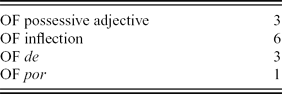
Table 3 summarizes the correspondences between the KS inflected genitive and the Sens MS. (As KS is a translation, from an unknown exemplar, not every inflected genitive has a corresponding phrase in Sens.)
KS inflected genitives and corresponding Sens phrases
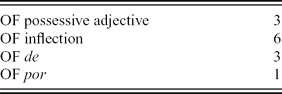
Possessive adjective. The KS scribe's use of an inflected noun rather than a possessive adjective, such as
- (26)
(a) godes seruise (36.8) ‘God's service
(b) son servise (6.80) ‘his service’
may have been for the sake of clarity, or a stylistic preference. However, this equivalence between possessive adjective and genitive inflection does not originate in OF; it was already a feature of OE (Mitchell Reference Mitchell1985: 565). In the three examples of this type the OF possessive adjective is only replaced with the genitive inflection, not an of-genitive. The OF possessive adjective and the ME genitive inflection share two characteristics: animacy and word order. The OF possessive adjective and ME genitive were both used with human nouns, and both occupied the slot immediately before the head noun.
Inflection. The six genitive noun phrases in which both KS and Sens have inflection, such as
- (27)
(a) godes sune (29.8)
(b) li Fils Deu (3.5)
‘God's son’
demonstrate that the preferred environment of the genitive inflection was similar in both languages: singular personal nouns with possessive functions (including subjective/objective). However, OF had a further constraint on the use of the inflection: the personal noun must be referred to by name or by a title indicating status (see section 3.2). The OF genitive inflection was not used with non-specific personal nouns, as we shall see below. The six genitive nouns in question all refer to God (five with Deu ‘God’ and one Nostre Segnor ‘Our Lord’), possibly the most specific personal noun in medieval Europe (there being, after all, only one). ME was bound by no such constraint, and as a result the two languages sometimes diverge on the use of inflection with non-specific personal nouns.
Examples such as (27) also highlight the fact that, despite the comments of Bennett & Smithers (1966: 213) and Hall (Reference Hall1920: 669) on the nature of the translation, KS was not a slavish translation of the French. Although there are points where the translator does seem to be influenced by the syntax of the French, he follows ME syntactic patterns in placing the inflected genitive before the head, whereas in OF it followed (the Lindisfarne Gospel glosses, for instance, follow the Latin syntax of the exemplar much more closely).
de. On three occasions the Sens MS has a periphrastic de-genitive but KS an inflected genitive.
- (28)
(a) þe gode cristenemannes herte (27.33)
(b) corage del bon crestien (2.47)
‘the good Christian's heart’
- (29)
(a) godes luue (30.29)
(b) l'amor de Deu (3.50)
‘God's love’/‘love of God’
- (30)
(a) mannes felarede (31.21)
(b) compaignie des gens (4.19)
‘man's fellowship’/‘fellowship of man’
In (28) and (30), OF did not permit the use of inflection, as inflected genitives were confined to specific personal nouns. The KS scribe was not similarly restricted, and so is able to use the inflected genitive. However, as we shall see in section 5.2, the context of a personal possessive noun is not an infallible guide for predicting whether the scribe will use the inflected genitive. ((29) demonstrates that it was possible in OF to use a periphrastic genitive when God was the genitive noun, although the Sens scribe prefers inflection.)
por. There is one example in which the Sens text has por where KS has a genitive phrase:
- (31)
(a) for godes luue (28.15) ‘for God's love’/‘for the love of God’
(b) por Deu (2.62) ‘for God’
This will be further discussed below along with the example of the periphrastic genitive used in a similar context.
5.2 KS periphrastic genitive
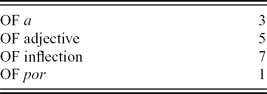
Table 4 shows some of the examples in which the KS of genitive does not correspond to the Sens de.Footnote 7
KS periphrastic genitives and non-periphrastic Sens phrases
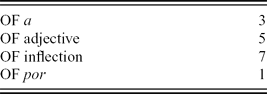
Preposition a in OF. The Sens MS has three examples in which the possessive/subjective genitive is expressed with the OF preposition a:
- (32)
(a) herte of þe gode Cristenemanne (28.7)
(b) cuer al crestien (2.54)
‘heart of the (good) Christian’
- (33)
(a) amonestement of þo dieule (28.18)
(b) l'amoneste al diable (2.65)
‘temptation of the devil’
- (34)
(a) time of his prophets (34.23)
(b) tans . . . as autres prophetes (6.37)
‘time of his/other prophets’
Although all three examples are personal nouns of possession, and (32) and (33) singular, here the KS scribe uses periphrasis rather than inflection. We have seen (section 4.1) that this is the context most strongly associated with the use of the genitive inflection; we also know that the scribe will use of in this context as well (see section 4.2). While one could make an argument for the possible influence of the OF periphrastic construction, even if it is not with de, it is more likely that these examples simply demonstrate the extent to which the ME periphrastic genitive has spread.
These examples, like (28)–(30), again highlight the difference in OF and ME genitive usage: the OF inflected genitive environment was more limited than that of ME. While both languages show a tendency to limit the inflection to personal nouns, in OF this constraint was extended, so that the genitive inflection was used only with very specific personal nouns, whereas the ME inflection could be used for more generic references. (32)–(34) show that OF had two periphrastic genitive constructions, while ME had only one. These differences between the two languages are rarely, if ever, commented upon in the literature, and bear further investigating.
Adjective. The genitive is inherently adjectival, and in OE the adjective was an alternative to genitive inflection (Mitchell Reference Mitchell1985: 542, 565); it is not surprising to find examples of an OF adjective being translated with a ME genitive phrase, such as
- (35)
(a) þo þrie kinges of heþenesse (27.20) ‘the three kings of heathendom’
(b) li troi roi paien (2.35) ‘the three pagan kings’
The KS scribe's genitive of description has shifted almost entirely from inflection to periphrasis (the one example which does use inflection, (2), has a personal noun). It is likely that the choice of periphrastic, rather than inflected, genitive was prompted by the general shift to the periphrastic (section 4.2.1), and the increasing restriction of the inflected genitive.
Inflection. There are six examples of the KS scribe using a periphrastic genitive where Sens has the inflected genitive. As in the above discussion of Sens inflection (section 5.1), in all six examples the genitive noun refers to the deity. All but one of the OF genitives have a possessive (subjective/objective) function:
- (36)
(a) an ongel of heuene (27.12) ‘an angel from heaven’
(b) li angeles Nostre Segnor (2.29) ‘the angel of our Lord’
- (37)
(a) wille of ure louerde (29.24)
(b) la volenté Nostre Segnor (3.18)
‘the will of our Lord’
- (38)
(a) (chald of) þo luue of God (30.10)
(b) (refroidi de) l'amor Deu (3.26)
‘(cold of) the love of God’
- (39)
(a) miracles of ure loruerde (30.2)
(b) miracles Nostre Segnor (3.32)
‘miracles of our Lord’
- (40)
(a) seruise of ure lorde (34.14)
(b) le servise Deu (6.31)
‘service of God’
These examples demonstrate the extent to which the KS periphrastic genitive had moved into the same functional space that the inflection occupied. Even with singular personal nouns with a possessive function the KS scribe uses of rather than -es. (In (36a), where the translation departs from the Sens text, the KS scribe does not have the option of using inflection with the non-personal noun.) In the remaining example, the genitive function may be descriptive or possessive, as in (2):
- (41)
(a) felarede of gode almichti (31.32)
(b) la compaignie Damedeu (4.29)
‘company of God Almighty’
(36)–(41) show that the KS periphrastic genitive can be used in contexts in which the inflection was also an option. These six examples also demonstrate again the difference between KS and Sens with regard to the nouns which refer to the deity: the Sens scribe shows a marked preference for using the inflection, a preference not shared by his counterpart across the Channel.
(41a) is not the first example of a genitive phrase with felarede; the earlier example (2) is repeated below as (42), along with the corresponding Sens phrase:
- (42)
(a) mannes felarede ‘man's fellowship’
(b) compaignie des gens ‘the company of men’
In these two examples, the KS scribe uses first an inflected and later a periphrastic genitive in a similar context; in each case the Sens scribe uses the opposite construction. There are two reasons for this conflict. Firstly, the OF inflection was restricted to specific personal nouns. (42b) is a general reference, not a specific one, and so for the Sens scribe the inflection was not an option here, as it was in (41b) with Damedeu. The KS scribe, not being bound by the same restriction, was free to use inflection with a generic noun in (42a).Footnote 8
In (41a), the KS scribe uses periphrasis; this example differs from (42a) in that an adjective modifies the genitive noun, unlike the unmodified noun of (42a). Furthermore, this adjective, unlike most in KS, follows the noun it modifies (almichti seems to be fixed in this position; all fourteen examples in KS have this order). In order to use inflected godes in (41a), the genitive would have had to precede the head noun. Had the genitive noun phrase consisted only of the unmodified noun, this would have been possible, *godes felarede (the asterisk here signalling an invented phrase). The post-posed adjective presents a problem. The KS scribe does not appear to have a productive genitive adjective inflection (see (8), also Allen Reference Allen2008: 126), and so has no way to overtly mark almichti as genitive. The phrase *godes almichti luue could be open to misinterpretation, as ‘God's almighty love’ rather than ‘God Almighty's Love’. The post-posed adjective prevents the use of the inflection, resulting in the choice of periphrastic genitive for (41a). In OF, on the other hand, noun and modifier concord was maintained (and continues to be in the modern language); the question of how or if to inflect an adjective only pertained to ME.
The choice of periphrasis in (41a) may indicate that in KS -es is still a morphological case ending (Allen Reference Allen2008: 138); unlike the cliticized ’s of ModE, the possessive marker cannot be attached to the entire noun phrase but only to the genitive noun itself. Allen also notes (146) that the genitive is a morphological category even in texts in which other morphological categories have been lost, suggesting that OF probably did not play a central role in the eventual cliticization of the genitive marker.
por. There is one example in which OF por is translated with a periphrastic genitive in KS:
- (42)
(a) for the luue of gode (28.13) ‘for the love of God’
(b) por Deu (2.60) ‘for God’
Considered with example (31), which uses inflection, these two phrases demonstrate the overlap between inflection and periphrasis in the KS genitive system. An identical non-genitive OF construction is translated once with inflection and once with periphrasis; the difference in construction in no way alters the meaning. This is another example of the interchangeability of the two genitive constructions in a similar environment. This variation does not have its source in OF, which does not employ a genitive construction in either example.
5.3 Summary
Unlike the verbs and adjectives examined in section 4.2.2, the examples in sections 5.1 and 5.2 do not demonstrate a strong OF influence on the KS genitive system.
KS and Sens do show similarities in the use of the inflection, namely that this construction is restricted to singular, personal nouns with a possessive (subjective/objective) function. However, there are significant differences. The OF inflected genitive adds a further restriction: nouns must be specific. The KS scribe did not share this restriction, and, as we have seen, does use the inflection for less specific nouns, which in OF required the periphrastic genitive. Another significant difference is in modifier marking; as we have seen in (41a), the KS scribe did not inflect adjectives within the genitive noun phrase (in this case leading to the use of periphrasis); in OF, both article and adjective agreed with the noun.
In two cases, a non-genitive phrase in Sens is replaced with a genitive in KS: the possessive adjective with inflection, and the adjective with periphrasis. However, this equivalence between the genitive and these non-genitive constructions was already a feature of OE, not imported from OF.
We have also seen examples in which the Sens text has the inflected genitive, but KS has the periphrastic. Even for examples in which the noun (always referring to the deity) functions possessively, the KS uses of. Although these examples do show the extent to which the periphrastic genitive has spread into the functional space occupied by the inflection, they are not evidence of OF influence; indeed, the Sens scribe shows a marked tendency to use the inflection when the genitive noun refers to the deity.
Finally, the use of both the inflected and periphrastic genitive where Sens has por is another example of the interchangeability between the two KS genitive constructions in an identical context. (These examples appear to represent a stylistic variation: whether something is done for God or for love of God has no bearing on the genitive.)
6 Conclusion
6.1 KS and OF
The KS genitive system is marked by the widespread use of the periphrastic genitive and the increasing restriction of the inflected genitive to personal nouns with possessive, subjective and objective functions. These features, as well as the virtual disappearance of genitive modifiers, give a system which is more like that of ModE than OE, which is perhaps not what we would expect from a text from a region which is so frequently labelled conservative. With the exception of the use of the periphrastic genitive as a loan-translation of de with OF verbs, I have not found compelling evidence that the changes to the genitive system were introduced from OF. The use of of as a translation of de with OF verbs is directly related to the clearest OF influence on this ME dialect: lexical borrowing.
It is quite likely that the shift to periphrastic of would have taken place even without the arrival of the Normans; many other Germanic languages developed a similar construction, always with a preposition which originally signified ‘from’ (Mustanoja Reference Mustanoja1960: 74). Although OF de was not the origin of the ME periphrastic genitive (nor the cause of the decline of the inflected genitive), it probably encouraged the similar native development (Mustanoja Reference Mustanoja1960: 78; Fischer Reference Fischer and Blake1992: 226; Allen Reference Allen1997: 77), causing it to take place more rapidly than it might otherwise have done. The ME and OF genitive systems had many similarities, but there were also important differences, and the two systems remained independent.
There is another reason why we should be hesitant to attribute ‘modernization’ of the genitive system to OF. Although the genitive is innovative, other parts of the KS case system are not: accusative and dative categories are maintained, yet OF never showed such distinctions in the nominal inflection, using a single form for all non-nominative functions. Furthermore, Allen has found no evidence that the loss of obsolete genitives was connected to the process of deflexion (2008: 173), suggesting that the general decay of the case system did not trigger the loss of certain genitive types. Whatever the root causes of the changes to the genitive system in ME may be, it appears that we will have to look beyond OF and the decline of the case system to find them.
6.2 Future investigations
The scope of this article has been relatively narrow – to examine in detail the genitive system of a single text, with particular focus on possible influence from OF. It is the proverbial drop in the ocean of empirical work which still needs to be done on the ME genitive (Allen Reference Allen, Dufresne, Dupuis and Vocaj2009: 49). I have not attempted to provide a complete history of the genitive in ME, nor to address the root causes of the developments, as a single text cannot provide all the information necessary to such tasks. The study has suggested some areas of further inquiry which will need to be investigated if we are to fully understand the evolution of the genitive.
I have suggested that the development of the KS genitive system was largely independent of French influence. However, this can only be confirmed for ME in general by a systematic study of a variety of texts; such a study would have to include texts from throughout the ME period, those which come from areas of French influence as well as areas where French influence was less pervasive. A particularly useful study would be on the genitive in the Ayenbite of Inwit, a somewhat later Kentish text which is also a translation of a French original. Although my findings are not contradicted by the information in either Gradon (Reference Gradon1979) or Allen (Reference Allen2008), neither account contains a detailed analysis of the Ayenbite genitive system; a thorough study of this much longer text is still needed (a preliminary investigation (Myers Reference Myers2008) shows that the two texts have very similar genitive systems, although a more detailed analysis will be needed to see if there are small variations). By examining the Ayenbite and other texts from this region, we can build up a picture of the Kentish genitive system, its forms and functions, and how the system evolved throughout the period; ideally, this Kentish study would be followed/accompanied by studies of the genitive system in other dialects.
Another topic which needs further investigation is the development of the ME genitive modifiers. Despite some morphologically conservative features, the genitive modifiers are at the least on the decline in Kentish. Articles/determiners, adjectives and nouns seem to have evolved somewhat independently in ME. The ‘inflection poor’ Orm has an invariant article yet occasionally shows genitive agreement on quantifiers (Allen Reference Allen2008: 146–7). My own earlier investigation of another text of the same period as Orm, In Die Pentecosten from the Lambeth Homilies (a SW Midland ‘translation’ of an Ælfrician homily), has suggested there may be a relationship between the presence of a marked genitive modifier and the form of the noun (genitive or common case plural) (Myers Reference Myers2008). A complete picture of the genitive system in ME will have to wait for more detailed studies of the genitive noun phrase; as French has always maintained modifier agreement, that language seems an unlikely source for the variation in the ME genitive modifier system.
Ideally, a large-scale study, or combination of studies, of texts from a variety of dialects from throughout the ME period will be carried out one day, providing the data necessary to determine not only the exact role of French in the evolution of the ME genitive, but in the evolution of that system as a whole.