Introduction
Given the wide availability of results from genome-wide association studies (GWAS), it is now possible to detect genetic relationships between phenotypes. This approach has facilitated the identification of genetic susceptibility factors that are common across psychiatric disorders (Cross-Disorder Group of the Psychiatric Genomics Consortium, 2013; Cross-Disorder Group of the Psychiatric Genomics Consortium et al. Reference Lee, Ripke, Neale, Faraone, Purcell, Perlis, Mowry, Thapar, Goddard, Witte, Absher, Agartz, Akil, Amin, Andreassen, Anjorin, Anney, Anttila, Arking, Asherson, Azevedo, Backlund, Badner, Bailey, Banaschewski, Barchas, Barnes, Barrett, Bass, Battaglia, Bauer, Bayes, Bellivier, Bergen, Berrettini, Betancur, Bettecken, Biederman, Binder, Black, Blackwood, Bloss, Boehnke, Boomsma, Breen, Breuer, Bruggeman, Cormican, Buccola, Buitelaar, Bunney, Buxbaum, Byerley, Byrne, Caesar, Cahn, Cantor, Casas, Chakravarti, Chambert, Choudhury, Cichon, Cloninger, Collier, Cook, Coon, Cormand, Corvin, Coryell, Craig, Craig, Crosbie, Cuccaro, Curtis, Czamara, Datta, Dawson, Day, De Geus, Degenhardt, Djurovic, Donohoe, Doyle, Duan, Dudbridge, Duketis, Ebstein, Edenberg, Elia, Ennis, Etain, Fanous, Farmer, Ferrier, Flickinger, Fombonne, Foroud, Frank, Franke, Fraser, Freedman, Freimer, Freitag, Friedl, Frisen, Gallagher, Gejman, Georgieva, Gershon, Geschwind, Giegling, Gill, Gordon, Gordon-Smith, Green, Greenwood, Grice, Gross, Grozeva, Guan, Gurling, De Haan, Haines, Hakonarson, Hallmayer, Hamilton, Hamshere, Hansen, Hartmann, Hautzinger, Heath, Henders, Herms, Hickie, Hipolito, Hoefels, Holmans, Holsboer, Hoogendijk, Hottenga, Hultman, Hus, Ingason, Ising, Jamain, Jones, Jones, Jones, Tzeng, Kahler, Kahn, Kandaswamy, Keller, Kennedy, Kenny, Kent, Kim, Kirov, Klauck, Klei, Knowles, Kohli, Koller, Konte, Korszun, Krabbendam, Krasucki, Kuntsi, Kwan, Landen, Langstrom, Lathrop, Lawrence, Lawson, Leboyer, Ledbetter, Lee, Lencz, Lesch, Levinson, Lewis, Li, Lichtenstein, Lieberman, Lin, Linszen, Liu, Lohoff, Loo, Lord, Lowe, Lucae, MacIntyre, Madden, Maestrini, Magnusson, Mahon, Maier, Malhotra, Mane, Martin, Martin, Mattheisen, Matthews, Mattingsdal, McCarroll, McGhee, McGough, McGrath, McGuffin, McInnis, McIntosh, McKinney, McLean, McMahon, McMahon, McQuillin, Medeiros, Medland, Meier, Melle, Meng, Meyer, Middeldorp, Middleton, Milanova, Miranda, Monaco, Montgomery, Moran, Moreno-De-Luca, Morken, Morris, Morrow, Moskvina, Muglia, Muhleisen, Muir, Muller-Myhsok, Murtha, Myers, Myin-Germeys, Neale, Nelson, Nievergelt, Nikolov, Nimgaonkar, Nolen, Nothen, Nurnberger, Nwulia, Nyholt, O'Dushlaine, Oades, Olincy, Oliveira, Olsen, Ophoff, Osby, Owen, Palotie, Parr, Paterson, Pato, Pato, Penninx, Pergadia, Pericak-Vance, Pickard, Pimm, Piven, Posthuma, Potash, Poustka, Propping, Puri, Quested, Quinn, Ramos-Quiroga, Rasmussen, Raychaudhuri, Rehnstrom, Reif, Ribases, Rice, Rietschel, Roeder, Roeyers, Rossin, Rothenberger, Rouleau, Ruderfer, Rujescu, Sanders, Sanders, Santangelo, Sergeant, Schachar, Schalling, Schatzberg, Scheftner, Schellenberg, Scherer, Schork, Schulze, Schumacher, Schwarz, Scolnick, Scott, Shi, Shilling, Shyn, Silverman, Slager, Smalley, Smit, Smith, Sonuga-Barke, St Clair, State, Steffens, Steinhausen, Strauss, Strohmaier, Stroup, Sutcliffe, Szatmari, Szelinger, Thirumalai, Thompson, Todorov, Tozzi, Treutlein, Uhr, van den Oord, Van Grootheest, Van Os, Vicente, Vieland, Vincent, Visscher, Walsh, Wassink, Watson, Weissman, Werge, Wienker, Wijsman, Willemsen, Williams, Willsey, Witt, Xu, Young, Yu, Zammit, Zandi, Zhang, Zitman, Zollner, Devlin, Kelsoe, Sklar, Daly, O'Donovan, Craddock, Sullivan, Smoller, Kendler and Wray2013). For example, significant genetic overlap of depression with schizophrenia and bipolar disorder in European (EUR) samples has been well-established (Cross-Disorder Group of the Psychiatric Genomics Consortium, 2013; Cross-Disorder Group of the Psychiatric Genomics Consortium et al. Reference Lee, Ripke, Neale, Faraone, Purcell, Perlis, Mowry, Thapar, Goddard, Witte, Absher, Agartz, Akil, Amin, Andreassen, Anjorin, Anney, Anttila, Arking, Asherson, Azevedo, Backlund, Badner, Bailey, Banaschewski, Barchas, Barnes, Barrett, Bass, Battaglia, Bauer, Bayes, Bellivier, Bergen, Berrettini, Betancur, Bettecken, Biederman, Binder, Black, Blackwood, Bloss, Boehnke, Boomsma, Breen, Breuer, Bruggeman, Cormican, Buccola, Buitelaar, Bunney, Buxbaum, Byerley, Byrne, Caesar, Cahn, Cantor, Casas, Chakravarti, Chambert, Choudhury, Cichon, Cloninger, Collier, Cook, Coon, Cormand, Corvin, Coryell, Craig, Craig, Crosbie, Cuccaro, Curtis, Czamara, Datta, Dawson, Day, De Geus, Degenhardt, Djurovic, Donohoe, Doyle, Duan, Dudbridge, Duketis, Ebstein, Edenberg, Elia, Ennis, Etain, Fanous, Farmer, Ferrier, Flickinger, Fombonne, Foroud, Frank, Franke, Fraser, Freedman, Freimer, Freitag, Friedl, Frisen, Gallagher, Gejman, Georgieva, Gershon, Geschwind, Giegling, Gill, Gordon, Gordon-Smith, Green, Greenwood, Grice, Gross, Grozeva, Guan, Gurling, De Haan, Haines, Hakonarson, Hallmayer, Hamilton, Hamshere, Hansen, Hartmann, Hautzinger, Heath, Henders, Herms, Hickie, Hipolito, Hoefels, Holmans, Holsboer, Hoogendijk, Hottenga, Hultman, Hus, Ingason, Ising, Jamain, Jones, Jones, Jones, Tzeng, Kahler, Kahn, Kandaswamy, Keller, Kennedy, Kenny, Kent, Kim, Kirov, Klauck, Klei, Knowles, Kohli, Koller, Konte, Korszun, Krabbendam, Krasucki, Kuntsi, Kwan, Landen, Langstrom, Lathrop, Lawrence, Lawson, Leboyer, Ledbetter, Lee, Lencz, Lesch, Levinson, Lewis, Li, Lichtenstein, Lieberman, Lin, Linszen, Liu, Lohoff, Loo, Lord, Lowe, Lucae, MacIntyre, Madden, Maestrini, Magnusson, Mahon, Maier, Malhotra, Mane, Martin, Martin, Mattheisen, Matthews, Mattingsdal, McCarroll, McGhee, McGough, McGrath, McGuffin, McInnis, McIntosh, McKinney, McLean, McMahon, McMahon, McQuillin, Medeiros, Medland, Meier, Melle, Meng, Meyer, Middeldorp, Middleton, Milanova, Miranda, Monaco, Montgomery, Moran, Moreno-De-Luca, Morken, Morris, Morrow, Moskvina, Muglia, Muhleisen, Muir, Muller-Myhsok, Murtha, Myers, Myin-Germeys, Neale, Nelson, Nievergelt, Nikolov, Nimgaonkar, Nolen, Nothen, Nurnberger, Nwulia, Nyholt, O'Dushlaine, Oades, Olincy, Oliveira, Olsen, Ophoff, Osby, Owen, Palotie, Parr, Paterson, Pato, Pato, Penninx, Pergadia, Pericak-Vance, Pickard, Pimm, Piven, Posthuma, Potash, Poustka, Propping, Puri, Quested, Quinn, Ramos-Quiroga, Rasmussen, Raychaudhuri, Rehnstrom, Reif, Ribases, Rice, Rietschel, Roeder, Roeyers, Rossin, Rothenberger, Rouleau, Ruderfer, Rujescu, Sanders, Sanders, Santangelo, Sergeant, Schachar, Schalling, Schatzberg, Scheftner, Schellenberg, Scherer, Schork, Schulze, Schumacher, Schwarz, Scolnick, Scott, Shi, Shilling, Shyn, Silverman, Slager, Smalley, Smit, Smith, Sonuga-Barke, St Clair, State, Steffens, Steinhausen, Strauss, Strohmaier, Stroup, Sutcliffe, Szatmari, Szelinger, Thirumalai, Thompson, Todorov, Tozzi, Treutlein, Uhr, van den Oord, Van Grootheest, Van Os, Vicente, Vieland, Vincent, Visscher, Walsh, Wassink, Watson, Weissman, Werge, Wienker, Wijsman, Willemsen, Williams, Willsey, Witt, Xu, Young, Yu, Zammit, Zandi, Zhang, Zitman, Zollner, Devlin, Kelsoe, Sklar, Daly, O'Donovan, Craddock, Sullivan, Smoller, Kendler and Wray2013). However, genetic overlap of these disorders has been largely unexamined in Chinese samples due to historically modest genetic samples of major depressive disorder (MDD) (Liu et al. Reference Liu, Saffen, Schulze, Burmeister, Sham, Yao, Kuo, Chen, An, Dai, Yue, Li, Xue, Su, Chen, Shi, Qiao, Liu, Xia and Chan2016).
By applying a trans-ethnic approach to the genetic relationship between major psychiatric disorders and MDD case–control status and clinical presentation, we can clarify: (i) the extent to which the genetic etiology of psychiatric comorbidity is shared across ancestry, and (ii) whether genetic liability for other disorders is reflected in certain characteristics of MDD, which may elucidate biological mechanisms underlying symptom presentation across both disorders. Appropriately accounting for variation in linkage disequilibrium (LD) across populations has been a complicating factor in trans-ethnic analyses, but recent advances (e.g. Vilhjalmsson et al. Reference Vilhjalmsson, Yang, Finucane, Gusev, Lindstrom, Ripke, Genovese, Loh, Bhatia, Do, Hayeck, Won, Kathiresan, Pato, Pato, Tamimi, Stahl, Zaitlen, Pasaniuc, Belbin, Kenny, Schierup, De Jager, Patsopoulos, McCarroll, Daly, Purcell, Chasman, Neale, Goddard, Visscher, Kraft, Patterson and Price2015; Brown et al. Reference Brown, Ye, Price and Zaitlen2016) have improved the methods by which these analyses can be conducted.
Our study examined association of polygenic risk scores (PRSs) from six European meta-analytic GWAS for psychiatric disorders and traits with depression symptoms, associated clinical characteristics, and MDD case–control status in a large sample of Han Chinese descent (N = 10 502) from the China, Oxford, and VCU Experimental Research on Genetic Epidemiology (CONVERGE) study (CONVERGE Consortium, 2015). CONVERGE was designed to examine genetic risk factors for recurrent MDD among a rigorously ascertained cohort. CONVERGE is the largest non-European collection of major depression cases and controls to date, and thus provides an optimal sample to study trans-ethnic polygenic association and shared common variant liability.
The current study explores the genetic risk underlying both severe forms of mental illness – recurrent MDD, bipolar disorder, schizophrenia, and anxiety disorders – and traits that have been previously associated with MDD, but do not represent clinically significant outcomes (Hettema et al. Reference Hettema, Neale, Myers, Prescott and Kendler2006; Musliner et al. Reference Musliner, Seifuddin, Judy, Pirooznia, Goes and Zandi2015; Okbay et al. Reference Okbay, Baselmans, De Neve, Turley, Nivard, Fontana, Meddens, Linner, Rietveld, Derringer, Gratten, Lee, Liu, de Vlaming, Ahluwalia, Buchwald, Cavadino, Frazier-Wood, Furlotte, Garfield, Geisel, Gonzalez, Haitjema, Karlsson, van der Laan, Ladwig, Lahti, van der Lee, Lind, Liu, Matteson, Mihailov, Miller, Minica, Nolte, Mook-Kanamori, van der Most, Oldmeadow, Qian, Raitakari, Rawal, Realo, Rueedi, Schmidt, Smith, Stergiakouli, Tanaka, Taylor, Wedenoja, Wellmann, Westra, Willems, Zhao, LifeLines Cohort, Amin, Bakshi, Boyle, Cherney, Cox, Davies, Davis, Ding, Direk, Eibich, Emeny, Fatemifar, Faul, Ferrucci, Forstner, Gieger, Gupta, Harris, Harris, Holliday, Hottenga, De Jager, Kaakinen, Kajantie, Karhunen, Kolcic, Kumari, Launer, Franke, Li-Gao, Koini, Loukola, Marques-Vidal, Montgomery, Mosing, Paternoster, Pattie, Petrovic, Pulkki-Raback, Quaye, Raikkonen, Rudan, Scott, Smith, Sutin, Trzaskowski, Vinkhuyzen, Yu, Zabaneh, Attia, Bennett, Berger, Bertram, Boomsma, Snieder, Chang, Cucca, Deary, van Duijn, Eriksson, Bultmann, de Geus, Groenen, Gudnason, Hansen, Hartman, Haworth, Hayward, Heath, Hinds, Hypponen, Iacono, Jarvelin, Jockel, Kaprio, Kardia, Keltikangas-Jarvinen, Kraft, Kubzansky, Lehtimaki, Magnusson, Martin, McGue, Metspalu, Mills, de Mutsert, Oldehinkel, Pasterkamp, Pedersen, Plomin, Polasek, Power, Rich, Rosendaal, den Ruijter, Schlessinger, Schmidt, Svento, Schmidt, Alizadeh, Sorensen, Spector, Steptoe, Terracciano, Thurik, Timpson, Tiemeier, Uitterlinden, Vollenweider, Wagner, Weir, Yang, Conley, Smith, Hofman, Johannesson, Laibson, Medland, Meyer, Pickrell, Esko, Krueger, Beauchamp, Koellinger, Benjamin, Bartels and Cesarini2016): neuroticism, depressive symptoms, and subjective well-being. Genetic relationships within the former set have been examined widely within samples of European descent (Hettema, Reference Hettema2008; Cross-Disorder Group of the Psychiatric Genomics Consortium, 2013; Cross-Disorder Group of the Psychiatric Genomics Consortium et al., Reference Lee, Ripke, Neale, Faraone, Purcell, Perlis, Mowry, Thapar, Goddard, Witte, Absher, Agartz, Akil, Amin, Andreassen, Anjorin, Anney, Anttila, Arking, Asherson, Azevedo, Backlund, Badner, Bailey, Banaschewski, Barchas, Barnes, Barrett, Bass, Battaglia, Bauer, Bayes, Bellivier, Bergen, Berrettini, Betancur, Bettecken, Biederman, Binder, Black, Blackwood, Bloss, Boehnke, Boomsma, Breen, Breuer, Bruggeman, Cormican, Buccola, Buitelaar, Bunney, Buxbaum, Byerley, Byrne, Caesar, Cahn, Cantor, Casas, Chakravarti, Chambert, Choudhury, Cichon, Cloninger, Collier, Cook, Coon, Cormand, Corvin, Coryell, Craig, Craig, Crosbie, Cuccaro, Curtis, Czamara, Datta, Dawson, Day, De Geus, Degenhardt, Djurovic, Donohoe, Doyle, Duan, Dudbridge, Duketis, Ebstein, Edenberg, Elia, Ennis, Etain, Fanous, Farmer, Ferrier, Flickinger, Fombonne, Foroud, Frank, Franke, Fraser, Freedman, Freimer, Freitag, Friedl, Frisen, Gallagher, Gejman, Georgieva, Gershon, Geschwind, Giegling, Gill, Gordon, Gordon-Smith, Green, Greenwood, Grice, Gross, Grozeva, Guan, Gurling, De Haan, Haines, Hakonarson, Hallmayer, Hamilton, Hamshere, Hansen, Hartmann, Hautzinger, Heath, Henders, Herms, Hickie, Hipolito, Hoefels, Holmans, Holsboer, Hoogendijk, Hottenga, Hultman, Hus, Ingason, Ising, Jamain, Jones, Jones, Jones, Tzeng, Kahler, Kahn, Kandaswamy, Keller, Kennedy, Kenny, Kent, Kim, Kirov, Klauck, Klei, Knowles, Kohli, Koller, Konte, Korszun, Krabbendam, Krasucki, Kuntsi, Kwan, Landen, Langstrom, Lathrop, Lawrence, Lawson, Leboyer, Ledbetter, Lee, Lencz, Lesch, Levinson, Lewis, Li, Lichtenstein, Lieberman, Lin, Linszen, Liu, Lohoff, Loo, Lord, Lowe, Lucae, MacIntyre, Madden, Maestrini, Magnusson, Mahon, Maier, Malhotra, Mane, Martin, Martin, Mattheisen, Matthews, Mattingsdal, McCarroll, McGhee, McGough, McGrath, McGuffin, McInnis, McIntosh, McKinney, McLean, McMahon, McMahon, McQuillin, Medeiros, Medland, Meier, Melle, Meng, Meyer, Middeldorp, Middleton, Milanova, Miranda, Monaco, Montgomery, Moran, Moreno-De-Luca, Morken, Morris, Morrow, Moskvina, Muglia, Muhleisen, Muir, Muller-Myhsok, Murtha, Myers, Myin-Germeys, Neale, Nelson, Nievergelt, Nikolov, Nimgaonkar, Nolen, Nothen, Nurnberger, Nwulia, Nyholt, O'Dushlaine, Oades, Olincy, Oliveira, Olsen, Ophoff, Osby, Owen, Palotie, Parr, Paterson, Pato, Pato, Penninx, Pergadia, Pericak-Vance, Pickard, Pimm, Piven, Posthuma, Potash, Poustka, Propping, Puri, Quested, Quinn, Ramos-Quiroga, Rasmussen, Raychaudhuri, Rehnstrom, Reif, Ribases, Rice, Rietschel, Roeder, Roeyers, Rossin, Rothenberger, Rouleau, Ruderfer, Rujescu, Sanders, Sanders, Santangelo, Sergeant, Schachar, Schalling, Schatzberg, Scheftner, Schellenberg, Scherer, Schork, Schulze, Schumacher, Schwarz, Scolnick, Scott, Shi, Shilling, Shyn, Silverman, Slager, Smalley, Smit, Smith, Sonuga-Barke, St Clair, State, Steffens, Steinhausen, Strauss, Strohmaier, Stroup, Sutcliffe, Szatmari, Szelinger, Thirumalai, Thompson, Todorov, Tozzi, Treutlein, Uhr, van den Oord, Van Grootheest, Van Os, Vicente, Vieland, Vincent, Visscher, Walsh, Wassink, Watson, Weissman, Werge, Wienker, Wijsman, Willemsen, Williams, Willsey, Witt, Xu, Young, Yu, Zammit, Zandi, Zhang, Zitman, Zollner, Devlin, Kelsoe, Sklar, Daly, O'Donovan, Craddock, Sullivan, Smoller, Kendler and Wray2013). By including subclinical traits, we aim to clarify genetic influences on the dimensional nature of risk: depressive symptoms, neuroticism, and subjective well-being are potentially indicative of genetic liability to MDD, and are genetically correlated with one another (Okbay et al. Reference Okbay, Baselmans, De Neve, Turley, Nivard, Fontana, Meddens, Linner, Rietveld, Derringer, Gratten, Lee, Liu, de Vlaming, Ahluwalia, Buchwald, Cavadino, Frazier-Wood, Furlotte, Garfield, Geisel, Gonzalez, Haitjema, Karlsson, van der Laan, Ladwig, Lahti, van der Lee, Lind, Liu, Matteson, Mihailov, Miller, Minica, Nolte, Mook-Kanamori, van der Most, Oldmeadow, Qian, Raitakari, Rawal, Realo, Rueedi, Schmidt, Smith, Stergiakouli, Tanaka, Taylor, Wedenoja, Wellmann, Westra, Willems, Zhao, LifeLines Cohort, Amin, Bakshi, Boyle, Cherney, Cox, Davies, Davis, Ding, Direk, Eibich, Emeny, Fatemifar, Faul, Ferrucci, Forstner, Gieger, Gupta, Harris, Harris, Holliday, Hottenga, De Jager, Kaakinen, Kajantie, Karhunen, Kolcic, Kumari, Launer, Franke, Li-Gao, Koini, Loukola, Marques-Vidal, Montgomery, Mosing, Paternoster, Pattie, Petrovic, Pulkki-Raback, Quaye, Raikkonen, Rudan, Scott, Smith, Sutin, Trzaskowski, Vinkhuyzen, Yu, Zabaneh, Attia, Bennett, Berger, Bertram, Boomsma, Snieder, Chang, Cucca, Deary, van Duijn, Eriksson, Bultmann, de Geus, Groenen, Gudnason, Hansen, Hartman, Haworth, Hayward, Heath, Hinds, Hypponen, Iacono, Jarvelin, Jockel, Kaprio, Kardia, Keltikangas-Jarvinen, Kraft, Kubzansky, Lehtimaki, Magnusson, Martin, McGue, Metspalu, Mills, de Mutsert, Oldehinkel, Pasterkamp, Pedersen, Plomin, Polasek, Power, Rich, Rosendaal, den Ruijter, Schlessinger, Schmidt, Svento, Schmidt, Alizadeh, Sorensen, Spector, Steptoe, Terracciano, Thurik, Timpson, Tiemeier, Uitterlinden, Vollenweider, Wagner, Weir, Yang, Conley, Smith, Hofman, Johannesson, Laibson, Medland, Meyer, Pickrell, Esko, Krueger, Beauchamp, Koellinger, Benjamin, Bartels and Cesarini2016). However, additional research is needed to determine the clinical utility of such phenotypes with respect to MDD; furthermore, whether any observed associations are robust across ethnicities has not yet been assessed.
The aims of the current study are as follows: (i) to examine whether European-based polygenic risk for severe psychiatric disorders or subclinical indicators of risk are associated with MDD or its clinical features in a Chinese sample; (ii) to examine genetic correlations between these discovery phenotypes and MDD; and (iii) to determine whether genetic relationships across ethnicity are quantitatively comparable to those within ethnicity. Overall, we expected to find significant associations of PRS with MDD case–control status to the degree that phenotypic co-morbidities exist between discovery and test phenotypes. We also hypothesized positive associations (except for subjective well-being, due to its valence) of PRS for severe psychopathology with severity and chronicity indicators in the MDD cases. We expected to observe positive genetic correlations across traits (again, except subjective well-being). Finally, we expected the observed associations/correlations to be modestly weaker than those observed within ethnicity.
Materials and methods
Sample ascertainment
Cases and controls were recruited from 51 Chinese mental health centers and psychiatric departments of general medical hospitals, in 40 cities across 21 provinces. Full details of sample ascertainment have been previously reported (CONVERGE Consortium, 2015), but we provide basic characteristics here. We reduced potential clinical heterogeneity by recruiting only female participants, and to minimize potential ethnic stratification, only participants whose grandparents (all four) were of Han Chinese descent were recruited to participate. Cases and controls [age M (s.d.) = 44.4 (8.9) and 47.7 (5.6), respectively] were excluded for diagnosis of bipolar disorder, any psychosis, and any significant mental deficit such as a diagnosis of intellectual disability. Cases had to have had at least two major depressive episodes, with the first episode occurring prior to age 50, and participants could not have abused drugs or alcohol prior to their first episode of depression. Controls were clinically screened to rule out prior depressive episodes and had to be at least 40 years of age, past the age of most typical MDD onset.
The study protocol was approved centrally by the Ethical Review Board of Oxford University, and by the ethics committees of all the participating hospitals in China. All participants provided informed consent to participate.
Diagnostic assessments
All participants were interviewed in sessions that lasted approximately 2 h. Interviewers were licensed psychiatrists, post-graduate medical students, or psychiatric nurses, and all were clinically trained by the CONVERGE team for at least 1 week. Interviews were recorded and included an assessment of lifetime psychopathology symptoms, demographic characteristics, and psychosocial functioning. Trained editors listened to a portion of the interviews to rate interview quality. We excluded participants who had incomplete assessment information, or who were lacking high-quality genetic data, and arrived at a final unrelated sample of 5220 controls and 5282 cases for analysis.
Diagnoses of depressive disorders were completed using the Composite International Diagnostic Interview (World Health Organization, 1997), which classifies diagnoses according to the Diagnostic and Statistical Manual of Mental Disorders, fourth edition (DSM-IV) criteria (American Psychiatric Association, 1994). Previous research on structural invariance of MDD measurement has been reported elsewhere, indicating that the DSM criteria perform similarly in this sample relative to European and U.S. samples (Kendler et al. Reference Kendler, Aggen, Li, Lewis, Breen, Boomsma, Bot, Penninx and Flint2015).
Outcome variables
We first examined clinical characteristics and related features within individuals diagnosed with MDD [described previously (CONVERGE Consortium, 2015)]. We further tested for associations with case–control status using several definitions of MDD. These outcomes are described below.
Family history
During their diagnostic interview, participants with a history of recurrent MDD were asked whether their biological parents and/or full biological siblings had a history of symptoms of depression. The history of lifetime major depression in parents and siblings was assessed using the Family History Research Diagnostic criteria (Endicott et al. Reference Endicott, Andreasen and Spitzer1975) and was adapted from the interview used in the Virginia Adult Twin Study of Psychiatric and Substance Use Disorders (Kendler & Prescott, Reference Kendler and Prescott2006). It should be noted that underreporting of family history can be present in non-family studies where multiple informants are unavailable for assessment. However, using diagnostic criteria in case–control designs, as was done here, significantly increases the sensitivity of family history reporting (Andreasen et al. Reference Andreasen, Endicott, Spitzer and Winokur1977). We created a binary (yes/no) variable for whether the participant had a family history of depression, as well as a continuous variable representing the ratio of family members with a history of depression.
Clinical characteristics
MDD cases were asked to report the number of times they had experienced a depressive episode. This variable was winsorized at 20 to reduce the effect of recall bias. We also assessed the longest duration of a depressive episode in weeks; the symptom count for the worst episode; age at onset (AAO), as both a continuous variable and a dichotomous variable split at the median (age 34); and whether the participant had experienced suicidal thoughts, made a plan for suicide, or attempted suicide, based on the hypothesis that individuals experiencing suicidal symptoms represent severe cases. AAO has been examined previously in this sample, with earlier AAO being associated with increased neuroticism and greater psychiatric co-morbidity (Docherty et al. Reference Docherty, Moscati, Peterson, Edwards, Adkins, Bacanu, Bigdeli, Webb, Flint and Kendler2016).
Comorbidity within MDD
MDD cases were assessed for a history of panic disorder, generalized anxiety disorder (GAD), multiple phobias, and dysthymia. Phobias were collapsed into an ‘any phobia’ category. While cases were excluded for schizophrenia-spectrum/bipolar disorders, anxiety disorders were co-morbid with many of the depression diagnoses, and these co-morbidities have been examined and reported previously (Li et al. Reference Li, Shi, Yang, Gao, Li, Tao, Wang, Zhang, Gao, Liu, Li, Li, Liu, Wang, Zhang, Lv, Wang, Chen, Hu, Sun, Shi, Chen, Xie, Flint, Kendler and Zhang2012).
Case–control status
All cases had a history of recurrent MDD, as described previously (CONVERGE Consortium, 2015). We tested for associations with overall MDD case status, as well as with melancholia (MEL) (Sun et al. Reference Sun, Li, Cai, Chen, Shen, Sun, Zhang, Zhang, Wang, Guo, Yang, Qiang, Yang, Wang, Du, Xia, Rong, Gan, Hu, Pan, Li, Sun, Han, Xiao, Dai, Jin, Zhang, Sun, Chen, Zhao, Dang, Shi, Kendler, Flint and Zhang2012) and with non-melancholic MDD. In these analyses, the comparison group was MDD – controls; i.e. MDD cases who did not have MEL were excluded when testing for associations with the MEL subtype, and vice versa.
Population structure
To reduce the effects of population stratification, ancestry principal components (PC) were constructed using EIGENSOFT 3.0 (Price et al. Reference Price, Patterson, Plenge, Weinblatt, Shadick and Reich2006) and SMARTPCA (Patterson et al. Reference Patterson, Price and Reich2006). To correct for dependence between markers, and thereby avoid the potential disruption of the eigenvalue structure, SNPs were pruned at r 2 > 0.7 prior to construction of PC scores, as recommended by Patterson et al. (Reference Patterson, Price and Reich2006). A total of 144 929 autosomal SNPs with Pr(G) ⩾ 0.9 and <1% missing rate were used to generate 10 intra-continental PC scores, two of which were included in the current analyses to maintain consistency with prior analyses (CONVERGE Consortium, 2015). All analyses also included age as a covariate.
Discovery phenotypes
We selected a limited number of meta/mega-analyses of psychiatric disorders and related phenotypes based on the availability of substantial discovery sample size and putative genetic relationship with major depression. Summary statistics for three binary phenotypes were used: (i) the Psychiatric Genomics Consortium's (PGC) analysis of bipolar disorder (BPD) (Psychiatric GWAS Consortium Bipolar Disorder Working Group, 2011), which consisted of 11 974 cases and 51 792 controls; (ii) the PGC's meta-analysis of schizophrenia (SCZ) (Schizophrenia Working Group of the Psychiatric Genomics Consortium, 2014), with 36 989 cases and 113 075 controls; and (iii) the ANGST Consortium's meta-analysis (Otowa et al. Reference Otowa, Hek, Lee, Byrne, Mirza, Nivard, Bigdeli, Aggen, Adkins, Wolen, Fanous, Keller, Castelao, Kutalik, der Auwera, Homuth, Nauck, Teumer, Milaneschi, Hottenga, Direk, Hofman, Uitterlinden, Mulder, Henders, Medland, Gordon, Heath, Madden, Pergadia, van der Most, Nolte, van Oort, Hartman, Oldehinkel, Preisig, Grabe, Middeldorp, Penninx, Boomsma, Martin, Montgomery, Maher, van den Oord, Wray, Tiemeier and Hettema2016) of ‘any anxiety disorder’ (ANX), with 5761 cases and 11 765 controls. Three continuous phenotypes were used, all from a meta-analysis reported by Okbay et al. (Reference Okbay, Baselmans, De Neve, Turley, Nivard, Fontana, Meddens, Linner, Rietveld, Derringer, Gratten, Lee, Liu, de Vlaming, Ahluwalia, Buchwald, Cavadino, Frazier-Wood, Furlotte, Garfield, Geisel, Gonzalez, Haitjema, Karlsson, van der Laan, Ladwig, Lahti, van der Lee, Lind, Liu, Matteson, Mihailov, Miller, Minica, Nolte, Mook-Kanamori, van der Most, Oldmeadow, Qian, Raitakari, Rawal, Realo, Rueedi, Schmidt, Smith, Stergiakouli, Tanaka, Taylor, Wedenoja, Wellmann, Westra, Willems, Zhao, LifeLines Cohort, Amin, Bakshi, Boyle, Cherney, Cox, Davies, Davis, Ding, Direk, Eibich, Emeny, Fatemifar, Faul, Ferrucci, Forstner, Gieger, Gupta, Harris, Harris, Holliday, Hottenga, De Jager, Kaakinen, Kajantie, Karhunen, Kolcic, Kumari, Launer, Franke, Li-Gao, Koini, Loukola, Marques-Vidal, Montgomery, Mosing, Paternoster, Pattie, Petrovic, Pulkki-Raback, Quaye, Raikkonen, Rudan, Scott, Smith, Sutin, Trzaskowski, Vinkhuyzen, Yu, Zabaneh, Attia, Bennett, Berger, Bertram, Boomsma, Snieder, Chang, Cucca, Deary, van Duijn, Eriksson, Bultmann, de Geus, Groenen, Gudnason, Hansen, Hartman, Haworth, Hayward, Heath, Hinds, Hypponen, Iacono, Jarvelin, Jockel, Kaprio, Kardia, Keltikangas-Jarvinen, Kraft, Kubzansky, Lehtimaki, Magnusson, Martin, McGue, Metspalu, Mills, de Mutsert, Oldehinkel, Pasterkamp, Pedersen, Plomin, Polasek, Power, Rich, Rosendaal, den Ruijter, Schlessinger, Schmidt, Svento, Schmidt, Alizadeh, Sorensen, Spector, Steptoe, Terracciano, Thurik, Timpson, Tiemeier, Uitterlinden, Vollenweider, Wagner, Weir, Yang, Conley, Smith, Hofman, Johannesson, Laibson, Medland, Meyer, Pickrell, Esko, Krueger, Beauchamp, Koellinger, Benjamin, Bartels and Cesarini2016): (i) depressive symptoms (DepSx; N = 161 460); (ii) neuroticism (N; N = 170 911); and (iii) subjective well-being (SWB; N = 298 420).
Polygenic risk scores
Python-based LDpred (Vilhjalmsson et al. Reference Vilhjalmsson, Yang, Finucane, Gusev, Lindstrom, Ripke, Genovese, Loh, Bhatia, Do, Hayeck, Won, Kathiresan, Pato, Pato, Tamimi, Stahl, Zaitlen, Pasaniuc, Belbin, Kenny, Schierup, De Jager, Patsopoulos, McCarroll, Daly, Purcell, Chasman, Neale, Goddard, Visscher, Kraft, Patterson and Price2015) was used to construct PRS for these analyses because of its ability to account for LD structure using our large East Asian (EAS) test sample, and its use of all common genetic variants rather than those corresponding to a specified p value threshold for inclusion in the PRS. Overlapping variants present in the discovery and CONVERGE samples were included in the polygenic score calculations, with the following numbers of variants, by discovery phenotype: BPD – 847 490; SCZ – 1 365 419; ANX – 1 861 031; DepSx – 1 888 775; Neuroticism – 1 888 756; and SWB – 835 698. LDpred uses postulated proportions of causal variants in the genome as Bayesian prior probabilities for PRS calculations, and a range of seven priors was tested (proportions of 1, 0.3, 0.1, 0.03, 0.01, 0.003, and 0.001) as well as the model of infinite variants of infinitesimally small effect, to construct scores. Here we focus on the 0.3 prior; complete results are available in the online Supplemental Table. To minimize error introduced by LDpred's utilization of hard-called data, we limited our analyses to markers with high-confidence genotype probabilities (⩾0.90). Critically, LDpred's design accounts for genomic differences across ethnicities (Vilhjalmsson et al. Reference Vilhjalmsson, Yang, Finucane, Gusev, Lindstrom, Ripke, Genovese, Loh, Bhatia, Do, Hayeck, Won, Kathiresan, Pato, Pato, Tamimi, Stahl, Zaitlen, Pasaniuc, Belbin, Kenny, Schierup, De Jager, Patsopoulos, McCarroll, Daly, Purcell, Chasman, Neale, Goddard, Visscher, Kraft, Patterson and Price2015), making it the most suitable method for the current analyses.
Phenotype associations
Linear or logistic regressions were run using R to compare full (PRS, two ancestry PC, and age) and restricted models where PRS was removed. Nagelkerke's pseudo-R 2 is reported based on the difference in R 2 between the full and reduced models. Experiment-wide multiple testing was corrected using a false discovery rate (FDR) of 5% (Benjamini & Hochberg, Reference Benjamini and Hochberg1995) using the p.adjust function in R. We report q-values to account for multiple testing, Nagelkerke's pseudo-R 2 values, and standardized parameter estimates for each PRS regression.
Empirical heritability and genetic correlation
Estimates of genetic correlation between CONVERGE MDD and the discovery phenotypes were obtained using Popcorn version 0.9.6 (Brown et al. Reference Brown, Ye, Price and Zaitlen2016), a python module designed for trans-ethnic heritability estimation. It leverages information about differences in LD between populations using reference genotypes [EUR and EAS genotypes from 1000 Genomes (1000 Genomes Project Consortium et al. Reference Auton, Brooks, Durbin, Garrison, Kang, Korbel, Marchini, McCarthy, McVean and Abecasis2015) were used in the present analyses] to produce an unbiased estimate of trans-ethnic genetic correlation. Notably, assumptions about population prevalence of the dichotomous (disease) phenotypes were required to calculate estimates on the putative underlying continuous liability distribution.
Results
Descriptive statistics
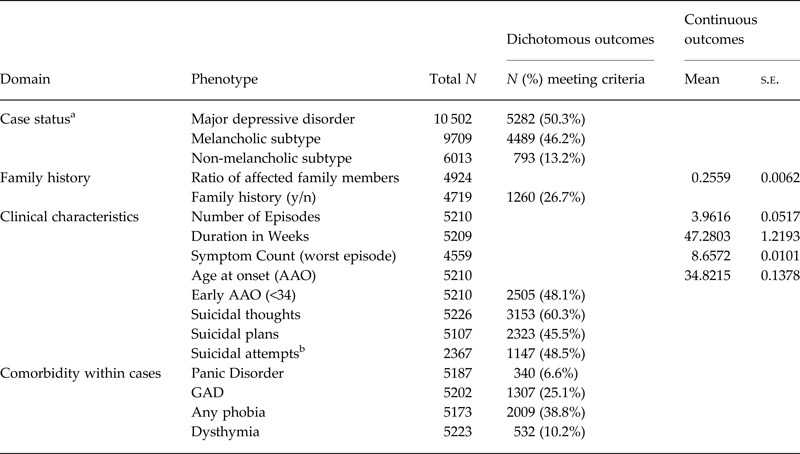
Table 1 provides sample sizes and descriptive statistics for each phenotype assessed. Due to the nature of the analyses, we included only individuals for whom quality controlled genetic data were available, and therefore for whom polygenic scores could be calculated (maximum N = 10 502). Briefly, cases with recurrent depression had an average AAO of 34.82 (s.d. = 0.14) and an average of 3.96 lifetime episodes (s.d. = 0.05); a quarter had a self-reported family history of MDD.
Descriptive statistics for outcome variables in linear and logistic regression analyses

a Reference group for each comparison is MDD – controls (N = 5220)
b Due to the format of the clinical interview, only respondents who endorsed suicidal plans (with some human error) were administered the item regarding suicide attempts
Associations from linear and logistic regressions
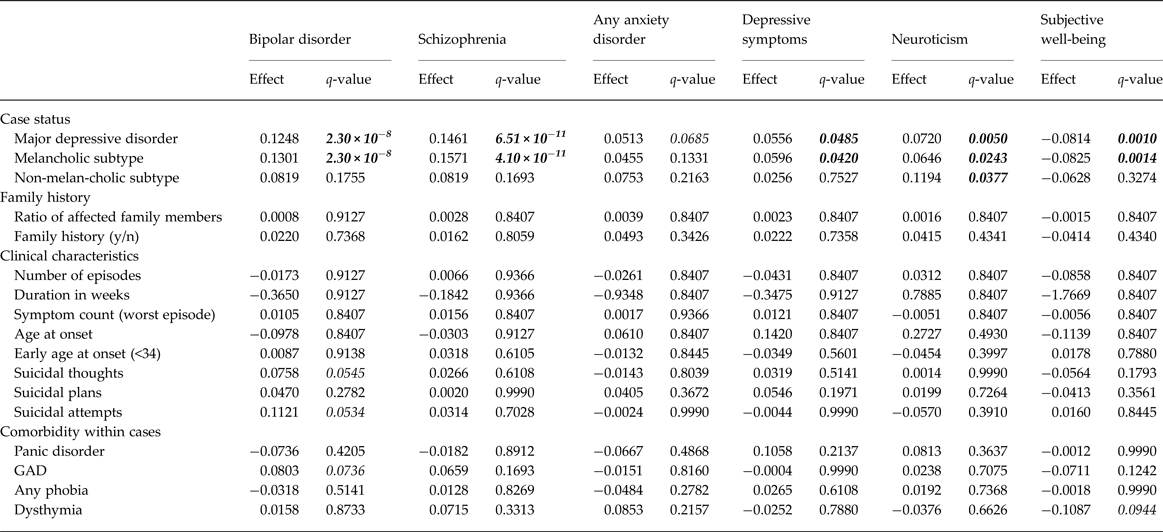
Complete results across all specified priors for LDpred are available in the online Supplemental Table. Here, we focus on results from the 0.3 prior, as this setting slightly outperformed others with respect to average R 2 accounted for by the full model. Results from the 0.3 prior are provided in Table 2. We observed statistically robust associations (q < 1 × 10⁻⁷) between polygenic scores derived from GWAS of bipolar disorder and schizophrenia with MDD case–control status and with MEL. We observed less robust, but still significant (q < 0.05), associations between scores derived from GWAS of depressive symptoms, neuroticism, and subjective well-being and MDD/MEL case–control status. Neuroticism scores were further associated with the non-melancholic subtype. Scores based on anxiety disorders were suggestively associated with MDD case–control status (q = 0.07). For overall MDD, the strongest effect sizes were observed for scores based on SCZ and BPD (Table 2); scores based on neuroticism and subjective well-being were more modest, and those derived from anxiety or depressive symptoms SNP weights were lowest.
Effect sizes and q-values for regressions of CONVERGE major depression-related phenotypes on European-derived polygenic risk scores for psychopathology and correlated phenotypes
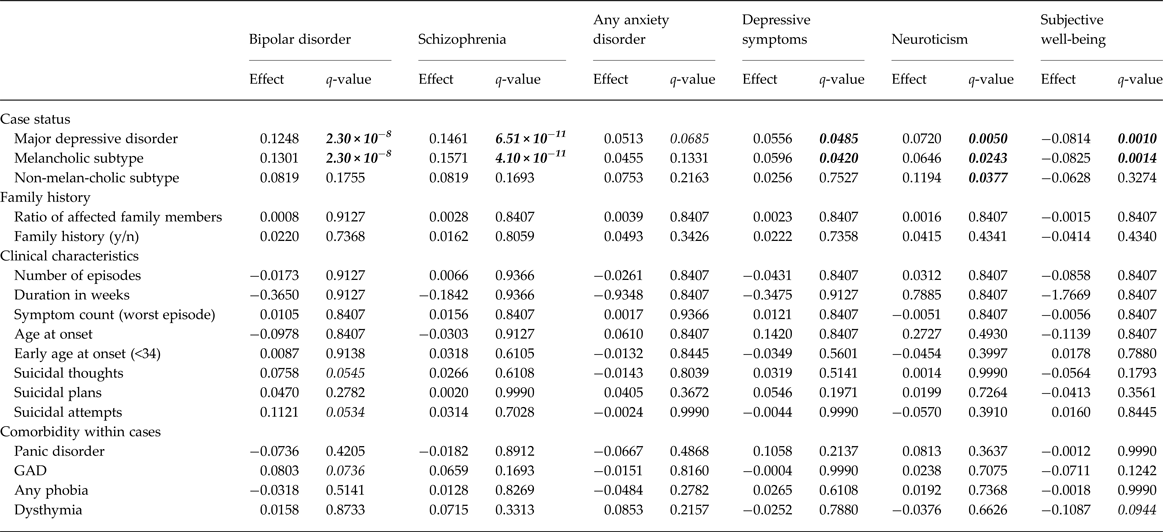
Associations with q < 0.05 are in bold and italicized text; associations with 0.05 < q < 0.10 are in italicized text
Associations between PRS and clinical characteristics or comorbid anxiety disorders were not robust: no associations achieved q < 0.05, though some met significant (though less conservative) p value thresholds (see online Supplemental Table). BPD scores were modestly (0.05 < q < 0.10) associated with suicidal thoughts and attempts. Finally, BPD scores were associated with GAD, and subjective well-being scores were inversely associated with dysthymia (both 0.05 < q < 0.10).
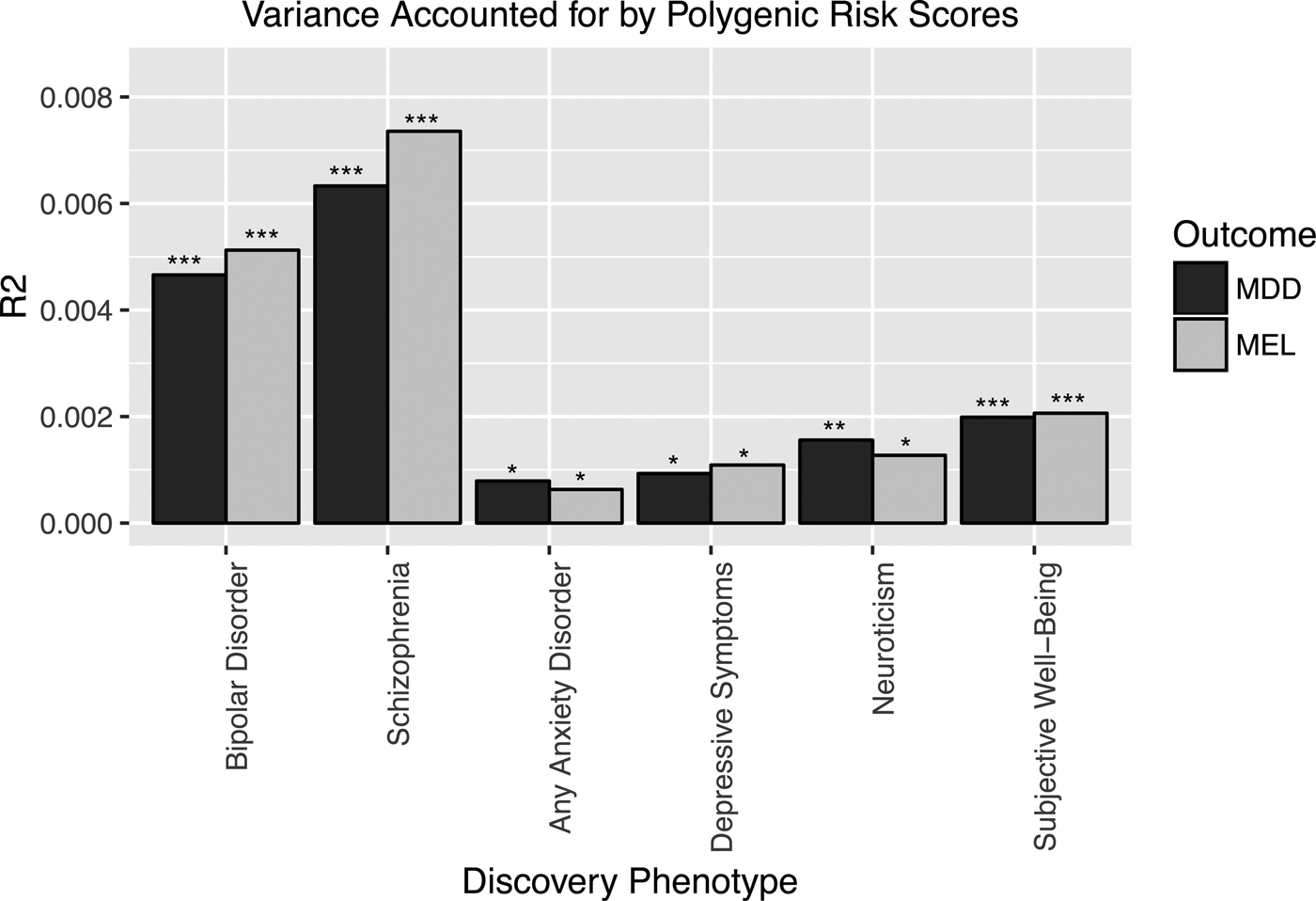
No score accounted for more than 1% of the variance in any CONVERGE phenotype (see online Supplemental Table). The highest R 2 estimates observed were based on PRS derived from SCZ and BPD and their associations with MDD and MEL. Figure 1 depicts variance in MDD and the MEL subtype accounted for by each polygenic score based on the 0.3 prior setting in LDpred. The range of R 2 varied across outcome and discovery phenotypes, sometimes by orders of magnitude, but given the consistently low proportions of variance accounted for it is not clear that these differences are meaningful.
Nagelkerke's pseudo-R 2 values for MDD and the melancholic subtype (MEL) for each polygenic risk score source. Values are based on scores weighted using the 0.3 prior in LDpred. Asterisks correspond to p values associated with dropping the score variable from the regression model. *<0.05; **<0.001; ***<0.0001.

Genetic correlations
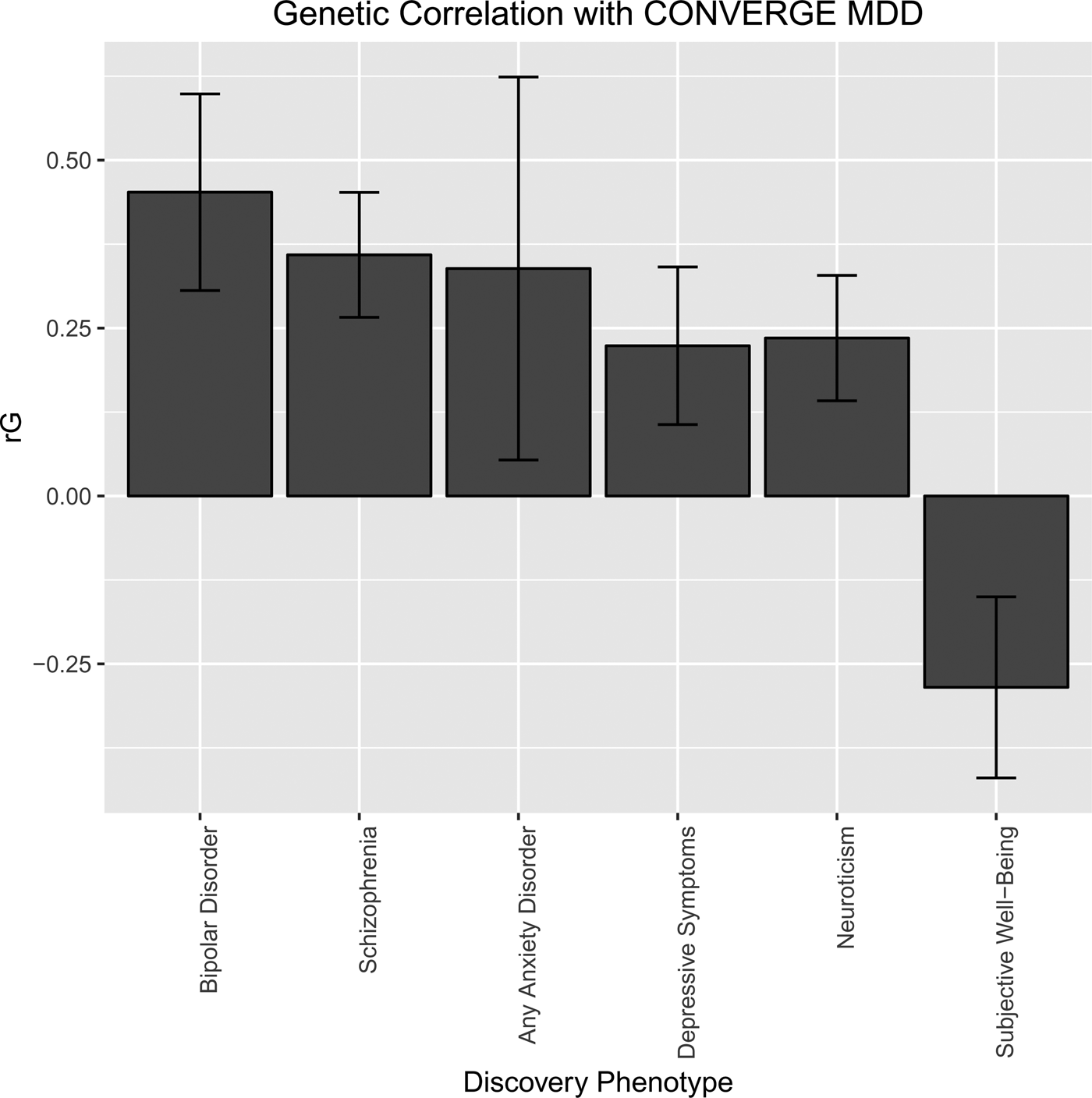
We calculated genetic correlations between discovery phenotypes and CONVERGE MDD. We limited these analyses to the MDD outcome due to the substantial overlap between MDD cases and those with the MEL subtype, and due to the overall absence of associations between PRS and measures of clinical presentation or comorbidity (see above). Results are presented in Fig. 2. The strongest correlation observed was for BPD [rG = 0.45, confidence interval (CI) 0.31–0.59, p = 6.9 × 10⁻¹⁰]; SCZ and ANX were moderately correlated with MDD (rG = 0.36, CI 0.26–0.46, p = 1.9 × 10⁻¹⁴; and rG = 0.34, CI 0.05–0.63, p = 9.9 × 10⁻³, respectively). Depressive symptoms and neuroticism were modestly correlated with MDD (rG = 0.22, CI 0.10–0.34, p = 9.4 × 10⁻⁵; and rG = 0.24, CI 0.14–0.34, 4.0 × 10⁻⁷, respectively), while subjective well-being was negatively correlated (rG = −0.28, CI −0.42 to −0.14, p = 1.7 × 10⁻⁵), as expected given the valence of the phenotypes.
Genetic correlations (95% confidence intervals) between discovery phenotypes, listed on the x-axis, with CONVERGE MDD. Analyses were conducted using Popcorn (Brown et al. Reference Brown, Ye, Price and Zaitlen2016), which accounts for genetic differences across ethnicities.

Discussion
In the current study, we examined the associations between aggregate genetic liability for psychiatric disorders and related traits in samples of European descent with MDD and its clinical features in a large sample of severely affected Han Chinese women. Until recent methodological advances, corresponding trans-ethnic associations have been fraught by technical limitations – importantly, LD structural differences between populations. In light of these advances, our aims were to address whether genetic liability for psychiatric disorders within European samples, which dominate the literature, can be replicated trans-ethnically, and to explore whether specific facets of MDD presentation are differentially related to risk for other psychiatric/psychological features, as this may elucidate shared biological mechanisms. We observed strong associations (q ⩽ 2.3 × 10⁻⁸) between risk scores derived from SCZ (R 2 = 0.006) and BPD (R 2 = 0.005) with CONVERGE case–control status, with more modest but still significant associations from scores based on depressive symptoms, neuroticism, and subjective well-being. Genetic correlations with MDD were modest to moderate (rG = 0.22–0.45) across assessed phenotypes, and strongest for SCZ and BPD. Furthermore, the effect sizes for scores based on BPD and SCZ increased slightly using the more severe melancholic MDD subtype. We did not, however, observe significant associations with MDD clinical features. We conclude that the genetic liability underlying severe psychopathology is robust across ethnicities. The lack of associations between EUR psychiatric PRS with EAS clinical features may due to several, non-mutually exclusive reasons: heterogeneity in the clinical presentation of MDD may be influenced prominently by environmental factors, genetic factors unrelated to other manifestations of psychopathology, or ethnicity-specific genetic influences.
Associations with MDD case–control status
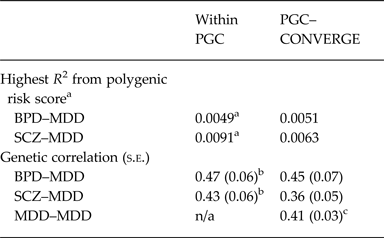
The strong association between SCZ or BPD with MDD case–control status is observed across multiple metrics, including effect size, variance accounted for by PRS, and genetic correlation, which is consistent with some previous research. Such associations have been observed in PGC-led analyses (Cross-Disorder Group of the Psychiatric Genomics Consortium, 2013; Cross-Disorder Group of the Psychiatric Genomics Consortium et al. Reference Lee, Ripke, Neale, Faraone, Purcell, Perlis, Mowry, Thapar, Goddard, Witte, Absher, Agartz, Akil, Amin, Andreassen, Anjorin, Anney, Anttila, Arking, Asherson, Azevedo, Backlund, Badner, Bailey, Banaschewski, Barchas, Barnes, Barrett, Bass, Battaglia, Bauer, Bayes, Bellivier, Bergen, Berrettini, Betancur, Bettecken, Biederman, Binder, Black, Blackwood, Bloss, Boehnke, Boomsma, Breen, Breuer, Bruggeman, Cormican, Buccola, Buitelaar, Bunney, Buxbaum, Byerley, Byrne, Caesar, Cahn, Cantor, Casas, Chakravarti, Chambert, Choudhury, Cichon, Cloninger, Collier, Cook, Coon, Cormand, Corvin, Coryell, Craig, Craig, Crosbie, Cuccaro, Curtis, Czamara, Datta, Dawson, Day, De Geus, Degenhardt, Djurovic, Donohoe, Doyle, Duan, Dudbridge, Duketis, Ebstein, Edenberg, Elia, Ennis, Etain, Fanous, Farmer, Ferrier, Flickinger, Fombonne, Foroud, Frank, Franke, Fraser, Freedman, Freimer, Freitag, Friedl, Frisen, Gallagher, Gejman, Georgieva, Gershon, Geschwind, Giegling, Gill, Gordon, Gordon-Smith, Green, Greenwood, Grice, Gross, Grozeva, Guan, Gurling, De Haan, Haines, Hakonarson, Hallmayer, Hamilton, Hamshere, Hansen, Hartmann, Hautzinger, Heath, Henders, Herms, Hickie, Hipolito, Hoefels, Holmans, Holsboer, Hoogendijk, Hottenga, Hultman, Hus, Ingason, Ising, Jamain, Jones, Jones, Jones, Tzeng, Kahler, Kahn, Kandaswamy, Keller, Kennedy, Kenny, Kent, Kim, Kirov, Klauck, Klei, Knowles, Kohli, Koller, Konte, Korszun, Krabbendam, Krasucki, Kuntsi, Kwan, Landen, Langstrom, Lathrop, Lawrence, Lawson, Leboyer, Ledbetter, Lee, Lencz, Lesch, Levinson, Lewis, Li, Lichtenstein, Lieberman, Lin, Linszen, Liu, Lohoff, Loo, Lord, Lowe, Lucae, MacIntyre, Madden, Maestrini, Magnusson, Mahon, Maier, Malhotra, Mane, Martin, Martin, Mattheisen, Matthews, Mattingsdal, McCarroll, McGhee, McGough, McGrath, McGuffin, McInnis, McIntosh, McKinney, McLean, McMahon, McMahon, McQuillin, Medeiros, Medland, Meier, Melle, Meng, Meyer, Middeldorp, Middleton, Milanova, Miranda, Monaco, Montgomery, Moran, Moreno-De-Luca, Morken, Morris, Morrow, Moskvina, Muglia, Muhleisen, Muir, Muller-Myhsok, Murtha, Myers, Myin-Germeys, Neale, Nelson, Nievergelt, Nikolov, Nimgaonkar, Nolen, Nothen, Nurnberger, Nwulia, Nyholt, O'Dushlaine, Oades, Olincy, Oliveira, Olsen, Ophoff, Osby, Owen, Palotie, Parr, Paterson, Pato, Pato, Penninx, Pergadia, Pericak-Vance, Pickard, Pimm, Piven, Posthuma, Potash, Poustka, Propping, Puri, Quested, Quinn, Ramos-Quiroga, Rasmussen, Raychaudhuri, Rehnstrom, Reif, Ribases, Rice, Rietschel, Roeder, Roeyers, Rossin, Rothenberger, Rouleau, Ruderfer, Rujescu, Sanders, Sanders, Santangelo, Sergeant, Schachar, Schalling, Schatzberg, Scheftner, Schellenberg, Scherer, Schork, Schulze, Schumacher, Schwarz, Scolnick, Scott, Shi, Shilling, Shyn, Silverman, Slager, Smalley, Smit, Smith, Sonuga-Barke, St Clair, State, Steffens, Steinhausen, Strauss, Strohmaier, Stroup, Sutcliffe, Szatmari, Szelinger, Thirumalai, Thompson, Todorov, Tozzi, Treutlein, Uhr, van den Oord, Van Grootheest, Van Os, Vicente, Vieland, Vincent, Visscher, Walsh, Wassink, Watson, Weissman, Werge, Wienker, Wijsman, Willemsen, Williams, Willsey, Witt, Xu, Young, Yu, Zammit, Zandi, Zhang, Zitman, Zollner, Devlin, Kelsoe, Sklar, Daly, O'Donovan, Craddock, Sullivan, Smoller, Kendler and Wray2013) and one previous study (Verduijn et al. Reference Verduijn, Milaneschi, Peyrot, Hottenga, Abdellaoui, de Geus, Smit, Breen, Lewis, Boomsma, Beekman and Penninx2017) has observed that MDD cases with earlier AAO or higher symptom severity are at increased genetic risk for SCZ and BPD, though those results were not replicated in the current study. The current results are notable in their quantitative similarity to those of the PGC (Table 3); the genetic signals relevant to MDD across EUR and EAS are only slightly attenuated, if at all. This is in contrast to substantial attenuation observed across EUR and samples of African descent (e.g. for SCZ (International Schizophrenia Consortium et al. Reference Purcell, Wray, Stone, Visscher, O'Donovan, Sullivan and Sklar2009)).
Comparison of relationships between BPD and MDD or SCZ and MDD, within EUR ethnicity (‘Within PGC’ column) or across ethnicities (‘PGC–CONVERGE’ column)
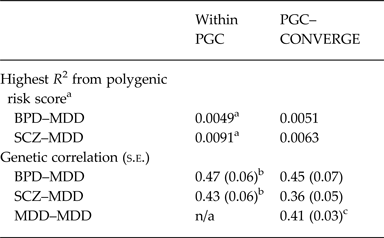
a Within-PGC results obtained from Cross-Disorder Group of the Psychiatric Genomics Consortium (2013)
In contrast to the SCZ/BPD results, the weaker results based on anxiety (‘any anxiety disorder’) are potentially due to the heterogeneity of the discovery phenotype or the reduced power in the anxiety discovery sample. Twin studies have demonstrated a substantial genetic correlation between GAD and MDD (Kendler et al. Reference Kendler, Prescott, Myers and Neale2003, Reference Kendler, Gardner, Gatz and Pedersen2007; Hettema et al. Reference Hettema, Neale, Myers, Prescott and Kendler2006), while MDD has appeared to be less strongly genetically correlated with phobias, panic disorder, and other internalizing disorders (Hettema et al. Reference Hettema, Neale, Myers, Prescott and Kendler2006), though this was not the case in a highly selected family sample (Guffanti et al. Reference Guffanti, Gameroff, Warner, Talati, Glatt, Wickramaratne and Weissman2016). Had discovery summary statistics been based on only GAD, it is possible that we would have observed more robust associations with CONVERGE outcomes. These results, in conjunction with a moderate genetic correlation with CONVERGE MDD, could indicate that while the genetic liability across ethnicities is similar, the manifestation of these disorders may be sensitive to non-genetic and/or ethnicity-specific factors.
The lower genetic correlations and proportions of variance accounted for by non-diagnostic discovery phenotypes – in particular, depressive symptoms and neuroticism – contribute to the suggestion that shared genetic liability is most evident within severe manifestations of psychopathology. Another potential factor impacting results is the difference in ascertainment: polygenic risk for depressive symptoms and neuroticism was based on population-based samples but projected into a severely affected MDD sample. Variation likely exists in phenotypic distributions and trait assessment across the discovery and target samples; for example, relative to clinically ascertained cases, population-based cases may have lower mean symptom counts, may include individuals whose depression was less persistent, and may meet criteria for less stringent screening instruments.
There is prior evidence of modest to high genetic correlations between N and depression (Hettema et al. Reference Hettema, Neale, Myers, Prescott and Kendler2006; Kendler & Myers, Reference Kendler and Myers2010); in addition, we have previously demonstrated associations between EUR-based N, using UK Biobank data, and CONVERGE MDD case–control status (Docherty et al. Reference Docherty, Moscati, Peterson, Edwards, Adkins, Bacanu, Bigdeli, Webb, Flint and Kendler2016). For comparison, however, the trans-ethnic correlation for recurrent MDD is 0.41 (Bigdeli et al. Reference Bigdeli, Ripke, Bacanu, Peterson, Abdellaoui, Andlauer, Beekman, Berger, Blackwood, Boomsma, Breen, Buttenschøn, Byrne, Cichon, Clarke, Couvy-Duchesne, Craddock, de Geus, Degenhardt, Dunn, Fanous, Forstner, Frank, Gill, Gordon, Grabe, Hamilton, Hardiman, Hayward, Heath, Henders, Herms, Hickie, Hoffmann, Homuth, Hottenga, Ising, Jansen, Kloiber, Knowles, Lang, Li, Lucae, MacIntyre, Madden, Martin, McGrath, McGuffin, McIntosh, Medland, Mehta, Middeldorp, Milaneschi, Montgomery, Mors, Müller-Myhsok, Nauck, Nyholt, Nöthen, Owen, Penninx, Pergadia, Perlis, Peyrot, Porteous, Potash, Rice, Rietschel, Riley, Rivera, Schoevers, Schulze, Shi, Shyn, Smit, Smoller, Streit, Strohmaier, Teumer, Treutlein, Van der Auwera, van Grootheest, van Hemert, Völzke, Webb, Weissman, Wellmann, Willemsen, Witt, Levinson, Lewis, Wray, Flint, Sullivan and Kendler2017), thus the magnitudes of our observed correlations are not unexpected. Findings for the non-melancholic MDD subtype further support the hypothesis that genetic factors are common across more severe psychopathologies. Only neuroticism PRS were associated with the less severe, non-melancholic MDD subtype. This association is consistent with previous research observing neuroticism to be higher among women with a history of non-melancholic depression (Kendler, Reference Kendler1997), though an earlier analysis of the CONVERGE sample observed higher N among the MEL group (Sun et al. Reference Sun, Li, Cai, Chen, Shen, Sun, Zhang, Zhang, Wang, Guo, Yang, Qiang, Yang, Wang, Du, Xia, Rong, Gan, Hu, Pan, Li, Sun, Han, Xiao, Dai, Jin, Zhang, Sun, Chen, Zhao, Dang, Shi, Kendler, Flint and Zhang2012). Furthermore, a study reported a strong genetic correlation (rG = 0.64) between neuroticism and MDD in the PGC (Smith et al. Reference Smith, Escott-Price, Davies, Bailey, Colodro-Conde, Ward, Vedernikov, Marioni, Cullen, Lyall, Hagenaars, Liewald, Luciano, Gale, Ritchie, Hayward, Nicholl, Bulik-Sullivan, Adams, Couvy-Duchesne, Graham, Mackay, Evans, Smith, Porteous, Medland, Martin, Holmans, McIntosh, Pell, Deary and O'Donovan2016), though the samples included were primarily of European ancestry. Thus, the current results should be interpreted with caution.
Also notable is the significant prediction of MDD and MEL status from the subjective well-being PRS in this sample. These results are consistent with recent polygenic research on well-being in a large European sample (Okbay et al. Reference Okbay, Baselmans, De Neve, Turley, Nivard, Fontana, Meddens, Linner, Rietveld, Derringer, Gratten, Lee, Liu, de Vlaming, Ahluwalia, Buchwald, Cavadino, Frazier-Wood, Furlotte, Garfield, Geisel, Gonzalez, Haitjema, Karlsson, van der Laan, Ladwig, Lahti, van der Lee, Lind, Liu, Matteson, Mihailov, Miller, Minica, Nolte, Mook-Kanamori, van der Most, Oldmeadow, Qian, Raitakari, Rawal, Realo, Rueedi, Schmidt, Smith, Stergiakouli, Tanaka, Taylor, Wedenoja, Wellmann, Westra, Willems, Zhao, LifeLines Cohort, Amin, Bakshi, Boyle, Cherney, Cox, Davies, Davis, Ding, Direk, Eibich, Emeny, Fatemifar, Faul, Ferrucci, Forstner, Gieger, Gupta, Harris, Harris, Holliday, Hottenga, De Jager, Kaakinen, Kajantie, Karhunen, Kolcic, Kumari, Launer, Franke, Li-Gao, Koini, Loukola, Marques-Vidal, Montgomery, Mosing, Paternoster, Pattie, Petrovic, Pulkki-Raback, Quaye, Raikkonen, Rudan, Scott, Smith, Sutin, Trzaskowski, Vinkhuyzen, Yu, Zabaneh, Attia, Bennett, Berger, Bertram, Boomsma, Snieder, Chang, Cucca, Deary, van Duijn, Eriksson, Bultmann, de Geus, Groenen, Gudnason, Hansen, Hartman, Haworth, Hayward, Heath, Hinds, Hypponen, Iacono, Jarvelin, Jockel, Kaprio, Kardia, Keltikangas-Jarvinen, Kraft, Kubzansky, Lehtimaki, Magnusson, Martin, McGue, Metspalu, Mills, de Mutsert, Oldehinkel, Pasterkamp, Pedersen, Plomin, Polasek, Power, Rich, Rosendaal, den Ruijter, Schlessinger, Schmidt, Svento, Schmidt, Alizadeh, Sorensen, Spector, Steptoe, Terracciano, Thurik, Timpson, Tiemeier, Uitterlinden, Vollenweider, Wagner, Weir, Yang, Conley, Smith, Hofman, Johannesson, Laibson, Medland, Meyer, Pickrell, Esko, Krueger, Beauchamp, Koellinger, Benjamin, Bartels and Cesarini2016), and establish a precedent for association with psychiatric phenotypes across European and Chinese ancestries. Association of well-being PRS with both MDD and MEL is also consistent with unpublished data from this group predicting decreased depressive symptoms, anxiety symptoms, and family history of mental health problems from well-being PRS in college students of European ancestry (A. R. Docherty et al. unpublished observations). However, in the current analysis, we did not observe well-being PRS to be significantly associated with the severity or chronicity of MDD beyond the severity that is reflected in MEL case status. Such results inform future study of polygenic resilience, pointing to the relevance of well-being PRS in predicting real-world outcomes and prognosis, but also indicate that clinical characteristics of MDD may be more sensitively predicted with (1) integration of additional risk factors or exposures, and/or (2) with future studies of well-being PRS based on non-European (or specifically Han) sample summary statistics.
Associations with features of MDD
With the exception of several suggestive (0.05 < q < 0.10) associations (BPD-based scores with suicidal thoughts, suicide attempts, and GAD; SWB-based scores with dysthymia), we did not observe strong relationships between PRS derived from EUR samples and features of MDD in CONVERGE. This is in contrast to some within-EUR analyses: e.g. BPD and SCZ were associated more strongly with early-onset MDD than with later-onset MDD as reported by Power et al. (Reference Power, Tansey, Buttenschøn, Cohen-Woods, Bigdeli, Hall, Kutalik, Lee, Ripke, Steinberg, Teumer, Viktorin, Wray, Arolt, Baune, Boomsma, Børglum, Byrne, Castelao, Craddock, Craig, Dannlowski, Deary, Degenhardt, Forstner, Gordon, Grabe, Grove, Hamilton, Hayward, Heath, Hocking, Homuth, Hottenga, Kloiber, Krogh, Landén, Lang, Levinson, Lichtenstein, Lucae, MacIntyre, Madden, Magnusson, Martin, McIntosh, Middeldorp, Milaneschi, Montgomery, Mors, Müller-Myhsok, Nyholt, Oskarsson, Owen, Padmanabhan, Penninx, Pergadia, Porteous, Potash, Preisig, Rivera, Shi, Shyn, Sigurdsson, Smit, Smith, Stefansson, Stefansson, Strohmaier, Sullivan, Thomson, Thorgeirsson, Van der Auwera, Weissman, Breen and Lewis2017) (CONVERGE served as a replication sample in that study).
One potential interpretation of the current results is that genetic factors contributing to clinical features of MDD are ethnicity-specific, or are unshared with variants impacting liability to other psychopathology. Another potential explanation is based on the ascertainment strategy: Power et al. (Reference Power, Tansey, Buttenschøn, Cohen-Woods, Bigdeli, Hall, Kutalik, Lee, Ripke, Steinberg, Teumer, Viktorin, Wray, Arolt, Baune, Boomsma, Børglum, Byrne, Castelao, Craddock, Craig, Dannlowski, Deary, Degenhardt, Forstner, Gordon, Grabe, Grove, Hamilton, Hayward, Heath, Hocking, Homuth, Hottenga, Kloiber, Krogh, Landén, Lang, Levinson, Lichtenstein, Lucae, MacIntyre, Madden, Magnusson, Martin, McIntosh, Middeldorp, Milaneschi, Montgomery, Mors, Müller-Myhsok, Nyholt, Oskarsson, Owen, Padmanabhan, Penninx, Pergadia, Porteous, Potash, Preisig, Rivera, Shi, Shyn, Sigurdsson, Smit, Smith, Stefansson, Stefansson, Strohmaier, Sullivan, Thomson, Thorgeirsson, Van der Auwera, Weissman, Breen and Lewis2017) recommended using more homogenous groups of MDD cases in the quest to identify genetic risk variants, an approach employed by CONVERGE. However, this results in a reduction in phenotypic variance (e.g. 75% of cases endorsed all nine DSM criteria for MD), reducing our power to detect true associations.
Yet, another potential explanation for the overall absence of associations with MDD clinical features is that clinical presentation is pathoplastic (Keller et al. Reference Keller, Neale and Kendler2007; Kendler & Aggen, Reference Kendler and Aggen2017) – that is, subject to environmental factors and individual variation in risk that is not a function of core physiological processes/genetic liability. Keller et al. (Reference Keller, Neale and Kendler2007) reported that MDD symptom endorsement varied in conjunction with exposure to diverse stressful life events, which suggests that genetic factors are not markedly influential on heterogeneity in symptom profiles, assuming environmental risk factors are independent (i.e. not a function of the depressive state). Kendler & Aggen (Reference Kendler and Aggen2017) further demonstrated that, within individuals, symptom presentation is only modestly heritable (r~0.3) across depressive episodes. These scenarios are not mutually exclusive: indeed, given the complexity of psychopathology, the current results may be due to a combination of ethnicity-specific genetic factors, ascertainment strategy, and the impact of sociocultural/environmental factors on fine-scale clinical heterogeneity.
Limitations
We note several limitations to the current study. First, while the ascertainment approach minimized the likelihood of false positives and was ideal for the primary aims of the CONVERGE study, the resulting sample of severely affected MDD cases is less phenotypically diverse than other MDD samples. This reduction in variance could have obscured potential associations between PRS and features of MDD cases.
Second, we utilized LDpred to generate PRS, whereas previous reports [e.g. the PGC Cross-Disorder Group (Cross-Disorder Group of the Psychiatric Genomics Consortium et al. Reference Lee, Ripke, Neale, Faraone, Purcell, Perlis, Mowry, Thapar, Goddard, Witte, Absher, Agartz, Akil, Amin, Andreassen, Anjorin, Anney, Anttila, Arking, Asherson, Azevedo, Backlund, Badner, Bailey, Banaschewski, Barchas, Barnes, Barrett, Bass, Battaglia, Bauer, Bayes, Bellivier, Bergen, Berrettini, Betancur, Bettecken, Biederman, Binder, Black, Blackwood, Bloss, Boehnke, Boomsma, Breen, Breuer, Bruggeman, Cormican, Buccola, Buitelaar, Bunney, Buxbaum, Byerley, Byrne, Caesar, Cahn, Cantor, Casas, Chakravarti, Chambert, Choudhury, Cichon, Cloninger, Collier, Cook, Coon, Cormand, Corvin, Coryell, Craig, Craig, Crosbie, Cuccaro, Curtis, Czamara, Datta, Dawson, Day, De Geus, Degenhardt, Djurovic, Donohoe, Doyle, Duan, Dudbridge, Duketis, Ebstein, Edenberg, Elia, Ennis, Etain, Fanous, Farmer, Ferrier, Flickinger, Fombonne, Foroud, Frank, Franke, Fraser, Freedman, Freimer, Freitag, Friedl, Frisen, Gallagher, Gejman, Georgieva, Gershon, Geschwind, Giegling, Gill, Gordon, Gordon-Smith, Green, Greenwood, Grice, Gross, Grozeva, Guan, Gurling, De Haan, Haines, Hakonarson, Hallmayer, Hamilton, Hamshere, Hansen, Hartmann, Hautzinger, Heath, Henders, Herms, Hickie, Hipolito, Hoefels, Holmans, Holsboer, Hoogendijk, Hottenga, Hultman, Hus, Ingason, Ising, Jamain, Jones, Jones, Jones, Tzeng, Kahler, Kahn, Kandaswamy, Keller, Kennedy, Kenny, Kent, Kim, Kirov, Klauck, Klei, Knowles, Kohli, Koller, Konte, Korszun, Krabbendam, Krasucki, Kuntsi, Kwan, Landen, Langstrom, Lathrop, Lawrence, Lawson, Leboyer, Ledbetter, Lee, Lencz, Lesch, Levinson, Lewis, Li, Lichtenstein, Lieberman, Lin, Linszen, Liu, Lohoff, Loo, Lord, Lowe, Lucae, MacIntyre, Madden, Maestrini, Magnusson, Mahon, Maier, Malhotra, Mane, Martin, Martin, Mattheisen, Matthews, Mattingsdal, McCarroll, McGhee, McGough, McGrath, McGuffin, McInnis, McIntosh, McKinney, McLean, McMahon, McMahon, McQuillin, Medeiros, Medland, Meier, Melle, Meng, Meyer, Middeldorp, Middleton, Milanova, Miranda, Monaco, Montgomery, Moran, Moreno-De-Luca, Morken, Morris, Morrow, Moskvina, Muglia, Muhleisen, Muir, Muller-Myhsok, Murtha, Myers, Myin-Germeys, Neale, Nelson, Nievergelt, Nikolov, Nimgaonkar, Nolen, Nothen, Nurnberger, Nwulia, Nyholt, O'Dushlaine, Oades, Olincy, Oliveira, Olsen, Ophoff, Osby, Owen, Palotie, Parr, Paterson, Pato, Pato, Penninx, Pergadia, Pericak-Vance, Pickard, Pimm, Piven, Posthuma, Potash, Poustka, Propping, Puri, Quested, Quinn, Ramos-Quiroga, Rasmussen, Raychaudhuri, Rehnstrom, Reif, Ribases, Rice, Rietschel, Roeder, Roeyers, Rossin, Rothenberger, Rouleau, Ruderfer, Rujescu, Sanders, Sanders, Santangelo, Sergeant, Schachar, Schalling, Schatzberg, Scheftner, Schellenberg, Scherer, Schork, Schulze, Schumacher, Schwarz, Scolnick, Scott, Shi, Shilling, Shyn, Silverman, Slager, Smalley, Smit, Smith, Sonuga-Barke, St Clair, State, Steffens, Steinhausen, Strauss, Strohmaier, Stroup, Sutcliffe, Szatmari, Szelinger, Thirumalai, Thompson, Todorov, Tozzi, Treutlein, Uhr, van den Oord, Van Grootheest, Van Os, Vicente, Vieland, Vincent, Visscher, Walsh, Wassink, Watson, Weissman, Werge, Wienker, Wijsman, Willemsen, Williams, Willsey, Witt, Xu, Young, Yu, Zammit, Zandi, Zhang, Zitman, Zollner, Devlin, Kelsoe, Sklar, Daly, O'Donovan, Craddock, Sullivan, Smoller, Kendler and Wray2013)] have typically used a method based on p value thresholds without modeling LD (International Schizophrenia Consortium et al. Reference Purcell, Wray, Stone, Visscher, O'Donovan, Sullivan and Sklar2009). LDpred outperforms traditional threshold-based scoring in terms of predicted R 2 in some cases (Vilhjalmsson et al. Reference Vilhjalmsson, Yang, Finucane, Gusev, Lindstrom, Ripke, Genovese, Loh, Bhatia, Do, Hayeck, Won, Kathiresan, Pato, Pato, Tamimi, Stahl, Zaitlen, Pasaniuc, Belbin, Kenny, Schierup, De Jager, Patsopoulos, McCarroll, Daly, Purcell, Chasman, Neale, Goddard, Visscher, Kraft, Patterson and Price2015) and it is possible that, had we employed the threshold-based method, our results might have suggested stronger attenuation of signal across ethnicities. However, LDpred facilitates comparisons across ethnicities due to its handling of LD in the derivation of PRS. One limitation of LDpred is its use of hard-called genetic data, though this is mitigated through the restriction to high-confidence (⩾0.9 probability) calls.
Third, our analyses were limited to Han Chinese women, and we are unable to determine the extent to which aggregate genetic factors influencing severe psychopathology are shared with MDD in Han Chinese men or with other East Asian ethnicities. As noted elsewhere, comparisons between EUR samples and other ethnicities, such as African Americans, have yielded less consistent evidence of shared genetic effects. Furthermore, we were unable to formally assess whether genetic relationships differed as a function of gender, as we utilized publicly available summary statistics from studies in which genders were combined. Prior work has demonstrated that restricting analyses to within a gender can, for example, result in increased estimates of genetic correlation (Bigdeli et al. Reference Bigdeli, Ripke, Bacanu, Peterson, Abdellaoui, Andlauer, Beekman, Berger, Blackwood, Boomsma, Breen, Buttenschøn, Byrne, Cichon, Clarke, Couvy-Duchesne, Craddock, de Geus, Degenhardt, Dunn, Fanous, Forstner, Frank, Gill, Gordon, Grabe, Hamilton, Hardiman, Hayward, Heath, Henders, Herms, Hickie, Hoffmann, Homuth, Hottenga, Ising, Jansen, Kloiber, Knowles, Lang, Li, Lucae, MacIntyre, Madden, Martin, McGrath, McGuffin, McIntosh, Medland, Mehta, Middeldorp, Milaneschi, Montgomery, Mors, Müller-Myhsok, Nauck, Nyholt, Nöthen, Owen, Penninx, Pergadia, Perlis, Peyrot, Porteous, Potash, Rice, Rietschel, Riley, Rivera, Schoevers, Schulze, Shi, Shyn, Smit, Smoller, Streit, Strohmaier, Teumer, Treutlein, Van der Auwera, van Grootheest, van Hemert, Völzke, Webb, Weissman, Wellmann, Willemsen, Witt, Levinson, Lewis, Wray, Flint, Sullivan and Kendler2017). It is possible that our findings were impacted by this factor.
These limitations are offset by a large, carefully and consistently ascertained sample, which improves statistical power, and by in-depth phenotypic assessments that enabled the exploration of features beyond MDD case–control status. Our findings provide support for the hypothesis that multiple manifestations of severe psychopathology are influenced to a non-trivial degree by common genetic liability, and that these shared genetic relationships are generalizable across some ethnic groups. In conjunction with future studies, the current findings have the potential to further clarify the etiology of severe psychopathology generally as well as elucidate genetic factors specific to MDD liability. Furthermore, understanding common v. ethnicity-specific factors may improve tailored approaches to treatment.
Supplementary material
The supplementary material for this article can be found at https://doi.org/10.1017/S0033291717002148.
Acknowledgements
This work was funded by the Wellcome Trust (grant numbers WT090532/Z/09/Z, WT083573/Z/07/Z, and WT089269/Z/09/Z), the National Institutes of Health (MH100549 to KSK; AA021399 to ACE; MH087646 to JMH; and MH093731 to ARD), and the Brain and Behavior Research Foundation (ARD).
Declaration of Interest
None to report.