Bycatch is generally considered a negative and wasteful consequence of applied trapping systems used in pest management. However, bycatch can provide useful data for (1) potential identification of new species records including unexpected introductions of pest species and threatened species (Buchholz et al. Reference Buchholz, Kreuels, Kronshage, Terlutter and Finch2011); (2) characterising the composition and diversity of insect communities in a given area that can be used to assess relative ecological health, comparing diversity between areas, and identifying biodiversity hotspots that may be set aside for protection (Pohl Reference Pohl2009); and (3) gaining general knowledge and data on local, regional, and even broader scaled distribution ranges useful for faunal catalogues, macroecological studies, and species inventories (Buchholz et al. Reference Buchholz, Kreuels, Kronshage, Terlutter and Finch2011).
During the summers of 2009–2011, Delta® sticky traps (Great Lakes IPM, Vestaburg, Michigan, United States of America) baited with single compounds and blends of sex-attractant pheromone compounds were set-up in Nova Scotia, Canada wild blueberry fields to examine the potential of a sex attractant-based trapping system for monitoring Aroga trialbamaculella Chambers (Lepidoptera: Gelechiidae), a pest of wild blueberries (Vaccinium angustifolium Aiton; Ericaceae) in the Maritime Provinces of Canada. Traps were hung from two-foot stakes in wild blueberry fields in Kemptville (44°2′58.330′′N, 65°49′59.260′′W; and 44°5′12.74′′N, 65°45′58.79′′W), Glenholme (45°24′25.800′′N, 63°32′8.760′′W) and Earltown (45°35′4.080′′N, 63°10′59.220W; 45°35′8.520′′N, 63°11′9.900′′W; and 45°35′42.600′′N, 63°13′37.800′′W), Nova Scotia, Canada. Traps in Kemptville were set-up in a 4 × 6 grid pattern at each field, whereas traps in Glenholme were erected in a picket-line fashion along the field edge alongside the blueberry crop. All traps were 20 m apart with 20 m from roadsides or woods. Trap catch counts were recorded weekly at each field and traps were rotated by one position throughout the grid or picket line each week to mitigate the impact of edge or crop effects. Traps were baited with rubber septa lures loaded at 1 mg/μl with single compounds and blends of (E)-9-tetradecenyl acetate, (Z)-5-dodecenyl acetate, (Z)-7-dodecenyl acetate, (Z)-11-tetradecenyl acetate, (Z)-9-tetradecenyl acetate, (Z)-3-dodecenyl acetate, and hexane. Selection of treatment compounds was based on their usefulness for trapping other Gelechiidae species and general access to commercial synthetic compounds listed on the Pherobase© database of pheromones and semiochemicals website (El-Sayed Reference El-Sayed2009).
In 2009, there were two species with high numbers from the study's total bycatch: one gelechiid, Bryotropha plantariella Tengstrom (Lepidoptera: Gelechiidae); and one noctuid, Cucullia umbratica Linnaeus (Lepidoptera: Noctuidae). In 2010, C. umbratica again had high catches within the total bycatch. In 2011, one gelechiid species, Agnippe prunifoliella Chambers (Lepidoptera: Gelechiidae), had marked numbers within the total bycatch. Samples representative of each species were prepared and purified for molecular identification using QIAprep Spin Miniprep Kit (QIAGEN Inc.©; Valencia, California, United States of America) and sent to McGill University and Genome Quebec Innovation Centre (MUGQIC), Montreal, Quebec, Canada, for sequencing. Sequence results were accessed through Nanuq, a web application designed by MUGQIC to support all genomic and proteomic services, and subjected to a BLAST (Basic Local Alignment Search Tool) search. Species identifications were determined by matching BLAST results with Barcode of Life Data Systems v 2.5 database sequences (Haussman et al. Reference Haussman, Hebert and Rougerie2009). Voucher specimens were sent to the Canadian National Collection of Insects, Arachnids, and Nematodes (CNC) in Ottawa, Ontario, Canada for cataloguing and identification using standard morphological techniques.
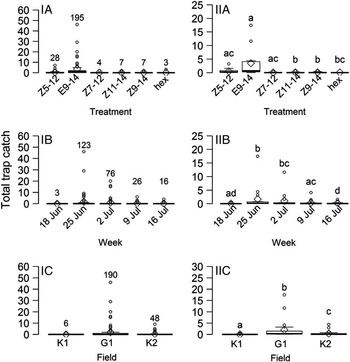
Bryotropha plantariella is a microlepidopteran occurring in lowland regions of Canada (Rutten and Karsholt Reference Rutten and Karsholt2004). In 2009 attractant-trapping studies, (E)-9-tetradecenyl acetate had the highest total (pooled) number of captures of B. plantariella, highest mean catch, and was different from all treatments excluding (Z)-5-dodecenyl acetate (Fig. 1, IA and IIA). Low catches in the (Z)-5-dodecenyl acetate treatment (4) resulted in a large standard deviation and the highest catching treatment, (E)-9-tetradecenyl acetate, fell within its modelled range. Compound (E)-9-tetradecenyl acetate is a new potential sex attractant for B. plantariella not yet recorded for this species. The trapping period of 25 June had a significantly greater mean catch than all other weeks (P < 0.002 for all cases) except 2 July (P = 0.11; Fig. 1, IIB). These periods indicate possible peak flight or mating times for B. plantariella. All fields were significantly different from each other with the Glenholme site (G1) having the greatest mean catch and also highest total number of captures (Fig. 1, IIC; P < 0.001 for all comparisons).
Observed (IA, IB, IC) and zero-inflated negative binomial model of expected (IIA, IIB, IIC) Bryotropha plantariella counts for 2009 attractant-trapping trials conducted in Nova Scotia, Canada wild blueberry fields. Treatments included: (Z)-5-dodecenyl acetate (Z5-12); (E)-9-tetradecenyl acetate (E9-14); (Z)-7-dodecenyl acetate (Z7-12); (Z)-11-tetradecenyl acetate (Z11-14); (Z)-9-tetradecenyl acetate (Z9-14), and hexane (hex). Fields included: Kemptville1 (K1); Glenholme (G1); and Kemptville2 (K2). Mean counts (diamonds) are included from the data for comparison. Treatment, Week, and Field in (IIA, IIB, IIC) that share letters did not have significantly different counts. Total counts are provided above boxplots.

There are currently no records of B. plantariella in Nova Scotia's three main catalogue sites: the Nova Scotia Museum of Natural History (Halifax, Nova Scotia, Canada), Department of Natural Resources (Shubenacadie, Nova Scotia, Canada), and the Nova Scotia Agricultural College A.D. Pickett Entomology Museum (Bible Hill, Nova Scotia, Canada). Based on CNC specimens, the only records of B. plantariella in Nova Scotia were in Parrsboro and White Point Beach, collected by McDunnough in the 1930s (J.-F. Landry, personal communication, CNC, 18 August 2011).
Cucullia umbratica catches from both 2009 and 2010 could not be modelled because catches occurred only in (Z)-9-tetradecenyl acetate (i.e. zeros in all other treatments), and thus model convergence was not reached. Wilcoxon rank-sum tests verify (Z)-9-tetradecenyl acetate as the most attractive compound for C. umbratica from treatments tested (2009, W = 0, P < 0.001; and 2010, W = 0, P < 0.001); suggesting this compound as a potential sex attractant, as previously identified for this species by El-Sayed (Reference El-Sayed2009). Cucullia umbratica is a European introduced species with one previous North American record in the Magdalen Islands (Québec, Canada) (Handfield and Handfield Reference Handfield and Handfield2010). According to Handfield and Handfield (Reference Handfield and Handfield2010), C. umbratica's accidental introduction to the Magdalen Islands (Québec, Canada) occurred during the 1990s. Since 1998, Handfield and Handfield (Reference Handfield and Handfield2010) have reported capturing over 100 C. umbratica specimens in the Magdalen Islands. No continental records for C. umbratica are previously known.
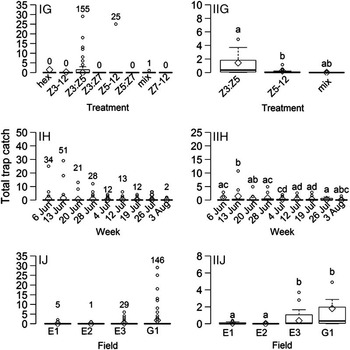
In 2011, most treatments caught low numbers of A. prunifoliella (Fig. 2, IG) and were removed to obtain model convergence (Fig. 2, IIG). (Z)-3-dodecenyl acetate: (Z)-5-dodecenyl acetate showed significantly greater mean catch than (Z)-5-dodecenyl acetate (P ⩽ 0.002) but not (Z)-5-dodecenyl acetate: (Z)-7-dodecenyl acetate: (Z)-3-dodecenyl acetate due to a large standard deviation. Blend (Z)-3-dodecenyl acetate: (Z)-5-dodecenyl acetate is a new potential sex attractant for A. prunifoliella not yet recorded for this species. Agnippe prunifoliella captures were relatively consistent across weeks making no indication of peak flight or mating times (Fig. 2, IIH). Field differences are as expected with fields with high total captures significantly different than fields with low total numbers of moths captured (Fig. 2, IIJ; P < 0.003 for all comparisons). Agnippe prunifoliella has previously been recorded in Canada (Haussman et al. Reference Haussman, Hebert and Rougerie2009), including Nova Scotia (Lafontaine et al. Reference Lafontaine, Troubridge and Thomas2010). There are currently no records of this species at the Nova Scotia Museum of Natural History, Department of Natural Resources, or the Nova Scotia Agricultural College A.D. Pickett Museum.
Observed (IJ, IK, IL) and zero-inflated negative binomial model of expected (IIJ, IIK, IIL) Agnippe prunifoliella counts for 2011 attractant-trapping trials conducted in Nova Scotia, Canada wild blueberry fields. Treatments included: hexane (hex); (Z)-3-dodecenyl acetate (Z3-12); (Z)-3-dodecenyl acetate × (Z)-5-dodecenyl acetate (Z3:Z5); (Z)-3-dodecenyl acetate × (Z)-7-dodecenyl acetate (Z3:Z7); (Z)-5-dodecenyl acetate (Z5-12); (Z)-5-dodecenyl acetate × (Z)-7-dodecenyl acetate (Z5:Z7); (Z)-5-dodecenyl acetate × (Z)-7-dodecenyl acetate × (Z)-3-dodecenyl acetate (mix); and (Z)-7-dodecenyl acetate (Z7-12). Sites included: Earltown1 (E1); Earltown2 (E2); Earltown3 (E3); and Glenholme (G4). Mean counts (diamonds) are included from the data for comparison. Treatment, Week, and Field in (IIG, IIH, III) that share letters did not have significantly different counts. Total counts are provided above boxplots.

Our studies initially sought to identify attractants for A. trialbamaculella, but fortuitously provided bycatch containing Lepidoptera previously unrecorded or rarely recorded in Nova Scotia, and identified new potential sex attractants for these species. This study clearly demonstrates that bycatch may be a valuable resource for identification of introduced species, new species records, potential pest species, and potential sex attractants.
Acknowledgements
This study was funded by the Nova Scotia Department of Agriculture Technology Development 2000 program, Wild Blueberry Producers Association of Nova Scotia (WBPANS), and Canadian Wild Blueberry Institute Research and Development Initiative (CWBIRDI). The authors are grateful to Allen Bonneyman, Charles Harrington, Muriel Jeffery, and Bill Crowell who provided field access for this study.