Introduction/Background
Mass-gathering events such as music festivals can have a higher incidence of illness and injury than the surrounding community because of a number of known risk factors and hazards associated with these types events.Reference FitzGibbon, Nable and Ayd 1 - Reference Nadesan, Kumari and Afiq 8 The use of both alcohol and drugs contribute to traumatic and non-traumatic illness and injury rates.Reference Munn, Lund, Golby and Turris 6 - Reference Lund and Turris 9 Other risk factors and hazards present at music festivals include prolonged stimulation and wakefulness, as well as environmental factors (eg, heat, cold, and precipitation) and crowd-related factors (eg, highly mobile crowds and/or high crowd density).Reference Friedman, Plocki and Likourezos 10
Media sources are replete with reports of the negative impact music festivals can have on ambulance services and local hospitals.Reference Chan 11 - Reference Zattell 13 The published metrics of these downstream effects (eg, ambulance transfer rates [ATRs] and transfer-to-hospital rates [TTHRs]) are known to vary greatly across music festivals. One contributing factor to these metrics that is often not captured in the published literature or represented in media reports is the variation in the capability of on-site health services to independently manage the medical needs of attendees.
First aid teams include individuals who have a standard first aid or an emergency medical responder (or equivalent) certification. This level of care is typically present at all music festivals. The term higher level of care (HLC) denotes the addition of individuals with scopes beyond those included in the first aid designation, such as paramedics, nurses, and physicians. Notably, HLC teams include professionals with the legal authority to assess, treat, diagnose, and prescribe.
Variability in clinical capacity (ranging from first aid level service to HLC level care) is an important distinction to understand. Teams that operate at a “first aid only” level of care cannot simply treat and release, in the absence of a comprehensive set of medical directives. Appropriately, first aid teams have a lower threshold for initiating transfer. The HLC providers have a greater capacity not only to provide evaluation and treatment on-site, but are also able to “release” patients for a return to the event.
The absence of comparisons in published literature (and media reports) makes it challenging to draw accurate conclusions about outcomes across the spectrum of events.
In the present study, the authors provide an analysis of patients transferred off-site from four large-scale music festivals with HLC medical capability on-site.
Terms of Reference
Within this manuscript, a field clinic refers to a fixed medical asset that resembles an urgent care clinic (eg, stretchers or equivalent and resuscitation bay). A first aid outpost is typically a tent with or without walls, staffed by two or more individuals with a first aid credential. A mobile team usually consists of two people with a first aid designation walking, on bicycles, or on golf carts (or equivalent). Transport means the method by which individuals travelled (eg, taxi or private vehicle) and transfer means referral off-site for services not available on-site (eg, pharmacy, x-ray, or specialist care).
A festival health team incorporates team members that offer the following types of services: peer support, health promotion, illness/injury prevention, and harm reduction.Reference Lund and Turris 14 The focus is on engaging with attendees in a non-judgmental and supportive way to provide education, resources, and peer support. Team members typically provide support around sexual health, hydration, substance use education, trip sitting, and health education.
Standard metrics used in the published body of literature on mass gatherings (MGs) were applied, including the:
1. Patient Presentation Rate (PPR)–the number of patients seen by the on-site health care team, per 1,000 attendees;
2. Percentage of Patients Seen and Transferred to Hospital (PPST)–the proportion of patients who were transferred to hospital, per 100 patients seen by medical services;
3. TTHR–the proportion of attendees requiring transfer-to-hospital from the event by either ambulance or non-ambulance means, per 1,000 attendees; and
4. ATR–the proportion of attendees requiring transfer-to-hospital by ambulance specifically, per 1,000 attendees.
The PPR is a measure of the event population’s utilization of on-site medical services. The TTHR and ATR are measures of the event’s impact on surrounding health facilities and the ambulance system, respectively. Together, these three metrics, along with the PPST, are proxy measures of both baseline event acuity and the effect of on-site, stand-alone medical care that obviates the need for hospital transfer.
The above metrics provide a descriptive, aggregate metric that captures an event’s medical service utilization. Because the literature does not always report each of these individual metrics, it has been difficult to draw comparisons between events directly in terms of the clinically relevant components of care (ie, the overall attendee need for medical services, the coordinated ability for treatment and release on-site, as well as measurement of the downstream effects on the local health care infrastructure). One of the aims of this paper is to suggest this useful reporting strategy in order to improve future comparisons and development of the science underpinning MG health.
Purpose of Study and Research Question
Within the medical literature, it has been documented that MGs have an unintended impact on local health care services.Reference Botelho-Nevers and Gautret 15 - Reference Ridpath, Driver and Nolan 17 The research question asked was: Over a period of two years, in a prospective convenience sample of four outdoor, summer music festivals with HLC medical teams, what were the patterns of illnesses and injuries that required transfer off-site for additional health care services?
Methods
Ethics approval was obtained through an existing registry of event patient encounters through the Research Ethics Board of the University of British Columbia (Vancouver, British Columbia, Canada). The Mass Gathering Medicine Event and Patient Registry was the database used for the present study.Reference Lund, Turris, Amiri, Lewis and Carson 18
Sampling Strategy
Patient encounters from a convenience sample of four large-scale music festivals were reviewed for 2016 and 2017.
Inclusion/Exclusion Criteria
All patient encounters were included for analysis if there was a documented transfer for off-site medical care; charts for patients not transferred to hospital were excluded from the study.
Data Collection and Analysis
Data abstractors were trained prior to the start of the study. Event data were provided by event organizers and analyzed descriptively using variables identified a priority. All patient encounters meeting inclusion criteria had their data extracted, de-identified, and entered into a data abstraction form within a secure Excel spreadsheet (Microsoft; Redmond, California USA; 2017/Version 16.9.1). Entries were independently quality checked by the lead researcher (ST) for each of the four festivals. If there was a misalignment between the initial data entry and the quality review, this was discussed via a team meeting and resolved at that time. For example, consistency was created in coding and categorizing seizures as “neurological” versus “toxicological” given that the on-site medical teams did not have any means of confirming the latter.
Variable Definitions
For patient/demographic data, the authors employed standard definitions (eg, age in years; sex as male, female, or other). Patient encounters were classified according to the primary indication for transfer using the chief complaint. Chief complaints were then categorized according to the approach described by Lund, et al.Reference Lund, Turris, Amiri, Lewis and Carson 18 Level of intervention, indication for transfer to acute care, and method of transport were also extracted. The metrics described in Table 1 were generated for each event.
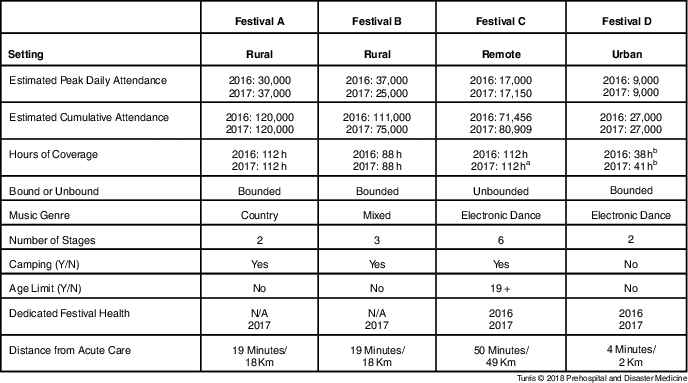
Summary of Festival Characteristics

Note: Distance from acute care was determined using Google Maps.
a Early emergency event closure.
b Discontinuous hours, as there was no camping at this event.
For event data, an “event day” was a 24-hour period defined by the opening hours on a calendar date until the opening hours the following day. For multi-day events, the start time was based on main venue opening and/or the performances commencing on a first or subsequent day. Data from the site build and take down periods were not included. Attendance was defined per “event day.” Cumulative attendance was the sum of attendance of all event days and expressed as “attendee days.”
Missing Data
Data quality was addressed in real time (eg, providers were asked to complete charts at the time of discharge). In the event that a chart was not complete, missing data would be specifically cited within the findings.
Results
Event Data
Festival A was an annual, three-day, country music festival with overnight camping that was open to all age groups. It was held in a rural community in Eastern Canada with a local population of just over 21,000. The festival had two main stages. Artists performed for four days and festival attendees could camp one day prior until the morning following the last day of music programming (five nights). The festival was held on event grounds not architecturally or naturally bounded. The landscape consisted of open fields with temporary fencing to separate the festival and camping areas. The field clinic was not accessible without a staff escort.
Festival B was an annual, three-day music festival with performances ranging from folk to electronic dance music (EDM), overnight camping, and a focus on a younger demographic. It was held in a rural community in Eastern Canada with a local population of 20,000+. The festival had three stages. Attendees could access the grounds from one day before the event until one day after music programming (four nights). This was a bounded event that took place on a flat grassy venue, allowing for easy transportation to both the campsite and main stages. The field clinic was not accessible to patients, except with a crew escort.
Festival C was an annual, five-day, EDM festival open only to ages 19 and over with camping on-site. It was held in a remote location in Western Canada with a local population of 1,200. The festival had six stages. Artists provided four days of continuous music and attendees could access the site from two days before until two days after music programming (seven nights). The festival was held on farmland in a mountain valley bounded by a river and steep slopes with limited road access. The field clinic was accessible to all attendees without an escort.
Festival D was an annual, three-day, all-ages, extreme sports and music festival with a series of evening music performances, primarily in the EDM and hip-hop/rap genres, and a peak demographic age of 15-30. It was held in an urban, Western Canadian community with a local population of just under 200,000. The festival had two stages. Day-time activities included both demonstration sports (eg, skate-boarding, motorcycle jumps, and bicycle motocross stunts) and crowd participation activities such as jumps onto crash pads, beach volleyball, and basketball. There was no overnight accommodation on the venue. The festival was held in an open field, bounded by temporary fencing. The field clinic was accessible to all attendees without an escort.
All four festivals took place in outdoor settings during the summer months and experienced typical summer weather with high ambient daytime temperatures, sun exposure, and for the Eastern events, a high heat index. On-site medical coverage for the three camping festivals typically began approximately eight hours prior to the official event start and ended approximately eight hours after official event end. Festival D had coverage beginning an hour before and an hour after gate opening and closure each day. Attendance numbers were obtained using media sources and/or event after action reports (including security and gate data) shared amongst production team members. When cumulative attendance was not reported by the media, the estimated cumulative attendance was determined by the peak attendance multiplied by the number of days. Event-specific variables are reported in Table 1.
Level of Care On-Site
There were multi-disciplinary medical teams at all four festivals, consisting of a blend of first aid and HLC team members on every shift. Each festival had a field clinic, roving first aid medical teams (first responders and paramedics), a festival health team, and first aid posts at various locations on venue, including camping areas. In addition, all festivals had access to standby ambulance services, including Advanced Life Support units.
All field clinics had the equipment required for Advanced Life Support interventions such as continuous vital signs monitoring, intubation, and advanced resuscitation. All professionals with the appropriate scope of practice had access to a comprehensive panel of symptom relief and emergency resuscitation medications. On-site point-of-care testing was limited to 12-lead electrocardiograms (ECGs), glucometers, urine dip sticks, and urine pregnancy tests. Festival C had point-of-care blood testing capabilities using an iStat (Abbott Laboratories; Abbott Park, Illinois USA).
Patient Data
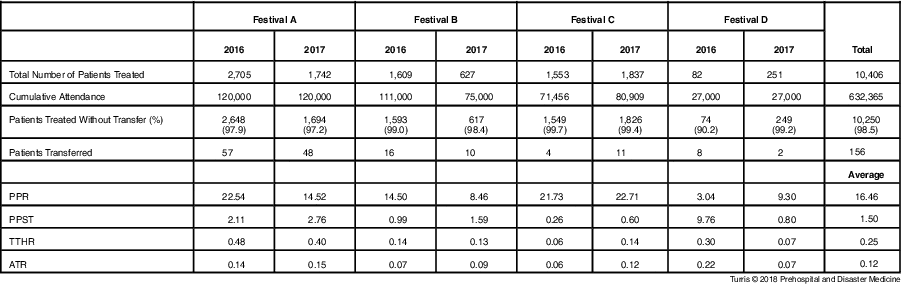
There were a total of 34 event days across the two editions of the four festivals, for a total of 632,365 cumulative attendee days. There was a total of 10,406 patient encounters during these 34 event days, with 156 patients subsequently transferred for off-site care and included in the analysis. The PPR was 16.5/1,000. The average age of the individuals assessed and treated (all comers) was 23.8 years old (SD = 7.8) and 55.3% were female.
Transfer Breakdown
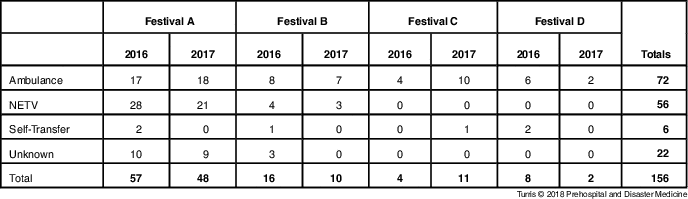
Of the 156 transfers for care off-site, 72 (46.1%) were transported by ambulance and 84 (53.8%) left the event by other transportation methods, including non-emergency transport vehicles (NETVs; 56.4%), private vehicles (6.4%), and by unknown means (22.1%; Table 2). Calculation of transfer metrics using these values yields an ATR of 0.12/1,000 attendees (range 0.06/1,000-0.22/1,000) an overall TTHR of 0.25/1,000 attendees (range 0.06/1,000-0.48/1,000), and a PPST of 1.5% (range 0.3%-2.8%). Data across events are summarized in Table 3.
Summary of Transport Methods Utilized During Festivals

Abbreviation: NETV, non-emergency transport vehicle.
Summary of Patient Encounter and Transfer Metrics Using Cumulative Attendance Rate

Abbreviations: ATR, ambulance transfer rate; PPR, patient presentation rate; PPST, percentage of patients seen transferred; TTHR, transfer-to-hospital rate.
Patterns of Injury/Illness
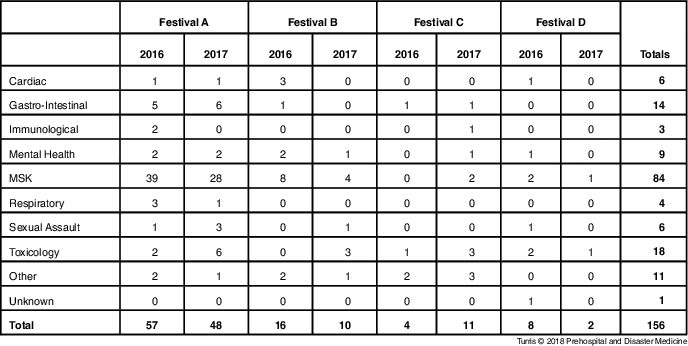
Musculo-skeletal (MSK) injuries were the most common reason for transfer (84/156; 53.8%). Toxicological and gastrointestinal presentations were the next most common reasons for transfer with 18/156 and 14/156, respectively. Of note, mental health reasons were relatively common with nine transfers total. Sexual assaults were similarly over-represented with six transfers. Results are summarized in Table 4.
Summary of Indications for Patient Transfers Off

Abbreviation: MSK, musculo-skeletal.
MSK
Fifty-four percent of individuals were transferred for care off-site for imaging (84/156). Lower limb injuries were the most common presenting complaint within this category (42/84; 50.0%). Most injuries were due to casual misadventure (eg, “jumping off of a truck tailgate,” or walking on uneven surfaces). The majority of patients with MSK injuries were transported by NETVs (48/84; 57.1%) versus ambulance (13/84; 15.5%; Table 2). Means of transport were missing for 12/84 cases (14.3%).
Toxicological
The effects of exposure to recreational drugs and alcohol was the stated reason for transfer in 18/156 cases (11.5%). An altered level-of-consciousness (LOC) was the most common presenting symptom within this category. Six patients presented with a decreased (and declining) LOC; an additional four patients presented as completely unresponsive. Two patients presented with confusion that failed to resolve and two others presented with agitated delirium.
In all cases, common differential diagnoses that might explain an altered LOC were ruled out (eg, hypoglycemia) and a LOC trend was recorded. Patients were closely observed (ie, 1:1 care), and if patients demonstrated a consistently declining LOC (rather than a trend toward an improvement in LOC) or developed airway issues, a transport was arranged. In two cases, patients were intubated before transfer. All patients with toxicological presentations were transported by ambulance.
None of the four festivals had on-site access to laboratory or point-of-care toxicological screening of patient blood or urine samples. Festival C had drug checking facilities available to medical services in order to test substances, if needed, but this was never used to guide clinical management. Based on self-reports (or reports by friends/family), in individuals transferred off-site (all comers), 3,4-methylenedioxymethamphetamine and cocaine were the most commonly reported substances ingested.
Gastrointestinal/Genitourinary
Nine percent of patients requiring transfer off-site presented with gastrointestinal-related symptoms (14/156). The most common patient presentation was abdominal pain (11/14; 78.6%), with the remainder due to nausea and vomiting (1/14; 7.1%) thought to be related to cannabinoid hyperemesis, testicular pain (1/14; 7.1%), and vaginal bleeding in pregnancy (1/14; 7.1%). Six of these patients (6/14; 42.9%) were transported by ambulance. It is noteworthy that in all cases of abdominal pain incapable of being managed on-site, the symptoms were unremitting after evaluation and treatment in the field clinic.
Cardiac
Four percent of patients requiring transfer off-site presented with “cardiac” symptoms (6/156). Each case fell into two categories: chest pain concerning for ischemia (2/6; 33.3%) and palpitations (4/6; 66.7%). All six patients were transported by ambulance. In all cases of chest pain, ECG capability on-site was unable to effectively rule in or rule out myocardial ischemia, and all patients with chest pain were transferred to permit serial cardiac enzyme measurement. Of the four patients with palpitations, new onset (or suspected) dysrhythmias (eg, atrial fibrillation or supraventricular tachycardia) required investigation and follow-up.
Allergic/Immunological
Two percent of illnesses transported were allergic/immunological reactions (3/156). Two of these reactions were anaphylactic reactions while the third was related to a pre-existing immune condition. These patients were transported to hospital by ambulance after initial treatment and stabilization on-site.
Mental Health
Six percent of the patients (9/156) transferred off-site were transferred for mental health issues. The most common presentation was suicidal ideation with intention to self-harm (7/9; 77.8%). In one case, certification under the Mental Health Act was required. Additionally, a transfer was made for psychosis and another for anxiety. Individuals were escorted to the emergency department (ED) by police in four cases (4/9; 44.4%), and otherwise were transported by ambulance (3/9; 33.3%) or by taxi with a medical team member as escort (1/9; 11.1%). Means of transport was not recorded for one case.
Sexual Assault
Sexual assault was the cause of several transfers to the ED for forensic assessment (6/156; 3.8%). Generally, patients were provided with one of several options for transport: family/friends, police (sexual assault team), or ambulance. Standard practice for such cases was observed, included ensuring privacy, involving a minimum number of team members, ensuring same sex health care providers, and where possible, the presence of a friend or family member at the bedside. In all of the six cases, patients were transported by ambulance, per patient preference. This may have been because the pragmatic options were transport in a police car or in an ambulance.
Other/Miscellaneous
Seven percent of patients transferred off-site presented with issues that did not fall into the major categories listed above (11/156; 7.0%). These included five patients for seizure (5/11; 45.5%), three for facial trauma from assault (3/11; 27.3%), headache (1/11; 9.1%), alcohol withdrawal (1/11; 9.1%), and pregnancy-related contractions (1/11; 9.1%). All patients in this category were transported by ambulance. For the seizures, the history was often limited by decreased LOC; only one individual was known to have a prior seizure disorder. Toxicological causes of seizures were not ruled out for these cases.
Discussion
The data presented outline the significant and varied burden of medical illness and injury that accompanies music festivals, even in the presence of on-site HLC team members. The patterns identified in the data identify additional preparations that might reduce the need for transfer-to-hospital.
These illnesses and injuries can have major downstream effects on local health care infrastructure, and increasingly, there is recognition of the need for mitigation of the impact on local health services (including but not limited to ambulances and EDs).Reference Turris and Lund 5 , Reference Munn, Lund, Golby and Turris 6 , Reference Nix, Khan, Hoban, Little, Keye and O’Connor 19 - Reference Stagelund, Jans, Nielsen, Jans and Wildgaard 29 Efforts are underway to investigate and delineate factors that influence illness and injury ratesReference Munn, Lund, Golby and Turris 6 , Reference Westrol, Koneru, Mcintyre, Caruso, Arshad and Merlin 30 as well as transfer rates.Reference Wood, Beaumont, May and Dargan 31 In the present study, the authors sought to understand that burden in some detail. Several themes were note-worthy.
Transfer Rates
Transfer-to-hospital rates are difficult to compare between studies because there are many differences between events (eg, hot and cold weather conditions) and differences in the composition of the medical teams (eg, first aid only versus HLC). The following music festivals had on-site HLC teams. Bledsoe, et alReference Bledsoe, Songer, Buchanan, Westin, Hodnick and Gorosh 24 reported an ATR of 0.61, similar to the ATR of 0.54 reported by Lund and colleagues.Reference Lund and Turris 9 Luther and colleaguesReference Luther, Gardiner and Lenson 32 reported an ATR of 0.22, along with Munn, et alReference Munn, Lund, Golby and Turris 6 who reported an ATR of 0.19. At the lower end of the range, the present study had an ATR of 0.12, similar to that reported by Friedman, et alReference Friedman, Plocki and Likourezos 10 at a rate of 0.10.
The integration of HLC team members may have reduced transfer rates, but the present study was not designed to examine this relationship. Published reports hypothesize that the addition of HLC teams reduces transfer rates;Reference Munn, Lund, Golby and Turris 6 , Reference Lund and Turris 9 , Reference Friedman, Plocki and Likourezos 10 , Reference Grange, Baumann and Vaezazizi 33 however, no clear conclusions can be drawn because existing reports in the published literature do not permit rigorous comparisons between like events.
In the present study, there were signals that the integration of HLC capabilities directly reduced the transfer rate. For example, respiratory illness was notable in year one for Festival B due to excessive heat and dust. Environmental conditions led to multiple patients presenting with respiratory symptoms. Sixty-nine unique individuals presented to the field clinic 98 times for the treatment of shortness of breath with wheezing. Of this sub-group of patients, 20 were seen between two to four times for treatment of “asthma.” None required transfer off-site. Without access to clinic stock medications (eg, salbutamol and prednisone) and the presence of health care professionals with the legal scope to diagnose, prescribe, treat, and release, all of these individuals would have required treatment in a hospital setting, substantially increasing transfers.
Intoxication
Intoxication accounted for less than 10% of transfers. In general, this finding is not congruent with published reports.Reference Chhabra, Gimbar, Walla and Thompson 28 , Reference Kamour, Yardley, Longshaw and Stuart 34 - Reference Ruest, Stephan, Masiakos, Biddinger, Camargo and Kharasch 36 This may be related to the integration of an HLC team, particularly one that has specifically prepared for the advanced assessment and monitoring of intoxicated patients. These types of teams are more comfortable and capable of taking a “watch and wait” approach that incorporates regular reassessment as well as clear clinical protocols/guidance about when to transfer. This skill set could substantially mitigate the impact on local ambulance services and EDs.
In terms of the existing evidence base, Ruest, et alReference Ruest, Stephan, Masiakos, Biddinger, Camargo and Kharasch 36 reported on 142 visits in their ED, arising over a period of four years from music concerts at a single, local event venue. They found that intoxication was the most common indication for transfer (96%). Similarly, Chhabra and colleagues reported on patient presentations from a three-day, outdoor music festival in Chicago (Illinois USA). The festival had an age limit of 18+, five stages, and did not offer on-site accommodations.Reference Chhabra, Gimbar, Walla and Thompson 28 They saw 28 patients transferred from the festival, only three of whom were not presenting for the effects of substance use. The level of care available on-site for this festival was not reported (Personal Communication; Dr. Chhabra, January 10, 2018).
Kamour and colleagues reported on the impact of Parklife, a large-scale music festival (70,000 patrons on each of the two days), on a local North Manchester (Indiana USA) ED.Reference Kamour, Yardley, Longshaw and Stuart 34 In their retrospective chart review, they identified 34 patients from the festival, approximately one-third of which required observation overnight and just over one-half of which had ingested recreational substances (56%). As above, it is unclear whether the on-site team was at the first aid level or included HLC team members.
MSK Injury
In the present study, the rate of transfer for MSK injury was high. Unless on-site medical teams can gain access to radiology, these types of injuries are likely to continue to create an uptick in ED use during large-scale events. However, the present study illustrates that although the burden on local EDs cannot be eliminated in this category, burden on the local ambulance service may be reduced by the use of NETVs to connect individuals with radiology services. In addition, as the evidence base and preparatory efforts grow, there may be opportunities to engage in interventions to prevent MSK injuries at festivals or to have on-site radiological capability.
Of note, the incidence of MSK injuries was much higher in Festival A, for both years, than for any other festival, regardless of size. However, the data set from this project is too small to draw conclusions about the reasons for the large numbers of MSK injuries for Festival A. No doubt in the future, the research team and others will investigate the influence of terrain, music genre,Reference Westrol, Koneru, Mcintyre, Caruso, Arshad and Merlin 30 , Reference Ruest, Stephan, Masiakos, Biddinger, Camargo and Kharasch 36 and the host of other factors that might explain this difference in rates of MSK injuries. None of the festivals had the ability to perform radiographic analysis on-site, so transfer to a facility with diagnostic imaging capacity was required.
Sexual Assaults
In the majority of cases, the sexual assaults were reported to happen in the early hours of the morning and primarily occurred in the camping areas. Most commonly, patients reported that they had separated from their friends and returned to the camping area alone to return to their tents.
In the present data, sexual assaults were over-represented and underline the importance of staff/crew training, as well as a having a procedure in place for meeting the unique needs of patients who are seen following a sexual assault. In addition, being proactive about health messaging (eg, “don’t party alone”) and taking action to reduce risk for attendees (eg, culture of safety, designated women’s or gender-neutral safe space as part of festival health plan, well-lit paths between the event grounds and the camping areas, meeting points for groups of friends, and finding your friends apps) may have an impact on the rates of sexual assault. 37
Mental Health
Not surprisingly, mental health issues arise at music festivals, and the festivals in this study were no exception. Patients presented with a variety of mental health issues, predominantly with symptoms arising from clinical depression and/or anxiety. As identified by Proudfoot, et al, triggers associated with depressive episodes included general stress, fatigue, sleep deprivation, and physical injury or illness.Reference Proudfoot, Whitton, Parker, Doran, Manicavasagar and Delmas 38 In addition, these authors identified triggers specifically associated with the onset of manic/hypomanic episodes, including recreational stimulant use, late night partying, going on vacation, and listening to loud music. It is possible that mental health cases were categorized and treated as intoxication.
Mitigation of Burden
There will almost always be patient transfers from large-scale music festivals. The numerator will never be zero as medically necessary transfers will occur. However, in order to approach zero, efforts may be directed toward minimizing preventable transfers in a safe and clinically defensible manner in order to mitigate the burden on local health care infrastructure. Categories in which patients were transported overwhelmingly by ambulance included cardiac, mental health, and sexual assault. Otherwise, ambulances were employed for individuals requiring supine transport and those who were unstable. Some creativity will be required and the potential for decreasing the number of indications for dedicated ambulance transport to hospital based on data and experience is real. In the present study, there was a role for NETVs, primarily to repatriate attendees and to connect injured individuals with radiology.
The role of NETVs is not well-described in the literature; however, in the present study, they were used in all of the festivals. Without this resource, an additional 48 people would likely have been transported by ambulance, which is a limited resource in a publicly funded system and an expensive service. In the present study, NETVs played a central role in reducing burden for local ambulance services. Anecdotally, pick-up at the hospital following ED visit to return to the event grounds was cited as a valuable guest service by attendees and event producers.
Interpreting Existing Evidence
Multi-Disciplinary Teams
There are two major challenges in interpreting the evidence around impact mitigation. First, it is currently not possible to compare “apples to apples.” In other words, when reviewing the literature, it can be difficult to determine whether a given on-site medical team provided first aid level service or integrated first aid with HLC members. With a first aid and/or purely prehospital level of care, patients with moderate to severe intoxication and an altered LOC would commonly have to be transferred. With independent clinicians on-site, patients might safely be managed and supported to recover slowly from their intoxication.Reference Lund and Turris 9 , Reference Munn, Laraya, Lund and Turris 39 On-site capacity to provide longitudinal care for patients obviates the need for a purely “treat and transfer” approach and allows for “treat, observe, and release,” decreasing the transport burden on the ambulance system, and the stretcher capacity in the local ED(s).
Providing longitudinal care required the inclusion of providers whose scope of practice encompasses independent assessment, diagnosis, treatment, and prescribing authority permitting treatment of common symptoms, illnesses, and injuries without the need to refer off-site (eg, nausea, vomiting, wheezing, wound repair, and joint relocation). The use of a multi-disciplinary team of health care professionals that includes both first aid and HLC providers at MGs likely reduces the number of transfers to tertiary care facilities.Reference Lund and Turris 9 , Reference Friedman, Plocki and Likourezos 10 , Reference Grange, Baumann and Vaezazizi 33 It is therefore hugely important when publishing metrics of medical service utilization and patient transfer at events to have a context that includes information about HLC capability.
Second, event reports often focus on the number of transfers. Unfortunately, there is a lack of a similar, standardized metric with which to measure the number of transfers averted by the presence of a well-equipped and well-supplied team that includes HLC providers. Table 4 contains many “zeros” indicating that no patients with those complaints were transported. Patients in each of these categories were seen, assessed, managed, and released without transfer-to-hospital at each of the described music festivals, and still others in those that were are likely to have been avoided. Although the focus of this paper is transfer rates by category and not the number of patients presenting overall, a better characterization of the number of transfers averted along the progression through the spectrum of festival medical care (event attendees to patients to transfers to hospital) is planned for future study at festivals with HLC teams on-site. The exact impact these teams have could be equally evaluated via an analysis of transports from similar music festivals without the incorporation of HLC team members/capabilities.
Recommendations for Future Research
Develop and Disseminate a Standardized Set of Data Points for MG Health Researchers
The present study draws on two years of data from four different music festivals. The authors were able to do this because the festivals shared a common approach to the documentation of patient encounters. At present, several groups are working, under the auspices of the World Health Organization (Geneva, Switzerland) Collaborating Centres on Mass Gatherings, on the creation of a Minimum Data Set,Reference Memish, Zumla and McCloskey 40 - Reference Turris, Lund and Hutton 42 and others have already crafted an approach to this challenge.Reference Gogaert, Vande Veegaete, Scholliers and Vandekerckhove 43 This would enable event medical teams to report on similar data points, across many events, ultimately creating a larger database that would support evidence-informed decisions about a variety of issues. As well, MG health researchers might consider reporting both transfers to hospital and transfers averted by the presence of a team capable of monitoring services on-site. Rigorous methodology would need to be developed before this question could be answered.
Describe and Delineate the Role of NETV
Having an alternative means of transporting individuals with minor injuries or illness presentations may reduce the impact on the local health care system. There is value in determining the framework for testing and implementing inclusion and exclusion criteria for ambulance versus NETV transfer decisions in the clinical context of music festivals and other events.
Consider Offering On-Site Imaging
Given the number of MSK injuries, and the number of off-site transfers to rule out fractures, it may be helpful to have imaging capacity on-site at selected large MGs. With the rise of portable point-of-care ultrasound (POCUS) and mobile x-ray imaging, there is potential for imaging integration in the future. 44 - 46 Some medical teams have already implemented POCUS with positive outcomes.Reference Prager, Sedgwick and Lund 47 Other areas of interest may be collaborating with registered mobile imaging services for MG events as they are fully equipped along with trained technicians. Having on-site imaging for part of each day or partnering with a local, out-of-hospital radiology clinic may help to prevent unnecessary transfers to hospital.
Develop National or International Guidelines for Music Festival Health Care Teams
The results of this study may support researchers in identifying and confirming common categories of illnesses and injuries that might benefit from a coordinated approach to prevention and treatment. As well, national guidelines would contain recommendations for size, composition, and deployment of on-site medical teams. For example, a set of national standards may recommend that overnight festivals include HLC team members so that hospital transfers are averted, where possible.
Limitations
The following are potential limitations for the present study: (1) ATR, PPR, PPST, and TTHR represent best estimates. Denominators for attendance were drawn from various sources including media reports, which are not always accurate. (2) Results related to toxicology were based on self-report, which has the potential to be unreliable. This may increase the number of cases that encompassed substance use; however, it likely did not impact the indication for transfer. (3) The present study analyzed data from a convenience sample of music festivals with on-site HLC teams, so the results will not apply to festivals with first aid only teams. Furthermore, the preparation and equipping of the HLC teams for specific and known patterns of presentation at individual festivals could inherently bias the capability of the events to avoid transfer. (4) The current study may under-estimate the full impact of this convenience sample of four music festivals on local community resources. Case series reporting has several weaknesses, including failure to capture the full range of casualties (eg, the patients who left without being seen by the on-site care team, those who attended medical services in the community as a “walk-in,” or who later sought care in other communities). As well, the present study did not capture data regarding increased workload on health resources in the days or hours before and/or after each event day. And (5) it is possible that the presence of well-developed festival health services targeted specifically at injury/illness prevention and harm reduction at music festivals influenced the PPR and ATR for one or more of the festivals studied.
Conclusions
This research enhances the current understanding of why patients are sent to hospital during music festivals, a sub-set of music-related MGs known to have increased risk for utilization of medical services and downstream effects on local hospitals and health care infrastructure. Transfer rates are low from festivals with blended first aid and HLC teams who are able to provide symptom relief and longitudinal care on-site. Intoxication, while a common presentation at music events, is not always the most common indication for transfer-to-hospital in the context of an HLC team. Ongoing research is aimed at better characterizing the beneficial effects of an HLC presence at these events, and to tailor on-site capabilities to further reduce impact on local health care infrastructure.
Acknowledgements
The authors wish to thank Mr. Kevin Jones, CEO of the medical services company that provided service for three of the festival studied, for his support of this project. They also thank Mr. Michael Camporese, St. John Ambulance (Vancouver, Canada) for his careful review of a draft of this manuscript.