

For a long time, images of rural markets in China have been associated with G. William Skinner's regional, hierarchical marketing system.Footnote 1 In this model, local markets, discrete at the lowest “market community” level, are vertically linked to multiple regional centres at the next level up in the hierarchical market system; as market links move upward, they become increasingly intertwined to form interlocking regional market systems. In Skinner's view, this pattern is not particular to China: “marketing structures of the kind described here for China appear to be characteristic of the whole class of civilizations known as ‘peasant’ or ‘traditional agrarian’ societies.” Nor is this pattern confined to the economic arena: “marketing structures inevitably shape local social organization and provide one of the crucial modes for integrating myriad peasant communities into the single social system which is the total society.”Footnote 2
Today, the picture of rural marketing in China presents a major departure from the Skinnerian model. Historically, villagers lived in a subsistence economy and their occasional activities in market exchange fitted the Skinnerian model well. This pattern was disrupted between the 1950s and the late 1970s as market activities were suppressed in Mao's collective era. After the 1980s, rural marketing was revived. However, in the last two decades, the traditional pattern has taken a significant turn. The late 20th century witnessed the making of new markets in rural China, where peasants grow cash crops and their produce is sold and transported to national markets spanning local and regional boundaries.Footnote 3Figure 1 contrasts these two patterns of market activities. In the Skinnerian model (Figure 1a), villagers, peddlers and middlemen participate in market transactions at their local markets, which gradually expand upwards to the market centres at the higher geographic levels along the market chain, aggregating from lower levels up, and increasingly interlocking into regional market systems. In contemporary rural marketing systems (Figure 1b), local markets are directly linked to national markets thousands of kilometres away.
Comparison of Two Rural Marketing Structures

These two marketing systems may appear similar, but they involve distinct organizing mechanisms. The Skinnerian model encompasses the “traditional economy” with a gradual expansion across levels of the hierarchical, regional system, where social, cultural and economic exchanges overlap and run continuously in physical and social spaces such that market exchange can take place even in the absence of financial capital – through credit lending, for example. In contrast, produce procurement today is organized through direct links between local and national markets across and above local and regional boundaries, and involves much larger stakes but sparse social relations. What accounts for the emergence of these produce markets that link disparate villages and regions to the national market system? Presumably, the link that connects local villages and produce growers to national markets is financial capital in market exchange, the flow of which transcends local boundaries, carries long-distance trade, and links isolated rural areas to national markets.
However, this is not the case. The shortage of financial capital in the agriculture sector is well documented, and rural China is no exception in this regard.Footnote 4 As the developmental economists Hans Binswanger and Mark Rosenzweig have argued, production relations are affected by specific market conditions and factors in the agricultural sector. The immobility of land creates spatial dispersion of production with considerable information and transport costs, leading to limited credit and other capital markets. Mutual gains in market transactions do not necessarily lead to trade in the presence of information asymmetry; hence, other mechanisms need to come into play to solve these information problems. In such cases, social institutions may play an important role in response to the organizational problems and in the realization of trade.Footnote 5 For example, in long-distance trade during the Middle Ages, social mechanisms such as reputation based on close-knit communities made it possible for the reputation mechanism to deter opportunistic behaviour.Footnote 6
Indeed, there is a considerable literature on the role of social relations and social capital in market transactions in shaping economic activities, gaining access to information, financial capital, and opportunities.Footnote 7 In the Chinese context, research has shown the importance of social relations and institutions to the rise of entrepreneurship and in inter-firm contractual relationships, and the intriguing interactions between politics and markets.Footnote 8 Building on these studies, we carry this line of research further by drawing on sociological arguments on capital conversion to identify the micro-processes and mechanisms that solve the problem of financial shortages in produce markets, and the specific conditions under which these mechanisms operate. By developing more nuanced analyses, we hope to use the analytical power of sociological theory to understand the role of social relations in the marketplace.
Our search for micro-processes in market making led us to FS Township, an agricultural town in Hebei province in northern China. Since the mid-1990s, FS Township has developed into one of the largest national markets for almonds, processing about one quarter of the total almond sales in China. It has also become a central region for winemaking grapes. Both markets are organized by market chains linking villager-growers, local peddlers and middlemen in the town centre, to external buyers in the national markets. Each year, produce worth millions of yuan is bought and sold during the harvest season and beyond. Produce from this region is transported directly to the buyers hundreds or thousands of kilometres away. Between 2004 and 2010, our research team visited this township several times each year to keep track of the rural development in this region. We conducted both participatory observations and extensive interviews with villagers, village cadres, peddlers, middlemen and representatives of external buyers to gain information and understanding of the development of rural marketing in this region.
There are noticeable variations in the structure of market chains across different produce markets.Footnote 9 For example, at one end of the market chain for winemaking grapes are a few large winemakers who buy the grapes; at the other end are thousands of grape growers. In between are a large number of arbitrageurs who have local agents specifically located within each village. Grape growing tends to be concentrated in a few villages, and the grapes are bought in large quantities within a short period of time, usually within two weeks. In contrast, the procurement process for almonds lasts for months. Almond trees are scattered across villages and are grown on a much smaller scale than the grapes; peddlers move through the different villages buying up truckloads of almonds which they then sell to middlemen in the town centre, who are in turn linked to the outside end-buyers. Variations across these market chains result from patterns of interactions between markets and social relations, and from market actors' efforts to solve the challenges in the processes of market making.
One defining characteristic of the produce markets we study here is that there is markedly little financial capital flowing through these market chains and their transactions. A large proportion of procurement and market transactions is carried out in the absence of financial capital on the basis of trust and credit lending. In the grape market, for example, in most cases procurement in villages does not incur immediate cash payment. Instead, in October, grape farmers receive IOUs issued by local agents, who are also from the same village as the farmers but who act as middlemen for buyers. Payment is only made several months later. In the almond market, in contrast, transactions between villagers and peddlers usually take the form of cash payments on the spot. The peddlers then sell the almonds on to middlemen in the township but without immediate cash payment. In most cases, the peddlers get paid after protracted time intervals, and only partially, when the middlemen receive payment from their upstream buyers. Therefore, the burden of mobilizing financial capital is tilted heavily towards the lower end of the market chain. It is the peddlers and middlemen in the local markets who need to come up with the financial resources to buy the produce. This is in sharp contrast to credit lending in small neighbourhood shops or traditional rural markets, where transactions are on a small scale and surrounded by dense, overlapping social relations. What we observe here can be characterized as credit taking imposed by the larger buyer with considerable market (or political) power but relatively sparse social relations or interactions.
Our focus in this study is on how different forms of capital – political, social and economic – are converted from one form to another and, in particular, the role social capital plays in the acquisition of financial capital or as a substitute for financial capital. In this article, we argue that the rise of produce markets requires that market actors solve a set of organizational problems, especially the mobilization of financial capital. In response to the shortage of financial capital, these market actors make use of social capital to conduct market transactions. First, gift exchange as a micro-mechanism makes it possible for local market exchange to take place even in the absence of financial capital. Second, credit taking on the basis of market power forges the link between external buyers and middlemen in local markets. Gift exchange and credit taking are two interrelated mechanisms that ensure the connection and operation of the entire market chain. The distribution of risks in (financial) capital mobilization varies across different market chains, depending on the relative strengths of the market power and social capital of the actors therein.
The rest of the article is organized as follows. First, we develop theoretical arguments that identify and explicate the processes in the mobilization and conversion of capital in market making. We then turn to a case study of capital flow in FS Township to illustrate our theoretical arguments. We conclude our study by discussing the implications of capital conversion for social structure and institutional changes in the larger societal context.
Two Mechanisms in Market Making: Gift Exchange and Credit Taking
The preceding discussion identifies two sets of organizational problems in the making of produce markets in the face of a shortage of capital. The first concerns how other forms of capital, political or social, are used to mobilize financial capital, and the second centres on how the risks and costs of such capital conversion are distributed among the actors in the market chain.
To develop a theoretical explanation of the observed patterns in the produce markets of our study, we start with the sociological insight about forms of capital and the conversion from one form to another. Bourdieu was most explicit on different forms of capital – economic, cultural, political and social – and their conversion. He argued that conversion between different forms of capital incurs costs and follows certain rules of convertibility. In a market society where resources are most transparent in monetary terms, economic resources are central to the conversion process. Bourdieu observed that:
The different types of capital can be derived from economic capital, but only at the cost of a more or less great effort of transformation, which is needed to produce the type of power effective in the field in question. For example, there are some goods and services to which economic capital gives immediate access, without secondary costs; others can be obtained only by virtue of a social capital of relationships (or social obligations) which cannot act instantaneously, at the appropriate movement, unless they have been established and maintained for a long time, as if for their own sake, and therefore outside their period of use.Footnote 10
To develop this line of argument further, we now discuss the main mechanisms in capital conversion and specify the conditions under which these mechanisms can operate. Our core idea centres on the conversion of other forms of capital to financial capital in market making. We begin with the premise that different forms of capital tend to reside in different “fields,” i.e. social, economic or political spaces, with their respective institutional settings and patterns of interaction. For example, social capital (a set of social relations) tends to be cumulated in the social field, that is, in communal settings, through social interactions such as weddings, ceremonies and collective projects; hence, it tends to be bound by a particular social space. In contrast, financial capital is likely to be cumulated and reside in the economic field, where market transactions and economic activities prevail. Our analytical question then becomes: in what ways can different forms of capital be transferred from one field to another?
For our research purposes, we highlight two fundamental and distinct mechanisms. Conversion processes often take place in the form of gift exchange across different fields, which may involve “multidimensional bargaining.”Footnote 11 That is, for such conversions to take place, those costs incurred in one field (stake in reputation, payment delay) may be recovered through gains in another (larger volumes in business dealings, future opportunities); compromise in the business arena may be compensated for by the strengthening of one's reputation or social relations in other, non-economic arenas. For this mechanism to be effective, continuous and intensive social interactions are needed. Second, conversion between different forms of capital is not always voluntary, nor are the conversions involved always as equal as the idea of reciprocity may portray. Often such conversion is imposed or coerced upon one party by another. This recognition leads us to the second mechanism: conversion among different forms of capital is often affected by power relations derived from positions in markets or in the political apparatus.
Gift exchange as a mechanism for capital conversion
Let us first consider the mechanism of “gift exchange,” a metaphor for reciprocity in social relations, the idea of social exchange of one kind in return for another. In our conceptualization, gift exchange is not an act, but is a process in which multidimensional bargaining across different fields takes place, where reciprocity has long been recognized as the key mechanism. This idea is implicit in the argument on the moral economy of peasants, and in the sociological argument about the embeddedness of economic activities in social relations.Footnote 12 Reciprocity implies the careful maintenance of one's balancing sheet based on the overall calculation of gives and takes that glue transactions together into a continuous and predictable steam of market or non-market activities. In the context of dispute resolution in rural counties in California, Ellickson pointed to similar patterns of multidimensional bargaining amid dense social relations:
A fundamental feature of rural society makes this enforcement system feasible: rural residents deal with one another on a large number of fronts, and most residents expect those interactions to continue far into the future. In sociological terms, their relationships are “multiplex,” not “simplex.” […] Thus any trespass dispute with a neighbor is almost certain to be but one thread in the rich fabric of a continuing relationship.Footnote 13
It is such “a continuing relationship” that makes multidimensional bargaining and capital conversion possible across different fields and over time. This property of gift exchange also implies the conditions under which this mechanism operates: central to the conversion process is the extent of connectedness among those fields where different forms of capital reside. The convertibility of capital depends on the interconnectedness among these fields, for those individuals facing a particular problem, in a particular institutional context. The interconnectedness of these fields varies greatly across institutional settings. In traditional villages, for example, morality, social norms and economic activities are highly interconnected. Conversion of resources from one field to another, or from one form (for example, social) to another (for example, economic), is made possible because these areas or these forms overlap or interconnect in certain ways such that conversion is meaningful to the parties.
These considerations have important implications for understanding the role of capital conversion in market making. Consider the market chains described above. One striking pattern of the market chain is that, as depicted in Figure 1, the interconnectedness among different forms of capital becomes loose as it moves up the levels of the market chains, from villagers, peddlers, local market centres organized by middlemen, to the outside buyers. Compare the villager-turned-peddler and an outside buyer. For the villager-peddler, he and his family have lived in this locality for generations and are embedded in dense social and economic relations. Not surprisingly, then, for the peddler the social, economic and political spaces are highly interconnected. But, for an outside buyer entering a village (or other outsiders involved in the market chain), the main motive is to profit from transactions in the economic arena; his interests and interactions are largely confined to the business arena (find a reliable local agent, cultivate trust to facilitate smooth transactions), and interactions with local residents are likely to end after transactions are completed. For the outside buyer, the interconnectedness among local economic, political and social areas is mostly relevant to the present (and anticipated future) business transactions. Accordingly, the conversion processes have different meanings and stakes for different actors involved in the transaction and in a specific context. There is a high convertibility, with a longer time horizon, for the villager-entrepreneur, but the converse is true for the outside buyer.
Seen in this light, we can draw several empirical implications about the conversion processes in the market chains. First, the interconnectedness among different arenas is closest at the lowest level of the market chain, i.e. within the village, where villagers and local agents are bound by dense interactions in daily activities. Therefore, we expect that capital conversion be most salient at this level. Second, the interconnectedness becomes increasingly loose as the market chain moves upward and relationships become sparse; that is, the higher the level of the market chain, the more distant it is from the dense, continuous social relations on a daily basis, and the more likely that social mechanisms are weaker relative to economic mechanisms. As a result, we should observe less capital conversion at higher levels of the market chain. Third, the same logic also applies to the spatial dimension of market operations. For the same villager-entrepreneur, the further his entrepreneurial activities are away from his familiar social space (e.g. his own village), the more likely that the value of the social capital that he possesses depreciates, and the less likely it is that capital conversion takes place. That is, wherever there is a scarcity of social resources (trust, social relations), it is expected that transactions are more likely to take the form of direct cash payment. By highlighting the conditions under which social capital takes effect (or the lack thereof), we hope to strengthen the analytical power of treating social capital as a mechanism in market transitions.
Credit taking on the basis of market (or political) power
As discussed above, the mechanism of gift exchange works best at those intersections of different areas (economic, political, social) and in those continuous, dense social relations where the gives and takes are played out across these areas or over time. However, this condition becomes difficult to sustain beyond local markets, especially in the link between local markets and external buyers where the stakes are high, social interactions sparse, and reputation mechanisms ineffective. How are these organizational problems dealt with at the higher levels of the market chain?
A striking characteristic in the produce markets is the widespread use and large number of IOUs. Unlike the typical voluntary, informal credit given in neighbourhood shops in traditional society, such IOUs are imposed upon those at the lower end of the market chain by external buyers exercising market power. We use the term credit taking rather than credit lending to emphasize the power relations involved, especially the coercive power of the upstream contractual partners in the market chain. Therefore, in addition to the gift exchange mechanism discussed above, the capital conversion process may be governed by the second mechanism – power relations derived from market structures or political authority. In those produce markets (for example, winemaking grapes) where one or just a few large companies are the end-buyers, the external buyers have considerable leverage in credit taking and in imposing the ratio of convertibility among different forms of capital. Similarly, we submit, bargaining between the middlemen and peasants also tends to favour the former because of their market power. Therefore, the conversion process varies with market structures. Those with greater market power have more advantage with regard to the ratio of convertibility among different forms of capital.
Credit taking differs from gift exchange mechanisms. As sociologists have argued, power is at the centre of all exchange relationships. Research has shown the importance of capital and its market power in shaping the landscape of contemporary industrial societies.Footnote 14 The use of IOUs in the grape market, as is shown below, originates from the monopoly of the large buyers, often state-owned firms, who collude with political authorities to force sellers at the lower end of the market chain to accept their transaction terms. In other words, the connection between external buyers and the local markets is based less on social relations and more on the power of the buyers who can impose credit taking upon those at the lower end of the market chain. In so doing, the sellers are left with no other alternative other than to “willingly” give credit to finance the procurement activities of the external buyers.
The relationship between market power and credit taking is best demonstrated by the empirical patterns in which credit-taking practices vary systematically with the degree of market power. For example, in the almond market chain, at the lower end of the market, peddlers are numerous and have to travel to and purchase almonds from different villages where they have sparse social relations and so cash payment is the market exchange norm. At the higher level of the market chain, however, external buyers can impose credit taking upon the middlemen because of their monopoly of market opportunities. The middlemen, who control the access to opportunities to connect with the external buyers, in turn impose credit taking upon the peddlers. In the winemaking grape market, the grapes are bought without cash payment and the IOUs are only paid after an extended period of time. To a large extent, these transactions are forced upon the villagers by those external buyers with market power. In other words, credit taking is most prevalent in those markets, or at those nodes of the market chain, with high a degree of buyer concentration.
It is worth pointing out that credit taking and gift exchange are closely interrelated in the produce markets. Credit taking by external buyers is made possible because of the availability of the gift exchange mechanism at the lower end of the market chain. That is, social trust and reciprocity between crop growers on the one hand, and local agents or middlemen on the other, facilitate market exchange in the absence of immediate cash payment in the local markets, thereby making it possible to link local sellers to national markets. Only in this way can the market chain be completed and the external buyers reach the sellers' produce. Credit taking at the top end of the market chain is made possible by the effectiveness of the gift exchange mechanism at the bottom end to realize market transactions in the absence of financial capital.
By focusing on capital conversion in the mobilization of financial capital in rural market making, our theoretical discussion above develops several lines of arguments: first, we specify the conditions under which social capital takes effect, thereby adding analytical power to the concept of social capital in market transactions; second, we point to the important role of credit taking and the underlying monopoly power of large firms. In so doing, we emphasize that the cost and risk of mobilizing financial capital are tilted heavily towards those at the lower end of the market chain.
Below is a case study of market making in FS Township, which illustrates the role of capital conversion in this process. We draw on our field observations to show distinct processes and mechanisms in mobilizing financial capital, and especially the conversion of social capital to financial capital.
Capital Conversion and Market Making: Illustrations from a Case Study
The context
Located in a mountainous region of Hebei province, FS Township is an agrarian town consisting of 27 villages where corn, grapes and almonds comprise the main crops. Compared with prosperous areas in the coastal provinces, FS Township was an underdeveloped, forgotten corner of rural China in the 1990s. Traditional “peasant society” in China has undergone decades of collectivization and the institutionalization of political authorities. State financial institutions, and in particular credit unions and the Agricultural Bank of China, have set up local offices in the town centre which give loans to the agricultural sector. Nevertheless, entrepreneurs struggling to set up their businesses faced daunting conditions: no reliable information about outside opportunities or potential contractual partners, no established market institutions for transactions, no legal protection, and, above all, little financial capital available to sustain transactions beyond the primitive stage. It was against this larger context that produce markets began to emerge.
As noted above, produce markets are defined by the chronic shortage of financial capital. Those at different levels of the market chains are constantly struggling to come up with the finance to expand their businesses, or to respond to debt pressures or crises. In the procurement process, it is the availability of financial capital that helps to overcome the start-up hurdle (packaging, labour and transportation, among other items), that makes the scale of procurement profitable, and that allows one to move up in the market chain to have a larger share of the profit. For business transactions on this scale, involving long-distance trade and fast turnover cycles, capital is central to linking these different nodes of the market chains. Flexibility in accessing financial capital is a key factor in produce markets, which fluctuate significantly from year to year and are contingent on crop life cycles and economic conditions in the larger context. For example, the volume of produce in the almond market in a good year can be three times as large as in the previous year. The middlemen and peddlers have to be in a position to mobilize financial capital to take advantage of the harvest.
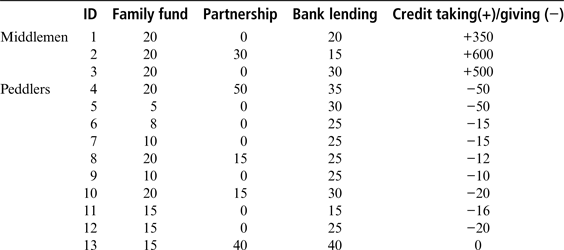
How do entrepreneurs solve the problem of a capital shortage in this context? Table 1 reports sources of financial capital for three middlemen and seven peddlers in FS Township, selected from our fieldwork records for illustration. The middlemen in our sample were among the largest in almond procurement; our selection of peddlers was more or less random as there are numerous peddlers and they are less distinguishable from one another in their capacity to mobilize financial resources. The information was gathered in 2009. Because the size of the produce markets in this region has become significant only in recent years, the structure and the scale of the financial capital presented here are close to the start-up stage for these entrepreneurs. We should note that, for illustration purposes, Table 1 only selected a sample of those entrepreneurs who had obtained bank loans; a much larger number of entrepreneurs (or want-to-be entrepreneurs) were unable to secure bank loans at all, and even for those entrepreneurs who benefited from bank loans, the amount loaned was much smaller than needed. This was especially true for those middlemen who had to rely on credit taking for procurement activities.
Sources of Financial Capital for Selected Peddlers and Middlemen (unit: RMB 10,000)
Source: Interviews in fieldwork.
We identify four channels in capital mobilization: (1) family accumulation; (2) bank lending; (3) partnership form of organization; and (4) credit taking. These processes may take place in sequence but are often simultaneous or parallel to one another. Below, we first outline the four main channels in capital mobilization and conversion and then illustrate the dynamic processes in a detailed case study of two entrepreneurs.
1. Different starting points: family and collective legacies in capital mobilization
The most familiar and primitive means of capital mobilization is accumulation from one's own business. This is the common starting point shared by most entrepreneurs. In the region of our research site, capital accumulation mostly comes from non-agricultural activities. As Table 1 shows, most local agents, peddlers and middlemen put in their own financial resources as the seed capital to start up their businesses.
This is labelled as “family accumulation” because it invariably involves family-based divisions of labour that allow engagement in off-farm work. In rural China, family, which is often the extended family, has long been the basic unit of organization in social, economic and political activities, involving collective efforts in family-based savings and capital accumulation. This is a common way for peddlers to begin their procurement activities. A related starting point was associated with the legacy of the village collectives of the Mao era. For example, all three middlemen listed in Table 1 benefited from their earlier experiences working for collective enterprises, which allowed them to build relationships with outside business partners and access financial capital.
This provides a first glimpse of the conversion of social capital in the field of everyday village life to financial capital in the economic field. In a traditional society where family and relatives are embedded in intensive social interactions and mutual assistance, this conversion takes place seamlessly in continuous everyday activities in the form of borrowing and lending within the family or among relatives or close friends. There is also a conversion of political capital to economic capital, as shown by the advantages rendered by occupying cadre positions in the collective era.
2. Bank lending
The ability to borrow from banks or credit unions, and so having access to financial institutions, is the key divide that stratifies the “haves” and “have-nots.” Indeed, bank lending is a critical means that sorts some into, and pushes others outside, the circle of middlemen.
Our fieldwork shows that bank lending activities in the rural areas have been largely conducted on the basis of informal personal relationships. Given the policy constraints imposed by the higher authorities and the scarcity of financial capital relative to the scale of entrepreneurial ambitions, bank lending becomes a seller's market, in which personal relations and private interests play a critical role. Among the ten entrepreneurs in Table 1, four had gained access to bank loans through close/blood ties. For example, one entrepreneur, XGM, had two partners with direct ties to banks. This helped him to acquire 800,000 yuan, which was more than five times greater than his own investment. In another case, YYJ's cousin was a loan officer in the credit union. This facilitated his access to a loan of 300,000 yuan, which was six times greater than his own investment.
In the absence of direct or close ties, others had to cultivate and strengthen social ties gradually to gain access. The typical way, as told by these entrepreneurs, was to cultivate social relations with those officers in charge of bank lending, through second or third nodes of social network ties. In one instance, a migrant worker could no longer continue to drive his truck owing to injury, so his relative took him to meet a friend at the local agricultural bank, who in turn helped him to obtain loans with which to start his business.
Yet, not all social relations matter. The observation that social capital plays an important role in gaining access to financial capital demands further explanation. It is worth noting that a position as a village cadre does not always help when applying for bank loans. Indeed, many cadre entrepreneurs have to operate without access to bank loans. Only occasionally, and increasingly rarely, does the strong backing from local government officials (for instance, township government heads) help to secure loans for individual entrepreneurs. Nor do the extensive social ties, which many entrepreneurs command, help much. In other words, the conversion between social capital and financial capital is especially stringent in bank lending. Central to this conversion process is the role of intensive, rather than extensive, social relations built on strong (typically personal/family) ties or backed up with significant social assets. This is the hurdle that differentiates entrepreneurs.
3. Partnerships
The demand for financial capital stimulates the rise of new organizational forms in problem solving. In particular, a new partnership form of organization emerges in the process, which binds several key players together to form one team to engage in business activities. Its significance is to go beyond the traditional, family-based organizational form in search of new forms of resource mobilization and conversion. Different partners bring different kinds of resources (social relations, access to financial institutions or business opportunities) to the partnership such that these resources are mobilized on a stable, organizational basis. In other words, this is the beginning of a process to internalize, and transform, the networks of trust into formal organizations.
The partnership form is especially effective in mobilizing financial capital. Take XGM for example. He started off with 150,000 yuan of his own funds, but increased his financial capital with a 400,000 yuan investment from his partners and by securing a loan of 400,000 yuan from the bank through his partners' contacts. In another case, ZS had only 50,000 yuan of his own funds; by entering into a partnership with two others, he gained access to 150,000 yuan.
4. Credit taking
The most important mechanism that plugs the gap in the flow of capital through the market chains is credit taking. We estimate that, in our fieldwork site, about three quarters of the total procurement transactions were in the form of credit taking, and amounted to tens of millions of yuan. It is here that the second mechanism, that of power relations, is most prevalent. The forces of capital and social fabric intersect in intricate ways in this arena.
Our fieldwork shows that credit taking takes place throughout the market chain, between the outside buyers (e.g. large firms) and middlemen, between middlemen and local agents, and between local agents and villagers as sellers. However, there are considerable variations in the extent of credit taking and in the nature of such relationships. For example, in the last column of Table 1, Case 3 is a middleman who took 5 million yuan of credit from peddlers in 2009. This implies that the external buyer also took the same amount of credit from him. Case 4, a peddler, had to lend credit of 500,000 yuan to the middleman in the same season. In the winemaking grape market, it is the villagers who have to accept IOUs and extend credit to the external buyers. These patterns vary systematically with the power relations in the market structure.
Take the winemaking grape market as an example. Winery G, a state-owned company, is one of the largest winemakers in China. Over the years, Winery G has gradually incorporated almost all of the local, smaller wineries as its subsidiaries, and together they have colluded in price fixing on the eve of the harvest season. Winery G receives special support from local governments because of its contribution to their revenues. As a result, it has privileged access to state-owned banks, whereas other small wineries are practically unable to access bank loans for purchasing grapes without the backing of Winery G. As the head of a small winery put it: “It is difficult to get bank loans. The state banks only give us loans with Winery G's endorsement.” In other words, through its political clout as well as it market power, Winery G monopolizes the financial supply and forces the sellers to “lend credit” to the buyers, thereby shifting the risk and cost of capital mobilization to those at the lower end of the market chain.
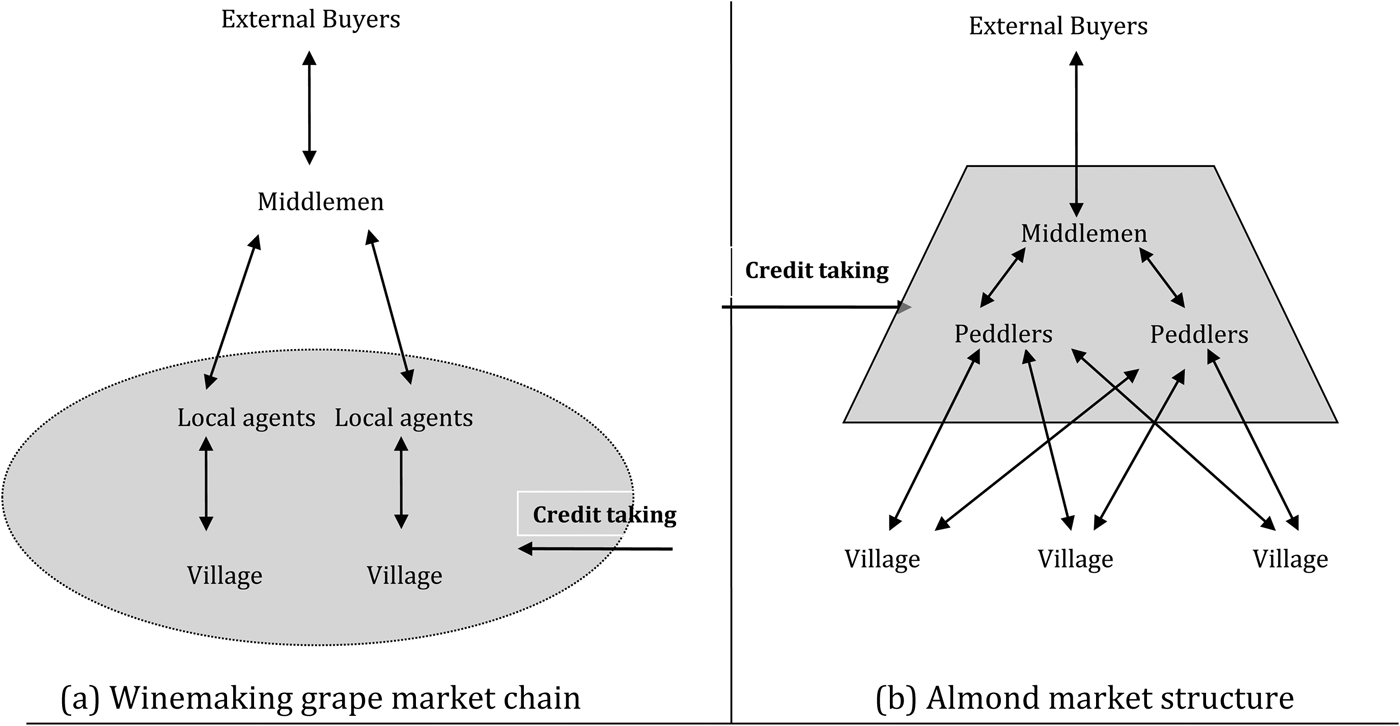
As described above, credit taking is made possible because of gift exchange relationships at the lower end of the market chain, but there are noticeable variations in the practice of credit taking across produce markets (see Figure 2). In the winemaking grape market (Figure 2a), the role of local agents is of particular significance. The relationship between local agents and villagers is largely based on trust and embedded in dense, stable social relations. The local agents here are typically local elites who have operated for many years and whose track records in business dealings are well known to the villagers. Strong relations are formed through lineage ties or the long, shared experience of mutual assistance. By making local agents, not the distant middlemen, credit takers, the credit market is also embedded in dense, social relations. Different fields – social, economic and political – are closely interconnected around local agents, making the conversion of capital across these fields possible and seamless.
Credit Taking in Two Market Chain Structures
In contrast, there is little credit taking between peasant sellers and villagers in the almond market, and all transactions are paid in cash on the spot. Peddlers in the almond market have to travel to different villages to buy almonds, and enter communities where they have sparse social relations, making the conversion of social capital to financial capital (credit lending) difficult. As a result, pure market exchange, i.e. cash payment in a spot market, is the dominant mode of transaction. But the middlemen make use of credit taking from the peddlers in response to the credit-taking practice by the external buyers (see Figure 2b). Similarly, in the grape market a local agent who procures grapes from within his own village often exercises a form of credit taking by delaying payment for several months. However, the same agent has to resort to cash payment up front when he conducts procurement outside of his village.
Further up the market chain, however, the interconnectedness of different fields becomes loose; hence, the conversion process becomes more challenging and unstable. When the peddler/local agent turns to the middlemen to sell on the produce, he is not paid right away; rather, the middlemen take credit from him, which will be paid back over a period of time (usually several months later and in instalments). Take the almond market for example. With a 45-day cycle of cash flow from the upstream payment, peddlers repeatedly came to the middlemen's office to ask (plea, beg) for payment, often to no avail. That is, a peddler must be able to secure a significant amount of financial capital in order to keep his procurement activities going.
The empirical evidence discussed above illustrates the mechanisms used to mobilize financial capital which are often characteristic of gift exchange relationships at the lower-end, and credit taking at the higher end, of the market chain. There are also considerable variations across different levels of the market chains whose patterns are consistent with the interconnectedness of those fields where different forms of capital reside.
A case study: a tale of two entrepreneurs
This section provides more detail of the processes and mechanisms outlined above by focusing on two entrepreneurs in the same village and in the same market setting – the procurement of winemaking grapes – in order to emphasize the contrast in their experiences and trajectories, and highlight the implications for understanding the process of capital conversion.
Let us begin with the story of XEW, the village head. By 2010, XEW, in his late 40s, had already been the head of his village for some 20 years. In the mid-1990s, he was the driving force behind the conversion of a large portion of the corn fields in his village to grape vineyards, which brought significant returns to the villagers and consolidated his leadership status in the village. Today, his village is one of the largest grape-growing villages in this region. The unique microclimate around his village means that the grapes grown there are much sought after by winemakers.
From the outset, XEW has participated in and organized the grape procurement in his village. As village head, he forged special ties with the largest winemaker in the country, which was located only about 20 miles away. Throughout, XEW has led more or less the same procurement team, consisting of the members of the village governing committee. At first, XEW's team was the only channel through which to buy grapes in the village. Being the village head, with the capacity to mobilize villagers and settle disputes, he was sought after by middlemen or directly by winemakers who wished to purchase the grapes in his village. His reputation and authority led to sizable contracts and successful mobilization in procurement.
Interestingly, XEW has remained a local agent at the lowest level of the market chain for all these years. Given his social standing, political capital and exposure to outside opportunities, it was surprising that he had not moved up the market chain, become a middleman and grabbed a larger share of the profits. The key constraint, it turns out, was the lack of financial capital to overcome the start-up costs of arranging transportation, getting packing boxes ready, hiring helping hands, and moving beyond his own village. As XEW lamented, “if I have capital [borrowed money from the bank], I can easily act as a middleman.” Each year, he had to struggle to get the packing materials, renew his connections, and re-explore his opportunities. He had to confine his operation largely to within his own village, where he could make use of credit taking in the absence of financial capital.
The limitation in access to financial capital proved to be a serious one for XEW. As markets evolved and expanded over the years, other entrepreneurs in the same village emerged and competed for procurement. As a result, the value of his social capital stock and his capacities in credit taking depreciated noticeably. At the same time, the role of village head became less and less important as resources and opportunities were increasingly allocated in the marketplace rather than filtered through political channels. By 2008, the winemaker no longer offered XEW a contract for procurement at all, and over the years there has been a steady decline in his share in procurement in the village, as shown in Figure 3.
The Proportion of Procurement by XEW Team in the Village
XEW's story illustrates different aspects of the capital conversion process. First, it shows capital conversion in action. XEW made use of his political capital – the role of village head – to acquire information and opportunity; he also converted social capital – his reputation in the village – to financial capital through credit taking. Second, the values of different forms of capital and their convertibility evolved over time. In the early days when political authority played a key role in village affairs, political capital (the role of village head) was extremely valuable and could be converted to other resources. However, along with the prevalence of market transactions, the value of the same political position depreciated noticeably. Third, the social capital and political capital at his disposal are largely confined to the social space of his own village, where different fields are highly interconnected. To move beyond the local space, he needs financial capital to set up a large-scale operation and to make cash payments to buy produce in those villages or areas where he cannot convert social capital. Thus, the lack of financial capital has severely limited his scale of operation.
XEW's story contrasts sharply with that of ZHJ, an entrepreneur in the same village. On appearance, ZHJ is a quiet, shy person, who hardly says a word. Compared with XEW and other entrepreneurs, he appears to lack the kind of charisma or street-smart to succeed as an entrepreneur. Surprisingly, however, he became a very successful middleman in this region. His trajectory of success demonstrates nicely the roles that family, bank lending, as well as the ability to take credit, have played in his entrepreneurial endeavours – all these involve the conversion of capital across different fields.
The capacity to mobilize financial resources is often the key to kick starting an entrepreneurial endeavour. In 2006, ZHJ, heavily in debt owing to illness, was unable to secure any loans. However, his family provided him with the funds to jumpstart his procurement activities. He was able to borrow a total of 230,000 yuan from his relatives and procured a total of 300,000 jin of grapes for a local winery. This success was the first step in ZHJ's entrepreneurial journey. Building on this success, in 2007, a business contact gave ZHJ a large contract for 700,000 jin of grapes. To fulfil this contract, ZHJ had to procure grapes from outside his own village and travel to villages so far away that his existing network of trust was no longer effective, and cash payment on the spot was required. “If you do not pay cash, they will not let you leave the village,” as ZHJ put it. This meant that a large amount of cash was needed in order for ZHJ to capitalize on this business opportunity. Here, his previous contact in the local credit union turned out to be especially valuable. By making use of his close ties with the heads of several credit unions, as well as using his fellow villagers' bank deposits as a guarantee, ZHJ was able to mobilize at his disposal more than one million yuan of short-term loans. As one of his partners said, “At that time, he [ZHJ] had nothing except a huge amount of debts. When we went to the winemaker, others negotiated with the managers there and he would say nothing at all, just sitting quietly at the side. But he had the ability to get loans, because he had relatives in the credit union.”
Access to bank loans may also be converted to social capital that enhances the capacity to take credit. After successfully procuring grapes and executing transactions using cash payments, ZHJ gained a good reputation and social capital with the local agents in remote areas. Indeed, ZHJ was careful to build on his social capital. When he was unable to make cash payments on time as promised, he would add any interest accrued during the delay when he eventually made the payment. This business practice was so unusual in this region that everyone talked about it for a long time. ZHJ then converted his accumulated social capital to economic capital. In the following year, 2008, ZHJ was able to procure a total of 1.1 million jin of grapes, most of which were bought on credit in remote villages on the basis of the social ties and trust he had established with local agents there.
Then, in a more dramatic episode in 2009, ZHJ used his social capital to substitute for financial capital. Instead of getting financial resources ready on the eve of the procurement season, as he had usually done in previous years, he invested all of his financial resources in a local brick manufacturer. As the procurement season began, he again worked with his team to procure an even larger amount of grapes, a total of 1.7 million jin, by taking credit of over one million yuan. Borrowing from a Chinese proverb to characterize his daring manoeuvre, he described his strategy as “capturing a fierce wolf bare-handed.”
But, of course, he was not bare handed. Through repeated transactions, ZHJ was able to accumulate valuable social capital, which in turn facilitated credit taking in the absence of financial capital. Indeed, ZHJ's story demonstrates several conversion processes. To begin with, his family ties allowed him to access the financial capital for the procurement of goods – the conversion of a particular form of social capital into financial capital. The subsequent business dealings, then, allowed him to convert financial capital to another form of social capital by building on his reputation and good will in remote villages. Such social capital, in turn, made it possible for him to take credit in his subsequent procurement activities. This is a case of conversion of social capital (family ties) to financial capital (bank loans) to social capital (reputation and good will in remote areas) and back to financial capital (credit taking in procurement).
These stories are about the processes and capacities, or the limitations thereof, of converting different forms of capital so that market transactions are able to operate even in the absence of financial capital. First of all, as we have shown, the conversion process varies according to different individuals associated with different positions or strategic affiliation. Second, the conversion process also varies with changes in the larger context. Political capital (cadre position), once crucial in order to secure business opportunities, has become less likely to be converted to economic capital (bank loans). In a similar manner, the value of social capital stock also changes considerably depending on the extent of competition for such social capital in the same social space. Finally, the convertibility and the ratio of conversion also evolve over time. As more local agents compete in the same village, the value of one's social capital for procurement depreciates accordingly. To all these we need to add the cautionary note that capital conversion is not a blank cheque to be used in whatever field and whenever needed; instead, we need to be serious about specifying the concrete conditions under which such conversion takes place.
Discussion and Conclusion
As noted above, developmental economists have long recognized that, owing to conditions and factors specific to agricultural markets, social institutions are often needed to deal with information asymmetry, credit shortages and other problems in market transactions. In this study, we develop theoretical explanations about interactions between markets, capital, and social relations in the creation of markets in rural China. Drawing on the sociological insight into different forms of capital, we explicate the mechanisms of capital conversion and the conditions under which these mechanisms take effect. We have illustrated our theoretical arguments and empirical implications with a study of the micro-processes of capital mobilization and conversion in an agrarian town in northern China.
Our study tells a story of the emergence of national agricultural markets in rural China in the face of a shortage of financial capital and the ensuing organizational solution. It illuminates the coexistence and mutual reinforcement of capitalist markets and social relations. As we have shown, access to financial institutions and the capacity to take credit are intertwined with dense social relations. And conversion between social and financial capital varies across levels of market chains and with different positions in the social space. At the village level, it is the dense social relations that cultivate trust for credit lending between the villagers and local agents/middlemen. At the higher level, access to financial institutions requires particularistic social relations that are more exclusive. On the other hand, in relations between middlemen and external buyers, bargaining power plays a more salient role, as manifested in the form of credit taking imposed by those with market power. In this light, the conversion of social capital into financial capital varies with the particularistic positions of the actors involved in the process.
This recognition leads us to the central issue of our study: the conditions under which different forms of capital can be converted from one to another, and the particular forms and mechanisms they use. We summarize our key findings as follows. First, interconnectedness between different fields where specific forms of capital reside makes it feasible for the conversion of various forms of capital. Accordingly, a fine-grained differentiation of different types of social capital is needed. For example, in the case study discussed above, we encountered different types of social capital at different levels of the market chain: (1) communal and kinship-based trust within the village, between villagers and local agents, and between middlemen and peddlers; (2) particularistic relationships between entrepreneurs and officers at the financial institutions that give the former access to bank lending; and (3) negotiated relationships between middlemen and external buyers based on a mixture of social relations, business interests, and bargaining power. These different types of social capital make it possible for the effective mobilization of capital, or operation in the absence of capital, but they vary with specific social settings (social relations within and across villages), business environments (financial resources, market opportunities), and institutional contexts (stages of market development).
Second, conversion varies at different levels of the market chain because actors at these intersections have different endowments of different forms of capital, and different exposures to these fields. For example, cadre-entrepreneurs benefit from the ease of conversion from political capital (cadre position) to economic capital (market opportunities, credit taking in village); however, large, external buyers often form close relations with local, political authorities to control financial resources. In other words, social, economic, and political mechanisms permeate in the market chain and they vary with dyad relationships between the actors. As a result, the extent of conversion also varies with different market structures: some require significant conversion (as in grape procurement involving credit taking), others involve little conversion (for example, transactions in the spot market of almond procurement). These variations also dictate the distribution of risks and costs of mobilizing financial capital in the market chains. As we show above, the larger burden of the risks and costs is carried by those who are disadvantaged in market power or political power at the lower end of the market chain.
An understanding of capital flow, or the lack of it, has broader implications beyond market making in the economic arena. That capital has played and still plays a critical role in the formation of the modern state and society is well recognized. Historical sociologist Charles Tilly has observed the intertwining of state making and the flow of capital in European history: “In the top-down system, we find the state logic of coercion. In the bottom-up system, the spatial logic of capital.”Footnote 15 Indeed, unlike other forms of factor resources, the flow of capital has the easy ability to transcend local boundaries, link local areas to national markets, and stimulate and span different areas of interconnectedness on a national scale. In so doing, capital also serves as a stratification mechanism that shapes and reshapes social relations. But note that efforts to make use of such conversions tap into the repertoire of local institutions and social relations; in so doing, they inadvertently reinforce particular kinds of social structures. For example, the use of gift exchange in the creation of rural markets reinforces rather than undermines kinship or communal-based social relations in village life. Specific social relations breed particular kinds of transaction patterns, which in turn feed back to reinforce distinct social structures. Entrepreneurial activities may also lead to the replication of social structures (social relations around local agents and social trust), which in turn shapes the specific forms and channels of capital conversion. In this sense, the universal processes of market making and the particular repertoire from which actors draw their strategies to solve market problems are intertwined to give rise to distinct forms of capitalism and social institutions in that particular context, and with Chinese characteristics.
Our empirical study focuses on a small corner of rural China, which inevitably introduces local specifics into the patterns we have attempted to explain. Therefore, we do not claim that the specific instances and operations in our fieldwork observations are generalizable to other marketplaces. Instead, we hope that the issues and mechanisms discussed here help to shed light on the processes of market making in rural China, and contribute to the understanding of how social capital and market forces interact to solve organizational problems in market making and the specific conditions under which these mechanisms operate.