Rule-utilitarianism has recently enjoyed a resurgence of interest, aroused in part by the promise of contemporary versions of rule-utilitarianism to achieve more successfully the advantages classically claimed for rule-utilitarian theories: to deliver prescriptions that match our pre-analytic moral intuitions about the moral status of individual acts; and to satisfy two significant claims – the claim that morality must serve to enhance human welfare, and the claim that morality must be universalizable.Footnote 1
An intriguing new debate has now broken out about how best to formulate rule-utilitarianism – whether to evaluate moral codes in terms of the value of their consequences at a fixed rate (such as 90 percent) of social acceptance (as Brad Hooker contends),Footnote 2 or to evaluate codes in terms of the value of their consequences throughout the entire range of possible acceptance rates (as Michael Ridge contends).Footnote 3 I shall introduce a third formulation, optimum-rate rule-utilitarianism, and argue that it achieves certain goals better than either Hook's fixed-rate rule-utilitarianism or Ridge's variable-rate rule-utilitarianism. But I shall also argue that none of these versions of rule-utilitarianism survive two criticisms that appear broadly to undermine rule-utilitarianism in any of its likely variants.
I. HOOKER'S FIXED-RATE RULE-UTILITARIANISM, AND RIDGE'S VARIABLE-RATE RULE-UTILITARIANISM
Early rule-utilitarians tested whether or not moral code C constitutes an ideal set of moral rules by comparing the consequences of 100 percent social compliance with C to the consequences of 100 percent social compliance with rival sets of rules.Footnote 4 ‘100 percent compliance’ may be understood to mean ‘no agent does what is prohibited by C.’
Subsequent rule-utilitarians typically rejected this test in favor of assessing a moral code by reference to the consequences of the code if it were accepted by fewer than 100 percent of the agents governed by the code. As Hooker describes this test, an agent who ‘accepts’ (which he calls ‘internalizing’) a code is understood to be someone who has dispositions to comply with the code, to encourage and form favorable attitudes towards others who comply, to feel guilt or shame when she breaks the code, to condemn and resent others’ breaking it, etc., and furthermore believes that these dispositions are justified.Footnote 5 Such an agent, however, may not always do as the code prescribes – she may make mistakes in applying the code, or succumb to the temptation to promote her own interests or the interests of her loved ones rather than do what the code requires. Thus Hooker's formulation of rule-utilitarianism reads as follows:Footnote 6
An act is wrong if it is forbidden by the code of rules whose internalization by the overwhelming majority of everyone everywhere in each new generation has maximum expected value in terms of well-being (with some priority for the worst-off). The calculation of a code's expected value includes all costs of getting the code internalized. If in terms of expected value two or more codes are better than the rest but equal to one another, the one closest to conventional morality determines what acts are wrong.Footnote 7
Hooker interprets ‘overwhelming majority’ to mean 90 percent acceptance.Footnote 8 The move from a 100 percent compliance test to a less-than-100 percent acceptance test is substantially motivated by the need to devise a code that would include realistic provisions for ‘partial compliance’ situations – situations in which not everyone does as morality requires. Unlike codes evaluated at 100 percent compliance levels, an ideal code evaluated at a less-than-100 percent acceptance rate will include such provisions, even though their inclusion makes it more burdensome to learn the code.Footnote 9
Ridge objects to Hooker's fixed-rate rule-utilitarianism (hereafter, FRRU) primarily because it is arbitrary to fix 90 percent acceptance as the key acceptance point. Why not 88 percent, or 89 percent, or 91 percent or 92 percent? What if only 60 percent of the population accepts the moral code? Any successful code must be formulated to address issues that arise at any such level of acceptance. To choose a single exact acceptance point is arbitrary, and nothing so important about morality should be arbitrary.Footnote 10
To avoid such arbitrariness, Ridge introduces ‘variable-rate rule-utilitarianism’ (hereafter, VRRU), which assesses a proposed moral code by estimating the consequences of that code at all possible levels of social acceptance, not just at some privileged fixed level of social acceptance such as 90 percent. His own version of VRRU may be stated as follows:
An act is morally right if it would be permitted (or required) by a moral code whose average expected value for all different levels of social acceptance is at least as high as that of any alternative code.Footnote 11
Ridge's theory evaluates a code by calculating the average of the expected values of the consequences of a code's acceptance at all possible rates of acceptance, from 0 percent through 100 percent acceptance.
Ridge argues that his theory has all the advantages but none of the problems associated with FRRU,Footnote 12 and specifically that it avoids the charge of arbitrariness, since it does not rely on identification of some specific level of social acceptance, but considers the consequences of a code across the whole spectrum of social acceptance rates.Footnote 13
II. OPTIMUM-RATE RULE-UTILITARIANISM
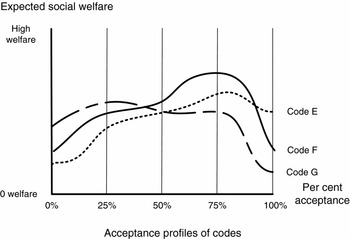
Ridge's VRRU avoids the charge of arbitrariness by examining a moral code's acceptance-utility across every possible level of social acceptance. However, it is far from clear that this is the most intuitively attractive technique for avoiding arbitrariness. It is true that testing a code by its acceptance-utility at exactly 90 percent acceptance seems arbitrary – but why test its acceptance-utility at every possible level, when in reality it must be accepted at some level or the other? Fortunately, there is another version of rule-utilitarianism utilizing an acceptance rate that is not arbitrary at all, and that seems to capture far better than either Hooker's or Ridge's versions the consequentialist spirit of rule-utilitarianism. To see this, recall that Hooker envisages that each generation would teach the ideal code to the next generation.Footnote 14 In selecting a code, the teaching generation will ask themselves ‘Which moral code would produce the best consequences?’ The consequences a given code produces are a function of two main factors: the content of the code, and the proportion of the population that accepts that code.Footnote 15 But the teaching generation can affect what proportion of the population accepts a given code through deft choice of teaching technique. For example, a harsher teaching technique may induce a larger proportion of the population to accept the code. Of course the techniques used to teach the code, and to secure its maintenance, themselves have an impact on social welfare, and Hooker correctly includes these costs as part of what has to be evaluated in appraising different codes. All this suggests that the teaching generation faces a choice over what we can call ‘acceptance profiles’ of the different codes that might be taught, as represented in the following graph.Footnote 16
An ‘acceptance profile’ of a code is the set of expected values it would produce at each of the possible levels of social acceptance (where the expected value of a code includes such items as the consequences of acts that comply with the code, the value of the code's psychological ‘acceptance effects’, the costs and benefits of teaching and maintaining it, etc.). Once we think in terms of code acceptance profiles, we can immediately see that – quite apart from the question of dealing with partial compliance – it might be irrational for the teaching generation to select a code in terms of the social welfare it would produce at 100 percent acceptance. Although the expected social welfare produced by most normatively plausible codes rises as their acceptance levels rise, after a certain point the expected social welfare produced by many codes decreases as the increasingly burdensome cost of teaching and maintaining the more demanding or esoteric provisions of the code outstrips the good procured by each degree of increased acceptance.Footnote 17 Agents will resist performing morally required actions when the personal cost is great, so that the effort to secure acceptance in these instances may outweigh the net good done by agents’ acceptance of the code in such circumstances. (The acceptance levels profiled in this chart represent both how many agents accept the code in question, and how many occasions the agents accept the code in question as governing their choices on that occasion.) Thus the teaching generation would not necessarily select a code with the aim of securing 100 percent acceptance of the code, since expected social welfare achieved by 100 percent acceptance will often be less than the expected social welfare achievable at some lower level of acceptance. Moreover, the code that has the best consequences at 100 percent acceptance may not have as good consequences at its optimum point as the optimum consequences achievable by some other code with worse consequences at 100 percent acceptance. For example, compare Code E with Code F. At 100 percent acceptance, code E would have better effects than Code F would at 100 percent. Nonetheless, at the level of acceptance at which Code F would achieve its optimum effects – roughly 75 percent acceptance – the social value produced by Code F would outstrip both the social value produced by Code E at 100 percent acceptance and the social value at the level of acceptance at which Code E would achieve its optimum effects – roughly 80 percent acceptance. The obvious thing for the teaching generation to do is to compare codes to see which code achieves the highest optimum acceptance level, where the optimum acceptance level for a code is the level of acceptance at which it achieves the greatest expected social good. The acceptance level that achieves this optimum will vary from code to code, and typically be less than 100 percent acceptance.
Figure 1.

Among the codes represented on this chart, Code F offers the highest optimum point. The teaching generation ought to select Code F to teach the new generation, and then aim, using the relevant teaching methods, to secure the acceptance level for Code F that would achieve this optimum point. Let us call the rule-utilitarian theory that captures this idea ‘optimum-rate rule-utilitarianism’ (ORRU). It may be stated as follows:
ORRU: An ideal code is the code whose optimum acceptance level is no lower than that of any alternative code.
Note that the 90 percent acceptance level, the level on which Hooker focuses, is not necessarily the optimum acceptance level for any given code, or for the best code. Thus his theory irrationally advocates teaching and acting in accordance with a code (such as E) that may fall short of the optimum level of expected social utility achievable through some other available code. No teaching generation would make such a choice. Note also that once the teaching generation asks which code it should teach, there is no reason for it to consider the acceptance-utilities for the various codes at all the possible levels of acceptance. Contra Ridge's claim, they need only concentrate on which code will enable them to achieve the highest acceptance-utility, and teach that one.Footnote 18
III. FRRU, VRRU, ORRU, AND THE PARTIAL COMPLIANCE PROBLEM
All versions of rule-utilitarianism must deal with the ‘partial compliance’ problem – the problem generated by the fact that, while a given moral code might produce excellent effects if everyone accepted or complied with it, it may produce extremely bad effects in a real-world situation in which there is only partial compliance or acceptance with the code. For example, Hooker describes a partial compliance case involving river pollution.Footnote 19 There, following Lyons,Footnote 20 he notes the distinction between cases involving maximizing conditions (where the agent needs to make the best of a generally good situation created by other agents’ contributions to produce a public good) and cases involving minimizing conditions (where the agent needs to make the best of a generally bad situation created by other agents’ failures to contribute to the production of a public good). In the pollution case, an important public good would be secured if almost everyone avoided polluting the river. If 90 percent of the industries bordering the river dispose of their waste elsewhere, the river will be healthy. However, if fewer than 90 percent dispose of their waste elsewhere, and more than 10 percent of the industries instead discharge waste into the river, the river will be dangerously polluted. On the other hand, suppose almost all the industries bordering the river discharge their waste into it so that the river is seriously polluted. If you are one of the industrialists, for you to join the few industrialists who avoid discharging waste into the river would be to impose a cost on yourself without producing any public good, since the river will be polluted whatever you do.Footnote 21
How should a rule-utilitarian deal with such cases? Ridge, like many rule-utilitarians, argues that the best way to deal with the problem is to incorporate into the moral code what I shall call ‘conditionalized rules’ prescribing or proscribing certain activities conditional on the level of a code's acceptance in society. He argues that the importance of avoiding heavy learning costs indicates that the best code would be one incorporating relatively few conditionalized rules for dealing with non-acceptance, stated with quite coarse-grained conditions, such as ‘When most people accept the code, do X’ and ‘When less than half the people accept the code, do Y’.Footnote 22 For the pollution case, the relevant rules might be ‘When most people accept the code, dispose of your waste elsewhere’, and ‘When less than half the people accept the code, dispose of your waste in the river.’
How does Hooker deal with the problem of partial compliance? Hooker agrees that it would be unfair to require anyone to follow a burdensome rule for the sake of a public good when this rule is being ignored by most others, and agrees that rule-utilitarianism must provide a way to avoid this kind of unfairness.Footnote 23 He states that rule-consequentialism ‘must not require agents to make sacrifices for others who are able to follow the same rule but won't’.Footnote 24 But exactly how does it avoid doing so?Footnote 25 The obvious suggestion is that his ideal code, like Ridge's, would include conditionalized rules permitting otherwise forbidden conduct when enough others are engaging in this conduct. Thus his FRRU might include such rules as the following:Footnote 26
R*: If enough other people are failing to contribute to the production of a public good that your contribution would not secure its attainment, then you ought not to contribute if doing so is costly.
Thus both Ridge and Hooker can be interpreted as claiming that the best rule-utilitarian solution to the partial compliance problem is to adopt conditionalized rules specifying how an agent is to act as a function of how others are acting in the same situation. I shall assume that ORRU would adopt the same strategy.
IV. A FATAL PROBLEM FOR FRRU, VRRU, AND ORRU
I will argue that Ridge's VRRU, Hooker's FRRU, and my ORRU – and indeed any version of rule-utilitarianism that invokes conditionalized rules to solve the partial compliance problem – suffer from a fatal problem not noticed by either Hooker or Ridge. I shall begin by describing how the problem arises for Ridge's VRRU.
As we have seen, Ridge argues that the ideal code best handles partial compliance problems – at different levels of acceptance – by including coarse-grained conditional rules of the form ‘When virtually everyone accepts the code, do V’, or ‘When less than half the people accept the code, do Y’.Footnote 27 The argument for a code incorporating such rules is that such a code would have higher average expected value than rival codes not incorporating conditionalized rules. Unfortunately this is false. A code incorporating conditionalized rules referring to the contributions of others towards producing some jointly producible public good may have no determinate expected value at all.Footnote 28 In such cases the code cannot be judged to have a higher expected value than any rival code.
To see the problem, consider a slightly revised and more detailed version of the pollution case. In this version, three industrialists own factories bordering the river, you among them. If two or more of the industrialists discharge waste into the river, it will be severely polluted. But if one or none discharge waste, and the others burn their waste, the river will remain healthy, and no other environmental damage will be done (although each industrialist who burns factory waste pays a higher price for disposal than she would if she discharged waste into the river).
The relevant conditionalized rules for a code governing this case would be as follows:
Code C
R1: If two other industrialists are discharging waste, you ought to discharge.
R2: If one other industrialist is discharging waste, while the other is burning waste, you ought to burn your waste.
R3: If no other industrialist is discharging waste, you ought to discharge your waste.Footnote 29
Suppose you are industrialist C. Table 1 represents the possible choices that might confront you. For example, in Choice 1 the other two industrialists are both discharging their waste, and your choice is either to discharge (D) or to burn (B) your waste in this situation. The river will be polluted whichever choice you make.

In these circumstances as industrialist C you have one possible occasion (Choice 1) on which your choice should be governed by rule R1; two possible occasions (Choices 2 and 3) on which your choice should be governed by rule R2; and one possible occasion (Choice 4) on which your choice should be governed by rule R3. Each of the other two industrialists has the same array of possible choices as seen from their perspectives.
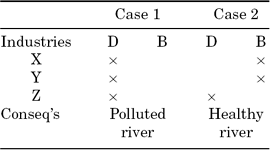
Let us apply Ridge's theory to this situation. To take just the simplest question: what would the consequences be at 100 percent acceptance, i.e. if all three industrialists accepted Code C? As soon as we ask this question, we can see that it has no determinate answer. For simplicity let us assume that each industrialist's accepting the code would result in his complying with it. If all three accepted and complied with Code C, there are two possible abstract patterns of discharging and burning waste, as shown in Table 2:
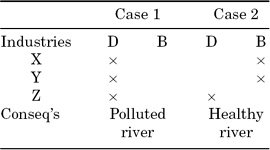
In Case 1, each industrialist appropriately accepts (and complies with) rule R1 of Code C. In Case 2, industrialists X and Y appropriately accept (and comply with) rule R2, while industrialist Z appropriately accepts (and complies with) rule R3. But these two patterns of action, predicated on universal acceptance of Code C, have very different consequences: in Case 1 the consequences (a polluted river) are very bad, while in Case 2 the consequences are very good (a healthy river, and one industrialist saves costs). Since either of these patterns of action (note Case 2 has several distinct realizations) involves universal acceptance of the code, but has very different consequences, it is indeterminate what the consequences would be of universal acceptance of the code.Footnote 30
Ridge advocates assessing moral codes by calculating their average expected value, which is arrived at by ascertaining their expected values at various levels of acceptance. This only compounds the problem just seen. Consider a scenario in which there are 100 sets of three industrialists whose factories are located on the banks of 100 rivers, each industrialist facing the same waste disposal and polluting options as in the original story. At one level of acceptance, in which all 100 trios of industrialists accept and comply with Code C, the expected value of their doing so is indeterminate, since some trios may comply by all following rule R1, while other trios may comply by displaying appropriate patterns of following R2 and R3. But other levels of acceptance display the same indeterminacy. Suppose only 90 percent of the industrialists accept Code C. Some trios of industrialists who are located together on one river will all accept and comply with Code C. But again, some of these trios may comply by all following R1, while other trios may comply by following R2 and R3. As we've seen, these two patterns of full compliance lead to very different consequences. So just by looking at these ‘full acceptance’ trios alone, without looking at what the non-accepters would do (and not even considering the complication that some industrialists who accept C may not successfully comply with its demands) we can see that there is no determinate answer to the question of what the consequences would be if 90 percent of the industrialists accept C. And of course this will be true for every possible level of acceptance that involves at least some trios of joint code-accepters.
This shows that Ridge cannot plausibly hope to solve partial compliance problems through utilizing rules that incorporate conditions referring to what contributions other agents are making to the production of some jointly producible public good (or bad). Of course, it is unlikely that Ridge would advocate a version of VRRU that included rules such as R1–R3, which are tailored specifically to one situation. But these rules reveal a problem that is more general, and crops up however such rules might be phrased, so long as they prescribe the same actions that R1–R3 prescribe. Note especially that the advocate of VRRU cannot hope to avoid indeterminacy by rejecting overtly conditionalized rules and instead endorsing non-conditionalized rules such as ‘Act so as to maximize social good in your circumstances’ to guide agents in cases such as the pollution case. Since the recommendation of this rule for any agent depends on what the other agents are doing, this rule, too, counts as being universally followed in both Cases 1 and 2 by the agents in table 2, and must be seen as covertly conditionalized.
This problem is not unique to Ridge's VRRU. It is equally devastating for FRRU, and for my proposed ORRU, since they, too, attempt to deal with partial compliance cases by use of conditionalized rules. As I have argued, Hooker's best strategy for dealing with partial compliance cases is to adopt conditionalized rules similar to those utilized in Ridge's theory. Thus he should adopt (and may have considered himself as adopting) a set of rules that could be stated something as follows:
R*: If enough other people are failing to contribute to the production of a public good that your contribution would not secure its attainment, then you ought not to contribute if doing so is costly.
R**: If enough other people are contributing to the production of a public good that adding your contribution is necessary and sufficient for its attainment, then you ought to contribute.
R***: If enough other people are contributing to the production of a public good to ensure its attainment, while your contribution would be personally costly, then you ought not to contribute.Footnote 31
But these conditionalized rules are simply more general versions of rules R1–R3, and they would be equally indeterminate for partial compliance problems arising at Hooker's fixed acceptance point of 90 percent, as well as when applied to partial compliance problems (such as the pollution case) that arise at other contribution rates. My proposed ORRU would include similar rules, and fall prey to the same problem.
We have now found that Ridge's VRRU, Hooker's FRRU, and my ORRU use a technique for dealing with partial compliance cases that fatally undermines all three theories. Unless proponents of rule-utilitarianism can devise some successful strategy for dealing with partial compliance cases that avoids this flaw by eschewing conditionalized rules (or their equivalent), we have raised the serious question whether any version of rule-utilitarianism can coherently give us the recommendations we need for partial compliance situations.Footnote 32 The use of conditionalized rules has sometimes been criticized on grounds that it leads to a rule-utilitarianism that is extensionally equivalent to act-utilitarianism. Couching rule-utilitarianism in terms of ‘acceptance’ rather than ‘compliance’ is often advocated on the ground that it avoids this extensional equivalence, but it does not avoid the problem of indeterminacy I have described here.
V. A SECOND FATAL PROBLEM FOR FRRU, VRRU, AND ORRU
Finally, I will describe a problem for these forms of rule-utilitarianism that has not previously been remarked. Consider again a rule's ‘acceptance profile’. Previously I characterized the ‘acceptance profile’ of a code as the set of expected values it would produce at all the possible levels of social acceptance (where the expected value of a code includes such items as the consequences of acts in accord with the code, the value of the code's ‘acceptance effects’, the costs and benefits of teaching and maintaining it, etc.). However, this description of the components of a code's expected value fails to mention a critical element: the effects, for each given level of acceptance, of the associated level of non-acceptance. Thus if a code requiring agents to keep their promises has an acceptance level of 60 percent, this means that 60 percent of the agents accept an obligation to keep their promises (and/or accept this obligation on 60 percent of the occasions on which they have made promises), and that 40 percent of the agents don't accept this obligation (and/or don't accept it on 40 percent of the occasions on which they have made promises). To calculate the overall expected consequences of 60 percent acceptance of this code, we must know both the effects produced by those who accept it, and the effects produced by those who fail to accept it (let us call these the ‘rejecters’). The implications of this fact seem to be overlooked by rule-utilitarians in their discussions of what the consequences of a given code would be, since these discussions typically focus only on the effects of acceptance or compliance.
To know what the consequences would be of the actions of the rejecters, we must know what they would do instead of accepting the code. But what would they do? There are many different ways of not accepting a code. Suppose Code C* requires debtors to repay all their debts. There are many ways in which one could reject this code, and there are many different ways one might act in light of the fact one rejects C*. For example, one might reject this code and instead accept and follow a different code – but a code whose recommendations frequently coincide with those of C* in almost all cases (for example, such a code might require debtors to repay all debts except those that would reduce the debtor to abject poverty). The acts of this type of C* code-rejecter would frequently duplicate those of C* code-accepters. But there are also many ways of rejecting C* that are likely to lead to very different actions from those performed by accepters of Code C*. For example, one might reject C* but accept a code whose recommendations often diverge from those of C*, but still require certain efforts to repay debts (such a code might permit partial or delayed repayment of debts when the debtor is hard-pressed for funds). Or one might reject C* but accept a code whose recommendations diverge from C* in being more demanding (such a code, pinning honor on reciprocal generosity, might dictate that debts should be repaid at double their amount). Or one might reject C* but accept a code that permits avoiding repayment of debts by killing those to whom one inconveniently owes money. Or one might reject C*, and indeed reject all codes, in favor of acting purely out of whim or self-interest. The possible ways of rejecting a given code are legion, and they can lead to very different actions, even among agents facing the same situation. This is not merely a logical possibility; it seems likely that different rejecters will reject any given code in many different ways.
Each of these ways of ‘not accepting’ the code would have different effects on social welfare. The consequences of a 60 percent acceptance rate for a given code depend heavily on what the code-rejecters would do, and it is not at all clear that we have any reliable way to determine what this would be – especially for cases in the further future.Footnote 33
Of course a similar point could be raised about the multitude of different ways of accepting a code (quite apart from the fact that one can accept a code but actually fail to comply). A debtor could repay a $100 debt by handing the lender a $100 bill, or by handing the lender ten $10 bills, or by writing a check, or by using PayPal, or by sending a money order through the mail, etc. In some cases these different ways of accepting the code would have different consequences (perhaps the debtor's handing the money in person to the lender would lead to further beneficial interactions between them, whereas sending a money order would end their interactions). However, insofar as a given code specifies the agent's duty in fairly concrete terms, the room for variance in carrying out the code's prescriptions may be somewhat less problematic than the room for variance in ways in which agents can fail to accept the code.Footnote 34
Unless we have a way of determining what the code-rejecters would do, we can't calculate the expected value of a given code for any acceptance level below 100 percent. And as an empirical matter, answering this question seems like an insurmountable hurdle. A proponent of rule-utilitarianism might attempt to solve this problem by simply stipulating what the rejecters would do, rather than trying to ascertain what they would do by determining the truth of the relevant counterfactuals. For example, it might be stipulated that the rejecters would follow self-interest rather than accept the code. Or it might be stipulated that the rejecters would obey the prevailing morality rather than the code under consideration. But how is the theorist non-arbitrarily to pick which stipulation to make? I cannot see any reasoned way to do this.
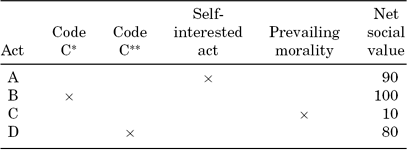
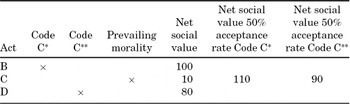
An advocate of rule-utilitarianism might hope that it makes no difference which baseline manner of non-acceptance we choose for comparing the consequences of each code at any given level of acceptance. If this were true, some Code C* could be shown to be superior to a rival Code C** whether we stipulate that all the rejecters pursue their self-interest, or stipulate that all the rejecters follow the prevailing moral code, or whatever. Hence we could select this baseline arbitrarily without affecting our determination of which code is best.Footnote 35 This hope might seem to be borne out by the following chart, in which an agent's available acts (A, B, C, etc.) are shown arrayed against columns designating which act would be chosen by which code (e.g. Code C* prescribes act B), which act would maximize self-interest (act A), which act is prescribed by the prevailing morality (act C), and the net social value that would be produced by each act.
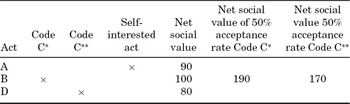
Suppose we arbitrarily stipulate that the ‘baseline’ act that would be performed by a code-rejecter is the self-interested act (that is, any agent who fails to accept the code performs the self-interested act). Thus, consider two agents who have precisely the same array of options shown in table 3, and let us compare the consequences of a 50 percent acceptance rate with Code C* and alternatively with Code C**. The comparison between (a) the consequences of a 50 percent acceptance rate for Code C* (one compliant act B with a net social value of 100, plus one non-compliant act A with a net social value of 90 = 190) and (b) the consequences of a 50 percent acceptance rate for Code C** (one compliant act D with a net social value of eighty plus one non-compliant act A with a net social value of 90 = 170) would be as follows:
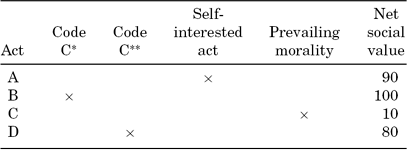

Suppose instead we arbitrarily stipulate that the ‘baseline’ for acts that would be performed by a code-rejecter is the act prescribed by the prevailing morality. Then (again for a group of two agents) the comparison between (a) the consequences of a 50 percent acceptance rate for Code C* (one compliant act B with a net social value of 100, plus one non-compliant act C with a net social value of 10 = 110) and (b) the consequences of a 50 percent acceptance rate for Code C** (one compliant act D with a net social value of 80, plus one non-compliant act C with a net social value of 10 = 90) would be as follows:

Whichever baseline we use as the act a rejecter would perform, Code C* achieves a higher net social utility than Code C**. So it appears that it makes no difference which baseline we select as the act the code-rejecter would perform, and hence that we need not worry about arbitrarily stipulating what act to utilize as the one that a code-rejecter would perform.
Unfortunately, this appearance is misleading, as are these charts. The argument goes wrong in that it does not take into account the value generated by the acceptance of some moral code in the society. General acceptance of a moral code would (for example) generate psychological costs for violating the code – social disapproval from one's peers, and in some cases feelings of guilt in the code-rejecter – which must be included in the net social value. If we add these in, it is possible to describe cases in which the highest net social utility is produced by C* if the baseline comparison for rejecter acts is the self-interested act, but is produced instead by C** if the baseline comparison for rejecter acts is the act prescribed by the prevailing morality.Footnote 36
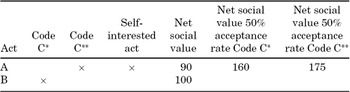
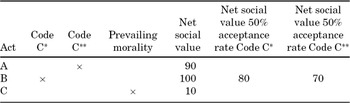
To see this, let's assume that social disapproval experienced by the agent of a non-compliant act has a disvalue of −25, while the feeling of guilt for not accepting and following the code on a given occasion has a disvalue of −5. Let's also change the case so that the act prescribed by Code C** is the very same act as that prescribed by self-interest, i.e. act A. We then get the following comparison.
As before, we begin by stipulating that the ‘baseline’ for acts that would be performed by a code-rejecter is the self-interested act. Thus (for a group of two agents) the comparison between (a) the consequences of a 50 percent acceptance rate for Code C* (one compliant act B with a net social value of 100, plus one non-compliant act A with a net social value of 90, plus a total of −30 from the costs of social disapproval and guilt = 160) and (b) the consequences of a 50 percent acceptance rate for Code C** (one compliant act A with a net social value of 90 plus one non-compliant act A with a net social value of 90, plus a total of –5 for feelings of guilt = 175) would be as represented in the following chart. Notice that since the act prescribed by Code C** is the very same act as the self-interested act, the rejecting agent will perform exactly the same act as he would if he accepted and followed Code C**. Although he may feel guilt (in acting for the wrong reason), he will not experience social disapproval, since no one will know that he was not ‘following’ Code C**.

baseline = self-interested act
Suppose instead we stipulate that the ‘baseline’ for acts that would be performed by a code-rejecter is the act prescribed by the prevailing morality. Then (again for a group of two agents) the comparison between (a) the consequences of a 50 percent acceptance rate for Code C* (one act B with a net social value of 100, plus one act C with a net social value of 10, plus a total of −30 from the costs of social disapproval and guilt = 80) and (b) the consequences of a 50 percent acceptance rate for Code C** (one act A with a net social value of 90, plus one act C with a net social value of 10, plus a total of −30 from the costs of social disapproval and guilt = 70) is represented in Table 7.

baseline = act prescribed by prevailing morality
In these comparisons, Code C** produces higher social value when the baseline is the self-interested act, whereas Code C* produces higher social value when the baseline is the act prescribed by the prevailing morality.
Thus it can make a difference in comparing candidate codes what baseline we utilize for the acts that code-rejecting agents would perform. We cannot, then, solve this problem, as the rule-utilitarian may have hoped, simply by arbitrarily stipulating a baseline for non-accepting acts. Since our stipulation makes a difference to which code has the best consequences, we need a compelling reason to make one stipulation or another – but there isn't any compelling reason to choose any given baseline.
My conclusion is that all forms of rule-utilitarianism are fatally flawed unless some solution can be found to the problem of determining, or specifying, what the code-rejecters would do instead of accepting the code under consideration. For if we cannot determine what the rejecters would do, we cannot say what the expected consequences of any given level (short of 100 percent) of acceptance of a code would be – and hence we cannot compare the consequences of rival codes in order to determine which code is ideal.
VI. CONCLUSION
I have described three different approaches to measuring the consequences of rules for purposes of formulating rule-utilitarianism: Hooker's fixed-rate rule-utilitarianism (which evaluates rules by their consequences at a fixed rate of acceptance, such as 90 percent), Ridge's variable-rate rule-utilitarianism (which evaluates rules by their consequences at every possible rate of acceptance), and my own suggestion, optimum-rate rule-utilitarianism (which evaluates rules by their consequences at their optimum acceptance rate). I have then argued that all three of these versions of rule-utilitarianism fall prey to the same two fatal objections. The first objection is that for all three theories, the preferred method for dealing with partial compliance cases invokes the use of conditionalized rules (according to which the best act for the agent is conditional on what other agents do), but these rules leave the expected social consequences of any code incorporating them completely indeterminate. The second fatal objection is that the evaluation of a code, as judged according to the expected social consequences of its acceptance (either at a single privileged rate lower than 100 percent, or at all possible rates) will turn partly on what actions are performed by those agents who reject it. Since there are so many different ways to reject a code, what these code-rejecters would do seems simply indeterminate. Moreover, there is no non-discriminatory way of arbitrarily stipulating what baseline rejection act the rejecters would perform. Hence again there is no way of measuring and comparing what the consequences of rival moral codes would be.
Unless an improved version of rule-utilitarianism is found that evades these two objections, we must be pessimistic about the ultimate fate of this type of theory.Footnote 37