1. Introduction
Banded iron formations (BIFs) are marine chemical precipitates that form an integral part of the preserved Archaean to lower Proterozoic successions worldwide (e.g. Klein, Reference Klein2005; Mloszewska et al. Reference Mloszewska, Pecoits, Cates, Mojzsis, O’Neil, Robbins and Konhauser2012). They are thinly banded or laminated rocks containing 15 % or more iron of sedimentary origin, and commonly but not necessarily chert layers (James, Reference James1954). BIFs typically consist of alternating Si- and Fe-rich layers within an evaluated total Fe and Si content of 20–40 wt % and 43–56 wt %, respectively (Klein, Reference Klein2005). BIFs widely occur in greenstone belts and supracrustal sequences (e.g. Frei & Polat, Reference Frei and Polat2007; Zhang et al. Reference Zhang, Zhai, Zhang, Xiang, Dai, Wang and Pirajno2012; Zhai & Santosh, Reference Zhai and Santosh2013; Angerer et al. Reference Angerer, Kerrich and Hagemann2013; Ganno et al. Reference Ganno, Ngnotué, Kouankap Nono, Nzenti and Notsa Fokeng2015; Haugaard et al. Reference Haugaard, Ootes and Konhauser2017; Rosière et al. Reference Rosière, Heimann, Oyhantçabal, Santos, Siegesmund, Basei, Oyhantçabal and Oriolo2018; Smith, Reference Smith, Siegesmund, Basei, Oyhantçabal and Oriolo2018). Since the deposition of BIFs has been linked to important compositional changes in the early history of Earth, these rocks are commonly used as proxies in understanding the evolution of life, oceans and the atmosphere in Archaean and Proterozoic times (e.g. Trendall, Reference Trendall, Altermann and Corcoran2002; Simonson, Reference Simonson, Chan and Archer2003; Klein, Reference Klein2005; Bekker et al. Reference Bekker, Slack, Planavsky, Krapez, Hofmann, Konhauser and Rouxel2010; Hagemann et al. Reference Hagemann, Angerer, Duuring, Rosière, Figueiredo e Silva, Lobato, Hensler and Walde2016; Konhausser et al. Reference Konhauser, Planavsky, Hardisty, Robbinsa, Warchola, Haugaard, Lalonde, Partin, Oonkg, Tsikos, Lyons, Bekker and Johnson2017). Nevertheless, the genesis and depositional settings of BIFs remain debated because of syn- and post-depositional processes (clastic contamination, hydrothermal alteration, metamorphism, weathering) that most BIFs have experienced (e.g. Manikyamba et al. Reference Manikyamba, Balaram and Naqvi1993; Arora et al. Reference Arora, Govil, Charan, Uday Raj, Balaram, Manikyamba, Chatterjee and Naqvi1995; Pecoits et al. Reference Pecoits, Gingras, Barley, Kappler, Posth and Konhauser2009; Viehmann et al. Reference Viehmann, Bau, Hoffmann and Münker2015; Barotte et al. Reference Barrote, Rosière, Rolim, Santos and McNaughton2017; Aoki et al. Reference Aoki, Kabashima, Kato, Hirata and Komiya2018; Soh Tamehe et al. Reference Soh Tamehe, Wei, Ganno, Rosière, Nzenti, Gatse and Guanwen2021). These processes have commonly affected the primary features of BIFs and modified their chemical composition. However, some immobile elements such as high field strength elements (HFSEs) and rare earth elements (REEs) were not significantly affected (e.g. Dymek & Klein, Reference Dymek and Klein1988; Bau & Dulski, Reference Bau and Dulski1996; Bolhar et al. Reference Bolhar, Kamber, Moorbath, Fedo and Whitehouse2004). Therefore, these elements are widely used to unravel the source and geotectonic environment of BIFs (e.g. Alexander et al. Reference Alexander, Bau, Andersson and Dulski2008; Basta et al. Reference Basta, Maurice, Fontbote and Favarger2011; Wang et al. Reference Wang, Zhang, Lan and Dai2014 a; Nkoumbou et al. Reference Nkoumbou, Gentry, Numbem, Ekwe Lobe and Nwagoum Keyamfe2017; Ganno et al. Reference Ganno, Njiosseu Tanko, Ngnotué, Kouankap Nono, Djoukouo Soh, Moudioh and Nzenti2017; Nzepang Tankwa et al. Reference Nzepang Tankwa, Ganno, Okunlola, Njiosseu Tanko, Soh Tamehe, Kamguia Woguia, Mbita and Nzenti2020 and references therein).
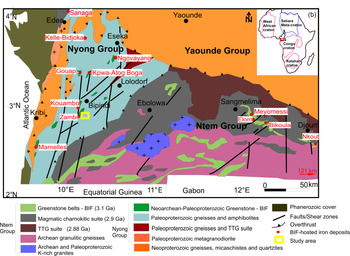
The Ntem Complex (Fig. 1a, b) represents the northwestern extension of the Congo Craton in southern Cameroon (Maurizot et al. Reference Maurizot, Abessolo, Feybesse, John and Lecomte1986; Nédélec et al. Reference Nédélec, Nsifa and Martin1990). This complex comprises significant BIF-hosted iron ore deposits, including the Mbalam (Suh et al. Reference Suh, Cabral, Shemang, Mbinkar and Mboudou2008; Chombong & Suh, Reference Chombong and Suh2013; Ilouga et al. Reference Ilouga, Suh and Ghogomu2013; Sundance Resources Ltd, 2015), Nkout (Anderson et al. Reference Anderson, Wall, Rollinson and Moon2014; Ndime et al. Reference Ndime, Ganno, Soh Tamehe and Nzenti2018, Reference Ndime, Ganno and Nzenti2019), Sanaga (Ilouga et al. Reference Ilouga, Ndong Bidzang, Ziem a Bidias, Olinga, Tata and Minyem2017; West African Minerals Corporation, 2017), Bikoula (Teutsong et al. Reference Teutsong, Bontognali, Ndjigui, Vrijmoed, Teagle, Cooper and Derek2017; Altus Strategies Plc, 2018), Mamelles (Milesi et al. Reference Milesi, Toteu, Deschamps, Feybesse, Lerouge, Cocherie, Penaye, Tchameni, Moloto-A-Kenguemba, Kampunzu, Nicol, Duguey, Leistel, Saint-Martin, Ralay, Heinry, Bouchot, Doumnang Mbaigane, Kanda Kula, Chene, Monthel, Boutin and Cailteux2006) and Gouap (Soh Tamehe et al. Reference Soh Tamehe, Wei, Ganno, Simon, Kouankap Nono, Nzenti, Lemdjou and Lin2019, Reference Soh Tamehe, Wei, Ganno, Rosière, Nzenti, Gatse and Guanwen2021), with total indicated resources of 4.2 billion metric tonnes at 32 % Fe and c. 200 million metric tonnes at 56.6 % Fe. Previous research works on the Ntem Complex iron deposits were mostly focused on their depositional settings based on the petrographical and geochemical studies of the BIFs and associated rocks. However, the origin and geodynamic environment of these BIF-hosted iron deposits remain poorly constrained. Compared to the well-known BIFs in the São Francisco Craton (e.g. Rosière & Rios, Reference Rosière and Rios2004; Piacentini et al. Reference Piacentini, Vasconcelos and Farley2013; Brando Soares et al. Reference Brando Soares, Corrêa Neto, Zeh, Cabral, Pereira, Prado, Almeida, Manduca, Silva, Mabub and Schlichta2017) and the North China Craton (e.g. Wang et al. Reference Wang, Konhauser and Zhang2015, Reference Wang, Huang, Tong, Zheng, Peng, Nan, Zhang and Zhai2016; Lan et al. Reference Lan, Long, Zhao and Zhai2019; Hu et al. Reference Hu, Wang and Zhang2020), the depositional age of the Ntem Complex BIFs is poorly documented in the literature (Ndime et al. Reference Ndime, Ganno and Nzenti2019; Soh Tamehe et al. Reference Soh Tamehe, Wei, Ganno, Simon, Kouankap Nono, Nzenti, Lemdjou and Lin2019, Reference Soh Tamehe, Wei, Ganno, Rosière, Nzenti, Gatse and Guanwen2021; Nzepang Tankwa et al. Reference Nzepang Tankwa, Ganno, Okunlola, Njiosseu Tanko, Soh Tamehe, Kamguia Woguia, Mbita and Nzenti2020).
(a) Geological map of SW Cameroon showing the location of the Bibole Formation (yellow square) and other discovered iron deposits (red dots) (modified after Maurizot et al. Reference Maurizot, Abessolo, Feybesse, John and Lecomte1986; Soh Tamehe et al. Reference Soh Tamehe, Wei, Ganno, Simon, Kouankap Nono, Nzenti, Lemdjou and Lin2019). (b) Inset illustrating the position of the SW Cameroon relative to the Congo craton in Africa. The red narrow indicates the direction where the Mbalam iron deposit is located ˜121 km from the Nkout deposit.

In this contribution, we present field investigations and whole-rock major- and trace-elemental compositions of the Bibole BIFs, aiming to infer their origin and depositional environment. We also report a secondary ion mass spectrometry (SIMS) U–Pb zircon age for the chlorite-magnetite BIFs interbedded with quartz-magnetite BIFs, in order to constrain the depositional age of the Bibole BIFs.
2. Geological setting
2.a. Regional geology
The Ntem Complex (Fig. 1a) is a stable block of Archaean and Palaeoproterozoic rocks bordered to the north by the Yaounde Group, which forms part of the North Equatorial Pan-African fold belt (Fig. 1a; Nzenti et al. Reference Nzenti, Barbey, Macaudière and Soba1988; Tchameni et al. Reference Tchameni, Mezger, Nsifa and Pouclet2001; Shang et al. Reference Shang, Liégeois, Satir, Frisch and Nsifa2010; Ngnotué et al. Reference Ngnotué, Ganno, Nzenti, Schulz, Tchaptchet and Suh2012). This complex is generally divided into two main lithologic assemblages which are, from east to west, the Ntem Group and the Nyong Group (Fig. 1a; Toteu et al. Reference Toteu, Van Schmus, Penaye and Nyobe1994; Tchameni et al. Reference Tchameni, Mezger, Nsifa and Pouclet2001; Penaye et al. Reference Penaye, Toteu, Tchameni, Van Schmus, Tchakounte, Ganwa, Minyem and Nsifa2004; Lerouge et al. Reference Lerouge, Cocherie, Toteu, Milesi, Penaye, Tchameni, Nsifa and Fanning2006). The Bibole area belongs to the Nyong Group, which is mainly composed of gneisses, schists, quartzites, amphibolites and BIFs deposited in continental shelf to submarine volcanic arc settings when considering their protoliths (Lerouge et al. Reference Lerouge, Cocherie, Toteu, Milesi, Penaye, Tchameni, Nsifa and Fanning2006; Ndema Mbongue et al. Reference Ndema Mbongue, Ngnotué, Ngo Nlend, Nzenti and Suh2014; Ganno et al. Reference Ganno, Moudioh, Nzina, Kouankap Nono and Nzenti2016, Reference Ganno, Njiosseu Tanko, Ngnotué, Kouankap Nono, Djoukouo Soh, Moudioh and Nzenti2017; Chombong et al. Reference Chombong, Suh, Lehmann, Vishiti, Ilouga, Shemang, Tantoh and Kedia2017; Soh Tamehe et al. Reference Soh Tamehe, Nzepang Tankwa, Wei, Ganno, Ngnotué, Kouankap Nono, Simon, Zhang and Nzenti2018, Reference Soh Tamehe, Wei, Ganno, Simon, Kouankap Nono, Nzenti, Lemdjou and Lin2019; Fuanya et al. Reference Fuanya, Bolarinwa, Kankeu, Yongue, Tangko and Nkepguep2019; Moudioh et al. Reference Moudioh, Soh Tamehe, Ganno, Nzepang Tankwa, Brando Soares, Ghosh, Kankeu and Nzenti2020). Eclogitic rocks and serpentinites were recently discovered in the Nyong Group, suggesting a subduction-related environment in which these rocks were formed (Loose & Schenk, Reference Loose and Schenk2018; Bouyo Houketchang et al. Reference Bouyo Houketchang, Penaye, Mourib and Toteu2019; Nga Essomba et al. Reference Nga Essomba, Ganno, Tanko Njiosseu, Ndema Mbongue, Kamguia Woguia, Soh Tamehe, Takodjou Wambo and Nzenti2020). The crystallization age for these eclogites is c. 2090 Ma, which is considered a metamorphic age (Loose & Schenk, Reference Loose and Schenk2018), and their P–T conditions were constrained at ∼25 kbar and 850 °C (Bouyo Houketchang et al. Reference Bouyo Houketchang, Penaye, Mourib and Toteu2019).
Previous geochronological studies on the Nyong Group reported three age groups (Lasserre & Soba, Reference Lasserre and Soba1976; Toteu et al. Reference Toteu, Van Schmus, Penaye and Nyobe1994, Reference Toteu, Van Schmus, Penaye and Michard2001; Lerouge et al. Reference Lerouge, Cocherie, Toteu, Milesi, Penaye, Tchameni, Nsifa and Fanning2006; Chombong et al. Reference Chombong, Suh, Lehmann, Vishiti, Ilouga, Shemang, Tantoh and Kedia2017; Nzepang Tankwa et al. Reference Nzepang Tankwa, Ganno, Okunlola, Njiosseu Tanko, Soh Tamehe, Kamguia Woguia, Mbita and Nzenti2020; Soh Tamehe et al. Reference Soh Tamehe, Wei, Ganno, Rosière, Nzenti, Gatse and Guanwen2021). The first age group is Archaean (2900–2500 Ma), and this age was obtained from U–Pb dating of detrital zircon in metasedimentary rocks and probably magmatic zircon from charnockites and magnetite gneisses. The second group is Palaeoproterozoic (2423–2050 Ma) and is interpreted as the age of charnockite emplacement and the maximum depositional age of sediments linked with a high-grade tectonometamorphic event. The third group of Neoproterozoic U–Pb ages ranges between 600 Ma and 500 Ma and corresponds to the later Pan-African tectonometamorphic activity which has partially overprinted the Nyong Group.
2.b. Geology of the BIFs
2.b.1. The Ntem Complex BIFs
The Ntem Complex comprises Neoarchaean–Palaeoproterozoic BIFs which are spatially associated with volcanic and sedimentary rocks (e.g. Lerouge et al. Reference Lerouge, Cocherie, Toteu, Milesi, Penaye, Tchameni, Nsifa and Fanning2006; Ndime et al. Reference Ndime, Ganno and Nzenti2019; Nzepang Tankwa et al. Reference Nzepang Tankwa, Ganno, Okunlola, Njiosseu Tanko, Soh Tamehe, Kamguia Woguia, Mbita and Nzenti2020; Soh Tamehe et al. Reference Soh Tamehe, Wei, Ganno, Rosière, Nzenti, Gatse and Guanwen2021). The Ntem Complex BIFs and associated rocks define a typical greenstone belt succession (Fig. 1a), which has been regionally metamorphosed up to granulite facies. These BIFs are mainly classified as oxide facies according to the major Fe-rich minerals such as magnetite and haematite (Suh et al. Reference Suh, Cabral, Shemang, Mbinkar and Mboudou2008; Ganno et al. Reference Ganno, Njiosseu Tanko, Ngnotué, Kouankap Nono, Djoukouo Soh, Moudioh and Nzenti2017 and references therein). The iron formation bands are characterized by granular or recrystallized quartz-rich bands alternating with iron-rich bands (Ilouga et al. Reference Ilouga, Suh and Ghogomu2013; Anderson et al. Reference Anderson, Wall, Rollinson and Moon2014 and references therein). The banding of the BIFs is generally rhythmic and occasionally irregular in width varying from micro- (0.1–1.7 mm) to meso-scale (1–3.5 cm). The Ntem Complex BIFs are extensively weathered and oxidized at the near-surface, resulting in the production of a cap of high-grade iron ore overlying the BIF units. The main iron ore minerals in the oxidized cap are martite and goethite.
2.b.2. The Bibole BIFs
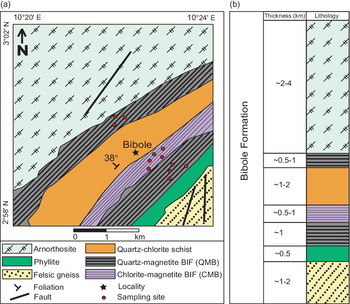
The newly discovered Bibole BIFs are located in the central part of the Nyong Group (Fig. 1a). Previous studies in this area were limited owing to heavy vegetation and thick lateritic covers. However, the occurrence of a steep valley of ∼300 m long allowed the discovery of different rock types interbedded with BIFs, leading to better observation and stratigraphic reconstruction. These rocks are oriented NE–SW and moderately dip to the NW with an average angle of 38° (Fig. 2a). From bottom to top, the stratigraphic sequence consists of felsic gneiss, phyllite, quartz-magnetite BIF (QMB), chlorite-magnetite BIF (CMB), quartz-chlorite schist and anorthosite (Fig. 2b). The contact between the Bibole BIFs and interlayered rocks is sharp and well defined without signs of discordance, suggesting that the deposition of both rocks may be continuous. When compared to the interbedded rocks, the BIFs are characterized by relatively thin layers (mesobands) with a thickness ranging from ∼0.5 to 1 m. The mesobanding structure consists of rhythmically alternating Fe-oxide and recrystallized quartz. The dominant structure in these BIFs is more likely to be a tectonometamorphic foliation overprinting the primary sedimentary structure. Three main deformation events have been recorded in the Bibole area (Ganno et al. Reference Ganno, Moudioh, Nzina, Kouankap Nono and Nzenti2016; Moudioh et al. Reference Moudioh, Soh Tamehe, Ganno, Nzepang Tankwa, Brando Soares, Ghosh, Kankeu and Nzenti2020). The first compressional D1 event is mainly made up by the NE–SW-trending S1 foliation with gentle (15–20°) to steep dips (∼70°), towards the NW. The D2 event is characterized by heterogeneous deformation associated with the development of C2 ductile shear planes and F2 isoclinal folds. The latest D3 deformation event is mainly brittle, producing veins and joints. The tectonometamorphic evolution reveals that the D1 event is associated with the 2090 Ma granulite/eclogite facies metamorphism, while D2 and D3 are related to retrograde metamorphism under amphibolite facies at c. 2040 Ma and later greenschist facies, respectively (Ndema Mbongue et al. Reference Ndema Mbongue, Ngnotué, Ngo Nlend, Nzenti and Suh2014; Owona et al. Reference Owona, Ratschbacher, Afzal, Nsangou Ngapna, Mvondo Ondoa and Ekodeck2021).
(a) Geological sketch map of the Bibole Formation showing the sample locations. (b) Stratigraphic column of the Bibole Formation.

3. Sampling and analytical methods
This study mainly focuses on the QMB and CMB. For petrographic studies, polished thin-sections were prepared at the Rock Mineral Preparation and Analysis Laboratory of the Institute of Geology and Geophysics, Chinese Academy of Sciences (IGGCAS) in Beijing (China). Detailed petrographic observations using transmitted and reflected light were conducted to determine the mineral paragenesis of the studied rocks. Whole-rock geochemical analyses were also conducted at the IGGCAS on a set of 11 representative BIF samples including six QMB and five CMB. The rock samples were trimmed to remove weathered surfaces and cleaned with deionized water. Then, the fresh rocks were crushed and powdered with an agate mill to a size of 200 mesh. Major oxides were analysed using an XRF-1500 sequential X-ray fluorescence (XRF) spectrometer on fused glass beads, with FeO and loss on ignition (LOI) analysed by wet chemical methods. Analytical uncertainties were better than 0.5 % for all major elements. Trace-element and REE contents were determined by inductively coupled plasma mass spectrometer (ICP-MS) after dissolution of ∼40 mg of sample powder using a HNO3 + HF mixture in a Teflon vessel. The analyses were performed with an Element Finnigan MAT spectrometer using the Chinese national standard samples GSR-1 (granite) and GSR-3 (basalt) for analytical quality monitoring. Uncertainties based on repeated analyses of internal standards are ±5 % for REEs and ±5–10 % for trace elements.
Prior to U–Pb isotopic analyses, zircon grains were separated from 5 kg of CMB sample using conventional density and magnetic separation techniques. Representative zircon grains were handpicked under a binocular microscope, mounted together with zircon standards in epoxy mounts and polished until the inner section was exposed. They were documented with transmitted and reflected light micrographs, then cathodoluminescence (CL) images using a JSM 6510 scanning electron microscope (SEM; JEOL) at Beijing CreaTech Testing Technology Co., Ltd. Measurements of U, Th and Pb were conducted using the Cameca IMS-1280 ion microprobe at the SIMS laboratory of IGGCAS, following the operating and data processing procedures described in detail by Li et al. (Reference Li, Liu, Li, Guo and Chamberlain2009). Each measurement consists of seven cycles, and the total analytical time is ∼12 min. The ellipsoidal spot is ∼20 × 30 μm in size. U–Th–Pb ratios and absolute abundances were determined relative to the standard zircon 91500, analyses of which were interspersed with those of unknown grains. The mass resolution used to measure Pb/Pb and Pb/U isotopic ratios was 5400 during the analyses. Measured compositions were corrected for common Pb using non-radiogenic 204Pb and a model Pb composition (Stacey & Kramers, Reference Stacey and Kramers1975), assuming that the common Pb is largely surface contamination introduced during sample preparation. Uncertainties on individual analysis in data tables are reported at the 1σ level; mean ages for pooled U/Pb (and Pb/Pb) analyses are quoted with 95 % confidence intervals. The reported weighted mean U–Pb ages and concordia plots were processed using the Isoplot/Ex v. 2.49 software (Ludwig, Reference Ludwig2001).
4. Results
4.a. Petrography
Irrespective of the mineral assemblages, two facies of BIFs have been recognized in the Bibole area. They include the oxide facies BIF (QMB) and mixed oxide-silicate facies BIF (CMB).
4.a.1. Quartz-magnetite BIFs
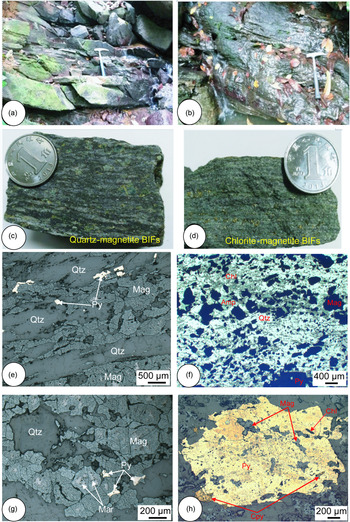
The QMB crop out as blocks with diameters varying from 1 to 3 m or as pavements in the Bibole river bed (Fig. 3a). In hand specimen, the rock is fine grained, consisting of alternating iron- and silica-rich layers ranging from 1 to 3 mm in width (Fig. 3c). The banded structure is commonly straight and discontinuous, but it is not well defined. The iron-rich bands are dark green in colour and composed of magnetite, martite and minor amphibole (tremolite), whereas the silica-rich bands are white in colour and mainly made up of quartz.
Field photos and photomicrographs of the Bibole BIFs. Outcrop of (a) QMB and (b) CMB in the Bibole river bed. Length of hammer for scale is 33 cm. Hand specimen of (c) QMB and (d) CMB. Diameter of coin for scale is 2.5 cm. Microstructure of (e, g) QMB consisting of quartz, magnetite and minor tremolite, and (f, h) CMB comprising chlorite, magnetite, pyrite, quartz, chalcopyrite and amphibole. Note the martitization of magnetite crystals in from the borders towards the centre. Mineral abbreviations: Amp – amphibole; Chl – chlorite; Py – pyrite; Cpy – chalcopyrite; Mag – magnetite; Mar – martite; Qtz – quartz.

Magnetite is the main iron mineral of the QMB, occurring as a dominant component of Fe-rich bands (>70 vol. %) and a minor amount (<10 vol. %) in Si-rich bands. In both bands, magnetite is dark grey in colour and occurs as subhedral to anhedral crystals with sizes ranging from 30 to 300 µm (Fig. 3e). The magnetite crystals are often interconnected to form irregular aggregates or scattered as individual grains in quartz (Fig. 3g). Some magnetite grains contain quartz and tremolite inclusions (Fig. 3e, g). The replacement of magnetite by martite is also noticeable in some BIF samples. Martite occurs along the magnetite edges (Fig. 3g). It is light grey in colour and occurs as anhedral to subhedral crystals of <10 µm in size. The transformation of magnetite to martite is probably linked to the near-surface oxidation as observed within the Mbalam and Gouap BIFs (Ilouga et al. Reference Ilouga, Suh and Ghogomu2013; Soh Tamehe et al. Reference Soh Tamehe, Wei, Ganno, Simon, Kouankap Nono, Nzenti, Lemdjou and Lin2019).
Quartz is the dominant mineral of the Si-rich bands and occurs as subhedral to anhedral crystals with sizes up to 250 µm. Quartz crystals frequently form irregular aggregates and are rarely found as individual grains within the Fe-rich bands (Fig. 3e).
Amphibole in the QMB is tremolite. The tremolite is yellow to pink in colour and occurs as subhedral to anhedral crystals developed alongside the magnetite aggregates interface. The crystal size varies from 100 to 600 µm. Some tremolite crystals contain minor quartz inclusions.
4.a.2. Chlorite-magnetite BIFs
The CMB crop out as flagstones at the Bibole river (Fig. 3b). The rock is dark green in colour (owing to the high content of chlorite), fine to medium grained and displays a schistose structure in hand specimen and thin-section (Fig. 3d, f). The cleavage planes are filled by magnetite and sulfides minerals (Fig. 3d), suggesting that the CMB were hydrothermally altered. The main minerals are chlorite, amphibole, magnetite and quartz with smaller amounts of pyrite and chalcopyrite (Fig. 3f, g).
Magnetite occurs as euhedral crystals with sizes ranging from 0.2 to 0.7 mm. Some crystals have undergone oxidation into martite. Pyrite occurs as both euhedral porphyroblasts with squared shapes (1.04 × 0.25 mm) and fine-grained (0.02 mm) disseminations within the rock (Fig. 3f). Magnetite, chlorite and chalcopyrite are occasionally found as inclusions in pyrite (Fig. 3g). Chalcopyrite appears as subhedral to anhedral crystals having an average size of 0.21 mm.
Chlorite appears as thin flakes (up to 0.3 mm) and often displays a preferred orientation with amphibole (Fig. 3f). Amphibole occurs as anhedral crystals having an average size of 0.75 mm, and is often associated with chlorite and quartz. The latter appears as euhedral to subhedral crystals with grain sizes ranging from 0.2 to 0.36 mm (Fig. 3f).
4.b. Geochemistry
4.b.1. Quartz-magnetite BIFs
Whole-rock, major- and trace-element compositions of the QMB (Table 1) show that SiO2 and Fe2O3 (total Fe) are the main components and represent more than 95 wt % of the bulk rock, reflecting the dominance of Fe-oxide minerals and quartz in the analysed samples. Their contents range from 40 to 48 wt % and from 50 to 56 wt % respectively. This result is consistent with the average concentration of the Ntem Complex BIFs, including the Kouambo (Ganno et al. Reference Ganno, Njiosseu Tanko, Ngnotué, Kouankap Nono, Djoukouo Soh, Moudioh and Nzenti2017), the Bikoula (Teutsong et al. Reference Teutsong, Bontognali, Ndjigui, Vrijmoed, Teagle, Cooper and Derek2017), the Kpwa-Atog Boga (Soh Tamehe et al. Reference Soh Tamehe, Nzepang Tankwa, Wei, Ganno, Ngnotué, Kouankap Nono, Simon, Zhang and Nzenti2018) and the Nkout (Ndime et al. Reference Ndime, Ganno and Nzenti2019) BIFs as well as the Xiaolaihe BIFs from the North China Craton (Peng et al. Reference Peng, Wang, Tong, Zhang and Zhang2018) (Table 2). The Al2O3 (0.24–0.47 wt %) and TiO2 (0.01–0.03 wt %) contents of the QMB are low, suggesting the absence of detrital input during their deposition. These low Al2O3 and TiO2 abundances are almost similar to those of the other Ntem Complex BIFs except the Kpwa-Atog Boga and Bikoula BIFs, and the Xiaolaihe BIFs (Table 2). Furthermore, the MgO (0.86–1.44 wt %) and CaO (0.50–1.07 wt %) contents of the QMB are relatively low, but not negligible. This indicates the presence of a minor amount of silicate minerals (e.g. tremolite) within these BIFs. All the studied BIF samples contain very low concentrations (<0.2 wt %) of other major elements.
Major- (wt %) and trace-element (ppm) compositions of the Bibole BIFs

Note: Chondrite (subscript CN; Sun & McDonough, Reference Sun, McDonough, Norry and Saunders1989) and post-Archaean Australian shale (PAAS, subscript SN; McLennan, Reference McLennan1989). La/La* = LaPAAS/(3PrPAAS − 2NdPAAS); Eu/Eu* = EuPAAS/(0.67SmPAAS + 0.33TbPAAS) (Bau & Dulski, Reference Bau and Dulski1996); Ce/Ce* = CePAAS/(2PrPAAS − NdPAAS); Y/Y* = 2YPAAS/(DyPAAS + HoPAAS) (Bolhar et al. Reference Bolhar, Kamber, Moorbath, Fedo and Whitehouse2004).
Average values of major- (wt %) and trace-element (ppm) compositions of the Bibole and selected worldwide BIFs

Note: Chondrite (subscript CN; Sun & McDonough, Reference Sun, McDonough, Norry and Saunders1989) and post-Archaean Australian shale (PAAS, subscript SN; McLennan, Reference McLennan1989). La/La* = LaPAAS/(3PrPAAS − 2NdPAAS); Eu/Eu* = EuPAAS/(0.67SmPAAS + 0.33TbPAAS) (Bau & Dulski, Reference Bau and Dulski1996); Ce/Ce* = CePAAS/(2PrPAAS − NdPAAS); Y/Y* = 2YPAAS/(DyPAAS + HoPAAS) (Bolhar et al. Reference Bolhar, Kamber, Moorbath, Fedo and Whitehouse2004). - = value not reported.
The QMB samples display very low contents of HFSEs such as Sc (0.20–1.15 ppm), Zr (1–5.73 ppm), Hf (0.05–0.15 ppm) and Th (0.08–0.30 ppm). With the exception of Cr (63–197 ppm) and Zn (14–33 ppm), the QMB have relatively low contents of transition metals such as Co (2.84–6.23 ppm), Ni (3.12–7.63 ppm) and V (4.09–10.18 ppm). In terms of large ion lithophile elements (LILEs), these BIF samples display variable concentrations of Ba (5.43–38.68 ppm), Sr (3.02–25.29 ppm) and Rb (0.20–1.46 ppm). Comparable results have been also reported from the other Ntem Complex BIFs (Ganno et al. Reference Ganno, Njiosseu Tanko, Ngnotué, Kouankap Nono, Djoukouo Soh, Moudioh and Nzenti2017; Teutsong et al. Reference Teutsong, Bontognali, Ndjigui, Vrijmoed, Teagle, Cooper and Derek2017; Soh Tamehe et al. Reference Soh Tamehe, Nzepang Tankwa, Wei, Ganno, Ngnotué, Kouankap Nono, Simon, Zhang and Nzenti2018; Ndime et al. Reference Ndime, Ganno and Nzenti2019) and the Xiaolaihe BIFs (Peng et al. Reference Peng, Wang, Tong, Zhang and Zhang2018) (Table 2).
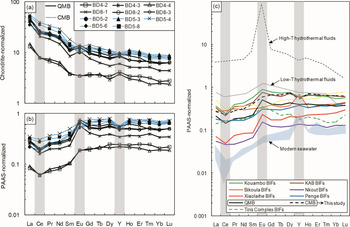
Based on ionic radius, yttrium shows similar chemical behaviour to REEs and is commonly inserted between Dy and Ho (Bau et al. Reference Bau, Koschinsky, Dulski and Hein1996; Sun et al. Reference Sun, Zhu, Tang, Zhang and Luo2015). The total REE and Y (∑REY) contents of all the QMB samples range from 21.42 to 62.97 ppm. The chondrite-normalized REE patterns (subscript ‘CN’) of the QMB display (i) LREE enrichment ((La/Yb)CN = 4.97–8.62), (ii) almost flat to slightly fractionated HREEs ((Tb/Yb)CN = 1.31–1.60), (iii) negative Ce anomalies, and (iv) weak negative to positive Eu anomalies ((Eu/Eu*)CN = 0.92–1.32) (Table 1; Fig. 4a). The REY patterns of the QMB samples, normalized to the Post-Archaean Australian Shale (PAAS, subscript ‘SN’ (shale-normalized)), are characterized by LREE depletion relative to HREEs ((La/Yb)SN = 0.40–0.69; Table 1; Fig. 4b, c). Data for typical modern seawater, hydrothermal fluids, the Ntem Complex BIFs (e.g. Kouambo BIFs (Ganno et al. Reference Ganno, Njiosseu Tanko, Ngnotué, Kouankap Nono, Djoukouo Soh, Moudioh and Nzenti2017); Kpwa-Atog Boga BIFs (Soh Tamehe et al. Reference Soh Tamehe, Nzepang Tankwa, Wei, Ganno, Ngnotué, Kouankap Nono, Simon, Zhang and Nzenti2018); Bikoula BIFs (Teutsong et al. Reference Teutsong, Bontognali, Ndjigui, Vrijmoed, Teagle, Cooper and Derek2017); Nkout BIFs (Ndime et al. Reference Ndime, Ganno and Nzenti2019), the well-studied African BIFs (e.g. the Palaeoproterozoic Tiris Complex BIFs from West Africa in Mauritania) (Taylor et al. Reference Taylor, Finn, Anderson, Bradley, Joud, Taleb Mohamed, Horton, Bouabdellah and Slack2016); Penge BIFs from South Africa (Bau & Dulski, Reference Bau and Dulski1996; Klein & Beukes, Reference Klein and Beukes1989) and the North China Craton BIFs (Xiaolaihe BIFs; Peng et al. Reference Peng, Wang, Tong, Zhang and Zhang2018) are plotted for comparison (Fig. 4c). However, a strong positive Y anomaly is observed in the Bikoula BIFs, while the Tiris Complex BIFs lack Ce and Y anomalies.
(a) Chondrite-normalized and (b, c) PAAS-normalized REY patterns of the average of the Bibole and world BIFs, seawater and high-T and low-T hydrothermal fluids. The normalization values of PAAS and chondrite are from McLennan (Reference McLennan1989) and Sun & McDonough (Reference Sun, McDonough, Norry and Saunders1989), respectively. Data sources: Penge BIFs (Bau & Dulski, Reference Bau and Dulski1996); Ntem Complex BIFs (Kouambo: Ganno et al. Reference Ganno, Njiosseu Tanko, Ngnotué, Kouankap Nono, Djoukouo Soh, Moudioh and Nzenti2017; Bikoula: Teutsong et al. Reference Teutsong, Bontognali, Ndjigui, Vrijmoed, Teagle, Cooper and Derek2017; Kpwa-Atog Boga: Soh Tamehe et al. Reference Soh Tamehe, Nzepang Tankwa, Wei, Ganno, Ngnotué, Kouankap Nono, Simon, Zhang and Nzenti2018; Nkout: Ndime et al. Reference Ndime, Ganno and Nzenti2019); African BIFs (Tiris Complex BIFs from Mauritania, West Africa: Taylor et al. Reference Taylor, Finn, Anderson, Bradley, Joud, Taleb Mohamed, Horton, Bouabdellah and Slack2016); Xiaolaihe BIFs from North China Craton (Peng et al. Reference Peng, Wang, Tong, Zhang and Zhang2018); high-T hydrothermal fluids (Bau & Dulski, Reference Bau and Dulski1999); low-T hydrothermal fluids (Bau & Dulski, Reference Bau and Dulski1999); seawater (Bolhar et al. Reference Bolhar, Kamber, Moorbath, Fedo and Whitehouse2004).

The QMB also display a positive Eu anomaly ((Eu/Eu*)SN = 1.30–2.07) similar to that of Archaean and early Palaeoproterozoic BIFs (e.g. Klein et Beukes, Reference Klein and Beukes1989; Planavsky et al. Reference Planavsky, Bekker, Rouxel, Kamber, Hofmann, Knudsen and Lyons2010; Taylor et al. Reference Taylor, Finn, Anderson, Bradley, Joud, Taleb Mohamed, Horton, Bouabdellah and Slack2016; Ganno et al. Reference Ganno, Njiosseu Tanko, Ngnotué, Kouankap Nono, Djoukouo Soh, Moudioh and Nzenti2017; Peng et al. Reference Peng, Wang, Tong, Zhang and Zhang2018; Ndime et al. Reference Ndime, Ganno and Nzenti2019; Fig. 4c). The REY patterns of the QMB samples are further characterized by (i) positive La ((La/La*)SN = 1.21–1.47) and slight Y ((Y/Y*)SN = 0.90–1.03) anomalies, (ii) negative Ce anomalies ((Ce/Ce*)SN = 0.70–0.79), and (iii) chondritic to super-chondritic Y/Ho ratios (30.44–34.32) (Table 1; Fig. 4b). These features are comparable to (but less pronounced than) those of other detritus-free Precambrian BIFs (e.g. Ganno et al. Reference Ganno, Njiosseu Tanko, Ngnotué, Kouankap Nono, Djoukouo Soh, Moudioh and Nzenti2017; Peng et al. Reference Peng, Wang, Tong, Zhang and Zhang2018; Ndime et al. Reference Ndime, Ganno and Nzenti2019; Fig. 4c).
4.b.2. Chlorite-magnetite BIFs
The elemental compositions (major, trace and REEs) of the CMB are shown in Table 1. The SiO2, TFe2O3 (total Fe as Fe2O3) and Al2O3 contents of these rocks vary between 48.45 and 55.30 wt %, 36.37 and 43.19 wt %, and 1.17 and 1.27 wt %, respectively. The other major elements (except MgO and CaO) have very low contents. The CMB samples are noticeably depleted in LILEs such as Rb, Sr and Ba, ranging from 0.01–0.29 ppm, 1.52–2.59 ppm and 2.14–3.07 ppm, respectively (Table 1). This is consistent with the absence of feldspars as revealed by the petrographic studies. They are also depleted in HFSEs, such as Zr (2.86–5.52 ppm), Hf (0.13–0.21 ppm), Nb (0.31–0.60 ppm) and Ta (0.03–0.04 ppm). However, the CMB display higher transition element contents (except Sc, V, Pb and Zn): Co (40.22–58.91 ppm), Ni (190.41–211.92 ppm), Cr (213.44–279.73 ppm) and Cu (467.10–952.45 ppm). High Ni and Cu abundances are most probably related to the presence of pyrite and chalcopyrite in this rock. In general, the higher concentration of the transitional elements in the CMB could be related to the hydrothermal fluids from mafic sources.
The CMB are characterized by low ∑REE contents (45.81–67.65 ppm). On the chondrite-normalized REE patterns (Fig. 4a), all the studied CMB samples show LREE enrichment relative to HREEs ((La/Yb)CN = 4.34–6.73), and weak negative Eu anomalies (Eu/Eu* = 0.77–0.86). On the PAAS-normalized REY diagram, the CMB exhibit depletion in LREEs relative to HREEs with (La/Yb)SN ratios ranging from 0.35 to 0.54 (Table 1; Fig. 4b, c). This rock type also shows negative Ce and Y anomalies with (Ce/Ce*)SN = 0.78–0.86 and (Y/Y*)SN = 0.69–0.78, weak positive Eu anomalies ((Eu/Eu*)SN = 1.08–1.24) and near-chondritic Y/Ho ratios (Y/Ho = 23.96–26.55).
4.c. Geochronology
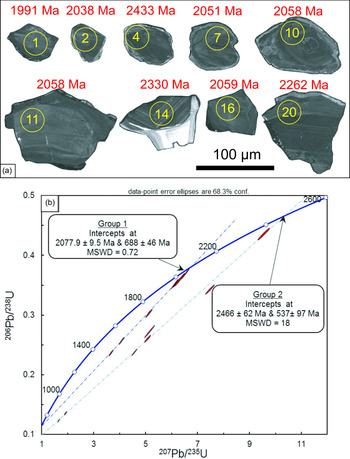
SIMS zircon U–Pb ages for the CMB (sample BD5) are given in Table 3. The zircon crystals display grey to dark cores, and are subhedral prismatic or fragmented in shape with grain sizes ranging from ∼72 to 138 μm (Fig. 5a). They exhibit variable Th (74–430 ppm) and U (369–1439 ppm) contents, and low to moderate Th/U ratios (0.15–0.34) (Table 3). The value of f206 also known as common Pb, is low ranging from 0.07 to 0.38 %. A few grains (n = 8) show clear oscillatory zoning typical of magmatic zircon (e.g. Belousova et al. Reference Belousova, Griffin, O’Reilly and Fisher2002; Corfu et al. Reference Corfu, Hanchar, Hoskin and Kinny2003), while other grains display spotted and spongy textures in transmitted light and blurred to vague oscillatory zoning on CL images (Fig. 5a). This suggests a metamorphic- or magmatic-hydrothermal origin (e.g. Hoskin, Reference Hoskin2005; Jiang et al. Reference Jiang, Li, Evans and Wu2019; Li et al. Reference Li, Zhou, Evans, Kong, Wu and Xi2019, Reference Li, Danisík, Zhou, Jiang and Wu2020). Twenty-five SIMS zircon U–Pb analyses were performed, and the measured radiogenic ratios are variously discordant. On the U–Pb concordia diagram (Fig. 5b), all analyses define two discordia lines and show evidence of two age populations. The first population (group 1) is dominated by metamorphic zircon grains with an upper intercept age of 2077.9 ± 9.5 Ma (mean square weighted deviation (MSWD) = 0.72) (Fig. 5b). The second age population (group 2) is composed of magmatic zircon grains. They also define another discordia line on the U–Pb concordia diagram, giving an upper intercept age of 2466 ± 62 Ma (MSWD = 18) (Fig. 5b). The two zircon age populations yielded Neoproterozoic lower-intercept ages.
SIMS U–Pb data for zircon from the Bibole chlorite-magnetite BIFs

(a) Representative CL images with corresponding apparent U–Pb ages (Ma) of zircon from Bibole BIF sample BD5 (spot number in yellow and age in red). (b) SIMS U–Pb concordia plots of metamorphic (group 1) and magmatic (group 2) zircon grains.

5. Discussion
5.a. Source characteristics of the Bibole BIFs
5.a.1. Detrital input
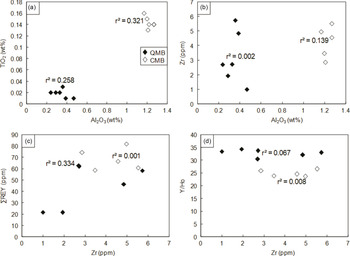
Although the BIFs are generally considered as pure chemical sediments, their compositions have often been influenced by the deposition of terrigenous material of a felsic or mafic source (e.g. Arora et al. Reference Arora, Govil, Charan, Uday Raj, Balaram, Manikyamba, Chatterjee and Naqvi1995; Basta et al. Reference Basta, Maurice, Fontbote and Favarger2011; Gourcerol et al. Reference Gourcerol, Thurston, Kontak, Côté-Mantha and Biczock2016; Ganno et al. Reference Ganno, Njiosseu Tanko, Ngnotué, Kouankap Nono, Djoukouo Soh, Moudioh and Nzenti2017; Ndime et al. Reference Ndime, Ganno and Nzenti2019; Soh Tamehe et al. Reference Soh Tamehe, Wei, Ganno, Rosière, Nzenti, Gatse and Guanwen2021). High concentrations of SiO2 (mean: 43.30 wt % and 51.92 wt %) and Fe2O3 (mean: 53.58 wt % and 39.72 wt %) in the QMB and CMB, respectively (Table 2) suggest that they are nearly pure chemical precipitates. The low Al2O3 (mean: 0.35 wt %) and TiO2 (mean: 0.02 wt %) contents of the QMB also indicate trivial incorporation of a terrigenous component, whereas the Al2O3 content of the CMB (up to 1.27 wt %) suggests that minor detrital input was involved during their precipitation (e.g. Arora et al. Reference Arora, Govil, Charan, Uday Raj, Balaram, Manikyamba, Chatterjee and Naqvi1995 and references therein). It is noteworthy that Al2O3 does not have a significant relationship with TiO2 and Zr for the studied BIFs (Fig. 6a, b), indicating near absence of detrital input during chemical precipitation of the Bibole BIFs. This is also corroborated by their very low contents of HFSEs (e.g. Sc, Hf, Zr, Th), which are generally enriched in contaminated BIFs (e.g. Mloszewska et al. Reference Mloszewska, Pecoits, Cates, Mojzsis, O’Neil, Robbins and Konhauser2012; Aoki et al. Reference Aoki, Kabashima, Kato, Hirata and Komiya2018). Moreover, the low ∑REY content (mean: 56.95 ppm; Table 2) as well as no to weak correlation between ΣREY and Zr for the Bibole BIFs (Fig. 6c) suggest that the contribution of detrital components to their composition was insignificant.
Harker variation diagrams for the Bibole BIFs. (a) TiO2 versus Al2O3; (b) Zr versus Al2O3; (c) ∑REE versus Zr; and (d) Y/Ho versus Zr.

Since the crustal material (e.g. felsic and basaltic rocks) had a constant Y/Ho ratio of 26 (Bau, Reference Bau1996), lower admixture of any contaminant in chemical sediments precipitated in the seawater would reduce the superchondritic Y/Ho ratio to similar to that of seawater (>44), and co-variation would be observed between Y/Ho and Zr (Bolhar et al. Reference Bolhar, Kamber, Moorbath, Fedo and Whitehouse2004). The QMB have Y/Ho ratios ranging from 30.44 to 34.32 (Table 1), which are above the chondritic ratios (28.75) of McDonough & Sun (Reference McDonough and Sun1995). On other hand, the CMB exhibit low Y/Ho ratios ranging from 23.96 to 26.55. There is striking evidence against contamination of the Bibole BIFs during their precipitation as shown by the null correlation (r = 0.062 and 0.008 for QMB and CMB, respectively) between Zr and Y/Ho (Fig. 6d). This suggests that the decrease in Y/Ho ratios in the original BIFs is not related to crustal contamination. In summary, we suggest that the Bibole BIFs were formed by chemical precipitation with insignificant admixture of detrital components, which is similar for most of the Ntem Complex BIFs (e.g. Ganno et al. Reference Ganno, Njiosseu Tanko, Ngnotué, Kouankap Nono, Djoukouo Soh, Moudioh and Nzenti2017; Ndime et al. Reference Ndime, Ganno and Nzenti2019; Soh Tamehe et al. 2020) and other BIFs worldwide (e.g. Bolhar et al. Reference Bolhar, Kamber, Moorbath, Fedo and Whitehouse2004; Pecoits et al. Reference Pecoits, Gingras, Barley, Kappler, Posth and Konhauser2009; Peng et al. Reference Peng, Wang, Tong, Zhang and Zhang2018).
5.a.2. Hydrothermal versus seawater input
Several authors (e.g. Bau, Reference Bau1993; Morris, Reference Morris1993; Bolhar et al. Reference Bolhar, Kamber, Moorbath, Fedo and Whitehouse2004; Ganno et al. Reference Ganno, Njiosseu Tanko, Ngnotué, Kouankap Nono, Djoukouo Soh, Moudioh and Nzenti2017; Soh Tamehe et al. Reference Soh Tamehe, Nzepang Tankwa, Wei, Ganno, Ngnotué, Kouankap Nono, Simon, Zhang and Nzenti2018 and references therein) have demonstrated that diagenesis and metamorphism do not significantly modify the primary REY content of BIFs. Thus, the REY signatures of BIFs are strong pieces of evidence for constraining their origin (e.g. Planavsky et al. Reference Planavsky, Bekker, Rouxel, Kamber, Hofmann, Knudsen and Lyons2010 and references therein). Shale-normalized REY patterns of most BIFs worldwide display seawater signatures, including (i) positive La, Gd and Y anomalies, (ii) high Y/Ho ratios (>40) and (iii) LREE depletion (e.g. Bau & Dulski, Reference Bau and Dulski1996; Alibo & Nozaki, Reference Alibo and Nozaki1999; Bolhar et al. Reference Bolhar, Kamber, Moorbath, Fedo and Whitehouse2004; Thurston et al. Reference Thurston, Kamber and Whitehouse2012). The REY patterns of the studied BIF samples are depleted in LREEs and show positive La, Gd and Y anomalies (except CMB samples, which display a negative YSN anomaly), whereas their average Y/Ho ratios are 32.85 and 24.92 for QMB and CMB, respectively (Fig. 4a; Table 2). The low Y/Ho ratios together with negative YSN anomalies of the CMB samples could be attributed to the precipitation of iron oxyhydroxides (Bau & Dulski, Reference Bau and Dulski1999; Basta et al. Reference Basta, Maurice, Fontbote and Favarger2011). Some authors (e.g. Douville et al. Reference Douville, Bienvenu, Charlou, Donval, Fouquet, Appriou and Gamo1999; Bau & Dulski, Reference Bau and Dulski1999) have proposed that the Y/Ho ratios of hydrothermal fluids at a vent site display a chondritic value of ∼28, while seawater has a superchondritic Y/Ho ratio (∼44). Hence, the near-chondritic average Y/Ho ratio of the Bibole BIFs was probably inherited from hydrothermal solutions. On the other hand, it is commonly accepted that positive Eu anomalies in BIFs reflect the influence of hydrothermal fluids on seawater composition (e.g. Bau & Dulski, Reference Bau and Dulski1996; Bolhar et al. Reference Bolhar, Kamber, Moorbath, Fedo and Whitehouse2004; Planavsky et al. Reference Planavsky, Bekker, Rouxel, Kamber, Hofmann, Knudsen and Lyons2010). Hydrothermal alteration of oceanic crust is caused by high-temperature (high-T, >300 °C) or low-temperature (low-T, <200 °C) hydrothermal fluids. High-T hydrothermal solutions display a large positive Eu anomaly (Eu/Eu* >1.52), similar to that of Archaean and early Proterozoic BIFs in which Fe and Si were mainly derived from high-T hydrothermal fluids (Derry & Jacobsen, Reference Derry and Jacobsen1990; Kato et al. Reference Kato, Ohta, Tsunematsu, Watanabe, Isozaki, Maruyama and Imai1998, Reference Kato, Kano and Kunugiza2002; Bolhar et al. Reference Bolhar, Kamber, Moorbath, Fedo and Whitehouse2004). The decrease in Eu anomaly with the decreasing depositional age of BIFs is attributed to the contribution of low-T hydrothermal solutions to the REE source (Danielson et al. Reference Danielson, Möller and Dulski1992; Bau & Moller, Reference Bau and Möller1993). The PAAS-normalized REY patterns of most late Proterozoic and Neoproterozoic BIFs worldwide exhibit weak positive to no Eu anomalies. The PAAS-normalized REY patterns of the Bibole BIFs exhibit positive Eu anomalies with mean (Eu/Eu*)SN of 1.86 and 1.15 for the QMB and CMB, respectively (Fig. 4b, c; Table 2). However, if the two BIF facies (QMB and CMB) are taken together, the average Eu anomaly of the Bibole BIFs is 1.50, which is comparable to that of the early Proterozoic Hamersely BIFs (Eu/Eu*SN = 1.52, Derry & Jacobsen, Reference Derry and Jacobsen1990). This result is consistent with the contribution of low-T hydrothermal fluids during the deposition of the Bibole BIFs formed at c. 2466 Ma during early Palaeoproterozoic time (e.g. Bau & Dulski, Reference Bau and Dulski1996; Bolhar et al. Reference Bolhar, Kamber, Moorbath, Fedo and Whitehouse2004).
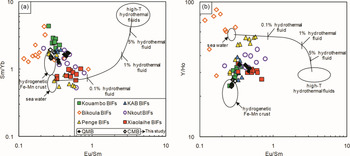
The REY distribution patterns of the Bibole BIFs show the characteristics of both low-T hydrothermal fluids (weak positive Eu anomaly) and seawater (LREE depletion relative to HREEs, negative Ce anomaly) (Fig. 4c). This indicates that Fe and Si in the Bibole BIFs were probably derived from the mixing of low-T hydrothermal solutions and seawater. Derry & Jacobsen (Reference Derry and Jacobsen1990) proposed that Palaeoproterozoic surface seawater and high-T hydrothermal fluids have a Y/Ho ratio of c. 65 and 28, respectively. The mean Y/Ho ratio of the detritus-free oxide facies BIFs (QMB) is 32.85, whereas the mixed oxide-silicate facies BIFs (CMB) exhibit an average Y/Ho ratio of 24.92. These values suggest that the Bibole BIFs would be precipitated from solutions composed of an ∼30 % seawater component and 70 % hydrothermal component. This result is further corroborated by the conservative two-component mixing models of Alexander et al. (Reference Alexander, Bau, Andersson and Dulski2008) (Fig. 7a, b). In both diagrams, it appears that a small seawater component and a significant low-T hydrothermal component have contributed to the precipitation of the studied BIFs, similar to those of the Ntem Complex BIFs (Ganno et al. Reference Ganno, Njiosseu Tanko, Ngnotué, Kouankap Nono, Djoukouo Soh, Moudioh and Nzenti2017; Teutsong et al. Reference Teutsong, Bontognali, Ndjigui, Vrijmoed, Teagle, Cooper and Derek2017; Soh Tamehe et al. Reference Soh Tamehe, Nzepang Tankwa, Wei, Ganno, Ngnotué, Kouankap Nono, Simon, Zhang and Nzenti2018; Ndime et al. Reference Ndime, Ganno and Nzenti2019), the Penge BIFs (Bau & Dulski, Reference Bau and Dulski1996) and the Xiaolaihe BIFs (Peng et al. Reference Peng, Wang, Tong, Zhang and Zhang2018). From the above results, we propose that the Bibole BIFs were formed by precipitation from low-T hydrothermal fluids and seawater.
Two-component conservation mixing lines (after Alexander et al. Reference Alexander, Bau, Andersson and Dulski2008) of (a) Sm/Yb versus Eu/Sm and (b) Y/Ho versus Eu/Sm ratios for the Bibole BIFs, the Ntem Complex BIFs and other well-studied African and North China Craton BIFs.

5.a.3. Depositional environment and redox state of ancient seawater
According to the classification of Gross (Reference Gross1980), BIFs can be distinguished between Algoma- and Superior-type BIFs based on their rock associations and depositional settings. The Superior-type BIFs are typically associated with quartzites and clastic sediments without significant volcanic rocks, and were deposited near continental margins. By contrast, the Algoma-type BIFs are generally associated with volcanogenic rocks and greywackes, and occur in greenstone belts. The lithologic association of the Bibole BIFs (see Fig. 2a, b) is found near the Bipindi greenstone belt (see Fig. 1), which was defined as a typical metavolcano-sedimentary sequence within the Nyong Group (Ganno et al. Reference Ganno, Njiosseu Tanko, Ngnotué, Kouankap Nono, Djoukouo Soh, Moudioh and Nzenti2017; Moudioh et al. Reference Moudioh, Soh Tamehe, Ganno, Nzepang Tankwa, Brando Soares, Ghosh, Kankeu and Nzenti2020). Moreover, Huston & Logan (Reference Huston and Logan2004) proposed discrimination of Algoma- and Superior-type BIFs based on their Eu anomalies (Eu/Eu*)SN. In general, Superior-type BIFs display low (Eu/Eu*)SN ratios (<1.8), whereas Algoma-type BIFs have high (Eu/Eu*)SN ratios (>1.8) (Huston & Logan, Reference Huston and Logan2004). The Eu anomalies of the oxide facies (QMB) and mixed oxide-silicate (CMB) BIFs range from 1.30 to 2.07 (mean: 1.86) and 1.08 to 1.24 (mean: 1.15), respectively. This indicates that the (Eu/Eu*)SN ratios of the QMB and CMB are consistent with the Algoma- and Superior-type BIFs, respectively. Given that previous studies have suggested that the BIFs from the Nyong Group probably precipitated in a back-arc basin or continental margin environment (Ganno et al. Reference Ganno, Njiosseu Tanko, Ngnotué, Kouankap Nono, Djoukouo Soh, Moudioh and Nzenti2017; Soh Tamehe et al. Reference Soh Tamehe, Nzepang Tankwa, Wei, Ganno, Ngnotué, Kouankap Nono, Simon, Zhang and Nzenti2018, Reference Soh Tamehe, Wei, Ganno, Rosière, Nzenti, Gatse and Guanwen2021; Moudioh et al. Reference Moudioh, Soh Tamehe, Ganno, Nzepang Tankwa, Brando Soares, Ghosh, Kankeu and Nzenti2020; Nzepang Tankwa et al. Reference Nzepang Tankwa, Ganno, Okunlola, Njiosseu Tanko, Soh Tamehe, Kamguia Woguia, Mbita and Nzenti2020), we propose that the Bibole BIFs were deposited in an extensional basin between an arc and a continental margin.
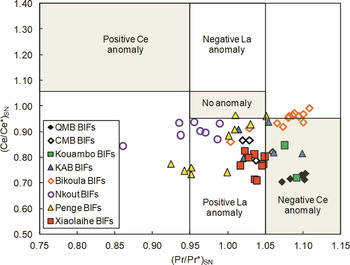
Ce anomalies in chemical sediments have been widely used to assess the redox state of the ancient seawater from which they were precipitated (e.g. Bau & Dulski, Reference Bau and Dulski1996; Planavsky et al. Reference Planavsky, Bekker, Rouxel, Kamber, Hofmann, Knudsen and Lyons2010; Wang et al. Reference Wang, Zhang, Lan and Dai2014 a; Silveira Braga et al. Reference Silveira Braga, Rosière, Queiroga, Rolim, Santos and McNaughton2015 and references therein). Oxygenated seawater displays strong negative Ce anomalies, while suboxic and anoxic seawaters lack negative Ce anomalies (Planavsky et al. Reference Planavsky, Bekker, Rouxel, Kamber, Hofmann, Knudsen and Lyons2010). However, the detection of Ce anomalies might be obscured by anomalous La abundance. Therefore, Bau & Dulski (Reference Bau and Dulski1996) suggested that the Ce/Ce* versus Pr/Pr* diagram could distinguish ‘true’ from ‘false’ negative Ce anomalies. In this discriminative binary plot (Fig. 8), most of the QMB samples show true negative Ce anomalies, while the CMB samples lack Ce anomalies. This suggests that the Bibole BIFs were precipitated in an oxic to slightly anoxic environment. Moreover, the binary diagram (Fig. 8) reveals that the oxide facies BIFs display Ce anomalies similar to those of most of the Ntem Complex BIFs (except the Nkout BIFs). Whereas the mixed oxide-silicate facies BIFs lack Ce anomalies, which are consistent with those of the Penge (Superior-type) and Xiaolaihe (Algoma-type) BIFs (Fig. 8), which are both early Palaeoproterozoic BIFs identified in the Transvaal Supergroup (Bau & Dulski, Reference Bau and Dulski1996; Smith, Reference Smith, Siegesmund, Basei, Oyhantçabal and Oriolo2018) and Qingyuan greenstone belt of the North China Craton (Peng et al. Reference Peng, Wang, Tong, Zhang and Zhang2018), respectively.
Plot of Ce and Pr anomalies normalized to PAAS for the Bibole BIFs to discriminate between positive La and true Ce anomalies (Bau & Dulski, Reference Bau and Dulski1996). Data for other Ntem Complex BIFs, well-studied African BIFs and North China Craton BIFs are plotted for comparison.

Decoupling of Th and U is usually attributed to the oxidation of immobile U4+ to mobile U6+ during oxic weathering, resulting in lower seawater Th/U ratio (Collerson & Kamber, Reference Collerson and Kamber1999). Therefore, Th–U decoupling can be also used to qualitatively constrain oxygen levels in the Neoarchaean surface system (Bau & Alexander, Reference Bau and Alexander2009). Condie (Reference Condie1993) has shown that the Th/U ratio in epiclastic sedimentary rocks is not very variable and falls close to the Th/U ratio of upper continental crust (∼3.9 on average). Overall, the average Th/U ratio of 3.81 observed in the Bibole BIFs suggests that the ambient seawater had preferentially received U input, implying oxidizing conditions in the source area of U. This is in agreement with the true negative Ce anomalies observed in the studied oxide facies BIF samples (see Fig. 8), although the mixed oxide-silicate facies BIF samples lack Ce anomalies. Thus, it can be concluded that the Bibole BIFs were precipitated in oxic to suboxic seawater.
5.b. Age and significance of the Bibole BIFs
In the Nyong Group, the youngest detrital zircon from metasediments yielded a U–Pb sensitive high-resolution ion microprobe (SHRIMP) age of 2423 ± 4 Ma (Lerouge et al. Reference Lerouge, Cocherie, Toteu, Milesi, Penaye, Tchameni, Nsifa and Fanning2006), or in situ U–Pb zircon age of 2422 ± 50 Ma (Soh Tamehe et al. 2020), which was interpreted as the maximum depositional age for this stratigraphic unit. The age of regional high-grade tectonometamorphic and hydrothermal activity was further constrained as late Palaeoproterozoic (2089 ± 8.3 Ma) by Soh Tamehe et al. (Reference Soh Tamehe, Wei, Ganno, Rosière, Nzenti, Gatse and Guanwen2021). This metamorphic event was related to the Eburnean/Trans-Amazonian orogeny, whereas the Pan-African tectonometamorphic activity that partially overprinted the Nyong Group was constrained at 600–500 Ma (SHRIMP U–Pb zircon age; Lerouge et al. Reference Lerouge, Cocherie, Toteu, Milesi, Penaye, Tchameni, Nsifa and Fanning2006; Chombong et al. Reference Chombong, Suh, Lehmann, Vishiti, Ilouga, Shemang, Tantoh and Kedia2017). Overall, the depositional age of the BIFs is poorly constrained in the Ntem Complex (Congo Craton). Chombong & Suh (Reference Chombong and Suh2013) reported a SHRIMP 207Pb–206Pb age of 2883 ± 20 Ma from metadacitic rocks intercalated with BIFs at Njweng prospect (Mbalam deposit). This age is interpreted as the onset age of BIF deposition in the Congo Craton, pointing to a Mesoarchean age for the Ntem Complex BIFs. More recently, Ndime et al. (Reference Ndime, Ganno and Nzenti2019) obtained a 207Pb–206Pb age of 2679 Ma from the Nkout magnetite BIFs comparable to the age of 2699 Ma (U–Pb SHRIMP on zircon; Chombong et al. Reference Chombong, Suh, Lehmann, Vishiti, Ilouga, Shemang, Tantoh and Kedia2017) reported for magnetite gneisses from the Ngovayang deposit (see Fig. 1). This age was assigned to a Neoarchaean metamorphic event in the Ntem Complex (Ndime et al. Reference Ndime, Ganno and Nzenti2019).
The CMB have been hydrothermally altered, as revealed by magnetite and sulfide minerals underlining the cleavage planes. Further evidence for hydrothermal alteration and metasomatism is provided through the strong positive co-variation (not shown) of the redox-sensitive elements such as Ce and Eu with ∑REE. This hydrothermal alteration event has affected zircon grains. Indeed, most of the zircon grains extracted from the CMB sample (BD5) are blurry with alteration haloes made by dark cores and light rims, suggesting overgrowth due to the overprint of a metamorphic or hydrothermal event. SIMS U–Pb analyses on metamorphic or hydrothermally modified zircon grains yielded an upper intercept age of 2077.9 ± 9.5 Ma, which overlaps the Eburnean/Trans-Amazonian high-grade metamorphic and hydrothermal event reported in the Nyong Group (Toteu et al. Reference Toteu, Van Schmus, Penaye and Nyobe1994; Lerouge et al. Reference Lerouge, Cocherie, Toteu, Milesi, Penaye, Tchameni, Nsifa and Fanning2006; Nzepang Tankwa et al. Reference Nzepang Tankwa, Ganno, Okunlola, Njiosseu Tanko, Soh Tamehe, Kamguia Woguia, Mbita and Nzenti2020; Soh Tamehe et al. Reference Soh Tamehe, Wei, Ganno, Rosière, Nzenti, Gatse and Guanwen2021). The detrital magmatic zircon grains yielded an upper intercept age of 2466 ± 62 Ma, interpreted as the best-estimate crystallization age of the magmatic protolith, suggesting an early Palaeoproterozoic precipitation of the CMB. These results constrain the maximum depositional age of the Bibole BIFs at c. 2466 Ma. This age is consistent with the previous depositional age of the Nyong Group sediments determined by SHRIMP and laser ablation ICP-MS methods, respectively, at c. 2423 Ma (Lerouge et al. Reference Lerouge, Cocherie, Toteu, Milesi, Penaye, Tchameni, Nsifa and Fanning2006) and c. 2422 Ma (Soh Tamehe et al. Reference Soh Tamehe, Wei, Ganno, Rosière, Nzenti, Gatse and Guanwen2021), implying the deposition of the Bibole BIFs between 2466 and 2422 Ma.
The deposition of the Bibole BIFs during early Palaeoproterozoic time is supported by their REY features (e.g. PAAS-normalized REY patterns showing HREE enrichment relative to LREEs and a strong negative Ce anomaly). This result suggests that the ancient seawater from which the Bibole BIFs precipitated was dominantly oxic, probably redox stratified with oxic shallow water and deeper anoxic water. Indeed, the shift from anoxic to oxic conditions also known as the Great Oxidation Event (GOE) occurring at c. 2450–2200 Ma (Bekker et al. Reference Bekker, Holland, Wang, Rumble, Stein, Hannah, Coetzee and Beukes2004) caused a series of chemical and environmental changes, including the rise of oxygen in the atmosphere, the onset of oxidation during continental weathering and the transformation of seawater chemistry (Huston & Logan, Reference Huston and Logan2004; Wang et al. Reference Wang, Zhang, Lan and Dai2014 b and references therein). The geochemical features and depositional age of the studied BIFs suggest that their formation was probably related to the GOE. Then, the Bibole BIFs suffered regional metamorphism and/or metasomatism at c. 2078 Ma, which overlaps with the Eburnean/Trans-Amazonian orogeny event (2100–2000 Ma) reported within the Nyong Group in the Congo Craton (Toteu et al. Reference Toteu, Van Schmus, Penaye and Nyobe1994; Lerouge et al. Reference Lerouge, Cocherie, Toteu, Milesi, Penaye, Tchameni, Nsifa and Fanning2006; Nzepang Tankwa et al. Reference Nzepang Tankwa, Ganno, Okunlola, Njiosseu Tanko, Soh Tamehe, Kamguia Woguia, Mbita and Nzenti2020; Soh Tamehe et al. Reference Soh Tamehe, Wei, Ganno, Rosière, Nzenti, Gatse and Guanwen2021) and its counterparts in the São Francisco Craton in northeastern Brazil (e.g. Aguilar et al. Reference Aguilar, Alkmim, Lana and Farina2017).
In summary, the Bibole BIFs were deposited at c. 2466 Ma and experienced metamorphism and metasomatism at c. 2078 Ma during the Eburnean/Trans-Amazonian orogeny in pre-drift reconstructions of the São Francisco–Congo Craton.
6. Conclusion
BIFs are closely associated with quartz-chlorite schist and phyllite in the Bibole area, which is located in the northwestern section of the Congo Craton in Cameroon. Detailed field investigations and geochemical and geochronological studies of the Bibole BIFs allowed us to draw the following conclusions:
(1) The Bibole BIFs contain oxide (QMB) and mixed oxide-silicate (CMB) facies.
(2) The geochemical characteristics of both BIF facies reveal that Fe2O3 and SiO2 are the dominant components. The lack of correlation between Zr and TiO2, Zr and Al2O3 and Zr and Y/Ho indicates that these BIFs have a minor detrital input into their original chemical precipitates.
(3) The REY patterns show the characteristics of both low-T hydrothermal fluids (weak positive Eu anomaly) and seawater (HREE enrichment, negative Ce anomaly). These features indicate that the source of Fe and Si of the Bibole BIFs is the mixing of low-T hydrothermal solutions and seawater. The presence of negative Ce anomalies in the oxide facies BIFs is attributed to an oxidizing depositional environment. In contrast, the lack of Ce anomalies for the mixed oxide-silicate facies BIFs suggests reducing conditions.
(4) Based on SIMS zircon U–Pb analyses, the Bibole BIFs were deposited at c. 2466 Ma and probably mark the onset of the rise of the atmospheric oxygen. These BIFs have experienced metamorphism and metasomatism at c. 2078 Ma during the Eburnean/Trans-Amazonian orogeny.
Acknowledgements
This work was supported by the Open Research Project of Key Laboratory of Mineral Resources, Institute of Geology and Geophysics, Chinese Academy of Sciences, Beijing, China (KLMR2017-02). The first author sincerely thanks the ‘Organization for Women in Science for the Developing World (OWSD)’ for scholarship attributed. Bai Yang, Huang Ke, Zhiguo Dong, Banglu Zhang, Wenjun Li and Bingyu Gao are thanked for their help during laboratory analyses. Two anonymous reviewers are gratefully acknowledged for their constructive and valuable comments that helped to improve the manuscript.