Introduction
The Clearfield™ (CL) rice production system is currently the most successful and effective system for weedy rice control. The adoption of the system globally was reviewed by Sudianto et al. (Reference Sudianto, Beng-Kah, Ting-Xiang, Saldain, Scott and Burgos2014). In the current review, Brazilian weed scientists describe the challenges and lessons learned from 18 yr of CL rice production in Brazil. This review also provides critical insights on improving weedy rice management in CL rice and in emerging technologies.
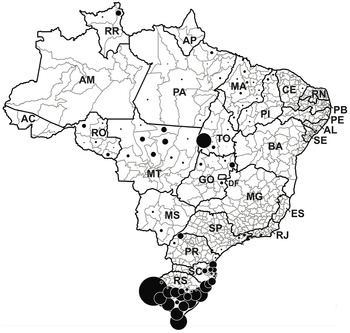
Rice (Oryza sativa L.) is grown throughout agricultural areas in Brazil, and its cultivation is divided into two basic systems. The first system, adopted in the north and central regions, involves cultivation in upland rainfed areas; the second consists of lowland rice paddy cultivation, predominantly in the south. The primary rice-producing states in Brazil are Rio Grande do Sul (RS) and Santa Catarina (SC) in the south, and Tocantins (TO) in the north (CONAB 2020) (Figure 1). The southern states of RS and SC are the leading rice producers with a combined area of 1.15 million ha cultivated annually and producing more than 70% of Brazilian rice. Rice production in these states is primarily in flooded systems, and CL rice is planted in 70% to 80% of the total area. In RS, where rice production records began in 1921, rice was produced on 80,000 ha with an average yield of 2,190 kg ha−1. The area and rice grain yield increased with time, reaching 400,000 ha and yielding 3,700 kg ha−1 in the 1970s, and the area increased further to 1 million ha with an average yield of 8,400 kg ha−1 in the 2019/20 growing season (IRGA 2020). Historically, in RS and SC, rice has been planted without crop rotation, which increased weed infestations, mainly weedy rice, grasses from the Echinochloa genus (Echinochloa spp.), and sedges (Cyperus spp.). Weedy rice is a significant pest in rice crops in Brazil and worldwide, impacting rice yield and quality (Ziska et al. Reference Ziska, Gealy, Burgos, Caicedo, Gressel, Lawton-Rauh, Avila, Theisen, Norsworthy, Ferrero, Vidotto, Johnson, Ferreira, Marchesan and Menezes2015). Weedy rice in southern Brazil is predominately of the indica and indica-aus type (Piveta et al. Reference Piveta, Noldin, Roma-Burgos, Viana, Benedetti, Pinto, Lamego and Avila LA2021; Qiu et al. Reference Qiu, Jia, Wu, Weng, Chen, Sun, Chen, Mao, Jiang, Ye, Turra, Guo, Ye, Zhu, Imaizumi, Song, Scarabel, Merotto, Olsen and Fan2020). In Brazil, the indica-type cultivars replaced the japonica type in the 1970s (Merotto et al. Reference Merotto, Goulart, Nunes, Kalsing, Markus, Menezes and Wander2016). The origin of the aus-type background found in Brazilian weedy rice is not known.
Rice production in Brazil in the 2019/20 growing season. The circles represent rice production in 558 Brazilian rice production microregions, with the largest circles representing the highest production. Abbreviations inside the map correspond to the states: AC, Acre; AL, Alagoas; AM, Amazonas; AP, Amapá; BA, Bahia; CE, Ceará; DF, Distrito Federal; ES, Espírito Santo; GO, Goiás; MA, Maranhão; MG, Minas Gerais; MS, Mato Grosso do Sul; MT, Mato Grosso; PA, Pará; PB, Paraíba; PE, Pernambuco; PI, Piauí; PR, Paraná; RJ, Rio de Janeiro; RN, Rio Grande do Norte; RO, Rondônia; RR, Roraima; RS, Rio Grande do Sul; SC, Santa Catarina; SE, Sergipe; SP, São Paulo; TO, Tocantins. Map courtesy of Alcido Elenor Wander (Embrapa Rice and Beans).

Weedy rice management in Brazil can be divided in two periods: the period before the launching of CL technology, which we call the “coexistence era,” and the period after the launching of CL for weedy rice control, which we call the “selective control era.” Before the CL launch, there were no options for selective weedy rice control (Ziska et al. Reference Ziska, Gealy, Burgos, Caicedo, Gressel, Lawton-Rauh, Avila, Theisen, Norsworthy, Ferrero, Vidotto, Johnson, Ferreira, Marchesan and Menezes2015). During the coexistence era, many tools were used, with limited effectiveness, to reduce weedy rice infestations and to mitigate their effect on rice yield (Andres et al. Reference Andres, Concenço, Theisen, Galon and Tesio2012; Avila et al. Reference Avila and Marchesan2000b). Historically, weedy rice infestations were commonly managed with fallow periods and late sowing to provide intense soil preparation to reduce the seedbank. This management strategy was ineffective in controlling weedy rice and on using natural resources and inputs, resulting in low rice yield. Indeed, before the introduction of CL in Brazil, many areas could not be planted with rice due to severe weedy rice infestation (Agostinetto et al. Reference Agostinetto, Fleck, Rizzardi, Merotto and Vidal2001). Alternative cultivation practices such as direct sowing, minimum tillage, or water seeding became popular, with water seeding proving to be the most effective due to the presence of the water early in the growing season (Avila et al. Reference Avila and Marchesan2000b). Other alternatives included soil preparation in the summer to reduce the seedbank, the use of winter crops, summer crop rotation, fallow periods, targeted application of nonselective herbicides on the remaining weedy rice plants (Andres et al. Reference Andres, Concenço, Theisen, Galon and Tesio2012; Avila et al. Reference Avila and Marchesan2000b; Marchesan et al. Reference Marchesan, Oliveira, Avila and Bundt2003), and the use of certified seeds free of weedy rice (SOSBAI 2018). Safeners applied to cultivated rice seeds had been proposed elsewhere for selective weedy rice control with clomazone based on pot experiments under greenhouse conditions (Busi et al. Reference Busi, Nguyen, Chauhan, Vidotto, Tabacchi and Powles2017). This technology was extensively evaluated in Brazil with the safener dietholate and the herbicide clomazone and resulted in reduced efficacy on weedy rice. The differences between field and pot experiments can be attributed to weedy rice diversity in the field and field plants being more robust than those grown in pots.
The CL rice system was made commercially available in Brazil in 2003, when the Rio Grande do Sul Rice Institute (IRGA) launched the cultivar ‘IRGA 422CL’ under a legal agreement with BASF SA (Lopes et al. Reference Lopes2003). The stewardship program proposed by BASF (2020) included: (1) use of certified seeds, (2) application of labeled herbicides, (3) adoption of label recommendations concerning herbicide application rates and timing, (4) establishment of permanent flooding soon after the POST herbicide application, (5) roguing the weedy rice escapes, (6) planting CL varieties for no more than two consecutive growing seasons, and (7) crop rotation. These stewardship protocols aimed to ensure that the system would provide a sustainable solution for weedy rice control.
The CL rice system brought enormous benefits to rice production in Brazil, as well as some important challenges. Understanding what we have learned from the CL system is important for maintaining the effectiveness of the system and better managing emerging weedy rice management technology. This review aims to give a brief overview of the challenges and benefits of the CL rice production system for weedy rice management in southern Brazil and to summarize what we have learned by managing this technology over the past 18 yr. The review is divided into cultivars and crop breeding, the contributions of CL to rice production in Brazil, the challenges of CL system in Brazil, and a synthesis of what we have learned.
Cultivars and Crop Breeding
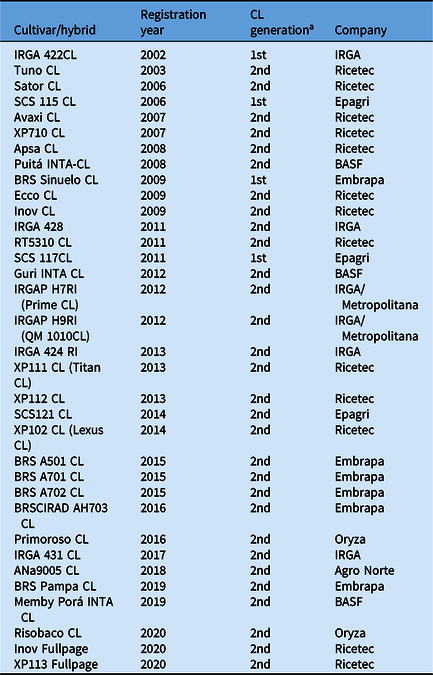
Over the 18-yr history of the CL system in Brazil, public (IRGA, Embrapa, and Epagri) and private (BASF, Ricetec, Oryza, Agronorte, and Metropolitana) companies have launched and registered in Brazil 33 cultivars and hybrids with different resistance levels to imidazolinone (IMI) herbicides (MAPA 2020) (Table 1). These cultivars were initially developed through induced mutations of the acetolactate synthase (ALS) gene (Croughan et al. Reference Croughan, Utomo, Asnders and Braverman1996). The first CL cultivar developed and commercialized in Brazil was IRGA 422CL (Lopes et al., Reference Lopes2003), obtained from the mutant line 93AS3510 (Croughan et al. Reference Croughan, Utomo, Asnders and Braverman1996) as the resistance gene donor. In Brazil, the so-called first-generation cultivars originated from the 93AS3510 line, which has a single point mutation in the ALS gene causing the G654E substitution (Roso et al. Reference Roso, Merotto, Delatorre and Menezes2010b). Following the launch of the IRGA 422CL cultivar, Ricetec launched the ‘Tuno CL’ hybrid in 2003 and Epagri launched the ‘SCS 115 CL’ cultivar in 2007. The Tuno CL hybrid carries the S653D mutation derived from the PCW16 line (Roso et al. Reference Roso, Merotto, Delatorre and Menezes2010b). SCS 115 CL is a first-generation cultivar developed for the pre-germinated system (Schiocchet et al. Reference Schiocchet, Yokoyama, Eberhardt, Noldin, Knoblauch, Marchalek, Peruch, Bacha, Ishiy, Alfonso-Morel, Vieira, Prado and Miura2007). Embrapa’s first CL cultivar was the ‘BRS Sinuelo CL’, obtained from the mutant 93AS3510 (Magalhães et al. Reference Magalhães, Fagundes, Franco, Andres, Rangel, Moraes, Moura Neto and Severo2011).
Rice cultivars and hybrids with tolerance to imidazolinone herbicides available in Brazil for the Clearfield™ (CL) production system presented in chronological order of registration at Brazil’s Ministry of Agriculture, Livestock, and Supply (MAPA 2020).

a CL generation: 1st, originated from Louisiana State University, of the 93AS3510 lineage (point mutation in the ALS gene that confers the G654E substitution in the ALS enzyme); 2nd, originated from LSU, of the PCW16 lineage (point mutation in the ALS gene that confers the S653D substitution in the ALS enzyme) or INTA (point mutation in the ALS gene that confers the A122T substitution in the ALS enzyme). Source: MAPA (2020).
BASF registered the ‘Puitá INTA CL’ cultivar in 2008 and the ‘Guri INTA CL’ cultivar in 2012, both of which are considered second-generation cultivars harboring the A122T mutation (Roso et al. Reference Roso, Merotto, Delatorre and Menezes2010b). Also considered to be second-generation IMI-resistant varieties are those developed from the PCW16 line, which are associated with the S653D mutation (Roso et al. Reference Roso, Merotto, Delatorre and Menezes2010b) used in most hybrid varieties.
The first-generation CL cultivars were replaced, because they had limited selectivity to IMI herbicides, resulting in severe crop injury. At present, the most widely used CL cultivars in Brazil are the second-generation ‘IRGA 424 RI’ from IRGA (RS) and ‘SCS121 CL’ from Epagri (SC). The hybrids launched in Brazil in the past 18 yr have occupied a small percentage of the total rice cultivated area. The list of all CL cultivars and hybrids registered in Brazil is shown in Table 1.
Contributions of the CL System to Rice Production in Brazil
Weedy Rice Control
Before the introduction of the CL system, selective weedy rice control was not possible; most paddy fields were highly infested with weedy rice, and some areas were abandoned (Merotto et al. Reference Merotto, Goulart, Nunes, Kalsing, Markus, Menezes and Wander2016). The CL rice system was the first and most successful selective weedy rice control in rice. The IMI herbicides, which are inhibitors of the acetolactate synthase (ALS) enzyme (EC 2.2.1.6, formerly EC 4.1.3.18), are used to control weedy rice in the CL system.
When the CL system was first introduced in Brazil, the manufacturer recommended a single POST application of the IMI herbicides imazethapyr + imazapic (Villa et al. Reference Villa, Marchesan, Avila, Massoni, Telo, Machado and Camargo2006). This approach was not effective for weedy rice control, and thus the recommendation was modified to PRE followed by early POST application, which resulted in higher levels of weedy rice control (Marchesan et al. Reference Marchesan, Massoni, Villa, Grohs, de Avila, Sartori and Bruck2011b; Santos et al. Reference Santos, Marchesan, Machado, Villa, Avila and Massoni2007; Villa et al. Reference Villa, Marchesan, Avila, Massoni, Telo, Machado and Camargo2006). With this new approach, the CL system revolutionized weedy rice management, attaining 99% control with two sequential applications.
Successful weedy rice control with this technology reduced the use of integrated weed management, and many producers use the CL system as their single tool for weedy rice management. On the other hand, producers who continued to use integrated weed management had more stable and sustainable weedy rice management. Although research on integrated weedy rice management has been less intense since the introduction of CL rice, several alternatives to weedy rice control methods are currently being adopted due to the increasing evolution of IMI-resistant weedy rice.
Adequate weedy rice control with the CL system depends on crop rotation, use of certified cultivated rice seeds, alternation between wet seeding and dry drill-seeded establishment systems, and roguing of weedy rice escapes. Different adjustments of these practices are being used in small and large farms to attain adequate crop and weed management of IMI-tolerant rice (Merotto et al. Reference Merotto, Goulart, Nunes, Kalsing, Markus, Menezes and Wander2016). Other practices are also useful in suppressing weedy rice infestations and contribute to the reduction of its seedbank, such as adopting the pre-germinated system (Avila et al. Reference de, Andres, Marchesan and Menezes2000a), crop rotation, and planting earlier in the season in early September (Sartori et al. Reference Sartori, Marchesan, Azevedo, Coelho and De Oliveira2014).
An additional strategy is to prepare the land immediately after rice harvest to reduce the weedy rice seedbank. Laying rice straw on the soil surface has shown promise, especially with tools such as a “knife roller,” which keeps the seeds (weeds and rice seeds) on the surface topsoil layer and stimulates their germination, reducing the weedy rice seedbank (Massoni et al. Reference Massoni, Marchesan, Grohs, Roso, Coelho, MacHado and Teló2013). However, this off-season management was mentioned by only 2% of consultants in the RS rice areas (Ulguim et al. Reference Ulguim, Fruet, Merotto and Silva2021). According to Noldin et al. (Reference Noldin, Chandler and McCauley2006), producers should avoid incorporating weedy rice seeds into the soil, because seeds left on the surface are more likely to germinate and be controlled by natural agents or with herbicides.
Integration with livestock is an important strategy in rice cultivation. Fallow reduces the weedy rice seedbank, especially with the presence of animals and their trampling action. Cattle production in the fallow period can reduce the weedy rice seedbank by 85% per year (Marchesan et al. Reference Marchesan, Oliveira, Avila and Bundt2003). Marchesan and colleagues (Reference Marchesan, Oliveira, Avila and Bundt2003) also reported that seeds located on the soil surface (0- to 1-cm deep) lose viability faster than those located at greater depths. However, it is essential to quarantine animals for at least 6 d between fields to avoid weed infestation in new areas, as viable weedy rice seeds can be found in the cattle feces until the 5th day after ingestion (Viero et al. Reference Viero, Schaedler, de Azevedo, Dos Santos, Scalcon R de, de David and da Rosa2018). Another strategy for weedy rice control is nonselective herbicide application, usually glyphosate, at the spiking stage of cultivated rice (S3 stage) (Counce et al. Reference Counce, Keisling and Mitchell2000). This strategy involves applying the herbicide before complete rice emergence, while only part of the coleoptile is visible (SOSBAI 2018). The integrated weedy rice management strategy is important to extend the lifetime of the technology and to ensure efficient weedy rice management.
Control of Other Weeds
Besides affording selective weedy rice control, IMI herbicides are broad-spectrum (Alister and Kogan Reference Alister and Kogan2005), controlling a wide variety of species, including many broadleaf weed species and sedges (Krausz and Kapusta Reference Krausz and Kapusta1998). An exception is imazethapyr, which is less effective on sedges and is not effective on some broadleaf weeds, especially those of the Fabaceae family, which includes the Aeschynomene and Sesbania genera (Pellerin et al. Reference Pellerin, Webster, Zhang and Blouin2003, Reference Pellerin, Webster, Zhang and Blouin2004).
The application of IMI herbicides in CL rice in conjunction with other herbicides has provided a good weed control spectrum. Due to the CL system’s success in managing weeds, one negative consequence was its use in areas where weedy rice was not present or in fields where the weedy rice infestation levels were not high enough to justify its use. One undesirable effect on these areas is related with the carryover effect of IMI herbicides. Another consequence of the success of IMI system is that most rice farmers adopted the CL system for many years (see “Continuous Use of CL Rice”).
Rice Grain Yield Increase
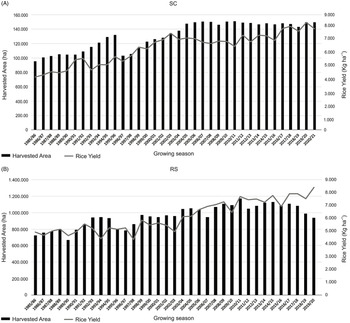
In RS, rice yields had increased rapidly overall after CL rice commercialization (Figure 2). Indeed, by the 2019/20 season, 85% of the RS rice production area (IRGA 2020) and more than 60% of the rice-growing area of SC were planted with CL cultivars (Avila et al. Reference Avila, Noldin, Mariot, Massoni, Fipke, Gehrke, Merotto, Tomita, Matos, Facioni, Vieira, Rosa, Santis, Camargo, Theisen and Roma-Burgos2021). The yield increase promoted by the CL system was due to more effective weed control, especially of weedy rice, and the simplicity with which certain management practices can be implemented, such as sowing at an optimal time, so the flowering and grain-filling period will happen when maximum solar radiation availability occurs, and response to fertilization and other production factors (Merotto et al. Reference Merotto, Goulart, Nunes, Kalsing, Markus, Menezes and Wander2016).
Evolution of rice yield and harvested area in the states of (A) Santa Catarina (SC) and (B) Rio Grande do Sul (RS) 18 yr before (1985–2003) and after (2003–2021) the launch of the Clearfield™ (CL) rice system. Data source: IRGA and EPAGRI.

Additional yield improvements under the CL rice system were achieved through institutional programs, including Projeto 10 from IRGA, CFC from Fondo Latinoamericano para Arroz de Riego (FLAR), and Marca from Embrapa, which promoted crop management practices to improve yields and better management of weedy rice and other critical weed species such as barnyardgrass [Echinochloa crus-galli (L.) P. Beauv.] and rice flatsedge (Cyperus iria L.) (Gomes et al. Reference Gomes, Petrini and Fagundes2004; Menezes et al. Reference Menezes, Macedo and Anahinoni2004). As a result, many rice farmers rapidly adopted the CL system, and average grain yield during the last 18 yr increased by more than 2,000 kg ha−1, reaching 8,400 kg ha−1 in RS (IRGA 2020; Merotto et al. Reference Merotto, Goulart, Nunes, Kalsing, Markus, Menezes and Wander2016). Although grain yield increase due to the CL system is unquestionable, problems involving IMI herbicide resistance in grasses and sedges have increased as will be addressed in the “Weed Resistance to Herbicides” section.
Challenges for CL Rice Production in Brazil
Seed Production System
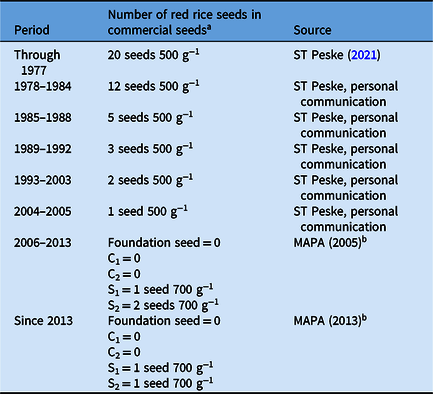
Rice seed quality is vital to the success of weedy rice control. The use of certified seeds free of weedy rice seeds is fundamental to the success of the CL rice production system. Historically, the legislation for rice seed production in Brazil allowed weedy rice grains in commercial seeds. In the 1970s, the seed law allowed up to 20 weedy rice grains in 500 g of rice seeds. Nowadays, zero weedy rice seeds are allowed per 500 g for certified seed, and 1 and 2 weedy rice seeds allowed per 500 g for S1 and S2 seeds, respectively (SOSBAI 2018). S1 seeds are non-certified seeds, first generation, originated from foundation or certified seeds (C2 or C2); S2 seeds are non-certified seeds, second generation, originated from foundation, certified (C1 or C2), or S1 seeds. In the 1980s, a state-certified seed production program was initiated in SC that expressly prohibited the presence of weedy rice seeds (Noldin et al. Reference Noldin, Knoblauch, Dal Piva and Alfonso-Morel1997). The certified seed production program was gradually expanded and subsequently adopted in RS.
The changes in rice seed quality with respect to weedy rice contamination are summarized in Table 2. The launch of the CL system in 2003 stimulated discussion concerning tougher legislation regarding rice seed quality as it relates to weedy rice contamination. In 2009, Brazilian legislation finally established zero tolerance for weedy rice in certified seed (MAPA 2013). However, many producers prefer to produce their seeds and even sell noncertified seed that contains weedy rice. Goulart et al. (Reference Goulart, Borba, Menezes and Merotto2014) showed that the genetic diversity of weedy rice resulting from uncertified seeds is high due to seed migration between fields. Only approximately 60% of growers in RS and 76% of growers in SC use certified seed, despite a push by public and private institutions to increase its use (Martins et al. Reference Martins, Noldin, Lucietti, Oliveira, Haverroth, Souza and Fernandes2017).
History of the number of weedy rice seeds allowed in commercial rice seeds in Rio Grande do Sul.

a Foundation seeds; C, certified seed; S, noncertified seed.
b Federal law applied nationwide.
Before introduction of the CL technology in RS, only 17% of seeds used by producers were free of weedy rice seeds (Marchesan et al. Reference Marchesan, Menezes NL and Siqueira C do2001). In addition to gene flow via pollen between CL rice and weedy rice, noncertified seed has contributed significantly to proliferation of IMI-resistant weedy rice and reduced effectiveness of the CL system in many production areas. Weedy rice plants have recently been found with characteristics similar to cultivated rice, with respect to plant size, vegetative cycle, and seed types (Piveta et al. Reference Piveta, Noldin, Roma-Burgos, Viana, Benedetti, Pinto, Lamego and Avila LA2021). The main difference between these weedy varieties and the cultivated rice plants is the reddish pericarp, which can only be detected in laboratory analysis. Other characteristics such as seed shattering and seed longevity are common characteristics of weedy rice. Recent data from seed certification studies in RS showed that 12% of seed lots were infested with weedy rice, even though no weedy rice had been identified during field inspections. This could reflect contemporary weedy rice populations that are more crop-like escaping detection. Ongoing technical discussions have focused on maintaining the production of quality seed free of weedy rice (JAN, personal observation).
Farmers´ Training
One of the initiatives that boosted grain yield following the introduction of CL rice was Projeto 10, which consisted of several strategies to transfer the available technology to rice growers in RS via an intensive training program for farmers (Menezes et al. Reference Menezes, Macedo and Anahinoni2004). The aim was to minimize the cultivar yield gap. The project integrated management practices by implementing a technology transfer system that involved establishing demonstration plots in different rice-producing regions and discussing management practices with producers and technicians. Basically, the program was based on use of the CL rice system to control weedy rice and the optimization of other crop management practices.
Despite intense information campaigns by public and private entities on the correct use of CL rice, the technology was adopted by many producers who failed to follow the stewardship protocols; thus, many farmers were unable to control weedy rice adequately. There is a need to continue monitoring how rice growers use the CL technology, to educate growers, to provide technical support, and to understand the residual effect of IMI herbicides on rotational crops (Sudianto et al. Reference Sudianto, Beng-Kah, Ting-Xiang, Saldain, Scott and Burgos2014). Such a program must offer sustainable solutions for weedy rice management and a permanent and intensive educational program devoted to rice producers. One of the lessons learned from the use of the CL in Brazil is the need for consistent information and widespread training of extension agents and farmers on this production system.
Continuous Use of CL Rice
Since the launch of the CL system in Brazil, one recommendation has been the use of the system for no more than two consecutive growing seasons (BASF 2020; Eberhardt et al. Reference Eberhardt, Noldin, Schiocchet, Bacha, Knoblauch, Marschalek, Vieira and Leites2007, Reference Eberhardt, Noldin, Schiocchet, Knoblauch, Marschalek, Leites, Guma and Wickert2015; Menezes Reference Menezes2003). However, in a recent survey (Avila et al. Reference Avila, Noldin, Mariot, Massoni, Fipke, Gehrke, Merotto, Tomita, Matos, Facioni, Vieira, Rosa, Santis, Camargo, Theisen and Roma-Burgos2021), only 40% of RS producers and 15.2% of SC producers reported using CL cultivars for up to three consecutive years. In RS, 26.7% of producers have used the CL technology for more than 10 consecutive years. In SC, 78.8% of producers did not answer this question, as 48.5% of them do not use this technology.
The principal reasons for the continuous use of CL rice were the possibility of improving rice yields through the control of weedy rice (Marchesan et al. Reference Marchesan, Massoni, Villa, Grohs, de Avila, Sartori and Bruck2011b), the relatively low cost of the weed control program compared with conventional programs, and the convenience of using one herbicide to control virtually all the weeds in rice (Menezes Reference Menezes2003). Other reasons included the carryover effect on non-CL cultivars (Avila et al. Reference Avila, Teló, Ferreira, Marchesan, Machado, Rossato, Cezimbra and Rigão2010b), risk of herbicide drift to adjacent non-CL rice fields (Dal Magro et al. Reference Dal Magro, Agostinetto, Pinto, Galon and Rezende2006), and the fact that the seedbank of weedy rice could persist in the field for at least three seasons (Marchesan et al. Reference Marchesan, Massoni, Grohs, Villa, Avila and Roso2011a). Therefore, although there are justifications for the widespread adoption of the CL system with cultivation in consecutive growing seasons, the consequences must be better understood to plan management practices that minimize its adverse effects.
Lack of Crop Rotation
Historically, crop rotation has not been adopted in the production of irrigated rice in southern Brazil. Before the launch of the CL rice system, farmers in RS used to keep part of the rice areas in fallow as pasture for cattle. The lack of crop rotation is partially due to the difficulty of managing dryland crops in lowland environments. The lowland soils are highly compacted due to their physical and chemical characteristics and the intensive soil preparation for rice production, with low total porosity and hydraulic conductivity (Drescher et al. Reference Drescher, Reinert, Denardin, Gubiani, Faganello and Zardin2017; Giacomeli et al. Reference Giacomeli, Marchesan, Sartori, Donato, da Silva, Kaiser and Aramburu2016), resulting in high mechanical resistance (Henry et al. Reference Henry, Sartori, Gaspar, Marchesan, Hirsh, Horton, Espinoza and James2018). Thus, the lowland soils are frequently subject to water scarcity or excess, low levels of organic matter and phosphorus, and high acidity, requiring a higher investment in fertilization (Vedelago et al. Reference Vedelago, Carmona, Boeni, Lange and Anghinoni2012).
However, the growing number of problems associated with the CL system, such as resistant weedy rice evolution, led researchers and producers to intensify the search for alternatives. The alternatives included soybean [Glycine max (L.) Merr.], which started very slowly, with only 11,000 ha in the 2009/10 growing season compared with approximately 1 million ha of cultivated rice (IRGA 2020). Widespread appreciation of the need for crop rotation and a greater understanding of the limitations of alternative crops in floodplain soils has led to greater adoption of soybean in rotation with rice. Lately, soybean crop rotation in the lowlands has reached 341,288 ha in RS (IRGA 2020). This area may be considered low compared to the total rice production area but is a remarkable improvement for the rice-based production system. Also, the use of soybean in crop rotation in farmers’ fields is now established in up to 25% of the total rice production area (Ulguim et al. Reference Ulguim, Fruet, Merotto and Silva2021), with the remainder being rice or fallow.
An important aspect in crop rotation in lowland areas is the use of cover crops adapted to the floodplain environment. The most important winter cover crop is ryegrass (Lolium multiflorum Lam.), which benefits rice and soybean cultivated in the summer (Moraes et al. Reference Moraes, Agostinetto, Vignolo, Santos and Panozzo2009). The crop rotation associated with cover crops prevents the increase of weedy rice in the seedbank (Avila et al. Reference Avila and Marchesan2000b; Ulguim et al. Reference Ulguim, Carlos, Santos, Zanon, Werle and Beck2018). The cultivation of soybeans and the necessary management demonstrate how changing practices can make weed control tactics more effective. The benefits of crop rotation include the diversification of herbicide mechanisms of action (MOAs) used in other crops in addition to those used in rice. Growers should minimize the use of glyphosate in the soybean rotation to avoid the chances of increasing evolution of weed resistance to glyphosate, especially weedy rice.
Lack of Herbicide Rotation
As previously discussed, there has been widespread noncompliance with the recommendation that the CL system should not be used in the same field over more than two consecutive growing seasons. Furthermore, there has been minimal rotation of the herbicides used. In a recent survey covering the last nine growing seasons in RS, ALS herbicides were used for POST weed management in approximately 95% of the surveyed fields (Ulguim et al. Reference Ulguim, Silva, Agostinetto, Avila Neto and Zandoná2019b). PRE or “spiking” application had greater diversity in terms of the herbicide MOA, with ALS herbicides used in 25% of cases (Ulguim et al. Reference Ulguim, Silva, Agostinetto, Avila Neto and Zandoná2019b). It is noteworthy that the primary approach to eliminating resistant weeds in RS has been nonselective herbicides at the spiking stage (S3) (Fruet et al. Reference Fruet B de, Merotto and Ulguim A da2020).
In southern Brazil, 65% of rice farmers combined different herbicides, while 38% rotate herbicides with different MOAs to manage resistant weeds (Fruet et al. Reference Fruet B de, Merotto and Ulguim A da2020). That study also showed that 52% of producers increased the rate of herbicide application on their farms. In another survey, 92% of producers indicated that they applied herbicides at higher levels than the labeled rate (Ulguim et al. Reference Ulguim, Silva, Agostinetto, Avila Neto and Zandoná2019b). Increased herbicide application is a major concern, because even though producers may initially improve weed control, this practice increases the selection pressure for weed resistance (Agostinetto et al. Reference Agostinetto, Magro, Vargas and Noldin2011).
The continuous use of CL rice, the lack of diverse herbicide MOAs, and higher herbicide rates are factors that contribute to more frequent weed resistance to ALS-inhibiting herbicides in rice farms. In general, few growers adopt herbicide rotation to minimize the evolution and spread of weed resistance to herbicides (Kalsing et al. Reference Kalsing2019; Norsworthy et al. Reference Norsworthy, Bond and Scott2013).
Gene Flow
Although cultivated rice and weedy rice are autogamous plants, cross-fertilization can occur. While the frequency is generally less than 1% (Gealy et al. Reference Gealy, Mitten and Rutger2003), it can sometimes reach as high as 52% (Langevin et al. Reference Langevin, Clay and Grace1990). In 2002, the first study in Brazil on conditions of gene flow between a breeding line of genetically modified cultivated rice and two weedy rice genotypes (one strawhull and one blackhull) showed values ranging from 0.02% to 0.48% (Noldin et al. Reference Noldin, Yokoyama, Antunes and Luzzardi2002). Subsequently, a natural crossing rate of 0.065% was reported between cultivated rice and weedy rice (Villa et al. Reference Villa, Marchesan, Avila, Massoni, Telo, Machado and Camargo2006). Due to the high levels of weedy rice control achieved in the CL system (>95%), many producers discontinued roguing (Eberhardt et al. Reference Eberhardt, Noldin, Schiocchet, Bacha, Knoblauch, Marschalek, Vieira and Leites2007, Reference Eberhardt, Noldin, Schiocchet, Knoblauch, Marschalek, Leites, Guma and Wickert2015). Consequently, weedy rice resistance to IMI herbicides evolved rapidly in several rice-growing regions of RS due to gene flow (Menezes et al. Reference Menezes, Mariot, Kalsing and Goulart2009).
Studies of the ALS gene mutation associated with resistance in weedy rice revealed the predominance of the G654E mutation, which is harbored by the first-generation cultivar IRGA 422CL (Roso et al. Reference Roso, Merotto, Delatorre and Menezes2010b). The S653D and A122T mutations were also detected in some outcrosses. The S653D and A122T mutations were present in hybrids and the Puitá INTA CL cultivar, respectively; these mutations confer a higher level of resistance than the G654E mutation (Roso et al. Reference Roso, Merotto, Delatorre and Menezes2010b).
The hybridization rate with different rice cultivars was evaluated in approximately 1 million seeds in a field experiment using the concentric circle method (Goulart et al. Reference Goulart, Borba, Menezes and Merotto2014). In this study, the occurrence of gene flow for weedy rice from the genotypes IRGA 422 CL (G653E), ‘Sator CL’ (S653D), Puitá INTA CL (A122T), and resistant weedy rice (G653E) was 0.024%, 0.027%, 0.019%, and 0.022%, respectively. The highest hybridization from Sator CL was likely due to its floral biology, which is more prone to pollen release. The details about the floral biology of the evaluated hybrid cultivar that favored hybridization is unknown. The data also demonstrate pollen flow from HR weedy rice to the natural weedy rice population. Therefore, once a few resistant weedy rice plants are present, resistance will spread quickly from cultivated rice and weedy rice via gene flow.
Weedy rice resistance to IMI herbicides can also arise from independent selection, as demonstrated in an exclusion paternity analysis conducted on IMI-resistant individuals of weedy rice (Goulart et al. Reference Goulart, Matzenbacher and Merotto2012). Seed migration is another means of gene flow when seeds from resistant weedy rice plants are present in cultivated rice seed, which sometimes occurs in noncertified seed. The lessons learned from the evolution of resistant biotypes in the CL system, especially gene flow, should be considered in developing new technologies involving herbicide-resistant rice cultivars.
Weed Resistance to Herbicides
Weedy rice resistance evolution to IMI herbicides is the largest concern in CL rice. In Brazil, resistant weedy rice was detected 3 to 4 yr after adoption of the CL rice production system (Merotto et al. Reference Merotto, Goulart, Nunes, Kalsing, Markus, Menezes and Wander2016). A long-term study conducted between 2006 and 2012 found resistant weedy rice in 56% to 100% of the analyzed suspected populations (Kalsing et al. Reference Kalsing2019), indicating the high occurrence of IMI-resistant weedy rice in rice cultivation in southern Brazil. Gene flow was the primary origin of IMI-resistant weedy rice, but independent selection occurred in 1.1% of the weedy rice plants evaluated, a frequency similar to that in other weeds subject to herbicide selection pressures (Goulart et al. Reference Goulart, Matzenbacher and Merotto2012). IMI-resistant weedy rice plants have increased production costs and reduced yield (Merotto et al. Reference Merotto, Goulart, Nunes, Kalsing, Markus, Menezes and Wander2016).
Currently, infestations of the Echinochloa complex resistant to herbicides are as prevalent as weedy rice in Brazil. Biotypes of E. crus-galli resistant to quinclorac were first identified in 1998, with resistance becoming widespread even before the CL system was introduced (Heap Reference Heap2021; Schaedler et al. Reference Schaedler, Moraes and Noldin2008). Initially, the IMI herbicides used in CL system were highly effective against Echinochloa spp., including quinclorac-resistant populations. However, approximately 4 yr after the introduction of the CL system, IMI-resistant E. crus-galli populations were identified (Merotto et al. Reference Merotto, Goulart, Nunes, Kalsing, Markus, Menezes and Wander2016). Between 2009 and 2011, a study evaluating 624 populations of E. crus-galli identified IMI resistance in 81% of the populations, with resistance broadly distributed across RS rice-growing regions (Matzenbacher et al. Reference Matzenbacher, Bortoly, Kalsing and Merotto2015). Resistance to quinclorac was also found in 19% of the evaluated populations, but all were susceptible to cyhalofop-butyl. Recently, E. crus-galli biotypes resistant to glyphosate were found in soybean fields in southern Brazil, signaling the risk of resistance evolution to this herbicide in rice (Heap Reference Heap2021).
In Echinochloa spp., the mechanism of resistance to IMI is associated with the mutations W574L and S653N of the ALS gene and enhanced herbicide detoxification caused by the increased expression of cytP450 and glutathione S-transferase genes (Dalazen et al. Reference Dalazen, Markus and Merotto2018). However, the mechanisms of resistance to quinclorac in these biotypes remain unclear. These results indicate that E. crus-galli populations in Brazil have evolved complex multiple herbicide resistance that may result in biotypes that are resistant to herbicides with a variety of MOAs, as has already occurred in other rice-growing regions outside Brazil (Rouse et al. Reference Rouse, Roma-Burgos, Norsworthy, Tseng, Starkey and Scott2018). Resistance to the ACCase inhibitor cyhalofop-butyl is already present in SC (Eberhardt et al. Reference Eberhardt, Oliveira Neto, Noldin and Vanti2016), indicating increasingly complex herbicide resistance in E. crus-galli. The occurrence of multiple resistance and the lack of complete E. crus-galli control in soybean rotations with rice demonstrate that E. crus-galli is as great a threat to rice cultivation as weedy rice.
Herbicide resistance among sedges has also occurred in areas under the CL rice system. Resistance initially evolved in smallflower umbrella sedge (Cyperus difformis L.), and more recently in C. iria (Heap Reference Heap2021). Populations of C. iria in RS showed resistance to ALS-inhibiting herbicides with a resistance factor (RF) of 5.49 for ethoxysulfuron and 2.47 for pyrazosulfuron (Spatt et al. Reference Spatt, Dornelles, Sanchotene, Brum, Carloto and Scherer2016). Resistance to ALS-inhibiting herbicides has also occurred in globe fringerush [Fimbristylis miliaceae (L). Vahl], while California arrowhead (Sagittaria montevidensis Cham. & Schltdl.) has evolved multiple resistance to ALS inhibitors and bentazon, a photosystem II–inhibiting herbicide (Heap Reference Heap2021).
One of the most important tools for mitigating the evolution of resistant genotypes in weeds is rotation of herbicide MOAs (Burgos et al. Reference Burgos, Norsworthy, Scott and Smith2008; Ulguim et al. Reference Ulguim, Agostinetto, Vargas, Da Silva, Da Silva and Da Rosa Westendorff2017). Good practices for reducing resistance evolution include rotating herbicide use spatially, temporally, or both (Hicks et al. Reference Hicks, Comont, Coutts, Crook, Hull, Norris, Neve, Childs and Freckleton2018; Norsworthy et al. Reference Norsworthy, Ward, Shaw, Llewellyn, Nichols, Webster, Bradley, Frisvold, Powles, Burgos, Witt and Barrett2012). However, the rotation of herbicide MOAs for weedy rice control in rice can only be accomplished through crop rotation, as we presently lack alternatives for weedy rice control in rice other than the CL system, but as described earlier, there are several limitations for rotation in lowland areas, resulting in the high selection pressure of IMI weed resistance.
Although rice producers and extension agents understand the strategies needed to manage and mitigate resistance, farmers are reluctant to adopt them for economic reasons (Fruet et al. Reference Fruet B de, Merotto and Ulguim A da2020; Norsworthy et al. Reference Norsworthy, Bond and Scott2013; Ulguim et al. Reference Ulguim, Silva, Agostinetto, Avila Neto and Zandoná2019b). Researchers have developed protocols for the rapid diagnosis of weedy rice herbicide resistance at the seed, seedling, and tiller stages and using molecular markers to identify the three types of mutations in the ALS gene (Roso et al. Reference Roso, Merotto, Delatorre and Menezes2010b, 2010a). However, these protocols have not become widely used, and the producers generally identify herbicide resistance as a problem once resistant biotypes cover a large area of their farm.
Over the years, we have observed different experiences with CL rice on the part of producers. Some farmers noticed problems with resistant weeds shortly after they began using CL system. In other cases, the technology has remained effective due to effective management slowing the evolution of herbicide-resistant weeds. Producers who effectively adopted appropriate control methods were able to obtain better performances in the long term. A valuable lesson is that we cannot underestimate the massive selection pressure that herbicides can exert on weed populations, resulting in quick evolution of complex resistance mechanisms.
Volunteer CL Rice
A low proportion of rice seeds shatter at harvest or fall from the combine. Shattered seeds that are not winterkilled or lost through predation emerge as volunteer rice plants in the following season. Hybrid rice has a higher degree of seed shattering than inbred rice, resulting in a higher population of volunteer rice. These volunteers have low yield and grain quality, which affects the crop’s productivity and quality (Singh et al. Reference Singh, Burgos, Singh, Gealy, Gbur and Caicedo2017). Therefore, volunteer rice is another type of weedy rice. IMI-resistant volunteer rice cannot be controlled by either PRE or POST herbicides. Nonuniform establishment of volunteer rice can affect grain quality, especially if plants are from different crop seasons. Grains with a different pericarp color or shape from that of the current cultivar affect a crop’s commercial classification. Also, high numbers of volunteer plants can result in overpopulation, with the volunteers being less productive, and reduces overall rice yield.
An additional concern is that herbicide-resistant volunteer rice plants, such as CL rice, may become agents for the flow of resistance genes to weedy rice populations (Sudianto et al. Reference Sudianto, Beng-Kah, Ting-Xiang, Saldain, Scott and Burgos2014). The difficulties in chemical control of volunteer CL rice highlight the importance of management before and after cultivation. Before cultivation, management should focus on preventing the emergence of volunteer plants. Postharvest management should prevent plants that were not eliminated during rice cultivation from reproducing and contributing to the seedbank.
In areas where rice is cultivated after CL rice, the producers in RS till the fields during the fallow season and delay rice planting to minimize the population of volunteer rice. Where crop rotation is practiced, the volunteer CL rice is controlled by burndown and PRE herbicides. One important practice is to minimize seed shattering during harvest and to not incorporate the seeds in the soil, allowing for predation and seed deterioration (Noldin et al. Reference Noldin, Chandler and McCauley2006). In Brazil there is lack of information on volunteer plants from hybrids and inbred cultivars. In Arkansas, Singh et al. (Reference Singh, Burgos, Singh, Abugho, Earnest, Gbur and Scott2016) report that after overwintering and burial for 130 d and 160 d, the survival rate of hybrid rice seeds (53% and 13%, respectively) was higher than that of conventional rice seeds (27% and 8%, respectively) across various depths of seed burial. It is important to study the behavior of volunteer rice to improve the management of weedy rice.
Soil Management in the Winter
Winter soil management affects several aspects of rice cultivation by creating a more suitable environment for rice planting in the next season. In addition, soil management during winter provides weed control and increases IMI herbicide degradation (see the “Herbicide Carryover” section). The primary winter management practice in RS is to allow livestock to graze on rice regrowth after harvest (Denardin et al. Reference Denardin LG de, Martins, Carmona F de, Veloso, Carmona, Carvalho PC de and Anghinoni2020), often without establishing a cover crop. Fallow and livestock are the predominant systems adopted during winter according to 44% and 49% of rice consultants’ responses, respectively (Ulguim et al. Reference Ulguim, Fruet, Merotto and Silva2021). After most of the rice plant regrowth is consumed by cattle, the soil is tilled, because rice straw degrades slowly during winter, and the soil is rutted by the rice combine harvesters (Botta et al. Reference Botta, Tolón-becerra, Lastra-bravo, Hidalgo, Rivero and Agnes2015).
A wide variety of species are suitable for use as cover crops during the winter in southern Brazil. However, few of these species are adapted to saturated or flooded soil, a common situation in rice production areas (Menezes et al. Reference Menezes, Mariot and Lopes2001). The native serradella [Ornithopus micranthus (Benth.) Arechav.], an species endemic to southern Brazil, northeastern Argentina, and Uruguay (Stępkowski et al. Reference Stępkowski, Banasiewicz, Granada, Andrews and Passaglia2018), can be used as a cover crop during the winter in rice-producing areas, because it is well adapted to wet soils and can establish symbiosis with nitrogen-fixing bacteria (Menezes et al. Reference Menezes, Mariot and Lopes2001). Furthermore, its use results in increased rice grain yield compared with fallow fields (Correia et al. Reference Correia S da, da Silva, Boeni, Bredemeier, Anghinoni, Menegati, Maass and Miozzo2018). Another option for cover crops is legumes such as white clover (Trifolium repens L.), red clover (Trifolium pratense L.), and Persian clover (Trifolium resupinatum L.), which are well suited for use in lowland cattle grazing (Weinert et al. Reference Weinert, Carlos, Pacheco, Sousa, Bortowski and Lages2019). However, the most common cover crop is ryegrass, because it grows well in the lowland areas and can be used as a cover crop or as forage for cattle grazing (Ulguim et al. Reference Ulguim, Carlos, Zanon, Ogoshi, Bexaira and Silva2019a).
Cover crop production in the winter favors nutrient cycling while adding crop residues in the soil, improving the system’s biodiversity (Carvalho et al. Reference Carvalho PC de, Anghinoni, Moraes, Souza, Sulc, Lang, Flores, Terra Lopes, da Silva, Conte, de Lima Wesp, Levien, Fontaneli and Bayer2010). However, if the cover crop produces a high amount of biomass, it can reduce rice emergence and initial growth and reduce yield. Some cover crops such as ryegrass also produce allelochemicals (Silveira et al. Reference Silveira, Feijó, Benetti, Refatti, Fipke, Camargo, Ziska and Avila2019), which can harm rice seedlings, affecting initial rice development (Bohnen et al. Reference Bohnen, Da Silva, Macedo and Marcolin2005).
The use of winter cover crops is beneficial for weed management in the CL system. In a study comparing areas in which rice was cultivated for five consecutive growing seasons without rotation to areas that use an integrated crop–livestock system, the number and diversity of weeds were higher in fields without crop rotation (Ulguim et al. Reference Ulguim, Carlos, Santos, Zanon, Werle and Beck2018). In particular, the population of C. iria was 50% lower in fields with crop rotation. The authors also observed an increase in the number and diversity of weeds when no winter cover crop was used, with a high incidence of Indian goosegrass [Eleusine indica (L.) Gaertn.], compared with fields with ryegrass. Unfortunately, most rice producers and extension agents in southern Brazil do not consider winter cover crops to be essential in weed management, and they therefore do not adopt this practice, contributing to higher weed populations and the evolution of herbicide-resistant weeds (Fruet et al. Reference Fruet B de, Merotto and Ulguim A da2020; Ulguim et al. Reference Ulguim, Silva, Agostinetto, Avila Neto and Zandoná2019b). Even though scientists have indicated several essential practices for winter land management, such as drainage, soil preparation, and use of cover crops, few producers have adopted these technologies, preferring to leave the area fallow over the winter instead (Ulguim et al. Reference Ulguim, Fruet, Merotto and Silva2021).
Herbicide Carryover
IMI herbicides are persistent in the soil. The half-life of imazethapyr is 60 to 90 d, of imazapyr 25 to 142 d, and of imazapic 120 d (Shaner Reference Shaner2014). Until 2009, the information available about the fate of IMI herbicides was primarily for aerobic conditions driven by soil aerobic microorganisms (Kraemer et al. Reference Kraemer, Marchesan, Avila, Machado and Grohs2009). Much more has been learned about the environmental fate of IMI in the last decade, especially in studies of rice cultivation in RS (Pinto et al. Reference Pinto, Noldin, Pinho, Rossi, Galon and Almeida2009a, 2009b, 2011). The persistence of herbicides in the field depends on the amount of herbicide applied and the dissipation process. The continuous use of the CL system may increase the carryover effect of IMI herbicides, as accelerated degradation has not been observed thus far (Bundt et al. Reference Bundt, Avila, Pivetta, Agostinetto, Dick and Burauel2015b).
Herbicide dissipation in lowland rice fields is quite different than in upland areas. Although continuous flooding (the most common rice irrigation method in southern Brazil) creates a favorable environment for surface transport of herbicides, minimal herbicide movement via runoff occurs in rice fields, because the areas have minimal slope or are practically flat (Martini et al. Reference Martini, Mezzomo, de, Massey, Marchesan, Zanella, Peixoto, Refatti, Cassol and Marques2013). The lack of oxygen in such systems reduces microorganism activity, thus reducing herbicide degradation. Most IMI herbicides degrade slowly in anaerobic soils (Flint and Witt Reference Flint and Witt1997). Alternative water management systems, such as intermittent flooding (Martini et al. Reference Martini, Mezzomo, de, Massey, Marchesan, Zanella, Peixoto, Refatti, Cassol and Marques2013) and sprinkler irrigation (Helgueira et al. Reference Helgueira, Rosa, Moura, Galon and Pinto2019), may be beneficial in reducing the persistence of IMI herbicides.
Water availability during the winter is another factor that affects herbicide carryover. Herbicide carryover in rice fields is higher during extremely dry or extremely wet winters. Excess water in the soil can move herbicides closer to the rice roots (Bundt et al. Reference Bundt A da, de, Agostinetto, Nohatto, Souto and Senseman2010). In dryer soils, herbicides may not be available for degradation, as moisture affects herbicide sorption, and the herbicide moves upward in the soil profile with water evaporation (Bundt et al. Reference Bundt A da, Agostinetto and Martins2013). Practices that can enhance herbicide degradation include tilling the soil after harvest and establishing drainage systems during the winter months.
Soil moisture during the winter determines the effect of the herbicide on winter cover crops such as ryegrass (Avila et al. Reference Avila, Marchezan, François, Cezimbra, Souto and Refatti2010a) and the extent of herbicide carryover. Drainage is crucial for establishing winter cover crops and can be an effective strategy to reduce herbicide carryover. Drainage improves soil aeration, while cover crops stimulate microbial activity, which in turn increases herbicide degradation. In areas with a high concentration of IMI herbicides in the soil, Ulguim et al. (Reference Ulguim, Carlos, Zanon, Ogoshi, Bexaira and Silva2019a) observed that ryegrass and white clover reduced herbicide carryover to soybeans. This shows the phytoremediation ability of some plant species (Souto et al. Reference Souto, Jacques, de Avila, Machado SL de, Zanella and Refatti2013) and the stimulation of soil microbial populations that metabolize herbicides (Souto et al. Reference Souto, Jacques and Zanella2020).
Soil pH also affects the persistence of IMI herbicides. Low soil pH increases sorption of IMI herbicide, thereby increasing persistence (Su et al. Reference Su, Hao, Ding, Wu, Xu, Xue, Shen, Sun and Lu2019). Lowland soils, where rice is grown in RS, are naturally acidic (Boeni et al. Reference Boeni, Anghinoni, Junior and Filho2010). Although soil pH increases after flooding, this happens together with a lower redox potential in the soil that reduces aerobic microbial activity, and the pH returns to normal levels as soon as the field is drained for harvesting. Best practices, therefore, include the application of lime to raise soil pH. Other hypotheses pertaining to herbicide carryover include the reduced ability of plants to overcome herbicide injuries in less fertile soils (which has been demonstrated in some instances) and herbicide concentrating in the root zone in shallow soils (Bundt et al. Reference Bundt, Avila, Agostinetto, Nohatto and Vargas2015a).
Depending on the relative contributions of the processes described, residual IMI herbicides may injure sensitive crops. In RS, injury to non-tolerant crops planted after CL rice has been observed, including injury to cover crops such as ryegrass (Avila et al. Reference Avila, Marchezan, François, Cezimbra, Souto and Refatti2010a; Bundt et al. Reference Bundt, Avila, Agostinetto, Nohatto and Vargas2015a). Residual IMI herbicide effect on non-tolerant rice planted 1 yr after CL rice is manifested in reduced grain yield between 30% (Avila et al. Reference Avila, Teló, Ferreira, Marchesan, Machado, Rossato, Cezimbra and Rigão2010b) and 55% (Marchesan et al. Reference Marchesan, Dos Santos, Grohs, De Avila, Machado, Senseman, Massoni and Sartori2010). Sorghum bicolor (L.) Moench is one of the most sensitive crops, with a reduction in aboveground dry mass of up to 94% (Souza et al. Reference Souza, Neto, Marinho, Saraiva, Faria, Silva and Silva2016). Residual IMI herbicides in soil reduced soybean shoot dry mass and leaf area by about 50% (Fraga et al. Reference Fraga, Agostinetto, Langaro, Oliveira, Ulguim and Silva2019).
It is important to use integrated crop management to avoid, or at least reduce, herbicide carryover in lowland areas. This management should include crop rotation, preferably soybean, which is most tolerant to IMI carryover. Furthermore, producers should plant a cover crop during the winter, correct the soil pH, and drain the field during the winter. For a detailed discussion of this topic, refer to Gehrke et al. (Reference Gehrke, Fipke, de and Camargo2021).
Complementary Methods for Weedy Rice Control
Producers have abandoned complementary weed control practices such as roguing, wick bar, and mechanical weeding, due to the availability of CL rice (Agostinetto et al. Reference Agostinetto, Fleck, Rizzardi, Merotto and Vidal2001). The abandonment of complementary weedy rice control methods is due to several factors, including the low availability and increasing cost for hand weeding.
Before the CL system was introduced, the producers had no other option than to use every tool they had available for weedy rice control; after the CL system was introduced, rice producers began to rely only on herbicides for weedy rice control. Powles and Gaines (Reference Powles and Gaines2016) called this “herbicide-only syndrome,” and this is the main factor driving producers’ failure to use complementary weed control methods.
Without a complementary control method, the remaining uncontrolled plants have resulted in outcrossing with CL rice and the fast evolution of IMI-resistant weedy rice populations. We have learned that complementary methods for weedy rice control are vital to improving the efficacy and longevity of the CL rice system.
Special Case: CL Rice in the Pre-germinated Rice System
Rice producers in southern Brazil, mainly in SC and part of RS, have adopted the water-seeded system with pre-germinated seeds to suppress weedy rice infestation. However, the selection pressure from decades of monoculture rice cultivation has also resulted in weedy rice plants that can now germinate and emerge under the water, even with continuous flooding after seeding (Kaspary et al. Reference Kaspary, Roma-Burgos and Merotto2020). Rice growers are in urgent need of new technologies to manage weedy rice.
Since the first CL rice cultivar for water-seeded rice was released by Epagri, growers have focused on how to manage the CL rice crop (Eberhardt et al. Reference Eberhardt, Noldin, Schiocchet, Bacha, Knoblauch, Marschalek, Vieira and Leites2007). Recommendations include rotation of the establishment systems, especially for producers intending to plant water-seeded rice in fields with high infestations of weedy rice, and to avoid ratoon from CL cultivars (Eberhardt et al. Reference Eberhardt, Noldin, Schiocchet, Bacha, Knoblauch, Marschalek, Vieira and Leites2007). However, most rice growers are unable to change their planting systems due to the soil type or climatic conditions being unfavorable for crop rotations. Producers have also avoided planting conventional cultivars after CL rice due to herbicide carryover and others have cultivated ratoon rice. As a result, the majority of the rice-growing areas in SC have been heavily infested with a diverse weedy rice population resistant to IMI herbicides, including plants that mimic commercial cultivars. Semi-dwarf weedy rice plants with long grains have become a major concern in certified seed production areas, because they are difficult to identify in the field. Although researchers, extension agents, and consultants have repeatedly advised growers in SC to rotate CL and conventional cultivars and to avoid ratooning the CL cultivars, most growers have not followed these recommendations (Eberhardt et al. Reference Eberhardt, Noldin, Schiocchet, Bacha, Knoblauch, Marschalek, Vieira and Leites2007, Reference Eberhardt, Noldin, Schiocchet, Knoblauch, Marschalek, Leites, Guma and Wickert2015). The result is that any surviving, uncontrolled weedy rice plants flower simultaneously with the CL rice varieties, resulting in gene flow. Although, herbicide carryover is a primary concern in RS (Pinto et al. Reference Pinto, Noldin, Pinho, Rossi, Galon and Almeida2009a, 2009b, 2011), it is not a problem in water-seeded systems in SC.
Over the past 18 yr, we have learned the difficulties of teaching producers about best management practices and effective increased adoption rates of such practice. We still need to identify strategies that researchers and extension agents can use to communicate more effectively with growers. Knowledge we have gained concerning weedy rice management in the CL system in Brazil (Figure 3) could be applied in other countries where this system is just beginning to be developed and commercialized.
Pragmatic recommendations for sustainable use of the Clearfield™ (CL) rice production system.

Conclusions
CL rice or any other weed management technology cannot be used as a “silver bullet” but must instead be part of an integrated weed management strategy. This is especially true for weedy rice, as this weed can outcross with HR rice cultivars and quickly generate herbicide-resistant weedy populations. The CL system must not be used in areas without a weedy rice infestation.
One of the most important aspects of a weed management strategy like the CL system is to train producers. This requires close cooperation between researchers, extension agents, and the industry to develop a coordinated message and promote a broader understanding of the system. We also need to train extension agents and producers more effectively on the optimal management of this technology to extend its period of usefulness.
Before launching any technology with resistant varieties to control weedy rice, it is mandatory to establish a meticulous rice seed production system free of weedy rice and to educate the growers on the importance of planting certified seeds for the sustainable production of rice.
To avoid IMI herbicide carryover to non-tolerant crops, including non-tolerant rice, producers should adopt the following practices: (1) do not use IMI herbicides for more than two consecutive growing seasons; (2) use the recommended label rate of herbicides; (3) drain the field before harvest, if possible, till and level the field, and drain the field during the winter; (4) plant cover crops to enhance herbicide phytodegradation; (5) lime the soil to raise its pH to enhance herbicide availability and degradation in the soil; (6) practice intermittent flooding, if possible, in the last season of CL rice production; (7) plant the least IMI-susceptible non-CL rice variety; and (8) rotate rice with other crops.
Adopting integrated weed management practices is essential to avoid the evolution of resistance in weedy rice and other weeds. These practices reduce selection pressures by rotating herbicides with different MOAs, applying herbicides sequentially, using herbicides with lower selection pressure, using mixtures of herbicides with different MOAs, and performing site-specific management with direct application of herbicides to surviving plants before the flowering stage. The occurrence of resistant populations can be further minimized by adopting practices such as crop rotation, rotation of control methods, rotation of cultivation methods, monitoring weed shifts, and preventing suspect plants from producing seeds.
New technologies for weedy rice control will likely become available in the near future. Based on what we have learned over the last 18 yr with the CL system in Brazil, we can apply these tools more wisely while continuing to use CL rice as a tool for weedy rice management.
Acknowledgments
We are grateful to CNPq for research fellowships granted to several authors, as follows: LAdA, N.Proc. 310538/2015-7 CNPq; AM, Proc. 303379/2019-7; EM, Proc. N. 305230/2018-2 CNPq; and DA, Proc. 308363/2018-3. We also thank Jesus Juarez de Oliveira Pinto for his work during his career, which helped us to understand the fate of IMI herbicides in rice fields and how to manage the CL system. We thank Alcido Elenor Wander for building the map showing rice production in Brazil (Figure 1). The authors declare that most of them have received partial funding to conduct experiments from BASF. We also declare that this funding was only used in research activities and did not affect the authors’ ability to write this review, which was strictly based on the science behind the technology.