Although the politics of memory and language have been extensively studied in various countries across the world, scholars have rarely compared these two kinds of politics, in either national or wider contexts. Such a comparison seems particularly appropriate in view of a structural similarity of memory and language as aspects of identity and, related to this, a similarity of configurations in political struggles around these aspects in many societies. The present article seeks to contribute to repairing this scholarly omission by comparing the politics of memory and language in a post-imperial context of Ukraine, where both domains continue to be sites of heated contestation centering on treatment of the imperial legacy. My analysis focuses on the period after the victory of Euromaidan and the subsequent Russian military aggression when memory and language became important aspects of political struggle between the active minority’s call for a radical break with the legacy of the Russian/Soviet rule and the majority’s preference for the preservation of the accustomed environment. It examines the government’s behavior in the two domains, taking into account constraints presented by opposition parties, civil society, some foreign states and international organizations, and the perceived preferences of the population.
In both cases, while nationalist-minded activists argue that Ukraine must cut all ties with the Moscow-led “Russian world,” the government has to take into account a likely impact of such policies on the loyalty of many citizens still supporting interpretations and practices that were brought about by the imperial rule and not abandoned during the years of independence. Remarkably, the government’s response to this dilemma has been different for each domain. As far as memory was concerned, it pursued a rather radical nationalist agenda, even though it was opposed by a large part of the population, particularly among those who disapproved of Euromaidan and resented its consequences. With regard to language, however, the authorities largely refrained from a resolute promotion of Ukrainian for the fear of alienating those who wish to continue relying on Russian. This difference is not warranted by public opinion, because support for the introduction of the Ukrainian language is actually stronger than for the removal of communist names and monuments, both among the population in general and in the pro-Maidan segment, in particular. One reason for a mismatch between state policies and popular preferences seems to be politicians’ misperception of what the public wants. Another has to do with a significant structural asymmetry of policymaking in the two domains. Of some importance can be also political actors’ own conservative preferences, which are arguably stronger with regard to language environment than memory landscape.
Memory and Language in the Politics of Identity
The politics of identity or, in a more widespread version of the term, identity politics is usually understood as encompassing “efforts by status-based movements to foster and explore the cultural identity of members,” whereby various groups are “advocating for recognition of and respect for their cultural differences, which derive from their distinct group identities” (Bernstein Reference Bernstein2005, 47, 50). In the American context where this term is most often used by both practitioners and analysts, it primarily pertains to phenomena such as civil rights, multiculturalism, women’s and gay movements; although, in other parts of the world, it has been also applied to separatist movements and ethnonationalist conflicts. In most cases, identity politics is seen by activists and supporters as, to quote a rather radical formulation, a “collective form of action denouncing the tyranny of the majority: the official identity of the ideal citizen (as constructed and favored by institutions) [which is] in fact hiding, diminishing, relegating, and subjugating minorities” (Dubreuil Reference Dubreil2017). At the same time, many scholars extend the term to include both the official prescriptions of identity and resistance to these prescriptions, paying attention not only to the struggle between the dominant and the subversive, but also to the competition on both levels or, more accurately, in various institutional and everyday practices. For instance, Campbell (Reference Campbell1992, vii) seeks to examine “the way in which the identity of ‘(the United States of) America’ has been written and rewritten through foreign policies operating in its name.” In addition to the external positioning of a nation among other nations, the politics of national identity is concerned with the internal organization of the nation, which also means the relations between its constituent groups with their competing claims for recognition and respect (Smith et al. Reference Smith, Law, Wilson, Bohr and Allworth1998; Martinez-Herrera and Miley Reference Martínez-Herrera and Miley2010). Particularly in newly independent or post-revolutionary states, both external and internal parameters of national identity are fluid and contested, hence “political and intellectual elites are able to make choices—but only within a limited range” (Suny Reference Suny1999/2000, 140). To set these parameters means to relate the nation in certain ways to other nations, supranational entities and subnational groups, meaning that the politics of national identity is interwoven with the politics of other identities pertaining to qualities the nation’s members supposedly have and collectivities these qualities define. In the most general sense, therefore, politics of identity can be viewed as “a struggle over the qualities attributed, socially and institutionally, to individuals and groupings of individuals” (Wiley Reference Wiley and Calhoun1994, 131).
Memory and language are inherent and interrelated aspects of this struggle inasmuch as they constitute important elements of individual and, especially, collective identities. As far as memory is concerned, historical scholarship, education, media, and other institutions work to supplement individual and family recollections with an account of main experiences of the entire nation or group, which scholars designate as collective or historical memory. This account of the past “provides us with narratives that tell us who we are, where we came from, and where we should be going. It defines a trajectory which helps construct the essence of a group’s identity, how it relates to other groups, and ascertains what its options are for facing present challenges” (Liu and Hilton Reference Liu and Hilton2005, 537). In view of its important legitimizing role, even democratic governments see the “correct” representation of the past as a means of strengthening national identity, whereas authoritarian regimes use it in political indoctrination (Evans Reference Evans2003). In relatively stable and coherent societies, the core elements of their perception of the past are generally accepted and often formalized, although the meaning and political ramifications of specific historical events can be strongly contested, with different groups emphasizing different aspects that resonate with their experiences and preoccupations. At times of radical political transformation, this contestation grows more salient as the politics of memory becomes “an integral part of the establishment of new collective identities and new principles of political legitimacy” (Bernhard and Kubik Reference Bernhard, Kubik, Bernhard and Kubik2014, 3). Similarly to other aspects of identity, mnemonic actors, a term Bernhard and Kubik coined to designate “political forces that are interested in specific interpretations of the past” (Reference Bernhard, Kubik, Bernhard and Kubik2014, 4), are constrained in their manipulations of history by the limits of what their respective audiences can accept as credible in view of prevalent norms and discourses. The historical memory of a given society, in general, and the memory regimes regarding certain important events, in particular, emerge as a result of struggle between influential mnemonic actors, particularly “advocates of instrumental persistence and instrumental change in the public presentation of the past” (Kubik and Bernhard Reference Kubik, Bernhard, Bernhard and Kubik2014, 10). Apart from domestic actors, participants in this struggle can include foreign states or international organizations that are interested in a certain treatment of particular events or application of certain general commemorating principles.
Language is even more relevant to the politics of identity in view of both the key role of linguistic means in the production of individual identities and the widespread perception of particular language varieties as defining characteristics of certain collectivities (Joseph Reference Joseph2004). Particularly important is the link between nations and their eponymous (standard) languages, which are not only presented as valuable symbols, but also imposed as communicative means, a process resulting in the marginalization of minority languages and substandard regional or class varieties (Blommaert Reference Blommaert and Ricento2006; Bourdieu 1991). In many postcolonial societies, while the state and other influential institutions highlight the symbolic importance of indigenous languages, the former colonial languages are tolerated or even supported as the primary means of communication in prestigious domains (O’Reilly Reference O’Reilly, Hogan-Brun and Wolff2003; Sirles Reference Sirles1999). Both the communicative and symbolic priorities of the government can be contested by some actors claiming to represent those groups whom these priorities allegedly deny recognition as equal parts of the nation or separate ethnonational collectivities. Apart from the retention of former colonial languages and the admission of minority ones, contestation can pertain to the revitalization of marginalized “heritage” languages and the openness to languages of international communication (Schmid Reference Schmid2001; Späti Reference Späti2015). The involvement of international actors is quite significant in language politics because foreign states tend to support their ethnolinguistically kindred groups, and international organizations seek to protect language rights of all minorities (Csergo Reference Csergo2007; Ozolins Reference Ozolins2003). Similarly to the politics of memory, the language regime of a society or a particular domain results from the interaction between political actors supporting specific arrangements; I will call them linguistic actors to highlight their functional analogy with mnemonic actors, as defined by Bernhard and Kubik (Reference Bernhard, Kubik, Bernhard and Kubik2014). As with memory, this interaction tends to become more conflictual and, by the same token, more conspicuous at times of radical change when the proposed regimes seem to be more directly related to new collective identities and principles of political legitimacy.
The disposition of forces in memory and language politics is often rather similar, because actors tend to orient their preferences to certain identity complexes that are, in turn, related to different ideological trends. In both cases, political struggles involve not only different groups of warriors, a designation Kubik and Bernhard (Reference Kubik, Bernhard, Bernhard and Kubik2014) give those actors who are strongly convinced that their view is right and others are wrong, but also actors who accept the legitimacy of other views (pluralists) or simply have little interest in identity matters (abnegators).Footnote 1 In imperial and post-imperial contexts, actors’ attitudes toward the empire informs both their interpretations of the past and their preferences in dealing with its legacy in the language domain. As far as the post-Soviet societies are concerned, nationalist parties of the 1990s “offered specific proposals for the content of their societies’ collective identities” (Abdelal Reference Abdelal2002, 459), including critical interpretations of the imperial past and emphasis on the symbolic and communicative roles of the national languages. Their proposals, however, only affected state policies to the extent that they were accepted by the former communists who had lost the monopoly on power but remained influential players in politics and the economy. It is in the interaction between these two main camps that both the political agenda and national identity were primarily shaped, with outcomes varying from the unequivocal Western orientation in the Baltics to the preservation of close ties with Russia in Belarus and Central Asia. Ukraine and several other countries found themselves in an interim position as “the nationalists and former Communists remained deadlocked,” which prevented the government “from decisively choosing a political-economic orientation toward either West or East” (459).
While in analyses of identity politics of the first post-Soviet decade, the focus on the nationalists and former communists was appropriate, particularly when the authors sought to compare different countries and thus could not afford examining in detail the political constellation in each of them, such an approach would not be productive for one-country studies of later periods. Both of the formerly dominant forces lost much of their influence, while new pragmatic parties co-opted many of their former members and adopted many of their ideas. In Ukraine, with its ideological diversity and highly competitive politics, the party configuration and the composition of the ruling coalition changed repeatedly for the decades of independence, the last radical change being the formation of a pro-Western coalition after the victory of Euromaidan in early 2014 (Matsievskyi Reference Matsievskyi2016). In my analysis of the post-Euromaidan politics of memory and language, I focus on the (three branches of) national government and only look at other actors in terms of their support for or opposition to the government’s moves. Apart from the opposition parties and local authorities, I take into account civil society whose social prominence and political influence greatly increased in the wake of Euromaidan (Puglisi Reference Puglisi2015). Among relevant foreign actors, I pay the primary attention to the West whose crucial role in supporting Ukraine against the Russian aggression makes the Ukrainian government particularly sensitive to its preferences, in contrast to the earlier situation of rather equal pressures from the West and Russia. Last, but not least, I examine to what extent actions and proposals of the government and other key policymakers resulted from their orientation toward perceived preferences of the Ukrainian population, in general, and their primary constituencies, in particular.
Memory and Language in Ukrainian Politics Before Euromaidan
Prior to focusing on the politics of memory and language after Euromaidan, I would like to characterize the role of memory and language matters in Ukrainian politics for the two first decades of independence, which established main actors and issues with which the analysis of the post-Maidan processes will be dealing. As argued previously, Ukraine was among those post-Soviet countries where neither nationalists nor former communists fully dominated national politics, thus preventing the government from pursuing a clear course. Actually, the former Communist nomenklatura, in the first post-Soviet decade, had much more political influence than the Ukrainian nationalists (or, as most of them called themselves, “national-democrats”), with the latter prevailing in only the western region. At the same time, the post-communists led by the new state’s first president Leonid Kravchuk took over some of the nationalist slogans and symbols in order to legitimize Ukrainian independence and, by the same token, their own continued ruling position (Kubicek 1998). While crucial for the consolidation of statehood, this strategy led to Kravchuk’s defeat in the highly polarized election of 1994 because he was blamed for both a severe economic crisis and a “nationalist” course allegedly driving Ukraine away from Russia and discriminating against its own Russian-speakers. The adoption of the opponents’ slogans seemed to work more successfully for the so-called “centrists” under the second president, Leonid Kuchma, who sought to marginalize both nationalist and leftist parties by presenting themselves as a pragmatic alternative to their divisive agendas (Kulyk Reference Kulyk2006a). Nevertheless, a successful combination of anti-establishment and moderate nationalist slogans by the charismatic candidate, Viktor Yushchenko, in the 2004 presidential campaign, urged Kuchma’s protégé Viktor Yanukovych to re-emphasize identity issues in order to present his opponent as an anti-Russian nationalist and the West’s puppet. Although the regime’s effort to ensure Yanukovych’s victory by means of electoral fraud failed as a result of large-scale protests known as the Orange Revolution, his Party of Regions managed to regain prominence during Yushchenko’s presidency and then succeed in getting its leader elected as president in 2010. Yushchenko’s opponents emphasized “anti-nationalist” slogans formerly associated with the left parties, hence the struggle between the anti-Orange and Orange parties resembled, as far as identity politics was concerned, the earlier confrontation between the former communists and nationalists (Wolczuk Reference Wolczuk2006). The anti-Orange predominance during Yanukovych’s presidency enabled Russia-friendly moves in various identity-related domains (Chalupa Reference Chalupa2010), which, however, came to an abrupt end with the victory of the Euromaidan protests provoked by one of these moves.
All along, the struggle was primarily waged over the preservation or demolition of the Soviet legacy in identity politics, with the nationalists pushing for a radical break and the communists doing their best to keep it intact. Given the weakness of civil society, the government and opposition actors were primarily constrained by the perceived preferences of their respective constituencies, although, in some cases, they also had to take into account insistent calls from influential foreign states and international organizations. As far as collective memory was concerned, state policies maneuvered between two opposing narratives of Ukraine’s past. The Soviet narrative continues the Soviet view of a common history uniting the East Slavic peoples and treats the Russian Empire and the USSR as voluntary unions of Russians and Ukrainians. In contrast, the narrative I will call anti-Soviet to emphasize its opposition to the Soviet one, sees Ukraine’s incorporation in Russian-dominated entities as imperial subjugation established and sustained largely by force (Kulyk Reference Kulyk2011). Under Kravchuk and Kuchma, the central government mostly originating in the former Communist nomenklatura accepted some elements of the anti-Soviet narrative but refrained from its wholesale substitution for the accustomed Soviet interpretation. Instead, it combined the two narratives on the national level and allowed regional authorities to pursue different policies, taking into account the respective populations’ preferences. While in the west, particularly Galicia, Soviet street names and monuments were mostly removed and replaced by non-Soviet ones, including some commemorating Ukrainian nationalist fighters who had been demonized by the Soviet regime, the toponymical and monumental landscape of the east and south remained almost unchanged. The regional diversity of memory regimes both dampened the confrontation between adherents of the opposing narratives and preserved the dominance of these narratives in the respective parts of the country (Portnov Reference Portnov2010).
The confrontation intensified after the Orange Revolution as President Yushchenko sought to change the ambivalent status quo by introducing policies based on the anti-Soviet narrative, and the anti-Orange elites defended the Soviet-implanted historical memory as part of a distinct identity of their east-southern constituency (Jilge Reference Jilge2008; Portnov Reference Portnov2010). Moreover, Yushchenko’s warrior-like promotion of the nationalist view of the past provoked critical responses from Russia and Poland seeing themselves as successors of those entities against which the Ukrainian nationalists had fought. The confrontation focused on two phenomena central to the anti-Soviet account of the 20th century history, namely, the Famine of 1932–1933 (Holodomor) in Soviet Ukraine and the armed struggle of the Ukrainian Insurgent Army (UPA) against the Nazi and Soviet rules during and after World War II. On the one hand, Yushchenko sought to instill the interpretation of the Holodomor as a Soviet act of genocide against the Ukrainian people, an effort that the anti-Orange elites tried to undermine both on the national level and in those regions they controlled (Riabchuk Reference Riabchuk2008; Zhurzhenko Reference Zhurzhenko2011). On the other hand, his decrees granting two long-deceased leaders of the World War II nationalist resistance the title of Heroes of Ukraine both angered many Ukrainians accustomed to the Soviet treatment of those leaders as Nazi collaborators and provoked an international scandal stirred by Polish politicians blaming the UPA for an anti-Polish ethnic cleansing in a border region (Riabchuk Reference Riabchuk, Amar, Balynskyi and Hrytsak2010). Upon coming to power in 2010, Yanukovych sought to revert to the Soviet interpretation but found himself constrained by a shift in public opinion that Yushchenko’s policies had induced. While the decrees glorifying the UPA leaders were annulled, the state-sponsored commemoration of the Holodomor victims continued, albeit without genocidal references, probably because of fear that its abandonment would be negatively perceived by a large part of the population (Chalupa Reference Chalupa2010; Yanukovych nazvav 2011).
The post-Orange confrontation between supporters of different post-imperial courses was no less noticeable in language politics where, similarly to the domain of memory, a search for compromise seemed to prevail in the first decade of independence. Although, officially, Ukrainian had the status as the sole state language and Russian found itself demoted to the level of minority languages, in practice, Russian was used at least as widely and regarded as highly as Ukrainian. Whereas Ukrainian nationalists called for a more radical policy that would bring the use of the titular language in accordance with its legal status, leftists and Russian/East Slavic nationalists pushed for the reverse move, namely, an upgrade of the status of Russian that would legalize its uninhibited use. At the same time, Russia and some other neighboring states warned against reduction of the use of their eponymous languages, encouraged by the insistence of international organizations on the protection of minority rights. Under these conditions, Kravchuk and Kuchma sought to slowly enhance the role of Ukrainian as a factor of nation-building without visibly encroaching on the use of other languages, particularly Russian. This orientation was reflected in a compromise provision of the post-Soviet Constitution of 1996: While upholding the exclusive status of Ukrainian, it guaranteed the free use of Russian and other minority languages (Arel Reference Arel1995; Kulyk Reference Kulyk and Törnquist-Plewa2006b).
However, these compromise-oriented policies left Russian apparently discriminated against and Ukrainian disadvantaged in practice, thus giving speakers of both languages reasons for dissatisfaction, which the respective elites could use for electoral purposes. Such use became particularly destructive after the issue of the status of Russian was picked up by one of the frontrunners in the 2004 presidential race, Yanukovych, thus antagonizing supporters of Ukrainian and escalating the confrontation. Notwithstanding his defeat in that race, Yanukovych persistently used the language issue in his and his party’s campaigns of the following years. In 2006, having established control over the east-southern regional and local councils, the Party of Regions rushed to upgrade the status of Russian on the respective territories, a move that Yushchenko managed to block with appeals to courts, which then invalidated the councils’ resolutions as infringing on the parliamentary prerogative (Kulyk Reference Kulyk2009). After Yanukovych became president, the anti-Orange parties made a status upgrade on the national level by means of a new law on language policy, which passed in 2012 with flagrant violations of the parliamentary procedure and in spite of vehement protests of champions of Ukrainian (Charnysh Reference Charnysh2013). Although it elevated the status of Russian only in the eastern and southern regionsFootnote 2 (and even there made little change in actual usage), for supporters of Ukrainian, the law became a hateful symbol of Yanukovych’s policy of Russification, to be revoked right after his demise.
In sum, Ukrainian politics regarding both memory and language was marked by a strong contestation over the course of post-Soviet development, with one of the main camps pushing for a radical break with the Soviet legacy and the other for effective preservation thereof. Whereas in the first decade of independence the central government mitigated warrior approaches of some parties, the later appropriation of divisive demands by major actors resulted in a protracted confrontation. As Yanukovych’s supporters and opponents were similarly aligned on the two controversial issues, it could be expected that these issues would be dealt with in a similar manner after his demise. Surprisingly, the new government chose very different strategies for the two domains.
After Euromaidan: A Radical Change in the Politics of Memory
Yanukovych’s flight after a bloody confrontation between protesters and the police following his orders brought about radical discredit and subsequent dissolution of his Party of Regions and thus an abrupt shift of power toward the former parties of the post-Orange opposition, which reestablished themselves as the Maidan government coalition. Although different in their ideological preferences, in general, and regarding identity matters, in particular, these parties were driven toward pro-European and post-imperial emancipatory policies by both the external and internal dynamics, that is, by the interaction with foreign powers on the one hand and the orientation toward pro-Maidan constituencies on the other. Moreover, the Russian aggression in response to the establishment of the Maidan government not only strengthened the imperative for Ukrainian policymakers to seek integration into the Western structures, but also, somewhat paradoxically, freed them from the need to take Russia’s position into account when making decisions on both foreign and domestic policies. At the same time, this meant a stronger dependence on the Western partners, in particular the United States and European Union, of which the latter (usually coordinating his actions with more geographically encompassing structures such as the Council of Europe and the Organization for Security and Co-operation in Europe) was more sensitive to matters of language and memory. Internally, the government was constrained not so much by the discredited anti-Maidan opposition as by the newly empowered civil society pressuring for the implementation and expansion of the Maidan agenda. Even among the population at large, Euromaidan and the war greatly diminished support for the preservation of ties with Russia and cultural legacies it aggressively asserted (Haran and Zolkina Reference Haran and Zolkina2017; Kulyk Reference Kulyk2016a).
Under such conditions, the post-Maidan government could and was even widely expected to pursue policies aimed at a radical break with the legacies of the Soviet rule and the pre-Maidan ambivalence about them. As far as memory matters were concerned, this was exactly what the government did. The most vivid manifestation of its radical course was the adoption and subsequent implementation of the so-called decommunization laws, in which the government embraced the agenda of nationalist mnemonic warriors, while most opponents of this course refrained from any attempt to block or mitigate it (Shevel Reference Shevel, Hale and Orttung2016). In April 2015, a specialized governmental agency for memory matters, the Ukrainian Institute of National Remembrance (UINR), together with a group of deputies from various coalition factions, submitted for the parliament’s consideration four draft laws explicitly dealing with historical representations, commemorations, and research. Particularly sensitive and controversial were two of these drafts; one of them denounced the Communist (as well as the Nazi) ideology and prohibited “propaganda” of its symbols, whereas the other glorified a long list of “fighters for Ukraine’s independence” and made it a criminal offense to deny the legitimacy of their struggle (Zakon Reference Ukraїny2015a, Reference Ukraїny2015b). Although these drafts aggressively asserted the anti-Soviet narrative as the only legitimate representation of Ukraine’s recent past, they were supported not only by confirmed Ukrainian nationalists, but also by many deputies who were ambivalent about or indifferent to controversial history issues. Just 2 days after the submission, the drafts were approved by the relevant parliamentary committees, and on the following day adopted in session through fast tracking with virtually no discussion. The prevalent position expressed by representatives of all coalition factions was that this was a long-overdue move demonstrating that “Ukraine is finally cutting an umbilical cord [connecting it] with the Kremlin and Moscow which has occupied Ukraine and is today waging an aggression against our state” (Stenohrama 2015).Footnote 3 Even the anti-Maidan opposition deputies, although not voting for the bills, made no attempt to block their adoption; they did not even vote “no,” choosing instead not to cast their votes at all, the same as several dozen deputies within the coalition.
It was only after the adoption that the laws caused a domestic and international controversy. A number of intellectuals, politicians, and activists in Ukraine and abroad warned that the imposition of one historical narrative as legally binding could result in limitations of the freedom of speech and historical studies. Moreover, critics argued that the glorification of the World War II Ukrainian nationalists who had not only fought against the Soviet regime, but also at times participated in anti-Semitic pogroms and anti-Polish ethnic cleansing would alienate many people in eastern Ukraine and harm the relations with Poland and other Western partners (Marples Reference Marples2015; Yavorskyi Reference Yavors’kyi2015). Notwithstanding these warnings, President Petro Poroshenko signed the adopted bills into laws. Asked to examine the controversial acts, the Council of Europe’s authoritative Venice Commission published its opinion in December 2015, finding the acts in violation of the Council’s standards and calling for a revision of some provisions (European Commission 2015). However, the Ukrainian authorities did not rush to respond to its recommendations. Although several coalition deputies introduced in May 2016 a bill mildly revising some of the laws in view of the commission’s recommendations, a relevant parliamentary committee examined it only 6 months later, and, despite its positive opinion, the bill has not yet been heard in session (Proekt Zakonu 2016). Several other bills suggesting the annulment of or revisions to the laws have not even been discussed in the committees. Finally, in November 2017, the Constitutional Court started hearing an appeal of opposition deputies to annul the law banning Communist “propaganda,” which, the appellants argued, violates constitutional freedoms (Savytskyi Reference Savytskyi2017). As of this writing, the court has not yet pronounced its decision, but the chances of satisfying the appeal seem to be slim, not least because, since Kuchma’s times, constitutional judges were notorious for their reluctance to contradict the presidential administration.
Meanwhile, the government began implementing the laws as resolutely as it was adopting them, with as little opposition from the Soviet mnemonic warriors or various abnegators in both pro- and anti-Maidan camps. On the one hand, hundreds of monuments to Lenin and other Communist figures were toppled down in all parts of the country (except for Crimea and occupied parts of the Donbas), thus bringing to completion an activist campaign that had started well before Euromaidan and intensified with its outbreak (Dekomunizatsiia n.d.). Under the new regime, pro-Maidan activists became more assertive, whereas local authorities, even if they did not consider the removal appropriate, did not dare to resolutely oppose the activists’ pressure, let alone resolutely suppress their attempts at toppling down (or mutilating) some monuments. Only in rare cases did the issue of removal cause perceptible controversies when some groups expressed their opposition in view of a certain monument’s perceived historical or artistic value. For instance, the municipal authorities in Kyiv refused to dismantle the allegedly valuable monument to the Soviet Ukrainian military commander Mykola Shchors, despite the UINR’s insistence on strict implementation of the law and militant nationalists’ attempts to destroy a prominent symbol of the Communist past (Vlada Kyeva 2017).
On the other hand, tens of thousands of names of administrative units, localities, streets, and other entities were changed from Communist to neutral or those related to the anti-Soviet narrative (Dekomunizatsiia n.d.; Savytskyi Reference Savytskyi2017). If local councils did not want to begin changes from below, the national parliament imposed them by its own fiat, which sometimes provoked protests of conservative residents, usually instigated by local authorities. The strongest of these protests took place in the central Ukrainian town of Komsomolsk, where the local council refused to change the town’s name and then objected to the parliament’s resolution renaming it as Horishni Plavni. Supported by the majority of residents, the municipal authorities suggested a different name and went to court in an unsuccessful attempt to have the parliamentary resolution revoked (P’etsukh Reference P’etsukh2016; Sud zalyshyv 2016). In most cases, however, whatever discontent the removal might have caused did not translate into perceptible protest because both the ordinary citizens and political actors focused on the more pressing matters of economic crisis and the war. Moreover, many of the opposition’s mnemonic warriors either fled the country right after the fall of Yanukovych or were prosecuted (and thus incapacitated) in view of their support of separatist activities in the following months. While the Party of Regions was heavily discredited and its remaining leaders had to rebrand themselves to ensure support from at least a fraction of its former constituency, its allied Communist Party failed to enter the post-Euromaidan parliament and was ultimately outlawed in 2016 in accordance with the law on the prohibition of Communist propaganda (V Ukraїni 2016).
Hesitant Policies in the Language Domain
The dynamics in the language domain were very different, first and foremost because of a different attitude of key players within the government. Although domestic and international opposition to changes of the ambivalent post-Soviet situation was no stronger than in the politics of memory, the president and the parliamentary coalition did not wish to pursue a radical course that would considerably enhance not just the symbolic value of the titular language, but also its communicative role. Although linguistic warriors in the pro-Maidan camp called for resolute measures similar to those taken in the memory domain, most politicians and officials preferred the preservation of status quo or, at most, limited changes in particular practices.
Actually, immediately after the victory of Euromaidan in February 2014, the realigned parliament seemed to take a radical approach when it voted to revoke the 2012 language law that Ukrainian linguistic warriors had long denounced as a means of renewed Russification. The voting, which took place within the context of extraordinary measures to restore law and order after the flight of Yanukovych, was presented as the annulment of an act that had been adopted by Yanukovych’s majority with a flagrant violation of parliamentary procedure. Accordingly, it was held in a flash-like manner, with no discussion in committees or in session. In response to opposition deputies’ post-voting denunciation of the move as paving the way for discrimination of speakers of Russian and other minority languages, representatives of the new coalition argued that the minority rights were guaranteed by the Constitution and a new democratic language law would soon be adopted (Stenohrama 2014). Nevertheless, the annulment was perceived as discriminatory and divisive not only by the anti-Maidan forces in Ukraine and Russia, but also by many Maidan activists worrying that such an ill-timed decision would be used to sow discord among Ukrainians (Bigg and Tereshchuk Reference Bigg and Tereshchuk2014). The government responded by a bilingual media campaign for the unity of Ukraine, which emphasized the value of bilingualism, thereby implicitly delegitimizing the resolute promotion of Ukrainian (Nedashkivska Reference Nedashkivska2015).
While Moscow did not pay much attention to Kyiv’s discourse or policies as it proceeded to invade Crimea and then the Donbas under the pretext of “protecting” the Russian-speaking population, the Ukrainian leadership decided to backpedal on the sensitive language issue. The move to annul the 2012 law was blocked by then acting President Oleksandr Turchynov. Although the parliament established a working group to draft a new language law instead of the 2012 one, the group failed to do the job and there were no reported attempts to replace it. The post-Maidan leadership seemed to conclude that the 2012 law was there to stay, because its abolishment would ignite a confrontation playing into Putin’s hands. Upon his election in May 2014, President Poroshenko initially limited his preoccupation with Ukrainian to supporting the retention of its exclusive status as the sole state language in a new constitution that he hoped to get adopted, a hope he had to give up later for reasons not related to language (Poroshenko: Yedynoiu 2014). As far as communicative practice was concerned, he put more emphasis on the importance of English than Ukrainian, and it is the former that appeared in his statements as worthy of actively learning and using (Poroshenko proponue 2014). Although later he came to support the idea of state promotion of the titular language, sometimes referring to “those measures that are called positive discrimination in the European political culture” (Poroshenko obitsiae 2014), he did not, until shortly before the end of his presidency, embrace the idea that the promotion should be based on a new comprehensive language law.
Not surprisingly, the most persistent and vocal opposition to this cautious approach came from deputies and activists who had long called for a resolute promotion of Ukrainian and, after the demise of Yanukovych’s regime, expected a radical change in state policies. After the failed attempt to have the 2012 law annulled by the parliament, they appealed to the Constitutional Court in July 2014, but the court did not even begin to consider the appeal for more than 2 years, thus confirming its reputation of a body loyal to the presidential administration (Marusyk Reference Marusyk2015). It was only in February 2018 that a majority of judges supported the annulment of the law. Meanwhile, seeing their preferred way blocked to change the language legislation, champions of Ukrainian focused on efforts to change the language norms at least for the most worrisome practices.
Language activists were particularly concerned with radio and television where the titular language was increasingly marginalized, not least because the 2012 law had abolished earlier requirements on a minimal percentage of airtime in that language (Kulyk Reference Kulyk2017a). Having demonstrated by their monitoring that the share of Ukrainian-language songs amounts to just a few percent, activists called for the introduction of a special quota that would put an end to what they viewed as discrimination of Ukrainian-speakers. The call was supported by a number of deputies in various coalition factions, the culture minister Vyacheslav Kyrylenko, and a number of prominent Ukrainian-language singers, whose joint effort helped overcome resistance of the radio lobby. In June 2016, a law introducing the 35 percent quota of songs in the state language was supported by a solid majority of deputies, even though in a less ambitious scope than originally proposed (Shamaida Reference Shamaida2016; Zakon Reference Ukraїny2016). After the law took effect in November 2016, not only linguistic warriors, but also moderate supporters of Ukrainian were pleased to see its radically increased presence on air, because many stations surpassed the established quota and the regulating agency did not hesitate to punish those few who failed to fulfill it (Kobelev Reference Kobelev2017; Kuzmenko Reference Kuzmenko2017).
This obvious success encouraged champions of Ukrainian to apply a similar instrument to television. In May 2017, the parliament approved a bill prescribing a minimum of 75 percent of the state language for nationwide broadcasters and 60 percent for local channels (Zakon Reference Ukraїny2017a). However, critics argued that, because of resistance of the television lobby, the bill ended up proposing a very lenient designation of Ukrainian-language programs that would result in a much lower actual share of that language, even when all changes would finally take effect after a long interim period (Shamaida Reference Shamaida2017a). Whatever their actual effect on language practice, the adoption of these two laws demonstrated that, when faced with strong initiatives for the expansion of Ukrainian, the coalition parties did not dare object publicly because their constituencies could interpret that as indifference to the national language. President Poroshenko ultimately presented his decision to sign the law on television quotas as the only appropriate response to “an unacceptably low share of the Ukrainian language” on most channels and their managers’ unwillingness to solve this problem on their own will (Poroshenko pidpyshe 2017).
In two other cases, the moves to enhance the role of Ukrainian in particular domains resulted from the interaction between the government’s interest in adopting a law regulating that domain and linguistic warriors’ insistence that its language provision introduce a clear norm on the use of the state language. The new law on civil service adopted in December 2015 stipulated that civil servants were obliged to master the state language and use it when on duty (Zakon Reference Ukraїny2015c, art. 8). Although this confirmation of the exclusive role of the state language in the public sector may seem trivial, it demonstrated the prevalence of supporters of Ukrainian over those deputies who wanted the new act to reflect the 2012 law’s provision on the use, alongside the state language, of the so-called regional languages, which would primarily mean Russian. Because the newly adopted law excluded the use of Russian instead of Ukrainian, it presented a challenge to many public servants primarily relying on the former language, whether for a low proficiency in or a low esteem of Ukrainian, a practice that the government has largely tolerated (Peshko Reference Peshko2016). In May 2017, it became mandatory for candidates for civil service to present certificates of fluency in the state language, but the government set a peculiar procedure of obtaining such a certificate, which language activists criticized as not ensuring a strict control of actual proficiency (Marusyk Reference Marusyk2017b). One indication of a lack of radical change is a lack of reports about dismissal of public servants unable or unwilling to use Ukrainian in their work, while there have been many reported complaints about officials’ continued reliance on Russian, a situation that leaves supporters of Ukrainian frustrated and thirsty for more radical policies.Footnote 4
A more heated controversy emerged after the adoption in September 2017 of a new law on education where linguistic warriors insisted on formulating a language article in such a way as to radically curtail the use of languages other than Ukrainian (Zakon Reference Ukraїny2017b, art. 7). Although the education ministry preferred a provision only slightly enhancing the role of Ukrainian in schools with the instruction in minority languages, champions of Ukrainian made it clear that such a version would not be adopted. Right before voting, a group of deputies and ministry officials designed a formulation that virtually excluded minority languages from education above the primary level, and the bulk of the coalition preferred supporting this radical formulation over the failure of the entire law intended to launch a much needed education reform (Stenohrama 2017a, 2017b). Because the new formulation differed drastically from the one agreed upon with leaders of ethnic minorities, its adoption caused an unusually harsh criticism from major minorities’ kin states, particularly Hungary and Romania, whose eponymous groups were to lose the long-existing systems of schools with all subjects in their group languages. Despite these states’ warning that the law would negatively affect not only bilateral relations, but also Ukraine’s European integration (Koval Reference Koval2017; Kuzmenko Reference Kuzmenko2017), Poroshenko decided to sign it, a decision that was likely meant to save both the education reform and his patriotic reputation. The government sought to mitigate the conflict by asking the Venice commission to examine the law and promising to follow its recommendations. While recognizing as legitimate the intention to ensure good knowledge of the state language, the commission’s opinion issued in December 2017 still recommended that a greater scope of minority language use be stipulated in the law and/or future acts on the manner of its implementation (European Commission 2017). In its response, the government was careful to balance good relations with key foreign partners and its domestic reputation among supporters of the national language (Klimkin: Kyiv 2017; Parubii: Zhodnykh 2017). No amendments were adopted by the time of this writing, but public statements and accessible drafts indicate that key actors are willing to make minor changes such as a prolongation of the interim period.
Whatever concessions the pragmatic part of the post-Maidan elite made on laws regulating language use in particular situations, it was very slow to change its critical attitude toward a comprehensive language law that would set unambiguous requirements on the use of the state language in all social domains. Not only did the government fail to introduce its own draft of such a law, but also it did not lend its support to an initiative that was finally taken by language activists and some pro-Ukrainianization deputies who submitted three somewhat similar documents in late 2016 and early 2017 (Shamaida Reference Shamaida2017b; Trach Reference Trach2017). Even after the most elaborate of the drafts was approved by the relevant parliamentary committee, for a long time, neither the president nor the leaders of the coalition factions expressed their opinion on the matter, which could be seen as tacit disapproval. Not surprisingly, the draft appeared on the parliamentary agenda only in the fall of 2018 when the new presidential campaign made it unacceptable for Poroshenko to continue opposing its adoption. As a result, the law was finally adopted as late as April 2019, a week after Poroshenko lost the election to Volodymyr Zelenskyi who viewed the law (and Ukrainianization in general) rather critically and is likely to initiate its subsequent revision.
Public Opinion: Stronger Support for Change in the Language Domain
What accounts for this difference between the politics of memory and language? The first thing worth checking is whether different attitudes of the population toward radical change in the two domains present different constraints for policymakers. Although many politicians and officials seem to believe that opposition to Ukrainianization is stronger than to de-communization, in fact, the opposite is true. In both cases, a significant part of the population does not consider resolute changes appropriate, but the pro-Maidan segment predominantly supports them, with support being considerably stronger with regard to language than memory. To demonstrate this point, I rely on data of a nationwide survey that was conducted by the Kyiv International Institute of Sociology (KIIS) in February 2017 (N = 2,040). While many surveys examined public opinion about matters of memory and language, most of them dealt with only one domain and/or inquired about particular aspects thereof. In contrast, this survey included two questions specifically asking the respondents’ opinion about the appropriateness of radical policies in the two domains, thus allowing a comparison of the acceptance of such policies by the Ukrainian population, in general, and certain groups, in particular. These comparable responses can be supplemented by other data from this and earlier surveys pertaining to the two domains under examination.
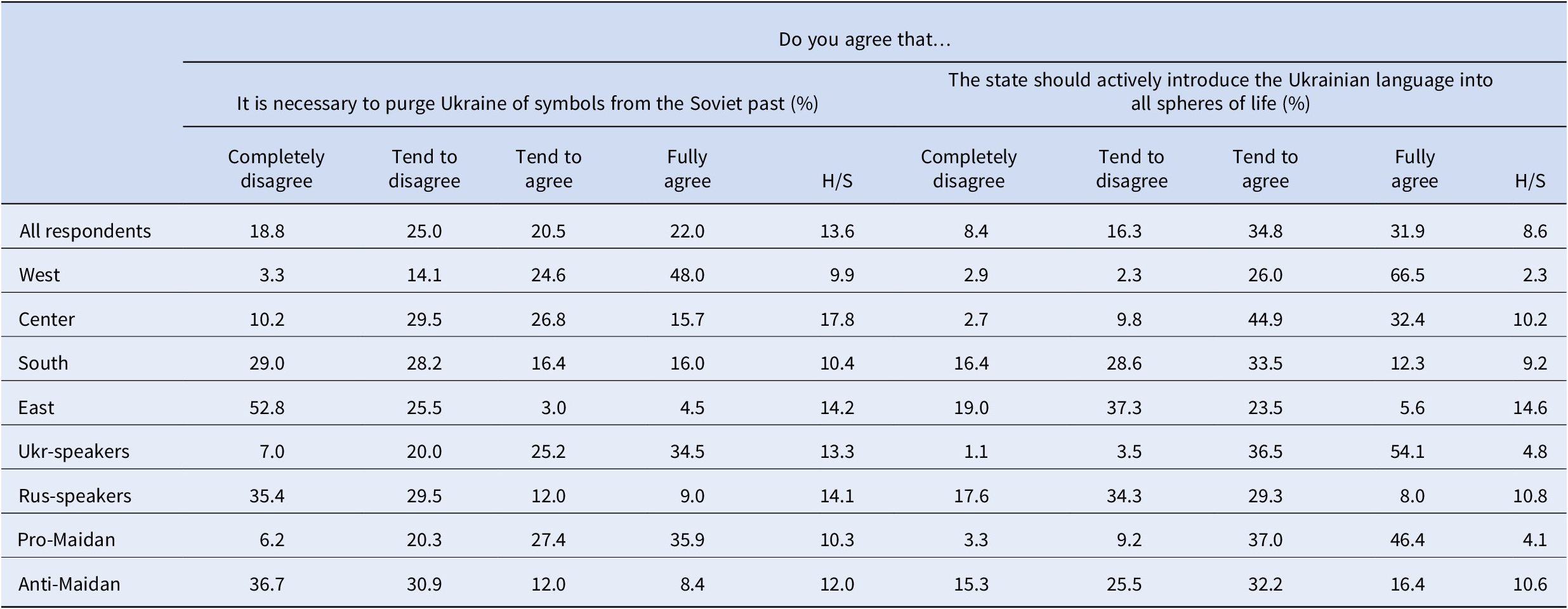
As figures in Table 1 vividly demonstrate, public support for the course to “actively introduce the Ukrainian language into all spheres of life” is considerably stronger than for the policy intended to “purge Ukraine of symbols from the Soviet past.” Although the public opinion about the two policies is structurally similar in that the differences between groups defined by certain demographic and ideological characteristics go in the same direction, in virtually all of these groups, the degree of support for Ukrainianization is higher than for decommunization. Even among westerners, Ukrainian-speakers, and Euromaidan supporters who are overwhelmingly supportive of resolute action in the language domain, there is perceptible opposition to radical policies on memory. At the same time, even among Russian speakers whom many actors and experts expect to actively oppose resolute language policies, the disagreement with Ukrainianization is actually weaker than with decommunization.

H/S = Hard to say; Rus = Russian; Ukr = Ukrainian.
Moreover, the KIIS surveys of February 2017 and September 2014 show that the opposition to decommunization increases with time: Whereas in 2014 the balance of agreement and disagreement (both resolute and hesitant) with this policy was positive, by 2017 it had become slightly negative.Footnote 5 In contrast, KIIS surveys of the last 5 years demonstrate an increasing support not only for the state’s promotion of the Ukrainian language as a symbolic value, but also for its imposition in certain communicative practices. In particular, the respondents declare an ever stronger preference for the written and oral interaction of their local authorities with citizens in Ukrainian only; although, in the predominantly Russian-speaking east and south, most people opt for the use of both Ukrainian and Russian. No less remarkable is a drastic increase in the popular support for the requirements that state that employees and even private service providers always respond in Ukrainian to those visitors or customers addressing them in this language, a pattern that has not yet become an unambiguous social norm (Kulyk Reference Kulyk2017b).
In principle, the stronger support in the 2017 survey for Ukrainianization than decommunization may have to do with the fact that the former was formulated in a positive term (introduce) and the latter in a negative term (purge). Yet, the differences between the levels of support are too big to be explained by the wording of the survey questions. In any event, public opinion certainly does not warrant a less radical course on language than on memory, particularly for the parties of the post-Maidan coalition whose supporters favor resolute changes in the former domain much more unanimously than in the latter.
Explaining the Mismatch
Part of the reason why the parties of the post-Maidan coalition do not adequately respond to the pro-Ukrainianization attitude of their constituencies seems to be their leaders’ lack of awareness thereof, which, in turn, partly has to do with their greater attention to public discourse than sociological data on public opinion. Having had this impression from public statements of politicians, I found it largely confirmed in my interviews and informal discussions (conducted between 2016 and 2018; that is, before the adoption of the new language law) with a number of government officials and political consultants working with the coalition parties. Influential policymakers and their advisers seemed to believe that the current cautious policy better reflected the preferences of the Ukrainian population, in general, and the pro-Maidan segment, in particular, than an aggressive promotion of Ukrainian, which would supposedly provoke Russian-speakers’ discontent. While not trusting survey data on the increasing support of such promotion among the population, they tended to accept the argument of some popular bloggers that the insistence on exclusive use of Ukrainian amounts to disrespect for Russian-speaking patriots defending Ukraine in the Donbas. Less convincing to these policymakers was the counterargument of many Ukrainian-speaking authors that the continued predominance of the former imperial language in many social domains is unacceptable, particularly in view of the war with neo-imperial Russia.
Judging by Facebook discussions among pro-Maidan users, which feature the opinions of highly educated and politically active urbanites, language does seem to be more contentious than memory. Most discussants support a more or less radical break with the Soviet past, but many of them resolutely object to calls for the exclusion of the Russian language from Ukrainian public space, including the social media themselves (Kulyk Reference Kulyk2016b). However, this apparent contrast obscures both the strong preference for some kind of Ukrainianization among the Maidan supporters and the considerable opposition to de-communization in other groups of the population. For a long time, these issues were not emphasized by political forces seeking to mobilize their constituencies against the incumbent government: The anti-Maidan forces primarily blamed it for the low living standards and the unabated war in the Donbas, whereas opponents within the pro-Maidan camp pointed to persistent corruption and murky deals with oligarchs. It remains to be seen whether memory and language re-emerge in the future electoral campaigns similarly to how they featured in the past confrontations between the Orange and anti-Orange elites.
It has certainly helped to pursue a consistent memory policy that the government has a designated body to deal with this domain, namely, the UINR charged with both the elaboration of legislation and supervision of its implementation. In contrast, language policy is assigned to several agencies whose leaders have different views of its appropriate manner and its priority on the government’s agenda. Although this structural asymmetry existed long before Euromaidan, the government established after its victory gave the memory domain a further advantage by appointing Volodymyr Viatrovych, an energetic manager and a staunch supporter of the nationalist narrative, as the institute’s director. It would take much more effort to create a special agency for language matters, and the government obviously did not consider it appropriate. That the abovementioned draft of a comprehensive language law stipulated several new agencies intended to ensure its implementation was one of the main points raised by critics who expected these agencies to cause social tension (U merezhi 2017). Because of this criticism, some of the provisions regarding new agencies were excluded from the draft between the first and second readings. Given that many politicians, officials, and other relevant figures continue to rely mainly on Russian in their work, often even in situations were Ukrainian is clearly required, one can assume that they reject the introduction of effective mechanisms of the promotion of Ukrainian not only to avoid discontent of ordinary citizens, but also to preserve their own linguistic comfort. While both de-communization and Ukrainianization in their radical versions can be ideologically problematic to many policymakers, the latter would affect their everyday life and work much more strongly. Actually, this can pertain to many ordinary citizens as well, notwithstanding their declared support for the promotion of the national language.
To conclude, post-Euromaidan policies regarding memory and language differed significantly because de-communization was launched on the government’s initiative and implemented rather radically and consistently, while perceptible moves toward Ukrainianization mostly responded to pressures from other actors and only pertained to particular practices. This difference did not result from constraints presented by demands of the population, opposition parties, civil society, foreign powers, or international organizations. In fact, the popular opposition to radical change on language was weaker than on memory, whereas the pressure from civil society in favor of resolute policies was more perceptible. The difference was primarily due to the government key figures’ own perceptions of the appropriate policies in the two domains, which reflected not only their excessive fears of provoking popular discontent, but also their distrust of policies that would radically change the country’s linguistic landscape and thus their own everyday lives.
Acknowledgments.
The 2017 survey was designed by Henry Hale and myself and funded from our research budgets at George Washington University and Yale University, respectively. The 2014 survey was made possible by a grant awarded to me by the Canadian Institute of Ukrainian Studies, University of Alberta.
Disclosures.
Author has nothing to disclose.