INTRODUCTION
Coastal lagoons are separated by a barrier from the adjacent ocean and connected to it at least intermittently (Kjerfve, Reference Kjerfve1994); they are characterized by elevated productivity, allowing the establishment of numerous marine populations (Contreras-Espinosa & Castañeda-López, Reference Contreras and Castañeda2004; Hauenstein et al., Reference Hauenstein, Peña-Cortés, Bertrán, Tapia and Schlatter2008). In coastal areas, fish are among the faunal groups with the most biological success because these areas offer them food and protection, favouring their development during their lifetime (Yáñez-Arancibia & Nugent, Reference Yánez-Arancibia and Nugent1977; Castro-Aguirre et al., Reference Castro-Aguirre, Espinosa-Pérez and Schmitter-Soto1999; Arceo-Carranza et al., Reference Arceo-Carranza, Vega-Cendejas, Montero-Muñoz and Hernández de Santillana2010).
On the coasts of Sonora, Mexico, the largest lagoons are Bahía de Guaymas, Bahía Yavaros, Estero Agiabampo, Estero de Lobos, Estero El Tóbari and Las Guásimas (Burrola-Sánchez et al., Reference Burrola-Sánchez, López-Martínez, Padilla-Arredondo, Urias-Laborin, Padilla-Serrato and López-Martínez2008); this last one is a very important ecological area (declared RAMSAR) for mollusc, crustacean and fish species (Varela, Reference Varela1990; Campoy & Calderón, Reference Campoy-Favela and Calderón-Aguilera1991; Audeves et al., Reference Audeves, Pérez, Rozo and Enríquez1997; Ontiveros-Granillo, Reference Ontiveros-Granillo2011). In Las Guásimas, 79 fish species have been recorded (Rodríguez-Félix, Reference Rodríguez-Félix2010; Ontiveros-Granillo, Reference Ontiveros-Granillo2011), of which Eucinostomus entomelas Zahuranec, 1980 (Dark-spot mojarra) (Yáñez-Arancibia, Reference Yánez-Arancibia and Nugent1977) and Micropogonias megalops Gilbert, 1890 (Bigeye croaker) are two of the ten most abundant species (Ontiveros-Granillo, Reference Ontiveros-Granillo2011), both subjected to fisheries exploitation (Sólis-Celada et al., Reference Solís-Celada, Quiroga-Brahms and Valdés-Guzmán1996; Aragón-Noriega et al., Reference Aragón-Noriega, Valenzuela-Quiñones, Esparza-Leal, Ortega-Rubio and Rodríguez-Quiroz2009). In spite of their economic importance, knowledge about their biology is scarce.
It is known that E. entomelas reaches 18 cm in standard length; it ranges from the southern part of the Baja California Peninsula and Central Gulf of California region down to Peru, and it inhabits coastal waters and shallow bays with soft substrates, generally forming schools. Juveniles are found in coastal lagoons and estuaries and are considered to be omnivorous (Fisher et al., Reference Fischer, Krupp, Schneider, Sommer, Carpenter and Niem1995; Allen & Robertson, Reference Allen and Robertson1998). As for M. megalops, it has been reported to reach ≥49 cm in total length; it lives in coastal lagoons, estuaries and river mouths, but it is also found in deep waters far from the coast. It ranges from the Rio Colorado delta down to the surroundings of Acapulco, Mexico (Fisher et al., Reference Fischer, Krupp, Schneider, Sommer, Carpenter and Niem1995; Allen & Robertson, Reference Allen and Robertson1998). Román-Rodriguez (Reference Román-Rodriguez2000) reports that in the northern region of the Gulf of California, M. megalops grows allometrically and lives up to 16 yr, reaching first maturity at 40 cm in total length and spawning in April.
Fish play an important role in the structure and functioning of many aquatic ecosystems through trophic interactions (Cruz-Escalona et al., Reference Cruz-Escalona, Zetina-Rejón and Arreguín-Sánchez2007). The study of their feeding habits allows knowledge about the biology and ecology of the organisms providing data on their interaction in the marine environment (Cailliet et al., Reference Cailliet, Love and Ebeling1996). This is the first work analysing the feeding spectrum of E. entomelas and M. megalops of Laguna Las Guásimas in Sonora, Mexico. Our objective was to characterize the diet of both species and identify if they compete for food, considering they are the two most abundant species in this lagoon.
MATERIALS AND METHODS
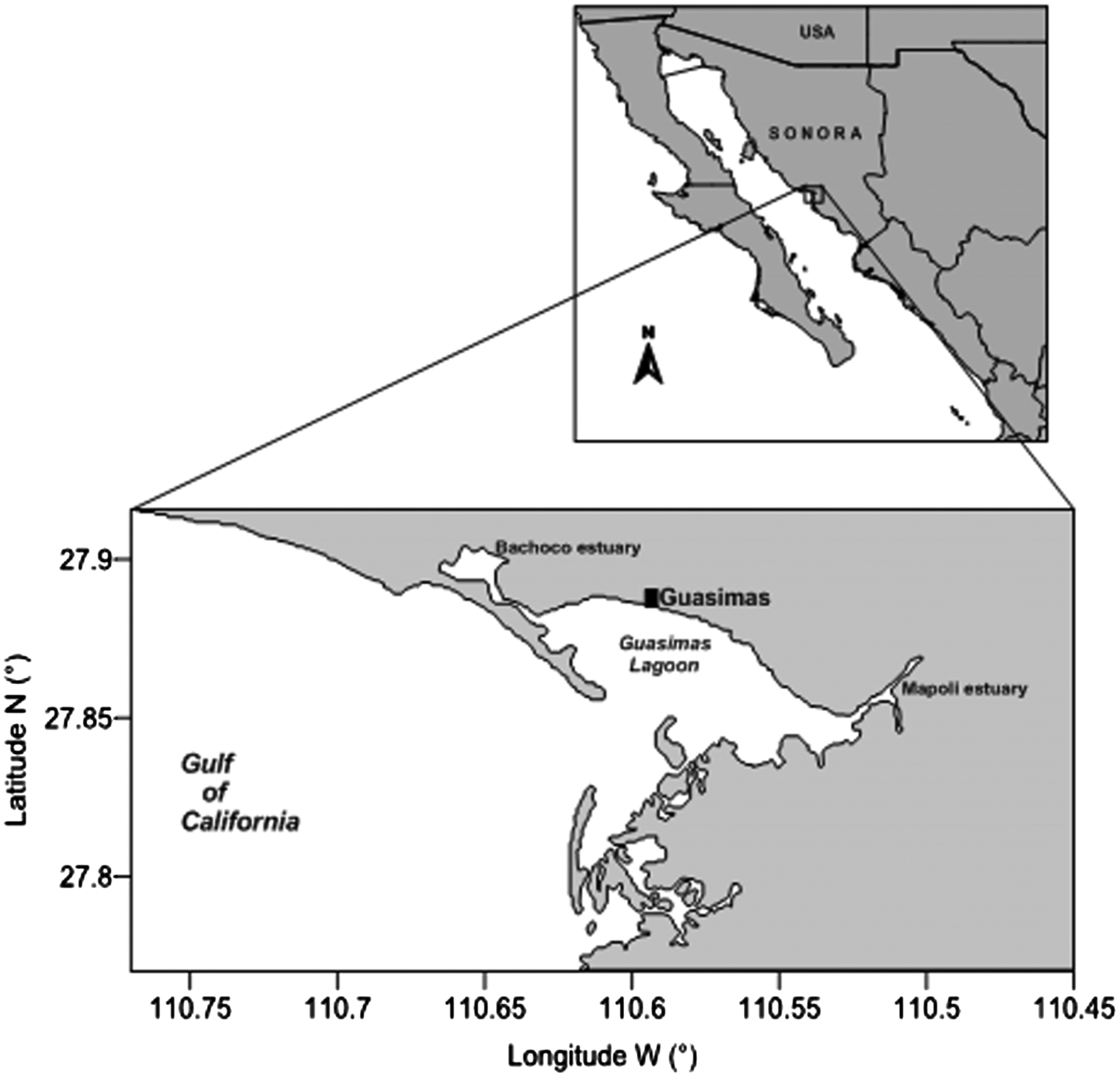
Biological samples of Eucinostomus entomelas and Micropogonias megalops were collected in November 2010, September 2011 and February 2012 in Laguna Las Guásimas, Sonora (27°50′–27°51′N 110°41′–110°26′W) (Figure 1). Boats known locally as ‘pangas’ were used for the collection. The capture of the individuals was performed with 5.7 cm mesh trawling nets of 15 m in length in the headrope, at a speed of 2 knots. Additionally, a 5.7 cm mesh gill net, 200 m in length and 1.70 m in height was used for collection near the bottom at a depth of 3 m. Individuals of E. entomelas and M. megalops were separated at capture, injected with formaldehyde at 10% directly into the stomach and placed in tagged plastic bags and preserved in 10% formaldehyde. In the laboratory, fish were identified to the species level using the keys by Fisher et al. (Reference Fischer, Krupp, Schneider, Sommer, Carpenter and Niem1995) and Robertson & Allen (2010) (Smithsonian Tropical Research Institute, 2008).
Study area, Laguna Las Guásimas.

Fork length (FL ±0.1 cm) of each individual was measured with a Vernier and total weight (TW ±0.1 g) with an Ohaus balance. Each fish was eviscerated and the sex was identified macroscopically. Size structure was analysed for each species with size intervals of 10 mm FL.
Stomachs were removed and preserved in formaldehyde at 10%. The emptiness index, which relates to the number of empty stomachs with the total number of stomachs, was determined. Stage of stomach fullness was identified using Stillwell & Kohler's (Reference Stillwell and Kohler1982) methodology, and they were grouped into four categories (1–25%, 26–50%, 51–75% and 76–100% fullness).
For taxonomic identification of prey items, specialized keys were used according to the type of prey. Algae were identified by Dawson's (Reference Dawson1966) key, copepods by using Palomares-Garcia et al. (Reference Palomares-Garcia, Suárez-Morales and Hernández-Trujillo1998) and echinoderms and molluscs were identified using the key by Fischer et al. (Reference Fischer, Krupp, Schneider, Sommer, Carpenter and Niem1995). Fish identification was performed by analysing the skeleton parts. Vertebrae were counted following Miller & Jorgensen (Reference Miller and Jorgensen1973). For fish showing a minimum digestive stage, Fischer et al. (Reference Fischer, Krupp, Schneider, Sommer, Carpenter and Niem1995) keys were used.
Prey that were too macerated or digested to be visually classified were identified starting from their hard structures, such as claws and other crustacean appendages, using Brusca's (Reference Brusca1980) specialized guide. For each prey category, the number of individuals corresponding to each food component was quantified and their wet weight was recorded to 0.0001 g. The quantification of fragmented prey was based on the number of pairs of eyes, head, mouth parts (mandibulae), telson and other anatomical structures that serve as reference to determine complete specimens.
Several methods have been proposed to quantify the importance of the different types of prey in aquatic species' diets (Berg, Reference Berg1979; Hyslop, Reference Hyslop1980; Tirasin & Jorgensen, Reference Tirasin and Jorgensen1999). To analyse the diet of each predator, the following factors were used in the present study: frequency of occurrence percentage (%FO), referred to as occurrence of prey type and total number of stomachs with food; %FO = (number of stomachs including type of prey/number of stomachs with food)*100; percentage in number (%N) that relates to the number of individuals of prey i found in stomachs with the total number of prey in all the stomach contents; and weight percentage (%W) that relates to the weight of all the individuals of prey i with the total weight of all the prey in the stomachs with food.
The index of relative importance (IRI) combines the three previous methods; it was proposed by Pinkas et al. (Reference Pinkas, Oliphant and Iverson1971) and modified by Hacunda (Reference Hacunda1981). The IRI was used to evaluate each species in general, by sex and by the importance of each food category in the trophic spectrum (Liao et al., Reference Liao, Pierce and Larscheid2001).
The index formula is as follows:
 $$IRI = \% FO \,\ast\, \lpar \% N + \% W\rpar$$
where %FO is the percentage of frequency of occurrence; %N is the percentage of numerical abundance; and %W is the weight percentage.
This index was expressed as:
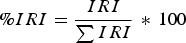 $$\% IRI = \displaystyle{{IRI} \over {\sum {IRI} }}\,\ast\, 100$$
To estimate the diet breadth, IRI absolute values were used according to Levin's (Krebs, Reference Krebs1989) standardized index, which assumes Bi values close to zero when the predator is a specialist and close to one when it is a generalist (Krebs, Reference Krebs1989).
To evaluate E. entomelas' diet overlap among predators and by sex, the Morisita–Horn (Smith & Zaret, Reference Smith and Zaret1982) index was applied, using IRI absolute values (Cλ), which can vary from zero, when diets are completely different, to one, when diets are identical.
To determine if the number of stomachs analysed was adequate to characterize the diet, the program EstimateS Win v.7.52 was used to obtain the cumulative curve of prey according to Jiménez-Valverde & Hortal (Reference Jiménez-Valverde and Hortal2003).
RESULTS
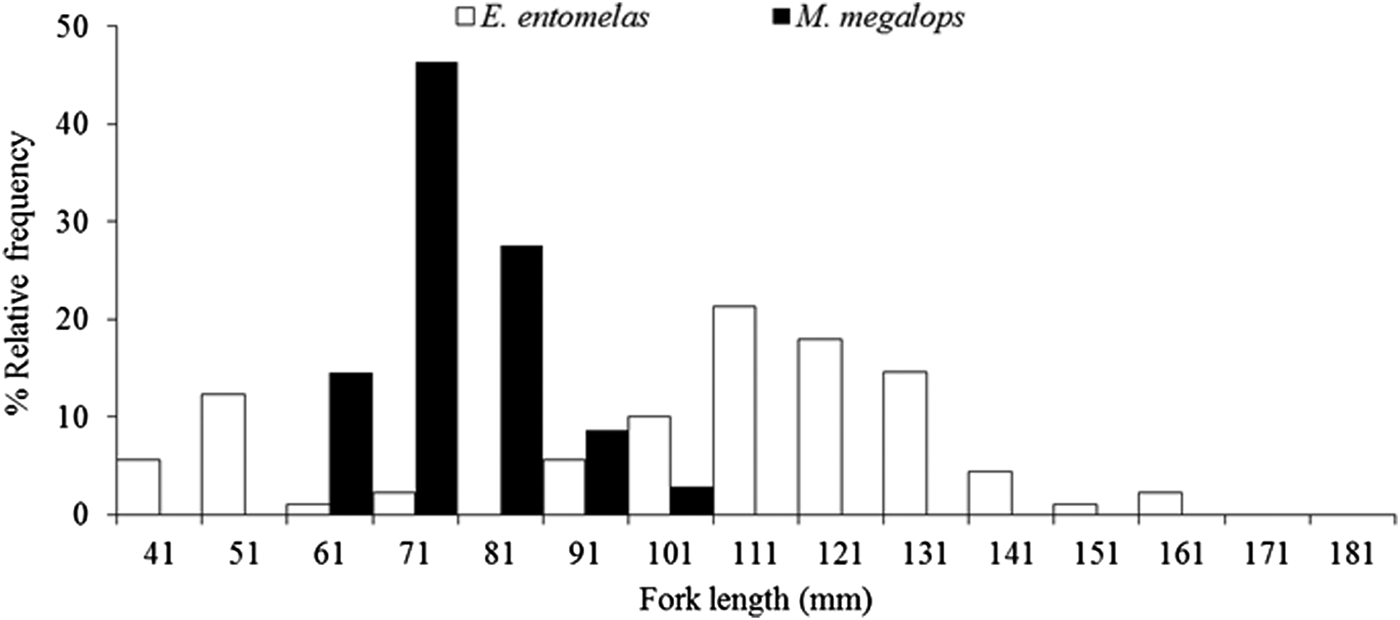
A total of 87 individuals of Eucinostomus entomelas were collected with a fork average length of 119 ± 32 mm (Figure 2) and average weight of 51 ± 31 g. From the whole sample, 52 stomachs contained food (60%) and 35 stomachs were empty (40%).
Size–frequency distribution of Eucinostomus entomelas and Micropogonias megalops, captured in Laguna Las Guásimas, Sonora.
A total of 69 individuals of Micropogonias megalops were collected with average fork length of 79.5 ± 9.1 mm (Figure 2) and average weight of 10.2 ± 3.5 g. 42 stomachs (61%) had food and 27 stomachs were empty (39%).
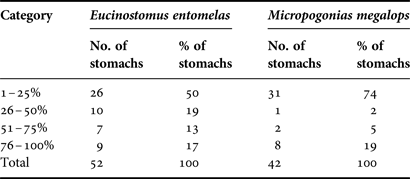
The percentage of gastric repletion for both species (E.entomelas and M. megalops) was the 1–25% range for 50% and 31% of the organisms analysed, respectively (Table 1).
Percentage of stomach fullness in a total sample of stomachs with food.
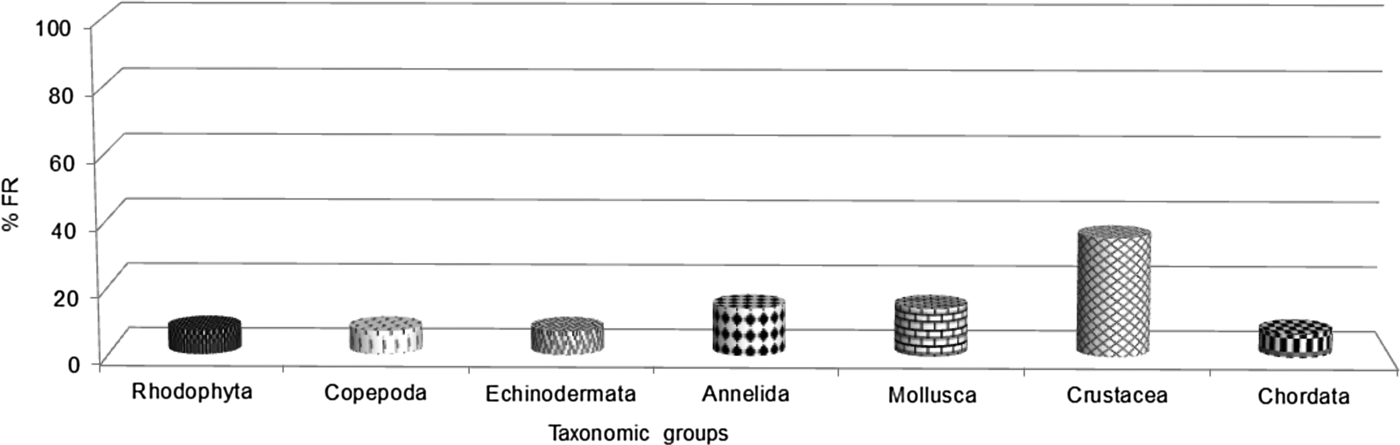
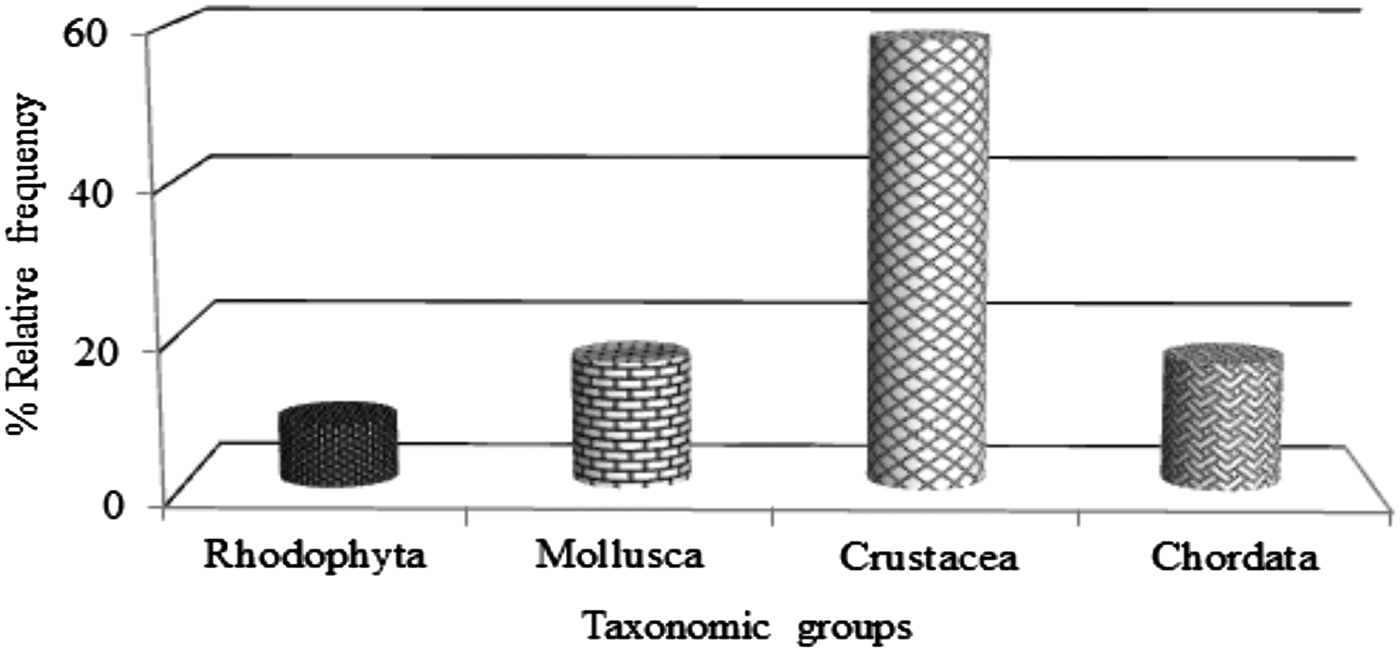
The trophic spectrum of E. entomelas consisted of 14 types of prey, corresponding to eight food categories. Of the total prey consumed, five (Figure 3) prey items were crustaceans (36%), two of each belonging to annelids, echinoderms and molluscs (14% each), and only one to rhodophytes, copepods and chordates (7% each).
Feeding preference of Eucinostomus entomelas by taxonomic group in Laguna Las Guásimas, Sonora.
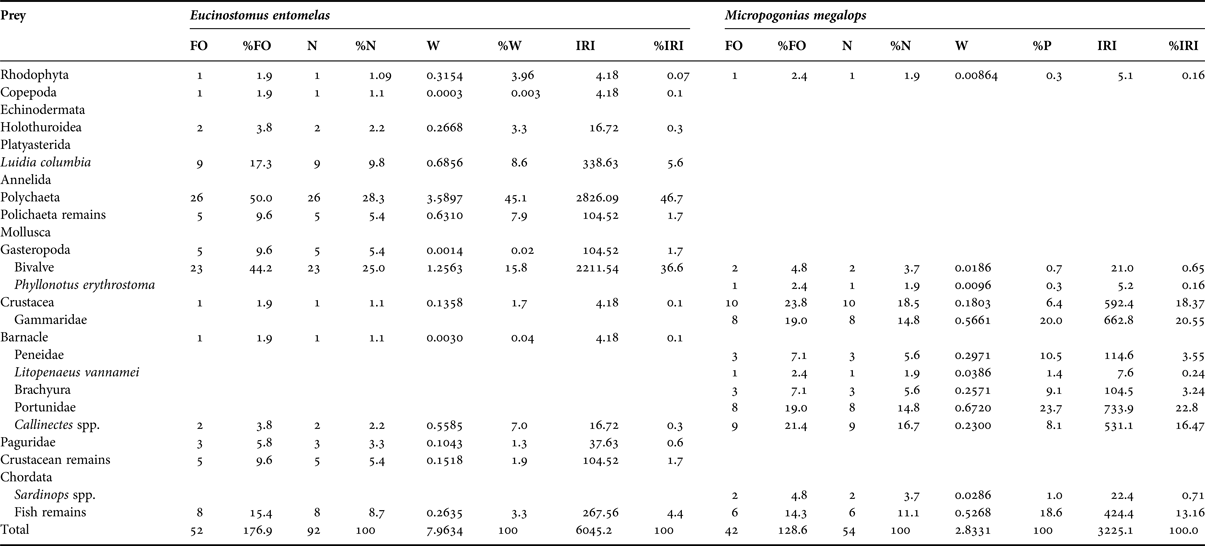
The most frequent prey species in stomachs were polychaetes (50.0%), bivalves (44.2%), Luidia columbia, Gray 1840 (17.3%) and fish remains (15.4%) (Table 2).
General feeding spectrum of Eucinostomus entomelas and Micropogonias megalops in Laguna Las Guásimas, Sonora, expressed in absolute and percentage values of the frequency of occurrence (FO and %FO), numerical (N and %N), gravimetric (W and %W) methods and index of relative importance (IRI and %IRI).
A total of 92 prey specimens were recorded. The most important items were polychaetes (28.3%) followed by bivalves (25.0%), Luidia columbia (9.8%) and fish remains (8.7%).
Total weight of prey was 7.9634 g; those showing higher weight percentage were polychaetes (45.1%), bivalves (15.8%), L. columbia (8.6%), polychaete remains (7.9%) and Callinectes spp., Fausto 1980 (7.0%). According to the IRI, the most important species were: polychaetes (46.7%); bivalves (36.6%); and L. columbia (5.6%).
While analysing diet by sex, of the 32 females collected, 16 stomachs were with food (50%) and 16 stomachs were empty (50%). The most important items were bivalves (38.1%), polychaetes (22.7%) and L. columbia (17.5%).
Of 35 males sampled, 21 stomachs were found with food (60%) and 14 were emply (40%). Based on %IRI, the males' diet was composed mainly of bivalves (55.9%) and polychaetes (29.9%).
In stomachs of M. megalops, 12 items were found, of which seven belonged to crustaceans (58%), two to molluscs and chordates (17% each) and one to rhodophytes (8%) (Figure 4).
Feeding preference of Micropogonias megalops by taxonomic group in Laguna Las Guásimas, Sonora.
In terms of frequency of occurrence, crustaceans contributed with 23.8% (10 stomachs), followed by crab Callinectes spp. with 21.4% (9), portunids and gammarids with 19.0% (8 each) and fish remains 14.3% (6) (Table 2).
A total of 54 prey items were found: 18.5% (10) were crustaceans; 16.7% (9) Callinectes spp.; 14.8% (8) portunids and gammarid amphipods; and 11.1% (6) fish remains.
The items in stomachs had a total weight of 2.8331 g. In terms of %W, the most important components were the family Portunidae with 23.7% (0.6720 g), Gammaridae Amphipoda with 20% (0.5661 g), fish remains 18.6% (0.5268 g) and Peneidae 10.5% (0.2971 g).
With respect to the IRI, Portunidae represented 22.76%, followed by Gammaridae with 20.55%, Crustacea 18.37%, Callinectes spp. 16.47%, fish remains 13.16% and the rest of the items contributed 8.69%.
With reference to sex, six males were obtained (9%), 63 juvenile (91%), and no females were identified. The trophic spectrum of six M. megalops males was composed of two types of prey. Amphipods of the family Gammaridae were the most important prey, with 50% frequency of occurrence (%FO), contributing 85.7% in number, 99.8% in weight and 92.8% in IRI. Fish remains contributed to 50% in FO, 14.3% in %N, 0.2% in weight and 7.2% in IRI, occupying second place in IRI.
With respect to diet breadth for E. entomelas, a value of Bi = 0.14 was found, classifying it as a specialist predator. On the other hand, when comparing by sex, females had values of Bi = 0.32 and males of Bi = 0.21, classifying them as specialists.
Micropogonias megalops was characterized as a specialist predator according to the estimated value of diet breadth (Bi = 0.43). The same behaviour was recorded for males (Bi = 0.16).
According to feeding preferences between E. entomelas and M. megalops, we found a low overlap (Cλ = 0.14). Nonetheless, when comparing E. entomelas' diet by sex, we found a high overlap (Cλ = 0.86).
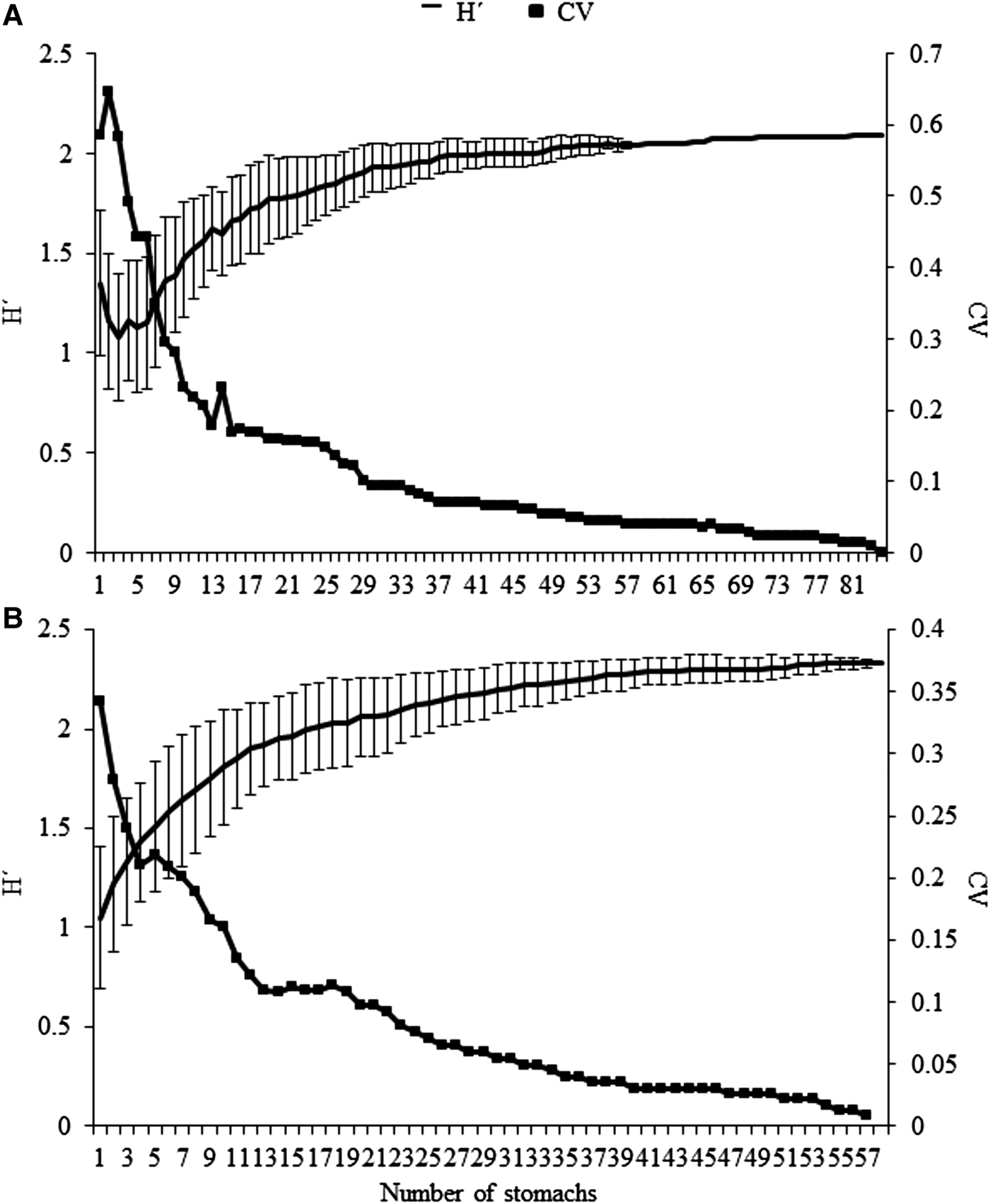
The cumulative prey species curve for each predator indicated the number of stomachs analysed was sufficient, obtaining coefficient of variation values under 0.05 (Figure 5).
Cumulative prey curve in the diet by predator in Laguna Las Guásimas, Sonora: (A) Eucinostomus entomelas; (B) Micropogonias megalops.
DISCUSSION
In our work we considered that variation between prey digestion degree and stomach fullness (1–25%) did not relate to the time of the day in Micropogonias megalops and Eucinostomus entomelas feeding, because this percentage was found in organisms collected during day and night, suggesting both predators consume food throughout the day. It could be attributed to the fact that once captured, the individuals were fixed one hour after having been collected, a period during which the digestion process continues degrading food (Abitia-Cárdenas et al., Reference Abitia-Cárdenas, Galván-Magaña and Muhlia-Melo1998).
In spite of the prey digestion stage, the preferential prey item found in E. entomelas stomachs was polychaetes (%IRI = 46.7), which agrees with that reported by Varela (Reference Varela1990), Arenas-Granados & Acero (Reference Arenas-Granados and Acero1992) and Aguirre-León & Díaz-Ruiz (Reference Aguirre-León and Díaz-Ruiz2004) with respect to the predator pressure that other components of the family Gerreidae place upon polychaetes. Eucinostomus entomelas also consumed six other taxonomic groups (Rhodophyta, Copepoda, Echinodermata, Mollusca, Crustacea and Chordata), of which only four (algae, copepods, polychaetes and crustaceans) have been found in stomach contents of other Gerreidae such as Eugerres plumier Cuvier 1830 (Aguirre-León & Díaz-Ruiz, Reference Aguirre-León and Díaz-Ruiz2000) and Diapterus rhombeus Cuvier 1829 (Aguirre-León & Díaz-Ruiz, Reference Aguirre-León and Díaz-Ruiz2004).
The trophic spectrum of E. entomelas indicates that it is a carnivorous predator which consumes mainly benthic organisms (e.g. Polychaeta, Bivalvia and Luidia columbia) and pelagic species (Copepoda) in smaller numbers. The presence of benthic prey in E. entomelas' diet is characteristic of the family Gerreidae, because they have a protractile mouth that allows them to feed on small invertebrates at the bottom and small quantities of plant material (Fisher et al., Reference Fischer, Krupp, Schneider, Sommer, Carpenter and Niem1995).
In the stomachs of E. entomelas Rhodophyta algae contributed 1.6% FO, which was considered as occasional feeding. When compared to Arenas-Granados & Acero (Reference Arenas-Granados and Acero1992), who reported that in 27 digestive tracts of Diapterus auratus Ranzani 1842, 60% FO of algae was found, this fish is classified as a euriphagus predator, differing from the feeding habits of E. entomelas.
Males consumed more bivalves (%IRI = 55.9) than females (%IRI = 38.1). The similarity in both main prey indicates that there is a good abundance of feeding resources in Las Guasimas, allowing them to consume the same types of prey but in different proportions. Feeding preference of E. entomelas males agrees with that reported on other Gerreidae: E. plumier; Gerres cinereus; D. rhombeus; Diapterus auratus; Eucinostomus melanopterus; E. harengulus; E. argenteus; and E. gula (Arenas-Granados & Acero, Reference Arenas-Granados and Acero1992).
In the trophic spectrum of M. megalops, four feeding categories were identified (Crustacea, Chordata, Mollusca and Rhodophyta) with Crustacea being the most important group (85.17% IRI). The food components of M. megalops were similar to those reported for the same scianid by Román-Rodríguez (Reference Román-Rodriguez2000), who found crustaceans, molluscs, ophiuroids, polychaetes, fish and unidentified organic material were the most important in this predator's diet. Feeding preference also agrees with that reported for other genera of the family Scianidae such as: Menticirrhus undulatus (Bocanegra-Castillo et al., Reference Bocanegra-Castillo, Abitia-Cárdenas and Galván-Magaña2000) and Cynoscion parvipinnis (Cruz-Escalona et al., Reference Cruz-Escalona, Campos-Dávila, Abitia-Cárdenas and Zetina-Rejón2010), but it differs from that found for Cynoscion othonopterus (Román-Rodríguez, Reference Román-Rodriguez2000) and Micropogonias furnieri (Bertrán et al., Reference Bertrán, Jiménez, Fierro, Peña-Cortés, Tapia, Hauenstein and Vargas-Chacoff2013); in both predators, clupeiform fish are the preferred prey (Cetengraulis mistecetus and Engraulis ringens, respectively).
Micropogonias megalops preference for crustaceans classifies it as a carcinophagous predator. The high consumption of crustaceans and molluscs confirms it is a predator living close to the bottom and feeding preferably on the two most abundant of benthic fauna in Laguna Las Guásimas (Campoy & Calderón, Reference Campoy-Favela and Calderón-Aguilera1991).
In the diet of M. megalops males, gammarid amphipods that inhabit soft bottoms (Winfield et al., Reference Winfield, Cházaro-Olvera, Ortiz and Palomo-Aguayo2011) were their main prey. Consumption of this type of prey suggests M. megalops males search for sandy areas for feeding. In our work we did not characterize the diet of females; however, for the scianid Cynoscion guatucupa Cuvier, 1830 (Garcia Reference Garcia2007) both males and females were found feeding on the same types of prey on the south-western Atlantic coasts.
Although E. entomelas feeds on 14 prey types in Laguna Las Guásimas, Levin's index value (Bi = 0.14) classified it as specialist predator because of the high incidence of bivalves and polychaetes found in its diet. The same result was obtained in females and males (Bi = 0.32 and Bi = 0.21, respectively).
Micropogonias megalops consumed 12 types of prey in Laguna Las Guásimas, but Levin's index value (Bi = 0.43) classified it as specialist predator because of the occurrence of crustaceans (shrimp, crabs and amphipods) found in the stomachs. The specialist behaviour of M. megalops has also been reported in other scianids by Bocanegra-Castillo et al. (Reference Bocanegra-Castillo, Abitia-Cárdenas and Galván-Magaña2000), Giberto et al. (Reference Giberto, Bremec, Acha and Mianzan2007) and Cruz-Escalona et al. (Reference Cruz-Escalona, Campos-Dávila, Abitia-Cárdenas and Zetina-Rejón2010), who classify Menticirrhus undulatus, Micropogonias furnieri and Cynoscion parvipinnis as specialist predators because of the high consumption of crustaceans or molluscs.
Both predator fish (E. entomelas and M. Megalops) had a low overlap (Cλ = 0.14) in diets because E. entomelas fed mainly on polychaetes while portunids are the preferential prey of M. megalops. In this respect, Varela (Reference Varela1990) points out that diet variations are influenced by availability and abundance of food resources, as well as by the trophic preferences of each species, which allows decreasing food competition between the species in our study and at the same time optimizes the use of resources.
In E. entomelas a high overlap (Cλ = 0.86) was found between sexes due to the consumption of bivalves and polychaetes, indicating a good distribution of food resources in Laguna Las Guasimas. In Gerridae, Franco-López et al. (Reference Franco-López, Abarca-Arenas, Barrera-Escorcia, Bedia-Sánchez and Rivera-Felix2011) found that consumption of resources in different proportion eliminates competition for food among individuals.
The difference in the food components consumed by E. entomelas and M. megalops suggests there are enough food resources in the lagoon, allowing a higher distribution of the groups of prey and contributing to decreased competition pressure for those resources in the lagoon.
The specimens of M. megalops showed sizes from 61 mm to 110 mm FL; 63 of the specimens were juveniles and six were males, suggesting M. megalops inhabits the lagoon in this stage for feeding and growth. However, the fact that only six specimens were sexually identified suggests that adults only come into the lagoon occasionally and use the ocean area of the Gulf of California for reproduction (Lopez-Martínez, personal communication). Yáñez-Arancibia & Nugent (Reference Yánez-Arancibia and Nugent1977) mention that fish inhabit the lagoon systems for feeding, growth and reproduction, which is highly relevant and highlights that although the role of the lagoons is obviously for feeding and growth, it is not the case for reproduction because many species inhabiting the lagoons perform reproduction in the ocean (Román-Rodriguez, Reference Román-Rodriguez2000).
On the other hand, 91% of E. entomelas individuals were mature adults, indicating that the species uses the lagoon for feeding and reproduction, which agrees with Yáñez-Arancibia & Nugent (Reference Yánez-Arancibia and Nugent1977) as previously mentioned.
In our work, we found that both predators use the lagoon for feeding, as well as for growth (E. entomelas) and for reproduction (M. megalops). The lagoon provides food for fish species that inhabit it in any life stage (juvenile, adult). The difference in preferential prey among predators (E. entomelas and M. megalops) also indicates there is a good distribution of food resources in the Las Guásimas lagoon system.
To corroborate the richness of food in the lagoon, we consider it would be appropriate to conduct a comparative analysis of the available resources in the environment with respect to what is being consumed by the predators inhabiting this system.
ACKNOWLEDGEMENTS
We are grateful to the staff of the Fisheries Laboratory of Centro de Investigaciones Biológicas del Noroeste (CIBNOR Guaymas), where our samples were analysed, to Dr K de la Rosa for her comments to improve our work and to D. Dorantes and A. Arkhipkin for English editing.
FINANCIAL SUPPORT
The current study was funded by the project CIBNOR (EP12) y Ciencia Basica CONACYT (106787).