One of the more controversial measures in the realm of infection control and prevention involves the healthcare personnel (HCP) mandate to obtain influenza vaccination. Despite recommendations for many years from the Centers for Disease Control and Prevention (CDC) and other professional organizations that all HCP be vaccinated against influenza,Reference Grohskopf, Olsen and Sokolow 1 , Reference Talbot 2 national vaccination rates remain stubbornly stuck well below the national target of >90%. 3 , 4 This rate remains low despite widely used strategies such as offering free vaccination, extensive educational and promotional campaigns, roving vaccinators to minimize HCP inconvenience, among other measures.Reference Lam, Chambers, MacDougall and McCarthy 5 , Reference Koh and Gordon 6
A small but increasing number of institutions have adopted vaccination mandates,Reference Talbot 2 employing multiple disciplinary steps up to and including termination of unvaccinated health care workers without medical contraindications (or sometimes religious objections). However, this practice remains controversial, and many hospital administrators and other leaders are reluctant to adopt this approach. While those who have published their experience with adopting such a policy have reported a minimal need to terminate HCPReference Rakita, Hagar, Crome and Lammert 7 – Reference Huynh, Poduska, Mallozzi and Culler 10 and a positive effect on employee satisfaction and patient safety culture,Reference Rakita, Hagar, Crome and Lammert 7 , Reference Feemster, Prasad and Smith 11 others argue that data supporting the impact of universal HCP flu vaccination on actual patient safety (ie, hospital-acquired influenza disease) are lacking.Reference Doshi 12 – Reference d’Costa 14 In long-term care settings, a Cochrane analysisReference Thomas, Jefferson and Lasserson 15 found no association between HCP vaccination and laboratory-proven influenza among residents, although all-cause mortality was decreased. Limited data for acute care are suggestive of benefit.Reference Weinstock, Eagan and Malak 16 – Reference Bénet, Régis and Voirin 18 Those who object to mandatory vaccination emphasize that without such data, termination of HCP is overly drastic and coercive and that high vaccination rates should be achieved in alternative ways.Reference Finch 19 , Reference Patel 20
Similar to many institutions, our health system was experiencing suboptimal HCP vaccination (57%–72%) prior to the 2011–2012 influenza season, and we set an institutional goal of at least 90% employee vaccination. While initially a HCP mandate was considered, we ultimately adopted a voluntary vaccination program, incorporating features of communications and behavior theory. We believe this intervention can serve as an example for other healthcare systems attempting large-scale organizational change; it highlights the effective use of incentives and disincentives (carrots and sticks), rather than mandates, to achieve desired behavior.
METHODS
Study Setting
Christiana Care Health System is a 2-hospital, 1,100-bed, private, not-for-profit, community-based academic healthcare system located in northern Delaware. The health system includes a community-based cancer center, 36 primary care and specialty outpatient practices, and a home healthcare service; it employs >10,000 personnel, including ~20% of its 1,500 medical-dental staff. Prior to 2011, the annual employee influenza vaccination campaign included promotional materials, web-based and in-person education, free vaccination for employees and medical-dental staff, roving vaccinators (primarily Employee Health) who provided vaccinations at convenient locations, and provision of vaccine doses to inpatient and outpatient areas for staff self-vaccination. During the 2009 H1N1 pandemic, the health system created a policy that required explicit declination in writing of influenza vaccine by all employees as well as the wearing of surgical masks for all nonvaccinated HCP within 6 feet of patients during the flu season. However, the policy did not include provisions to enforce either of these measures.
Intervention
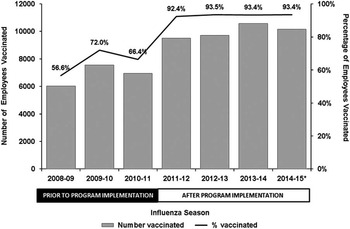
After the 2009–2010 influenza season, the employee seasonal influenza vaccination rate subsequently declined (Figure 1), and we convened a multidisciplinary task force with a goal of improving employee vaccination to at least 90%. The Infection Prevention Department led the task force, which included members from Employee Health, Pharmacy, Nursing, Employee Relations, Physician Relations, Information Technology, External Affairs, Legal, and Outpatient Services departments. After initially considering adopting a mandatory vaccination policy, ultimately the task force decided to pursue a voluntary method that included strengthening tracking and enforcement of the mandatory declination and masking policies, increasing availability and promotion of vaccine, using the existing disciplinary process for noncompliant employees, and linking an existing financial incentive to achieving high vaccination rates. For more detailed information regarding the intervention, please refer to the Supplemental Materials.
Number and percentage of vaccinated employed healthcare personnel, 2008–2009 through 2013–2014 influenza seasons.

Strengthening tracking and enforcement of policies
The task force considered lack of enforcement and accountability to be primary reasons that the mandatory declination and masking policies had not previously been successful. While Employee Health maintained vaccination records, whether those without documented vaccination had actually been vaccinated outside of the system was unknown. Thus, the new policy required all employees to complete 1 of 3 forms prior to November 30: a consent form (which included attestation of vaccination elsewhere), an exemption form (ie, either medical contraindications or religious exemption), or a declination form, which included reasons for declining. The policy did not require proof of medical contraindication (as defined by the CDCReference Grohskopf, Olsen and Sokolow 1 ), religious basis for objection, or vaccination elsewhere. Philosophical or other objections to “mandatory” vaccination were considered declinations. Each form included a bar code, which was scanned by a newly created web-based application along with the HCP’s identification badge. This automatically updated the vaccination database with vaccinated, exempt or declined status. Beginning 2 weeks after the start of the campaign, every manager and vice president in the system began receiving weekly lists of their employees, notated as vaccinated, not vaccinated, or no response. Managers were required to follow up with employees who had not responded. In addition, managers were aware of which employees had not been vaccinated and, thus, were required to wear masks once the flu season began (determined based on increasing influenza in the county and/or inpatients with laboratory-confirmed influenza).
Increasing availability and promotion of influenza vaccination
Rather than relying on roving vaccinators, meetings, and distribution of vaccine for self-vaccination, the task force decided to adopt a “blitz” campaign during the first 2 weeks of the season. Beginning in early October, vaccination stations were set up across all shifts at entrances to hospitals and other outpatient/ancillary facilities. Staff were not prohibited from entering via other entrances, nor were they required to stop at a vaccination station. At each entrance, volunteer “clerks” (who ranged from administrative assistants to leadership personnel) scanned the HCP’s identification badge and the appropriate form (taking ~30 seconds), and then directed him/her to the next available vaccinator (volunteer nurses and pharmacists). After vaccination (or attesting vaccination elsewhere), HCP were given hanging badges, stating “I’m vaccinated because I care,” to wear with their regular identification badges. Wearing the tag was not mandatory, but anyone not wearing an “I’m vaccinated” tag was required to mask while in patient care areas, regardless of their actual vaccination status. After the blitz ended, Employee Health staff served as roving vaccinators to capture weekend staff and others, but the need for this measure was greatly diminished compared to prior years, as ~70% of all employees were vaccinated during the initial “blitz.”
Disciplinary process for noncompliance
The policy used the existing disciplinary process for employees who either did not complete 1 of the 3 forms by November 30 (ie, the mandatory declination), or who were not vaccinated and repeatedly failed to mask. While the discipline alone did not result in termination, it was considered in performance evaluations and could result in an employee being considered “below standard.” Employees in this status were ineligible for annual raises or any financial incentive.
Financial incentive
Health system leadership approved use of the employee influenza vaccination rate as 1 of 3 metrics comprising a pre-existing employee bonus program, known as the Transformation Rewards Program (TRP). This program had been in existence for 2 years previously and required achievement of at least a minimum level for 3 separate metrics for distribution of any bonus. The 3 metric categories were financial viability, patient satisfaction, and patient safety. Prior patient safety metrics had included hand hygiene rates and reduction in hospital-acquired infections, but for fiscal year 2012 a minimum 75% employee influenza vaccination rate (excluding those with medical/religious exemptions) was designated as the TRP patient safety metric, with additional payout available if rates reached 80% or 85%. After determination of the total TRP bonus amount, that amount was then paid to all full-time employees in good standing (and prorated for part-time employees). Individuals were not required to be vaccinated themselves to receive the TRP bonus, as long as they were not under any disciplinary measures.
Similar methods were maintained for the 2012–2013 and 2013–2014 seasons. Egg allergy was removed as an accepted medical exemption for 2013–2014 given the new availability of egg-free vaccine. For the 2013 TRP bonus program the minimum vaccination rate required increased to 85%, with additional payout if for 90% or 95%, and for the 2014 TRP a flat rate of 90% was chosen. In all years, the policies applied to all health system employees, regardless of level of clinical contact. In addition, the masking policy also applied to non-vaccinated physicians not employed by the health system.
Analysis
We implemented the intervention during the 2011–2012 influenza season, and studied the 2011–2012, 2012–2013, 2013–2014, and 2014–2015 seasons. Relatively limited vaccination information was available prior to the 2011–2012 season (ie, total number of vaccines administered and total number of employees). We calculated employee vaccination rates as follows: the numerator included all recorded employee vaccinations between September and March of each influenza season (vaccinations acquired outside of the health system were not reliably tracked prior to 2011). For the 2011–2012 and 2012–2013 seasons, we determined the denominator at the end of the influenza season in March to include all active employees as of that date, while for the 2013–2014 and 2014–2015 seasons, we included all active employees between October 1 and March 31, even if the employee was terminated during that period. We performed the Cochrane-Armitage test for trend to determine whether the proportion of employees receiving flu vaccination, declining, or declaring exempt status changed over time (STATA, version 13.0). This program was not externally funded and was declared exempt by the Christiana Care Institutional Review Board.
RESULTS
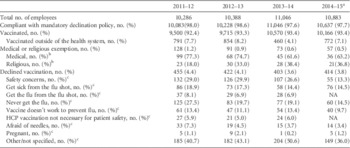
Prior to the 2011–2012 influenza season, employee vaccination rates ranged from 56% to 72%, similar to mean national rates for healthcare systems. After the new program was implemented, the proportion of employees receiving flu vaccination increased to 92% in 2011–12 and 93% in the following 3 seasons (P<.001). Compliance with the mandatory declination policy was 98% in all 4 seasons (Table 1). During the 4 influenza seasons, the percentage of employees declaring a medical/religious exemption decreased (1.2% to 0.5%, P<.001), as did the percentage of those declining vaccination (4.4% to 3.8%, P=.001). The reasons for declination did not change significantly, with the most commonly reported reasons being safety concerns, lack of perceived risk of influenza, and fear of getting sick or getting influenza from the vaccine. While the patient safety metric for the TRP program was achieved each year, the bonus was not distributed for the 2013 program because a separate metric failed to meet the minimum standard required for the bonus program to be implemented.
Influenza Vaccination, Exemption and Declination Rates during the 2011–2012, 2012–2013, and 2013–2014 Influenza Seasons

NOTE. HCP, healthcare personnel; NA, not available. For the 2014–2015 season, the reasons for declination options were revised; these data are currently being analyzed further.
a Preliminary data (as of January 21, 2015).
b Percentage of those who were exempt; percentages may exceed 100%, as more than one option may have been chosen.
c Percentage of those who declined; percentages may exceed 100%, as more than one option may have been chosen.
Prior to implementation of the new program (the 2010–2011 flu season), the vaccination rate for nurses was estimated at 71% and for physicians at 55%, but the majority of vaccines received outside of the health system were not captured. The first season after implementation (2011–2012), vaccination rates improved significantly but varied by job type. Nonclinical employees had the highest vaccination rate (98%), followed by nurses (91%), other clinical staff (91%), and physicians (81%). For the 2013–2014 season, rates were high among all job categories: nurses (90%), physicians (95%), other clinical staff (89%), and nonclinical employees (90%). Vaccination rates by job category were not available for the other influenza seasons.
DISCUSSION
Influenza vaccination rates among employees of a large multisite healthcare system increased substantially and were sustained over 3 subsequent years following implementation of a multidimensional intervention, without resorting to a mandate. Many interventions to achieve behavior change within organizations fail when they do not take into account the knowledge and principles related to the psychology of individual change.Reference Prochaska, Prochaska and Levesque 21 Our intervention to increase HCP influenza vaccination demonstrates theory and findings from the fields of communications, psychology, and behavioral economics, as well as adoption and diffusion of innovations and organizational changes. Programs based on such theories are more effective than those lacking a theoretical base.Reference Glanz and Bishop 22 We believe that this intervention can serve as an example for other healthcare systems attempting behavioral change within large organizations.
The transtheoretical model of changeReference Fishbein and Ajzen 23 – Reference Prochaska and DiClemente 25 posits that behavior is driven by intentions that, in turn, result from a combination of self-efficacy, norms and knowledge, and beliefs and attitudes. Adoption of new behavior often occurs following progress through stages of readiness for change.Reference Prochaska, Velicer and Rossi 26 For example, healthcare workers who are not ready to accept vaccination at the beginning of influenza season may need to progress through precontemplation, contemplation and preparation stages prior to accepting vaccination. Decisional balance is the process of weighing the gains and losses related to a decision. Ambivalent personnel may not decide until this balance clearly favors one or the other.Reference Prochaska, Prochaska and Levesque 21 Decisional balance was demonstrated anecdotally in our program when Employee Health reported a surge of employee vaccinations among those who had previously declined, once the start date for masking was announced (the negative consequences of remaining unvaccinated outweighed the benefits of declining vaccination). Behavioral economics plays a role as well, as programs that are able to ‘nudge’ individuals to accept the right action voluntarily may be equally or even more effective than forcing them to make the same choice.Reference Thaler and Sunstein 27
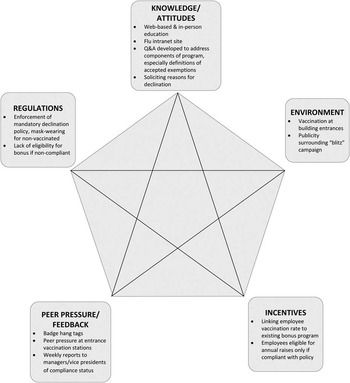
Schwartz and CohenReference Schwartz and Cohen 28 described 5 general categories for implementing behavior change in their model of diffusion of medical innovation: knowledge/attitudes, environment, peer pressure/feedback, regulation, and incentives. The intervention reported here incorporated all 5 domains (Figure 2), which may in part explain its success. While the details of our intervention are specific to our healthcare setting, we believe that the same basic approach has high potential for successful replication of locally adapted programs by other hospitals, health systems, and providers. Unlike mandatory vaccination policies, which require all employees to rapidly engage in the desired action or face termination, programs such as ours, which allow declination but incorporate both incentives and disincentives to encourage the desired action, may be nearly as effective but with less controversy and thus greater acceptability. Although vaccination mandates may be ethically justified,Reference Caplan 29 they may also conflict with increasing focus on continuous quality improvement/total quality management in health care, which emphasizes systems rather than individuals and rewards rather than punitive measures to improve quality and outcomes. 30
Categories of interventions used to increase healthcare personnel vaccination rates, based on Schwartz and Cohen’s28 diffusion of medical innovation model.

Professional societies and others have advocated mandatory HCP vaccination against influenza as well as other diseases, if rates cannot be improved through other means.Reference Talbot 2 , Reference Cardo, Dennehy and Halverson 31 – Reference Ottenberg, Wu, Poland, Jacobson, Koenig and Tilburt 36 Despite proven effectiveness, proven safety, low cost, several vaccine administration options (eg, intramuscular, intranasal, intradermal), and strong CDC recommendations for vaccination of not only HCP but all persons >6 months of age,Reference Grohskopf, Olsen and Sokolow 1 only 43% of the general adult population 37 and 72% of HCP 3 accept influenza vaccination. While nationally the HCP vaccination rate has improved compared with prior years, 3 it remains well below the national goal of >90%. 4 As a result, healthcare facilities are increasingly implementing various types of HCP vaccination mandates. A survey of >800 US hospitals revealed that approximately half have implemented some form of HCP vaccination requirement, including mandatory declination policies such as the one we employed.Reference Miller, Ahmed, Lindley and Wortley 38 Of these programs, however, only 44% included any consequences for vaccine refusal, such as a masking requirement (which poses its own enforcement difficulties); however, 14% included termination for unvaccinated HCP. Mandatory declination policies are frequently employed but with mixed results.Reference Talbot 39 , Reference Polgreen, Septimus and Parry 40 Our experience demonstrated that such requirements are ineffective without accompanying accountability. We believe that adding accountability by requiring manager intervention and informing vice presidents was a major component of our success.
The sustainability of any infection prevention program is an important consideration. We demonstrated sustained success over the 3 years of the program. While flu season severity and perceived risk of influenza inform vaccination decisions,Reference Daley, Crane and Chandramouli 41 , Reference Brewer, Chapman, Gibbons, Gerrard, McCaul and Weinstein 42 we continued to have excellent acceptance in 2012–2013 following the extremely mild flu season in 2011–2012. Despite highly publicized reports of lack of vaccine effectiveness in 2012–2013 and the lack of a TRP bonus in 2013, vaccination rates in our health system remained stable through 2014–2015. Should the influenza vaccination rate be dropped as the patient safety metric of the TRP program, our rates may decrease. However, we are hopeful that influenza vaccination has become ingrained as a patient safety initiative as a result of our overall program.
This study was subject to several limitations. Our program was specifically tailored for our facilities and medical community, and our ability to leverage an existing bonus program to increase interest in, visibility of, and peer pressure surrounding our influenza campaign was an important component of our success. While a financial incentive may not be feasible for many healthcare systems, other institutions may be able to utilize similar existing incentive programs to increase motivation among HCP. This pre-post study may have benefited from temporal societal trends that resulted in increased HCP vaccination; however, our results were substantially higher than those documented nationally (93% vs 72%), 3 likely related to our intervention. We did not require written documentation of outside vaccination, medical contraindication, or religious objection, instead allowing HCP to simply attest to their status, consistent with current CDC protocol. 43 The fact that the percentage of those claiming vaccination elsewhere or a religious exemption decreased, despite increased requirements for the financial bonus, suggests that HCP were not trying to increase the rate dishonestly. Finally, it was not our intent to separate the various components of our intervention to determine which were most effective; rather, the “bundling” of multiple components into an intervention has been demonstrated to reduce healthcare-associated infections,Reference Furuya, Dick, Perencevich, Pogorzelska, Goldmann and Stone 44 and interventions that impact only 1 or 2 aspects of the workplace environment or design are unlikely to change behavior.Reference Shea and Solomon 45
In summary, organizational change, as exemplified by HCP influenza vaccination, remains a vexing challenge for many institutions. Considerable resources are expended every year to provide vaccination and to implement the many interventions necessary to convince HCP to accept vaccination. While mandatory vaccination is a feasible option for improving vaccination within some healthcare systems, this study demonstrates that very high levels of HCP vaccination can be achieved by development and implementation of a locally adapted vaccination program that allows for varying HCP readiness for change.
Acknowledgments
The authors would like to thank the Christiana Care Universal Flu Vaccination Task Force for their work in developing and implementing the program described in this manuscript, and Seema Sonnad, PhD, Christiana Care Value Institute, for her assistance with statistical analysis.
Financial support. This work was supported by Christiana Care Health System, and the Christiana Care Value Institute.
Potential conflicts of interest. All authors report no conflicts of interest related to this work.
Supplementary Material
To view supplementary material for this article, please visit http://dx.doi.org/10.1017/ice.2015.47