

Introduction
As the population in most developed nations begins to age, employers are experiencing a greying cadre of workers in their labour force (McKelvey, Reference McKelvey2009). In the United States, 24.3 million (or 16.3%) workers are aged 55 or older. Likewise, in Canada, one in every six working Canadians is aged 55 and older (Carrière & Galarneau, Reference Carrière and Galarneau2011), and that number is projected to climb to one out of every four persons by the year 2021 (Statistics Canada, 2011). A number of commentators have predicted that the aging workforce will lead to a shortage of skilled workers as a result of low birth rates and a wave of early “baby boomer” retirements (Burke & Ng, Reference Burke and Ng2006; Conference Board of Canada, 2008; Martin-Matthews, Reference Martin-Matthews2011).
However, more-recent studies (e.g., Carrière & Galarneau, Reference Carrière and Galarneau2011, Reference Carrière and Galarneau2012) have shown that the anticipated mass retirement has not yet materialized. The Conference Board of Canada (2011) reported that many older workers are putting off retirement because of the ongoing financial crisis and recent economic conditions. Furthermore, a number of policy changes, such as the elimination of a mandatory retirement age and new rules raising the age of eligibility for Old Age Security from 65 to 67, are contributing to rising labour force participation rates among older workers (Courchene & Meredith, Reference Courchene and Meredith2012; McDonald & Donahue, Reference McDonald and Donahue2011; Uppal, Reference Uppal2010). Work-related motives such as enjoyment of work, personal growth needs, and the social rewards of work also provide incentives for older workers to stay in the workforce (Kooij, de Lange, Jansen, & Dikkers, Reference Kooij, de Lange, Jansen and Dikkers2008; Nakai, Chang, Snell, & Fluckinger, Reference Nakai, Chang, Snell and Fluckinger2011). The retention of older workers brings with it significant economic and human resource ramifications to organizations (Brooke, Reference Brooke2003). Negative stereotypes such as age-related poor health, an inflexible attitude, resistance to change, and low trainability have come to stigmatize older workers (cf. Burke & Ng, Reference Burke and Ng2006; Maurer, Barbeite, Weiss, & Lippstreu, Reference Maurer, Barbeite, Weiss and Lippstreu2008). On the part of employers, these stereotypes also call into question the work motivation, engagement, and job performance of older workers (Kanfer & Ackerman, Reference Kanfer and Ackerman2004; Stamov-Rosharpnagel & Hertel, Reference Stamov-Rosharpnagel and Hertel2010). Although employers agree that the aging workforce is an important issue, they are not seen as being responsive to the needs of older workers (Conference Board of Canada, 2008).
Against this backdrop, we sought to investigate how age-related changes affect workers, how older workers deal with a loss of resources, how they adjust in the workplace, and why some are more successful than others with these efforts. We followed the lead of Freund and Riediger (Reference Freund and Riediger2001) in defining resources as the means to achieving one’s goals, resources which could be biological, socio-cultural, and psychological. As individuals move across the life span from adolescence to old age, they make resource gains in knowledge and experience, even as they undergo resource losses such as stamina and health. Successful aging, therefore, entails managing resources to maximize the gains and minimize the losses through life management strategies (Freund & Baltes, Reference Freund and Baltes1998; Heckhausen, Wrosch, & Schulz, Reference Heckhausen, Wrosch and Schulz2010). Furthermore, Hobfoll (Reference Hobfoll1989) has suggested that individuals will strive to obtain, maintain, and protect whatever valuable resources they have. Older workers may employ various strategies to adapt to a change in resources, and these strategies help older workers cope and maintain their functioning in the workplace.
The purpose of our study was to explore how older workers keep up and adapt to the workplace after age 55. This knowledge is important because we need older workers to stay longer in the workforce to plug the shortage of skilled workers (Burke & Ng, Reference Burke and Ng2006) and to reduce the strain on our retirement system (Baldwin, Reference Baldwin2009; MacDonald, Moore, Chen, & Brown, Reference MacDonald, Moore, Chen and Brown2011). As the workforce continues to age, stereotypes of older workers become more prevalent and affect more workers, which could discourage them from staying in the workforce (Posthuma & Campion, Reference Posthuma and Campion2009). Older workers also require different types of employer support due to declining resources (Hobfoll, Reference Hobfoll2002), and an understanding of how employers can provide that support might encourage older workers to remain in the workforce longer. We applied Baltes and Baltes’ (Reference Baltes, Baltes, Baltes and Baltes1990) selection, optimization, and compensation life management model, as well as Hobfoll’s (Reference Hobfoll1989, Reference Hobfoll2002) conservation of resource theory to guide our data analysis and discussion on the ways in which older workers cope and contribute in the workplace.
Conceptual Background and Theory
Past research on older workers has often taken a negative approach, focusing on what is wrong with older workers as well as the challenges associated with managing an aging workforce (Brooke & Taylor, Reference Brooke and Taylor2005). Peeters and van Emmerik (Reference Peeters and van Emmerik2008) chronicled how cognitive, physical, and mental changes take place as individuals age. As people grow older, they inevitably experience losses in cognitive resources, physical functioning, and mental well-being. The loss of resources and functioning adds to the stereotypical view of older workers as unable to cope and as having lower productivity and work performance (Kanfer & Ackerman, Reference Kanfer and Ackerman2004; Maurer et al., Reference Maurer, Barbeite, Weiss and Lippstreu2008). Yet despite declining resources associated with age, there is little link between age and work performance; instead, adaptation and skills acquisition may protect older workers from declining productivity (Charness, Czaja, & Sharit, Reference Charness, Czaja, Sharit, Schulz and Adams2007). For example, Brooke (Reference Brooke2003) conducted a cost-benefit analysis focusing on older and younger workers, and concluded that investments in older workers (e.g., recruitment, training) were well worth their costs (e.g., absenteeism, workplace injuries) when compared to similar investments made in younger workers. Older workers want to remain longer with an employer when they are treated fairly and if their contributions are valued because such attitudes foster a sense of belonging with the organization (Armstrong-Stassen & Schlosser, Reference Armstrong-Stassen and Schlosser2011). As the proportion of older workers who choose to remain in the workforce increases, a compelling case can be made to further our understanding of the challenges faced by older workers as well as of the opportunities they present to employers.
Selection, Optimization, and Compensation
As mentioned, we drew upon Baltes and Baltes’ work on the psychology of aging and how people manage their lives in a way that fosters their personal development and well-being (Baltes & Baltes, Reference Baltes, Baltes, Baltes and Baltes1990; Baltes & Dickson, Reference Baltes and Dickson2001; Freund & Baltes, Reference Freund and Baltes1998), as well as on the work of Stevan Hobfoll (Reference Hobfoll1989, Reference Hobfoll2002) on the conservation of resources to help explain how individuals cope with declining resources as they age. Although other theoretical frameworks exist (e.g., role theory, continuity theory, stage theory, and the life course perspective), they focus on retirement adjustment (see Wang, Henkens, & van Solinge, Reference Wang, Henkens and van Solinge2011, for a review), rather than on adjustment in the workplace.
Baltes et al. (Reference Baltes, Baltes, Baltes and Baltes1990) proposed that individuals successfully adapt to the loss of resources through adjustments in their use and allocation which Baltes et al. refer to as selection, optimization, and compensation (SOC). The SOC theoretical framework builds on the assumption that individuals encounter certain opportunities as well as limitations in resources which require them to make choices regarding the allocation of those resources. The SOC model is also consistent with socio-emotional selectivity theory (Burnett-Wolle & Godbey, Reference Burnett-Wolle and Godbey2007) which states that as individuals perceive diminishment of time left to them, they discard peripheral matters and focus on important ones. According to Baltes’ SOC formulation, selection involves setting goals and deciding on goal priorities. Two types of selection have been identified: elective and loss-based selection. Elective-based selection refers to individual choices based on available resources. Loss-based selection entails the development of new goals that can be achieved with available resources. Therefore, selection of goals may depend on personal value preferences (e.g., preference for work/life balance following childbirth), or goal selection might occur from the loss of resources (e.g., an individual might switch to coaching instead of competing. following an injury).
Optimization refers to changes in resource allocation or refinement as a means of achieving higher levels of functioning in selected goals. Optimization includes the investment of time and energy in the acquisition, refinement, and application of goal-relevant resources (i.e., skills) (Young, Baltes, & Pratt, Reference Young, Baltes and Pratt2007). Lastly, compensation is concerned with the acquisition and use of alternate means to reach goals and to maintain functioning in the face of actual or anticipated resource loss. Charness et al. (Reference Charness, Czaja, Sharit, Schulz and Adams2007) suggested that acquiring technological skills is one way to maintain work performance given that technology is changing the way we work. Compensation can also involve conserving resources when the effort to acquire new resources becomes difficult or challenging (Hobfoll, Reference Hobfoll2002). In sum, SOC is a life management strategy which helps individuals minimize age-related losses and maximize age-related gains.
To date, little research on SOC by older workers has been focused on their adjustments at work. For example, Jopp and Smith (Reference Jopp and Smith2006) reported findings from two studies with a focus on subjective well-being (aging satisfaction) of older workers, aged 71 to 91. Burnett-Wolle and Godbey (Reference Burnett-Wolle and Godbey2007) examined SOC processes among older adults, but within the context of leisure. Young et al. (Reference Young, Baltes and Pratt2007) demonstrated how the use of SOC strategies could reduce job and family stressors, but their sample was not specific to older workers. Likewise, Yeung and Fung (Reference Yeung and Fung2009) examined how SOC can contribute to job performance, but the sample was specific to Chinese sales insurance workers. Thus, little existing research on SOC has shed light on how older workers cope in the workplace in light of declining resources.
Furthermore, much of the research on SOC has been quantitative in nature (see Rozario, Kidahashi, & DeRienzis, Reference Rozario, Kidahashi and DeRienzis2011, for an exception) and has focused on construct validity and measurement issues (e.g., Abraham & Hansson, Reference Abraham and Hansson1995; Freund & Baltes, Reference Freund and Baltes2002b), thereby limiting our understanding of how older workers apply SOC in their adjustment to the workplace. In addition, experimental studies on understanding aging and work performance are not possible because age levels cannot be manipulated (see Charness, Reference Charness2008). As a result, calls to understand why some older workers cope more successfully than others have not been addressed (Riediger & Ebner, Reference Riediger and Ebner2007). Our approach to document the experiences of older workers adds to the inquiry into SOC by identifying the differing ways in which older workers manage life, cope, and contribute in the workplace, beyond those ways that can be identified in quantitative studies.
Method
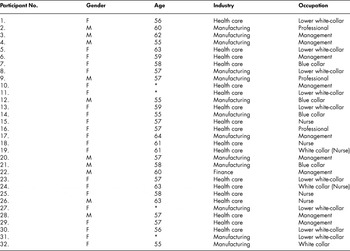
The present study drew on 32 semi-structured interviews conducted, as a part of a community project with workers in the health care and manufacturing industries,1 at both blue- and white-collar and professional occupational levels, in a mid-sized city (75,000–125,000 people) in Ontario, Canada. The purpose was to identify and investigate labour market challenges and opportunities confronted by workers at the back end of their careers. The research sought to identify the main positive and negative job-related experiences associated with aging as well as the role of organizational practices in leveraging productive capacity. Recruitment for interviews was conducted by public advertisement in local newspapers, association circulars, and publicly displayed posters. Interviews were conducted at the local university as well as at the city’s Workforce Development Board. The final recruited sample yielded more women than men, distributed throughout the occupational hierarchy. Their ages ranged from 55 to 64 years.
Respondents were asked to “walk through” their work history to help them gain an appreciation of their own seniority. They were also asked to comment, from their own personal experiences, on what they regarded as the main contributions made by their age and to identify what barriers there might be in making those contributions. The main questions directing this study were, “How are people coping?,” “What can we do to help?,” and “What more needs to be known to promote sustainability of a robust senior cohort in the labour force?” The interviews were semi-structured and conducted in an open manner to allow the participants to freely identify and investigate the labour market challenges and opportunities they faced in aging.
The analyses followed a qualitative approach, using content analysis, which allowed us to inductively explore for themes and patterns. Interviews were conducted until saturation was reached, at which time subsequent interviews no longer provided us with new insights or information. A team of student research assistants were trained to code the transcripts using multiple keywords from the project objectives. A team of five social science professors (including one author of this study) who were subject matter experts reviewed the transcripts independently, and selected those codes that directly related to the study’s objectives. Any disagreements in the coding between the research assistants and subject matter experts were discussed until a common understanding was reached.
Findings
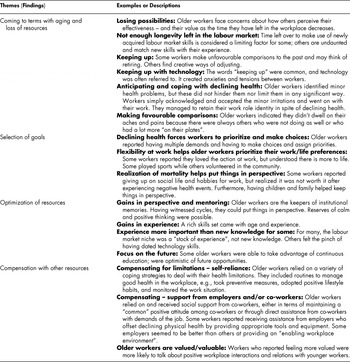
To maintain the respondents’ anonymity, we have identified the interviewees only by their gender, age, industry, and position (see Table 1). We begin here by documenting the experiences of how older workers perceived aging and feelings of loss, followed by categorizing the narratives based upon the dominant study themes guided by Baltes’ SOC formulation. Although the narratives are identified with specific themes and discussed within that context, we note that the boundaries between the themes are blurred. In keeping with the work by Zikic and Richardson (Reference Zikic and Richardson2007), the interconnectivity between the themes signifies that the narratives are part of a broader and dynamic combination of individual and contextual factors. For the purpose of this study, we have defined older workers as individuals aged 55 and older. A summary of the main findings with examples or descriptions is provided in Table 2.
Demographic profile of the study participants

* Denotes respondents who did not wish to disclose their age; the interviewers confirmed they were 55 and older.
How older workers keep up: The use of selection, optimization, and compensation in the workplace

Coming to Terms with Aging and Loss of Resources
A recurring theme that dominated the interviews in our study was coming to terms with aging and loss. Although the most common conceptualization of age was chronological, individuals also perceived age based on how they felt (subjective age), in comparison with others (relative age), and as evaluated by others (social age) (Clarke & Korotchenko, Reference Clarke and Korotchenko2011; Cleveland, Shore, & Murphy, Reference Cleveland, Shore and Murphy1997). Although individuals evaluated themselves on the basis of subjective and relative age, the most common assessment involved social age. In this assessment, the interviewees were concerned with how others perceived their effectiveness as they aged. The fear of aging was frequently associated with loss of usefulness, loss of opportunities, and loss of time. One interviewee described the difficulty in coming to terms with aging, and mused about her own usefulness in the labour market:
To be quite honest, I’m having a real hard time getting older. I feel like my world has narrowed down and I don’t have – I don’t feel that I have the freedom just to leave the job because I think I can get another job, because of my age. I think would people look at me and think, well, “Why would we hire her? She doesn’t have many years left.” (Female, 59, health care, management)
Participants’ perceptions of others’ views of their age (i.e., social age) also appeared to be a factor limiting an upgrading of opportunities for many older workers. The fear of not having enough time or longevity in the labour market was particularly salient.
I’ve looked at going back to school. I spoke with, uh, counsellors and, essentially, they just said you know, with somebody in your position, the odds of you graduating from, say, a community college program and getting gainful employment aren’t all that great. (Female, 56, health care, lower white-collar)
You know if it … if I take a course and upgrade my skills for a year I’m 63. Who’s still going to hire me? (Female, 63, manufacturing, lower white-collar)
Another frequently reported loss among the interviewees was the loss of skills. The words “keeping up” were common, and “technology” was often referred to, which created significant anxieties among older workers. Older workers were concerned with losing their proficiency and usefulness, especially when they could not keep up with new technology, as suggested by this comment:
I don’t know if this is reflective of a general trend, or just a particular niche I seem to have fallen into, but there are many people running, um, organizations, and they are not up to date in technology; they, um, they can’t necessarily understand when a younger person tries to explain it to them. (Female, 56, health care, lower white-collar)
In the ’50s, I mean, there were parts you could take from a motor and you could throw it against a wall and it would stick and the motor would work. Now, everything is diagnostic. Everything is modular. (Male, 60, manufacturing, professional)
While there were concerns with aging and with keeping up, some interviewees were able to compare themselves and their accomplishments favourably with others and with the past, in terms of what they could achieve. Some of the workers in our study indicated that they don’t dwell on their “aches and pains” because there are always others who are not doing as well or who have a lot more “on their plates.” One worker mused about retiring while others found better ways to adjust and keep up: they accepted the limitations and made the best of things. For example:
I don’t. I don’t dwell on my aches and pains. There’s always somebody worse off than I am, you know. I just keep going. If it gets real bad, I’ll go to the doctor’s. There isn’t anything he can do anyway. So, you know: just learn to live with it. (Female, health care, lower white-collar)
So I do get this feeling that the job is not being done maybe as well, when I’m getting a little older. And so I’m sort of pulled between the idea of retiring … and staying on until I’m at least 65 … I have my own goals and objectives for that job, and I’m thinking I’m not able to keep up with them as much as I did when I was in my 40s and 50s. … But I think, again, I’m very comfortable with the age I’m at. (Female, 63, health care, lower white-collar)
Sure, you start to slow up, but that doesn’t mean you can’t do the job. You just, you just find better ways of doing it and that’s, that’s what I’ve learned. (Male, 62, manufacturing, management)
I don’t like people to see me kind of straining to look at something. That would bother me … Losing, I mean, losing my vision or it deteriorating would be awful, but the job part of it, I could handle. (Female, 63, health care, lower white-collar)
The process of aging appeared to have an effect on the overall well-being of the older workers in our study. The workers appeared most concerned with how they were viewed by others: that is, their social age. Although aging is often associated with loss of cognitive, physical, and mental resources (Peeters & van Emmerik, Reference Peeters and van Emmerik2008), they were interpreted in practical terms by the workers in our study. The interviewees feared losing opportunities as a result of their remaining time in the labour market. Their ability to keep up with change (i.e., technology) and/or pace (stamina) was also raised as a result of aging. When confronted with a loss, individuals activated life management strategies to cope with that loss and to maintain work functioning. This view is consistent with the action-theoretical approach, where the focus is on proactive and agentic strategies (Freund & Baltes, Reference Freund and Baltes2002b; Freund, Reference Freund2006). The alternate view to life management might be to sit back and wait to see what life has to offer, then to take advantage of what presents itself and let go of things when confronted with losses (cf. Freund & Baltes, Reference Freund and Baltes2002b).
Selection
A first key life management strategy is the prioritization of goals as resources become increasingly scarce. As resources decline, individuals make adjustments to their personal needs and preferences (e.g., more work/life balance or more leisure time). Baltes’ SOC model suggests that to maintain positive work functioning, workers select goals that promote a fit between resources and needs (Freund & Baltes, Reference Freund and Baltes2002b; Freund, Reference Freund2006). As previously observed, the aging workers in our study anticipated declining health, and many identified minor health problems. The loss of resources necessitated that individuals construct a goal hierarchy or set more-realistic goals – for example, individuals may concentrate their energy on a few priorities (Freund & Baltes, Reference Freund and Baltes1998). Consistent with the selection process, our interviewees made work/life choices based on their existing resources. Goal conflict may also occur when the goals are incompatible (e.g., enjoying work but also wanting to spend more time on hobbies in light of declining “active” time). When this occurs, individuals prioritize one goal and postpone pursuing the other as part of temporal sequencing (Freund, Reference Freund2008). Therefore, it was not surprising to hear many of our interviewees prioritize their work/life goals according to personal preferences.
Ah, my health is, is fine in terms of my ability to work. Um, I’d certainly like to be ah, healthier. I’ve got, you know, multiple little things, as I think most people do as they get older, um, that kind of put a kibosh on some things that you want to do. (Female, health care, management)
I don’t work any more than I have to. I’m willing to work if, you know, if there’s a special project that needs doing, I, you know, and I do volunteer to write, we have child sponsorships. So I volunteer to write the profiles for that program. So, but I try and, because I’ve got two grandchildren as well, I – they’re my priority and when I go home, I don’t worry about work or think about work. (Female, 59, health care, management)
Probably the best way to summarize my scenario – may be different than many – is, I enjoy my work. I’m passionate about it. I like it. It’s stimulating. I’m well respected in what I do. I’d just like to have a little more personal time … Thursday night men’s hockey league when you’re never there. Yes. So rather than let the team down, I would say, you know what, I just can’t sign up because – and I miss that, and I probably have some regrets, you know, because those kinds of things are things you can’t buy back. (Male, 55, manufacturing, management)
Furthermore, loss-based selection occurs when individuals experience real or imminent loss of resources. The loss threatens the maintenance of a given level of functioning and requires individuals to develop new goals, sacrifice less-important goals, or adapt to new standards which can be achieved with fewer resources (Freund & Baltes, Reference Freund and Baltes1998; Freund & Baltes, Reference Freund and Baltes2002a). In our study, we saw many older workers question the sacrifices they made at work in light of declining health and saw them recalibrate their goals. The realization of mortality also afforded them perspective as the interviewees rethought their work/life priorities.
No time for anything else, no social life, no hobbies anymore, hobbies I used to do and that kind of thing – had to give everything up. Is it worth it? And then when I got the heart problem and everything else, then I knew it wasn’t worth it. (Male, 58, manufacturing, blue collar)
But at 62, I feel you should be able to do that because leisure time is very important, especially now when you, um, hear of people, you know, dying so young. (Male, 62, manufacturing, management)
Part of the reason I’m looking to getting out this coming May is … I had a second quadruple bypass … so I’d like to just go out and play … and do what I can. (Male, 63, health care, nurse)
From our interviews, there was ample evidence to suggest that the workers engaged in some form of selection strategy when confronted with declining resources. The way in which selection strategy occurred varied with the type of loss experienced by older workers. For those who were in relatively good health, goal prioritization (temporal sequencing) became an important tool in resource allocation when goal conflict occurred. In contrast, those who experienced real loss (e.g., health) had fewer choices and resorted to sacrificing (e.g., giving up work in favour of preserving health). Given the involuntary loss, the workers had to recalibrate or set more-realistic goals (e.g., reducing work hours or retiring). The role of selection represents a critical first step in the SOC process because it is used to manage goals before goal attainment can occur.
Optimization
The next component in Baltes’ SOC life management model is optimization of resources. It involves strategies that are aimed at strengthening skills and capabilities to achieve the selected goals. This may include such things as enhancing current skills or putting extra time and effort into a task (Freund, Reference Freund2006; Yeung & Fung, Reference Yeung and Fung2009). As individuals experience declining resources with age, they concurrently benefit from other accumulating resources such as knowledge and experience. Consistent with the optimization strategy to minimize losses and maximize gains, the workers in our study focused on the gains they had made through aging, and they tapped into that accumulating resource to enhance their work functioning. The workers simply shifted their focus from declining resources to areas of gain to enhance their usefulness in the workplace. The interviewees in our study were able to identify a lack of experience among their (younger) co-workers as a resource gap, and to make the case that knowledge and experience can make a valuable contribution to the workplace, including training the younger workers.
What I do and what I can achieve, um, you can’t be taught. You know, a young person coming out of college, we bring them along every year, but I mean, the, ah, the school of hard knocks, the experience, it just is something that only comes with age, you know. (Male, 55, manufacturing, management)
So then what happens is, um, you lose really quality high-grade people like me, only because they can’t deviate from the norm. If I could give this survey anything to buy into on people who are currently in the workforce, I think industry today has to be flexible with an older worker. Say, “You know what? We’d rather have a piece of you than none of you. What is it going to take to keep you, because you’re valuable and, and you can teach the younger people, and so on and so forth.” (Male, 55, manufacturing, management)
And I see that they don’t have the experience … experience is really key … It’s very hands on. And academically you can know it, I knew lots of stuff as a diploma nurse but unless you’re gonna, you’re going to implement it and use it, you know, you lose it. (Female, 57, health care, nurse)
Additionally, a recent extension of the SOC model involves the introduction of future time perspective (FTP) into life span research (see Zacher & Frese, Reference Zacher and Frese2009). FTP describes an individual’s perception, beliefs, and expectations concerning their personal future (Zacher & Frese, Reference Zacher and Frese2011). From a work perspective, FTP can be conceived in terms of the length of one’s personal remaining time at work, and beliefs about new goals, options, and possibilities one will have in the personal future at work (i.e., a focus on opportunities). The FTP is important because it contributes to the developmental adaptation of individuals, and provides older workers with new purpose and hope as they age (Zacher & Frese, Reference Zacher and Frese2011). Consistent with FTP, the focus on opportunities and positive outcomes afforded by experience can provide a “new lease on life” for older workers. For example, the workers indicated that there is a labour market niche for “stock of experience” rather than “new knowledge” that opens up future possibilities for them.
There’s going to be opportunities there [retirement homes] for me to get positions in management and whatnot, because with my experience people do, when I send them my resume, they’re on the phone to me immediately. (Female, 58, health care, nurse)
In school, and working. I just got hired. I’m working part time learning the job, and then in June when I graduate I have a full time job. (Female, 55, manufacturing, white collar)
Many of our interviewees were also able to take stock and reflect on what they have done. While they may have had less use of certain resources (e.g., stamina), they were able to deploy other reserves such as perspective, calmness, and positive thinking. This view is also consistent with Baltes’ optimization perspective whereby as individuals age, the time perspective and available resources dictate an increase in process (judgement of effort) and a decrease in outcomes (performance achievement) (Freund, Reference Freund2008; Kanfer & Ackerman, Reference Kanfer and Ackerman2004). Having witnessed cycles, older workers are essentially keepers of workplace memory and are able to put things into perspective. The introspective mood is best captured by two interviewees in health care:
Yeah, sometimes I, well, um, sometimes there’s a sort of, you know, been there done that, we did that once before, you know. Things go around, “Now we’re going to visit all new moms. Now we’re not going to visit all new moms for five, ten years. Now we’re going to visit all new moms.” You know, there’s sort of, the, that sort of, you think, “Oh my goodness.” … I like to revamp things, but I seem to want to add on but not throw things out. (Female, 61, health care, nurse)
I find that I’m not as much as I think I’m running a lot I feel like I’ve slowed down a bit. That I don’t get quite as excited and upset at what’s going on in life; I can usually put things in perspective … I feel like I have an inner strength that I didn’t realize I had … But it’s amazing how when you have to do things and you do it, and it’s just fine. Things work out. (Female, 58, health care, blue collar)
Although multivariate studies (e.g., Baltes & Heydens-Gahir, Reference Baltes and Heydens-Gahir2003; Freund, Reference Freund2006; Freund & Baltes, Reference Freund and Baltes2002a; Jopp & Smith, Reference Jopp and Smith2006) have demonstrated the successful use of optimization strategies as a process for attaining desired goals, we have extended the literature by focusing on the accumulation of resources as a way to maximize gains to be had with age. While accumulation of resources is often associated with adolescents and young adults (where learning and acquisition of skills occur) (Freund, Reference Freund2006), resource gains such as knowledge, wisdom, and experience accrue with older workers. Furthermore, a focus on opportunities (Zacher & Frese, Reference Zacher and Frese2009, Reference Zacher and Frese2011) can contribute to the subjective well-being and successful aging of older workers. Earlier review of the literature suggests that older workers derive satisfaction from centrality of work, staying connected, receiving recognition, and contributing to society. Suffice to say, having future plans and possibilities provides individuals with an important sense of purpose, direction, and meaning, even at a later stage of one’s life cycle. Some of these positive emotions (i.e., feeling supported and valued) can also be derived from the ways in which organizations and organizational members (e.g., co-workers) support older workers.
Compensation
The third strategy evidenced in our study and through which older workers coped with a loss of resources was to find alternate means to maintain the desired level of functioning. This was often accomplished with the assistance of support systems from both the employer and co-workers. Some of the workers reported receiving assistance from their employers to offset declining physical health with the provision of the appropriate tools and equipment (e.g., use of technology, flexible work arrangements).
Well, I’m pretty lucky in that respect, um, in being healthy. My only real problem is vision … they provided me with a bigger screen, and since that time, everybody else has gotten one, too, because they realized that the screens were too small. (Female, 63, health care, lower white-collar)
Others relied on and received social support from co-workers, either in terms of maintaining a common positive attitude or through direct assistance from co-workers with the demands of the job. Social support has also been shown to be an important determinant of health and well-being of older workers (Chappell & Funk, Reference Chappell and Funk2011). Workers who reported feeling valued were also more likely to talk about positive workplace interactions and relations with younger workers.
So yeah, this place is, it’s actually an excellent place to work, or it’s a good agency and we’ve had excellent managers who are very, you know, understanding and, you know, family friendly, sort of. Well of course, that’s one of our initiatives: trying to make family-friendly work places. (Female, 61, health care, white-collar nurse)
They treat me as a peer. Especially the younger guys coming in now. They’ll come and ask me a lot of questions. And if I don’t know I’ll tell them. I’m quite frank about if I don’t know something, I’ll [say], “No idea.” … I’ve always loved – in my other job I always taught a lot – I enjoy teaching people.” (Male, 57, manufacturing, professional)
We note that although optimization and compensation are both aimed as means for attaining goals, compensation is further distinguished from optimization, in that compensation is geared towards avoiding loss or negative outcomes (Freund, Reference Freund2006). Compensation is, therefore, linked to individuals’ need to maintain and extend resources. The impact of resource loss is most pronounced at old age (Jopp & Smith, Reference Jopp and Smith2006), and older adults would be most likely to engage in resource conservation to avoid further loss of functioning. Furthermore, acquiring new resources (e.g., learning new skills) becomes increasingly difficult and costly because it requires time, effort, money, and social support (Freund, Reference Freund2006). The compensation strategy of loss avoidance is consistent with Hobfoll’s (Reference Hobfoll1989, Reference Hobfoll2002) conservation of resource theory, as individuals engage in short-term protective function (Jopp & Smith, Reference Jopp and Smith2006). This was evident in our study as the workers took steps to conserve whatever resources they had and to maintain their health.
I did. Yes I, I had ailments to the point that, um, I was on a disability pension. … Well, yes. I, I, have some medication and it is an expense. … Yeah, I just have to again draw that line between, uh, how much do I take on before I jeopardize my health and end up in the same position I was before. (Female, 59, health care, lower white-collar)
Additionally, individuals may also counteract resource loss and strive to improve a particular state (e.g., promote health and well-being) as a way to maintain current levels of functioning. Although the maintenance and loss prevention strategy has been most prevalent among older individuals, the improvement orientation often associated with younger adults (Riediger & Ebner, Reference Riediger and Ebner2007) was also adopted by older workers in our study. The study interviewees certainly indicated to us that they relied on a variety of different strategies (e.g., taking preventive measures, adopting positive lifestyles, and monitoring the work situation) to maintain and promote good health.
I can walk … to work. And at my lunch hour I walk … So my arms are swinging, they’re already, you know, I’m breathing and I’m already looser. … And I do a little walking meditation before I even get there. (Female, 59, health care, lower white-collar)
I’ve worked in business for thirty years; I’ve never been sick a day … I mean I take medication for high blood pressure. But other than that. Never been sick a day. (Female, 64, manufacturing, management)
Um, really not too much, [I take] a little bit of blood pressure once in a while, but that can be looked after with, uh, drinking lots of water, and diet and, uh, taking high blood pressure medication, which I’m on – a very light medication. (Male, 55, manufacturing, blue collar)
Consistent with findings in prior research (e.g., Yeatts, Folts, & Knapp, Reference Yeatts, Folts and Knapp2000), older workers in our study relied on external means such as assistance from employers and co-workers to maintain their work functioning. Support from co-workers can also promote feelings of being valued which can enhance the sense of self-worth among individuals. Additionally, although compensation is often associated with external sources of support, we found that it can also be internally derived, coming from within the individual. Internal compensation may involve resource maintenance to avoid further loss of resource, but also self-improvement to promote good health. The workers in our study undertook different strategies to counteract the loss of resource and actively promote positive health and well-being. This self-motivated improvement process can mitigate the loss of resources, but more importantly, it could potentially reduce stress and promote positive emotions such as a sense of independence and self-reliance (Baltes & Heydens-Gahir, Reference Baltes and Heydens-Gahir2003; Young et al., Reference Young, Baltes and Pratt2007). Thus, compensation can complement optimization as effective strategies in extending declining resources with an eye to future opportunities.
Discussion and Implications
This study sought to examine how older workers deal with a loss of resources, how they engage in life management, and how they maintain their workplace functioning as they age (see Table 2 for detailed findings). Some of the workers we interviewed expressed difficulties in coming to terms with aging, and mused about their own usefulness in the labour market. It has been noted that older workers often perceive a heightened risk of job loss and greater feelings of job insecurity due to the changing nature of work (Sweet, Reference Sweet2007; Zikic & Richardson, Reference Zikic and Richardson2007). Indeed, studies have shown that older workers hold more negative beliefs about other older workers than do younger workers (Hassell & Perrewe, Reference Hassell and Perrewe1995), and they receive more negative performance ratings and fewer developmental opportunities from younger managers (Shore, Cleveland, & Goldberg, Reference Shore, Cleveland and Goldberg2003). Others were concerned with their “social age” or how they were viewed by others, which dampened their desire to upgrade their skills. Although some of the workers were worried about “keeping up” especially with technology, they also displayed remarkable adaptation and emphasized “stock of experience” rather than “new knowledge.” Past research has also documented that older workers engage in skills maintenance by keeping current with training to avoid the appearance of being “out of touch” (Berger, Reference Berger2009). The focus on FTP provided the workers with new possibilities and positive outlooks. Furthermore, the workers were cognizant of their declining health, and many took steps to counteract the loss with physical activities to maintain and improve their health. To that extent, our findings describe how individuals minimize age-related losses and maximize age-related gains. Overall, our findings suggest that older workers are in fact more adaptable than they have been stereotypically portrayed.
Our study also adds to the inquiry into the SOC model by identifying the differing ways in which older workers manage life and cope in the workplace. Although prior research on SOC has shown that individuals engage in selection to find a fit between their resources and goals, our study further indicates that the way in which selection occurs varies with the loss experienced by older workers. In particular, those who were in relatively good health but faced competing demands (e.g., work and life) were able to make choices and prioritize their goals on the basis of temporal sequencing. In contrast, those who experienced a loss of health were faced with having to recalibrate (or reduce) their goals. This pattern of selection builds on the notion of horizontal (conflicting) and vertical (superordinate and subordinate) goals proposed by Freund (Reference Freund2008), and it adds to our understanding of how individuals manage life goals. Given the exploratory nature of our findings, we suggest that future studies investigate how elective and loss-based selection may vary with horizontal and vertical goal selection, how individuals select and pursue goals, and how they disengage from these goals.
Although previous SOC models on selection have emphasized enhancing skills or putting in extra time and effort into a task, our findings also suggest that resources accumulate as individuals age, and that older workers can leverage these resource gains (e.g., perspectives, wisdom, experience) to maintain their work functioning. Building on the work of Zacher and Frese (Reference Zacher and Frese2009, Reference Zacher and Frese2011), our study’s focus on FTP has allowed individuals to find new purpose and possibilities from these gains and thus enhance their subjective well-being. Although we are mindful that false hope and unrealistic optimism can lead to negative emotions and outcomes, we encourage additional work on the future time perspective, and in particular the motivation for pursuing future opportunities as they relate to diminishing resources and outlook. The optimism expressed by the older workers (e.g., making favourable comparisons) also strengthens an individual’s emotional well-being, consistent with positive-psychology literature.
Additionally, although the workers relied on external sources of support, such as employers and co-workers, to compensate for diminished resources, another important finding from our study points to internal sources of compensation for loss of resources. While the concepts of loss avoidance and resource maintenance are not new (Riediger & Ebner Reference Riediger and Ebner2007), the promotion of health as observed in our study is new and does point to a degree of self-motivational improvement. Feelings of self-sufficiency and independence can promote a sense of control and lead to less reliance on employer and social support, and enhance individuals’ overall well-being (Rozario et al., Reference Rozario, Kidahashi and DeRienzis2011). From a theory-building perspective, internal motivation and a sense of control may contribute to our understanding on how individuals engage in SOC strategies. Thus, our study suggests that self-reliance, optimism, and a focus on the future should be investigated as mechanisms for internal coping and adaptation among older workers.
We note that although previous studies have found that older workers engage in compensation more frequently than optimization as a strategy to attain goals (e.g., Freund Reference Freund2006; Rozario et al., Reference Rozario, Kidahashi and DeRienzis2011), our findings suggest that older workers engage equally in optimization and compensation. We also found that patterns of SOC activities differ across different job levels in both sectors. Specifically, lower-level workers were more likely to engage in loss avoidance, while higher-level workers were more likely to emphasize a gain in experience and a focus on the future. Given that our findings were exploratory in nature, we propose that future work investigate the patterns of engagement between optimization and compensation, and how each promotes successful adaptation for individuals, including gender, and across different jobs and in different industries. This information is important to advance our knowledge on effective use of SOC to adapt to life changes and aging in the workplace, as well as informing employers on providing the right types of accommodation for older workers.
The narratives in our study have suggested that older workers are in fact much more adaptable than previously portrayed, and that they are actively engaged in strategies to maintain and enhance their work functioning. Therefore, it is important to emphasize that as individuals age, they substitute the loss of resources (e.g., health and stamina) with gains in other areas (e.g., perspectives and experience), and that they contribute to workplace functioning in differing ways.
Stereotypes and discriminatory attitudes could result in poor retention of older workers, barriers to retraining, and employment for those wishing to re-enter the workforce. As a result, employers must ensure that older workers are treated with respect and dignity and do not face undue discrimination as a result of old age. Studies have shown that customers prefer to deal with an older worker than a younger worker because of the older worker’s greater experience (cf. Burke & Ng, Reference Burke and Ng2006). From an organizational perspective, employers must ensure that the contributions of older workers are valued, and they are treated with respect and dignity to foster a sense of belonging among older workers.
An important finding stemming from the FTP dimension of SOC is a focus on opportunities. While some of our interviewees were concerned with their social age, which limits their motivation for upgrading their skills, an emphasis on the future which includes finding opportunities to contribute (e.g., mentoring and in advisory capacities) can enhance both younger and older worker contributions to a firm. As Brooke (Reference Brooke2003) explained, investments in older workers such as training and job redesign may yield significant benefits and payoffs – for both older workers and employers – that enable older workers to remain in the labour market longer. These investments will also signal to older workers the employer’s willingness to invest in them and the potential for opportunities in the future, thus encouraging them to upgrade their skills.
We acknowledge that not all of the narratives from the study participants fully supported the SOC model; there were examples where the older workers experienced frustration arising from an inability to connect with younger workers (i.e., inter-generational relations), the inability to cope with the demands in the work environment (e.g., abuse from patients in the case of health care workers), and a lack of support from employers. Other concerns involved financial resources (e.g., pensions) and caregiving (e.g., for their own parents) which could distract from successful workplace adaptation. Nonetheless, our aim was to document examples of successful adaptation using the SOC model to inform employers and older workers to help extend their work life. One important aspect of the SOC model which deserves attention is skills acquisition among older workers. In light of the changing nature of work and technological advances, Charness et al. (Reference Charness, Czaja, Sharit, Schulz and Adams2007, Reference Charness, Czaja and Sharit2009) noted that acquiring new skills can protect older workers from losing productivity in the workplace.
From a human resource management perspective, retaining older workers in the organization for as long as possible is important. First, despite the negative stereotypes, Yeung and Fung (Reference Yeung and Fung2009) reported that when older workers engage in SOC strategies, they maintained their job performance and had improved productivity. Second, older workers are keepers of institutional memory and they can pass on that knowledge to younger workers. Therefore, formal programs should be instituted for the successful transfer of knowledge from one generation of workers to the next. We also surmise that the proactive nature of SOC can be a diagnostic tool to inform employers on the appropriate policies and practices for older workers. For example, knowing the needs of aging workers can help employers identify the right learning and developmental opportunities, workplace accommodation, and the types of challenges older workers seek. On this basis, managers and human resource practitioners should ensure that organizational policies and practices such as providing physical and emotional support, retraining, opportunities, flexible work arrangements, and rewards and benefits that older workers find attractive, are consistent with the SOC concepts.
A few limitations should be noted to put our findings into perspective. First, our interview sample size was small (n = 32), although it is not atypical of qualitative studies using interviews. Interviews were conducted until saturation, at which time subsequent interviews no longer made a unique contribution to our understanding (Glasser & Strauss, Reference Glasser and Strauss1967). For example, Guest, Bruce, and Johnson (Reference Guest, Bruce and Johnson2006) found that in their study which involved 60 interviews, theme saturation was achieved after 12 interviews. Second, given that our sample was restricted to the health care and manufacturing industries, the generalizability of our findings should be regarded cautiously. Nonetheless, both industries represent 40 per cent of the workforce in the geographical region we examined and are representative of other medium-sized cities across Canada (Sands, Reference Sands2010). Future research should extend inquiry to other secondary sectors of the economy such as retail and services. We also did not examine differences in adaptation, or intentions to stay on the job, across gender, industries, and occupations; this would best be conducted using a larger sample across different industries (see Shacklock, Brunetto, & Nelson, Reference Shacklock, Brunetto and Nelson2009).
A third limitation is that, as in any qualitative research, study respondents may have engaged in socially desirable responses to our interview questions, and interviewers may influence the respondents’ quantity and quality of information. We also acknowledge that self-selection may have occurred in participant recruitment; however, our focus was on exploring the ways in which older workers adapt in the workplace, rather than on finding relationships or making generalizations. Our aim was to document these narratives as examples to help workers (and inform their employers) adapt in the workplace as they age. Finally, our sample was restricted to those between ages 55 and 64, and so may not apply to workers older than 65 and who wish to continue working. Despite these limitations, we felt that the trade-off was necessary to generate insights that can help us understand how older workers keep up and extend their work life.
In summary, our study highlights that older workers are concerned with aging and that they adopt different strategies to cope in the workplace. Despite some successful techniques documented in our study, older workers continue to face cultural (e.g., stereotypes, ageism) and structural barriers to work (e.g., discrimination, lack of workplace accommodation).
Having older workers in the workforce is important to sustain both our labour force and our economy; moreover, older workers may in fact want to extend their work life. Although public policies are in place to protect older workers (mostly against discrimination), our findings also suggest that employers should utilize the SOC model as a diagnostic tool to assist older workers adapt to the workplace and maintain their productivity, and to stay in the workforce longer.