Soybean seed yields in the United States have increased 24.3 kgha−1yr−1 from 1924 to 2016 (USDA National Agricultural Statistics Service 2017). Specht et al. (Reference Specht, Hume and Kumudini1999) concluded that 50% of this increase could be attributed solely to genetic gain and hypothesized that improvements in agronomic practices and their interactions with genetic gain as well as increases in atmospheric carbon dioxide also played significant roles. Rowntree et al. (Reference Rowntree, Suhre, Weidenbenner, Wilson, Davis, Naeve, Casteel, Diers, Esker, Specht and Conley2013) found that earlier planting combined with genetic gain has increased yield in maturity group (MG) III soybean. Rincker et al. (Reference Rincker, Nelson, Specht, Sleper, Cary, Cianzio, Casteel, Conley, Chen, Davis, Fox, Graef, Godsey, Holshouser, Jiang, Kantartzi, Kenworthy, Lee, Mian, McHale, Naeve, Orf, Poysa, Schapaugh, Shannon, Uniatowski, Wang and Diers2014) reported that newer cultivars within a given MG reach maturity about 1 wk later than those from the 1950s, which explains in part why yields of newer cultivars may respond more positively to earlier planting. Multiple studies have also suggested that more recently released soybean cultivars are genetically adapted to produce higher yields under greater intraspecific competition than those released in earlier years due to high-density breeding tactics (Cober et al. Reference Cober, Morrison, Ma and Butler2005; De Bruin and Pedersen Reference De Bruin and Pedersen2009; Specht et al. Reference Specht, Hume and Kumudini1999; Suhre et al. Reference Suhre, Weidenbenner, Rowntree, Wilson, Naeve, Conley, Casteel, Diers, Esker, Specht and Davis2014). Suhre et al. (Reference Suhre, Weidenbenner, Rowntree, Wilson, Naeve, Conley, Casteel, Diers, Esker, Specht and Davis2014) found that branch yield per plant and harvest index were increased in newer cultivars relative to older ones, indicating improved carbon partitioning during the seed fill period. Other studies have found much greater dry matter accumulation in newer than older soybean cultivars but no change in harvest index (Cober et al. Reference Cober, Morrison, Ma and Butler2005; De Bruin and Pedersen Reference De Bruin and Pedersen2009).
Agronomic improvements have increased protection of soybean yield potential by conferring a competitive advantage over weeds (Bullock et al. Reference Bullock, Khan and Rayburn1998; Knezevic et al. Reference Knezevic, Evans and Mainz2003; Yelverton and Coble Reference Yelverton and Coble1991). Breeding efforts have also resulted in increased intraspecific competitive ability, which allows for cultural practices such as narrower crop row spacing (De Bruin and Pedersen Reference De Bruin and Pedersen2008). However, we are not aware of previous research that has determined the effect of breeding on the interspecific competitive ability of soybean with weeds. Volunteer corn has been a well-documented weed in soybean production systems and has become increasingly prominent due to the widespread adoption of herbicide-resistant, transgenic crops (Andersen and Geadelmann Reference Andersen and Geadelmann1982; Beckett and Stoller Reference Beckett and Stoller1988; Deen et al. Reference Deen, Hamill, Shropshire, Soltani and Sikkema2006; Marquardt et al. Reference Marquardt, Krupke and Johnson2012). Beckett and Stoller (Reference Beckett and Stoller1988) found that up to 51% loss in wide-row (76 cm) soybean yield occurred at volunteer corn densities of 10 to 11 plants m−2 compared with weed-free soybean. They also reported that a clump of 10 plants of volunteer corn created an area of influence with a radius of up to 86 cm. Marquardt et al. (Reference Marquardt, Krupke and Johnson2012) found that narrow-row (<60 cm) soybean yield loss was 41% at volunteer corn densities of 16 plants m−2.
The objectives of this study were to determine (1) whether modern soybean cultivars yield more than older cultivars across a range of competitive crop–weed environments, and (2) whether soybean breeding over time has indirectly increased soybean competitiveness with weeds. Our hypothesis was that recently released soybean cultivars would be more competitive than older releases and would attain some of their increased yield potential under increasingly competitive environments. Volunteer corn was chosen as a model weed for these objectives due to its competitive ability and its common occurrence in midwestern soybean fields.
Materials and Methods
Experimental Design
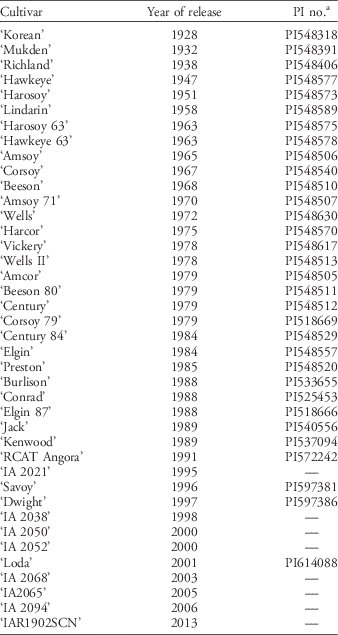
Field research was conducted during 2014, 2015, and 2016 at the University of Wisconsin Arlington Agricultural Research Station near Arlington, WI (43.18°N, 89.20°W). Soil type at this site is a Plano silt loam (Fine-silty, mixed, superactive, mesic Typic Arguidolls). Volunteer corn seed was collected from the field in the fall before spring planting for each year of study and was the F2 progeny of a locally distributed hybrid (‘RK585RR,’ Renk Seed, 6809 Wilburn Road, Sun Prairie, WI). Forty MG II soybean cultivars (Table 1) and three seeding densities of volunteer corn (0 [weed-free], 2.8 [low], and 11.2 [high] seeds m−2) were arranged in a randomized complete block design in a split-plot arrangement with three replicates. The seeding density of volunteer corn was used as the whole-plot factor, and soybean cultivar was used as the subplot factor. The soybean cultivars used in this study are the same 39 MG II public cultivars used by Rowntree et al. (Reference Rowntree, Suhre, Weidenbenner, Wilson, Davis, Naeve, Casteel, Diers, Esker, Specht and Conley2013) with the addition of a more recently released cultivar from Iowa State University (‘IAR1902SCN’). Plot dimensions were 2.3-m wide by 5.8-m long, and soybeans were seeded in four rows at 400,000 seeds ha−1 with 38-cm row spacing using a cone-style plot planter (ALMACO, 99 M Avenue, Nevada, IA). Volunteer corn seed was planted in-row with soybean. Metribuzin (TriCor® DF, United Phosphorus, King of Prussia, PA) and S-metolachlor (Dual II Magnum®, Syngenta, Greensboro, NC) at 0.42 and 1.43 kg ai ha−1, respectively, were applied PRE for early-season control of weeds other than volunteer corn. Weed escapes were removed by hand as needed throughout the growing season.
List of maturity group II soybean cultivars, year of release, and plant introduction number (PI no.).

a Dash (—) indicates plant introduction number is not available.
Data Collection
Soybean and volunteer corn plant density were measured at the time of emergence. In 2015 and 2016, 3 volunteer corn plants plot−1 and 3 soybean plants plot−1 were flagged randomly for in-season growth measurements. At V4 and R1 soybean growth stages, height and width of each flagged plant were measured to determine shoot cylindrical volume (V) as a nondestructive indicator of plant growth and competitive ability (Bussler et al. Reference Bussler, Maxwell and Puettmann1995; Colquhoun et al. Reference Colquhoun, Stoltenberg, Binning and Boerboom2001; Conley et al. Reference Conley, Binning, Boerboom and Stoltenberg2002). Relative shoot volume (V R) of soybean and volunteer corn were calculated using Equation 1.
 $$V_{{\rm R}} \,{\equals}\,{{V_{{{\rm weed}}} } \over {V_{{{\rm weed}}} {\plus}{\rm }V_{{{\rm crop}}} }}$$
At soybean maturity (R8), flagged volunteer corn plants in each plot were cut at the ground level, machine chopped, and dried at 55 C to constant mass to determine aboveground shoot biomass. Soybean grain was harvested from each plot by machine (ALMACO) and dried. Total sample mass was determined, and soybean grain was separated from volunteer corn seed and other debris. The soybean mass was measured, and a percentage relative to total sample mass was calculated to determine plot yield (Marquardt et al. Reference Marquardt, Krupke and Johnson2012). Soybean grain was adjusted to 13% moisture before data analysis.
Statistical Analysis
Data were subjected to a mixed-effect regression analysis using PROC MIXED in SAS v. 9.3 (SAS Institute, Cary, NC). The main effects of volunteer corn seeding rate, soybean cultivar year of release, and the rate by year of release interaction were treated as fixed effects. Variables were removed from the model if deemed insignificant by the −2 log-likelihood method (Suhre et al. Reference Suhre, Weidenbenner, Rowntree, Wilson, Naeve, Conley, Casteel, Diers, Esker, Specht and Davis2014). Block, cultivar, environment, and cultivar by environment and block (environment by release year) interactions were considered to be random effects. Cultivar was assigned as random, because cultivars were selected from a large pool of available cultivars over eight decades (Rowntree et al. Reference Rowntree, Suhre, Weidenbenner, Wilson, Davis, Naeve, Casteel, Diers, Esker, Specht and Conley2013). Fixed effects were tested for significance (α=0.05) using the appropriate F-test. All volumes and volunteer corn shoot biomass were transformed [y=ln(x)] and V
R values were transformed
 $$\left[ {y\,{\equals}\,{\rm arcsin}} \right\left\,({\sqrt x } \right)]$$
to meet assumptions of ANOVA.
Results and Discussion
Soybean density at emergence was affected by environment but not by year of release (unpublished data), indicating that even though density at emergence was different among years, density was similar among soybean cultivars. Additionally, neither soybean yield nor volunteer corn shoot dry biomass was affected by environment, so data were pooled across years.
Soybean Yield
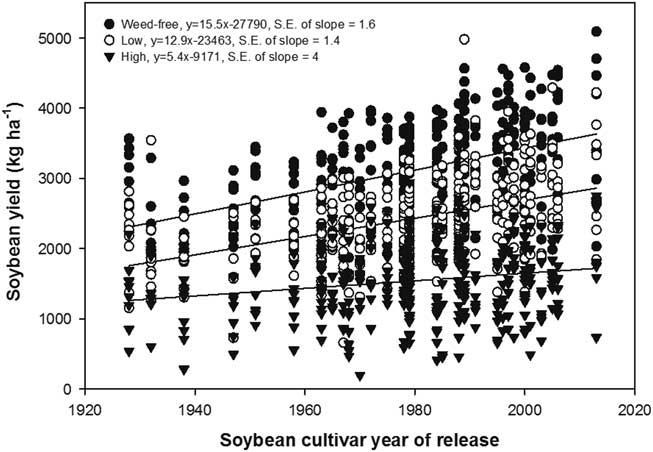
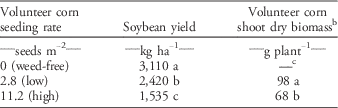
Soybean seed yield was reduced when grown with volunteer corn, and the high volunteer corn density reduced yield more than the low density (Table 2). Seed yield (kg ha−1) was higher for more recently released cultivars than older cultivars at each volunteer corn seeding rate (Figure 1). The rate of genetic yield gain at the weed-free, low, and high volunteer corn seeding rates were 15.5±1.6, 12.9±1.4, and 5.4±1.4 kgha−1yr−1, respectively. The rates of gain did not differ between the weed-free and low volunteer corn seeding rates, but both were greater than at the high volunteer corn seeding rate.
Relationship between soybean seed yield and year of release of 40 maturity group II soybean cultivars at three volunteer corn seeding rates.

Influence of volunteer corn seeding rate on soybean yield and volunteer corn shoot dry biomass at R8 soybean pooled across cultivars and years.Footnote a

a Values followed by the same letter within a column do not differ (P<0.05).
b Data were back-transformed for presentation.
c No data.
The rates of soybean genetic yield gain reported here are lower than some rates reported by others, which were as high as 24.1 kgha−1yr−1 for MG II cultivars (Rincker et al. Reference Rincker, Nelson, Specht, Sleper, Cary, Cianzio, Casteel, Conley, Chen, Davis, Fox, Graef, Godsey, Holshouser, Jiang, Kantartzi, Kenworthy, Lee, Mian, McHale, Naeve, Orf, Poysa, Schapaugh, Shannon, Uniatowski, Wang and Diers2014; Rowntree et al. Reference Rowntree, Suhre, Weidenbenner, Wilson, Davis, Naeve, Casteel, Diers, Esker, Specht and Conley2013; Suhre et al. Reference Suhre, Weidenbenner, Rowntree, Wilson, Naeve, Conley, Casteel, Diers, Esker, Specht and Davis2014). Even so, our results showed increased soybean yield with cultivar release year even at the highest competition level. This suggests that even in highly competitive environments, newer soybean cultivars attained more of their yield potential compared with older cultivars.
Soybean Competitive Ability
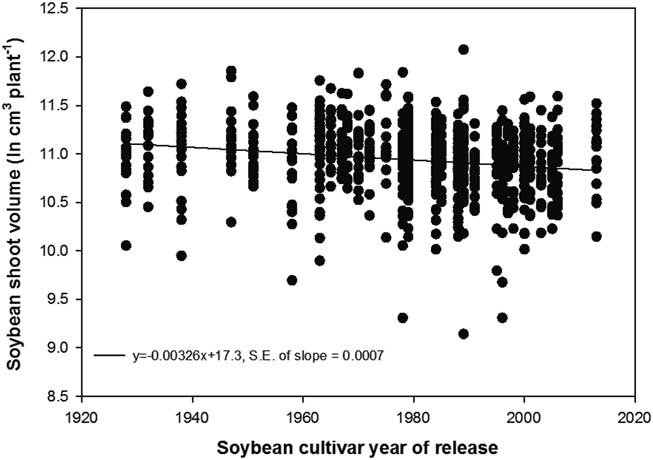
Soybean cultivar release year and volunteer corn seeding rate interacted to affect V4 soybean shoot volume. The volunteer corn seeding rate and cultivar release year did not interact to affect R1 soybean shoot volume, and there was no difference between soybean shoot volume across competitive environments. This indicates that yield loss in the presence of volunteer corn was not associated with reduced growth in the early reproductive phases. R1 soybean shoot volume decreased approximately 1 cm3 per year of release (Figure 2). This is likely due to shorter soybean height of newer compared with older cultivars (unpublished data) and is consistent with results of previous research (Suhre et al. Reference Suhre, Weidenbenner, Rowntree, Wilson, Naeve, Conley, Casteel, Diers, Esker, Specht and Davis2014; Ustun et al. Reference Ustun, Allen and English2001) that has shown breeding for decreased lodging has shortened stem height.
Relationship between the natural logarithm of R1 soybean shoot volume and year of release of 40 maturity group II soybean cultivars pooled across competitive environments.

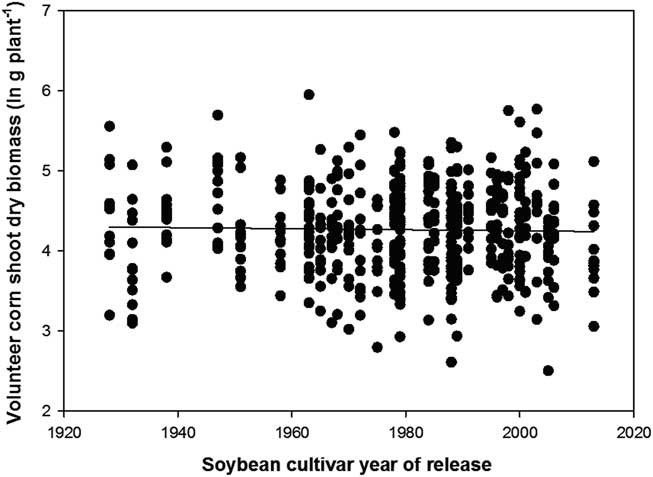
A more direct indicator of whether soybean competitive ability with weeds has changed over time is how it impacts the growth of neighboring weeds. Volunteer corn shoot dry biomass (g plant−1) was less for the high than the low seeding rate (Table 2). These results are consistent with results of previous research that showed greater intraspecific competition among volunteer corn plants as density increased (Beckett and Stoller Reference Beckett and Stoller1988). Neither volunteer corn volume (V weed) nor the V R at either V4 or R1 soybean were significant for any of the fixed effects (unpublished data). Volunteer corn shoot dry biomass at the high seeding rate was 30 g plant−1 less compared with the lower seeding rate (Table 2) but was not affected by soybean cultivar year of release (Figure 3). The lack of soybean cultivar effect suggests that less volunteer corn shoot dry biomass at the higher seeding rate was likely due to greater intraspecific competition than interspecific competition.
Relationship between the natural logarithm of volunteer corn shoot dry biomass and year of release of 40 maturity group II soybean cultivars pooled across competitive environments.

These results show that breeding efforts have led to robust modern soybean cultivars with the ability to produce higher yields compared with older cultivars in highly competitive environments. The results suggest that while there has been an increase in soybean intraspecific competitive ability (Suhre et al. Reference Suhre, Weidenbenner, Rowntree, Wilson, Naeve, Conley, Casteel, Diers, Esker, Specht and Davis2014), yield gain over time is not associated with greater suppressive ability of the highly competitive species volunteer corn. However, interspecific competitive ability of newer cultivars in less competitive environments is not known. Greater weed-suppressive ability of soybean cultivars may be realized if breeders include selection under a range of competitive environments, but gains would potentially be small and of much less priority than increased yield potential and disease resistance. These results highlight the importance of other cultural practices for weed suppression in soybean production systems such as narrow row spacing, earlier planting, and optimal seeding rates (Bullock et al. Reference Bullock, Khan and Rayburn1998; Knezevic et al. Reference Knezevic, Evans and Mainz2003; Rowntree et al. Reference Rowntree, Suhre, Weidenbenner, Wilson, Davis, Naeve, Casteel, Diers, Esker, Specht and Conley2013). While our research focus was to understand potential changes in soybean competitiveness over time with a highly competitive weed species, future research is warranted to determine soybean weed-suppressive ability relative to a less competitive weed species or mixed weed species communities.
Acknowledgments
The authors would like to acknowledge Thomas Butts, Daniel Smith, Nathan Drewitz, John Gaska, and Adam Roth, who assisted with this project’s implementation, maintenance, and data collection. This research was funded by the United Soybean Board and the Wisconsin Soybean Marketing Board.