INTRODUCTION
Referential communication is effective to the extent that it takes into account shared and unshared information between the speaker and the addressee. To achieve successful communication, speakers and addressees collaborate in a framework of common ground, defined as the sum of their mutual knowledge, beliefs, assumptions and attitudes (Clark, Reference Clark1992; Clark & Marshall, Reference Clark, Marshall, Joshe, Webber and Sag1981). One of the important components in monitoring common ground during activities with physical objects is keeping track of what is visually accessible to co-participants. For example, when two people are standing at a kitchen counter cooking dinner, the accessibility of physically available objects in their shared field of perception constrains their communication patterns. If one of the cooks asks for ‘the knife’ when there are two knives of different sizes on the counter, he needs to specify the size of the required knife for the communication to proceed smoothly. Otherwise, the addressee could develop some uncertainty about which knife is required, delaying her reach for an object. On the other hand, when the unwanted knife is not visually accessible to the addressee, hidden behind an occluder such as a big cooking pot, specification of the size of the required knife is redundant. This example demonstrates the need to monitor communicative partners' immediate or potential perceptual access to external objects when producing referential terms for these objects – the need to take into account what Clark & Marshall (Reference Clark, Marshall, Joshe, Webber and Sag1981) have dubbed ‘physical copresence’. A number of studies with adult participants have shown that assumptions about the availability of the referent to the interactant's visual attention is a major factor in determining the type of linguistic form produced by speakers and the particular referent identified by addressees (Chafe, Reference Chafe and Li1976; Clark & Marshall, Reference Clark, Marshall, Joshe, Webber and Sag1981; Gerrig, Brennan & Ohaeri, Reference Gerrig, Brennan and Ohaeri2001; Gundel, Hedberg & Zacharski, Reference Gundel, Hedberg and Zacharski1993; Hanna, Tannenhaus & Trueswell, Reference Hanna, Tannenhaus and Trueswell2003).
On developmental grounds, beginning from Piaget (Reference Piaget1926), many researchers claimed that children before school age have difficulty evaluating the visual perspective of others and shaping their communicative behavior accordingly (e.g. Deutsch & Pechmann, Reference Deutsch and Pechmann1982; Flavell, Speer, Green & August, Reference Flavell, Speer, Green and August1981; Glucksberg, Krauss & Higgins, Reference Glucksberg, Krauss, Higgings and Horowiz1975; Sonnenschein & Whitehurst, Reference Sonnenschein and Whitehurst1984; Warren & Tate, Reference Warren, Tate, Diaz and Berk1992). According to this view, until the end of preschool years, children focus predominantly on their own point of view and are unable to integrate other people's perspective into a certain situation, thus being prone to producing inadequate referential forms. The reasoning is that cognitive immaturity in coordinating the communicative partner's visual perspective with one's own leads to immature referential communication skills, in which language is used ambiguously to identify referents. Pechmann & Deutsch (Reference Deutsch and Pechmann1982), for example, showed that when young children are not yet able to produce adequate verbal descriptions for reference, they employ non-verbal means such as pointing that often fall short of accomplishing unique identification.
However, such accounts attributing total egocentrism to preschool age children are often disputed. In studying pragmatic development of young children, O'Neill (Reference O'Neill1996) found that children as young as two (mean age 2 ; 3) used more gestures to clarify the location of a hidden toy when their mother did not witness the event of hiding of a toy. In another study (O'Neill & Topolovec, Reference O'Neill and Topolovec2001), two-year-olds (mean age 2 ; 8) used more discriminatory verbal descriptors in addition to pointing to single out a box in conditions where two boxes were adjacently stacked as opposed to when they were laid far apart. This indicates an awareness that a mere pointing gesture is deemed inadequate to uniquely specify one of the two boxes in the former condition. Matthews, Lieven, Theakson & Tomasello (Reference Matthews, Lieven, Theakson and Tomasello2006) demonstrated that, beginning from age three, children begin to use full nouns vs. pronouns according to perceptual availability of referents for the addressee. In studies with more complicated arrays of objects, Nadig & Sedivy (Reference Nadig and Sedivy2002) showed that five- to six-year-olds were more likely to use a noun modified by a scalar adjective (e.g. big cup) when their communicative partner had visual access to two cups of differing sizes than in situations where one of the cups was exclusively available to the child speakers. In a recent training study, Matthews, Lieven & Tomasello (Reference Matthews, Lieven and Tomasello2007) demonstrated that providing feedback to two-, three- and four-year-old children about their initially ambiguous referential expressions led to improved linguistic strategies in subsequent sessions.
These studies show that preschool children can monitor the informational needs of their partners in certain situations and design their communicative forms accordingly. However, because the manipulation of what is ‘known’ by interlocutors varies across a diverse set of studies, it is not easy to determine the effect of the children's understanding of interlocutor knowledge in their choice of referring expressions by comparing across different studies. Thus, further research is needed to clarify the specific conditions that prompt children towards usage and development of referentially more appropriate forms. Pursuing this line of research, Matthews, Lieven & Tomasello (under review) demonstrate that specific feedback during training (e.g. ‘Do you need the black sheep or the white sheep?’) led to more informative referring expressions than general requests for clarification (e.g. ‘Which sheep do you need?’).
We know that even adults provide evidence for initial egocentric reasoning during certain communication tasks (Epley, Morewedge & Keysar, Reference Epley, Morewedge and Keysar2004; Horton & Keysar, Reference Horton and Keysar1996; Keysar, Barr, Balin & Brauner, Reference Keysar, Barr, Balin and Brauner2000). If speakers, whether children or adults, do not produce referentially specific forms in uniquely identifying a referent in one instance, it does not necessarily mean that they cannot ever appreciate the extent of commonality of the visual fields between their communicative partners and themselves. Horton & Gerrig (Reference Horton and Gerrig2005) talk about two distinct processes in designing audience-oriented utterances: commonality assessment and message formation: ‘Believing that you and your addressee share some set of knowledge is quite different from deciding how to construct utterances that take this belief into account’ (p. 4). Ackerman (Reference Ackerman1993) also established the importance of distinguishing between children's detection of ambiguity in the visually shared area with addressees and response decisions.
How one construes the requirement of a communicative task might be crucial in determining the types of constructions, which, in turn, affect the form of referring terms. In a former study with Turkish and English storytellers (Küntay & Koçbaş, Reference Küntay, Koçbaş, Guo, Lieven, Ervin-Tripp, Budwig, Özçalışkan and Nakamura2008), we found that whether speakers use referentially appropriate forms for introducing story characters is dependent on the types of constructions chosen to embed these referential terms. In this paper, we show that, although there are increases in the number of utterances that take addressee's visual perspective into account across age-based groups, even the youngest children can be encouraged to form more informative utterances under certain communicative situations. We examine both how and the extent to which Turkish speakers of different ages consider pragmatic constraints exhibited by mutually and privately perceivable objects in producing referential utterances in dyadic situations. Preschool children, school-age children and adults were recruited to carry out a referential language production task using the same physical set-up. In addition to examining the form of the referring expressions, we take into account the constructions used in producing the referential utterances.
Relevant properties in Turkish
How does the Turkish language express definiteness and uniqueness in referring expressions? Unlike article-bearing languages such as English and French, Turkish does not have a formal article system that marks the identifiability of nouns by indefinite and definite articles, often relying on contextual cues for interpreting identifiability of referents. The discourse status of a referent is indicated through a combination of devices such as indefinite numerals and case marking in Turkish. There is an indefinite numeral bi(r) ‘one’ that can be optionally used to express indefiniteness and non-specificity of referents (e.g. bir kalem ‘INDEF pen’ ‘a pen’ implies any pen, not a specific one) (Dede, Reference Dede, Slobin and Zimber1986).
The Turkish language uses nominal case marking to indicate non-subject grammatical roles, which implies definiteness. In this study, we expect participants to place referring expressions in direct object positions in their utterances. Specific referents in direct object position bear accusative case marking while non-specific referents do not usually feature case marking (Enç, Reference Enç1991; Erguvanlı, Reference Erguvanlı1984; Ketrez, Reference Ketrez2004). As exemplified in (1a), the accusative marking on the direct object signifies that the speaker has a specific and identifiable pen in mind. The absence of accusative in the same sentence (1b), on the other hand, implies that no unique entity is entailed, i.e. anything that fits the category of pen will do.
(1a) Bana kalem-i ver. I-DAT pen-ACC give. ‘Give me the pen.’
(1b) Bana kalem ver. I-DAT pen give ‘Give me a pen.’
Adjective production is also relevant in this study. In Turkish, adjectives are prenominal (such as in 2a) when they are used as modifiers and postnominal when used as predicates (2b).
(2a) Büyük kalem-i ver. big pen-ACC give ‘Give me the big pen.’
(2b) Kalembüyük.pen big‘The pen is big.’
Utterances, such as (2a), that include a prenominal discriminatory adjective, accusative case marking and a verb of giving are standard constructions for disambiguating referential forms used by adults in Study 1. In other words, such constructions are used when the speaker and the addressee both have visual access to two objects of different sizes from the same category. Absence of any or all of the linguistic features used in (2a) (i.e. adjective, accusative case marking, verb of giving) for the same situation indicates relatively immature referential requesting strategies, as would be seen in children's constructions.
Set-up and research questions
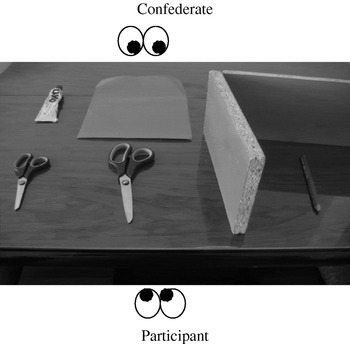
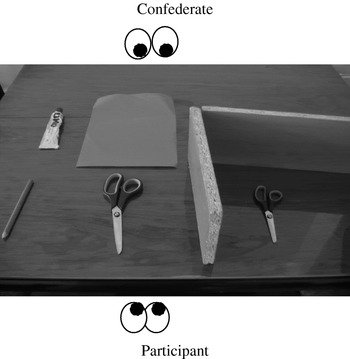
The set-up used in this study is a modified version of what Nadig & Sedivy (Reference Nadig and Sedivy2002) used with preschoolers and what Epley et al. (Reference Epley, Morewedge and Keysar2004) used with children and adults – a referential communication task (Glucksberg, Krauss & Weisberg, Reference Glucksberg, Krauss and Weisberg1966) that provides a measure of the participant's skill as a speaker to linguistically encode one of the multiple potential referents in the visual environment (Roberts & Patterson, Reference Roberts and Patterson1983). The display structure used by Nadig & Sedivy (Reference Nadig and Sedivy2002) and Epley et al. (Reference Epley, Morewedge and Keysar2004) for the referents was a vertical grid of slots with multiple objects, some of which can be made available exclusively to the participant (i.e. unavailable to a trained confederate) through wooden doors that obstruct the confederate's sight of these objects. In our display (see Figure 1), we set up two regions by dividing up the surface of a table into two spaces: the common ground and the privileged ground. The common ground is the visually shared part of the table, whereas the privileged ground is the non-shared part of the table available only to the participant. When an object is in the common ground, it is perceptually accessible by both the participant and the confederate. However, if an object is in the privileged ground, it is available only to the participant and not to the confederate, being obscured from the confederate's visual field. The creation of stable common and privileged ground locations is achieved in this simple manner to avoid complicated ways of portioning off different parts of the addressee's visual scene in each trial.
Sample trial of the common ground condition.

Three different age groups were included in our study: five- to six-year-olds, nine- to ten-year-olds and adults. None of the similar previous studies systematically included more than one age group of children, although the group of children in the Epley et al. (Reference Epley, Morewedge and Keysar2004) study came from a large age range (i.e. four to twelve years), and showed within-group differences that appear age related. Thus, in our study, we included a group of school-age children in addition to preschoolers and adults in order to determine whether developmental changes take place beyond preschool years and between school years and adulthood.
Our task involved elicited production of language: we asked the participants to verbally identify a particular object from an array of objects so that the confederate can pick up that object to use in an arts-and-crafts activity. In some conditions, a similar object of a different size was present in the common ground; in other conditions, this competitor object was placed only in the privileged ground of the participant. Example (2a) above illustrates the utterance type produced by adults when two objects of different sizes were in the common ground. We used the size property of the objects as a contrasting feature in our task because Nadig & Sedivy (Reference Nadig and Sedivy2002) suggest that color terms are more often used redundantly even when there is no other object in the same category in the display, whereas scalar adjectives are generally used in a contrastive function.
We addressed the following specific questions:
(i) Are there any age-related differences in the rate of use of disambiguating adjectives of size in the common ground vs. the privileged ground conditions? We expected that all age groups would use more discriminating adjectives in the common ground condition than in the privileged ground condition but that the tendency to use adjectives in a disambiguating fashion would increase with age.
(ii) Are there any age-related differences in the form of linguistic constructions used to request referents from the confederate? We undertake this second question because the type of constructions employed might be clues to the pragmatic intentions of the speaker when uttering a referential term. The crucial difference is between utterances comprised of bare nouns (e.g. uhu ‘glue’) on one hand and, on the other hand, more complex utterances that either add the accusative case marking on the noun indicating that the object is to be acted upon (e.g. uhu-yu ‘glue-ACCUSATIVE’) or contain the full requestive sentences wherein a verb is also specified (e.g. uhu-yu verirmisin?, glue-ACCUSATIVE would-you-give, ‘would you give me the glue?’). If the referential term is composed of a bare noun without any other sentential device accompanying it, the speaker might only be labeling the general category of the object and not attempting to uniquely identify the relevant object, whereas more fleshed out constructions may reveal the construal of the task more as a requestive referent identification task.
Study 1 was conducted with the above questions in mind. A subsequent study (Study 2) was run with just five- to six-year-old children to determine whether they would use more mature referential strategies if we changed our instructions to encourage requestive forms by prompting for polite language. This manipulation addressed a third question:
(iii) Do preschoolers use more uniquely identifying referring expressions in conditions where polite requesting forms are explicitly demanded from them as opposed to conditions in which more neutral instructions as in Study 1? We speculated that the urge to use requestive language would prompt full constructions, which, in turn, would lead to more referentially appropriate utterances.
STUDY 1
METHOD
Participants
Fifteen preschoolers (six boys and nine girls; mean age=5 ; 6, range: 5 ; 2–5 ; 8), fifteen primary school children (six boys and nine girls; mean age=9 ; 5, range: 8 ; 10–10 ; 1) and fifteen college-age adults (five males and ten females) participated in the task. (Each participant took part in a subsequent referent identification task, the results of which will not be reported here (Bahtiyar & Küntay, Reference Bahtiyar, Küntay, Caunt-Nulton, Kulatilake and Woo2007). Two preschoolers and one school-age participant were replaced because of experimenter error in giving the instructions. All of the participants were native speakers of Turkish from middle-SES backgrounds living in Istanbul. An undergraduate research assistant who was trained on the procedures of the experiments played the role of the confederate in the experimental sessions.
Apparatus
The experiment took place on a table where the participant and the confederate were seated on opposite sides. The table was divided into two parts by an L-shaped wooden block of 50 cm in length and 15 cm in height. The participant was seated behind the area covered by this block from the confederate. As depicted in Figures 1 and 2, the mutually visible part of the table is considered to be the common ground and the separated part, accessible just to the participant, is considered to be the privileged ground.
Sample trial of the privileged ground condition.

As potential referents, materials necessary for an arts-and-crafts activity were used (i.e. scissors, colored pencils, colored papers, and adhesives). There were two of each of these objects in different sizes.
Procedure
The children and the adults were tested individually in a quiet room in their respective educational institutions. The participants were first told that the purpose of the experiment was to design a new game for children. Then the experimenter explained the two different regions of the set-up, one accessible just to the participant (i.e. privileged ground) and one accessible to both the participant and the listener (i.e. common ground), repeating the instructions twice. The child participants were also moved to or near the chair where the confederate was to be seated to demonstrate that there is no visual access to the area blocked by the L-shaped barrier from that vantage point. Then, all the objects to be used in the experiment were held out by the experimenter and labeled by the participant. In the few cases where the child was not able to provide a label, the experimenter supplied the label. Just before the experiment began, the confederate entered the room and was introduced to the child. At the end of the experiment, the children were asked to rate the game as fun or boring. The experimental sessions were videotaped to be transcribed and coded later.
During the testing procedure, participants were asked to give instructions to the confederate ‘to pick out a particular object’ from an array of five objects as part of an arts-and-crafts session. Three conditions were compared across twelve trials. In the common ground condition, the target object and a contrasting object of the same kind (e.g. two pairs of scissors in different sizes) were visible to both the participant and the confederate (see Figure 1). Therefore, a size adjective was required to clear up the ambiguity. In the privileged ground condition, the participant saw both the target (e.g. a big pair of scissors) and the contrasting object (e.g. a small pair of scissors), but the contrasting object was obscured from the confederate's sight by the wooden block, making the adjective redundant from the confederate's view (see Figure 2). A third condition, the baseline condition, was administered as a control condition, in which only the target object was visible to both the confederate and the participant. The participants saw an unrelated control object (e.g. an adhesive) in the area obscured from the confederate's view.
Before each trial, the experimenter first asked the confederate to close her eyes and turn her back to the participant and then replaced the objects in the display. After reorganizing the display, the experimenter pointed at the target object and said to the participant, Bunu almasını söyle ‘Tell her to pick this up’. The confederate then turned her face towards the participant, opened her eyes, and looked at the participant until the participant gave a verbal response. If the participant attempted to point at the target object, the experimenter warned him/her not to point and asked for a verbal behavior. The confederate then picked up the object referred by the participant. When the participant produced an ambiguous utterance in the common ground trials, the confederate chose either of the object pairs. After each trial, the confederate used the object that she had picked up in constructing an arts-and-crafts project, such as paper boats, to make the activity appear more realistic for the participant. The order of twelve trials (four common ground+four privileged ground+four baseline conditions) was randomized and given in the same order to all participants.
Transcription and coding
All the utterances produced were transcribed verbatim and then coded based on whether the participants produced discriminating adjectival modifiers or not. The form of the linguistic construction embedding the referential expression was also coded to indicate whether it included an accusative case marking and a verbal phrase. All the transcriptions and the codings were done by the first author and checked by the second author, who are both native speakers of Turkish. The agreement between the coders was 100% once a couple of inconsistencies between the transcriptions were cleared up.
RESULTS
The first analysis examines the percentage of trials in which discriminating scalar adjectives were used in the three different conditions and by the different age groups. The second set of analyses examines patterns of constructions embedding the referential forms produced by the different age groups.
Rate of adjective production
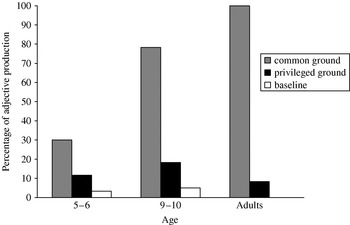
Figure 3 shows the mean proportion of trials where adjectival modifiers were produced for the common ground, the privileged ground and the baseline conditions by age. Even though some younger participants started out with a gestural referential device, which we describe later, we used only the verbal responses provided either spontaneously or upon promptings by the experimenter for this analysis. In the common ground condition, where there were two similar objects of different sizes in the shared visual scene, an adjectival modifier was produced in 100% of the trials by the adult participants, in 78% of the trials by the primary school children, and in 30% of the trials by the preschoolers. In the privileged ground condition, when a modifier was not necessary from the perspective of the confederate, adjectives were produced in 8% of the trials by the adult participants, in 18% of the trials by the primary school children, and in 12% of the trials by the preschoolers. Adjectival modifiers were hardly ever produced by any of the age groups in the baseline condition. In this condition, the adult participants did not produce modifiers at all, whereas the primary school children produced adjectives in 5% of the trials and the preschoolers in 3% of the trials.
Percentage of trials in which adjectives were produced by different age groups in different conditions.

These scores were entered into a mixed ANOVA with factors condition (3) (repeated measures)×age (3). There was a main effect of condition, (F(2, 84)=172·28, p<0·001, partial η2=0·802), and a main effect of age (F(2, 41)=6·22, p=0·004, partial η2=0·230). The interaction between condition and age was also found to be significant (F(4, 84)=20·28, p<0·001, partial η2=0·491).
As recommended by Keppel (Reference Keppel1982), the significant omnibus interaction effect was followed up with analyses of simple effects. The analyses revealed age-related differences only in the common ground condition, where the adult participants produced significantly more adjectival modifiers than the preschoolers (F(1, 84)=108·4, p<0·001) and the primary school children (F(1, 84)=10·4, p=0·002), and the primary school children used more adjectival modifiers than the preschool children (F(1, 84)=51·6, p<0·001). In the other two conditions (i.e. the privileged ground and the baseline conditions) the age groups did not differ in respect to the proportion of trials where adjectival modifiers were produced.
More analyses of simple effects were run to see whether each age group differed in the adjective production rate across conditions. The analyses revealed a significant difference between common ground condition and privileged ground condition (F(1, 14)=5·39, p<0·05) and common ground and baseline conditions (F(1, 14)=11·37, p<0·01) for preschoolers. Similarly, the primary school children produced more adjectives in the common ground condition than privileged ground (F(1, 14)=58·37, p<0·01) and baseline conditions (F(1,14)=86·26, p<0·01). For the adult participants, the rate of adjectival production was significantly higher in the common ground condition than in the privileged ground (F(1, 14)=794·6, p<0·01) and in the baseline conditions (F(1, 14)=945, p<0·01). No age group was found to differ in the proportion of production of adjectival modifiers in the privileged and the baseline conditions.
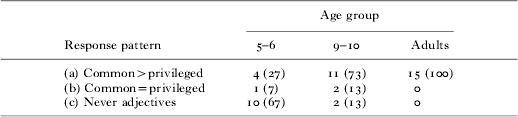
Table 1 provides the results of an examination of the participants' individual response patterns. For each age group, we present the number and percentage of children who: (a) produced more adjectives in the common ground trials than in the privileged ground trials; (b) produced the same number of adjectives in the common ground trials as in the privileged ground trials; and (c) who never produced any adjectives throughout the experiment.
Number and percentage of children exhibiting different response patterns for adjective production in each age group

These results show that only four children (27%) in the five- to six-year-old group are responsible for the differences in adjective production between the common ground and privileged ground conditions. This ratio is 73% in the nine- to ten-year-old group and 100% in adults. Ten (67%) in the youngest age group do not produce any adjectives in any of the conditions. In summary, only a small percentage of five- to six-year-olds discriminated the conditions by providing adjectives appropriately in ways similar to the older age groups; most did not display any discrimination at all. Yet, the significant differences observed between the common ground condition and the other two conditions in the rates of adjective production in preschoolers indicate an emerging sensitivity to the need for adjectives to be used for disambiguation, at least for some children in this age group.
Referential constructions
The second set of analyses involved a detailed characterization of the types of referential devices used for the objects. To begin with, many preschoolers initially preferred a gestural device, pointing to or touching the object, although the instructions prompted for verbal responses. Because the participants were told that they cannot use demonstrative gestures after each trial in which they did so, this tendency was observed only for the first two trials. Seven (47%) of the five- to six-year-olds attempted to point to the referent in both of the first two trials, while this tendency was weaker in the older age groups: three participants (20%) among the nine- to ten-year-olds and two participants (13%) among the adults. It is clear that the preschoolers tended to use a pointing gesture more than the two older age groups and this was seen in almost half of the participants for the youngest group.
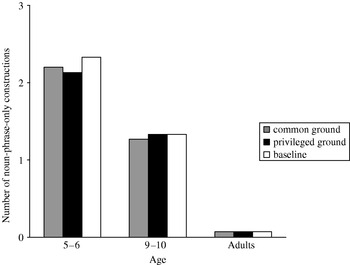
The linguistic form of the referential expressions used by the participants also exhibited some interesting age-related patterns. To reiterate, providing case marking on a noun and/or placing it in a verbal construction reveals a pragmatic intent of requesting an object, whereas a bare noun might just reflect an intent of labeling. Figure 4 indicates the means of number of nouns phrases not followed by accusative case marking and/or a verbal phrase in each condition by age group. Since there were four trials in each condition, the means are out of 4. A mixed ANOVA with factors condition (3) and age (3) showed a significant main effect of age (F(1, 42)=7·36, p=0·002, partial η2=0·259). There were no significant differences between conditions with respect to the type of referential construction. It is clear that the adults rarely use merely noun phrase constructions in their references. In addition, with increasing age, participants produce fuller constructions, including accusative case marking on the noun phrase and/or a verbal element rather than bare nouns, revealing a pragmatic intent of requesting a particular object regardless of the experimental condition.
Number of noun-phrase-only constructions provided by each age group in each condition.

In summary, across all conditions, the five- to six-year-olds predominantly provided a bare noun form to refer to the required object (i.e. makas ‘scissors’) without placing them in a construction where there is a verb such as ‘take’ or ‘want’ or the accusative case marking on the noun. Adults, on the other hand, mostly used the referential form with accusative case marking and in a full construction in all conditions (e.g. makas-ı alır-mı-sın, scissors-ACCUSATIVE will-you-take, ‘will you take the scissors?’). Nine- to ten-year-olds performed somewhere in between.
Moreover, it is interesting to note that the children who did produce adjectival modifiers in the task produced fuller sentences than their peers who did not produce modifiers at all. That is, six out of ten children, who did not produce adjectives at all in the common ground, used bare noun phrases without placing them in a construction while referring to the target object (e.g. kalem ‘pencil’). However, three out of the four children who produced adjectival modifiers also constructed more complex utterances (e.g. Gülce abla, küçük kalemi alabilirmisin? ‘Sister Gülce, can you pick up the small pen?’), where the noun phrase is used as a complement in a verbal construction of request.
DISCUSSION
All age groups distinguish the common ground condition from the privileged ground and the baseline conditions to some extent. Some speakers in the youngest group, five- to six-year-olds, produced more adjectival modifiers when two competing objects are available to both themselves and the confederate than when one of the objects is hidden from the confederate's viewpoint. However, their group performance was not yet at the level of older children and adults.
Our adult participants seem to show better discrimination between the common ground condition and the privileged ground condition through their usage of adjectives (100% vs. 8%) than what Nadig & Sedivy (Reference Nadig and Sedivy2002) found for their adults (100% vs. 47%), but our preschoolers do not produce as many adjectives as Nadig & Sedivy's (Reference Nadig and Sedivy2002), either in the privileged condition (in 12% of trials in our study versus in 50% of trials in Nadig & Sedivy's study) or in the common ground condition (in 30% of trials in our study versus in 75% of trials in Nadig & Sedivy's study). It is also true that, in Nadig & Sedivy (Reference Nadig and Sedivy2002), both preschoolers and a pilot group of adults used many more adjectives than our participants in the privileged ground condition. One reason for this discrepancy may be cross-linguistic differences. However, there is no reason to believe that Turkish five-year-olds should be lagging behind their American counterparts in employing adjectival modification with a function of contrastive referent identification. In fact, the differences could not be attributed to some cross-linguistic factors boosting adjective production because the rates of production of adjectives in the baseline condition are nearly null in both their and our studies. In addition, a study by Diesendruck, Hall & Graham (Reference Diesendruck, Hall and Graham2006) shows that English- and Hebrew-speaking four-year-olds can both derive contrastive meanings from pronominal adjectives although the two languages work quite differently from a structural point of view. We speculate that the Nadig & Sedivy (Reference Nadig and Sedivy2002) task structure leads participants to be more prone to adjective production overall, suggesting a relative lack of differentiation between the common ground and the privileged ground conditions.
The use of adjectives in elicited language can be affected by the participants' perceptions of the requirements of the task. In our experimental set-up, as opposed to Nadig & Sedivy's (Reference Nadig and Sedivy2002), it might be easier to grasp the restricted nature of the privileged space and ignore it, since it is partitioned out from the common ground space with the L-shaped wooden separator. This space is permanently inaccessible to the confederate across all the trials. In Nadig & Sedivy (Reference Nadig and Sedivy2002), putting all four of the objects in the same vertical plane might not engender an effective creation of privileged space. Moreover, because privileged locations are recreated for each trial, the processing load of keeping track of the privileged space might be high. These differences might have caused the participants of the Nadig & Sedivy (Reference Nadig and Sedivy2002) study to be less cognizant of the differences between the privileged ground and the common ground conditions, leading to substantial rates of adjective production in both conditions.
Our results also indicated that the rate of adjective production in the privileged ground condition was closer to that in the baseline condition than in the common ground condition. In contrast, in Nadig & Sedivy's (Reference Nadig and Sedivy2002) study, the adjective production in the privileged ground condition is significantly more than that in the baseline condition for both preschoolers and adults, suggesting that the privileged ground situation is perceived differently than a situation where no similar objects are present in the display. This strengthens the proposal that the participants of the Nadig & Sedivy (Reference Nadig and Sedivy2002) experiment, independent of their age, had difficulty in keeping track of the privileged status of the objects, thus producing adjectival modifiers in the privileged condition redundantly.
Similar to our study, a low incidence of modifier use was also observed in an experimental study of Finnish children between three and nine years of age (Dasinger, Reference Dasinger1995). In this study, even the oldest children did not describe subsequent actions on two similar objects of different colors with referential terms including color modifiers more than 50% of the time. The fact that color terms were often used redundantly, but not in a discriminatory fashion, led Dasinger to speculate that adjectives are functioning as descriptors instead of determiners (Karmiloff-Smith, Reference Karmiloff-Smith1979). Because the rate of adjective usage in both preschoolers and adults was so high in the privileged ground condition in Nadig & Sedivy (Reference Nadig and Sedivy2002), there is room for speculating that at least some of these usages were primarily descriptive, not contrastive of the objects in the common ground. Nadig & Sedivy (Reference Nadig and Sedivy2002) themselves suggest this interpretation for the high use of adjectives in the privileged ground condition as well.
An important finding of our study is that, in addition to development between preschool and school-age children, there is development beyond nine- to ten-years of age towards adulthood. Thus, the factors responsible for adultlike performance in this task take many years to develop. The change in the type of linguistic constructions used for requesting objects is quite revealing in this regard. Across ages, there is an increase in the number of participants who engage in the pragmatic act of requesting a referent from the confederate and who use adjectives in a contrastive function. The gradual increase in the usage of adjectives and in the linguistic constructions of requests suggests that there might be a relation between the two. It is plausible that the pragmatic function of requesting objects, as opposed to labeling objects, calls for unique identification of an object, which, in turn, motivates adjective usage. The communicative act of labeling preferred by the youngest speakers, on the other hand, does not entail unique identification, but specifies a broad category, which does not call for contrastive adjectives.
In sum, the participants' performance in this first study allows us to evaluate age-related differences in message formation, revealing how preschoolers fare in integrating their communicative partner's perspective into their communicative behavior in comparison to older speakers. This is revealed by the extent to which differently aged speakers produce disambiguating referential constructions that could uniquely identify a certain object. We conclude that, when there is a contrasting set of objects in the common ground, the linguistic expressions preschoolers produce are relatively more ambiguous than those produced by older children and adults. This might be because their pragmatic intentions in regard to performing the task are different than the older participants. However, this conclusion does not warrant us to deduce that preschoolers lag behind older participants in assessment of commonality, which is forming a judgment about whether a particular knowledge is shared by the addressee (Horton & Gerrig, Reference Horton and Gerrig2005).
Even for the youngest age included in Study 1, we know that Turkish children can embed referential terms in multiword verbal constructions and, in fact, have been using accusative case marking for three years or so (Aksu-Koç & Slobin, Reference Aksu-Koç, Slobin and Slobin1985). Thus, it is not because of lack of grammatical competence that five- to six-year-olds produced fewer distinguishing adjectives than their English-speaking counterparts or older Turkish speakers. In order to examine whether the intended communicative function of their speech act (whether it is a label or a request) makes a difference, we ran the same study with another set of preschoolers (Study 2), with some modifications in the given instructions.
STUDY 2: ELICITING REQUESTIVE UTTERANCES
In our follow-up study (Study 2), conducted with another set of preschool-age children, we aimed to increase requesting behavior as opposed to labeling behavior. As Brown & Levinson argue (Reference Brown and Levinson1987), if speakers intend to be polite, they adapt more to a partner's perspective. We hypothesized, based on such a premise and on our observations during Study 1, that if we can get preschoolers to engage in requestive speech acts, they will also provide more discriminating forms to specify clearly to the addressee which object they want. Because children often get prompted by adults to use more polite language than they normally do, they would be more familiar with politeness-eliciting instructions than those encouraging clarity. By introducing such prompting for polite requestive language, we examine a potential link between requestive speech acts and unique identification of referents, which was implied by the results of Study 1. More specifically, we expected that the preschooler group that is prompted for polite request forms in Study 2 will use more uniquely identifying adjectives than the group in Study 1, who did not receive such prompting.
Participants
Fifteen preschoolers (five boys and ten girls) participated in the task. The mean age was 5 ; 3 (range: 4 ; 10–6 ; 1), which was slightly younger than that in Study 1. All children were native speakers of Turkish, comparable in socioeconomic background to the participants of Study 1. Two participants were replaced, one because of poor sound-recording quality and the other due to inappropriate experimenter prompting.
Apparatus and procedure
The same experimental set-up from Study 1 was used in Study 2 (see Figures 1 and 2). Similar to Study 1, in Study 2 children participated in an arts-and-crafts activity. The same objects (i.e. different sizes of scissors, colored pencils, colored papers, and adhesives) were used as potential referents. The only difference between the two studies was the set of instructions used to elicit language production from the participants. In Study 2, the instructions prompted for polite requestive language. Children were told that they need to ‘ask politely for the object pointed’ from the confederate, and if they use ‘nice language to request things’, they will receive a gift at the end of the session. The instructions repeated the prompts for polite requestive language in three different sentences at the beginning of the experiment: ‘Özlem abladan gösterdiğim şeyleri rica edeceksin. Özlem abla güzel güzel isteyince veriyor. Eğer böyle güzel güzel istersen, sonunda sana hediye verecekmiş Özlem abla.’ The children were not further prompted if they did not provide requestive language in the first couple of trials. As in Study 1, each trial was preceded by the instruction ‘Bunu almasını söyle’ ‘Tell her to pick this up’.
Similar to Study 1, the participants were tested across 12 trials (4 common ground+4 privileged ground+4 baseline conditions). The order of the trials was the same as in Study 1. All of the experimental sessions were videotaped to be transcribed and coded later.
Transcription and coding
Similar to Study 1, the utterances produced were transcribed verbatim and then coded with respect to whether the participants produced discriminating adjectival modifiers or not. The form of the linguistic construction embedding the referential expression was also coded to indicate whether it included an accusative case marking and a verbal phrase. All the transcriptions and the coding were done by the second author and checked by the first author, who are both native speakers of Turkish. The agreement between the coders was 100%.
RESULTS
For the preschoolers who were prompted for polite request forms, the effect of the condition (common vs. privileged vs. baseline) on the rate of adjective usage was analyzed with repeated ANOVA, revealing a main effect of condition (F(2, 28)=19·79, p<0·001, partial η2=0·586). Planned comparisons were run to analyze the effect in more detail. The analyses revealed a significant difference between the common ground trials and the baseline conditions (F(1, 28)=39·24, p<0·001). In the common ground trials, when two competing objects were available both to the confederate and the participant, the participants produced more adjectival modifiers than they did in the baseline condition. In addition, a significant difference in adjective production was found between the common ground trials and the privileged ground condition, in which only one of the competing objects was perceptually available to the confederate but two competing objects were available to the participant (F(1, 28)=13·26, p=0·011). The difference between privileged ground and baseline conditions also reached significance (F(1, 28)=6·87, p=0·037). The participants produced more adjectives in the privileged ground condition than the baseline condition.
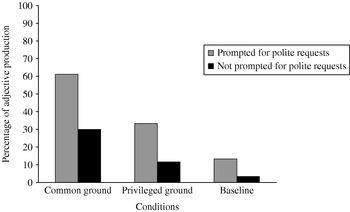
Figure 5 shows the percentage of adjective production produced by the two preschool groups. The group of Study 1 is not prompted for requestive language, whereas the participants of Study 2 were prompted for polite requests.

In order to compare the two preschool groups of Study 1 and Study 2, a mixed ANOVA was conducted with factors condition (3) (repeated measures)×group (2). The group variable encodes the difference between the two sets of preschool-age children. There was a main effect of condition (F(2, 56)=23·36, p<0·001, partial η2=0·455) and a main effect of group (F(2, 28)=4·81, p=0·037, partial η2=0·147). The interaction between condition and group was not significant. Planned comparison of the main effect of condition revealed that participants produced significantly more adjectival modifiers in the common ground condition than in the privileged ground (F(1, 56)=17·50, p<0·001) and the baseline conditions (F(1, 56)=45·79, p<0·001), and they used more adjectival modifiers in the privileged ground condition than the baseline condition (F(1, 56)=6·67, p=0·012). In sum, we found that the participants in Study 2, who were urged to produce polite language, produced more discriminating adjectival modifiers at all conditions compared to the participants of Study 1, who frequently produced noun-only utterances.
Referential constructions
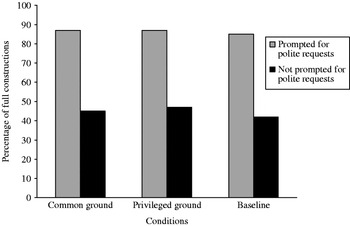
The next analysis looks at whether the types of constructions differ across Study 1 and Study 2. Figure 6 shows the percentage of full constructions (verbs and/or accusatives) used by the preschool-age group who were exposed to politeness prompting (Study 2) compared to the group that was not urged to provide polite request forms.

A mixed ANOVA with factors condition (3) and group (2) showed a significant main effect of group on the rate of full constructions (F(1, 28)=7·31, p=0·012, partial η2=0·207). In Study 2, only two preschoolers provided noun-only constructions to refer to the items pointed out. Neither of these children used any distinguishing adjectives in any of the trials. The remainder of the participants (N=13) provided complex constructions that marked their speech act as a request of an object through a verb such as al ‘take’ or an accusative ending marking the object requested as a direct object.
In sum, prompting children to ‘ask [the confederate] nicely’ for the objects appears to lead to more elaborate referential constructions, where verbs and accusative case marking are employed, compared to a condition where such prompting is lacking. Such a difference in the framing of referential utterances might also have led to more frequent use of discriminating adjectives. As Figure 6 shows, we see an increase in the proportion of adjectives used not only in the common ground condition, but also in the privileged and the baseline conditions. However, the difference in the rate of adjective production was again observed across conditions for the participants of Study 2 as for the participants of Study 1.
GENERAL DISCUSSION
In the first cross-sectional study, we found progressively more frequent uniquely identifying referring terms with adjectival modification in the common ground condition with increasing age. In other words, there is development in the production of linguistic devices of unique referent identification across age groups, not only from preschool ages into school ages, but from school ages into adulthood. We also established that even the youngest group can integrate the visual perspective of a partner to some extent while designing utterances, providing more adjectives overall in the common ground conditions as opposed to in the other conditions. However, the preschoolers in Study 1 still provided a substantial number of referring expressions that do not uniquely identify the referent from the partner's point of view.
It is possible that some of the developmental differences are due to the dissimilar approaches of the different age groups towards the particular task. Such a conclusion is warranted by the finding that preschoolers tend to use constructions that label an object, whereas older speakers use full-fledged constructions of requests, although the youngest group is definitely linguistically able to produce such complex constructions (Aksu-Koç & Slobin, Reference Aksu-Koç, Slobin and Slobin1985). Warden (Reference Warden1976) underscores the effect of contextual assumptions of participants on their use of referential expressions. He proposes that naming an item and identifying it are two different communicative functions. In naming an item, a speaker does not need to take into account his listener's prior state of knowledge whereas, in identifying an item, he has to. Thus, it is possible that at least some of the younger speakers were functioning more in the naming mode rather than in the identification mode compared to the older speakers in our referential communication task.
The form of the communication might change according to the type of stance participants take to a particular task – thus, when we find developmental differences, we might not be tapping into differences in underlying cognitive–communicative capacities, but, rather, into these dissimilar stances. What were the differences in the approaches of the preschoolers who produced verbal constructions such as bana kalem-i verirmisin (me pen-ACC would-you-give, ‘would you give me the pen’) and those who just said kalem (‘pen’)? We thought that the former set of children was framing their utterance as a referential request, which, in turn, led them to uniquely identify the object pointed out by the experimenter. The children who used bare nouns, on the other hand, were just producing a referential label, pointing out a certain category without identifying a particular entity belonging to that category.
In order to test this hypothesis, we conducted a follow-up study, in which we attempted to induce children to produce referential requests in full verbal constructions. Indeed, our expectations were confirmed. We found that the preschool-age participants prompted for polite request forms produced more requestive constructions and discriminating adjectives, and more so in the common ground condition. Thus, when young children embed referring terms in requestive speech acts, they become more inclined to produce unambiguous referential terms.
Why might requestive speech lead to referential clarity? Brown & Levinson (Reference Brown and Levinson1987), in their seminal work on politeness and language, assert that, if speakers intend to be polite, they adapt more to a partner's perspective. Schober & Brennan (Reference Schober, Brennan, Graesser, Gernsbacher and Goldman2003) discuss findings of a study (described in Hermann, Reference Hermann1988) showing that students describing the location of an object's position to an addressee took their partner's perspective far more often when they were told that their addressee represented a professor than when it represented a fellow student. Ervin-Tripp, Guo & Lambert (Reference Ervin-Tripp, Guo and Lampert1990) point out that making a request from an addressee calls for specifying enough information to enable them to figure out what action is desired so that non-compliance is prevented. An obstacle to achieving the interactant's compliance in referential requests would be ambiguity regarding which object is to be picked up. In view of that, when preschool children operate in a requestive mode, they tend to employ full verbal constructions where the unique characteristics of the demanded object are spelled out. In contrast, in situations where preschool age children are not prompted to use polite request forms, many young participants approach the task with a referential labeling goal. The groups of older children and adults, on the other hand, have increasingly larger number of individuals who glean that the marking of their utterance as a request and signaling the uniqueness of reference are of importance, even without any prompting for polite request forms.
Horton & Gerrig (Reference Horton and Gerrig2002) suggest that speakers' tendency to design their utterance in consideration of particular addressees depends on their realization that audience design is necessary. We showed in this study that five- to six-year-old speakers of Turkish provided more elaborate descriptions overall and more discriminating adjectives in the common ground condition when they were encouraged to form requestive instead of labeling speech acts. We propose that, for the preschool age group, the ability to formulate a message that takes into account what is shared and unshared knowledge is fragile. As Matthews et al. (Reference Matthews, Lieven, Theakson and Tomasello2006: 419) assert, ‘knowing that things can be given and new for other people in general terms and knowing that and how this is expressed in language are two different matters’. Prompting preschool-age speakers to use requestive language seems to lead preschool children to design their utterances to better take into account their partner's perspective.
However, there is a caveat to the above discussion. When prompted for requestive language, the five-year-olds produced relatively more elaborate language. As Whitehurst, Sonnenschein & Ianfolla (Reference Whitehurst, Sonnenschein and Ianfolla1981) demonstrated, five-year-olds pay attention to the length of utterances more than the informative–ambiguous distinction, often producing over-specified referential forms after listening to informative, but non-redundant, speakers. Thus, are our speakers producing more adjectives because they are being more verbose or are they really adapting their referential expressions to the different conditions of visual access of the addressee to the referents? Figure 5 shows that in both Study 1 and Study 2 the children prod0uced roughly twice as many adjectives in the common ground condition as in the privileged ground condition. On the basis of this comparison, it could be argued that the children in Study 2 were not more informative than those in Study 1. However, it is also evident from Figure 6 that the participants in Study 2 were generally producing more elaborate constructions in all conditions. Thus, the greater use of adjectives in the common ground condition compared to the privileged ground condition cannot be explained merely by the increased elaborativeness of the language used. It is possible, though, that the improved performance of the children in Study 2, compared to their counterparts in Study 1, could be accounted for by the combined effects of a newly emerging ability for appropriate referential language and use of more elaborate constructions (O'Neill & Topolovec, Reference O'Neill and Topolovec2001). It is possible that only some children understood the need to use an adjectival modifier to uniquely specify a referent in the common ground condition when prompted for requestive speech acts. Others, on the other hand, were using the prompt to generate lengthier language overall, which also led to more adjective usage. Further work, such as current studies of Matthews, Lieven & Tomasello (under review) are needed to see how these two strategies might interact in development. Matthews, Lieven & Tomasello (Reference Matthews, Lieven and Tomasello2007) showed that children as young as 2 ; 6 can be trained to become informative and that they are not just learning to become as elaborate as possible in all communicative situations.
The fact that young children can be prompted to formulate more adequate referential messages shows that they can implicitly assess commonality even when their initial attempts at linguistic expressions are relatively immature. Even the youngest age group is starting to take into account a partner's visual perspective, providing distinguishing adjectives more often in the common ground condition than in the privileged ground condition. However, with respect to ‘message formation’, we observe gradual attainment of the adult norms across the three increasing age groups. Children become progressively more likely to use case marking and to use the referring expressions in a verbal form, signaling clear pragmatic intent to make a request. Moreover, when this pragmatic intent is highlighted by the experimental instructions, five-year-olds demonstrate an increase in the amount of requestive speech acts and the amount of uniquely identifying referring expressions.
A major limitation of our experimental study is that given that there is conversational evidence that their initial conceptualization is acceptable, preschoolers (or even older speakers) do not self-monitor their linguistic devices (Schober, Reference Schober, Fussell and Kreuz1998). Consequently, the first couple of trials set the trend for a certain referential strategy to continue for the subsequent trials. If a child participant uses a referentially ambiguous term for the first common ground trial, and gets implicit approval from the confederate by her picking up one of the named objects, she will be tempted to continue with that strategy. As Schober (Reference Schober1993, Reference Schober, Fussell and Kreuz1998) has suggested for adult conversationalists, interactants' previous conversational history is strongly determinant of how they will keep referring to the same thing. When addressees do not give any evidence of misunderstanding or discomfort with a referential expression used by a speaker, the speaker will not change her ways of referring (Schoeber, Reference Schober, Fussell and Kreuz1998). Younger participants might be more susceptible than older speakers to the absence of naturally occurring interactive processes, such as the absence of clarification requests or corrective feedback. It will be very important in future work to simulate such naturalistic conversational discourse by manipulating how the confederate reacts to the participants. A recent study by Matthews, Lieven & Tomasello (Reference Matthews, Lieven and Tomasello2007) shows that children as young as 2 ; 6 can be trained to use uniquely identifying referential expressions in their requests, especially when their adult interactant provides clarification requests as feedback about their relatively less appropriate communicative attempts.
In conclusion, it is important to understand how children approach the communication task by evaluating behavior in referential communications tasks. This study shows that when preschoolers embed referring terms in requestive speech acts, they become more inclined to produce unambiguous referential terms. In future work tracking the developmental course of referential communication ability, we will need to examine younger age groups, non-verbal means of monitoring different visual perspectives of the listener, and the effect of providing naturalistic feedback to our participants.