Introduction
Mungbean [Vigna radiata (L.) Wilczek] can be used in a wide range of food applications and is also an ideal nutritional complement that can contribute to a healthy and balanced diet, particularly in poor and anaemic women and children (AVRDC, 2002). The analysis of key agronomical traits, such as seed quality and disease susceptibility, highlights the importance of conserving diversity within the mungbean germplasm (Lambrides and Godwin, Reference Lambrides, Godwin and Kole2007; Chankaew et al., Reference Chankaew, Somta, Sorajjapinun and Srinives2011). Mungbean development and breeding have been carried out for several decades; despite this, molecular genomic datasets are limited. Recently, next-generation Illumina HiSeq technology has allowed genome-wide marker development for mungbean, enabling further genomic studies (Van et al., Reference Van, Kang, Han, Lee, Gwag, Moon and Lee2013).
In Indonesia, mungbean ranks second only to soybean as an economically significant legume. Mungbean landraces (local cultivars) are widely dispersed in several regions of different main islands, of which many are still cultivated by traditional farming despite their superior agronomical traits. The landraces are usually endowed with tremendous genetic variability, which could be useful for mungbean improvement (Jambormias et al., Reference Jambormias, Madubun and Hitijanhubessy2003; Tripathy et al., Reference Tripathy, Suchinnata, Lenka and Sahoo2010). Moreover, genetic differences between landraces and commercial varieties and the level of heterogeneity still existing in landraces are not yet well characterized. In this study, we estimated the genetic diversity of the Indonesian mungbean germplasm using a newly developed simple sequence repeat (SSR) marker analysis, with the aim of obtaining information of future importance for the selection and breeding of mungbean varieties with desirable traits.
Materials and methods
In this study, we selected 83 accessions from diverse mungbean-producing areas of Indonesia (Table S1, available online). The samples comprised 16 cultivars and 67 landraces and were obtained from the germplasm collection of the Indonesian Center for Agricultural Biotechnology and Genetic Resources Research and Development (ICABIOGRAD). Genomic DNA was extracted from young leaves using a standard cetyltrimethylammonium bromide (CTAB) method (Gelvin and Schilperoort, Reference Gelvin and Schilperoort1995). DNA samples were equalized for concentration and then PCR-amplified using 30 SSR primer sets that were developed based on sequence variations between two mungbean genomes (Sunhwanokdu and Gyeonggijaerae 5; Table S2, available online). PCR products were separated using the fluorescence-based capillary electrophoresis Fragment Analyzer CE System (Advanced Analytical Technologies, Inc., Ames, Iowa, USA). Population structure was estimated using the model-based program STRUCTURE (Version 2.3; Falush et al., Reference Falush, Stephens and Pritchard2003). Polymorphic information content (PIC) values were calculated for the total population and for SSR markers (Liu, Reference Liu2001). Genetic diversity index and phylogenetic tree were generated based on Nei's method, and support for clusters was evaluated by bootstrap analysis of 1000 permutations using PowerMarker V3.25 (Felsenstein, Reference Felsenstein1985; Liu and Muse, Reference Liu and Muse2005).
Results and discussion
Genetic diversity within crop collections is beneficial for their effective conservation and management and for crop improvement strategies (Mondini et al., Reference Mondini, Noorani and Pagnotta2009; Vetriventhan et al., Reference Vetriventhan, Upadhaya, Anandakumar, Senthilvel, Parzies, Bharathi, Varshney and Gowda2012). The molecular evaluation of landraces carried out in the present study could be useful as an integral part of pre-breeding process. Of the 30 SSR markers, 29 exhibited polymorphism, in which a total of 107 alleles were detected and average per locus was 3.7, which is relatively comparable to that in other reports in mungbean (Kumar et al., Reference Kumar, Tan, Quah and Yusoff2002; Gwag et al., Reference Gwag, Dixit, Park, Ma, Kwon, Cho, Lee, Lee, Kang and Lee2010). The PIC value, reflecting allele diversity for a particular marker, ranged from 0.012 (SSR_34) to 0.819 (SSR_33), with an average of 0.33. Diversity index for the full 29-marker set was in range of 0.012–0.833 with an average of 0.38. The mean PIC value and diversity index were indicative of low levels of genetic diversity in the tested mungbean germplasm. Interestingly, although mungbean is a self-pollinating crop, a number of loci displayed heterozygosity, probably due to residual heterozygosity in the collection as well as outcrossing in some cultivars (Blair et al., Reference Blair, Diaz, Buendia and Duque2009).
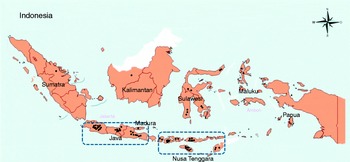
Admixture model-based simulations for the inferred population structure were performed by varying K from two to ten iterations using all the 83 accessions, which were mostly collected from Java and Nusa Tenggara (Fig. 1). However, no clear number of subpopulations was determined in this analysis. All the F st estimates revealed non-significant differences in the overall genetic structure, and the low F st values clearly revealed low levels of differentiation in the mungbean population. The fact that the mungbean landraces evaluated in this study could not be discretely distributed by their regions of origin is in good agreement with a previous study in mungbean and common bean (Burle et al., Reference Burle, Fonseca, Kami and Gepts2010; Gwag et al., Reference Gwag, Dixit, Park, Ma, Kwon, Cho, Lee, Lee, Kang and Lee2010), which is probably due to high homogeneity among the accessions (Evanno et al., Reference Evanno, Regnaut and Goudet2005). To provide a comprehensive picture of genetic structure, however, a geographical broadly representative collection of mungbean landraces across Indonesian islands is needed.
Geographical distribution of Indonesian mungbean germplasm used in this study. Black dots indicate the collection sites of genotypes as listed in Table S1 (available online). The primary mungbean producers, Java and Nusa Tenggara, are indicated with dotted-line boxes.

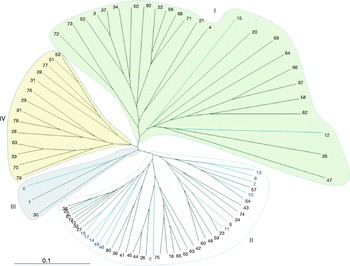
A neighbour-joining tree with bootstrap analysis demonstrated differentiation among the accessions, which largely grouped according to the individual genetic characteristics rather than geographical origin (Fig. 2 and Table S1, available online). All clusters consisted of a mix of landraces of different origins and varieties. The majority of accessions from the regions of Java (West, Central and East) and Nusa Tenggara (West and East) were dispersed in all the four main clusters, which is consistent with the diversity index. By contrast, most of the landraces from West Nusa Tenggara and East Nusa Tenggara dominated clusters I and IV, respectively, and were relatively closely grouped therein. Of the 16 improved varieties, 13 were genetically similar to local cultivars, most of which were from Java and fewer originated from Nusa Tenggara (cluster II). Indonesian varieties may be developed mainly with a genetic background of Java landraces, as supported by their closest genetic relationship (0.042) in comparison with other landrace populations from other regions. Additionally, Nusa Tenggara has a number of dry regions and this may have induced adaptation to drought tolerance in mungbean varieties from these regions (IAARD, 2012) and would explain the clustering of these accessions. The landrace from the region furthest west (Sumatra; Local Adnan Lubis) was genetically distant to those from eastern parts of Indonesia (North Maluku; Plastik and Local Pasar Jailolo). The diverse nature of these landraces may be a reflection of the prevalent diverse agroclimatic conditions of each region (Burle et al., Reference Burle, Fonseca, Kami and Gepts2010), but dissemination and extensive distribution with their origin lead to a low association of germplasm with geographical diversity (Poehlman, Reference Poehlman1991).
Neighbour-joining tree based on the distance matrix of 29 simple sequence repeat markers genotyped in 83 mungbean accessions estimated with a bootstrap analysis using 1000 permutations. Landraces and varieties are edge labelled with a serial number and are depicted in black and blue colours, respectively.

In summary, the phylogenetic clusters derived from our mungbean genotyping provide a strong basis for ongoing diversity analysis of local cultivars. Further data are required to build upon the initial dataset and refine the definition of fine structure within the mungbean collection, for example, agromorphological data collection that is underway. In addition, genetic differentiation between the mungbean accessions would be enhanced by the use of additional molecular markers developed from the genomes of mungbean or its close relatives. The collection of diverse local cultivars and their subsequent genotyping would enhance germplasm diversity and provide information, both of which are beneficial for developing collection strategies and breeding purposes with desirable agromorphological characteristics. Overall, these newly developed SSR markers could be useful for detecting genetic diversity, which presents an opportunity for the identification and characterization of loci responsible for important and desirable traits.
Supplementary material
To view supplementary material for this article, please visit http://dx.doi.org/10.1017/S1479262114000343
Acknowledgements
This study was supported by a grant from the Next-Generation BioGreen 21 Program (no. PJ008117) of the Rural Development Administration, Republic of Korea.