Introduction
Seed banks are an ‘invisible’ component of terrestrial ecosystems. As a result, adequately sampling the soil seed bank imposes a challenging task for ecologists. The difficulty surrounding seed-bank sampling is notably visible by the multitude of ways seed-bank data are collected and presented (Warr et al., Reference Warr, Thompson and Kent1993). This heterogeneity in seed-bank methodology, with variations in field-sampling design, greenhouse procedures, seed-count mode or length of the germination trials, etc., originates from the broad lack of sufficient scientific background information (Bossuyt and Honnay, Reference Bossuyt and Honnay2008) on, for example, small-scale spatial seed-bank heterogeneity (Plue et al., Reference Plue, Goyens, Van Meirvenne, Verheyen and Hermy2010), seed-bank species–area relations (but see Dupuy and Chazdon, Reference Dupuy and Chazdon1998), and stratification treatments or germination cues (but see Måren et al., Reference Måren, Janovksy, Spindelbock, Daws, Kaland and Vandvik2010). Obviously, the resulting patchwork of wide-ranging methodological approaches to seed-bank research does not add to the comparability across studies (Warr et al., Reference Warr, Thompson and Kent1993). Therefore, this study attempts to synthesize the impact of sampling methods (i.e. field-sampling design) on seed-bank diversity records of temperate deciduous forests in central and north-west Europe. More specifically, the study focus revolves around the methodological failure in detecting ancient forest species (as defined by Hermy et al., Reference Hermy, Honnay, Firbank, Grashof-Bokdam and Lawesson1999 and Verheyen et al., Reference Verheyen, Honnay, Motzkin, Hermy and Foster2003), a widely recognized group of herbaceous species characteristic of the herbaceous understorey of ancient temperate deciduous forests.
Ancient forest species are labelled as species having only a transient seed bank, which do not rely on or invest in a persistent seed bank (Verheyen et al., Reference Verheyen, Honnay, Motzkin, Hermy and Foster2003; Hermy and Verheyen, Reference Hermy and Verheyen2007). This is largely because of their apparent absence in most seed-bank records of temperate forests (e.g. Verheyen et al., Reference Verheyen, Honnay, Motzkin, Hermy and Foster2003; Hopfensperger, Reference Hopfensperger2007; Bossuyt and Honnay, Reference Bossuyt and Honnay2008) on the one hand, combined with the numerous adaptations to survive the shaded forest understorey conditions (e.g. Brown and Oosterhuis, Reference Brown and Oosterhuis1981) on the other hand. However, Brown and Oosterhuis (Reference Brown and Oosterhuis1981) and Bossuyt and Hermy (Reference Bossuyt and Hermy2001) did suggest that some ancient forest species do potentially form a low-density persistent seed bank, which may serve as an additional recruitment pool to established populations (Bossuyt and Hermy, Reference Bossuyt and Hermy2001) or enable the floristic recovery of degraded forest communities (Brown and Oosterhuis, Reference Brown and Oosterhuis1981). Indeed, even in relatively stable environments such as temperate deciduous forests, persistent seed banks may still remain a valuable feature to a species' local persistence (Snyder, Reference Snyder2006; Satterthwaite, Reference Satterthwaite2010). Therefore, Bossuyt and Hermy (Reference Bossuyt and Hermy2001) signalled that more in-depth research would be required into both the ancient forest species' germination cues, as well as into the possibility that inadequate sampling leads to a failure in detecting these species (Holderegger, Reference Holderegger1996; Bossuyt and Honnay, Reference Bossuyt and Honnay2008). Unfortunately, the fact that methodological shortcomings may have biased this view on seed banking in ancient forest species seems easily overlooked. Consequently, the common theorem in seed-bank literature remains the non-seed-banking behaviour of ancient forest species; hence the need to look into the methodological impact on the retrieval of ancient forest species in seed-bank studies.
The first and most fundamental pillar of seed-bank research in any plant community is the total surface area sampled (e.g. Bigwood and Inouye, Reference Bigwood and Inouye1988; Warr et al., Reference Warr, Thompson and Kent1993; Bossuyt et al., Reference Bossuyt, Van Wichelen and Hoffmann2007; Stark et al., Reference Stark, Arsenault and Bradfield2008). Most authors agree that the total sampled area – apart from sampling mode, seed count method, etc. – needs to be (extremely) large in order to obtain a reliable estimate of seed-bank composition (notably of rare species, e.g. Bossuyt et al., Reference Bossuyt, Van Wichelen and Hoffmann2007; Stark et al., Reference Stark, Arsenault and Bradfield2008) or even more so for seed densities (e.g. Thompson, Reference Thompson1986; Warr et al., Reference Warr, Thompson and Kent1993). Second, sampling mode has also received some attention (Bigwood and Inouye, Reference Bigwood and Inouye1988; Ambrosio et al., Reference Ambrosio, Iglesias, Marin and Del Monte2004; Bossuyt et al., Reference Bossuyt, Van Wichelen and Hoffmann2007). At a constant sampling area, researchers should opt for many small samples per plot (Bigwood and Inouye, Reference Bigwood and Inouye1988) and use a systematic rather than a random sampling design (Ambrosio et al., Reference Ambrosio, Iglesias, Marin and Del Monte2004; Bossuyt et al., Reference Bossuyt, Van Wichelen and Hoffmann2007). Furthermore, while direct seed counts often present entirely different estimates of seed-bank characteristics compared to germination protocols (Gross, Reference Gross1990; Price et al., Reference Price, Wright, Gross and Whalley2010), seed-bank samples should be left to germinate for over 2 years (Kostel-Hughes et al., Reference Kostel-Hughes, Young and Carreiro1998) up to 4 years (Jankowska-Blaszczuk and Grubb, Reference Jankowska-Blaszczuk and Grubb2006) to tackle delayed germination, rather than the short periods currently applied. Numerous other methodological characteristics vary among studies, e.g. sampled depth, timing of sampling and greenhouse parameters such as, for example, watering frequency or temperature regime. However, guidelines in these sampling parameters are nearly absent (but see, for example, Ter Heerdt et al., Reference Ter Heerdt, Schutter and Bakker1999; Devlaeminck et al., Reference Devlaeminck, Bossuyt and Hermy2004) and their impact on seed-bank estimates is, thus, only poorly understood. Yet, despite a clear consensus on several characteristics, many studies constrain these parameters, and notably so the sampled area, justifying the suboptimal design by a lack of sufficient space, time or resources. Unfortunately, few studies appreciate the impact that this may have upon the reliability of seed-bank records.
Therefore, the question at hand is to what extent methodology may have contributed to a potentially biased view of persistent seed-bank records in temperate deciduous forests, focusing explicitly on how the current methodology fails to detect ancient forest species. Many seed-bank studies in this review aim to either estimate the seed-bank restoration potential or obtain a full description of the persistent seed-banking community in temperate deciduous forests. This study therefore focuses on γ-diversity at the study level as both types of studies would benefit from accurate lists of retrieved seed-banking species. These lists would preferably include the herbaceous species characteristic of the herb layer in ancient temperate deciduous forests, should this study prove that these ancient forest species are actually present in the seed bank.
We compiled an illustrative dataset from 31 seed-bank studies in temperate deciduous forests of central and north-west Europe to establish: (1) potential general trade-offs among methodological characteristics in seed-bank research; (2) the extent to which methodological study characteristics determined seed-bank γ-diversity, average species' retrieval frequency and seed density in temperate deciduous forest; and, most importantly, (3) how ancient forest species behave as a function of these methodological characteristics.
Materials and methods
Data collection and data quality assessment
Because of the specific focus on the methodological impact of seed-bank research on the retrieval of ancient forest species from the persistent seed bank, a strict selection of papers and data quality assessment (following Harrison, Reference Harrison2011) was compulsory. At first, potentially suitable seed-bank studies were located in ISI Web of Knowledge© via queries using the general keywords ‘seed bank’, ‘temperate forest’ and ‘Europe’. We only considered central and north-west European studies as complete lists of ancient forest species in North America are scarce. We refrained from using only one list because of the observed (albeit minor) divergence in the European ancient forest species lists. Finally, as ancient forest species are a concept of temperate deciduous forests, studies in pure coniferous forest were excluded, retaining studies in only (at least) mixed temperate deciduous forests. As we focus upon persistent seed banking in ancient forest species, data quality needed to be assessed. Hence, all 34 selected studies were carefully scrutinized for irregularities regarding sampling, greenhouse procedures and/or data representation [e.g. complex resampling procedures (Augusto et al., Reference Augusto, Dupouey, Picard and Ranger2001)]. Studies in which disturbed habitats were included in the presented seed-bank records (forest rides, Buckley et al., Reference Buckley, Howell and Anderson1997; skid trails, Ebrecht and Schmidt, Reference Ebrecht and Schmidt2008), and where these seed-bank data from the disturbed habitats could not be separated from the overall presented seed-bank data, were equally omitted. To improve the likelihood of detecting truly persistent seeds in (ancient forest) plant species and guarantee data quality, studies were additionally checked for a number of characteristics such as removal of litter layer (the layer with the highest probability of containing transient seeds), removal of vegetative plant parts (assuring germination from seed) and optimal timing of seed-bank sampling (assuring the recovery of persistent seeds due to the absence of transient seeds through germination or death) (e.g. Estonia – end of June, Zobel et al., Reference Zobel, Kalamees, Püssa, Roosaluste and Moora2007). When the litter layer was sampled separately, these data were removed from the dataset (e.g. Staaf et al., Reference Staaf, Jonsson and Olsen1987). As nine (out of 34) studies did not provide the opportunity to remove the litter layer data from the mineral soil seed bank, ‘sampled litter layer’ was necessarily included as an extra methodological study characteristic. A final selection criterion encompassed the use of a germination protocol as a means to quantify the soil seed bank [all studies but one (Wódkiewicz and Kwiatkowska-Falinska, Reference Wódkiewicz and Kwiatkowska-Falinska2010) used a germination protocol], as today this remains the fastest and most common way to evaluate the seed bank. A total of 28 studies withstood these selection criteria (for a full list including methodological details, see supplementary Table S1, available online only at http://journals.cambridge.org). Another three unpublished datasets (for full details, see supplementary Table S2, available online only at http://journals.cambridge.org) which complied with all selection criteria were included into the dataset, amounting to a dataset of 31 seed-bank studies. We then assembled two 31 × 374 study–species matrices. One matrix included the characteristic seed density (seeds m− 2) of a recorded species in a study (i.e. omitting zeros in studies in which a species was not recorded), while the second matrix presented the relative frequency (i.e. number of plots in which a species was recorded divided by the total number of plots; in %) of a species in a study. Species not determined to the species level were not included in these matrices. Finally, we calculated per study: γ-diversity (i.e. total species richness), total seed density (sum of seed densities of all recorded species; in number m− 2) and the average frequency with which species were retrieved in a study.
Defining ancient forest species
The defining characteristic of ancient forest species is their particularly strong bond to forest patches with a long continuous history of forest cover, triggered by their inability to easily colonize suitable recent habitats through either low reproductive output, limited dispersal abilities, recruitment problems or a synergy between these factors (e.g. Hermy et al., Reference Hermy, Honnay, Firbank, Grashof-Bokdam and Lawesson1999; Verheyen et al., Reference Verheyen, Honnay, Motzkin, Hermy and Foster2003; Baeten et al., Reference Baeten, Jacquemyn, Van Calster, Van Beek, Devlaeminck, Verheyen and Hermy2009; De Frenne et al., Reference De Frenne, Baeten, Graae, Brunet, Wulf, Orczewska, Kolb, Jansen, Jamoneau, Jacquemyn, Hermy, Diekmann, De Schrijver, De Sanctis, Decocq, Cousins and Verheyen2011). While this implies that ancient forest species may not be a purely homogeneous group from a mere trait-based perspective, ancient forest species are a homogeneous group in the sense that these different traits in different ancient forest species yield an identical life-history response, i.e. a low colonization capacity constraining their distribution mainly to ancient forest patches in a fragmented forest landscape. Nonetheless, there remains some regional divergence in which species are considered ancient forest species. This may be due to either climatic or edaphic compensations throughout a species' range but this may equally be due to absence of a species in the studied forests, because a species was there but not recorded or recognized (Hermy et al., Reference Hermy, Honnay, Firbank, Grashof-Bokdam and Lawesson1999). For these reasons, none of the lists that circulate in the literature are faultlessly applicable across the entire central and north-west European region. To overcome both regional and potential researcher bias, we opted to use four lists of ancient forest species circulating across north-west Europe, applying them in the analyses across central and north-west Europe, as these lists will likely be broadly applicable beyond their original range (Hermy et al., Reference Hermy, Honnay, Firbank, Grashof-Bokdam and Lawesson1999). The lists from Peterken (Reference Peterken1976, Britain), Hermy et al. (Reference Hermy, Honnay, Firbank, Grashof-Bokdam and Lawesson1999, north-west Europe) and Schmidt et al. (Reference Schmidt, Ewald, Fischer, von Oheimb, Kriebitsch, Schmidt and Ellenberg2003, northern Germany) were used, and one list derived from Verheyen et al. (Reference Verheyen, Honnay, Motzkin, Hermy and Foster2003, north-west Europe). The list of Verheyen et al. (Reference Verheyen, Honnay, Motzkin, Hermy and Foster2003) defines ancient forest species based on a species' colonization capacity as quantified by the Colonization Capacity Index (CCI hereafter). The CCI is an index ranging from +100 (slow colonizers) to − 100 (fast colonizers), calculated on how frequently a species is reported to have a (significant) link to either ancient or recent forest over various studies across north-west Europe. This indicates the colonization capacity of each species and establishes how bound a species is to centuries of continuous forest cover, which, as mentioned earlier on, is the most defining characteristic of ancient forest species. Using the list of CCI per species of Verheyen et al. (Reference Verheyen, Honnay, Motzkin, Hermy and Foster2003), we constructed a list of ancient forest species by drawing an arbitrary threshold at a CCI of >10. All species above this threshold were considered ancient forest species. This list is of particular interest as it reconciles most concerns regarding the regionality in the response of particular species, not least because a limited realized colonization capacity is mostly trait-based and traits vary significantly less, i.e. to an extent that they do not significantly affect a species' colonization capacity (De Frenne et al., Reference De Frenne, Baeten, Graae, Brunet, Wulf, Orczewska, Kolb, Jansen, Jamoneau, Jacquemyn, Hermy, Diekmann, De Schrijver, De Sanctis, Decocq, Cousins and Verheyen2011), across north-west Europe. Using these four lists we calculated per list and per study: γ-diversity in ancient forest species, total ancient forest species seed density (number of seeds m− 2; sum of seed densities of all recorded ancient forest species), the share of ancient forest species relative to the overall species richness and the average frequency with which ancient forest species were retrieved in a study.
Data analysis
First, several variables describing the methodological study characteristics were quantified: sampled surface area per plot (a), total number of plots (b), total actual sampled surface area (i.e. a × b), sampled depth, length of germination period and whether or not the litter layer was sampled. At first, these methodological variables were correlated among each other [Pearson correlation or the computationally identical point bi-serial correlation (Glass and Hopkins, Reference Glass and Hopkins1995) when including the ‘sampled litter layer’ variable; log(X+1)-transformation if necessary] to test for methodological trade-offs during seed-bank analysis. Then correlation analyses [Pearson correlation; log(X+1)-transformation if necessary] checked for significant correlations among the diversity variables.
Subsequently, in order to ascertain whether the seed-bank methodology would significantly affect the retrieval of (ancient forest) species, we assessed whether each of the individual sampling characteristics did indeed relate to the recorded species richness, species frequency and seed density variables. Therefore, we performed a partial Pearson correlation analysis (Legendre and Legendre, Reference Legendre and Legendre1998) using methodological, γ-diversity (total species richness), species frequency and seed density variables. To that purpose, the diversity variables of all four lists were partially correlated to one methodological variable, controlling for all other methodological characteristics. We discarded sampled plot area in the partial correlation analyses because a relation between the sampled area collected at the plot level and diversity measures collected at the study level is a relation linking variables at a different scale, therefore being potentially meaningless.
In order to subsequently evaluate the overall importance of the methodological variables in predicting the γ-diversity (i.e. total species richness), average species' retrieval frequency and seed density variables for all four lists, Poisson-based Generalized Linear Models (GzLMs) were applied. These GzLMs included ‘sampled litter layer’ as fixed factor, while all other continuous methodological variables (except for sampled plot area) were included as covariates. Model structure encompassed main effects only, to avoid overfitting of the 31 data points. Non-significant model terms were progressively omitted from the GzLMs, which were re-run at each occasion after first omitting the most insignificant model term.
Total sampled area proved to be a vital determinant of both the overall retrieved species richness (γ-diversity) and the ancient forest species richness. Therefore, we were interested to test whether the share of ancient forest species in the seed bank increased with the increase in total sampled area. Therefore, the ratio of ancient forest species to the overall richness was partially correlated to total sampled surface area, i.e. controlling for the remaining methodological characteristics. This would then clarify whether or not the increase in ancient forest species with total sampled surface area was faster than the overall increase in recovered species, further underlining the importance of high sampling efforts in temperate deciduous forests. Loglinear-based GzLMs were also applied to establish the predictive power of the various methodological characteristics on the species richness–ancient forest species richness ratio. All analyses were performed in SPSS 17.0 (SPSS Inc., Chicago, Illinois, USA).
Results
Relations among methodological characteristics and among diversity characteristics
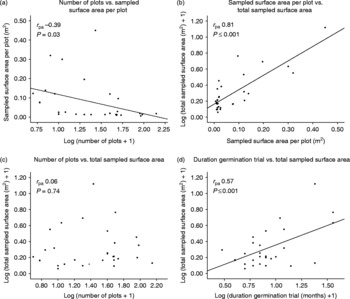
Several methodological characteristics were significantly correlated with each other. As the sampled surface area per plot increased, a significant increase in total sampled surface area was found (Pearson r = 0.81, P ≤ 0.001) (Fig. 1b). Simultaneously, the area sampled per plot significantly diminished with an increase in number of sampled plots (Pearson r = − 0.39, P = 0.03) (Fig. 1a). Total sampled surface area and the number of plots displayed no significant correlation (Pearson r = 0.06, P = 0.74) (Fig. 1c). The length of the germination experiment significantly increased as both more plot and more total surface area were sampled (Pearson r = 0.47, P = 0.008 and Pearson r = 0.57, P ≤ 0.001, respectively) (Fig. 1d). None of the remaining characteristics were significantly correlated (see supplementary Table S3, available online only at http://journals.cambridge.org).
Trade-offs between methodological study characteristics. Trade-offs were established using partial Pearson correlation coefficients between two methodological variables, controlling for all other remaining methodological variables. Regression lines are only given in the case of statistical significance of the partial Pearson correlation.

The various diversity variables were also significantly correlated with each other (supplementary Table S3). All species richness variables, i.e. total species richness (γ-diversity) and the ancient forest species variables, were positively and significantly correlated with each other. The same observation was made for frequency variables (supplementary Table S3). Ancient forest seed density variables equally correlated positively and significantly among each other (supplementary Table S3). Total seed density did relate positively to ancient forest seed density but only for the lists by Hermy et al. (Reference Hermy, Honnay, Firbank, Grashof-Bokdam and Lawesson1999) and Verheyen et al. (Reference Verheyen, Honnay, Motzkin, Hermy and Foster2003) (supplementary Table S3).
Methodology–diversity relations
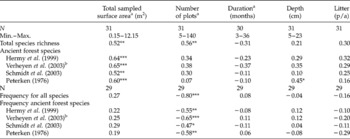
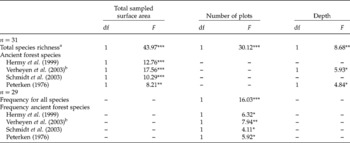
The partial Pearson correlations revealed several significant correlations. All species richness variables increased significantly as the total sampled surface area increased. The number of plots correlated positively and significantly to total species richness (γ-diversity), but showed no relation to the ancient forest species richness variables. Ancient forest species richness only increased with increasing depth sampled for the list by Peterken (Reference Peterken1976). None of the remaining correlations were significant (Table 1). Results from the GzLMs corroborated these results, as total sampled surface area proved a significant positive predictor of all species richness variables (Table 2). In addition, sampled depth proved a positive and significant predictor variable of species richness, excluding ancient forest species richness following Hermy et al. (Reference Hermy, Honnay, Firbank, Grashof-Bokdam and Lawesson1999) and Schmidt et al. (Reference Schmidt, Ewald, Fischer, von Oheimb, Kriebitsch, Schmidt and Ellenberg2003) (Table 2). Total species richness equally related significantly to the number of plots (df 1, F = 30.12, P ≤ 0.001), duration of the experiment (df 1, F = 16.30, P ≤ 0.001) and whether the litter layer was sampled or not (df 1, F = 7.72, P = 0.005). The latter three predictor variables did not explain any variation in the ancient forest species richness variables.
Partial Pearson correlation coefficient between species richness and frequency variables and each of the methodological study characteristics, controlling for all other methodological characteristics

*** P ≤ 0.001, ** 0.001 < P ≤ 0.01, * 0.01 < P ≤ 0.05.
p/a, present/absent.
a log (X+1)-transformed.
b Ancient forest species richness/frequency based on species with a Colonization Capacity Index (CCI)>10.
Main effects of the methodological characteristics in the Poisson-based Generalized Linear Models applied on the species richness variables

*** P ≤ 0.001, ** 0.001 < P ≤ 0.01, * 0.01 < P ≤ 0.05.
a Total species richness was equally dependent upon duration of the experiment (df 1, F = 16.30, P ≤ 0.001) and whether the litter layer was sampled or not (df 1, F = 7.72, P = 0.005); neither duration of the experiment nor litter layer were significant predictors to the frequency variables.
b Ancient forest species richness based on species with a Colonization Capacity Index (CCI)>10.
All frequency variables, i.e. the average frequency with which (ancient forest) species were retrieved, significantly declined as the number of plots in a study increased. None of the other explanatory variables correlated significantly to any of the frequency variables (Table 1). In the GzLMs, the number of plots was a significant explanatory variable of the frequency variables (Table 2).
Seed density variables did not correlate with any of the methodological study characteristics. Only one correlation was significant: total seed density increased as the number of plots in a study increased (Pearson r pa = 0.50, P = 0.01). The GzLMs confirmed this result, indicating that only total seed density depended upon methodological characteristics, namely the number of plots (df 1, F = 7.97, P = 0.005), duration of germination trial (df 1, F = 4.11, P = 0.04) and sampled depth (df 1, F = 5.38, P = 0.02).
On the one hand, the ancient forest species richness/total species richness ratios were not significantly (partially) correlated to total sampled surface area. The ratio based on the ancient forest species list by Peterken (Reference Peterken1976) was significantly negatively and positively (partially) correlated respectively to the number of plots and sampled depth. No other partial correlations were significant. The GzLMs partly endorsed these results. The number of plots proved a significant negative predictor of the ancient forest species richness/total species richness ratios, based on the species lists by Schmidt et al. (Reference Schmidt, Ewald, Fischer, von Oheimb, Kriebitsch, Schmidt and Ellenberg2003) and Peterken (Reference Peterken1976) (for all results on the ancient forest species richness/total species richness ratio, see supplementary Table S4, available online only at http://journals.cambridge.org).
A complete list of all seed-banking species and the average seed density at which these species were recorded in the 31 studies in temperate deciduous forests across central and north-west Europe is given in supplementary Table S5 (available online only at http://journals.cambridge.org).
Discussion
Methodological trade-offs
Seed-bank research in temperate deciduous forest appears bound by a few obvious methodological trade-offs. As the sampled surface area per plot increases, so does the total sampled area in a study (Fig. 1b). Yet, this does not appear to be the result of a higher sampling effort in terms of plots sampled (Fig. 1c). On the contrary, as the number of plots increased, the sampled surface area per plot decreased significantly (Fig. 1a). In other words, when few seed-bank plots were laid out, they were generally intensively sampled in terms of total sampled area. Hence, when a soil seed-bank study is set up, an investment in number of plot replications translates into a significant decrease in the sampled plot area, negatively affecting the retrieval of species in a plot (frequency; Tables 1 and 2). Remarkably, when a large area or a large number of plots was sampled within a study, the germination trial tended to last longer. This probably reflects the researchers' intent to invest more resources in the germination trial after a high investment of resources in sampling.
Methodology constrains seed-bank records
Although long suspected or implicitly admitted in the literature, these results quantitatively illustrate for the first time the profound impact seed-bank methodology has on total seed-bank diversity records in a study (Tables 1 and 2, Fig. 2), such as γ-diversity or a species' retrieval frequency. In essence, this is extremely important as the majority of studies (16 out of the 28 studies retrieved from ISI Web of Knowledge©) incorporated within this review aimed precisely at obtaining detailed records of seed-banking communities, as their main focus was either the restoration potential (e.g. Brown and Oosterhuis, Reference Brown and Oosterhuis1981; Dougall and Dodd, Reference Dougall and Dodd1997; Bossuyt et al., Reference Bossuyt, Heyn and Hermy2002; Amrein et al., Reference Amrein, Rusterholz and Baur2005; Zobel et al., Reference Zobel, Kalamees, Püssa, Roosaluste and Moora2007) or an accurate description of the persistent seed-banking community (e.g. Staaf et al., Reference Staaf, Jonsson and Olsen1987; Petrov, Reference Petrov1987; Kjellson, Reference Kjellson1992; Jankowska-Blaszczuk and Grubb, Reference Jankowska-Blaszczuk and Grubb1997; Jankowska-Blaszczuk et al., Reference Jankowska-Blaszczuk, Kwiatkowska, Panufnik and Tanner1998). In such instances, accurate species lists including rare and – from a restoration perspective – desirable target species, such as ancient forest species, are crucial.
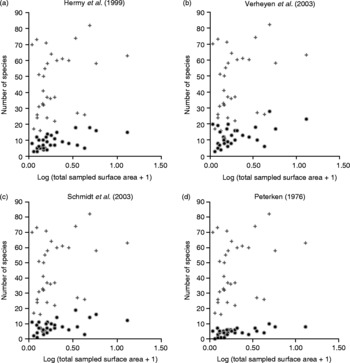
Scatterplots presenting the relation between species richness for four ancient species richness variables (black circles) and log(X+1)-transformed total sampled surface area. In each scatterplot, the total species richness (crosses) is presented as a reference.

Our results suggest that total sampled surface area, the number of plots and sampled depth are the three methodological characteristics most important in constraining total seed-bank γ-diversity, both in terms of species richness and species' retrieval frequencies (Tables 1 and 2). Moreover, as far as overall species richness is concerned, all methodological variables influence the final number of species retrieved (Table 2). Ultimately, species composition may thus be strongly affected as methodology changes the retrieval of particular groups of seed banking species, i.e. ancient forest species (Tables 1 and 2, Fig. 2). Conversely, seed density is hardly affected by the variation in methodology, despite the accuracy of seed density estimates often being reported as most sensitive to sampling methodology, notably the total sampled surface area (e.g. Thompson, Reference Thompson1986; Bigwood and Inouye, Reference Bigwood and Inouye1988; Warr et al., Reference Warr, Thompson and Kent1993; Stark et al., Reference Stark, Arsenault and Bradfield2008). Hence, this result suggests that the absolute seed density recorded does seem independent of the total area sampled, yet estimates of seed density may become more variable (and less accurate) when less surface area is sampled (Bigwood and Inouye, Reference Bigwood and Inouye1988), most likely due to the fine-scale clustered distribution of seeds in the soil (Thompson, Reference Thompson1986; Plue et al., Reference Plue, Goyens, Van Meirvenne, Verheyen and Hermy2010).
Total surface area seems to be of the utmost importance to the quality of seed-bank records. Our results unequivocally pinpoint the necessity to increase the total sampled area as much as practically feasible, as the upper limit does not yet seem to have been reached (cf. Figure 2). Importantly, however, the relation between ancient forest species richness and total sampled surface area is a logarithmic one [i.e. ancient forest species richness ~ Log(sampled surface area +1)]. This thus implies that as the total sampled surface area increases, the increase of ancient forest species is initially quite fast, but requires an increasingly larger additional surface area to be sampled to maintain this increase at the same pace. This further emphasizes the necessity to encourage at least a sizeable increase in the total sampled surface area in comparison to many of the studies included in this review, as this would imply that a great deal of ancient forest species might then be captured. However, as long as studies sampling high total surface areas remain scarce (i.e. only Brown and Oosterhuis, Reference Brown and Oosterhuis1981), it remains precarious to put forward a specific threshold that should be upheld when sampling.
Seed-bank diversity in ancient forest species: why size matters!
Ancient forest species are broadly considered to yield only transient seed banks (e.g. Hermy and Verheyen, Reference Hermy and Verheyen2007). However, we argue that this view on the non-seed-banking behaviour in ancient forest species may be biased (but see Bossuyt and Hermy, Reference Bossuyt and Hermy2001) due to the generally insufficient sampling effort in the field (Fig. 2) (as suspected by Holderegger, Reference Holderegger1996; Bossuyt and Honnay, Reference Bossuyt and Honnay2008). This inadequate sampling effort mainly appears threefold. At first, our results unequivocally show that more ancient forest species – irrespective of the list of ancient forest species used – were retrieved in the seed bank as the total sampled surface area increased (Tables 1 and 2, Fig. 2). Therefore, detecting ancient forest species (as for total species richness) seems to rely primarily upon the size of the total sampled surface area. Secondly, size also matters in terms of number of plots in a study (Tables 1 and 2). More specifically, while the number of plots will have no effect on ancient forest species richness, the number of plots does determine the frequency with which ancient forest species (and all species by extension, Tables 1 and 2) are recovered. Most likely, this is due to the plot sample area–plot number trade-off (Fig. 1a): more plots implied that less surface area within a plot will be sampled, in turn probably yielding a reduced chance of detecting ancient forest species in a plot. Finally, depth also served as a significant positive predictor of ancient forest species richness (Table 2), hinting at the possibility that ancient forest species seeds are more persistent than so far hypothesized (positive depth–persistence relation; Bekker et al., Reference Bekker, Bakker, Grandin, Kalamees, Milberg, Poschlod, Thompson and Willems1998).
Unlike ancient forest species, a great many seed-banking species do remain frequently recorded irrespective of the number of plots sampled or the sampled surface area (e.g. Cirsium arvense, Hypericum perforatum, Juncus effusus, Plantago major, Urtica dioica). These, often light-dependent, species mostly rely upon small, highly persistent seeds (Thompson et al., Reference Thompson, Bakker, Bekker and Hodgson1998) as the prime vehicle for their local long-term survival in the spatiotemporally variable forest environment. Therefore, these species invest in seed number (many small seeds) rather than seed quality (few, large seeds in ancient forest species; Hermy et al., Reference Hermy, Honnay, Firbank, Grashof-Bokdam and Lawesson1999), with their seeds consequently being more abundantly scattered across the soil surface. Therefore, these species will be retrieved more easily when a reduced surface area is sampled, as opposed to the scarcer seeds of ancient forest species and other less fecund forest-dwelling species (e.g. Geum urbanum, Cardamine pratensis) or rarer early-successional species (Solanum dulcamara, Atropa bella-donna). Because of the latter, equally rare seed-banking species contributing to the seed-bank community, ancient forest species do not appear uniquely rare compared to the whole seed-bank community (i.e. constant ancient forest species richness/total species richness ratio; Fig. 2). Seed banking in ancient forest species may thus be a more prevailing trait than formerly imagined, likely through the apparent methodological failure in detecting them (this study; Holderegger, Reference Holderegger1996; Bossuyt and Honnay, Reference Bossuyt and Honnay2008).
Future ‘best practice’ for seed-bank research in forests
We by no means intend to label previous or future seed-bank research in forests as inadequate. On the contrary, our primary aim is to raise awareness of the far-reaching impact of seed-bank methodology on seed-bank records in temperate deciduous forests and, ultimately, the conclusions or hypotheses drawn from sub-optimally collected data. Nonetheless, the need to streamline future seed-bank sampling to increase reliability of seed-bank records and comparability among studies, drives us to formulate a set of future ‘best practice’ sampling guidelines in temperate deciduous forests aimed at retrieving ancient forest species, in a decreasing order of importance:
● Maximize the total surface area that is sampled in a particular study.
● Based on the trade-off in plot number versus plot sampling effort (Fig. 1a), we advise researchers to collect core samples within small plots (e.g. 2 m × 2 m). Compared to an identical sampling effort in a 10 m × 10 m plot, these are then sampled more intensively and thus more precisely.
● Seed-bank patterns at coarser scales within a forest stand can be accommodated by sampling several small plots within that stand.
● Given the retrieval of ancient forest species at greater sampling depths, a depth of 10 cm should be respected.
While this study subscribes to the well-established theorem that sampling more soil will retrieve more species, it is not the punchline of this study. The most important find of this study is that intensive sampling captures ancient forest species, which according to mainstream literature are not even supposed to be there. Indeed, next to conventional seed-bank literature, the low Seed Longevity Index (i.e. a theoretical-empirical proxy of seed persistence) in ancient forest species is often used to back the hypothesis of non-persistence of ancient forest species (e.g. Verheyen et al., Reference Verheyen, Honnay, Motzkin, Hermy and Foster2003). However, the Seed Longevity Index depends precisely upon the number of times a species was retrieved from the seed bank (Bekker et al., Reference Bekker, Bakker, Grandin, Kalamees, Milberg, Poschlod, Thompson and Willems1998), using those designs which apparently fail to adequately retrieve ancient forest species. Hence, this circular reasoning sustains the biased view on the non-seed-banking behaviour in ancient forest species, despite discordant reports in, for example, Brown and Oosterhuis (Reference Brown and Oosterhuis1981), Jankowska-Blaszczuk and Grubb (Reference Jankowska-Blaszczuk and Grubb1997), Leckie et al. (Reference Leckie, Vellend, Bell, Waterway and Lechowicz2000), Bossuyt and Hermy (Reference Bossuyt and Hermy2001) or Wódkiewicz and Kwiatkowska-Falinska (Reference Wódkiewicz and Kwiatkowska-Falinska2010).
Therefore, we are convinced that persistently low sampling efforts may miss ancient forest species and may thus lead to incorrect views, conclusions and hypotheses concerning seed banking in temperate deciduous forests. Accordingly, we therefore believe it is important to maximize the total sampled surface area, in order to achieve a higher quality of seed-bank data.
Acknowledgements
J.P. wishes to thank Dr Rebecca Devlaeminck and Dr Inga Schmidt-Mölder for making their seed-bank data available. J.P. was partly funded by an open postdoctoral grant from the Swedish Research Council for Environment, Agricultural Sciences and Spatial Planning (FORMAS). We thank the four reviewers who, through their comments, helped to improve the manuscript.