Introduction
Chilean musicians are today scattered through the world. The ones remaining in Chile are sometimes scattered as well. Our goal is to get together and do something for a music that was uprooted from its people. … We, performers and scholars, stand up alone, only with a score and an instrument in our hands, and we sing to Chile and its music.Footnote 1
In October 1985, the Asociación Musical Anacrusa (Anacrusa Music Association) began the programme notes of its first music festival by stating a feeling of isolation and denouncing the dispersion and alienation of Chilean music from the country's people. Twelve years after the military coup of 11 September 1973, and still under Pinochet's military dictatorship, Chilean cultural life offered little opportunities for the development of a local contemporary music scene. The murder of emblematic figures, such as the conductor and Latin American pioneering figure of the youth orchestra system Jorge Peña Hen (1928–73), the exile of several composers and musicians, and the de-articulation of the cultural institutions of Salvador Allende's government, the Unidad Popular (Popular Unity, 1970–73), had a significant impact on the country's musical life. The Music Faculty of the Universidad de Chile, which had organized the work of the main ensembles and festivals devoted to twentieth century music since the 1940s, lost autonomy through the designation of university rectors by the military junta, leading to a reduction in the budget for musical activities and to the dismissal of students and professors.Footnote 2
Created as an independent association in 1984, although with strong links to the Universidad de Chile, Anacrusa developed a project for the promotion of Chilean and Latin American contemporary music, organizing concerts, workshops, and lectures that frequently took place at the Goethe-Institute Santiago. As a ‘West German island’ protected by the norms of cultural diplomacy, the Goethe-Institute offered a suitable place for these events, enabling freedom of expression. This article consists of two parts. In the first, I study the institutional role of the Goethe-Institute Santiago in Chilean musical life, especially concerning its support for the development of a contemporary music scene during the military dictatorship, as seen in its collaboration with Anacrusa. In the second, I explore the circulation and reception of musical works by Chilean composers living in exile. I focus on the music performed in three festivals organized by Anacrusa during the last years of the dictatorship (1985, 1987, and 1989), which constitute the association's most representative events. I take three works performed at these editions of the festival, Gustavo Becerra-Schmidt's (1925–2010) ‘Bericht über den Tod eines Genossen’ (‘Report about the Death of a Comrade’) from Triptychon (1981) for voice and piano, Sergio Ortega's (1938–2003) Ayes y lamentos por Alejo Carpentier (Sighs and Laments for Alejo Carpentier) (1983) for solo harpsichord, and Fernando García's (b. 1930) Tierras ofendidas (Offended Lands) (1984) for flute, oboe, and clarinet as a point of entrance into an exploration of the aesthetic, political, and personal significance of these events.
As cultural artefacts with a complex history, the musical works by Becerra-Schmidt, Ortega, and García found their way to Chile through intertwined paths. Their Chilean performances were not only the result of the encounter between musicians residing in Chile and those living in exile, but were also facilitated through West German cultural diplomacy, the exchanges with Latin American colleagues, and by performers who had recently returned from exile. The material journey of musical scores and letters from Cuba and Europe was also essential for the circulation of this music. All this must be understood as a network of interactions between a wide variety of agents and agencies. In that sense, I understand the process of circulation of Chilean music from the exile as an histoire croisée, as proposed by Michael Werner and Bénédicte Zimmermann; a history that makes evident an intercrossing of different scales and points of view.Footnote 3 In this article, I propose an intersection between a broader historical context that frames West German cultural diplomacy in Chile and a microhistorical perspective that takes as a point of departure the circulation of three particular musical works.Footnote 4 A combination of these interpretative perspectives provides a productive framework for understanding the interactions between the musical generation that grew up during the military dictatorship in the 1980s and the ‘lost’ Chilean musical avant-garde of the 1960s. As stated by Anacrusa in the quotation that opens this article, the disconnect between these two generations was clear and the interactions I focus on here are some of the first attempts at bridging that gap. Since there is a lack of research on the relationship between art music composers living in exile and the local Chilean musical scene, Anacrusa's strategies to address the situation provides an ideal point of entry for further research on this topic.
The Goethe-Institute Santiago during the Chilean dictatorship, 1973–1990
Originally established in 1932, the Goethe-Institute was restructured in 1951 as part of a major re-orientation of the Federal Republic of Germany's (FRG) cultural diplomacy programmes. Although organized as an autonomous non-profit cultural institution (Verein), the Goethe-Institute's activities were expected to be aligned with the goals of its main sponsor, the FRG's Federal Foreign Office. Gradually, during the years of the Cold War, the Goethe-Institute developed a strong international network on the basis of the programmes and activities of the German binational cultural institutes operating in different countries throughout the world.Footnote 5
In Chile, the Instituto Chileno-Alemán de Cultura (Chilean-German Cultural Institute) was created in 1952, shortly after the first West German embassy was opened in Santiago. In 1961, the Goethe-Institute Santiago was founded and in December 1963 both institutions relocated to an upscaled building acquired in the city centre. The new concert hall of the Goethe-Institute, with a capacity of c. 400 people, built on the Instituto Chileno-Alemán's reputation as a fine space for chamber music. By 1964, the Goethe-Institute Santiago was recognized as one of the most culturally active Goethe-Institutes in the Americas; it was particularly known for its programmes of art music.Footnote 6
The Goethe-Institute Santiago and the Embassy of the FRG worked closely together and reported their cultural activities to the Federal Foreign Office through annual reports. The musical programming during the 1950s and 1960s was in general oriented to the promotion of the German musical canon.Footnote 7 However, since the mid-1960s, this emphasis began to morph into a project aimed at cultivating the values of a renewed West German culture in the world, including jazz and a strengthening of the presence of contemporary music. In December 1970, Willy Brandt's government presented its ‘Guidelines for Foreign Cultural Policy’ (Leitsätze für die Auswärtige Kulturpolitik). The reform was centred on an expanded concept of culture (‘erweiterter Kulturbegriff’) that understood it not as a ‘privilege for elitist groups anymore, but [as] an offer for everyone. … [Culture] is part of the process of dynamic transformation of our society, which delineates the paths of international cooperation among all social groups.’Footnote 8 Opening to ideas that generated lively debates in West Germany – for example, democracy, ecology, or memory – and strengthening international cooperation, cultural work abroad was no longer considered a matter of short-term events, but a project of long-term collaborations with local partners. For the music field, this meant trying to find an updated alternative to the German notion of Kulturnation. As such, the old emphasis on the German music canon was ‘expanded’ with the mounting presence of other types of musical manifestations.
This change into an expanded cultural conception was contemporary with Allende's government, which was perceived by the FRG with scepticism. The positioning of the FRG in the cultural field was especially important during these years, since the Goethe-Institute was implicitly competing with the GDR and its ‘Instituto Chileno-Alemán Democrático de Cultura’. After the military coup of 1973, the FRG offered political asylum to Chilean refugees and pleaded for the respect of human rights. Nevertheless, unlike the GDR, Italy, England, and other countries, and expecting an eventual democratic election, the FRG did not break diplomatic relations with the Chilean dictatorship. When it became clear that the country was moving towards a long authoritarian regime, the FRG decided to maintain its cultural programming as a way of encouraging democracy. Furthermore, throughout the years of Pinochet's regime, the Goethe-Institute became the most active European cultural institute in Chile, comparable only with the intense activity of the cultural institute of the United States (Instituto Chileno-Norteamericano de Cultura).Footnote 9
The role of music in the context of the Chilean dictatorship was discussed in the official communications between the Goethe-Institute, the FRG embassy, and the Federal Foreign Office. As stated in the cultural-political reports for 1973 and 1975, the traditional audiences for art music were part of a rather small Chilean elite. However, contemporary music could become a tool to encourage a democratic attitude, considering that artistic experimentation had practically disappeared from cultural life.Footnote 10 Nevertheless, the West German embassy was aware that generally, in Chile, the musical avant-garde was associated with leftist political orientations and that support of this music should be carefully planned in order to achieve continuity. As stated in the 1979 annual report:
The efforts of the [Goethe-]Institute in providing a space for the young Chilean musical avant-garde must be especially recognized. Obviously, the avant-garde's inherent and typical connection with ‘leftist tendencies’ is not always uncritically accepted by some governmental circles. However, in general terms we can affirm that the [Goethe-]Institute is making a clever use of its limited space of action, making good use of the available resources.Footnote 11
During the first years of the military dictatorship, the Goethe-Institute collaborated with the Universidad Católica's contemporary music festivals and developed the project ‘Estudio de la Nueva Música’, directed by the German conductor Ernst Huber-Contwig, which regularly offered workshops and concerts. During the 1980s, the Chilean quintet Ensemble Bartok offered concerts and festivals at the Goethe-Institute.Footnote 12 In 1984, Heinz Jürgens was appointed director of the Goethe-Institute Santiago. That year, with financial sponsorship from the Goethe-Institute, Helmut Lachenmann and the Ensemble Modern visited Chile for the first time. The ensemble, along with Chilean composer Juan Allende-Blin, would return in 1992, also with the institute's support. In his first annual report to the embassy, Jürgens explains that no similar event was planned for 1985, although Chilean composers and musicians, ‘all fans of Lachenmann and the Ensemble Modern’, were conceiving their own musical projects in collaboration with the institute.Footnote 13 The support given to Anacrusa's projects during the next couple of years followed the ‘Guidelines for Foreign Cultural Policy’, in an attempt to strengthen the work with local partners on long-term projects, setting up the stage for a critical democratic transformation of the country's political landscape.
Collaboration between Anacrusa and the Goethe-Institute Santiago
Most of the ‘Lachenmann fans’ mentioned in Jürgens’ report had studied at the Music Department of the Universidad de Chile. By 1984, the year Anacrusa was founded, they were in their thirties. This group included musicologists (Carmen Peña, Juan Pablo González, Rodrigo Torres, Denise Sargent), composers (Guillermo Rifo, Cecilia Cordero, Gabriel Matthey), and performers (Pedro Sierra, Clara Jury, Rodrigo Díaz).Footnote 14 The organization of the Anacrusa festivals was coordinated by pianist Cecilia Plaza and composer Eduardo Cáceres, in whose house the Anacrusa meetings took place. Being one of the older members of Anacrusa and having been a teacher and mentor to several other members of the group, pianist and composer Cirilo Vila (1937–2015) was one of the groups’ inspirational figures.
Beside the organization of concerts and festivals, Anacrusa also worked to develop a sense of community and provide a protected space for freedom of expression in the context of the military dictatorship. At the association's meetings, members felt free to talk about music as well as political topics that would not otherwise be easy to discuss in public without fear of being spied on and the conversation reported to the Central Nacional de Informaciones (National Information Center, CNI), the regime's intelligence agency. These concerns were still prevalent in the mid-1980s. The Goethe-Institute Santiago provided a similarly safe space; although the military or national security forces could enter the institute's foyer, the institute's status as a West German diplomatic corps prevented them from having access to the concert hall. Thus, the institute's backyard was often used for political discussions. In fact, Jürgens encouraged this use of the premises; for example, the institute would organize presentations of censored movies – people would come with sleeping bags, since the movies often ended after the curfew.Footnote 15 Nevertheless, surveillance and acts of intimidation were still common. The minutes of one of Anacrusa's notebooks state that in 1987 a similar notebook with information about the organization's meetings had been stolen along with other objects from a yellow Fiat 147 that belonged to Cáceres and was parked outside of the institute.Footnote 16 From an institutional perspective, the Goethe-Institute Santiago was not a completely free-operating enterprise during those years; it did lose a certain degree of independence since a German Verein was no longer recognized as an autonomous entity. For this reason, the director had to report the institute's activities to the board of the Instituto Chileno-Alemán, while the later was in charge of signing legal documents concerning budget and programming. Even after the return of democracy at the beginning of the 1990s, Dieter Strauss, Jürgens's successor as director of the Goethe-Institute, had frictions with the board of the Instituto Chileno-Alemán due to his work with retornados (individuals who came back from the exile). Strauss was severely criticized for organizing a retrospective film cycle of renowned writer and filmmaker Antonio Skármeta (b. 1940). These sorts of problems eventually led to him being sent back to Germany in 1992, after only two and a half years in Chile.Footnote 17
Anacrusa's biggest events were the four ‘Encuentros’, or festivals, organized in 1985, 1987, 1989, and 1994 at the Goethe-Institute Santiago, as well as a summer course in 1992 in La Serena, in northern Chile.Footnote 18 After a first festival devoted to Chilean music in 1985,Footnote 19 the 1987 festival was dedicated to the Southern Cone and included the collaboration of the Goethe-Institutes of Buenos Aires, Córdoba, and Montevideo, as well as the support of the Instituto Paraguayo-Alemán de Cultura.Footnote 20 The latter financed the travel costs of the composers Alicia Terzian and Gerardo Gandini from Buenos Aires, Óscar Bazán from Córdoba, Coriún Aharonián from Montevideo, and Luis Szarán from Asunción. The 1989 festival, devoted to Latin America, reached the largest number of participants, with around thirty guests. Nearly half of the visitors’ expenses were financed by the Goethe-Institutes of Buenos Aires, San Juan, Mendoza, and Córdoba (in Argentina), Caracas (Venezuela), La Paz (Bolivia), Bogotá (Colombia), Porto Alegre and Belo Horizonte (Brazil), and, yet again, the Instituto Paraguayo-Alemán.Footnote 21 The festival included six concerts and an electroacoustic presentation at the Goethe-Institute, as well as courses and workshops at Universidad de Chile. Anacrusa's festivals also evidence a connection with the Cursos Latinoamericanos de Música Contemporánea (CLAMC, 1971–89), including the participation of Aharonián (1987 and 1992), Gilberto Mendes and Mariano Etkin (1992), Cergio Prudencio (1989 and 1992), and other members of the CLAMC network, to which Eduardo Cáceres also belonged.Footnote 22 The connections between Anacrusa and the CLAMC not only contributed to the building of Latin American networks during the late 1980s and 1990s, but since organizers and participants at the CLAMC considered music as a tool for political and cultural resistance, this conception also influenced and shaped the discussions at the core of the Anacrusa festivals.Footnote 23
The Goethe-Institute was an active sponsor of new music projects throughout the Southern Cone from the early 1970s. It collaborated with the CLAMC from the inauguration of those workshops in 1971 and lent its space for the fifth and sixth CLAMC events that took place in 1976 and 1977 in Buenos Aires.Footnote 24 As in the case of Anacrusa, the Goethe-Institute also supported the concerts of the Núcleo Música Nueva, a Uruguayan contemporary music association to which Aharonián and his wife, composer Graciela Paraskevaídis, belonged. Although these activities exceed the limits of this article, it is important to note that the study of the Goethe-Institute's transnational support to contemporary music initiatives throughout South America would allow new perspectives for the study of musical developments in the region. This would be especially important in the case of projects and networks established by socially engaged musicians through the rise of military dictatorships in the area.
The establishment of a series of Latin American networks through its festivals allowed Anacrusa to achieve one of its main goals: overcoming the isolation of these contemporary music scenes. Photographic and videographic evidence shows that the concerts were always well attended. The audiences were not only conformed by musicians, but they were a mixed group of younger and older people. The concerts, roundtables, and other activities enabled access to the musical production of a wide variety of composers from all over Latin America as well as the ideas and discourses these musicians favoured.Footnote 25
While the main goal of the Anacrusa festivals was to allow for these crucial pan-Latin American exchanges, the festivals also generated and spread a positive image of the FRG. Although not directly present, West German music culture was implicitly involved, since some of the Latin American guests sent to Chile through the Goethe-Institutes were also former DAAD fellows or had spent some time in Germany, as was the case for Aharonián and Paraskevaídis. Cecilia Plaza, the main pianist of Anacrusa, had studied in Cologne in 1983 and 1988. Anacrusa also planned to invite Karlheinz Stockhausen and Hans Werner Henze to Chile in 1989.Footnote 26 Although these invitations could not be carried out, they show an interest in the German music avant-garde that was mediated by the institutional network of West German cultural diplomacy.
The Chilean Exile in the 1985, 1987, and 1989 Anacrusa festivals
A panoramic study of Chilean composers living in exile during the military dictatorship and their interactions with local Chilean musical life is still pending. In his doctoral dissertation, Mauricio Gómez Gálvez has contributed to this topic by outlining the European trajectories of Sergio Ortega and Patricio Wang (b. 1952). Overall, Gómez Gálvez observes that the first years of the military dictatorship were marked by a more ‘combative’ attitude among exiled composers. This is expressed in works of an explicit political intention that denounce the violence and abuse of human rights of the Pinochet dictatorship. Some examples include Becerra-Schmidt's Corvalán (1974) and Chile 1973 (1974) for voice and electronics and for orchestra, respectively; Gabriel Brnčić's Cueca para la exaltación de Jorge Peña Hen (1975–76) for two guitars; and Ortega's Chacabuco (1975) for piano as well as his cantata La dignidad (1979). This attitude can be also extended to some works by composers who, although living abroad, were not experiencing political persecution; for example, Juan Orrego-Salas's cantata Un canto para Bolívar op. 78 (1978) composed for the Nueva Canción group Quilapayún; León Schidlowsky's Misa sine nomine (1976–77) for choir, percussion, and organ; and Leni Alexander's Ils se sont perdus dans l'espace étoilé (1975) for ensemble; the last two dedicated to the memory of Víctor Jara, the popular Nueva Canción singer who was murdered by the military at the outset of Pinochet's dictatorship. Gómez Gálvez suggests that the works written in exile during the 1980s reflect the gradual integration of these composers to their new life experiences abroad.Footnote 27
An undated document from Anacrusa's archive entitled ‘Fissure of ’73: Summary’ presents a list of composers who left Chile due to the military coup, indicating their new countries of residence. This document, evidently connected to Anacrusa's main goal of establishing contact with Chilean composers and musicians throughout the world, maps out a partially unknown history via its missing protagonists.Footnote 28 The list includes Eduardo Maturana, living in Panama; Enrique Rivera and Edmundo Vásquez, residing in Germany; Ortega, who settled in France; García, who took up residence in Cuba; and Melikof Karaian, who moved to Austria. It also includes composers who had left Chile before 1973, such as Jorge Arriagada, living in France; Schidlowsky, settled in Israel; Brnčić, who had moved to Spain from Argentina; and Becerra-Schmidt and David Serendero, who resided in the FRG. As chief coordinator of Anacrusa, Eduardo Cáceres maintained an intense correspondence with Chilean composers abroad and actively encouraged them to send scores for the festival. This includes correspondence with some of the main figures of the 1960s leftist avant-garde, especially members of the Chilean Communist and Socialist parties such as Becerra-Schmidt, Maturana, Ortega, Brnčić, and García. Cáceres also established contact with Orrego-Salas, who had been residing in the United States since 1961 as the director of Indiana University's Latin American Music Center. Orrego-Salas, who was in Chile attending an architecture congress in 1987, participated in the festival that year. Leni Alexander, one of the few female composers programmed in the festivals, was living in Paris when the military coup happened. During the 1980s she alternated residences between Chile, France, and Germany, but continued sending her music while living in Europe.Footnote 29
The 1985 festival included works by Becerra-Schmidt and Brnčić. Brnčić vividly remembers the difficulties in sending his piece, Bach y las monedas (1980) for magnetic tape, to the festival from Barcelona. In the end, the piece was sent in a cassette recording brought personally to Chile by his friend Fernán Díaz, ‘extending a bridge between the exile and the homeland’.Footnote 30 The 1987 festival also included pieces by Brnčić, Becerra-Schmidt, and Ortega. The 1989 festival featured García's Tierras ofendidas (1984) and Celso Garrido-Lecca's Simpay (1988) for guitar. Born in Peru, Garrido-Lecca had studied in Chile and was also part of the politically committed generation of the 1960s. This edition of the festival also included works by younger Chilean composers settled in Europe, including Wang, Ramón Gorigoitia, and Vladimir Wistuba. Their pieces are included in the double cassette featuring some of the music played at that festival.Footnote 31
Gustavo Becerra-Schmidt: ‘Bericht über den Tod eines Genossen’
The music of Becerra-Schmidt played an important role during the first Anacrusa festival. Two of his choral works were performed by the vocal ensemble Collegium Josquin and conducted by Alejandro Reyes at the first concert, on 1 October 1985; and an homage to him was included as part of the concert on 5 October. This homage featured Manos de obreros (1967) for voice and guitar, performed by Rosario Cristi and Luis Orlandini; Trozo (1961) for solo cello performed by Celso López; and two lieder from his Triptychon (1981) with texts by Bertold Brecht (I. ‘Herr Doktor’ and II. ‘Bericht über den Tod eines Genossen’) performed by Hanns Stein (b. 1926) and Cirilo Vila. Since the score of the second lied is published and a recording of the performance is available, I have chosen to focus my microhistorical analysis on this piece.Footnote 32
The recording of ‘Bericht über den Tod eines Genossen’ includes about fifteen seconds of the final ovation, with enthusiastic whistles included. Since the lyrics were sung in German, a language only few in the audience could understand, and a translation was not provided, one can assume that the cheering applause was not a consequence of understanding the literary content of the lied, but rather a corollary of the broader symbolic meaning of the performance. Becerra-Schmidt, who had been awarded Chile's National Music Prize in 1971, was a renowned composer, professor, and music theorist in his country.Footnote 33 The intense homage of the 5 October concert shows that this memory had prevailed in his country through the years of the dictatorship.
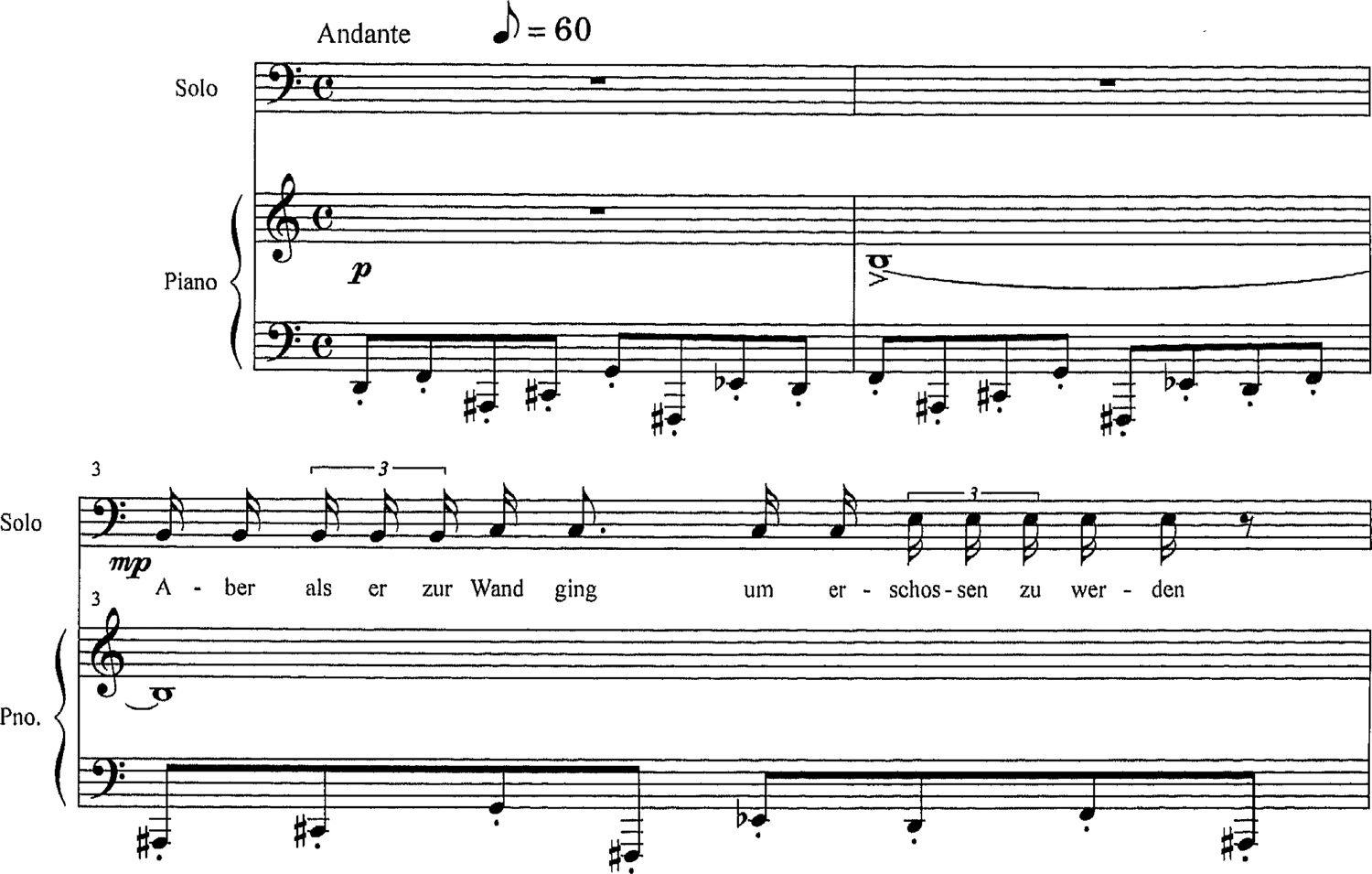
Becerra-Schmidt was the cultural attaché of the Chilean embassy in Bonn in 1973. Upon the impossibility of returning to Chile after the coup, he accepted an invitation from the University of Oldenburg and became a professor there in 1974. When Cáceres lived in Cologne in 1983, he established contact with Becerra-Schmidt and became his private student, attending intensive weekend-long composition lessons with him in Oldenburg. When Cáceres returned to Chile, he asked Becerra-Schmidt to send some of his works for the Anacrusa festivals. Aware of the potential trouble of sending overtly political works, Becerra-Schmidt proposed pieces with a less evident political content.Footnote 34 It is possible that this concern also motivated his choice to favour a song with a German text. The musical setting is simple and presents no evident political connotations. The left hand of the piano plays an ostinato of quavers in staccato based on D, F, A♯1, C♯, G, F♯1, and E♭1. Since the score is set in 4/4, the seven notes of the ostinato are constantly shifting to different metric positions. The right hand and the voice are based on the remaining five notes of a chromatic scale (B, C, E, G♯, A). Owing to the use of repeated notes and the intervals of major and minor second, the vocal line acquires the character of a recitative (Example 1). In line with the socially engaged aesthetic represented by German lieder of composers such as Hanns Eisler or Paul Dessau, the setting of Brecht's poem avoids unnecessary ornamentation in an attempt to highlight the dramatic poetic images – in which a man walking to his own execution, notices that the walls, the guns, the bullets, and the chains he is wearing were made by people just like him – in an austere way.
Becerra-Schmidt: ‘Bericht über den Tod eines Genossen’, bb. 1–3. Archive Gustavo Becerra-Schmidt, University of Oldenburg.

At the Anacrusa festival, Becerra-Schmidt's lied was sung by Hanns Stein, a Chile-based singer, with whom the composer already had a long-standing history of musical collaborations. Having escaped Nazism from the Czech Republic in 1939, Stein spoke both Czech and German fluently; he was an active member of the Chilean Communist Party, and, since the mid-1960s, he sung lieder by Eisler, Dessau, and Kurt Weill in Chile. Stein was a true champion of the politically committed German song tradition who inspired young composers such as Becerra-Schmidt, García, Maturana, and Ortega to compose lieder for him. In their use of atonal and dodecaphonic textures and Sprechgesang the Chilean politically engaged lieder wrote by these composers in the mid-1960s are close to the aesthetics of German expressionism.Footnote 35 At the Anacrusa concert, Stein was accompanied on the piano by Anacrusa's member Cirilo Vila, who was a former student of Becerra-Schmidt and had returned to Chile in 1970, after studying with Max Deutsch and Olivier Messiaen in Paris. In 1971, Vila and Stein had released an LP together, Eisler-Brecht: Canciones, with the label DICAP.Footnote 36 During the dictatorship, Stein and his family went into the exile in East Berlin, where Stein became a professor at the Hanns Eisler Musikhochschule. While in exile, Stein continued singing lieder by Chilean composers and re-established the contact with Becerra-Schmidt. When Stein returned to Chile in 1980, the Goethe-Institute Santiago offered him some of the few performing possibilities he had in the country. On the other hand, Vila, who was not a member of any political party, had managed to maintain, not without difficulties, his teaching position at Universidad de Chile during the dictatorship. However, Vila experienced harassment and threats about losing his position at the university among other things due to having played concerts with Stein. In fact, in 1987, he was almost fired when he was accused of supporting a student strike against José Luis Federici, rector of the Universidad de Chile.Footnote 37 In sum, the fact that Vila agreed to play with Stein at the Anacrusa festival in 1985, when Pinochet was still in power, could be understood as an act of political resistance that involved real professional risks.
According to Becerra-Schmidt's work catalogue, the lied was premiered in Oldenburg, while Stein and Vila had already performed it at the Goethe-Institute in 1984.Footnote 38 In August 1986, Becerra travelled to Chile and was present at the release of Anacrusa's festival cassette, where his song was included.Footnote 39 In August 1988, Becerra-Schmidt visited Chile again and attended meetings and concerts dedicated to his works in Santiago and Viña del Mar. On 23 August, Vila and Stein performed ‘Bericht über den Tod eines Genossen’, now in the presence of the composer.Footnote 40 The performance of this short lied in the German language symbolized an encounter between the memory of the politically engaged music movement previous to 1973, the exile trajectories of Becerra-Schmidt and Stein in both Germanies, and the effort of local musicians to keep the presence of this recognized composer alive in the country.
Sergio Ortega: Ayes y lamentos por Alejo Carpentier
Ayes y lamentos por Alejo Carpentier had its Chilean premiere on 3 October 1987, with Maite Daiber on harpsichord, and was included in the double cassette of the second festival.Footnote 41 During Allende's government, Ortega had been a professor at Universidad de Chile and artistic director of the university's television channel (Canal 9). He had also collaborated with Nueva Canción musicians including Víctor Jara, Isabel Parra, and Quilapayún. After 1973, Ortega established himself in France and became director of the conservatory of Pantin, near Paris.Footnote 42
Well known as the composer of some emblematic songs of the Chilean resistance, such as ‘Venceremos’ (1970) and ‘El pueblo unido’ (1973), Ortega's instrumental art music compositions are less familiar. As in some of his other works, in Ayes y lamentos por Alejo Carpentier (1983) elements of the Western art music tradition are merged with elements of Latin American popular and traditional music.Footnote 43 The piece was written for Richard Siegel, North American harpsichordist and teacher at the Pantin conservatory, who premiered it at the Venice Contemporary Music Festival in February 1983.Footnote 44 It was written as an homage to the famous Cuban writer Alejo Carpentier after his death in 1980. Carpentier had lived in Paris since 1966, working as cultural attaché for the Cuban government. Sharing a common political ideology, it is very likely that Ortega and Carpentier personally met in the French capital. Although the title speaks of Ayes y lamentos, alluding to ‘lamentations’, in a letter to Cáceres, Ortega states that Carpentier's death should be celebrated with happiness:
Alejo Carpentier's death, a man of such an accomplished and full life, a brilliant Cuban intellectual, was to me a privileged moment [to allow us] to contemplate his work and life in this world as a whole. This observation filled me with enthusiasm, happiness, and hope (and of course, I am a professional of hope), because it is still possible – and always more – that men like Carpentier exist and are recognized, not only internationally, but also in their own country and by their own people; for the biggest ones, this has been always the most important thing.
(La muerte de Alejo Carpentier, hombre de vida tan lograda y tan llena, brillante intelectual cubano, apareció para mí como un momento privilegiado para contemplar como un todo su obra y su paso por el mundo. Esta observación me llenó de entusiasmo, alegría y esperanza (de la esperanza soy un profesional, naturalmente), ya que sigue siendo posible – y cada vez mas – que hombres así, como Carpentier, se produzcan y sean reconocidos, no solamente en el mundo entero, sino en su propio país y por su propio pueblo, lo cual ha sido siempre lo más importante para los más grandes.)Footnote 45
Having been written in exile, this optimistic statement becomes a nostalgic touch. If Carpentier was celebrated in Cuba, what were his thoughts about his own recognition in Chile? The message, written in the context of an isolated performance of one of his instrumental pieces in a distant Chile, reads like a critique between the lines.
Although the piece presents no direct political message, Ortega explains in his letter that it
shows some of Carpentier's loves, [the love] for apparently simple ways of expression that gives voice to those whose voices are barely heard, as well as [love for] for the pleasure of writing; these loves that are also mine.
(muestra algunos de los amores de Carpentier, por la expresión de apariencia simple, que da voz a tantos cuyas voces casi no se escuchan, y por el placer de escribir, amores que son también los míos.)Footnote 46
The conception of giving a voice to the ‘people’ is represented though the use of guajiras, ‘todas originales – tocadas a la Chacón’.Footnote 47 The designation ‘a la Chacón’ playfully merges the baroque ciaccona with a resemblance of Cuban ‘son’ or ‘danzón’. A Cuban touch is also implicit in the initial indication ‘Dolce – ostinato sabroso’, that is, an ostinato with Cuban taste or ‘flavour’.Footnote 48
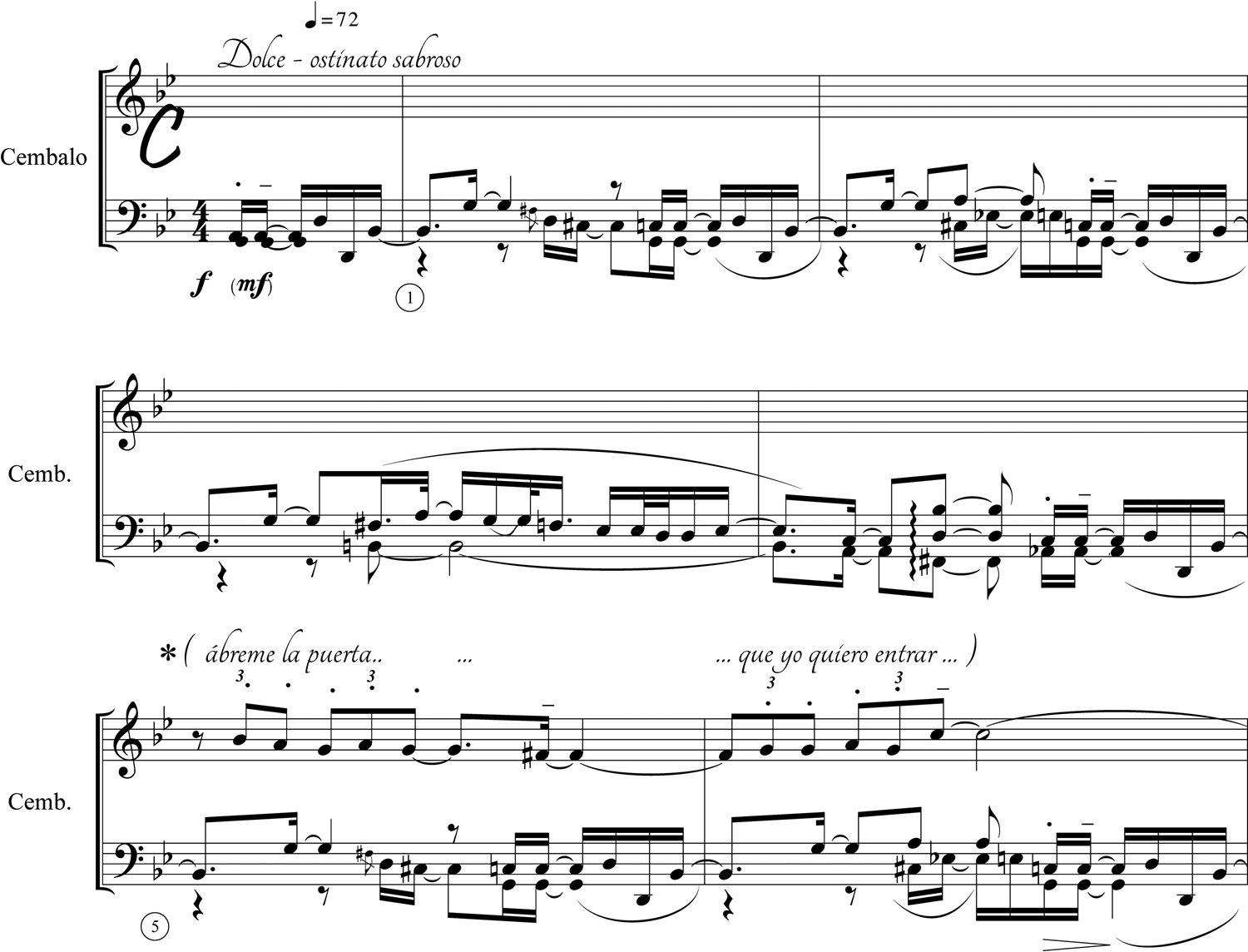
Over a syncopated bass ostinato, the guarijas are successively presented and used as material for thematic development in a general chromatic environment. The guajira is announced on the score with each new thematic exposition. Ortega indicates that the instrumentalist should either rhythmically declaim or sing them (Example 2). The last section is a final cadenza that invites to improvisation on a musical material called ‘Los troncos y las lianas’.Footnote 49 In Daiber's recording, she chose to sing the first themes, while the word ‘Jamás’ (‘never more’, b. 41) was declaimed, as though resembling a political statement.
Ortega, Ayes y lamentos por Alejo Carpentier, 1983, bb. 1–6. Transcription Daniel Meza.

In the use of the harpsichord and the allusion to the baroque ciaccona with a final virtuousic cadenza, Ayes y lamentos por Alejo Carpentier connects to Carpentier's own predilection for the baroque period.Footnote 50 The premiere in Venice is relevant in this context, being the same scenery of Carpentier's classic novel Concierto barroco (1974). In this novel, a Mexican lord in Montezuma costume and his servant Filomeno end the carnival night playing an improvised concert at the Ospedale della Pietá, with the participation of Antonio Vivaldi, Georg Friedrich Handel, Domenico Scarlatti, and Filomeno playing Afro-Latin American rhythms with kitchen artefacts. Just as tongue-in-cheek as Carpentier's text, Ortega emphasizes in this piece the possibility of an original and playful encounter between European, Indigenous, and African heritage, from which Latin American art music was born.
Maite Daiber, the Chilean performer of the piece, had also lived through the experience of exile. In 1974, Daiber's husband, Gonzalo Toro, a lecturer at the music department of the Universidad de Chile and a militant of Movimiento de Izquierda Revolucionaria (MIR), went missing after being arrested. Just as it happened with over 1,000 political disappearances during this period, Toro's case is still unresolved. When this occurred, Daiber was prevented from continuing her musicology studies at Universidad de Chile. As a result, she moved to Dublin, Ireland, where she received a scholarship to study at Trinity College. Later she received a degree in harpsichord performance from the Royal Academy of Music in London. At the beginning of the 1980s, while living in Italy, Daiber was able to return to Chile, where she made a living as a harpsichord player and pianist. As stated in an interview, Daiber only came to play Ortega's piece because of her painful life experience, which had unexpectedly resulted in the opportunity to become a harpsichord player.Footnote 51 Being a former student of the Universidad de Chile, Daiber knew Ortega, as well as most of the composers forced into exile. Playing at the Anacrusa festival, that particular piece symbolized for her a coming to terms with a part of her life that had been violently interrupted.Footnote 52
Fernando García: Tierras ofendidas
Fernando García's Tierras ofendidas was premiered by Eduardo Perea (flute), Santiago Araya (oboe), and Luis Yáñez (clarinet), with the participation of pianist and composer Andrés Maupoint – at that time a young composition student – as conductor on 15 October 1989. The piece was included in the double cassette of the third festival. Although reported as a Chilean premiere in the programme notes, García's work catalogue indicates this performance as world premiere.Footnote 53 García, an active member of the Chilean Communist Youth, spent the early years of his exile (1973–79) in Peru, before settling in Havana, Cuba, were his wife, dancer Hilda Riveros, was offered a position at the National Ballet.
In 1986, Cecilia Plaza had premiered García's piece De mi patria. Meditaciones para piano en el centenario de la muerte de Liszt (1986) during a concert at the Goethe-Institute dedicated to the 100th centenary of Franz Liszt's death. The concert included commissions to the Chilean composers Juan Amenábar, Hernán Ramírez, Cáceres, Vila, García, and Becerra-Schmidt. The correspondence between the organizers of the festival and García was more difficult than with the composers in Europe, since Cuba and Chile had no diplomatic relations. In fact, the communication between García and Anacrusa was possible due to the intervention of Coriún Aharonián, who was able to receive letters from Cuba and forward them to Chile in new envelopes, since Uruguay's military dictatorship had ended in 1985. As one would expect, this system was very time-consuming and often prevented García's scores from arriving in time for their Chilean performance (as was the case with the invitation to perform his music in the 1987 festival).Footnote 54
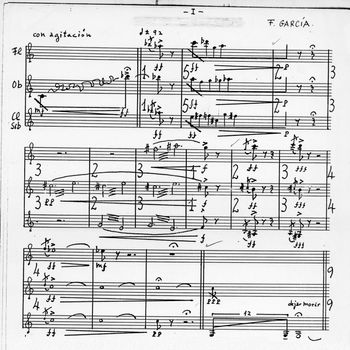
The 1989 festival happened one year after the plebiscite of 1988, when Chileans had voted against the permanence of Pinochet in power. The country was now preparing for the plebiscite of December 1989, which would result in the election of Christian Democrat Patricio Aylwin as president. However, by May 1989, García still advised Cáceres not to include the titles of the two movements of Tierras ofendidas in the programme notes. He feared potential censorship. García was so apprehensive about this, and so convinced that his correspondence could be intercepted and scrutinized,Footnote 55 that he made sure the titles of the movements in the score he sent for the performance were removed, as the copies preserved in the Anacrusa archive show. The fact is that the suggestive titles ‘Tormentos’ (which could be literally translated as ‘Torments’ but also, more obliquely, as ‘Tortures’) and ‘Desapariciones’ (‘Disappearances’) could be directly linked to the Chilean dictatorship and its abuses of human rights (Example 3).
García, Tierras ofendidas, 1984, bb. 1–14. Fondo Documental Anacrusa, Biblioteca Nacional.

Another programmatic element in this work is a quotation of Pablo Neruda's famous poem ‘Explico algunas cosas’ (‘I Explain Some Things’), from España en el corazón (Spain in the Heart) (1937) preceding the score. Written in the context of the Spanish Civil War, Neruda's verses can be also understood as a timeless rejection of evil: ‘Jackals that the jackals would despise, / stones that the dry thistle would bite on and spit out, / vipers that the vipers would abominate!’Footnote 56 García introduced a slight change to Neruda's verses, transforming ‘jackals’ into ‘jackal’ and ‘stones’ into ‘stone’. By the use of the singular form, one could interpret that García is representing the evil in one singular figure, thus alluding directly to Pinochet. Despite García's concern, the programme notes included the titles of both movements, and Neruda's verses were recited at the beginning by the oboist Santiago Araya. As Araya remembers, the musicians decided to recite the verses as a way of transmitting more effectively the work's political content to the audience.Footnote 57
Tierras ofendidas is an expressive work, rich in articulation marks, differentiated dynamics and a continuous tempo change, resulting in irregular phrases within a rather chromatic context. The score contains different symbols for aleatoric sections. ‘Tormentos’ is designed as a movement ‘with agitation’. It features vivid gestures that go on to fortissimo, contrasted with pianissimo moments programmatically annotated as ‘dejar morir’ (‘let it die’, bb. 13 and 32) and ‘morendo’ (‘dying’). The slower second movement, ‘Desapariciones’, introduces a new, alienating sonority with the use of quarter-tone glissandi. Phrases where the dynamic range moves into pianissimo are again annotated as ‘morendo’ (b. 14) or ‘dejar morir’. Together with the programmatic elements – Neruda's quotation, the titles of the movements, and the use of these expressive annotations – the subtle use of expressive musical elements results in a delicate score that denounces human rights abuses, without ever becoming a political pamphlet.
When the performance took place, neither Araya nor Maupoint could remember having much information about García or his music other than the fact that he lived in exile. For these musicians who were in their mid-twenties and had not experienced musical life previous to 1973, the performance had a meaning that went beyond a musical style that at this time was unfamiliar for them. In fact, beside the Anacrusa festivals, the contact with contemporary music was very limited in the country and young musicians were not used to facing an atonal score with aleatoric sections. Beyond the musical meaning, for them it was deeply meaningful to take part in one of the very few instances for contemporary music happening in Chile as a form of ‘cultural survival’ in a country with a stagnant cultural life.Footnote 58 For Maupoint, who had since then conducted and premiered several works by this composer, playing García's music at that time had a meaning that was impossible to reproduce after the return to democracy.Footnote 59
Conclusions
As seen in the case of Anacrusa, the Chilean military dictatorship resulted in a real experiential gap between composers and musicians of different generations. Most initiatives to re-establish this generational contact were isolated and conditioned by the individual character of personal relationships. Thus, the performances of music by exiled composers became symbolic moments of political and cultural resistance during Anacrusa's festivals. Nevertheless, they did not result in a continuous reception of music by composers living abroad. Knowledge about the activities, ideas, and whereabouts of the ‘lost’ generation of the 1960s remained fragmented. For further research, it would be interesting to study the institutional and political conditions that allowed for the return and integration of some musicians into Chilean musical institutions but provided no incentive to many others. From the perspective of the Goethe-Institute, the collaboration with Anacrusa was in line with a broader conception of culture and the establishment of cultural policies in the FRG, which encouraged work with local partners in developing and furthering the values of liberal democracy. By supporting this project, the institute succeeded in presenting a positive and renewed image of the FRG abroad.
The year 1990 brought both, the return to democracy in Chile and German reunification. While Germany directed its efforts of cultural work to the former Eastern socialist block, thus reducing its budget for Latin America, Chilean musical institutions began to slowly change. Of the figures studied in this article, García and Stein became professors at Universidad de Chile in 1990, while Becerra-Schmidt and Ortega decided to stay in Europe. In 2003, after some isolated performances of his compositions in Chile, Ortega reached the pinnacle of his career as art music composer shortly before his death, as the operatic version of Fulgor y muerte de Joaquín Murieta (1998) was premiered at the Teatro Municipal in Santiago and toured to the Savonnlina Opera Festival in Finland, where it was enthusiastically received.Footnote 60 García was awarded Chile's National Music Prize in 2002 and his works are frequently played in local festivals. However, research on his period in exile is still missing. Becerra-Schmidt visited Chile on several occasions and continued to be welcomed as a recognized composer, although his life work in Germany is rather unknown in Chile. Absent and present at the same time, further research on these musicians and their work and a deeper knowledge about their transnational trajectories as well as their personal and symbolic connections to their country of origin is still necessary to continue filling the gap between the Chilean musical scenes before and after 1973.