Interventional closure of unwanted vessels or shunts in preterm and young infants is limited by the relatively large size of introducer sheaths that are often required to deliver appropriately sized occlusion devices. The Amplatzer vascular plug IV (AGA Medical Corporation, Frankfurt, Germany) is made of flexible nitinol mesh and has a double-lobed design. The device can be delivered via a large lumen (0.038 inch) 4 French catheter. We describe our initial experience with the use of this device in a series of eight infants with a variety of vascular malformations.
Materials and methods
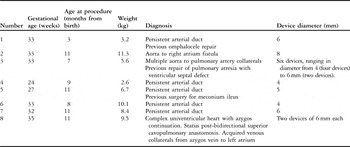
A total of eight consecutive infants, ranging in age from 3 to 11 months, presenting with clinically relevant unwanted shunts underwent transcatheter occlusion. All of them were born preterm – gestational age ranging from 24 to 35 weeks. Of the eight infants, two previously underwent abdominal surgery for an omphalocele and for a meconium ileus, respectively, and two underwent previous cardiac surgery for biventricular repair of complex pulmonary atresia, and a bidirectional superior caval vein to pulmonary artery anastomosis for complex univentricular physiology, respectively. Their weight at the time of the cardiac catheterisation procedure ranged between 2.6 and 11.3 kilograms. Of the infants, five underwent occlusion of a persistently patent arterial duct, one had an aorta to right atrium shunt, one had multiple major collateral vessels from the aorta to the pulmonary arterial system, and one had acquired venous connections between the azygos vein and the left atrium following a superior cavopulmonary anastomosis. The individual diagnoses, and lesions requiring closure are detailed in Table 1.
Demographic data of the patient population.

After informed consent was obtained, all patients underwent cardiac catheterisation under general anaesthesia. Depending on the vessel that needed to be occluded, percutaneous vascular access was gained using a combination of the femoral artery and vein, or the brachial artery. Following angiographic demonstration of the target vessel, a vascular plug IV was chosen with a diameter that exceeded the minimum diameter of the target vessel by between 1 and 2 millimetres. The vessel was selectively cannulated using a large (0.038 inch lumen) 4 French catheter (Cordis Europe, Roden, The Netherlands). The device was then appropriately deployed, and following angiographic confirmation of appropriate positioning, was released.
Results
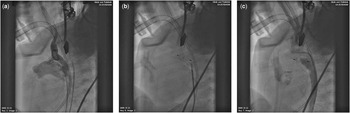
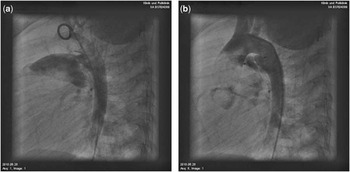
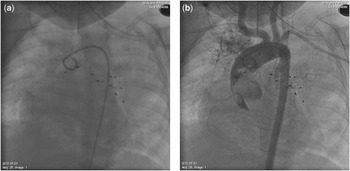
Direct angiography following the procedure confirmed complete closure of the shunt in three of eight patients – all with a persistent arterial duct (Fig 1); two patients with a duct and another with a small residual shunt in an aorta to right atrium fistula, respectively, had complete occlusion of the shunt on follow-up echocardiographic examination 24 hours later (Fig 2). The infant with multiple aortopulmonary collaterals shows evidence of a small, single residual aortopulmonary communication at follow-up, but with normalisation of right ventricular systolic pressure (Fig 3). The patient with univentricular physiology showed a sustained improvement in systemic arterial oxygen saturation – from 78% before the procedure to 85% after the procedure. All procedures were uncomplicated. All five infants who were breathing spontaneously before the catheterisation procedure were routinely extubated directly following closure of their shunt. The two infants (patients 1 and 4), both of whom were ventilator-dependent in the months before the occlusion procedure, could be successfully weaned off mechanical ventilation at 48 and 96 hours after closure of their arterial duct. Patient 3, in whom closure of the major aortopulmonary collateral vessels was undertaken in two stages – the first via a femoral arterial approach and the second via the brachial artery a few days later – was successfully extubated 4 days following near-complete closure of all collaterals. Of the eight infants, five were discharged from hospital on the following day and three (patients 1, 3, and 4) were discharged at between 2 and 3 weeks after interventional closure of their unwanted shunts. The duration of follow-up ranges from 6 weeks to 10 months, and there are no untoward late complications during this period.
(a) Aortogram in patient 1, showing a significant duct. (b) The vascular plug IV (6 millimetres diameter) is appropriately deployed and released. (c) Post-occlusion angiogram showing complete occlusion of the duct.

(a) Aortogram demonstrating a large duct in patient 7. (b) Post-procedure aortogram (6-millimetre device) showing a small residual shunt that had disappeared the following day.

(a) Chest X-ray in the postero-anterior projection, following the deployment of six vascular plugs to close multiple aortopulmonary collateral vessels in patient 3. A 4-French pigtail catheter is in situ in the ascending aorta. (b) Aortography shows a minor residual shunt to the right upper lobe. This could also be shown at follow-up echocardiography. All the other collaterals are completely occluded.

Discussion
A wide variety of devices is available for transcatheter closure of unwanted shunts in young patients. Notable exceptions to this approach are young infants, in whom considerations of vessel size versus the size of the delivery system preclude standard usage of the more established closure devices. The Amplatzer vascular plug, in its earlier versions, was occasionally used in this setting.Reference Hijazi1–Reference Javois, Husayni, Thoele and Van Bergen3 The newest version of the device, the vascular plug IV, was recently used to successfully occlude anomalous systemic arterial supply to a lung segment in a term neonate.Reference Bentham and Wilson4 We report on our experience with a consecutive series of infants (all of whom had been born preterm), in whom closure of unwanted shunts was successfully accomplished. Of the patients in our series, one (patient 2) is briefly reported elsewhere.Reference Wilmes, Lehn and Sreeram5 The vascular plug IV can be delivered through a 4-French catheter, making its use possible even in very small infants. The device diameter is generally chosen to be 1 to 2 millimetres larger than the minimum diameter of the vessel to be occluded. The shape of the device has the additional potential advantage that it is unlikely to cause obstruction to blood flow to either of the branch pulmonary arteries or the aorta, even if the device protrudes into one of these vessels. With increased experience, we are able to deliver the device into the duct using a single arterial approach, without the necessity for aortography before release of the device. An additional advantage is that the device is relatively cheap, costing only a fraction of the price of the standard duct occlusion systems.
There are potential concerns that the previous versions of the device may effectively stent the duct, resulting in an unacceptable residual shunt, requiring either device removal, or the addition of catheter-delivered coils to achieve complete occlusion.Reference Javois, Husayni, Thoele and Van Bergen3 This, however, is our experience with the new device. None of the patients in our series has a residual shunt at follow-up, and we have observed no device-related complications – embolisation, migration, stenting of the treated vessel resulting in a residual shunt, obstruction to flow due to device protrusion – to date. The Amplatzer vascular plug IV clearly merits further evaluation and application in young patients for a variety of unwanted shunt lesions.