1. Introduction
Integrated learning applications on mobile devices can be beneficial to students of all ages, both in and out of the classroom. Researchers have outlined a variety of ways in which mobile devices can be used to provide greater flexibility in the study of English as a Foreign Language (EFL), vocabulary development, and learning in higher education (Song & Fox, Reference Song and Fox2008). Many studies have successfully applied mobile learning techniques to the instruction of foreign languages via mobile devices and wireless networks (Cavus & Ibrahim, Reference Cavus and Ibrahim2009; Kadyte, Reference Kadyte2004). One study on the attitudes of language learners demonstrated the effectiveness of using wireless application protocol (WAP) sites for the training of listening skills (Nah, White & Sussex, Reference Nah, White and Sussex2008). Nonetheless, developing and evaluating such applications to accommodate the limitations of small screens on smart phones and Personal Digital Assistants (PDAs) is crucial.
Beginning in 2014, all secondary school students in Taiwan will be required to take listening tests in English; therefore, students will need more opportunities to practice their listening skills in their daily lives. This study employed adaptive learning for the training of listening skills in English. Many English instructors over-emphasize grammar and vocabulary building, which has led to listening comprehension becoming the weakest skill among Taiwanese students (Liu, Chen, & Chang, Reference Liu, Chen and Chang2009). Fortunately, the training of listening skills has been made more convenient through computers and the internet. Digital multimedia, such as the MPEG audio player 3 (mp3) and digital video disks (DVDs), can provide exposure to English programs, songs, and videos. Moreover, these digital formats offer various subtitle or caption choices and repeatable viewing at will to facilitate the development of listening skills.
Research has indicated that videos with subtitles can be helpful for the development of vocabulary and the skills related to listening and reading (Danan, Reference Danan1992; Reference Danan2004; Reference Danan2010). Markham, Peter and McCarthy (Reference Markham, Peter and McCarthy2001) claimed that videos with subtitles can be helpful in the development of listening comprehension, by encouraging students to study using movies or videos in which they have an interest. By creating context and non-verbal input, videos can provide visual cues to remedy a lack of language knowledge (Seo, Reference Seo2002). Multimedia can provide listeners with voices, visual data, and text (subtitles or captions) in various languages. Previous studies have demonstrated that computer technology is useful for language learning and the use of multimedia is conducive to the acquisition of vocabulary (Liu, Moore, Graham & Lee, Reference Liu, Moore, Graham and Lee2002). Chai and Erlam (Reference Chai and Erlam2008) investigated the influence of captions on learning vocabulary and phrases in a second language and found a positive correlation between the presence of captions and learning effectiveness. Winke, Gass, and Sydorenko (Reference Winke, Gass and Sydorenko2010) reported that captions could increase students’ attention and learning achievements by providing links with previous knowledge. Wang and Liu (Reference Wang and Liu2011) indicated that filtered captions could enhance the interest of students in learning English as well as their study efficiency. From the perspective of Second Language Acquisition (SLA) and language-learning motivation, Noels (Reference Noels2001) identified the intrinsic language-learning goals as a feeling of enjoyment and enhanced understanding obtained during the process of learning. Motivating goals can help learners to focus on learning tasks (Zimmerman, Reference Zimmerman2008) and personalized learning using mobile devices can motivate students to study harder (Kukulska-Hulme & Shield, Reference Kukulska-Hulme and Shield2008).
The maximum number of words appearing in the captions after caption filtering was determined according to the limitations of short-term memory (Hsu & Chang, Reference Hsu and Chang2011). Based on Information Processing Theory (IPT), verbal memory and image memory, as manifested in short-term memory, have an inferential linkage via captions, which can aid in comprehension. Language related long-term memories are fetched in order to compare or contrast them with the information in the short-term memory. For example, certain tones or body language refer to anger, while others refer to excitement. Short-term memory and working memory (including the phonological loop) retain information related to a person’s immediate perceptual awareness for only 1.5 to 2 seconds (Morris & Jones, Reference Morris and Jones1990). This makes it clear that providing scaffolding is important, because of its role in supporting the development of listening skills, particularly when using multimedia in an unfamiliar language.
Our study developed an Adaptive Caption Filtering system for English as Foreign Language learners using handheld devices to learn English listening. The system filters out the easier words and retains the harder words to be shown as captions with their Chinese translations in the videos. Students were provided with partial captions in line with their proficiency in the language, which allowed them to focus on the perceptual processing of the ears and enhance the comprehension process involved in listening. This system used three levels of caption filtering specially adapted to student needs. The three levels in this study are named Elementary, Intermediate, and High Intermediate, in line with the degrees of the General English Proficiency Test (GEPT) which was developed in 1999, commissioned by the Ministry of Education in Taiwan (Roever & Pan, Reference Roever and Pan2008; Hsu, Hwang & Chang, Reference Hsu, Hwang and Chang2010). GEPT contains five levels called Elementary, Intermediate, High Intermediate, Advanced, and Superior. Statistical results show that most of the senior high school students in Taiwan are at the Elementary and Intermediate levels (Roever & Pan, Reference Roever and Pan2008); therefore, this study used the terms of the three lower difficulty levels, Elementary, Intermediate and High Intermediate.
Elementary level captioning in this study excluded 220 English sight wordsFootnote 1 from the captions, allowing students to focus on words they may not have already been familiar with; intermediate level excluded 1000 high frequency English words and 2200 high frequency English words were hidden at the high intermediate caption filtering level.
Therefore, the research objectives of the study were to develop and evaluate caption filtering systems for mobile devices as a means of supporting the development of listening skills. Students in non-English-speaking countries generally possess limited English vocabulary and therefore rely more heavily on captions when watching videos. Considering the limitations in human working memory, we evaluated the filtering results and proposed the following three research questions:
1. Was the assigned level of caption filtering correlated with the level selected by students?
2. How did the learning motivation of students using adaptive caption filtering differ from that of students using uniform caption filtering?
3. How did the students evaluate the adaptive caption filtering with regard to usability, satisfaction, and enjoyment?
2. Literature review
2.1. Information processing theory
According to information processing theory (IPT) (Miller, Reference Miller1956), when students are presented a new message, they must focus their attention before they can receive external stimulus. To make students aware of the message, features must be included according to the habits or learning preferences of students. Individuals select various parts of the message to be stored in the short-term memory. After encoding or rehearsing the message in the short-term memory, the message is transformed into semantic or mental images and combined with prior knowledge. Clues are often required to retrieve relevant data from the long-term memory, which is then sent to the short-term memory. After information is processed in the short-term memory, new information in the form of inferences and judgments is stored in the long-term memory. A flowchart of information processing theory, presented in Figure 1 (based on Card, Moran, & Newell, Reference Card, Moran and Newell1983), shows the theoretical foundation of this study. The limitations of short-term memory often necessitate the provision of prompts to assist students in dealing with input data, enabling them to pay attention to the message received from the sensory register.
The adaptive video caption filtering system developed based on information processing theory.

As shown in Figure 1, senses are the physiological methods of perception. Much of the extraneous information is forgotten, while important information passes through selective filters to gain our attention (Cowan, Reference Cowan1998). Attention usually refers to selective attention, which means attending to one stimulus while ignoring other competing stimuli (Broadbent, Reference Broadbent1958). Students pay attention to internal as well as external stimuli. Mobile devices can work as an extension of the short-term memory, allowing materials to be reviewed anytime and anywhere. Thus, new information obtained from listening is more likely to be combined with long-term memories and stored back in the long-term memory. Personalized listening assistance should contribute to the acuity of one’s perceptions as well as their listening comprehension and learning motivation.
The phonological loop is an important component of working memory, capable of holding 1.5 to 2 seconds of spoken information (Morris & Jones, Reference Morris and Jones1990). Video captions can enhance this process to aid in listening comprehension. Limitations in one’s capacity to deal with input can lead to cognitive fatigue, requiring that demands on information processing be reduced in order to restore one’s attention capacity. This study utilized caption-filtering based on English proficiency, supplying an appropriate number of words, with an appropriate level of complexity, to protect students from cognitive overload and help focus their attention on new information (Ozcelik & Yildirim, Reference Ozcelik and Yildirim2005).
2.2. Mobile-assisted language learning
An increasing number of researchers have investigated the use of mobile devices for language learning (Kiernan & Aizawa, Reference Kiernan and Aizawa2004; Thornton & Houser, Reference Thornton and Houser2005). One recent study confirmed that the Mobile-Assisted Language Learning (MALL) approach can improve students’ English skills, while refining their self-study behavior and enhancing self-efficacy (Kondo, Ishikawa, Smith, Sakamoto, Shimomura, & Wada, Reference Kondo, Ishikawa, Smith, Sakamoto, Shimomura and Wada2012). A survey of 75 Japanese students found that over two-thirds of the students would like to use mobile phones for language learning in either the short- or long-term (Stockwell, Reference Stockwell2008). Another study proposed the provision of audio or video for individual learning as a stand-alone application delivered directly to portable devices (Kukulska-Hulme & Shield, Reference Kukulska-Hulme and Shield2008). Personal learning via mobile devices can motivate students to learn, while supporting social contact and collaborative learning, both of which are crucial to language learning (Kukulska-Hulme & Shield, Reference Kukulska-Hulme and Shield2008).
A previous study promoted the use of mobile technologies to expand English vocabulary (Song & Fox, Reference Song and Fox2008). The results indicated the effectiveness of using PDAs to improve referential, situated, constructive, reflective, explorative, and conversant uses of vocabulary. Clearly, mobile devices can be used in many ways to teach vocabulary, with special consideration for the needs and contexts of students. One study found that WAP (i.e., Wireless Application Protocol) sites are effective for the development of listening skills through student-centered and collaborative learning (Nah, White, & Sussex, Reference Nah, White and Sussex2008). Previous research has demonstrated that participants from different cultural backgrounds vary in their attitudes towards MALL in terms of technological affordance, applicability, and a constructivist pedagogy. It was suggested that future studies apply Davis’s (Reference Davis1989) technology acceptance model (TAM) to investigate the usefulness and ease-of-use of MALL as perceived by EFL learners (Hsu, Reference Hsu2013). The current study used TAM to evaluate the perceptions of students regarding mobile device use in improving English listening comprehension.
2.3. Listening and captioning
Many English learning systems provide subtitles or captions to help students understand the learning content. Subtitles are on-screen text transcribed and translated from the video soundtrack into the students’ native language; captions are the on-screen text in the same language as the soundtrack (Markham, Peter & McCarthy, Reference Markham, Peter and McCarthy2001). In this study, “subtitles” refers to on-screen Chinese text (the first language of participants, L1) combined with an English soundtrack, while “captions” refers to an English soundtrack with on-screen English text (foreign language of participants, FL) as well as the instant translation of English text into Chinese (L1). People in many countries rely on captions or subtitles while watching television programs (Koolstra & Beentjes, Reference Koolstra and Beentjes1999). Most of the television programs in Taiwan present captions or subtitles. This study employed many daily life videos to attract learners and train their daily life listening comprehension of a foreign language. Filtered captioning means that the harder words of English and its translations will be retained in the video but the easier words will be hidden.
The provision of captions when using videos as materials for training listening skills in a foreign language has many advantages (Yang, Huang, Tsai, Chung, & Wu, Reference Yang, Huang, Tsai, Chung and Wu2009). Captioned videos bring the voices of native speakers into the learning environment and are being used increasingly as a pedagogical tool in online courses (Winke, Gass, & Sydorenko, Reference Winke, Gass and Sydorenko2010). Garza (Reference Garza1991) indicated that the use of captions could bridge the gap between competence in reading and listening. Chung (Reference Chung1996) reported that videos with captions could help students to associate the spoken and written forms of words more easily and quickly than videos without captions (Chung, Reference Chung1996). Many studies have shown that the use of subtitles also enhances reading ability, the building of vocabulary, and listening comprehension in a foreign language (Danan, Reference Danan2010; Hayati & Mohmedi, Reference Hayati and Mohmedi2011; Markham, Peter, & McCarthy, Reference Markham, Peter and McCarthy2001).
Researchers have indicated that foreign language learners can benefit from simultaneous audio and visual input (Seo, Reference Seo2002) and many studies related to language learning have employed videos as learning materials (Chapple & Curtis, Reference Chapple and Curtis2000; Vanderplank, Reference Vanderplank2010; Williams & Thorne, Reference Williams and Thorne2000). Chapple and Curtis (Reference Chapple and Curtis2000) used videos in an ESL environment in Hong Kong to develop the language skills of students. After watching eight films in English or with English captions, the students reported that their English language skills had improved in all areas, particularly their speaking and listening skills, and that their confidence in using English had increased. Williams and Thorne (Reference Williams and Thorne2000) used videos in a second language for vocational training, which had the added benefit of language acquisition. Subtitles can help to resolve many of the difficulties involved in comprehending foreign cultures from videos. Foreign language films with subtitles have also been shown to help listening comprehension (Markham, Peter, & McCarthy, Reference Markham, Peter and McCarthy2001). It has been shown that slowing down or speeding up the tempo is not necessary for listening comprehension (Derwing & Munro, Reference Derwing and Munro2001; Vandergrift, Reference Vandergrift2007).
A number of studies have pointed out that relying too heavily on subtitles is not conducive to improving listening proficiency (Latifi, Mobalegh, & Mohammadi, Reference Latifi, Mobalegh and Mohammadi2011). Studies have indicated that videos without subtitles or captions can be more beneficial, as they induce students to pay attention to various features of pronunciation, such as reduced forms, assimilation, elision, and re-syllabification (Hulstijn, Reference Hulstijn2003; Field, Reference Field2003; Vandergrift, Reference Vandergrift2007). They suggested that translated subtitles should not be provided for listening practice sessions. Subtitles should be time-toggled on and off to assess their usefulness (Grgurovic & Hegelheimer, Reference Grgurovic and Hegelheimer2007; Winke, et al., Reference Winke, Gass and Sydorenko2010) and provide appropriate learning support at the right time to prevent students from relying on supports or distracting them during the learning process. Our study attempted to provide a learning system capable of providing captions filtered in accordance with the actual needs of students. Current mobile phones are small, constantly available, and provide excellent streaming of video from sources such as YouTube (Godwin-Jones, Reference Godwin-Jones2012).
2.4. Technology acceptance model
Usage analysis was conducted to assess the usefulness, ease-of-use, and satisfaction with the MALL system as perceived by students, and data about these factors was also investigated to see whether any correlations existed among them. We employed the technology acceptance model (TAM) questionnaire (Davis, Reference Davis1989) to explore the relationships among cognition, influence, and technology according to these perceptions. TAM addresses two aspects: perceived usefulness and perceived ease-of-use. Perceived usefulness means that users subjectively perceive an improvement in their performance when using a particular information system. Perceived ease-of-use refers to the usability and convenience of using a particular information system. These two aspects define individual behavioral intentions with regard to various technologies (Davis, Reference Davis1989; Davis, Bagozzi, & Warshaw, Reference Davis, Bagozzi and Warshaw1989). TAM was used as a theoretical basis from which to assess the crucial factors influencing the acceptance of computer information systems (Agarwal & Prasad, Reference Agarwal and Prasad1999), and was therefore deemed appropriate to investigate the perceptions of mobile device users.
3. Research methods
3.1. System development
Few studies have explored the optimal number of words that should appear on a small screen handheld device at any one time. Interface adaption refers to the number and size of words appearing in the captions on a mobile device, such that students need not use the zooming function or interrupt their viewing. Many multimedia language instruction materials are restricted by small screens, and excessive text over a video clip has been shown to overload the short-term memory of students. Our study sought to improve the interface adaption of video captions on mobile devices through caption filtering to maximize listening comprehension. Thus, the captions were limited to only new or difficult words.
The caption filtering program was developed using Python, a programming language appropriate to the task. The program is called the Caption Adaptive Filter-based Language Listening system (CAFLL) for handheld devices. The operation of the system comprises two parts. The first step involves merging captions that originally required more than one line. The second step involves filtering out the most frequently used words while retaining more difficult or seldom seen words. Two databases were employed. The first one is a word bank containing the 2200 most frequently used words, the 1000 most frequently used words, and 220 sight words, which represented three levels of caption filtering. The second database stores the captions following the merging and filtering according to the level of caption filtering selected by the user. The original caption files are stored as “srt” files, consisting of time sequence, time interval, and captions. Following the final stage of caption filtering, the remaining captions are subjected to statistical computation to determine whether they satisfy the requirements for adaptation to the available screen sizes of various handheld devices. The results of the merging and filtering processes, such as the number of words in each sentence and the total number of words in the video, are also stored in the database. Information related to the merging of captions, such as the times at which merging was performed, is stored in the database whenever merge mode is implemented. The information remaining after filtering, such as the filtered captions, remaining captions, and the number of words remaining in each sentence is also stored. Filtered captions are then embedded in the video for broadcasting on handheld devices. The example of filtering results is shown in the left part of Figure 2.
Example of filtering results (left); caption filtering system framework (right).
3.2. Participants
The subjects included 161 students, averaging eighteen years of age, in four classes studying EFL. Two classes were designated the experimental group and the others were the control group. The 82 students in the experimental group were provided with personalized captions, filtered according to the requirements and proficiency of individual students. All of the 79 students in the control group were provided with a standard level of caption filtering, as detailed in Figure 3. The students in both groups had studied English for an average of eight years. Students did not have enough time to watch a 15-minute movie several times in twenty minutes, but they could pause the movie whenever they did not understand what was said in the video. Students were free to practise listening whenever they wished during the control time. To control for variance in the study, students were expected to watch particular movies from the school library at stipulated times.
Flowchart of the experimental design.
3.3. Research tools
The research tools in this study included a learning achievement pre-test, and a questionnaire to measure the perceptions of students with regard to learning motivation, the usability of the program, and their satisfaction with it. The pre-test of this study contained a listening comprehension test. The listening pre-test covered the elementary and intermediate levels of the General English Proficiency Test, comprising three groups of fifteen multiple choice questions for a perfect score of 120. In the experimental group, students who scored more than 80 points were assigned the 2200 most frequently used words for their captions; those who scored between 60 and 80 points were assigned the 1000 most frequently used words; those who scored fewer than 60 points were assigned only 220 sight words.
Listening proficiency and listening comprehension cannot be improved in only a matter of weeks. Therefore, our aim was not to evaluate the teaching effectiveness of the program, but rather we examined intrinsic and extrinsic goal orientation using the Motivated Strategies for Learning Questionnaire (MSLQ) (Pintrich & Schunk, Reference Pintrich and Schunk1996; Tsai, Lin, & Yuan, Reference Tsai, Lin and Yuan2001). We also used a seven-point Likert scale to explore the usability of caption filtering (Lewis, Reference Lewis1995) and the satisfaction and enjoyment it instilled in students. Learning motivation is the most important factor leading a learner to actively participate in learning activities. As with previous studies, this study explored both extrinsic (perceived usefulness and ease of use) and intrinsic (perceived enjoyment) motivators to explain students’ intention to use a new learning medium (Matthew Lee, Christy Cheung & Chen, Reference Matthew Lee, Christy Cheung and Chen2005). This study evaluated the learning motivation of the students in the experimental group after they used the recommended filtering degree based on the pre-test. Moreover, this study also assessed the learning motivations of the students in the control group after the three levels of filtering were demonstrated to them. A number of open questions, such as which kinds of caption modes were perceived as most helpful, were also included. Finally, the instructors interviewed two students who achieved intermediate scores (>80) in the listening pre-test, and two students who attained elementary level scores (<60).
3.4. Experimental procedures
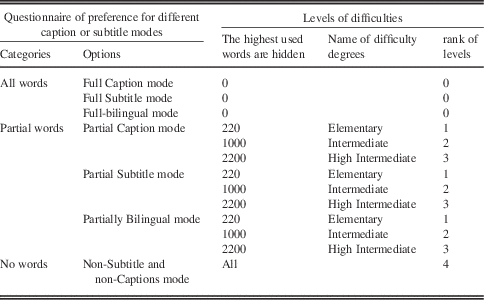
Figure 3 presents a flow chart of the experiment. At the beginning of the learning activities, the students took the pre-test in order to become aware of the treatment level they needed. To assess the preference of each student for different caption modes, the questionnaire divided the choices into seven categories, although the experimental treatments only provided three levels of partially bilingual modes, as shown in Table 1. Regardless of the level of filtering, all items were rendered as partial caption mode. The Chinese translation of the partial captions was named partial subtitle mode. The English and Chinese remaining after filtering were named partially bilingual mode. Before using the questionnaire to investigate the preference of each student for different caption modes, the researcher showed the students in the experimental group a video that demonstrated all the possible caption or subtitle modes provided, including partial caption mode, partial subtitle mode, and partial bilingual mode, based on their pre-test results. The remaining four modes are full caption mode, full subtitle mode, non-subtitle and non-caption mode, and full-bilingual mode. All the categories are shown in the left two columns of Table 1. In this ranking question, the researchers were still unable to ascertain what filtering levels were required, and only had a rough idea of the students’ preferences. Therefore, to gain a clearer understanding of the impact of the different filtering levels on the students, the study also surveyed the requirement of filtering levels in the open questionnaire. The filtering levels of bilingual modes included level zero which means no filtered words, level one which filtered 220 sight words, level two which filtered the 1000 most frequently used words, level three which filtered the 2200 most frequently used words, and level four which filtered all words. Consequently, the researcher could ascertain each learner’s preference as well as the requirement for different levels of hiding captions and subtitles, in addition to the information from the pre-test.
The preference of different caption or subtitle modes and the levels of difficulties
Then, in the experimental group, the study treated the students with the partially bilingual mode in the personalized caption-filtering degree based on their pre-test. The students in both groups were given twenty minutes to finish watching each movie. The actual run time was fifteen minutes for each video clip, but play may be frequently paused by the learners so the students themselves governed the total watching time, which is twenty minutes. Following the viewing of the movies, the students filled out the usability and learning motivation questionnaires. Treatment in the experimental group was operationalized as adaptive or personalized caption filtering, while treatment in the control group was non-adaptive or standard caption filtering.
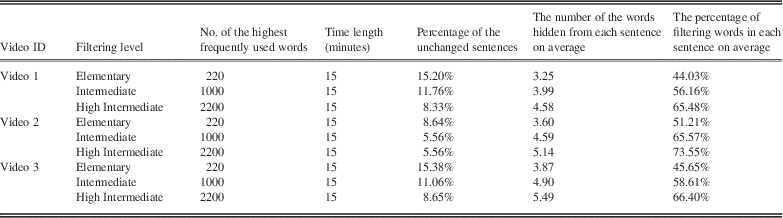
As for the control group, during the first movie, students were provided with captions that hid the 2200 most frequently-used words. During the second movie, the captions hid the 1000 most frequently-used words, and the 220 sight words were hidden in the third movie. The students then filled out the questionnaires on motivation, usability, satisfaction, and enjoyment. Finally, the students in the control group would also rank their preference for different caption and subtitle mode, like the survey before the experiments in the experimental group. The type of handheld used is a smart phone with a 4-inch screen. The students in both groups (i.e., control and experimental groups) watched three 15-minute video clips. The related information of the video clips for this study, such as the percentage of unchanged sentences after filtering, the number of the words hidden from each sentence on average, the percentage of filtering words in each sentence on average, is shown in Table 2.
The percentage of the most frequently-used words at each level in each video clip
4. Results
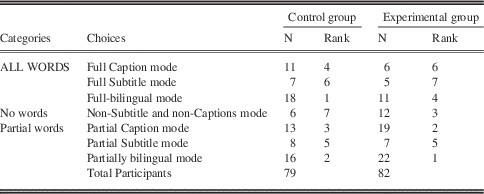
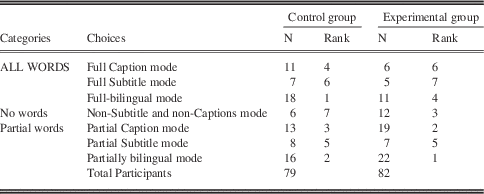
The questionnaire regarding individual preferences for diverse caption modes was completed by the students in the experimental group before three rounds of experiments, but by the students in the control group after the experiments. It was found that most of the students in the control group had a preference for full-bilingual mode, as shown in Table 3. Partially bilingual mode was the second choice in the control group, but the first choice in the experimental group. Compared to the control group, students in the experimental group preferred partially bilingual mode and preferred not to use only first language subtitles when training their listening skills. The following table presents individual preferences in all modes of subtitles and captions.
Student preferences in the modes of subtitles and captions following the experiments
In the abovementioned ranking question, the researchers had a rough idea about the preferences of the students. To gain a clearer understanding of the impact of the different filtering levels on the students, we also surveyed the requirement of filtering levels in the open questionnaire. Consequently, the researcher could discover each learner’s preference as well as requirement for different levels of hiding captions and subtitles in addition to the information from the pre-test. The following subsection illustrates the consistency and correlation between the adaptive captions provided by the program for the students in the experimental group, and the level of caption filtering deemed suitable by students for the training of listening.
4.1. Consistency and correlation analyses
The mean values and standard deviation of the pre-test scores were 65.87 for the control group and 64.09 for the experimental group. The t-test results (t=0.40, p >.05) presented no significant differences between the two groups, indicating equivalent knowledge prior to the learning activity.
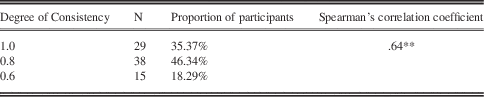
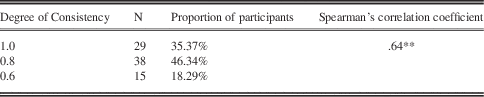
Students in the experimental group selected the level of caption-filtering they deemed necessary from the following five options: no filtered words, 220 sight words, the 1000 most frequently-used words, the 2200 most frequently-used words, and all words, to help them comprehend the videos they watched, and their selection results were compared with the adaptive captions recommended by the system based on their pre-test, as shown in Table 4. Twenty-nine students selected the same level of caption filtering as that assigned. The degree of consistency was 0, 0.2, 0.4, 0.6, 0.8, and 1.0, respectively. A score of 1.0 indicated one hundred percent consistency between the students’ selection and the recommended results, while a score of 0.8 indicated a difference of one level, a score of 0.6 indicated a difference of two levels, and so on. Thirty-eight students selected caption-filtering one level higher or lower than the assigned level. Only fifteen students selected caption-filtering two levels higher or lower than that recommended for them and most of the students selected levels lower than that recommended by the program. From this, we can infer that most students believe they rely heavily on captions while watching videos. SPSS was used to calculate Spearman’s correlation coefficient between the recommended level of caption-filtering and that selected for students in the experimental group. The results present a highly significant correlation between the selected and recommended levels of caption filtering (Spearman’s correlation coefficient=.64**). The following subsections present the learning motivation and usability evaluation results in terms of the CAFLL system.
Consistency and correlation between the recommended levels of caption filtering and the levels selected by students in the experimental group
4.2. Analysis of learning motivation
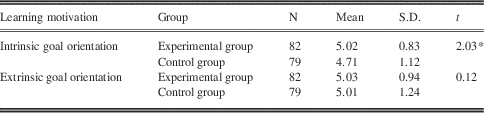
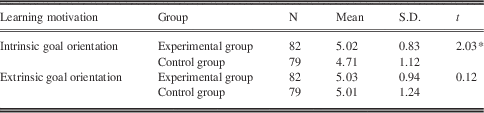
Table 5 presents the learning motivation t-test results for the two groups, including intrinsic and extrinsic goal orientation The mean and standard deviations of the intrinsic goal orientation rating were 5.02 and 0.83 for the experimental group, and 4.71 and 1.12 for the control group. These results present a significant difference in the ratings of intrinsic goal orientation between the two groups (t=2.03, p<.05), indicating that students who used adaptive captions (experimental group) had a higher intrinsic motivation to comprehend what they heard in the movie, using the tools provided.
Learning motivation T-test results between the experimental and control groups
*p<.05
The mean and standard deviation of the ratings for extrinsic goal orientation were 5.03 and 0.94 for the experimental group, and 5.01 and 1.24 for the control group. No significant difference was observed in the ratings for extrinsic goal orientation between the two groups (t=0.12, p>.05). The mean of the experimental group (5.03) was not significantly higher than that of the control group (5.01).
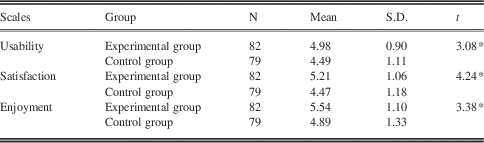
Therefore, we conclude that adaptive caption filtering had a significant impact on improving the intrinsic learning motivation of students toward the listening course. The following will further analyze the students’ perceived enjoyment, usability and satisfaction.
4.3. Analysis of usability, satisfaction, and enjoyment
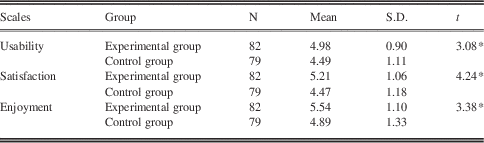
To better understand student attitudes toward adaptive caption filtering on mobile devices, this study collected student feedback in terms of “perceived usability” of 4.98 and 4.49 in the experimental and control groups respectively, shown as Table 6. The average ratings for “perceived satisfaction” were 5.21 and 4.47, while those for “perceived enjoyment” were 5.54 and 4.89 for the experimental and control groups respectively. These results confirm that most students (particularly those in the adaptive caption-filtering group) enjoyed watching the videos and practicing their foreign language listening skills in this manner. Compared with the control group, the students in the experimental group gave higher ratings for “perceived usability” and “perceived satisfaction”, implying that the students who used adaptive caption-filtering believed more strongly in the usability of the adaptive caption filtering system than those who used a standard level of caption filtering.
T-test results of usability, satisfaction, and enjoyment in the adaptive and standard caption groups
*p<.05
5. Conclusions
5.1. Implications and contributions
The proposed listening system enables the adjustment of caption filtering according to the difficulty of the vocabulary as well as the ability of students. The results of this study indicate that the filtering of partial captions helps to retain the advantages of viewing content without captions as well as the benefits of using full captions. Harder words with their translations shown in the captions provide a scaffold for students in terms of additional resources. A recent study has indicated that learners’ perceived need for full captions is strong, if the keyword caption the students used is not bilingual (Perez, Peters & Desmet, Reference Perez, Peters and Desmet2014). In the meanwhile, another study found that the students using annotated keyword captions exhibited better performance in the ability to recognize reduced forms and overall listening comprehension than the ones using the full caption or the keyword-only caption (Yang & Chang, Reference Yang and Chang2014). On the other hand, easier words hidden from captions in our study enforce students’ attention on aural input. This serves the dual purpose of helping students to understand the content and learning the language through visual input, even as they develop their listening comprehension (Kellerman, Reference Kellerman1990). Compared with hidden vocabulary, many of the words in the captions are relatively unfamiliar, and according to the tenets of information processing theory, the difficulty of caption content is a key factor in the processing of perceptual data. Kelly (Reference Kelly1991) argued that vocabulary problems can be a serious hindrance to the development of listening comprehension among advanced students, and demonstrated that the provision of captions can help to overcome these difficulties. Captions provide visual information related to the foreign words heard in the video (Danan, Reference Danan2004), which can help to promote comprehension, even when many of the familiar words are heard and not seen. Filtering out familiar words from the captions forces students to deal with various aspects of connected speech, such as reduced forms, assimilation, elision, and re-syllabification (Field, Reference Field2003; Hulstijn, Reference Hulstijn2003; Mitterer & McQueen, Reference Mitterer and McQueen2009). Thus, watching closed-captioned films in the target language can be beneficial for ESL or EFL students (Stewart & Pertusa, Reference Stewart and Pertusa2004).
Our study sought to take advantage of the portability of handheld devices as well as their capacity to function as an extension of the short-term memory. Because the screen of mobile devices is smaller than that of personal computers, it is even more important to provide shorter captions. Most of the students in this study reported positive impressions regarding the proposed caption filtering method. This study confirms the effectiveness of using partially hidden captions for the selective presentation of vocabulary according to the degree of difficulty as well as the proficiency of students. The results agree with the previous study in which the researchers also confirmed that learners’ reliance on captions varies individually. They noted that lower-level achievers rely on captions for listening comprehension more than their high-level counterparts, indicating that learners at various comprehension levels require different degrees of caption support (Leveridge & Yang, Reference Leveridge and Yang2013).
5.2. Research limitations
Time limitations prevented us from observing the long-term progress of students in their listening proficiency. We therefore focused mainly on efforts to improve learning motivation, satisfaction, and enjoyment. For the sake of experimental control, this study did not allow students to watch the partially-captioned video except during school hours. Nonetheless, it could be reasonably inferred that in the future, students could review the captioned videos on their own mobile devices in their leisure hours, thereby increasing the benefits afforded by this kind of exercise. Furthermore, caption filtering could be applied to the enormous number of short videos being produced for Massive Open Online Courses (MOOCs).
5.3. Suggestions for future applications and studies
Older students, such as senior high school students or undergraduates, have already learned many frequently-used English words and could therefore benefit from more advanced filtering options (Hsu & Chang, Reference Hsu and Chang2010). In future studies, instructors could consider other filtering mechanisms, such as target-word strategies, which have demonstrated positive results in vocabulary acquisition among low-achievement students in elementary school (Hsu, Hwang, Chang & Chang, Reference Hsu, Hwang, Chang and Chang2013).
The effectiveness of these measures hinges largely on whether students possess sufficient confidence in their own abilities to watch content without captions, or whether they use captions habitually while watching English language movies. Thus, this study suggests that instructors assess the confidence of participants using questionnaires, such as ARCS (i.e., Attention, Relevance, Confidence, and Satisfaction) motivation. If it were found that students habitually used captions, instructors might be required to implement measures aimed at breaking this habit.
In an ESL or EFL environment, comprehension is often impeded by the speed of presentation and quantity of unknown vocabulary (Smidt & Hegelheimer, Reference Smidt and Hegelheimer2004). This study focused on assessing the impact of partial captions when a video is played at a natural spoken tempo; however, it would be interesting to observe whether varying the speed of presentation has any impact on learning results when augmented using partial captions.
This study employed videos of approximately fifteen minutes, based on the fact that TV programs are broken into segments of ten to fifteen minutes to allow viewers to take a mental break during commercials. Researchers have demonstrated that clips of excessive length challenge the limitations of the working memory and most learners are unable to concentrate well for periods exceeding fifteen minutes. Considering the importance of learning duration on learning performance, some researchers have suggested that extending the length of video segments may prove beneficial to the development of listening proficiency (Norris, Hossain & Soloway, Reference Norris, Hossain and Soloway2011; Peng, Chuang, Hwang, Chu, Wu & Huang, Reference Peng, Chuang, Hwang, Chu, Wu and Huang2009); however, other studies have indicated that the ideal length will fall somewhere between three and fifteen minutes (Hsu, Hwang, Chang & Chang, Reference Hsu, Hwang, Chang and Chang2013). The researchers will extend the current experiments to include videos of various lengths in order to test these hypotheses.
Overall, the current system shows considerable promise in improving the effectiveness of personalized learning aimed at listening comprehension in a foreign language. English teachers do not necessarily have the skills to develop digital systems such as the caption-filtering system in the study; therefore, future study could develop a free caption-processing tool, which allows a selection of words to be shown or hidden. This caption-filtering freeware could produce reusable captions or subtitles or adapt diverse partial captions to different users. This study focused on evaluating the system according to the a priori English proficiency of the learners. In the future, this could be extended to include the preferences and genders of learners.
Acknowledgements
This study is supported in part by the National Science Council of the Republic of China under contract numbers NSC 102-2511-S-003-055-MY2.