Introduction
In 1949, the journal Cinema published an article entitled ‘Il cinema ha capito i reduci?’ It reported a recent episode in which an Italian war veteran had written to a newspaper announcing that he was going to kill himself. The journalist, Lamberto Sechi, used this case to compare the representation of veterans in Hollywood and Italian cinema: whereas Hollywood managed to produce ‘piccoli drammi intimi’ that captured the alienation and out-of-placeness of the returning soldier in both its public and private aspects – in films such as The Best Years of Our Lives (Wyler, 1946) and Till the End of Time (Dmytryk, 1946) – Italian films, according to Sechi, had relied on either sentiment or on schematic ideological positions (Reference Sechi1949, 175).Footnote 1 He cites recent films such as La vita ricomincia (Mattoli, 1946), Il bandito (Lattuada, 1946), and Caccia tragica (De Santis, 1947) to prove his point.
However, Sechi’s further claim that the reduce had become a forgotten figure on Italian screens by 1949 is not accurate. Between 1945 and 1954, Italian cinema actually produced dozens of films featuring ex-combatants. Many of these films have never been analysed by scholars, because they operate in the mode of melodrama, and thus fall outside the critical parameters that deemed (and still deem) neorealism to be the only cinematic style capable of adequately representing post-war Italian society. In this sense, Sechi’s assertion that the reduce is a ‘personaggio ideale di una storia facilmente commovente’ is accurate (1949, 174). Despite the critical neglect of these films, however, they offer to the viewing public a figure who has ‘the power to embody difficult national issues’ and to ‘disturb and dismantle widely accepted versions of national narratives of conflict’ (McVeigh and Cooper Reference McVeigh and Cooper2013, 9–10). The idea of the reduce as an ‘uncomfortable or disturbing reminder’ (McVeigh and Cooper Reference McVeigh and Cooper2013, 7) is crucial to my reading of post-war Italian cinema, where he stands in for the ideological chaos of that period, the legacy of Fascism, and the idea of Italian victimhood. Even in films that are typically dismissed as lightweight and politically empty, he remains a complex figure of guilt and innocence, emotions that are then displaced onto the private sphere and onto the sphere of gender relations through plots that depict love triangles, unfaithful wives, and dramatic stories of injustice and forgiveness.
This article will first sketch out the historical context within which the reduce is situated, highlighting the silence that surrounded the figure until recent historiography began to re-evaluate him; it will then discuss how the returning soldier, coming home to a country that fails to recognise him fully, and which is in turn unfamiliar to him, is a key figure of melodrama, a hyperbolic mode that itself functions in terms of (mis)recognition, and divisions of guilt and innocence, silence and expression. It will analyse how the love triangle in various films stands in for an ideological choice, and will discuss how notions of justice and victimhood, embodied by the reduce, resonate both on a personal and public level. The nature of what the reduce has suffered, often in prison or concentration camps, cannot be described, and becomes unspeakable, with silence and circumlocution the only options, and the article relates this private struggle for articulation with Italian repression of many aspects of its war experience on an official level. The disturbance caused by the reduce to the domestic space and familial relations speaks to the Italian struggle to come to terms with the past while simultaneously trying to move on from it.Footnote 2
The corpus of films under examination includes the following:Footnote 3

While the corpus includes a few films that are reasonably well known (Il bandito, Non c’è pace tra gli ulivi, Riso amaro, Napoli milionaria), most are critically unexamined. Some were successful at the box-office, others less so, but it is undeniable that in the post-war period melodrama was a pervasive mode, and that many of its most significant films were positively received by a national audience, making them ‘capolavori di massa’ (Aprà Reference Aprà1976).Footnote 4 Some of these films were made in the immediate post-war period, but others were released as late as 1956; this gives the lie to the idea that Italy’s wartime experiences were elided from its screens in the 1950s, and film, as I will show, was a powerful vector for negotiating the national past.
The return home
Ruth Ben-Ghiat (Reference Ben-Ghiat2001, 256) has written extensively of the reduce as a ‘shameful symbol’ of the guilt and trauma of Fascism and of Italy’s alliance with Nazism, as well as of its failed war.Footnote 5 Soldiers deported to Germany after the armistice of 8 September 1943, and those captured and imprisoned abroad, in Russia, Africa and elsewhere, were often regarded as pariahs when they returned, and carried with them the symbolic task of expiating the sins of the Italian nation. Over a million Italian soldiers were captured after 8 September in Italy, France, the Balkans and Greece.Footnote 6 Approximately 600,000 were sent to German camps (where an estimated 20,000 died).Footnote 7 Around 20,000 Italians were also interned in Russia, and 408,000 were made prisoners of the British in Africa, Australia, and Britain, with a further 120,000 held in the USA (Bistarelli Reference Bistarelli2007, 40).Footnote 8
It is important to bear in mind that the term reduce covers many categories, and includes combatants as well as non-combatants, partisans, prisoners and non-prisoners.Footnote 9 The films I am analysing generally ignore civilian deportees, and focus on returning soldiers; these are treated quite vaguely, and in general the only firm distinctions the films make are between partisans and those imprisoned who did not fight in the Resistance. Historiographically, one particular category that has received much attention recently is that of the ‘internati militari italiani’, those deported to camps in Germany after 8 September 1943, and who chose not to collaborate with the Germans, and refused to fight against the Allies.Footnote 10 They will figure in particularly interesting ways in my discussion of discourses of victimhood and innocence.
Reduci were felt to be ‘testimoni fastidiosi’ of Italy’s experience of Fascism and war (Sommaruga Reference Sommaruga1992, 259), and their return was accompanied by widespread silence, a silence that for many historians is now evidence of the nation’s need to represss Italy’s wartime experience in all its complexity.Footnote 11 The official report of the Commissione storica italo-tedesca, carried out at the behest of the Italian and German governments in 2012, asserts that after 1945 the returning military internees had been completely forgotten, calling them ‘vittime dimenticate’.Footnote 12 In the collective memory, they were often overshadowed by the deportati and partigiani.Footnote 13 Additionally, Claudio Pavone (Reference Pavone2013, 116) has discussed the fears of antifascist leaders after the war about the reincorporation of veterans who had not passed through the Resistance and had not experienced antifascism; social disorder was also provoked by the reduci who throughout 1946 gathered in public protests against the lack of jobs for them (Bistarelli Reference Bistarelli2007, 124–133).Footnote 14
The silence surrounding the returning veterans can be placed in the broader context of historiography of the last 15 years or so on the myth of ‘italiani brava gente’ – the refusal to acknowledge the horrors and war crimes carried out by Italian soldiers, especially in the Balkans and Greece. Filippo Focardi has amply documented the attempts to ‘scaricare sui tedeschi il peso di ogni responsabilità, e contemporaneamente attribuire una dimensione epica e nazionale alla Resistenza’ (2013, viii);Footnote 15 the way in which both institutions and discourse of the state, as well as press, worked to present Italians as both ‘vittime della ventennale dittatura mussoliniana, ma anche come vittime della guerra’ (Focardi Reference Focardi2013, 89) was joined with the over-emphasis on the Resistance as a symbolic cleansing.Footnote 16 In addition, as Ben-Ghiat (Reference Ben-Ghiat1999, 89-91), notes, the failure to effectively purge Italy’s institutions of fascists, or to carry out trials for crimes committed, completes the picture of an uneasy relationship to a past that was not confronted in post-war Italy.Footnote 17
The last 30 years or so have seen a new historiographic interest in veterans and in those who were imprisoned, in particular, the IMI (Internati Militari Italiani), who were given the choice after the armistice of 8 September 1943 of fighting alongside the Germans or being deported and imprisoned. Only a minority of soldiers agreed to collaborate, even when imprisoned,Footnote 18 and this refusal to collaborate began to be read in the 1980s by historians (many of them ex-internati themselves) as a ‘Resistenza senz’armi’ (Associazione nazionale ex internati, 1984). The idea of ‘l’altra Resistenza’, the title of ex-internato and future PCI leader Alessandro Natta’s seminal book (Reference Natta1997, but written in 1954), has been picked up in terms such as ‘Resistenza del filo spinato’ (Bistarelli Reference Bistarelli2007, 24), ‘Resistenza disarmata’ (Sommaruga Reference Sommaruga1995b, 101) and ‘Resistenza attiva’ (Giuntella Reference Giuntella1986, 71). The effect of this challenge to previous designations of the IMI’s choice as a ‘Resistenza passiva’Footnote 19 has been to broaden the notion of the Resistance in the post-war period, and to redress the overshadowing of the IMI by the partisans. The relationship between the official Resistance and the returned soldiers was complex and fraught: although in 1944 the Comitato di Liberazione Nazionale Alta Italia (CLNAI) had recognised the ‘disperata resistenza degli internati’, the Italian government only recognised their contribution in 1977, awarding the ‘distintivo d’onore’ to ex-internati for their refusal to collaborate.Footnote 20
The Italian situation was also peculiar in that it was characterised by the delayed return of many veterans: although the majority returned home in 1946 and in the first part of 1947 (Bistarelli Reference Bistarelli2007, 41), some prisoners were held in Russian camps until the 1950s, with perhaps the most famous case being that of Nicola Silvestro, whose return to Naples in 1958 after being missing for 20 years was covered by national newspapers and magazines.Footnote 21 For many years letters continued to appear in the national press from readers seeking information on family members, and hoping that they were still alive.Footnote 22 The idea that these men might reappear, or miraculously come back to life (they were often referred to as redivivi) attests to the ongoing nature of the trauma of loss and gives a unique (and melodramatic) inflection to the Italian post-war situation.
The condition of the men who returned was often serious, as they suffered from trauma, physical injuries and malnutrition. This is attested to in letters to La Settimana Incom Illustrata in 1952: in response to a female reader’s letter complaining about the lack of healthy men, 82 girls wrote in lamenting that the men who have returned, for whom they had already sacrificed years waiting, are like ‘bambini malati’.Footnote 23 These letters help recover what Robert Burgoyne (Reference Burgoyne2013, 353), writing on historical film, calls history’s ‘emotional archaeology’, its affective surround, and they effectively render ‘the “inside” of historical events’. The corpus of films about veterans, I argue, also does this, conveying the affective valence of such a traumatic moment, and allowing the ‘recovery of a barred emotional history’ (Burgoyne Reference Burgoyne2013, 351).
Realism, melodrama and post-war Italian cinema
Ben-Ghiat (Reference Ben-Ghiat1995, 662) makes the point that neorealism (or at least the few films generally considered as such), in its studied avoidance of the representation of Fascism, both ‘determined what it was necessary to remember’ and became a ‘model for what would be elided from post-war memory’. Although it is Italian neorealism that is conventionally read as the authoritative cinematic chronicle of Italy’s experience of the Second World War and the Resistance, through canonical films such as Rossellini’s Roma città aperta (1945) and Paisà (1946), as I will show, many of the films analysed enact the conditions of what was sayable about the Fascist past, but do so through the mode of melodrama. Despite recent critical work which has restored a fuller picture of the period, especially evaluating the role of melodrama, and providing a greater focus on the continuities between pre- and post-war Italian cinema, a certain orthodoxy has remained, by which neorealism is, in Pasolini’s words, a product of the Resistance, and Italy’s struggle for reconstruction and its inability to deal with the traumas of the past are best seen through the lens of neorealism.Footnote 24 However, the traumas of Fascism, war, occupation, and Resistance were worked through by Italian cinema after the war in a range of genres and modes, principally melodrama, as I will demonstrate here.
The fact that films about reduci were being released as late as 1956 also helps to challenge the prevailing critical view that Italian cinema of the 1950s was silent on the events of Fascism and the war. Vittorio Spinazzola’s assertion (Reference Spinazzola1974, 228) that until 1959, with the success of Monicelli’s La grande guerra and Rossellini’s Il generale della Rovere, the struggle against Fascism was absent from Italian screens, is a very common one.Footnote 25 The year 1959 is consistently read as the key date after which Italian cinema once again began to address the nation’s past: in his recent book, Giacomo Lichtner argues that the themes of Fascism, war and Resistance ‘had been rare, unpopular, and often censored in the 1950s’ – this is only the case, however, if we ignore melodrama, and films that cannot be defined as auteur cinema; it is symptomatic that Lichtner reads the period post-1959 as a ‘neorealist revival’ (2013, 89), speaking to the ways in which screen representations deemed politically commmitted are necessarily associated with neorealism.Footnote 26 Just as Gian Piero Brunetta’s diagnosis of Italian cinema’s ‘amnesia’ in the 1950s towards Fascism and the Resistance is only partially true (1996, 14), Agostino Bistarelli’s assertion (2007, 53) that the reduce disappeared from screens after 1948 is also faulty. In fact, the reduce has an extensive presence in post-war Italian cinema, a presence that has been mainly ignored because the figure is found in the supposedly trivial and feminised mode of melodrama.
Already in the 1950s, left-wing Italian critics were discussing whether melodramas about the war and the Resistance should be taken seriously. The discomfort around what was perceived to be melodrama’s ‘trivialisation’ of the Resistance, in particular, affected the critical reception of films such as ’O sole mio (Gentilomo, 1946) and Avanti a lui tremava tutta Roma (Gallone, 1946).Footnote 27 However, the general dismissal of films that address the war in a melodramatic register ignores the importance of the ‘affective charge’ (Wood Reference Wood2005, 207) of melodrama in making sense of the complex and chaotic situation of post-war Italy.Footnote 28 The figure of the reduce lends itself perfectly to melodrama, a mode that foregrounds love triangles, and narratives of victimhood and injustice, of homecoming and misrecognition. The figure operates as a symptom or trace, in the same way that Danielle Hipkins defines the over-representation of the figure of the prostitute in post-war Italian cinema (and of course, in post-war melodrama, the reduce and prostitute are often found together, as marginalised figures). Hipkins (Reference Hipkins2016, 7) reads the prostitute as a symptom or ‘lightning conductor’ for a range of social anxieties and ideological contradictions that cannot be spoken directly by cinema of the period; the reduce, I argue, operates in a specifically national context to embody repressed issues and anxieties around Fascism, the war, post-war masculinities and the struggle for memory.
In recent years, the relation between neorealism and melodrama has been re-evaluated in the light of Christine Gledhill’s formulation of the latter as less a genre than a mode or modality that spans texts and genres; ‘the notion of modality, like register in socio-linguistics, defines a specific mode of aesthetic articulation adaptable across a range of genres, across decades, and across national cultures’ (2000, 229). Rather than seeing melodrama as simply emotional or hysterical excess,Footnote 29 conceiving of melodrama as inhabiting nearly all films in the post-war period in Italy, including those canonically read as neorealist, is helpful, as we can understand events of public history and private emotions being equally significant.Footnote 30 As Anna Garofalo (Reference Garofalo1956, 11) put it, ‘la crisi degli affetti, dei rapporti amorosi è in pieno sviluppo e si inserisce nel più vasto quadro del disastro nazionale’. One of the reasons for the critical neglect of the films about reduci (with the exception of Il bandito and Napoli milionaria) is that often the reduce is inserted into a schematic love triangle or other domestic plot, with little detailed investigation of his plight and its cause, and the war and experience of imprisonment are often relegated to the background.
In this sense, comparisons can be drawn with post-war Hollywood film noir, which, as we have seen, also addressed the trauma of the returning American veteran obliquely: as Frank Krutnik notes, returning veteran figures ‘receive a standardised address within the generic mode of the thriller’ (Reference Krutnik1991, 66), and are part of what he terms noir’s ‘highly regulated and ‘self-perpetuating system of narrative representation’ (72).Footnote 31 In the Italian context, the reduce was often inserted into the melodramatic film in a similarly standardised or schematic fashion, with his troubled past only serving as a narrative pretext for the film’s dramatic plot unfolding. Yet if we examine seriously this ‘self-perpetuating system of narrative representation’, we can understand how melodrama often steps in where both neorealism and historiography fail, and recognise how these films were trying to address the ‘renegotiation of familial and gender roles’ (Pattinson, Noakes and Ugolini Reference Pattinson, Noakes and Ugolini2014, 181) that occurred in the period. Emiliano Morreale confirms that ‘alcuni film che utilizzano in maniera più vistosa schemi melodrammatici sollevano temi tra i più scabrosi del periodo, che spesso la poltica dell’epoca non sa bene come inquadrare, e che talvolta solo in anni più recenti saranno affrontati dalla storiografia’ (2011, 165). Much work in the Anglo-American context has focused on melodrama as ‘a site for symbolic resistance to dominant modes of social organization’ (Bachman and Calder Williams Reference Bachman and Calder Williams2012, 61), and it is into this strand that my work falls.Footnote 32
As Ruth Ben-Ghiat notes, cinema can have the function of ‘conveying realms of perception and feeling connected with coping with the legacies of the past’ (2010, 159). However, it is not just the neorealist films that Ben-Ghiat discusess which perform this function. Indeed, melodrama, through its hyperbolic emotional register, is uniquely placed to express the ‘realms of feeling’ Italians struggled with, albeit in a displaced and oblique style. As Linda Williams notes:
If emotional and moral registers are sounded, if a work invites us to feel sympathy for the virtues of beset victims, if the narrative trajectory is ultimately more concerned with a retrieval and staging of innocence than with the psychological causes of motives and action, then the operative mode is melodrama. (Williams Reference Williams1998, 42)
These questions of victimhood and innocence, narrated in an emotional register, are central to the reduce melodramas, through whose plots questions of national innocence and guilt are explored, as we will see.
Love triangles and victimhood
The characterisation of Italian soldiers as victims of Fascism has been a persistent one: Gabriella Gribaudi discusses how capture and imprisonment in Russia, for example, allowed the Italian solider to be transformed ‘da invasore a vittima’ (2016, 164). Focardi shows how, already in February 1945, Avanti, discussing ‘il dramma dei reduci’, described them as ‘disgraziate vittime della guerra del fascismo’ (2013, 92). The physical and emotional suffering of reduci was also emphasised in the unpublished memoirs they wrote after the war.Footnote 33 It is clear that the suffering of the imprisoned soldiers was real and unrecognised: Schreiber notes that the IMI ‘non hanno trovato né in Germania né in Italia il posto al quale avrebbero avuto diritto per il loro comportamento e per quel vero e proprio martirio fisico e morale patito nei Lager tedeschi’.Footnote 34 Some ex-internati have even drawn parallels in their writings with the experience of the Jews: ‘Auschwitz c’è stato, Buchenwald e Belsen, ed anche i lager dove hanno penato e resistito soldati e ufficiali italiani’ (Natta Reference Natta1992, 327).Footnote 35 A scene in Caccia tragica features a close-up of a camp tattoo on the reduce’s wrist and thus clearly aligns him with Jewish suffering.Footnote 36
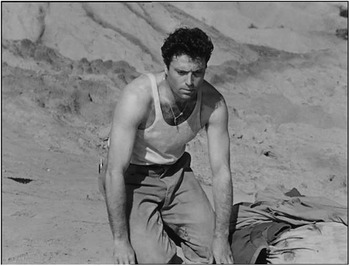
In post-war cinema, this victimhood and suffering is often played out in displaced fashion through romantic relationships. I have written elsewhere (O’Rawe Reference O’Rawe2014, 117–137) about how the use of the love triangle (often between brothers) in films representing the anni di piombo works to elide ideological differences and to encourage a narrative of equivalence which also neutralises and expels a difficult past. In the films under examination here, the love triangle brings into complicated proximity men on both sides of the ideological conflict through the body of the woman. For example, in Cuori senza frontiere, Raf Vallone’s ex-soldier returns to his tiny village near the Yugoslav border, which has been divided into two, and fights for the love of Donata (Gina Lollobrigida) against her lover, who has decided to live on the Yugoslav side of the border. Their violent confrontation is clearly a way of working out issues around political belonging and the fate of the Italian border. In Il Cristo proibito, Vallone again plays a soldier, Bruno, who returns from prigionia to find that his brother, a partisan, has been killed, and determines to avenge his death (Figure 1). He then discovers that his ex-girlfriend, believing him to be dead, had slept with the brother while Bruno was away. Her ingenuous confession, ‘era come se mi fossi data a te’, suggests a fundamental sameness of ideological positions between the partisan and the soldier, and makes of the surviving brother, betrayed, victimised, and aiming to dispense justice, the representative of the Italy to come.
Raf Vallone as Bruno returns home in Il Cristo proibito (Curzio Malaparte, 1951; © Viggo Srl)

Similarly, in Non c’è pace tra gli ulivi Vallone again plays a reduce who comes back to discover his girlfriend involved with an older man, clearly linked to the Fascist hierarchy, and an analogous model is visible in Atto di accusa, where Marcello Mastroianni’s reduce is framed for murder by his ex-girlfriend’s new, much older husband. The complexity of the plots – in Gli innocenti pagano the soldier becomes involved with his dead friend’s girlfriend, but his own ex-wife has left him, and his new love has also had a relationship with a powerful man while her lover was away – is of course typical of the schemes of melodrama, but also alludes to the disruption of domestic life and the difficulty for the returning man to understand the new kinds of relations that have sprung up. These new relations have a basis in fact: Maria Porzio, for example, discusses the difficulties that many reduci faced upon returning home and discovering their wives had begun new relationships.Footnote 37
The casting of Raf Vallone in so many of these films is particularly interesting (he appears also as reduci in Il bivio, Perdonami! and Riso amaro): as an ex-partisan and writer for L’Unità, as well as an ex-footballer, the actor embodies a robust physicality, and a left-wing persona; his characters are, nevertheless, haunted by the events of the war, and exhibit a fundamental sense of defeat. The tortured paternalism of many of his characters shows an awareness that previous gender certainties (about female behaviour and the need for strong masculinity) are crumbling. Vallone, who emerged as a star well after the war, in 1949 with Riso amaro, was thus distinctly unlike Amedeo Nazzari, who as an emblem of pre-war cinema had to redeem himself through roles as reduci in films such as Il bandito, Pietà per chi cade, and Alina, in which his characters acknowledge and atone for their compromised past.
In Caccia tragica, the love triangle is reversed, and Andrea Checchi plays a reduce who has turned to banditry and, although tied to Vivi Gioi’s collaborationist femme fatale, is drawn to the good woman (Carla del Poggio), girlfriend of fellow veteran Massimo Girotti. This model is also present in Il sole sorge ancora where Vittorio Duse has to choose between a collaborator and a woman of the Resistance. In that film, and in others such as Due lettere anonime (where Clara Calamai makes a choice between Checchi’s Resistance fighter and her Fascist lover, played by Otello Toso) and Achtung! banditi!, where Gina Lollobrigida has to choose between her brother, a former alpino helping the Germans, and a man of the Resistance, the setting is not post-war, but post-8 September.Footnote 38 In that moment, the stakes are clearer, as the war is ongoing, and the starkness of the moral choice is evident, even as it is run together with a sexual, romantic or familial choice, as the male heroes are clearly labelled as former soldiers turned Resistance fighters after the Armistice.Footnote 39
However, the majority of these films are set after the end of the war, and dramatise the failed attempt to settle back into domestic or civilian life, using gender relations as the lens through which this failure is interrogated. For example, the trope of misrecognition is very prominent in Tragico ritorno, Il bandito, Napoli milionaria and La vita ricomincia. Footnote 40 The overdetermined dialogue often makes blatantly obvious the recourse to a melodramatic notion of recognition of virtue or villainy in this process: as Marcello Mastroianni’s reduce remarks bitterly in Tragico ritorno on finding that his son doesn’t recognise him and that he is looked on with suspicion: ‘qui tutto è cambiato. La gente nemmeno ti guarda, forse perché non ti riconosce e chi ti riconosce ti guarda con rancore, forse perché sei ancora vivo’.Footnote 41 The recognition scene in Il bandito, meanwhile, where Ernesto (Nazzari) meets his sister (Carla del Poggio) working in a brothel and finally recognises her, plays out in the classic melodramatic fashion involving extended silences and inarticulacy, as no words are possible, but instead only the man’s tears when he realises what has happened. As Steve Neale writes of tears in melodrama, they are an effect and a signal of temporal irreversibility, indicating the protagonist’s recognition that ‘it is always too late’ (1986, 10).Footnote 42
The belated return home of the soldier to discover a transformed domestic scenario reflects a historical reality, but has other functions;Footnote 43 the word reduce itself, which literally means ‘one who returns’, foregrounds the act of the return, rather than, for example, the events survived. As Morreale argues (Reference Morreale2011, 48), ‘spesso […] la loro funzione più importante è proprio questa: l’arrivo e la partenza troppo presto o troppo tardi. A volte reduci di guerra (Pietà per chi cade, Noi peccatori) […] arrivano all’inizio del film e trovano una situazione tragica’.Footnote 44
The ‘too-lateness’, which is typical of melodrama, works primarily to emphasise the reduce’s impotence when confronted with changes in the domestic set-up and in gender relations. Danielle Hipkins (Reference Hipkins2007) writes of how in the post-war period many films, through the figure of the female prostitute, use sexual relations as an arena for playing out questions of guilt and innocence, displacing Italian guilt onto the female figure. The crisis in gender relations dramatised in films such as Il bandito (where Nazzari’s sister has turned to prostitution in his absence) and La vita ricomincia (in which Fosco Giachetti’s wife, played by Alida Valli, has been forced to prostitute herself to save their son) stands for an inability to come to terms with the past, and with what may have happened while men were away.
Several of these films manifest a particular anxiety around women’s work: in the absence of most of the male population, this female work happens in morally dubious ways, like sex work (Il bandito/La vita ricomincia) or black marketeering (Napoli milionaria). Again, there is a historical referent for this: in many cases returning soldiers displaced from the workplace women who had been employed in their absence, a situation legitimised in the parliamentary bill of 1946 that mandated that in private companies composed of more than twenty employees, 50 per cent of new employees in the next two years had to be war veterans.Footnote 45 In fact Porzio notes that ‘la frivolezza delle donne nel periodo che seguì l’arrivo degli Alleati rappresentò anche uno degli argomenti su cui puntarono i reduci di ritorno dalla prigionia per sostenere il loro diritto di ritornare al lavoro e riprendere quei posti che per le condizioni eccezionali della guerra furono affidati alle donne’ (2011, 115).
Thus the fear that without a strong masculine presence Italian women would ‘slip into sexual sin’ is clearly seen in many films, as Hipkins notes (2007, 100). Some films represent rape by occupying forces as the inevitable consequence of Italian male absence (Guai ai vinti/Non c’è pace/Il Cristo proibito), while concerns about slippages in female behaviour are amply on view in Napoli milionaria, and in Un uomo ritorna, in which Gino Cervi’s reduce is appalled by his young sister, who has been frequenting American soldiers and learning American songs and dances in his absence. The question of blame for the absence of the man is then raised: in Il Cristo proibito Raf Vallone’s character is blamed both for the death of his brother (his father says accusingly: ‘tu non c’eri. Forse non avrebbero ammazzato tuo fratello se tu fossi stato qui a difenderlo’) and for the rape by Germans of his old love Nella, who laments ‘tu non puoi sapere … eri lontano’. Similarly, in La vita ricomincia, Valli’s character, forced to prostitute herself to save her son during her husband’s absence, accuses him, ‘voi andate a combattere senza pensare a chi resta’, and in Penne nere, the Cossacks attack the women of the Friulian village where the young men have gone off to fight.Footnote 46
The reduce thus is doubly victimised when what happens to the women he leaves behind is also coded as his fault. The reason he left to fight is never explicitly mentioned, so what is left ambivalent is whether it is Fascism itself or the humiliation of the war defeat that is the cause of the personal and national suffering. Even in Tragico ritorno, where Mastroianni’s character returns after eight years to find that his wife, believing him dead, has remarried, and his son calls another man father, his wife eventually tells him accusingly ‘tu non tornavi’. Although she and her new husband point out that the law is on his side if he wishes to resume his place in the household, it is made clear that morally that is not the case and the fact of his absence is enough to justify the loss of his family. In Il bandito, when Ernesto discovers that his mother was killed during the war, the neighbour breaking the news adds somewhat reproachfully, ‘ti ha aspettato tanto la tua povera mamma’. The lack of sympathy displayed to the reduce for the losses he has suffered, which were out of his control, is marked, and again positions him to the viewer as a victim: in La vita ricomincia, when Giachetti’s character discovers he has lost his medical laboratory while away, his ex-partner says dismissively ‘ecco la vostra mentalità di reduce. Vi sentite tutti danneggiati, tutti vittime’.
These films are dominated by ideas of innocence, guilt, sacrifice and expiation, but are incoherent on who is actually to blame. In several examples the collective is blamed: everyone is guilty but also nobody. The hysterical ending of Il Cristo proibito is an extreme case in point: Bruno (Vallone) mistakenly kills the man he thinks is his brother’s betrayer, the saintly Antonio, who deliberately sacrifices himself for Bruno; but Bruno then learns the real identity of the traitor, the ex-partisan Pinin. The confrontation between Bruno and Pinin, on a bare hilltop dotted with graves of partisans, is weighted with symbolism: Pinin, the ex-partisan turned betrayer can only offer as an explanation that ‘eravamo tutti pazzi in quegli anni’. This faint allusion to partisan violence also creates an equivalence between himself and Bruno. Pinin begs Bruno to kill him and put him out of his misery, but, to a swelling non-diegetic score, Bruno refuses as a single melodramatic tear runs down Pinin’s cheek. Bruno is then symbolically forgiven by his mother, presumably for his (unspoken) war crimes, but finishes the film in an extraordinary scene in which he crawls towards Antonio’s holy dwelling while an extra-diegetic voice booms out ‘perché sono sempre gli innocenti a pagare?’ and other such rhetorical questions.
Il Cristo proibito is the most overt and heavy-handed treatment of the question of guilt and innocence, implicating the entire village with the mantra ‘la colpa è di tutti’, but it is ultimately most interesting for its total failure to resolve these questions, with Vallone’s character simply disappearing from the frame as the camera lingers on the Tuscan hills, and the voice-over screams three times ‘Perché??’Footnote 47 The religious framing of the ending is paralled in the endings of Guai ai vinti and Noi peccatori, which align their female protagonists explicitly with the figure of the Madonna as emblem of suffering, sacrifice and redemption. Noi peccatori’s hyperbolic ending sees reduce Stefano (Steve Barclay) beg his paralysed love, played by Yvonne Sanson, for forgiveness during Mass. Sanson, gazing at a portrait of the Madonna and Child, rises to her feet and walks, and Stefano, finally moved by this visible sign of his forgiveness, and absolved from the fact that (in gloriously melodramatic fashion) she had debased herself to become a nightclub singer in order to pay for an operation to restore his sight, kneels down in front of the altar. The final shot of the film, a two-shot of Barclay and Sanson in profile gazing at the altar, with tears in their eyes as he blesses himself, to the accompaniment of Renzo Rossellini’s swelling melodramatic score, is emblematic of Louis Bayman’s description of the Marian cult in post-war Italian melodrama: these films ‘enact a process of absolving victimhood parallel to that which the county was undergoing after the war, but with the figure of transgression and absolution shifted from public and masculine questions to the private and female sphere’ (2014, 49), a sphere, I would add, also occupied now by the male protagonist.Footnote 48
Vengeance and silence
In the reduce’s thirst for justice or vendetta the inadequacy of the legal system is exposed: this happens strikingly in Un uomo ritorna, Non c’è pace, Il Cristo proibito and Atto di accusa. The possibility of official or institutional justice is dismissed, as is patriotism itself: family and the domestic are the only things worth fighting for. This tendency takes on a particular inflection in noir-style films: Il bivio, Il bandito, Atto di accusa and Gli innocenti pagano (and also Gioventù perduta (Germi, 1947), in which Massimo Girotti’s police commissioner is a reduce) show how ‘redundant Fascist militarism’ (Hipkins Reference Hipkins2007, 93) is now recycled as vendetta or lawlessness. In Il bandito, Ernesto the reduce says ‘dovrei ammazzare un sacco di gente, ma dicono che è proibito’ as he turns outlaw.Footnote 49 In Il bivio, a noir set in post-war Turin, Raf Vallone plays a former soldier turned corrupt police chief, and blames his army training for his ruthlessness, as he is now secretly the head of a criminal gang: ‘uno come me, cresciuto nell’odio, nella violenza, nella guerra, non può avere scrupoli’. He, like Ernesto in Il bandito, is killed at the end of the film, but this narrative purging cannot remove the force of their dominating presence.Footnote 50
However, in general, what has happened during the war is represented as unspeakable both for those who return and those who stayed home. Use of circumlocution or ellipsis is common when referring to camp experience, both spatially – Russia is referred to as ‘laggiù’ (Il Cristo), and as ‘lassù’ (Due lettere), the prison camp in Africa in Noi peccatori is also ‘laggiù’ – and temporally (‘allora’, used in Atto di accusa). The reduce refuses to, cannot, or is prevented from narrating his experiences, and he and his family members have to resort to circumlocution or euphemism, using expressions like ‘quello che hai passato’, ‘quello che ho visto’, ‘quello che hai patito’, ‘ne ho passato di tutti i colori’. In Napoli milionaria, Gennaro first cannot recount his suffering (‘te l’è passata brutta’/‘non ne parliamo ...’) and then when he tries to express it (‘questo ve la dovete sentire’) the reply is merely ‘i guai li abbiamo passati pure noi’.Footnote 51 In Un uomo ritorna Sergio evades the topic of his experiences, claiming that ‘sono centinaia di migliaia quelli che potrebbero raccontare la storia. Per fortuna, la maggior parte ha solo voglia di dimenticarla’. Fosco Giachetti’s character in La vita ricomincia merely says shortly: ‘Il racconto dei miei guai l’avrò fatto almeno una decina di volte. Del resto, puoi immaginare …’. His elision of the past as ‘una passeggiata di sei anni’ can also be tied more broadly to the lack of representation of violence or war crimes abroad: in Il Cristo proibito, Bruno confesses that he had to finish off a friend in Russia who was dying, but Nella narrates it for him, as he is unable tell the story. What happened abroad cannot be narrated, or, as in Napoli milionaria, if it is narrated, it cannot be listened to.Footnote 52 It is never directly shown on screen, and as discussed, many of the films begin with the moment of return to Italy, when veterans discover that things have already changed.Footnote 53
These overdetermined lacunae are indices of the melodramatic ‘text of muteness’ in Peter Brooks’ terms, standing in for victimhood and able ‘to render meanings which are ineffable, but nonetheless operative within the sphere of human ethical relationships’ (1995, 72).Footnote 54 They draw attention to what cannot be said and expressed, to the ‘unspeakable truth’of the period (Williams Reference Williams1998, 52). The silences also, of course, bear upon the experience of reduci themselves, and on the repression that they felt surrounded their experiences. As Bistarelli points out, ‘il silenzio e la rimozione sono le due facce del problema reduci’ (2007, 13), and Claudio Sommaruga, a reduce himself, is adamant on the collective ‘dovere di parlare’ belatedly acknowledged by survivors, most of whom had kept silent out of shame.Footnote 55
Time, change, haunting
This mutual incomprehension (the reduce says bitterly in Caccia tragica, ‘Voi non avete capito niente di quello che abbiamo sofferto ... noi che siamo stati lontani in prigionia’...)Footnote 56 also alludes to a situation in which everything has changed due to the war, with the reduce himself becoming the very figure of that change. As Anna Maria Torriglia claims (2002, 15), ‘the disruption of identity and the various losses the war induced created an uneasy, ambivalent relationship with time itself’. The need to disavow not only Fascism, but the experiences of fighting in the war and of imprisonment, created a sense of discontinuity with the past, which these films make evident through the fixation on unrecognisability, change, and rupture with the domestic past. This, as Gribaudi points out, is also congruent with the way in which many memoirs by reduci constructed their experiences of imprisonment: in terms of a prima and a dopo, with a trasformazione in between (2016, 215).
The transformation of the reduce into someone or something else, is thus historically grounded – as Bertacchi notes (Reference Bertacchi1999, 275), ‘la prigionia ha reso diversi e irriconoscilibi non solo nell’aspetto esteriore, ha cambiato la stessa comunicazione affettiva’ – but the codes of melodrama, which emphasise suffering and sacrifice, symbolically and hyperbolically cast the reduce as a figure who instantiates the impossibility of returning to the pre-war (or pre-Fascist) era. The cry of the ex-prisoner in Pian delle Stelle, ‘non sono lo stesso uomo’ speaks to and resonates with a set of transformations, which, at their most emphatic, project the reduce as someone who has symbolically died,Footnote 57 and thus as a ghostly figure who haunts the nation.
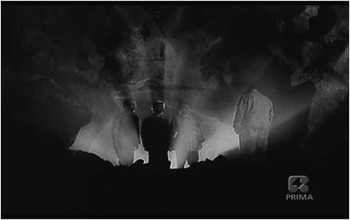
This metaphor of haunting can be found in the description of the reduce as a ‘spettro’ in Il Cristo proibito, and echoes an early journalistic description of the returning soliders as ‘ridotti a larve di creature umane’.Footnote 58 They are represented as literal ghosts at the extraordinary climax of La pattuglia dell’Amba Alagi (1953):Footnote 59 Luciano (played by singer Luciano Tajoli), the only survivor of a patrol defeated at the Battle of Amba Alagi in Ethiopia in 1941, travels through Italy visiting the relatives and loved ones of his ex-comrades. He in turn dies a sacrificial death, protecting his ex-love, and the film ends with a ghostly reunion as his comrades reappear on the Amba Alagi mountain, in the cave in which they began the film, and lead him into the light emanating from the back of the frame (Figure 3).
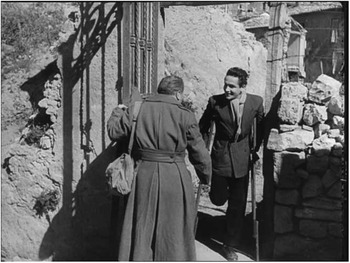
Gino Cervi arrives home from war in Un uomo ritorna (Max Neufeld, 1946; © Viggo Srl)

The ending of La pattuglia dell'Amba Alagi (Flavio Calzavara, 1953)Footnote 60

Derek Duncan notes the temporal disruption offered by ghosts:
The power of the ghost is to disturb linear conceptions of how time unfolds and of how it is inhabited. [. . .] Ghosts can be objects of a melancholic attachment that doesn’t want them to go, that requires the trace of their presence precisely in order not to mourn them (2011, 219).
The melancholic attachment to the homosocial bond, which can now only be attained in fantasy, represents an escape from the difficulty of changed domestic and gender roles, and also indicates that there is no earthly place for the reduce: in the words of Sommaruga, ‘il reduce è un diverso, sospeso con un vuoto di anni fra passato e futuro’ (1995b: 107).
Conclusion
The body of films examined shows the potency of melodrama in offering a treatment of the reduce’s time figured as, in Williams’ words, ‘the ultimate object of loss’ (1998, 69). Melodrama also offers a mode of dealing with national trauma that attempts to contain it diegetically, while often failing to grant comforting closure or cure via resolutions and happy endings.Footnote 61 The ghosts of La pattuglia dell’Amba Alagi are a striking sign of this lack of closure, of the unfinished past, which bleeds over into the present. Gender is the locus through which questions of history and national guilt are being worked out, displaced onto individuals and onto romantic and domestic relationships; the centring of ‘feminised’ and suffering masculinity in these films, through the occupation of a position of victimhood, shows the collapsing of the masculine space of war into the private sphere. As Gribaudi (Reference Gribaudi2016, 219) notes of reduci, ‘il rifiuto della guerra […] porta con sé il rifiuto di un mondo solo maschile; […] la disfatta, la condizione stessa di inferiorità li spinge a cercare altrove i simboli di un’identificazione per forza in contraddizone con quella del combattente’. It is striking that unlike neorealism, melodrama both gives women a space in the diegesis and interpellates female, and male, spectators in the drama of Italy’s difficult past.Footnote 62
Lamberto Sechi ended his 1949 article on the failure to represent the reduce adequately in cinema by lamenting the lack of screen attention to ‘le particolari e contraddittorie situazioni nelle quali il combattente è venuto a trovarsi nel corso del conflitto’ (1949, 175). However, as I have shown, the particularity of the Italian post-war experience and that of its returning soldiers does manifest itself through the obsessive return to these themes, in films that have been dismissed as lightweight, sentimental and implicitly unhistorical. The inability to directly broach or represent the experiences of the reduci, alongside the representation of that impossibility of representation, make it clear that the reduce operates as a symptom for Italy’s repression of Fascism and the war; as Elisabeth Bronfen argues, ‘any symptom articulates something that is so dangerous to the health of the psyche that it must be repressed and yet so strong in its desire for articulation that it can’t be’ (quoted in Hipkins Reference Hipkins2007, 87). The role of these films is thus to address, obliquely and incompletely, what has been repressed, decades before Italian historiography and public discourse came to terms with it, chiming with what Morreale identifies as melodrama’s role of ‘supplenza/exploitation sui temi dell’attualità, spesso rimosso dal neorealismo vero e proprio che preferisce concentrarsi sui momenti di lotta sociale in forma diretta’ (2011, 165). The fact that these melodramatic films managed this, and reached a wide public despite being critically ignored, testifies to the critical inability to see beyond neorealism as a mode of representing history. These films’ focus on the private, the emotional, and the romantic dimensions of the post-war experience throws into relief the extent to which the war, and the post-war return, may actually have been lived and experienced as melodrama in Italy.
Acknowledgements
I would like to thank Danielle Hipkins, Dana Renga, John Foot, Ruth Glynn, Alan O’Leary, Giacomo Lichtner, Gianluca Fantoni, Louis Bayman, the anonymous peer reviewers, and audiences in Cambridge, Zurich, Leeds, and Rome for helpful comments and feedback on this project and the article.
Notes on contributor
Dr. Catherine O’Rawe is Reader in Modern Italian Culture at the University of Bristol. She is the author of Stars and Masculinities in Contemporary Italian Cinema (Palgrave Macmillan, 2014), and co-author (with Jacqueline Reich) of Divi: la mascolinità nel cinema italiano (Donzelli, 2015). She was co-investigator on the AHRC-funded project ‘Italian Cinema Audiences 1945–60’ (2013–2016), from which a monograph is forthcoming.