Introduction
The genus Begonia comprises 1839 species (Hughes et al., Reference Hughes, Moonlight, Jara, Tebbitt, Wilson and Pullan2015–) distributed mainly in South America, Africa and Asia. Hughes (Reference Hughes2008) enumerated 57 species of Begonia split between nine sections distributed in Myanmar. Since then, an additional four species have been described (Tanaka & Hayami, Reference Tanaka and Hayami2011; Peng et al., Reference Peng, Wang, Kono and Yang2014; Tanaka & Peng, Reference Tanaka and Peng2016; Tseng et al., Reference Tseng, Kim, Peng, Htwe, Cho, Kono and Chung2017), two of these from Kachin in northern Myanmar.
The largest section of Begonia in Myanmar is sect. Platycentrum, represented by more than 20 species. Closely related are species in sect. Sphenanthera, a section containing about eight species in Myanmar and distinguished from sect. Platycentrum by number of locules (2 versus 3 or 4), number of female perianth segments (5 [rarely 3, 6 or 8] versus 4) and fruit characteristics (dry, leathery or papery versus fleshy or berry-like). The sections are not monophyletic (Tebbitt et al., Reference Tebbitt, Forrest, Santoriello, Clement and Swensen2006) but have been retained because they conveniently separate the species into two readily distinguishable groups.
During a field trip in Kachin, northern Myanmar, a new species of Begonia was recognised in the evergreen subtropical forests north of the village of Putao (former Fort Hertz). The new species is distinguished by its combination of four perianth segments in the female flower, two ovary wings, two locules, two styles and a dioecious breeding system.
Observations of key morphological characters (Doorenbos et al., Reference Doorenbos, Sosef and Wilde1998) were performed on living and pressed plants to establish the taxonomic status of the new collection. Digital images of herbarium specimens were used as a complement to the type descriptions of related species.
Begonia mariachristinae Wahlsteen sp. nov.
Begonia mariachristinae Wahlsteen differs from Begonia longifolia Blume in having 4 perianth segments in the female flower (versus 5 or 6), 2-locular fruit and 2 (rarely 3) styles, and being dioecious (versus having 3-locular fruit and 3 styles and being monoecious); it differs from the dioecious Begonia acetosella Craib. in being a smaller plant (40–60 cm versus c.2 m) with 2-locular fruit (versus 4-locular). – Type: Myanmar, Kachin, Putao between lat 27.680652, long 97.392283 and lat 27.714888, long 97.396161, 550–613 m, 7 xi 2016, specimens pressed from cultivated plants on 24 xi 2017, E. Wahlsteen EW16003 (holo LD, iso E). Figs 1, 2.
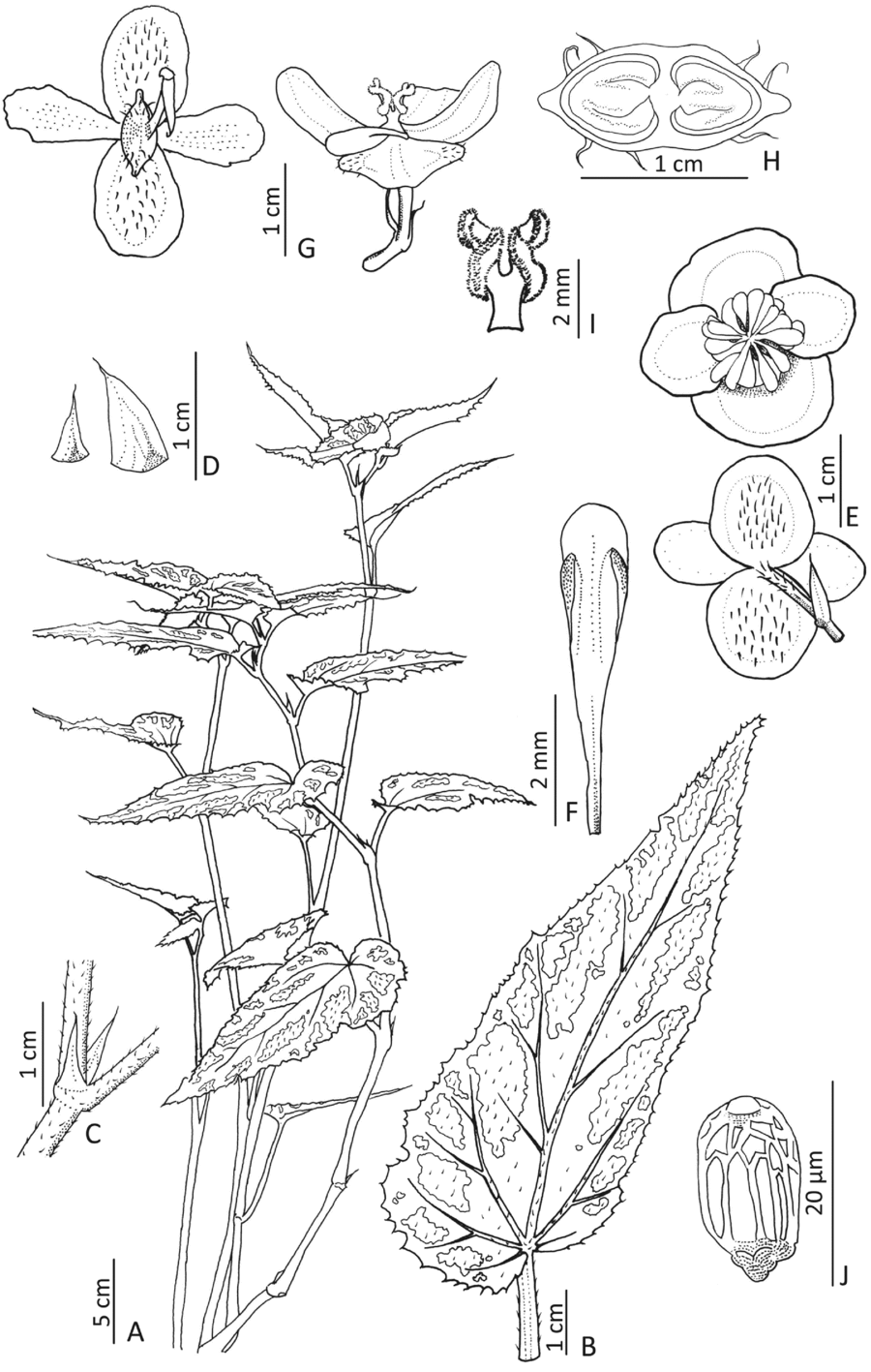
Begonia mariachristinae Wahlsteen. A, Habit; B, leaf; C, stipules and node from upper part; D, stipules from upper part (left) and lower part (right); E, male flowers; F, stamen; G, female flowers; H, ovary cross-section; I, style; J, seed. Drawn by the author from the type collection.

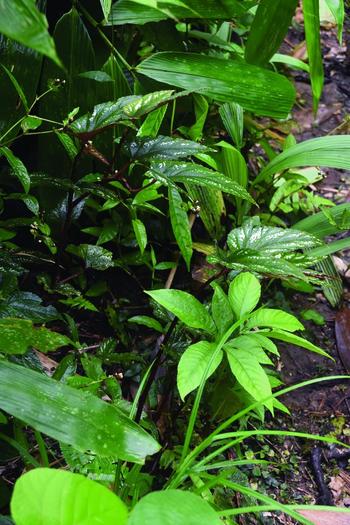
Begonia mariachristinae Wahlsteen at the type locality between Putao and Mount Madoi. Photograph by the author.

Dioecious, upright, single- or few-stemmed perennial, evergreen herb, lacking a rhizome or tuber. Stem 40–60 cm, dark red to maroon, lower portion with a few scattered hairs, upper portion with dense, soft hairs, internodes 6–14 cm, branching. Stipules persistent, papery, in lower part broad lanceolate-deltoid, in upper part narrow lanceolate-sublinear, 7–15 × 4–7 mm, glabrous, margin entire. Leaves alternate; petioles joining blades at a distinct angle, 10–50 × 1–1.5 mm, hairs in lower parts scattered, hirsute, in upper parts villous; blade held horizontal, upper surface dark green, sometimes almost blackish, with large silver white patches between main veins, conspicuously hispid with reddish hairs, lower surface deep red to maroon, with a few hairs scattered along midrib, lanceolate-ovate, 6–11.5 × 2.5–4.5 cm, apex acuminate, base oblique, margin serrulate with larger teeth at main veins’ ends, venation palmate-pinnate, main veins deep red. Inflorescences axillary, unisexual, males solitary or in a simple cyme, females solitary; peduncle sparsely hairy or subglabrous, 7–10 mm; bracts of male and female flowers persistent, 1 or 2 on each pedicel, narrow lanceolate-sublinear, c.2 × 8 mm, apex acuminate, margin entire, both surfaces glabrous; pedicels sparsely hairy, c.2.7 cm long, red to pink. Male flowers: perianth segments 4, outer two pink with membranous white edges, middle part of outer surface hispid with hairs bent towards apex, broadly ovate, almost circular, 1 × 1.1 cm, apex rounded, inner two perianth segments white and pink, elliptic-obovate, 7 × 11 mm, both surfaces glabrous, apex rounded; stamens c.45, androecium forming an open funnel shape; filaments c.1.5 mm long, free, born on a c.0.5 mm tall torus; anthers oblanceolate, flat, c.4 × 1 mm, dehiscing via two splits by each margin, connectives extended. Female flowers: perianth segments 4, outer two free, pink with membranous white edge, middle part of outer surface hispid with hairs bent towards apex, ovate, 1.3 × 0.8 cm, apex rounded, inner two perianth segments free, white with a pink flush, obovate, 5 × 11 mm, both surfaces glabrous, apex rounded; ovary peripheral parts hispid, with 2 (rarely 3) equal, triangular wings, 9–11 × 4–5 mm, locules 2, placentation axillary, branched twice; styles 2 (or 3), fused at one-third of its length, 2-lobed; stigma in a spiralled band connecting the two style lobes. Seeds ovoid to cylindrical, c.0.2 mm long, operculum somewhat protruding, collar cells length more than one-half of total seed length, testa cell length one-third to one-half of a collar cell. Fruit not seen.
Phenology
The collection of Bogner 2549 made in late April has buds and open male flowers. Seeds were present in November 2016.
Distribution and habitat
Begonia mariachristinae seems to be endemic to northern Kachin, Myanmar, where it occurs at an altitude of 500–1625 m in the mountains north of the town of Putao (former Fort Hertz). The species is found in the shaded understorey of evergreen rain forest and appears to have been collected on only two occasions, in 2002 and 2016.
Conservation status
Data Deficient (DD) (IUCN, 2012). The species seemed to be rather common by the paths between our camps three and four, a distance of only 4 km (for coordinates, see type description). However, its habitat is remote and requires several days of trekking to reach, and should not suffer from strong human pressures.
Additional specimens examined. Myanmar, Kachin State, Hkamti Plain, near Putao, 29 iv 2002, J Bogner 2549 (US 00810119 photo!).
Following the keys and descriptions in Doorenbos et al. (Reference Doorenbos, Sosef and Wilde1998), Begonia mariachristinae is affiliated with species in either sect. Platycentrum or sect. Sphenanthera. However, it does not comfortably fit within either section. Begonia sect. Platycentrum comprises species with 5 or 3 perianth segments in the female flower and ovaries with 3 unequal wings. Begonia sect. Sphenanthera, according to Doorenbos et al. (Reference Doorenbos, Sosef and Wilde1998), is defined by fleshy fruits with 3 or 4 locules. Thus, sect. Sphenanthera corresponds best to the characters of Begonia mariachristinae but differs in the number of locules. However, the new species is easy to distinguish from the most similar species in sect. Sphenanthera. It differs from Begonia acetosella in being a smaller plant (40–60 cm versus c.2 m) with silvery patched leaves (versus plain green leaves) and with 2-locular fruit (versus 4-locular). From Begonia longifolia it differs in having 4 perianth segments in the female flower (versus 5 or 6), 2-locular fruit and 2 (rarely 3) styles, and being dioecious (versus 3-locular fruit, 3 styles and being monoecious). Begonia longifolia also has plain green leaves without silver patches.
Begonia mariachristinae performs best in a humid greenhouse or a terrarium but suffers in a regular indoor climate, with heavy necrosis. It can withstand a few nights of light frost, and its seed is easy to germinate at about 25°C. The seedlings take about 8 months to flower.
Living plants have been sent to the botanical gardens of Gothenburg (Sweden) and Edinburgh (UK).
The species epithet honours the patient and understanding woman who chose to share her life with me.