INTRODUCTION
Fungicides are widely used in modern agricultural practices to control plant diseases. Yet, repeated use of fungicides has created great concerns in environmental health and food safety worldwide (van den Bosch et al. Reference Van Den Bosch, Oliver, Van Den Berg and Paveley2014). During recent decades, much research effort has been directed towards the development of biological control measures in the hope of reducing use of harmful chemicals in agricultural production. However, developing and evaluating eco-friendly and effective products as alternatives to fungicides remains challenging. Only through continued research will the reliance on fungicides be gradually reduced or eliminated in agriculture. Applying the principles of induced systemic resistance (ISR) and systemic acquired resistance (SAR) (Vallad & Goodman Reference Vallad and Goodman2004) appears to be a promising avenue for combating plant pathogens in the future.
Plants have pre-existing physical and chemical barriers that can serve as first lines of protection from micro-organism invasion. In addition, plant defence systems can be induced by a wide array of biotic and abiotic stress, collectively called elicitors (Albert Reference Albert2013; Thakur & Sohal Reference Thakur and Sohal2013). Elicitors could be proteins, glycoproteins, oligopeptides, carbohydrates, lipids, toxins or other small molecules that can trigger intracellular defence reactions. Pathogen-derived elicitors could be specific or general in nature. A specific elicitor can be recognized by, and interact with, a corresponding receptor in plants, whereas a general elicitor can trigger non-specific defence in both host and non-host plants. It has been widely accepted that plants, in response to pathogen attacks, often undergo physical modifications of cell structures and reprogramme chemical and physiological reactions of cells in order to limit or suppress pathogen penetration and/or colonization (Spoel & Dong Reference Spoel and Dong2012; Fu & Dong Reference Fu and Dong2013).
Upon perception and recognition of a pathogen, plant cells accumulate high levels of toxic reactive oxygen species (ROS) near the infection sites, resulting in programmed cell death, a phenomenon called HR (hypersensitive response) (Greenberg Reference Greenberg1997; Lamb & Dixon Reference Lamb and Dixon1997). Reactive oxygen species such as hydrogen peroxide (H2O2) and NO (nitric oxide) can also serve as signalling molecules to activate signalling cascades involving jasmonic acid/ethylene or salicylic acid pathways, which subsequently activate a broad spectrum of defence reactions (Mur et al. Reference Mur, Prats, Pierre, Hall and Hebelstrup2013; Scheler et al. Reference Scheler, Durner and Astier2013; Herrera-Vásquez et al. Reference Herrera-Vásquez, Salinas and Holuigue2015). Other inducible defence reactions include cell wall cross-linking, increase of lignification, accumulation of secondary metabolites such as phytoalexins, phenolic compounds and tannins, and the production of pathogenesis-related (PR) proteins (Van Loon & Van Strien Reference Van Loon and Van Strien1999; Hückelhoven Reference Hückelhoven2007; Sels et al. Reference Sels, Mathys, De Coninck, Cammue and De Bolle2008). Plant defence mechanisms have been intensively investigated in the field of plant biology, accumulating tremendous information on how ISR and SAR are regulated and executed in plants. The information has been widely applied, with some success, to control plant diseases (Vallad & Goodman Reference Vallad and Goodman2004; Burketova et al. Reference Burketova, Trda, Ott and Valentova2015; Conrath et al. Reference Conrath, Beckers, Langenbach and Jaskiewicz2015; Rao et al. Reference Rao, Reddy and Surekha2015; Sarma et al. Reference Sarma, Yadav, Singh and Singh2015; Oliveira et al. Reference Oliveira, Varanda and Félix2016).
In the present study, total proteins were purified from eight pathogenic fungi commonly found in agricultural production. It was demonstrated that proteins purified from Alternaria brassicicola, Alternaria alternata, Phoma spp., Rhizoctonia solani, Sclerotium rolfsii, Colletotrichum gloeosporioides, Colletotrichum higginsianum or Fusarium oxysporum f. sp. lactucae had very different effects on the growth of sweet pepper, cabbage, tomato, watermelon, cucumber and tomato seedlings. Fungal proteins, after being applied onto test plants, also displayed variations in terms of effectiveness on the reduction of disease incidence caused by different fungal pathogens even though the proteins had no antifungal activities. Significantly, it was observed that proteins purified from Alternaria spp. reduced anthracnose incidence on cucumber by at least 52%. The Alternaria proteins were also highly effective in reducing damping-off disease caused by R. solani. An Alternaria protein effector 1 (Ape1)-coding gene was cloned from Alternaria spp. and expressed in Escherichia coli. The expressed Ape1 resulted in a remarkable reduction of anthracnose incidence on cucumber leaves, probably due to the non-specific induction of plant defence reactions.
MATERIALS AND METHODS
Biological materials and their maintenance
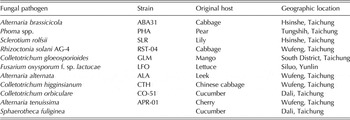
Plant pathogenic fungi used in the present study and their origins are listed in Table 1. Fungal strains were single spores isolated from surface-sterilized plant materials. Sphaerotheca fuliginea, the causal agent of cucumber powdery mildew, was maintained on cucumber leaves in greenhouses located on the National Chung Hsing University campus (Taichung, Taiwan). Other fungi were routinely maintained on potato dextrose agar (PDA) at 25–28 °C. For protein extraction, fungi were cultured in 500 ml potato dextrose broth (PDB) for 7–9 days. Plants used in the current study included: Chinese cabbage (Brassica campestris cv. Fung-Shan), cabbage (Brassica oleracea cv. Tops), tomato (Solanum lycopersicum cv. Known-You 301), sweet pepper (Capsicum annuum cv. Green star), watermelon (Citrullus lanatus cv. Flower Mountain) and cucumber (Cucumis sativus cv. Swallow). All plant seeds were purchased from Known-You Seed Co. (Kaohsiung, Taiwan). Plants were grown in a commercial potting mix (Bas Van Buuren B.V., De Lier, Netherlands) and maintained in a greenhouse. Escherichia coli strains used for plasmid propagation were cultured in Luria broth (LB) medium at 37 °C.
Fungal pathogens used in this study and their origins

Extraction of fungal proteins
Fungal proteins were purified according to protocols reported by Bridge (Reference Bridge1996) and Bridge et al. (Reference Bridge, Kokubun, Simmonds and Cutler2004), with modifications. Unless otherwise stated, all steps were performed at 4 °C. Fungal hyphae (0·5 g) grown in PDB were harvested by centrifugation (Sigma/2 K-15, Sigma Lab GmbH, Osterode am Harz, Germany) at 5000 g for 20 min, ground in liquid nitrogen and sea sand using a pestle and mortar. Fungal proteins were purified using an extraction buffer, containing 0·7 m sucrose, 0·5 m Tris-base, 50 mm EDTA-Na2·H2O, 0·1 m potassium chloride (KCl), 30 mm hydrochloric acid (HCl), 2% β-mercaptoethanol (2-ME), 2·8% polyvinylpyrrolidone and 2 mm PNSF (phenylmethylsulfonyl fluoride), or a lysis buffer, each 100 ml containing 57·06 g urea, 4 g 3-[(3-cholamidopropyl) dimethylammonio]-1-propanesulphonate (CHAPS), 0·48 g Tris-base, 4 ml Triton X-100 and 4 ml Nonidet P-40 (Lin et al. Reference Lin, Lin and Huang2014). Fungal proteins were precipitated with cold 0·1 m ammonium acetate/methanol (v/v) for 16 h and dissolved in phosphate-buffered saline (PBS), dialysed and quantified based on the Bradford dye-binding method (Bradford Reference Bradford1976). Proteins were separated by sodium dodecyl sulphate–polyacrylamide gel electrophoresis (SDS–PAGE) and stained with Coomassie Brilliant Blue.
Assays for antagonistic activity
The direct toxicity of purified proteins towards test pathogens was cross-examined on water agar spread with fungal protein extracts (2 µg/ml). An 8·4 mm agar plug carrying fungal mycelium was placed on a sterilized cover glass laid on the centre of the plate and fungal growth was monitored daily. Control plates were spread with water or PBS lysis buffer (100×) only. Lysis buffer containing Nonidet P-40 was diluted 100-fold because Nonidet P-40 alone has been found to activate cucumber disease resistance against anthracnose disease (Lin et al. Reference Lin, Lin and Huang2014).
Assays for plant growth
The effect of protein extracts on plant growth was assessed on plants (cabbage, tomato, sweet pepper, watermelon and cucumber) grown in peat moss (BVB no. 4, Bas Van Buuren, Maasland, New Zealand) in a 48-well tray (21 × 10.75 inches). Plants bearing true second leaves were sprayed to run-off weekly with protein crude extracts (2 µg/ml) and plant height and fresh weight were measured 30 days after treatment. Control plants were sprayed with extraction buffer, which was diluted 10 000× because of the presence of urea (57·06 g/100 ml). Each treatment contained four replicates and each replicate had 16 seedlings. All test plants were fertilized once a week with Hyponex No. 2 fertilizer (Hyponex, Marysville, OH, USA).
Inoculation and disease control
Plants grown in 10 cm pots were sprayed with protein extracts, water or buffer when the first true leaves emerged. Plants were inoculated to run-off with conidial suspensions prepared from fungal pathogens 4–6 h after the above-mentioned treatments. A. brassicicola, C. higginsianum and Colletotrichum orbiculare were cultured on PDA for 5–7 days for conidial formation. Conidia were harvested by flooding and scraping with sterile water and by centrifugation (Sigma/2 K-15, Sigma Lab GmbH) at 3000 rpm for 5 min, and their concentrations were adjusted to 104 conidia per ml with the use of a haemocytometer. Spores of S. fuliginea, the causal agent of powdery mildew, were washed off from diseased leaves, adjusted to 104 conidia per ml, and sprayed to run-off on to cucumber leaves. Disease severity on the 3rd and 4th leaves from the top was assessed 7–14 days post-inoculation (dpi) using the following scale: 0, no lesions; 1, lesion areas 1–10%; 2, 11–25%; 3, 26–50%; and 4, ⩾50%. Disease severity was determined according to the following formula:
 $$\eqalign {\hbox{Disease severity} \ (\% ) & = \left[ {\displaystyle{{\Sigma \;{\rm} (\hbox{disease scale} \times N_1 )} \over {N_2 \times 4}}} \right] \cr & \quad \times 100}$$
where N 1 is the number of diseased leaves and N 2 is the total number of leaves examined. Each treatment contained at least four leaves and experiments were conducted twice. The significance of treatments was determined by analysis of variance and treatment means separated based on the Duncan's multiple range test available in the SAS package (SAS Institute, Cary, NC, USA).
R. solani AG-4 inoculum was prepared as described previously (Hsieh et al. Reference Hsieh, Lin, Lin, Chung and Huang2016). Briefly, R. solani AG-4 was grown on sterilized shredded potato (100 g) for 7 days, mixed with sterilized peat moss (1:10, w/v) and 400 ml water, and incubated at room temperature (~25 °C) with stirring every 2–3 days for 2 weeks. The resultant culture was further mixed with unsterilized peat moss (3:100, w/w) to make a 3% infected soil. Plant seeds were individually germinated in non-infected peat moss in a 96-well tray (2·5 cm diametre). Seedlings (7 days old) were sprayed with protein extracts, water or buffer and transferred to R. solani-infected soils in a 48-well tray (52·5 × 26·9 cm2) 12 h after treatment. Inoculated plants were bagged for 16–24 h and moved to the greenhouse after bag removal. Disease incidence was assessed 7–14 dpi.
Assays for enzymatic activities
After spraying with fungal proteins, plant materials (10 g) were harvested, ground in liquid nitrogen, suspended in 1 ml of 50 mm Tris–HCl buffer (pH 8·5) and centrifuged at 12 000 g at 4 °C for 20 min. To measure phenylalanine ammonia lyase (PAL) activity, supernatant was mixed with equal volume of 30 mm L-phenylalanine, incubated at 40 °C in a water bath for 1 h, then placed on ice and measured spectrophotometrically for absorbance at 290 nm. The quantity of PAL activity was calculated by reference to a regression line established using cinnamic acid (Sigma-Aldrich, St. Louis, MO, USA) as described by Zucker (Reference Zucker1965) and Lamb & Rubery (Reference Lamb and Rubery1976). The quantity of protein was determined by the Bradford method. The following formula was used to calculate PAL activity:
 $$ \eqalign {\hbox{PAL (nM/}{\rm \mu}\,{\rm g/h)} & = (148 {\cdot} 18 \times {\rm OD}_{{\rm 290}{\kern 1pt} {\rm nm}} ) \cr & \quad - 0 {\cdot} 4674/\hbox{total protein}/{\rm h.}}$$
To measure peroxidase (POD) activity, supernatant of plant extracts was mixed with 1 ml of 50 mm phosphate potassium buffer (pH 5·8) and centrifuged as described above. The supernatant was mixed with 10 ml each of 21·6 mm guaiacol and 39 mm H2O2, and absorbance at 470 nm measured (Zhang & Kirkham Reference Zhang and Kirkham1994). One unit of POD activity was defined by the formation of 1 µm tetra-guaiacol per min:
 $$\eqalign {{\rm POD}\,({\rm unit}/\mu {\rm g}) & = \hbox{OD}_{{\rm 470}{\kern 1pt} {\rm nm}} /26 {\cdot} 6 \times \hbox{reaction time} \cr & \quad \times \hbox{total proteins}}$$
Molecular cloning and sequence analysis
Two primers P1-F (5′-ccgggatccatggccaacccccgcattgaa-3′) and P1-R (5′-ccggaattcctatatgctcagcgccatgat-3′) were designed based on PeaT1 coding gene sequences (accession no. EF030819). Restriction endonuclease recognition sites BamHI and EcoRI (underlines) were incorporated into the primers to facilitate cloning. Fungal mycelia (~100 mg) of A. alternata and Alternaria tenuissima were placed separately in a 1·5-ml centrifuge tube with five stainless steel balls (5 mm, Glen Mills, Clifton, NJ, USA), homogenized using a Model MM400 homogenizer (Retsch Tech GmbH, Haan, Germany) set at 1800 rpm for 1 min, and used for RNA isolation using Trizol reagent (Invitrogen, Carlsbad, CA, USA). Double-strand cDNA was synthesized with the oligo(dT)18 primer using a MasterAmp High Fidelity RT–PCR kit (Epicentre, Madison, WI, USA). The resultant DNA fragment was purified using a GFX PCR DNA and Gel Band Purification kit (GE Healthcare, Little Chalfont, UK), digested with endonucleases, and cloned into a pET-28a expression vector (Novagen, Madison, WI, USA). The resultant clones, pALA1 and pAPR1, were sequenced at Tri-I Biotech (Taipei, Taiwan). Similarity searching was performed at the NCBI (National Center for Biotechnology Information) using the BLASTX program. Sequences reported in the present study have been deposited with the EMBL/GenBank Data Libraries under accession numbers: KX134679 (clone ALA-01), KX134680 (clone APR01-09) and KX134681 (clone APR01-16).
Expression and purification of fungal proteins
Plasmid clones (pALA1 and pAPR1) were independently transformed into E. coli BL21 (DE3) competent cells. Three single BL21 colonies (ALA-01, APR-09 and APR-16) appearing on LB agar medium supplemented with 30 µg/ml kanamycin were picked and grown in 50 ml LB at 37 °C for 16 h, mixed with fresh LB (1:200, v/v) and incubated for additional 2–3 h with shaking (200 rpm, ModeS306R, Firstek, Taiwan) until absorbance wavelength at 600 nm reached 0·6–0·8. Alternaria protein effector 1 was expressed by adding isopropyl β-D-1-thiogalactopyranoside (IPTG) to a final concentration of 1 mm and incubating at 30 °C for 4 h. Bacterial cells were harvested by centrifuging at 5000 rpm for 10 min on a Sigma centrifuge (Model 2k-15, Sigma Lab GmbH), re-suspended in 10× binding buffer (50 mm Tris–HCl, 500 mm sodium chloride (NaCl), pH 7·4) and broken down using a UH-500A sonicator (CCWY, Beijing, China). After centrifugation at 13 500 rpm for 40 min, protein crude extracts (supernatants) were collected. Fungal protein was purified further by passing through a His-trap column (GE Healthcare) to reach ~90% purity.
RESULTS
Fungal protein effects on plant growth
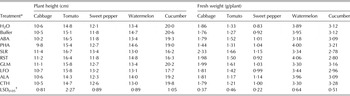
The yields of fungal proteins extracted from A. brassicicola, A. alternata, Phoma spp., R. solani, S. rolfsii, C. gloeosporioides, C. higginsianum and F. oxysporum f. sp. lactucae varied from 125 to 150 µg/ml/g fresh mycelium weight. In-vitro assays revealed no growth inhibitory effects of fungal proteins towards pathogens (data not shown). Proteins were sprayed to run-off onto plant seedlings weekly for 30 days. Protein extracts prepared from S. rolfsii promoted growth of cabbage, tomato and sweet pepper seedlings significantly (P < 0·05) (Fig. 1 and Table 2) and had little or no effect on watermelon and cucumber seedlings. Protein extracts prepared from A. brassicicola promoted growth of tomato and cabbage seedlings (Fig. 1). When assessed on sweet pepper, proteins prepared from all test fungi, particularly those from S. rolfsii, C. gloeosporioides and F. oxysporum f. sp. lactucae, promoted seedling growth. Protein crude extracts from other fungi had little or no effects on sweet pepper growth (Table 2).
The effect of fungal proteins on plant growth. Cabbage (a) and tomato (b) seedlings after being sprayed with proteins purified from Alternaria brassicicola (ABA) show improved growth 30 days after treatment compared with those sprayed with extraction buffer only (CKII) which contained 57·06 g/100 ml urea. To minimize the effect of urea on plant growth, extraction buffer was diluted 10 000-fold. (c) Proteins purified from Sclerotium rolfsii (SLR) promote growth of sweet pepper seedlings in relation to those treated with water (CKI) and buffer (CKII). Colour online.

Effect of crude proteins extracted from plant fungal pathogens on the growth of vegetable seedlings

* Proteins were extracted from Alternaria brassicicola (ABA), Phoma spp. (PHA), Sclerotium rolfsii (SLR), Rhizoctonia solani (RST), Colletotrichum gloeosporioides (GLM), Fusarium oxysporum f. sp. lactucae (LFO), Alternaria alternata (ALA) or Colletotrichum higginsianum (CTH) and sprayed weekly to run-off onto seedlings for 30 days. Seedlings sprayed with water or lysis buffer were used as mock controls.
† Significantly different at P < 0·05 according to Fisher's protected LSD test.
Control of cabbage black spot by fungal crude proteins
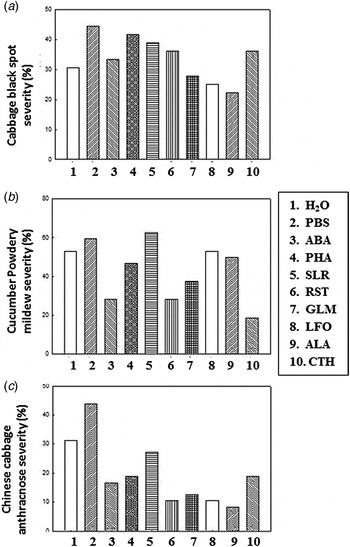
An experiment was set up to evaluate whether or not fungal protein extracts would reduce cabbage black spot caused by A. brassicicola. It was determined that only proteins prepared from A. alternate reduced black spot incidence on cabbage leaves (Fig. 2 a). Proteins prepared from other fungi had little or no effect on the reduction of cabbage black spot. Experiments were replicated three times with similar results.
The effect of fungal proteins on plant disease incidence. (a) Cabbage seedlings sprayed with fungal proteins (2 µg/ml) and inoculated with Alternaria brassicicola. (b) Cucumber seedlings sprayed with fungal proteins and inoculated with Sphaerotheca fuliginea conidia collected from affected leaves. (c) Chinese cabbage seedlings sprayed with fungal proteins and inoculated with conidial suspension prepared from Colletotrichum higginsianum. Disease severity was determined 7–14 days post-inoculation. Plants sprayed with water or extraction buffer were used as controls. Extraction buffer was diluted 10000-fold to minimize the effect of urea on plant growth. Fungal proteins were purified from A. brassicicola (ABA), Alternaria alternata (ALA), Phoma spp. (PHA), Rhizoctonia solani (RST), Sclerotium rolfsii (SLR), Colletotrichum gloeosporioides (GLM), C. higginsianum (CTH) and Fusarium oxysporum f. sp. lactucae (LFO).

Reduction of powdery mildew on cucumber by fungal proteins
To test the effect of fungal proteins on powdery mildew incidence, cucumber leaves were sprayed with fungal proteins and inoculated with conidia prepared from S. fuliginea. It was observed that protein extracts purified from A. brassicicola, R. solani, C. gloeosporioides and C. higginsianum reduced powdery mildew incidence on cucumber leaves (Fig. 2 b). Proteins prepared from A. alternata had no effects on the reduction of powdery mildew. Experiments were conducted three times with similar results.
Reduction of anthracnose diseases on Chinese cabbage by fungal proteins
Infectivity tests on Chinese cabbage seedlings revealed that proteins purified from A. alternata reduced anthracnose incidence induced by C. higginsianum (Fig. 2 c). Compared with PBS buffer controls, protein extracts from another seven fungal species showed a reduction of anthracnose on Chinese cabbage; however, the effects were not significant in relation to water controls.
Alternaria proteins effectively suppressed cucumber anthracnose
Proteins purified from Alternaria spp. were investigated further for controlling anthracnose diseases. Infectivity tests on cucumber leaves also revealed that proteins purified from A. brassicicola and A. alternate reduced C. orbiculare-induced anthracnose incidence, by 60 and 52%, respectively (Fig. 3). Alternaria protein extracts had little or no effects on conidial germination (data not shown). Cucumber seedlings treated with protein extracts from A. alternata and inoculated with conidial suspensions of C. orbiculare simultaneously or 24 h after protein treatment had similar effects on disease reduction (data not shown). A serial dilution of A. alternata proteins revealed that protein concentration at 2 µg/ml was sufficient to reduce anthracnose incidence on cucumber leaves.
The effect of proteins purified from Alternaria brassicicola (ABA) and Alternaria alternata (ALA) on anthracnose incidence in cucumber leaves. (a) Anthracnose caused by Colletotrichum orbiculare on cucumber leaves after being treated with A. alternata proteins, water (blank) or extraction buffer (control). Extraction buffer was diluted 10000-fold to minimize the effect of urea on plant growth. Disease severity was determined 5 days post-inoculation. Only representatives are shown. (b) Quantitative analysis of anthracnose lesions on cucumber leaves. The data presented are the mean ± standard error of the mean (s.e.m.). Colour online.

Reduction of R. solani-induced damping-off by Alternaria proteins
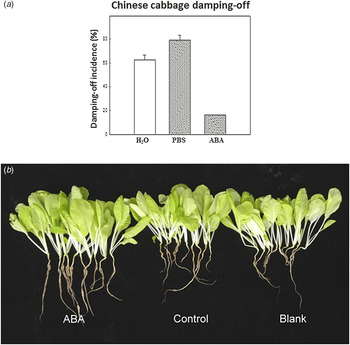
Proteins purified from A. brassicicola were investigated for controlling damping-off on sweet pepper and Chinese cabbage seedlings. Plant seedlings were sprayed with protein extracts purified from A. brassicicola and planted in R. solani-infested soils 12 h after treatment. The results indicated that A. brassicicola protein extracts reduced damping-off incidence on sweet pepper seedlings by 12% (Fig. 4). A. brassicicola protein extracts reduced damping-off on Chinese cabbage seedlings by as much as 60% (Fig. 5 a). Roots of Chinese cabbage seedlings treated with A. brassicicola protein extracts appeared healthy even in the presence of R. solani; however, seedlings treated with water or buffer had relatively poor root systems (Fig. 5 b).
The effect of total proteins purified from Alternaria brassicicola (ABA) on damping-off disease of sweet pepper seedlings. (a) Sweet pepper seedlings sprayed with fungal proteins, water (blank) or extraction buffer (control) were planted in Rhizoctonia solani-infested soils. Disease severity was determined 30 days post-inoculation. Extraction buffer was diluted 10000-fold to minimize the effect of urea on plant growth. (b) Quantitative analysis of Rhizoctonia incidence and damping-off of sweet pepper seedlings. The data presented are the mean ± standard error of the mean (s.e.m.). Colour online.

The effect of total proteins purified from Alternaria brassicicola (ABA) on damping-off disease of Chinese cabbage seedlings. (a) Rhizoctonia incidence and damping-off of Chinese cabbage seedlings. Seedlings treated with ABA proteins, water (blank) or extraction buffer (control), were planted in Rhizoctonia solani-infested soils. Extraction buffer was diluted 10000-fold to minimize the effect of urea on plant growth. Disease severity was determined 30 days post-inoculation. (b) Chinese cabbage root systems after treatment and inoculation with R. solani. The data presented are the mean ± standard error of the mean (s.e.m.). Colour online.

Induction of phenylalanine ammonia lyase and peroxidase activities by fungal proteins
Previous studies have shown that Chinese cabbage seedlings treated with proteins purified from A. tenuissima displayed resistance to damping-off (Hsieh et al. Reference Hsieh, Lin, Lin, Chung and Huang2016). Assays for PAL and POD activities revealed that both PAL and POD were induced to high levels in Chinese cabbage seedlings treated with A. tenuissima proteins (Fig. 6).
Assays for PAL and POD activities in Chinese cabbage seedlings. Seedlings after being treated with total proteins purified from Alternaria tenuissima (APR) have higher PAL (a) and POD (b) activities compared with those treated with water and extraction buffer. Extraction buffer was diluted 10 000-fold to minimize the effect of urea on plant growth. The data presented are the mean ± standard error of the mean (s.e.m.).

Cloning and expression of a nascent polypeptide-associated complex-like protein from Alternaria spp.
Since proteins purified from Alternaria spp. exhibited a broad-spectrum ability against different diseases, an attempt was made to characterize the protein responsible for disease suppression. A PeaT1 protein purified from A. tenuissima has been characterized to promote plant growth and to induce defence response (Mao et al. Reference Mao, Liu, Yang, Long, Zhao, Zeng, Liu, Yuan and Qiu2010; Zhang et al. Reference Zhang, Yang, Qiu, Guo, Zeng, Mao and Gao2011). Two primers complementary to the PeaT1 gene sequence (accession no. EF030819) were synthesized and used for polymerase chain reaction (PCR) amplification. A 630-bp DNA fragment was amplified from cDNA pool of A. alternata and A. tenuissima, and cloned into a pET-28a vector to yield pALA1 and pAPR1. Transformation of pALA1 and pAPR1 into E. coli BL21 (DE3) identified three independent colonies (ALA-01, APR-09 and APR-16). The cloned gene was designated Ape1 gene. Sequence analysis revealed that Ape1 in the ALA-01, APR-09 and APR-16 clones, respectively, displayed 97, 98 and 98% nucleotide identity to PeaT1 of A. tenuissima isolated from China. Alternaria protein effector 1 contained a 627-bp open reading frame (ORF), which encoded a polypeptide of 208 amino acids showing strong similarity to α subunit of nascent polypeptide-associated complex (NAC) of fungi. Alternaria protein effector 1 contained an NAC domain and a ubiquitin-associated (UBA)-like domain.
Recombinant Alternaria protein effector 1 protein reduces cucumber anthracnose
The Ape1 gene cloned in the pET-28a vector was expressed in the E. coli BL21 (DE3) cell line. Three independent clones, ALA-01, APR-09 and APR-16, were selected and used for large-scale production of Ape1 protein in axenic culture. Sodium dodecyl sulphate–polyacrylamide gel electrophoresis analysis of purified proteins identified a prominent polypeptide between 34 and 42 kDa from three clones (Fig. 7 a). Recombinant Ape1 protein was further purified by passing through a His tag column, yielding higher purity of Ape1 (Fig. 7 b). The recombinant Ape1 protein (2 µg/ml), after spraying onto cucumber leaves, reduced anthracnose incidence considerably (P < 0·05) (Fig. 7 c and d). Proteins extracted from un-induced E. coli or bacteria carrying the pET-28a vector alone failed to reduce anthracnose on cucumber leaves.
Expression and characterization of the Ape1. (a) Sodium dodecyl sulphate–polyacrylamide gel electrophoresis analysis of the Ape1 protein. The Ape1 gene was amplified from Alternaria alternata (ALA) and Alternaria tenuissima (APR), cloned into a pET-28a vector, and expressed in Escherichia coli BL21 (DE3) cells. (b) Recombinant Ape1 protein was purified using a His tag column and analysed by SDS–PAGE. (c) Recombinant Ape1 protein (2 µg/ml) sprayed onto cucumber protect the leaves from anthracnose disease. The data presented are the mean ± standard error of the mean (s.e.m.) of four biological samples. (d) Cucumber leaves treated with recombinant Ape1 of A. tenuissima and inoculated with Colletotrichum orbiculare develop fewer anthracnose lesions compared with those treated with PBS buffer (control). Disease severity was determined 5 days post-inoculation. Only representatives are shown. Colour online.

DISCUSSION
Plant diseases reduce agricultural production markedly. Diseases must be controlled in order to achieve acceptable quality and quantity of crops and to meet the challenge of a rapid increase of human population. Application of fungicides is one of the most common practices for controlling plant diseases worldwide. However, it is well known that frequent uses of fungicides not only pollute the environment, affecting human health both directly and indirectly, but also induce the occurrence of pathogen resistance (van den Bosch et al. Reference Van Den Bosch, Oliver, Van Den Berg and Paveley2014). Thus, finding alternatives to fungicides will be imperative for long-term sustainable agricultural practices. The present work demonstrated the possible application of fungal proteins for controlling plant diseases under greenhouse conditions.
In order to explore alternatives for controlling plant diseases, fungal proteins were purified from three soil-borne (S. rolfsii, R. solani and F. oxysporum f. sp. lactucae) and five foliar fungal pathogens of vegetables and evaluated for their ability to reduce vegetable diseases caused by four different pathogens. Because all test proteins lacked antimicrobial activities, the observed effects on disease reduction could be attributed to the induction of host innate defence reactions. This speculation was further supported by the observation that proteins purified from A. tenuissima triggered accumulation of both PAL and POD activities in Chinese cabbage leaves. Moreover, some of fungal proteins had effects on plant growth. It was also observed that different plants respond to fungal proteins differently, suggesting the presence of certain levels of specific interactions between fungal proteins and host genotypes. For example: S. rolfsii proteins were able to enhance the growth of cabbage, tomato and sweet pepper but not watermelon and cucumber seedlings. However, proteins prepared from A. brassicicola increased the growth of tomato and cabbage seedlings and had no drastic growth effects on other test plants. The growth of sweet pepper could be readily enhanced by proteins prepared from all test fungi, indicating the importance of host genotypes in response to fungal proteins.
Pathogen-derived elicitors have been well known to trigger a wide range of plant defence mechanisms (Burketova et al. Reference Burketova, Trda, Ott and Valentova2015; Cui et al. Reference Cui, Tsuda and Parker2015), yet only a few proteinaceous elicitors have ever been successfully used to control plant diseases under field conditions. In the present study, proteins purified from eight different pathogenic fungi were tested for their efficacies in reducing disease incidence on cabbage, Chinese cabbage, sweet pepper and cucumber. Infectious assays revealed that only proteins purified from A. alternata had effects on controlling cabbage black spot caused by A. brassicicola. Although S. rolfsii proteins were able to promote cabbage growth, the proteins failed to enhance resistance against A. brassicicola. The results implicate the fundamental differences between plant growth and disease resistance in a given species.
Assays on cucumber leaves against powdery mildew revealed that proteins purified from A. brassicicola, R. solani, C. gloeosporioides and C. higginsianum reduced powdery mildew incidence considerably. Although A. alternata proteins could effectively reduce black spot on cabbage, the proteins had no effects on the reduction of powdery mildew on cucumber, indicating the complexity of fungal protein-induced resistance in different plant genotypes. Fungal proteins purified from eight pathogens all had variable effectiveness against Chinese cabbage anthracnose caused by C. higginsianum. Further tests on cucumber leaves also revealed that proteins purified from both A. alternata and A. brassicicola were effective in reducing cucumber anthracnose incidence caused by C. orbiculare. A. brassicicola proteins also effectively reduced damping-off incidence induced by R. solani in both sweet pepper and Chinese cabbage seedlings. However, it was observed that proteins from different Alternaria spp. were different in their capabilities of inducing resistance (Hsieh et al. Reference Hsieh, Lin, Lin, Chung and Huang2016).
Although exogenous application of fungal proteins onto plants did not induce any visible lesions, Chinese cabbage leaves challenged with proteins purified from A. tenuissima were found to have higher PAL and POD activities, suggesting the involvement of cellular defence mechanisms. Phenylalanine ammonia lyase is the key determinant of phenylpropanoid production, including flavonoids, furanocoumarin phytoalexins, chlorogenic acid and cell wall-associated defence components, all implicated in plant defence reactions (Zucker Reference Zucker1965; Shoresh et al. Reference Shoresh, Harman and Mastouri2010). Peroxidase activity has diverse functions in plants, including auxin catabolism, lignin formation, polymerization of phenols, defence mechanisms against pathogens, respiration and light-mediated processes (Gaspar et al. Reference Gaspar, Penel, Thorpe and Greppin1982; Huystee Reference Huystee1987). The expression of PAL and POD-coding genes and their enzymatic activities are often elevated in response to stress, wounding and pathogen attacks (Zhang & Kirkham Reference Zhang and Kirkham1994). Unexpectedly, none of the test proteins in the current study triggered visible hypersensitive reactions on test plants. It appears that treating plants with fungal proteins could lead to the induction of SAR. It is likely to be true in the case of R. solani-induced damping-off on sweet pepper and Chinese cabbage seedlings. Both seedlings reduced damping-off incidence considerably after being sprayed with Alternaria proteins and planted in the R. solani-infested soils. The results suggest a promising future for controlling plant diseases using fungus-derived proteins or elicitors.
A heat-stable PeaT1 protein identified in a JH505 strain of A. tenuissima has been demonstrated to promote seed germination and plant growth and to induce expression of plant defence-related genes in various crops (Zhao et al. Reference Zhao, Qiu, Liu and Yang2005, Reference Zhao, Yang, Zhang, Yuan and Qiu2007; Wu et al. Reference Wu, Qiu, Yang, Wu and Zhao2007; Zhang et al. Reference Zhang, Yang, Qiu, Guo, Zeng, Mao and Gao2011). Tobacco plants treated with purified PeaT1 protein enhanced resistance to tobacco mosaic virus (TMV) in a salicylic acid-dependent manner (Mao et al. Reference Mao, Liu, Yang, Long, Zhao, Zeng, Liu, Yuan and Qiu2010; Zhang et al. Reference Zhang, Yang, Qiu, Guo, Zeng, Mao and Gao2011). Yet the feasibility of PeaT1 in the induction of plant resistance against fungal pathogens and the diseases induced by them remains largely unproved. A PebC1 protein, orthologous to PeaT1, was purified from the gray mould pathogen Botrytis cinerea and was shown to induce resistance against B. cinerea on tomato and enhance root growth and drought tolerance in wheat (Zhang et al. Reference Zhang, Yang, Liu, Qiu, Zhang, Zeng, Yuan and Mao2010). In the present study, an Ape1 gene, homologous to PeaT1, was amplified by PCR from genomic DNA of A. alternata and A. tenuissima and independently cloned into the bacterial expression vector pET-28a. Experiments have demonstrated that the E. coli-expressed Ape1, before and after being purified by a His tag column, effectively reduced anthracnose incidence on cucumber. The results confirm that Ape1 is the primary activator in the crude protein extracts responsible for disease reduction observed in the present study. Alternaria protein effector 1 encodes a polypeptide containing a NAC domain and a UBA domain. Deletion of an NAC subunit in yeasts led to defects in protein targeting to the mitochondria and a decrease in fumarase activity (Lithgow Reference Lithgow2000; Yogev et al. Reference Yogev, Karniely and Pines2007). Mutational inactivation of a NAC gene in Sclerotinia sclerotiorum affected the expression of a polygalacturonases-coding gene and fungal virulence (Li et al. Reference Li, Guo, Xu, Chen, Zhang, Pan, Li and Gao2015). Proteins containing a UBA domain have been shown to be required for a wide range of biological functions, such as protein trafficking, proteasomal degradation, DNA repair and cell cycle regulation (Hofmann & Bucher Reference Hofmann and Bucher1996; Su & Lau Reference Su and Lau2009). The biological function of Ape1 in Alternaria spp. remains uncertain.
Alternaria protein effector 1 might not be the only protein in Alternaria spp. that triggers defence resistance in plants against pathogens. Recent studies have found that small, heat-labile proteins (M.W. ⩾10 kDa) of A. tenuissima also displayed a remarkable ability to reduce damping-off in Chinese cabbage seedlings (Hsieh et al. Reference Hsieh, Lin, Lin, Chung and Huang2016). Moreover, a 66 kDa protein purified from A. tenuissima has been shown to reduce TMV-induced lesion formation on tobacco (Li et al. Reference Li, Qiu, Yang, Zeng, Yuan and Zhu2008). A PeaT2 protein purified from A. tenuissima is similar to prohibitin and has been shown to stimulate growth and root elongation of wheat seedlings (Liu et al. Reference Liu, Zeng, Liu, Yuan and Qiu2007).
In conclusion, the present study has shown that fungal proteins provide great protection to plants against several fungal pathogens, probably by triggering defence reactions. The purified proteins after being sprayed onto leaves not only reduced foliar diseases, but also resulted in a considerable reduction in a soil-borne disease caused by R. solani. How to improve the efficacy of those protein activators for controlling plant diseases will be the next logical step towards its application in the agricultural field. Nevertheless, the current study provides a system for future research on how to screen an effective activator from pathogens for disease management. Continued research into the development of eco-friendly alternatives in addition to toxic fungicides is not just an environmental issue but an issue important to food safety for many generations to come.
This research was supported by grants from the National Science Council (NSC) in Taiwan (grant numbers NSC 97-2313-B-005-035-MY3 and NSC 098-2811-B- 005-010) to J.-W.H.