Introduction
The French poet Georges Duhamel once said that ‘The Mediterranean ends where the olive ceases to grow’.Footnote 1 It is believed that the first variety of olive tree cultivated by man (Olea Europaea ssp.e.v.e.) appeared in the Middle East around 5500 years ago (Zohary and Hopf, Reference Zohary and Hopf1994). Although the debate continues over the precise location of its original development, it does seem clear that its expansion came from the domestication of wild varieties of olive trees which, millennia ago, grew spontaneously in Mediterranean woodlands (Bersnard et al., 2001). The earliest written sources record how olive oil was part of everyday life in antiquity, used not only in food but also in medicine, cosmetics and for liturgical purposes (Amouretti, Reference Amouretti1996). Moving beyond its ancient history, even today, nine out of every ten olive trees planted in the world grows in the Mediterranean region (IOOC, 2010). However, without wishing to minimise the secular role of the olive tree and oil, it is nonetheless true that within the famous Mediterranean trilogy (grain, olives and grapes), the tree of Minerva occupied a less important role than is commonly assumed. The latest studies of land use patterns show that its expansion in the form of single crop cultivation dates back only as far the last few decades. Furthermore, the single crop landscapes of olive groves that are now prevalent throughout the countryside of southern Spain did not originate in antiquity, as many visitors perhaps assume, but instead began only in the late nineteenth century (Zambrana, Reference Zambrana1987, Reference Zambrana2006).
Currently, Spain dedicates a higher land area to olive growing than any other country. Andalusia is the region of Spain with the highest concentration of olive trees and has the greatest specialisation in oil at a global level. The Andalusian province of Jaen, with an area of just over a million hectares, has over seventy million olive trees. Yet in 1750 it had just 42,000 hectares of olive groves, which represented just three per cent of the total surface area. Major expansion did not come until the twentieth century (Sánchez, Reference Sánchez1989). The explanation of the process of specialisation in oil production has generated a broad consensus among the majority of Spanish researchers. It can be summarised as follows. Nineteenth-century Spanish agriculture expanded as a consequence of new market opportunities which helped to boost internal and external demand, and large scale specialised olive growing was a part of this development. Specifically, the relative improvements seen in the potential profitability of the crop promoted its expansion (Carreras and Tafunell, Reference Carreras and Tafunell2004: 159–60; Kondo, Reference Kondo1990: 73–4; Mataix and Barbancho, Reference Mataix and Barbancho2008: 286–7). The availability of foreign markets helped to promote oil production as well as the increase in internal demand (GHER, 1981, 1988: 37; Guzmán, Reference Guzmán2004; Garrido, Reference Garrido2005, Reference Garrido2007; Mata Olmo, Reference Mata Olmo1987: 151–2; Pascual and Sudriá, 2005: 213; Simpson, Reference Simpson1997; Vives, Reference Vives1977: 591; Zambrana, Reference Zambrana2006: 58). Against this background, many studies have not hesitated to state that the fall of the Ancien Regime and the liberal agrarian reforms which followed from this were also major factors in the growth in production (Bernal, Reference Bernal1979: 178; Garrido, Reference Garrido2007: 27–30; GEHR, 1988: 37; Guzmán, Reference Guzmán2004; Kondo, Reference Kondo1990: 73–4; Mataix and Barbancho, Reference Mataix and Barbancho2008: 286; Zambrana, Reference Zambrana2006: 58).
Associating the olive grove with agrarian modernity is thus a commonplace of Spanish historiography. For the authors cited above, olives represent a highly capitalised crop, and their large scale cultivation was linked to the growth of the market and was dependent on large landowners as the only group capable of taking on the high costs of exploitation. In this interpretation, the olive tree and its landscapes almost appear to wait patiently through the centuries for the moment at which institutional changes and market conditions allowed them to increase in importance. This account of the industry's development is supported by evidence of long term statistics relating to prices, trade and production (see, for instance Barciela et al., Reference Barciela, Giráldez, GEHR, López, Carreras and Tafunell2005; GEHR, 1981, 1991; Ramón, Reference Ramón2000; Zambrana, Reference Zambrana1987; Reference Zambrana2006), and emphasises the role of major entrepreneurs in the sector such as the Carbonell (Castejón, Reference Castejón1977), the Ybarra (Sierra, Reference Sierra1992) and the Pallarés (Pérez, Reference Pérez2010) families. However, knowledge about the role of peasant farmers in this process of change and the environmental aspects of olive growing remains poor. Crudely expressed, we have little real knowledge of the material, ecological or social basis of the history of this crop over the long term.
The following few pages aim to clarify these issues, analysing environmental and social aspects of the expansion of olive orchards over the last three centuries in southern Europe, always striving to contextualise these data within the institutional and social frameworks of each period. Employing such a long term perspective, it is not possible to provide a detailed description of the evolution of this crop, and my intention is rather to provide a broad, general view of developments in order to throw light on the complex history of the Mediterranean olive grove. I shall argue that olive orchards, a form of agriculture well adapted to the environmental circumstances of the Mediterranean basin, had a multifunctional purpose throughout history, required less capital and labour than historians generally assume, and that their expansion from the middle of the eighteenth century represented a process of appropriation of traditional wild olive trees, intensifying management and focusing production on the more profitable product, olive oil, as market opportunities grew.
Case study, methods and sources
The research presented here focuses on the years of major growth in oil production starting in c.1750, and employs a representative south Spanish case study to document the character of subsequent expansion. But given the problems associated with such single local case studies it is important to emphasise that this is probably the only way to provide a profound and long term historical analysis, given the particular character of the sources available. Infante (Reference Infante2011) details the documentation used for each specific calculation as well as the methods used, but a brief review also needs to be provided here. In broad terms, information was obtained about olive production, inputs, agrarian management, the structure of the olive farm and other qualitative data. For the mid eighteenth century this material was derived from the General and Individual Responses for the Marqués de la Ensenada Cadastral Survey, the first cadastral survey undertaken in the Kingdom of Castille and a source which provides information about the rural property of each farmer and about the organisation of land in each village. The ‘notary protocols’ from each municipality were also examined in order to obtain information about yields and management practices, and a range of documentation relating to lawsuits, post mortem inventories, leases, etc. were also studied. These sources of evidence are all available from the sixteenth century. From the mid nineteenth century, following the fiscal reform, the sources of the amillaramientos (tax assessments) and the cartillas evaluatorias (assessment books) provide important information, up to the end of the century. These sources allow a direct comparison with the situation a century earlier, as presented in the Ensenada Cadastre.
From the start of Franco's regime, the quality and quantity of historical documentation declines. Nonetheless, it has been possible to use, albeit cautiously, data derived from the Vertical Olive Union, the National Supply Maps and various local statistics, together with the ‘Instituto Nacional de Estadística Statistical Summaries’ which provide local information from the mid twentieth century. Lastly, the agrarian census, one of the best sources for the study of agriculture in Spain, provides excellent data for the final decades of the twentieth century (1962, 1972, 1982, 1989 and 1999); while for the last few decades, the ‘Multi-Territorial Information System’ created by Andalusia's Regional government provides numerous agrarian statistics at a municipal level, allowing the data series to be completed up to the present day. However, paradoxically, municipal information declined in quality over the course of the twentieth century. Furthermore, most of these statistics translate their data into monetary rather than physical values, which makes it difficult to carry out estimates of the olive groves as functioning agro-ecosystems. For these reasons, and also because of the unreliable character of much of the information available for the period of Franco's regime, use has also been made of ‘oral history’, in the form of semi-guided interviews with farmers which have provided vital information about olive growing from the mid twentieth century, its transformation in the 1980s, and its present state (Infante, Reference Infante2011).
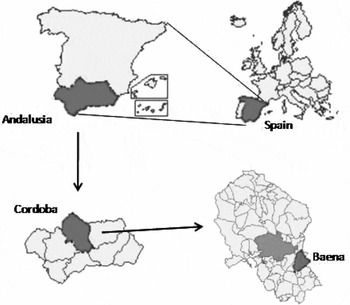
Using these sources it is possible to make reliable estimates of productive and other qualitative aspects of olive orchards over the long term, as well as to throw light on changing management practices. In particular, an attempt has been made to reconstruct the labour invested on olive farms in different periods, as well as the levels of production not only in terms of olive oil but also with regard to fodder, branches, wood and the vegetation growing between the tress and grazed by livestock. These data are expressed either in terms of energy or as quantities of dry matter produced, following the methodology developed by González de Molina and Guzmán (Reference González de Molina and Guzmán2006). The municipality of Baena, in the province of Cordoba, has been selected as a case study partly because it is representative of a wider region, lying as it does at the centre of the most important area of olive production in the world (Figure 1); and partly because it is a district particularly rich in the kinds of documentary sources detailed above. Previous research has, moreover, shown that the development of its olive industry followed a path typical of a much wider area (González de Molina et al., Reference Garrabou and González de Molina2010; Guzmán, Reference Guzmán2004).
Location of the municipality of Baena.
Source: Based on the Andalusian Institute of Statistics (2010).

The municipality of Baena, which is located within the valley of the river Guadalquivir, is characterised by typical Andalusian countryside. Although it almost borders the mountains, the area is not in itself mountainous and was dominated during the period studied here by the kind of large landed estate typical of Andalusia. Much research has already been undertaken into the history of the region (Bernal, Reference Bernal1979; Cruz Villalón, Reference Cruz Villalón1980; Mata Olmo, Reference Mata Olmo1987; Ponsot, Reference Ponsot1986), the majority of which has emphasised the importance of olive groves on large estates, serviced by a population of day labourers. The majority of the Andalusian population were concentrated in the area around Baena, due to the peculiar fertility of the soils beside the river Guadalquivir. The district was characterised, in the mid eighteenth century, by relatively low levels of market integration, although from the time of the Ancient Regime it was reasonably well connected to the centre of the country, and was close to the port of Malaga. In the second half of the nineteenth century, the first railways crossed this area, linking Andalusia's ports to inland Spain.
Baena covers a large area of land, around 363 square kilometres. It experiences high temperatures in the summer but the thermal oscillation is lower than in areas further inland, thereby avoiding long periods of winter frost. The average temperature gradient is between three and seven per cent. Baena thus has a Mediterranean climate with clear ocean influences and an average annual rainfall of just 641 mm and a PET (potential evapotranspiration) of around 1378 mm.
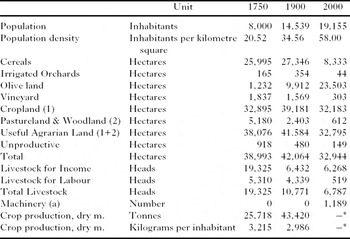
In the mid eighteenth century, Baena had 8,000 inhabitants (twenty-three inhabitants per square kilometre), a low population density compared with other territories in northern Spain, and was thus an area with high levels of land availability, in excess of four hectares per inhabitant. Much of the land was devoted to livestock farming. It was, as Herman Daly said (Reference Daly2005), an ‘empty’ territory, where labour, rather than resources, was the main limiting factor. In fact, a significant part of the arable land (52.5 %) was devoted to cereal crops, with land fallowed two years in three and producing low yields.
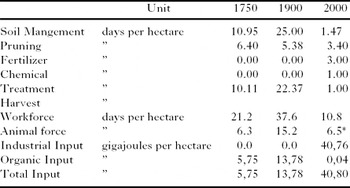
After the fall of the Ancien Régime new liberal policies facilitated access to land for a very large number of formerly landless peasants. Over the course of the nineteenth century there were several distributions of land which attracted significant population numbers (Horcas, Reference Horcas1990). Other liberal measures, such as land seizures and the redemption of tithe rent charges, also facilitated access to land ownership. Such liberal reforms, together with the demands for food from a growing population, stimulated improvements in production and productivity. Two mechanisms were of key importance in increasing production. The first was the cultivation of new lands: the cultivated area in Baena grew by twenty per cent between 1750 and 1900 (Table 1). The second important factor was the adoption of more intensive rotations, with higher inputs of labour and manure (González de Molina et al., Reference Garrabou and González de Molina2010). By the end of the nineteenth century, the amount of land dedicated to agriculture had increased to levels never seen before, and more intensive rotations had been almost universally adopted. But in addition, the dietary needs of the urban population were more effectively met by replacing livestock farming, which could only be sustained with low population densities, with an agricultural system based on the cultivation of cereal crops, in the manner described by Ester Boserup (Reference Boserup1965, Reference Boserup1981).
Indicators of the agrarian system of Baena 1750, 1900 and 2000.

(a) Tractors, cultivators and combine harvesters.
* Data not available.
Sources: see text.
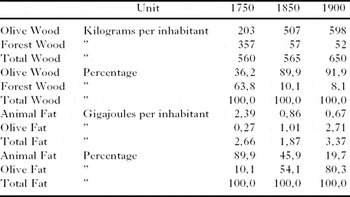
Wood and Fat available in Baena (1750, 1900 and 2000).

Source: Data from Infante (Reference Infante2011).
As a result of the general reduction in livestock numbers, there was a net decrease of around thirty-nine per cent in the amount of manure available to fertilise the crops, leading to a decline in per capita agrarian production. The agro-eco system of Baena was close to its limits in the last decade of the nineteenth century: in general terms there was stagnation or even a reduction in yields, with the exception of the woody crops. The survey carried out by the Ministry of Development following the farming crisis of the late nineteenth century asked directly about the causes of the crisis in production. The municipality of Baena responded that it was due to the ‘impoverishment of the fields, lacking in fertiliser, poorly worked and tired of producing’.Footnote 2
Some authors have argued that productive crises of this kind tend to accelerate the industrialisation of agriculture (Soto et al., Reference Soto, González de Molina and Infante2010). It is certainly true that southern Spain, during the period of the autarkic policies of the Franco regime, industrialised its agriculture by multiplying the use of industrial inputs, radically changing the traditional functioning of the sector. The use of inorganic fertilisers meant that former strategies, such as the fallowing of land and the application of manure, could be abandoned. The costs of applying the new methods of fertilisation were much lower than those involved in managing livestock or renouncing a year's harvest. Moreover, the adoption of machinery made farming tasks much more efficient and, consequently, less human and traditional animal labour was required to carry out farming tasks or transportation. Andalusia shows these changes well. Farm machinery increased from just over 8,000 tractors in 1960 to over 123,000 in 2000. Consequently, animal labour, which traditionally carried out the tasks of transportation and soil management, declined rapidly in importance during this period. Mules and donkeys, crucial in the middle of last century, have now practically disappeared from the countryside. The addition of inorganic fertilisers multiplied tenfold in the second half of the twentieth century and improvements in efficiency have meant that less labour is required per cultivated hectare. In Andalusia, in 1960, over seventy-three per cent of the active population worked in the agrarian sector. By 2000, this figure had fallen to eleven per cent (Zambrana, Reference Zambrana2006). The next few pages seek to analyse the place of olive groves in the agrarian history of this particular region.
Olive orchards in an ‘empty world’ (1750–1820)
A commonly expressed view in Spanish historiography on olive orchards under the Ancien Regime is that the olive tree only provided one product of any importance: oil (Bernal, Reference Bernal1979:176, Reference Bernal and Zambrana1987:13; Herr, Reference Herr1996; Zapata, Reference Zapata1986:291). Furthermore, to produce oil required major investments of capital (Álvarez and García Baquero, Reference Álvarez and García-Baquero1981; Caballero, Reference Caballero2004; Herr, Reference Herr1996) which could only be met by large landowners. As a consequence, the production of olive crops was seen as the prerogative of large landowners and large estates in Andalusia (Bernal, Reference Bernal1988; Caballero, Reference Caballero2004:62; Herr, Reference Herr1996; Simpson, Reference Simpson1997:32).Footnote 3 However, in contrast to this widely held view, it is possible to produce evidence to suggest a rather different role for the olive grove under the Ancien Regime. In the first place, we should point out that olive land in the mid eighteenth century was much more limited than we might expect from the widespread idea of the ‘Mediterranean trilogy’ (Table 1). As indicated above, olives did not take up a significant area of land within pre-industrial agriculture, a situation that did not change significantly until well into the industrialisation of the economy (Infante, Reference Infante2011). In the pre-industrial economy the expansion of olive groves was not a priority because the main focus was on the need to supply a range of goods to the rural community and moreover the fluid distribution networks required for trade were not available. The proximity of some farm land to ports meant that some agricultural goods could be produced for more distant markets (González de Molina, Reference González de Molina2010; Krausmann, Reference Krausmann2004; Sieferle, Reference Sieferle2010; Wrigley, Reference Wrigley2010), but the agro-climatic requirements of the olive meant that it could not be grown in coastal areas. It was not therefore possible for olive production to spread in the way that, for example, viticulture did, before the industrialisation of transport.
Furthermore, it is clear from reconstructions of the olive growing landscapes that in the mid eighteenth century olive groves were scattered, with low intensity coverage, more similar to the traditional wild olive woodlands than the estates we currently see in the Andalusian countryside.Footnote 4 In Baena, leases from the ‘notary protocols’ contain numerous descriptions of olive trees scattered among other crops or being managed like forest land or pasture. For instance, in 1721 Francisco Hermosilla rented to Antonio Priego ‘a farm with 20 ha in which there are olive trees, holm oaks and cereals’, and another which contained ‘land under cereal cultivation with ten olive trees among it’. Olive trees could be found even on irrigated land: ‘we rent a farm of vegetables with a few scattered olive trees’.Footnote 5 The cadastral survey of the mid eighteenth century similarly shows that in many places olive trees were extremely scattered and were managed in a similar manner to forest land or pasture, rather than as cropland.
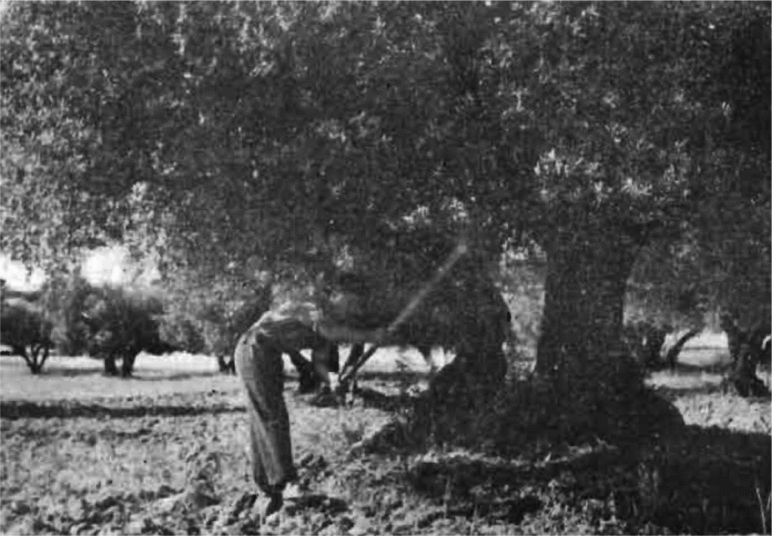
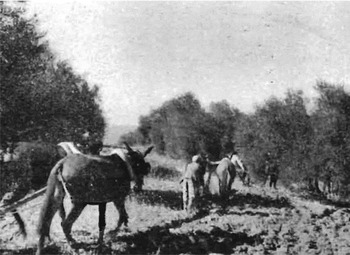
By the mid eighteenth centuryFootnote 6 the olive orchards of Baena were barely tilled twice a year, using few men and animals. The base of the olive trees were dug out manually, where animals could not reach (Figure 2). The only additional chore was the manual reaping of ground cover plants during the summer. This was primarily to kill the weeds to prevent them competing with the olive for resources in the hot and dry Mediterranean summer. This fairly non-intensive approach was more in line with forestry use rather than the production of oil. Olive yield per hectare barely surpassed 600 kilograms, whereas today it is usual to produce over 4500 kilograms per hectare, clearly suggesting a low intensity management regime in comparison with later practice, and evidently geared towards providing farmers with a range of produce (see Table 3).Footnote 7
Manual digging was the most widespread technique to manage the soil by 1750.
Source: Puerta Castelló (1960:8).

Indicators about olive management in Baena (1750, 1900 and 2000)

* Machine
Source: Data from Infante (Reference Infante2011).
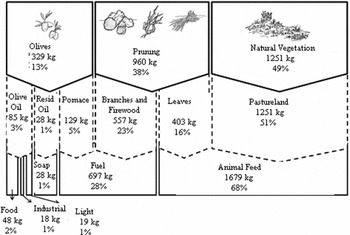
As Enric Tello has pointed out, landscapes can be seen as ‘organized information’ which can convey information about the material and energy flows across the agro-ecosystem. The mid eighteenth century landscapes of olive production described above seem to indicate a range of uses, very different from the widespread idea of olive orchards as mere producers of oil, and it is possible to estimate, within reasonable limits of accuracy, the scale of production on a typical farm around 1750. Olives themselves represented only thirteen per cent of the total volume of dry matter. They provided pomace as well as oil, and the oil was used not only as food, but also for lighting, industry and soap. As a result, marketable olive oil represented just over two per cent of the total produce of the orchards. Fuel and animal uses formed the majority of the production representing twenty-eight and sixty-eight per cent respectively of the total amount (Figure 3).
The use of olive products, in kilograms of dry matter per hectare, in 1750.
Source: Infante (Reference Infante2011).

The use of animals to manage the soil had increased by the nineteenth century.
Source: Puesta Castelló (1960:3)

By confirming this range of uses of the olive tree, it is possible to argue that the expansion of cultivation after around 1750 represented not only the promotion of a more profitable crop, but also the development of a means of management adopted by small landowners in order to provide their domestic economies with a wide range of products. Olive orchards represented a good adaptive strategy for peasants with insufficient land. In addition to olives, they provided wood and timber from prunings for domestic fuel, leaves to feed goats and ground cover plants to feed sheep, as well as pomace to feed livestock, etc.
Much of the historiography relating to olive growing during the Ancien Regime maintains that the first olive groves were probably in the hands of small and medium landowners who managed a crop that required little investment of capital (Garrido, Reference Garrido2007; Guzmán, Reference Guzmán2004: 318–320; Higueras Arnal, Reference Higueras Arnal1961; Jiménez Blanco, Reference Jiménez Blanco1984: 475; Zambrana, Reference Zambrana1987:63, Reference Zambrana2006: 58). Moreover, in Baena it has been shown that the majority of the olive orchards were in the hands of small owners. Farms of under twenty hectares represented over ninety-six per cent of the olive producing farms and half of the total land area devoted to olives. Furthermore, if we analyse the twenty-one smallest owners in Baena, all of them dedicated the whole of their land to scattered olive trees (Infante, Reference Infante2011). Such evidence clearly associates the olive tree not with the larger farmers but with the small peasant producers.
The evidence thus suggests that in the mid eighteenth century olive production took the form of scattered groves, in which little labour was invested and which were principally in the hands of small landowners. Far from being highly capitalised, as other authors have suggested, olives were in fact a low intensity crop that expanded more through silvo-pastoral exploitation for subsistence than through specialised production for the market. Such a suggestion is not entirely new. It has, for example, been shown how, in certain areas of Andalusia characterised by a premature olive specialisation such as Aljarafe, near Seville City, olive trees were used to produce fodder for livestock (Herrera, Reference Herrera García1980). In these areas, early accounts suggest that the olive was practically a wild tree that had been reconverted from its ancient uncultivated form. This explains why olives were not seen in terms of single crop cultivation in Andalusia until well into the twentieth century by some authors (Guzmán, Reference Guzmán2004: 302). A similar phenomenon is reflected in the literature relating to other olive growing countries in the Mediterranean. In Italy, for example, the exploitation of scattered and wild olive groves appears to predate specialised production for oil in both Toscana (Landeschi, 1770) and Mezzogiorno (Bevilaqcua, 1989, 2000).
The first expansion wave, 1820–1936
From the mid eighteenth century a series of social and political transformations eventually toppled the pillars of the Ancien Regime. Liberal agriculture opened up the possibility of developing new markets. As noted above, all the literature on olive growing agrees that these transformations generated new opportunities for expansion. As far as we know, the area of land dedicated to olive growing expanded significantly between the mid eighteenth and mid nineteenth centuries, as did production and the volume of oil exported. For example, the land area dedicated to olive groves in the province of Jaen doubled between 1750 and 1850. Furthermore, the first statistic for foreign trade calculated in Spain in 1792 showed exports of just over 1,300 metric tonnes of oil. By 1850, this figure had risen to 10,500 metric tonnes and by 1900 to 33,000. By 1930 it had increased to 100,000 metric tonnes (Infante, Reference Infante2011; Zambrana, Reference Zambrana1987).
New market opportunities and the increase in the volume of exports have led certain authors to hypothesise that the expansion of olive growing was supported by the new bourgeois classes (GEHR, 1981; Garrido, Reference Garrido2005, Reference Garrido2007; Caballero, Reference Caballero2004). According to this interpretation, the new owners of olive groves exploited them for commercial purposes which, when seen in perspective, must have provided an example for other parts of the country where the industry expanded less dramatically (Carreras and Tafunell, Reference Carreras and Tafunell2004: 161). The new oil-producing bourgeoisie has even been presented as a social group that ‘pressed a cosmopolitan seal on production, consumption and commerce’ (GEHR, 1981: 77). This interpretation leads to the assertion that olive growing consolidated traditional forms of production, based on large estates (García Fernández, Reference García Fernández1967: 14; Garrido, Reference Garrido2007: 44–5; GHER, 1988: 56; Jiménez Blanco, Reference Jiménez Blanco1984: 475; Zambrana, Reference Zambrana1987: 63). This process of expansion and modernisation was completed after the economic crisis at the end of the nineteenth century. The mass importation of petroleum and other cheaper oils pushed the price of olive oil down. The most influential work on this period is perhaps that of Zambrana (Reference Zambrana1987), which argued that, following the crisis in the sector, it was obliged to transform in order to remain competitive. This involved improvements in the management of olive groves and the modernisation of mills, which were now beginning to produce quality oil that could compete in the new global markets. The process was so successful that the early decades of the twentieth century are still remembered as the ‘golden age’ of the Spanish olive grove.
The first agronomical studies of olive growing (Arias, Reference Arias1833; Esponera, Reference Esponera1851:16; Hidalgo Tablada, Reference Hidalgo Tablada1899; JCA, 1891; Rojo Payo, Reference Rojo Payo1840; Serra, 1876, Reference Serra1878: 474) make it clear that olive groves were beginning to be managed with greater attention and care. Although the situation was still a long way from the strongly capital intensive industry envisaged by some of the literature, olive management was certainly becoming more standardised in terms of soil management, pruning and harvesting. The sources make it clear that in Baena there were major changes in the character of oil production, involving in particular more intensive methods of soil management. They describe how the soil was now tilled three times a year, between March and May, and although the bases of the olive tree trunks were still dug out, manual reaping during the summer was replaced by very superficial tilling using harrow passes (see Table 3). As a result, yields of olives increased threefold on the previous century, up to 1000 kilograms per hectare, reflecting in large measure the fact that ground vegetation, which competed with the olive trees for nutrients and water in the summer, was now being more effectively controlled (Gómez, Reference Gómez2009; Guzmán and Alonso, Reference Guzmán2004). Other innovations included the introduction of the mouldboard ploughFootnote 8 and more systematic pruning of the trees.Footnote 9 Human labour increased from twenty-one days per hectare in 1750 to thirty-eight days in 1900 and animal labour rose from six obradas per hectare to fifteen obradas per hectare (see Table 3). Although the total biomass produced in the tree, including pruned material and ground cover plants, remained relatively stable, its composition was radically altered by the new forms of management, which aimed to maximise the production of olives, as the part of the crop that offered the greatest added value.
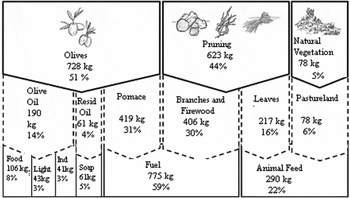
The use of olive products, in kilograms of dry matter per hectare, in 1900.
Source: Infante (Reference Infante2011).

In the mid eighteenth century, olive trees had been scattered across the landscape of Baena, integrated with other forms of use and subject to fairly non intensive management. During this period of expansion, the area of land devoted to olives in Baena increased from just over 1,200 hectares in 1750 to 10,000 hectares by 1900, and at the same time the tree density per hectare grew considerably. Nevertheless, even though higher olive yields were obtained, total crop productivity, measured in terms of total biomass, also remained high. In fact, half of total production was still derived from pruning and vegetative cover. Around two thirds of the material from olive groves was used for fire wood and twenty-two per cent (290 kilograms per hectare) was still made up of the leaves and the natural vegetation that were used to feed livestock. There was an increasing emphasis on the production of oil, but the quantity marketed for human consumption remained low, at about eight per cent of total production. In 1892, Díaz del Pino (cited in Zambrana, Reference Zambrana1987: 210) estimated that only thirty-seven per cent of the oil produced was used for food and seven per cent for export. Most was used for lighting, or industrial lubrication.
Thus even in the late nineteenth century, olive groves were not just used to produce olives and oil for human consumption, and still fulfilled a range of functions. This observation can form the basis for a more complex interpretation of the expansion of olive groves in southern Spain. In pre-industrial rural communities, olive growing represented a lucrative way of using land that could generate a wide variety of basic subsistence products. As growing population pressure required more intensive forms of land use in Andalusia during the eighteenth and nineteenth centuries, the expansion of olive groves was accompanied by an ongoing process of deforestation and increase of agricultural land. Although new crops provided more biotic production per inhabitant, loss of forest meant a reduction in the amount of grazing available, as well as a decline in the supply of fuel and other commodities. In this context, the olive tree, with its multi-functional nature, was capable of substituting goods that were previously provided by forest lands. Total wood potentially provided by forest and olive land was 560 kilograms per inhabitant in 1750. At this stage, the wood from olive groves represented over one third of this total, that from forests making up the remainder. By 1900 the wood available in Baena from olive trees had increased to ninety-two per cent and the total amount was 650 kilograms per inhabitant. Thus in the period between 1750 and 1900, before the transition to an inorganic economy, the use of forest land was replaced by the use of olive wood, and by the end of the period most villages in the region consumed more fuel derived from olive trees than from forest land.
Another factor in the development of the economic significance of olive groves came through changes in diet and nutrition. The decline in livestock numbers which occurred in the region as the population rose and land use became more intensive limited the consumption of animal fats. The expansion of olive groves over the course of the nineteenth century led to a significant growth in the production of olive oil, to a point at which, by 1900, vegetable fats had surpassed animal fats in terms of relative importance in the local diet. In the mid eighteenth century the people of Baena consumed an average of 2,66 gigajoules of fat, ten per cent of which came from olive oil and ninety per cent from animal products (milk and meat): by 1900 they consumed 3,37 gigajoules per inhabitant, eighty per cent from olive oil and twenty per cent from animals. It was thus only in this relatively recent period that the classic ‘bread and oil’ diet of southern Europe was widely adopted: it was an adaptive strategy to achieve the greatest amount of protein and energy using the lowest amount of land at a time of rapid demographic expansion. Indeed, the statistics reflect huge levels of oil consumption, which has led the Andalusian diet to be identified nowadays with the mass consumption of oil.
The argument that there was, in the course of the nineteenth century, a transition from the consumption of animal fats to the consumption of vegetable fats, and a substitution of the fuel and grazing provided by forest land to that appropriated from cultivated olive groves, receives considerable support from a careful re-reading of some of the classic agricultural texts from the period. It is easy to find descriptions that stress how the products of the olive ‘replace the destroyed forest’, or how the olive provide ‘more products than other crops’ (Esponera, Reference Esponera1851: 4). Even in the late nineteenth century Mariano Serra (Reference Serra1878: 466–67), in his famous ‘Elements of Agriculture’, described the various products derived from the olive groves in similar terms.
There is another ecological perspective which can shed light on the expansion of olive groves in this period. It is well known that in both Atlantic (Allen, Reference Allen2008; Chorley, Reference Chorley1981; Cunfer and Krausmann, Reference Cunfer and Krausmann2009; Krausmann, Reference Krausmann2004) and Mediterranean European economies (González de Molina et al, Reference González de Molina, García, Guzmán, Soto and Infante2010; Garrabou et al., Reference Garrabou, Tello, Olarieta, Garrbou and González de Molina2010), the availability of nitrogen was a factor in limiting the increase of agricultural production.Footnote 10 Nonetheless, in eighteenth-century England (Allen, Reference Allen2008) and in parts of Central Europe in the nineteenth century (Cunfer and Krausmann, Reference Cunfer and Krausmann2009), it was possible to double production within the context of organic farming. The changes brought about by the famous agricultural revolution, such as the improvement of rotations or the management of livestock (Overton, 2001), meant that the use of nutrients, and particularly nitrogen, could be optimised in order to increase yields. In Mediterranean agriculture, however, low rainfall levels reduced gross primary production so that although there were certain improvements in land productivity (Pinilla, Reference Pinilla2004), it was not possible to increase livestock numbers significantly and thus emulate the agricultural models of the north (González de Molina, Reference González de Molina2002). In the introduction I noted how a number of studies have shown that by the 1880s Baena was suffering from serious fertility problems. In this context, olive-growing had particular advantages as an economic strategy.
Olive nitrogen balance in Baena (1750, 1900 and 2000).
Sources: García et al. (Reference García, Guzmán, González de Molina, Soto, Herrera, Infante-Amate, Garrabou and González de Molina2010), González de Molina et al. (Reference Garrabou and González de Molina2010) and Infante (Reference Infante2011).

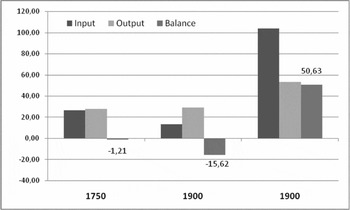
The famous ecologist González Bernáldez has pointed out that the land currently used for olive production is naturally derived from wild Mediterranean forest domesticated by humans over the centuries (González Bernáldez, Reference González Bernáldez1981). Genetic analysis has shown that the current varieties of olive derive from the wild variety (Besnard et al., Reference Besnard, Baradat and Bervillé2001). The olive tree that we have described seems to mark a transitional phase between the scattered trees of the eighteenth century, domesticated from the wild varieties, and a monoculture landscape. The olive's ecological adaptation to the environment is clearly demonstrated by the minor levels of erosion and the even balances of nutrients which were associated with olive groves. The trees receive sufficient nutrients for successful growth simply from the nitrogen fixed in the soils by the plants growing between them, and do not require additional inputs from livestock manure. The specialisation introduced at the turn of the twentieth century, however, fostered a more intensive approach to management which, among other things, led to unsustainable soil losses through erosion (Vanwallghem et al., 2011) and involved what was, in effect, nutrient mining. By 1900 this loss of nutrients amounted to 15.6 kilograms per hectare. However, according to García et al. (Reference García, Guzmán, González de Molina, Soto, Herrera, Infante-Amate, Garrabou and González de Molina2010) and González de Molina et al. (Reference Garrabou and González de Molina2010), such losses could be sustained for several decades without seeing a decline in yields. In fact, in Baena, even without manuring, the nutrient balance for olives was more positive in this period than that for other crops.
These facts help us to understand how, and why, small landowners played a key role in the great expansion of olive groves in the course of the nineteenth century. However, in the subsequent period of agricultural stagnation beginning in the 1880s the literature is filled with the oft-repeated assumption that the downturn in costs resulting from competition from foreign oils could only be assimilated by large farms, able to exploit significant economies of scale (García Fernández, Reference García Fernández1967: 14; Garrido, Reference Garrido2007: 44–5; GHER, 1988:56; Jiménez Blanco,1984: 475; Zambrana, Reference Zambrana1987: 63). Such assertions have been contested by a number of researchers, who have argued that olive growing remained the domain of small landowners (Cruz Villalón, Reference Cruz Villalón1980; Mata Olmo, Reference Mata Olmo1987). Villalón in particular has argued that the agrarian landscape in 1910 was ‘barely altered: the same structure of plot divisions has been retained: small plots are for olive groves and the larger ones are used to grow cereals’ (Cruz Villalón, Reference Cruz Villalón1980: 255). Strong support for this view can be found in the work of the Grupo de Estudios Agrarios (2002) which, when analysing the structure of property ownership in Andalusia, stated that, far from a prevailing process of proletarianisation, the system of peasant ownership gained strength in the late nineteenth and early twentieth century. This was particularly the case in the province of Jaen, which saw the greatest expansion in the number of owners, and the greatest reduction in average farm size, as well as the greatest growth in olive growing. In spite of a fashionable emphasis on the role of leading families, such as the Carbonells, the Pallarés and the Ybarras, olive-growing seems to have remained largely the preserve of peasant farmers.
Until the late nineteenth century, as I have documented elsewhere (Infante, Reference Infante2011), there was a close relationship between peasant economies and scattered, multi-functional olive groves with low levels of capital investment. Large estates did of course exist in Andalusia, and while they owned commercial olive groves these constituted only a small proportion of the total. Different social groups, with different interests and within changing historical contexts, were thus involved in the expansion of olive groves: but the role of the small farmers, and the importance of olive groves as multifunctional areas providing a range of resources appropriate to peasant households, has unquestionably been under-estimated in previous studies.
The great transformation, 1936–2000
Between 1936 and 1975 the history of Spain was dominated by a Civil War and a fascist political regime. The exceptional nature of this period affected the whole of Spanish society and, of course, the evolution of olive growing. In the decades following the Civil War, policies of autarchy and economic intervention subjugated the oil sector as well as the rest of agriculture (Tió, Reference Tió1982). The free exportation of oil was restricted and production was partly nationalised. The literature about olive growing clearly indicates a process of rupture (Garrido et al, Reference Garrido2007: 270; Zambrana, 2000) which put a stop to the progress that had been made in the sector in the first three decades of the twentieth century, and also sparked the creation of a black market, in which the price of oil rose sharply (Christiansen, Reference Christiansen2002; Gutiérrez del Castillo, Reference Gutiérrez del Castillo1983).
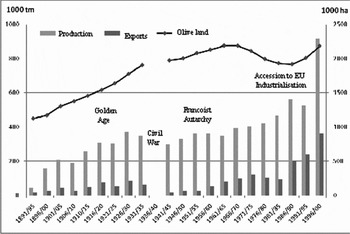
The period following the end of Franco's regime saw significant changes in the Spanish economy and society. Democracy returned, the country became fully open to Western economics and in 1986 it completed its affiliation to the European Economic Community. All these changes disrupted the evolution of agriculture in southern Spain, including the oil sector. In the final decades of the twentieth century, the amount of land dedicated to olive growing increased in Andalusia by over 300,000 hectares and oil production tripled. Figure 7 shows that the main variables had remained stable and even decreased up to the 1980s, but since then production of oil has expanded greatly and the amount of land dedicated to olives has recovered and even increased.
Olive production, exports and extent of land use in Spain, 1891–2000.
Sources: Zambrana (Reference Zambrana1987, Reference Zambrana2006).

The reasons for the emergence of the olive oil industry from the crisis and its strong growth since the 1980s can be summarised as follows: the industrialisation of agriculture and the modernisation of mills; the expansion of oil consumption to other areas; and, finally, participation in the Common Agricultural Policy. Spain has received the largest share of the European subsidies for olive oil production, which rose from 160 million euros in 1966 to over 2300 million by the year 2000 (EC, 1997). In addition, numerous research papers since the 1970s have argued that the consumption of olive oil is extraordinarily beneficial to health (for example, Keys, Reference Keys1970) and numerous international bodies decided to invest large quantities of money to promote oil in international markets (Scheidel and Krausmann, Reference Scheidel and Krausmann2011: 53). Nonetheless, the most important stimulus to expansion came from agricultural industrialisation which, by the 1980s, involved the mass consumption of inputs from outside the sector in the form of synthetic fertilisers and machinery. Today, there are around ten million hectares of olive groves in the world, over eighty per cent of which are in the Mediterranean basin (IOOC, 2011), largely because towns such as Baena have focused their agrarian activity almost entirely on the production of oil: almost ninety per cent of cultivated land is allocated to this crop, which is largely managed industrially.
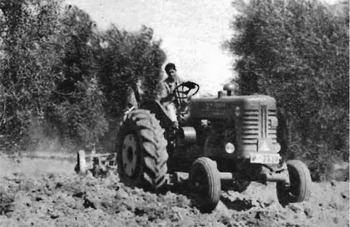
The most important change in management came in the early 1970s, with greater use of tractors replacing animal labour. The improved efficiency of mechanical traction made it possible for farmers to increase tillage significantly. At the start of the 1990s, another development occurred. Mouldboard ploughing, which had been used during the spring to eliminate spontaneous ground cover, was replaced by the application of weed killers.
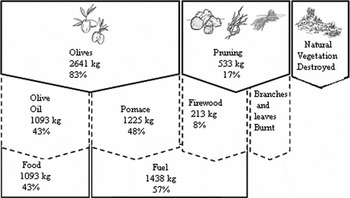
These profound transformations of the landscape and land management have, of course, radically altered production systems and traditional ways of using the olive trees. Figure 9 shows again the data for the products from each hectare of olive land in Baena. Some, like the natural vegetation growing between trees, have now been completely destroyed. Others, like wood or pomace, have become mere waste products which are used only because it is difficult to dispose of them otherwise. Olives themselves represent eighty-three per cent of total production, in contrast with thirteen per cent and fifty-one per cent in 1750 and 1900 respectively. The production destined for food is over 1000 kilograms per hectare, ten times the level a century ago. These figures clearly indicate a process of progressive simplification in the olive agro-ecosystem: from a complex system of management, production and uses appropriate to peasant economies, to a much simpler model, focused on a single product.
Tractors with mouldboard ploughs started to be used in the second half of the twentieth century.
Source: Fuente: Puerta Castelló (1960:1).

The use of olive farm products, in kilograms of dry matter per hectare, in 1900.
Source: Data from Infante (Reference Infante2011).

The increase in productivity could only be achieved with higher external inputs, which involved a dependence on non-renewable resources and exacerbated problems of pollution, unsustainable levels of erosion, and a loss of traditional landscape character (Beaufoy, Reference Beaufoy2001). The last three decades have been the most prolific in the growth of the olive grove. However, in just a few years, new management approaches have been able to break with the rationality and sustainability of an age-old crop that had discretely occupied the landscapes of the Mediterranean.
Conclusion
Mediterranean agriculture was unable to adopt the kind of strategies for growth seen in other European regions. However, olive trees, with their need for mild winters and their ability to tolerate summer rainfall levels of less than 200 millimetres, were a woody crop ideally suited to the Mediterranean environment. Initially, when the region appeared as an ‘empty country’ in the late eighteenth century, olive trees were scattered sparsely in mountainous areas and across agricultural land alike. Pre industrial olive groves, far from being used solely to produce olives and extract oil, served a range of functions. Pre-industrial rural communities expanded olive-growing because, as well as representing a lucrative form of land use, it generated a wide variety of basic subsistence products: wood for fuel; branches to make charcoal; leaves and foliage for fodder. Over time, the character of production, and thus of the associated landscapes, evolved towards single-crop cultivation and, by the late twentieth century, the olive had become an industrial crop that was highly dependent on external inputs.
Growing population pressure and the new market opportunities derived from the liberal agrarian reforms initially encouraged the expansion of olive groves. In addition to providing significant earnings for owners, the trees compensated for the loss of fuel and other products resulting from deforestation. Between 1750 and 1900, before the transition to an inorganic economy, the exploitation of olive groves had replaced the use of forest land. By 1900 Baena, for example, consumed more fuel from olive trees than from the forests. This process was accompanied by another transition, in nutrition. Olive oil provided an excellent substitute for fat formerly provided by livestock. Finally, the success of the crop was a consequence of its natural adaptation to contexts of nutrient scarcity, a great advantage in the context of pre-industrial southern Spain. These findings allow us to understand why olive groves were so closely associated with social groups of small and medium sized land owners.
Over the last three decades the material dynamic that conditioned the expansion of olive groves in Andalusia has been broken. Thanks to the technological package of the Green Revolution, it has become possible to overcome the restrictions imposed by pre-industrial forms of production. Only then, and with the economic incentives derived from the Common Agricultural Policy, did the single crop cultivation of olives spread throughout Andalusia so that the olive became, for the first time in history, the dominant feature of southern Spain's rural landscape. Twenty-first-century olive groves are nothing like those that characterised the Andalusian countryside centuries ago: their vast expansion and growing intensification has turned them into mere producers of oil, reliant on external inputs, whose viability depends on foreign markets.
Acknowledgements
The author would like to thank Manuel González de Molina, David Soto, Roberto García, Ramón Garrabou, Juan Francisco Zambrana, José A. Gómez and Gloria Guzmán for their useful comments on different versions of this paper. It was finished during an inspiring stay at the University of East Anglia where I was able to improve some aspects thanks to the help and comments of Tom Williamson. This article has been made possible by the funding received for project HAR2009-13748-C03-03 (Spanish Ministry of Science and Innovation) and the ‘Sustainable Farm Systems’ project (Social Sciences and Humanities Research Council of Canada).