Introduction
Conjugated linoleic acid (CLA) is a collective term that designates a group of positional and geometrical isomers of linoleic acid (9cis,12cis 18:2) with two conjugated double bonds. Many studies are carried out on synthetic CLA (mainly 9cis,11trans and 10trans,12cis 18:2) because of its numerous beneficial properties suggested for human health including anticarcinogenic, antiatherogenic, antiadipogenic and antidiabetogenic properties (Whale et al., Reference Whale, Heys and Rotondo2004). Natural CLA are mainly present in ruminant products such as meat, milk and dairy products, which constitute the major source of dietary CLA, mainly 9cis,11trans 18:2, for humans (Pariza et al., Reference Pariza, Park and Cook2001). Incorporation of CLA into lipids in ruminant tissues or in milk results, for a small part, from bacterial transisomerisation and biohydrogenation of dietary polyunsaturated fatty acids (PUFA) (mainly linoleic acid from forages, cereals or oleaginous seeds) in the rumen (Ritzenthaler et al., Reference Ritzenthaler, Mc Guire, Falen, Shultz, Dasgupta and Mc Guire2001) and, for a large part, from an endogenous synthesis (Bauman et al., Reference Bauman, Baumgard, Corl and Griinari1999). This endogenous synthesis involves 9cis,11trans CLA synthesis from vaccenic acid (VA, 11trans 18:1), another intermediate in ruminal biohydrogenation (Griinari et al., Reference Griinari, Corl, Chouinard, Nurmela and Bauman2000). This reaction is catalysed by the stearoyl-CoA desaturase (Δ9 desaturase, EC 1.14.99.5) as demonstrated by using different specific stimulators or inhibitors of the activity of this enzyme (Griinari et al., Reference Griinari, Corl, Chouinard, Nurmela and Bauman2000; Corl et al., Reference Corl, Baumgard, Dwyer, Griinari, Phillips and Bauman2001). In lactating cows, it has been clearly demonstrated that VA is desaturated into CLA in the mammary gland, this metabolic pathway being involved for 60% to 90% of CLA incorporated into the milk fat (Bauman et al., Reference Bauman, Baumgard, Corl and Griinari1999; Griinari et al., Reference Griinari, Corl, Chouinard, Nurmela and Bauman2000). In contrast, in the growing ruminant, no specific study has determined so far as to which tissue and/or organ can be implicated in the endogenous synthesis of CLA. In this type of animal, the Δ9 desaturase is mainly present in the adipose tissues (St John et al., Reference St John, Lunt and Smith1991; Ward et al., Reference Ward, Travers, Richards, Vernon, Salter, Buttery and Barber1998), whereas data are contradictory in ruminant liver. Indeed, Cameron et al. (Reference Cameron, Rogers, Oman, May, Lunt and Smith1994) did not detect any Δ9-desaturase mRNA in the liver of bovine, whereas Ward et al. (Reference Ward, Travers, Richards, Vernon, Salter, Buttery and Barber1998) showed a significant amount of Δ9-desaturase transcripts in the liver of ovine which could be induced by high-fat diets (Chang et al., Reference Chang, Lunt and Smith1992). In this context, Gruffat et al. (Reference Gruffat, De La Torre, Chardigny, Durand, Loreau and Bauchart2005), by using the in vitro method of incubated liver slices, have recently demonstrated that the liver is not involved in the endogenous synthesis of CLA in the growing ruminant. With regard to the possible role of adipose tissue in the endogenous synthesis of CLA, some authors have clearly demonstrated that CLA is mainly stored in the triglyceride (TG) fraction in adipose tissues of ruminant (Raes et al., Reference Raes, De Smet, Balcaen, Clayes and Demeyer2003; Bauchart et al., Reference Bauchart, Gladine, Gruffat, Leloutre and Durand2005). Moreover, Santora et al. (Reference Santora, Palmquist and Roehrig2000) have shown in mouse fed a diet supplemented with CLA that CLA isomers are detected in both TG and phospholipid (PL) fractions of tissues, whereas when animals fed on VA, CLA isomers are only esterified into TG. All these results contribute to identify adipose tissue as a potential site for endogenous synthesis of CLA.
Once CLA is synthesised, its metabolism in tissues and/or organs is also poorly documented. In a few studies, the liver of different animal species given diets supplemented with CLA such as rat (Banni et al., Reference Banni, Day, Evans, Corongiu and Lombardi1995; Sébédio et al., Reference Sébédio, Juanéda, Dobson, Ramilison, Martin, Chardigny and Christie1997 and Reference Sébédio, Angioni, Chardigny, Grégoire, Juanéda and Berdeaux2001), lamb (Banni et al., Reference Banni, Carta, Contini, Angioni, Deiana, Dessi, Melis and Corongiu1996) and mice (Belury and KempaSteczko, Reference Belury and KempaSteczko1997), was shown to be involved in the CLA desaturation into conjugated 18:3 by the Δ6-desaturase activity (Sébédio et al., Reference Sébédio, Juanéda, Dobson, Ramilison, Martin, Chardigny and Christie1997). Direct demonstration of the role of the liver of rat and bovine in the CLA desaturation was reported by Gruffat et al. (Reference Gruffat, De La Torre, Chardigny, Durand, Loreau, Sébédio and Bauchart2003) and De La Torre et al. (Reference De La Torre, Gruffat, Chardigny, Sébédio, Durand, Loreau and Bauchart2005a), respectively, by using the in vitro method of incubated liver slices.
In this context, the aim of our study is to compare in bovine, by using the in vitro method of incubated adipose tissue slices, characteristics of VA and 9cis,11trans CLA metabolisms with stearic acid metabolism which is the preferential substrate of Δ9 desaturase (Jeffcoat et al., Reference Jeffcoat, Brawn, Safford and James1977). For this purpose, the metabolism of these three fatty acids (FAs) was studied in two adipose tissues (subcutaneous (SC) and intermuscular (IM)), the first being representative of the adipose mass of ruminant and the second being representative of adipose tissue linked to muscle and consequently to meat.
Material and methods
Chemicals and materials
Medium for incubation of adipose tissue slices (M-199) and Hank’s buffer were purchased from Invitrogen (Cergy Pontoise, France). Bovine serum albumin (BSA) free of FA, glutamine (300 mg/l), FA and antibiotic–antimycotic cocktail (penicillin: 100 U/ml, streptomycin 0.1 mg/ml, amphoterine B 0.25 μg/ml) were purchased from Sigma Chemical Co. (St Louis, MO, USA). Tri [9,10 3H] olein (185 MBq/ml), 1,2 dipalmitoyl L-3-phosphatidyl [N-methyl-3H]choline (37 MBq/ml) and [1-14C] stearic acid (7.4 MBq/ml) were purchased from Amersham International (Bucks, UK). [1-14C] VA (1.97 GBq/mmol) and [1-14C] 9cis,11trans CLA (1.97 GBq/mmol) were graciously provided by the Atomic Energy Centre (Saclay, Gif/Yvette, France). Organic solvents (chloroform, methanol, propanol, diethyl ether, acetic acid) were purchased from VWR International (Fontenay sous Bois, France). Ready Safe® scintillation cocktail was purchased from Beckman Instruments (Fullerton, CA, USA). Plastic organ culture Petri dishes were purchased by Beckton Dickinson (Cockeysville, MD, USA). Aminopropyl-activated silica Sep-Pak® cartridges were purchased from Waters (Milford, MA, USA).
Adipose tissue preparation
All experiments were conducted in a manner compatible with national legislation on animal care (Certificate of Authorisation to Experiment on Living Animal no 7740, Ministry of Agriculture and Fish Products). Six Charolais steers (age: 2.2 ± 0.1 years old, live weight: 758.6 ± 13.4 kg) were fed a conventional diet (concentrate (68%), grass silage (28%), soy cake (3.5%), vitamins and minerals (0.5%)). Just after slaughtering, SC and IM adipose tissue samples (around 200 g) were taken up in the region of the 6th rib, the IM adipose tissue sample being taken up between the thoracic portion of the trapezii muscle and the rhomboideus thoracis muscle. The samples were immediately placed into an incubator vessel containing sterile Hank’s buffer, pH 7.4 at 37°C.
Adipose tissue incubation
SC and IM adipose tissues were finely cut freehand into 20- to 25-mg pieces of uniform shape and placed (around 10 slices) on stainless grids positioned on a plastic organ-culture Petri dish in the presence of M-199 medium (0.9 ml per dish, two dishes per experimental condition and per animal) supplemented with insulin (2 U/l), acetate (5 mM) in the presence of the antibiotic–antimycotic cocktail and a FA mixture, representative of bovine plasma non-esterified FA in composition and concentration (0.75 mM final concentration which consisted of caprylic acid (13.5 μM), capric acid (13.6 μM), myristic acid (49 μM), palmitic acid (170 μM), stearic acid (186 μM), oleic acid (181 μM), linoleic acid (22 μM), VA (58.6 μM) and 9cis,11trans CLA (56 μM)), complexed with BSA (FA: albumin molar ratio 4 : 1). Adipose tissue samples were placed under a water-saturated atmosphere (95% O2 and 5% CO2) for 3 h at 37°C in order to restore a correct metabolic activity. The medium was then replaced with fresh similar medium containing the same mixture of FA as previously except for some FA which were omitted from the mixture and which were added as radioactive substances at the same concentration than in the non-radioactive mixture. Depending on the experimentations, these FA were: [1-14C]-18:0 (56 mCi/mmol, 10 μCi/ml); [1-14C]-9cis,11trans CLA (51.2 mCi/mmol, 3 μCi/ml); or [1-14C]-VA (53.4 mCi/mmol, 3 μCi/ml). Incubation of adipose tissue slices was stopped after 16 h of labelling: briefly, media (1.8 ml) were collected and adipose tissue slices were washed with 1 ml of Hank’s buffer. The washing solutions were grouped with the corresponding incubation media.
Determination of adipose tissue slice functionality
The amount of glucose removed during the labelling period by adipose tissue slices was determined at the beginning and the end of incubation using a commercial kit (glucose GOD-PAP, BioDirect, Taunton, MA, USA). The G6PDH activity was measured (Chilliard et al., Reference Chilliard, Gagliostro, Flechet, Lefaivre and Sebastian1991) on adipose tissues just after slaughtering of animals, and at the beginning and the end of incubation. For this purpose, adipose tissue samples (around 200 mg) were homogenised in a cold (4°C) solution of 0.3 M sucrose, 30 mM Tris (pH 7.4), 0.9 mM EDTA and 1 mM glutathione. Homogenates were centrifuged for 40 min at 20 000 × g at 4°C. The G6PDH activity was measured by incubating (37°C) 10 μl of supernatant in 100 mM glycylglycine buffer (pH 7.6) containing MgCl2 (10 mM), NADP (0.2 mM) and glucose-6-phosphate (2 mM) in a final volume of 1 ml. Activity was expressed in μmol of NADP reduced/min per g of adipose tissue.
Determination of FA bioconversion
Total adipose tissue lipids were extracted according to the method of Folch et al. (Reference Folch, Lees and Sloane-Stanley1957), and their corresponding FA were liberated and methylated by transmethylation at room temperature according to the method of Christie et al. (Reference Christie, Sébédio and Juanéda2001). Fatty acid methyl ester (FAME) containing [14C] FAME were analysed by gas-liquid chromatography (GLC) using Peri 2100 chromatograph (Périchrom, Saulx-les-Chartreux, France), equipped with a split/splitless injector and a fused Stabilwax wide-bore silica column (60 m × 0.53 mm i.d.; film thickness; 0.50 μm; Restek, Evry, France). The outflow from the column was split between a flame-ionisation detector (15%) and a copper oxide oven heated at 700°C in order to transform the [14C] FA into 14CO2 (85%). Radioactivity was quantified with a radiodetector (GC-RAM) (Lablogic Systems Ltd., Sheffield, UK) by counting 14CO2 after its mixing with a 9 : 1 ratio of argon/methane, as previously described (Bretillon et al., Reference Bretillon, Chardigny, Grégoire, Berdeaux and Sébédio1999). Data were computed using Laura software (Lablogic Systems Ltd.).
Determination of FA esterification into neutral and polar lipids
Total adipose tissue lipids were extracted according to the method of Folch et al. (Reference Folch, Lees and Sloane-Stanley1957) after the addition of a standard (non-radioactive) adipose tissue homogenate (approximately 10 mg of lipids) as a lipid carrier, and of [3H] trioleylglycerol (67 Bq) and [3H] phosphatidylcholine (100 Bq) as internal TG and phospholipid (PL) standards (Graulet et al., Reference Graulet, Gruffat, Durand and Bauchart1998). Neutral and polar lipids were separated by affinity-liquid chromatography with aminopropyl-activated silica Sep-Pak® cartridge according to Kaluzny et al. (Reference Kaluzny, Rode, Meritt and Epps1985). They were directly collected into scintillation vials, evaporated to dryness under an air stream, and counted for radioactivity.
Statistical analysis
Values are expressed as mean ± SEM for the six independent experiments. Comparison of means between FA (18:0 v. VA v. 9cis,11trans CLA) and between adipose tissues (SC v. IM) were tested by analysis of variance (ANOVA) using the GLM procedure of SAS (1987; SAS Institute Inc., Cary, NC, USA). When differences were significant, the Student’s t test was used to compare differences between FA within an adipose tissue.
Results
In vitro functionality of explants from both bovine SC and IM adipose tissues after 16 h of incubation was tested by measuring the uptake of glucose by explants and the activity of the glucose-6-phosphate dehydrogenase (G6PDH) at the beginning and at the end of incubation. These parameters were not significantly different between the two adipose tissues (Table 1). G6PDH activity was 61% and 84% of the initial level at the end of incubation period in SC and IM adipose tissues, respectively.
Glucose utilization and glucose-6-phosphate dehydrogenase (G6PDH) activity in subcutaneous (SC) and intermuscular (IM) adipose tissue explants of Charolais steers

Data are mean ± s.e. of six animals.
Uptake of FA (18:0, VA, 9cis,11trans CLA) by tissue explants was similar between FAs and between adipose tissues, and averaged to 40% of FA added to the medium (Table 2). FAs were preferentially directed towards the esterification pathway since this metabolic pathway involved more than 80% of FA present in adipocytes (Table 2). All FAs in both adipose tissues were essentially esterified into neutral lipids (around 90%), although the part of 9cis,11trans CLA esterified into neutral lipids was slightly lower in IM (87% of esterified CLA) than in SC adipose tissue (94% of esterified CLA) (P = 0.001). Consequently, the production of phospholipids from 9cis,11trans CLA was higher in IM compared with SC adipose tissue (13% v. 6% of esterified CLA in IM and SC adipose tissues, respectively, P = 0.001).
Uptake and esterification into phospholipids and neutral lipids of stearic acid (18:0), vaccenic acid (VA) and 9cis,11trans CLA (CLA) in subcutaneous (SC) and intermuscular (IM) adipose tissue explants of Charolais steers

FA = fatty acid.
Data are mean ± s.e. of six animals.
a,bSignificant differences between adipose tissues (P = 0.001).
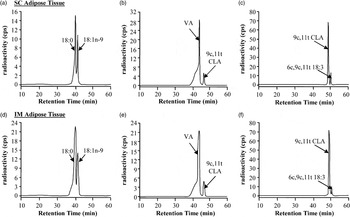
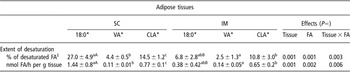
Total lipids were extracted from both SC and IM adipose tissues after 16 h of incubation. Analysis of FA was determined by GLC coupled with a radiodetector to quantify their relative radioactivity. New labelled FAs produced during a 16-h period of incubation of explants were identified according to the similarity of their respective retention times with those of corresponding standards. Representative radiochromatograms of FAs from lipids of adipose tissue explants incubated with [1-14C]-18:0, [1-14C]-9cis,11trans CLA or [1-14C]-VA were presented in Figure 1. Quantitatively, the intensity of bioconversion of stearic acid into oleic acid (Table 3) was four times higher in SC than in IM adipose tissue (27% v. 6.8% of desaturated 18:0 in SC and IM adipose tissues, respectively, P < 0.0001) corresponding to the desaturation of 1.44 and 0.38 nM of 18:0/ h per g of tissue in SC and IM adipose tissues, respectively (P < 0.0001). Vaccenic acid desaturation into 9cis,11trans CLA was six-fold lower than desaturation of stearic acid into oleic acid (Table 3) in SC adipose tissue (P < 0.01) and corresponded to 4.4% of VA present in adipocytes. In IM adipose tissue, the rate of desaturation of VA was not significantly different (2.5% of cell VA) than this one in SC adipose tissue. This led to comparable rates of desaturation for stearic acid and VA in IM adipose tissue. 9cis,11trans CLA was exclusively desaturated into 6cis,9cis,11trans 18:3 in both adipose tissues at the extent of 14.5% and 10.8% of cell CLA in SC and IM adipose tissues, respectively. This desaturation was 1.86-fold lower than the one of stearic acid into oleic acid and 3.3-fold higher than the one of VA into 9cis,11trans CLA (Table 3) in SC adipose tissue (P < 0.01). However, it was similar to the one of stearic acid in IM adipose tissue and stayed 4.3-fold higher than the one of VA (P < 0.01) in this tissue.
Representative radiochromatograms of desaturation of stearic acid (14C-18:0) into oleic acid (14C-18:1 n-9) (a, d), of vaccenic acid (14C-VA) into 9cis,11trans CLA (b, e) and of 9cis,11trans CLA into 6cis,9cis,11trans 18:3 (c, f) in subcutaneous (SC) (a, b, c) and intermuscular (IM) (d, e, f) adipose tissue explants of Charolais steers. Adipose tissue slices were incubated in a medium containing a mixture of FA (0.75 mM) and 186 μM [1-14C]-18:0 or 58.6 μM [1-14C]-vaccenic acid or 56 μM [1-14C]-9cis,11trans CLA for 16 h. Cellular lipids were extracted, transformed into methyl esters and analysed by gas-liquid chromatography. The outflow from the column was split between a flame-ionisation detector (15%) and a copper oxide oven in order to transform the labelled fatty acids into 14CO2 (85%). The radioactivity was determined with a radiodetector by counting 14CO2. The proportions of radioactivity recovered in other fatty acids were calculated as the ratio between the radioactivity corresponding to the metabolite and the sum of the radioactivity present in peak of precursor plus its corresponding metabolite.

Extent of desaturation of stearic acid (18:0), vaccenic acid (VA) and 9cis, 11trans CLA (CLA) in subcutaneous (SC) and intermuscular (IM) adipose tissue explants of Charolais steers

FA = fatty acid.
Data are mean ± s.e. of six animals.
*Means desaturation of C18:0 to oleic acid, VA to CLA, and CLA to conjugated 18:3.
§Ratio between the radioactivity corresponding to the product of desaturation and the sum of the radioactivity present in peak of precursor (18:0, VA, CLA) plus its corresponding product of desaturation.
a,b,cSignificant differences between FA within an adipose tissue (P < 0.01).
A,BSignificant differences between the two adipose tissues for a FA (P < 0.0001).
Discussion
It is now well accepted that the CLA present in the products of ruminants results principally from a tissue synthesis by Δ9 desaturation of VA (Bauman et al., Reference Bauman, Baumgard, Corl and Griinari1999). Among the different tissues and organs which can be involved in this reaction in the growing bovine, it was recently shown that the liver is not implicated despite its central role in lipid metabolism (Gruffat et al., Reference Gruffat, De La Torre, Chardigny, Durand, Loreau and Bauchart2005). Adipose tissue also plays an important role in lipid metabolism of ruminants since it is the major site of de novo synthesis of FAs (Hanson and Ballard, Reference Hanson and Ballard1967). Moreover, adipose tissue is known to accumulate trans FA such as VA and CLA mainly stored in the TG fraction (Raes et al., Reference Raes, De Smet, Balcaen, Clayes and Demeyer2003; Bauchart et al., Reference Bauchart, Gladine, Gruffat, Leloutre and Durand2005). In this context, the aim of this study was to investigate the metabolic behaviour of VA and 9cis,11trans CLA (the main CLA isomer present in ruminant products) in bovine SC and IM adipose tissues. Moreover, these characteristics were compared with those obtained for stearic acid, the preferential substrate of Δ9 desaturase (Jeffcoat et al., Reference Jeffcoat, Brawn, Safford and James1977). For this purpose, the in vitro method of incubated adipose tissue slices has been chosen to retain the normal cellular architecture and intact conjunctive tissue (Novakofski, Reference Novakofski2004).
To verify the viability and the metabolic activity of SC and IM adipose tissue explants, glucose uptake and G6PDH activity were measured as previously proposed by Faulconnier et al. (Reference Faulconnier, Thevenet, Flechet and Chilliard1994) and Chilliard and Faulconnier (Reference Chilliard and Faulconnier1995). Indeed, although acetate is the primary source of carbon for lipogenesis and energy metabolism in adipose tissues of the ruminant, these authors have shown that ruminant adipose tissue explants can readily use glucose interchangeably with acetate for metabolic pathways such as FA synthesis or oxidation, when glucose availability is high during incubation. The intensity of glucose uptake determined in our experimental conditions agrees with the results of Faulconnier et al. (Reference Faulconnier, Thevenet, Flechet and Chilliard1994) and Chilliard and Faulconnier (Reference Chilliard and Faulconnier1995) on perirenal adipose tissue explants of cull cows. Moreover, the slight decrease in G6PDH activity observed at the end of incubation of bovine adipose tissue explants when compared to initial activity in SC and IM adipose tissues was also obtained by Faulconnier et al. (Reference Faulconnier, Thevenet, Flechet and Chilliard1994) on perirenal adipose tissue explants of cull cows, who suggest that the enzyme lability could be linked to its high initial activity in bovine adipose tissues compared to ovine animals (Vernon et al., Reference Vernon, Barber and Finley1991).
To our knowledge, only one study was interested in the uptake of FA by SC adipose tissue explants of the ruminant (Jacobi and Miner, Reference Jacobi and Miner2002). These authors showed an uptake of FA 10-fold higher than this one observed in the present study. However, discrepancies between the results of Jacobi and Miner (Reference Jacobi and Miner2002) and ours would be probably explained by differences in the incubation conditions of FA. Indeed, Jacobi and Miner (Reference Jacobi and Miner2002) determined the intensity of 14C-palmitate and 14C-oleate uptakes by adipose tissue explants by adding these FA at a tracer dose to the medium, whereas, in our experiment, 14C-18:0, 14C-VA and 14C-9cis,11trans CLA were mixed with long-chain FA of which the composition and concentration are similar to that of bovine plasma non-esterified FA to simulate the in vivo physiological conditions. In these conditions, the competition between the labelled FA and the other non-labelled FA uptake decreased the intensity of cell uptake of the labelled FA compared with results obtained by Jacobi and Miner (Reference Jacobi and Miner2002) where only the labelled FA can be taken up by cells.
In the adipose tissue, all FAs tested in our experiment using SC and IM adipose tissues were preferentially esterified in neutral lipid in agreement with the fundamental role of adipocytes, which is to store energy in the form of triglycerides in dietary situation of energy excess (Chilliard, Reference Chilliard1993).
Unlike lipogenic characteristics, the desaturation of the three FAs studied for the SC and IM adipose tissues was largely affected by the type of FA and the anatomic site of adipose tissues.
In the SC adipose tissue, stearic acid was highly desaturated into oleic acid in agreement with the fact that stearic acid is the preferential substrate of Δ9 desaturase (Jeffcoat et al., Reference Jeffcoat, Brawn, Safford and James1977). However, the intensity of the reaction was inferior to that determined in the adipose tissue of ruminant by others (Siebert et al., Reference Siebert, Pitchford, Kruk, Kuchel, Deland and Bottema2003; Archibeque et al., Reference Archibeque, Lunt, Gilbert, Tume and Smith2005). In our experimental conditions, adipose tissue explants were incubated with 14C-18:0 and a physiological mixture of FA available for adipocytes, whereas the Δ9-desaturase activity determined by Siebert et al. (Reference Siebert, Pitchford, Kruk, Kuchel, Deland and Bottema2003) and Archibeque et al. (Reference Archibeque, Lunt, Gilbert, Tume and Smith2005) was performed using microsomal fraction of adipocytes in the presence of only one FA. This eliminates any competition between FA as well as any cellular regulatory factors other than microsomal ones. The determination of Δ9-desaturase activity in our experimental conditions has thus the major advantage to be closer to the physiological conditions in vivo. In IM adipose tissue, Δ9 desaturation of stearic acid was much lower than in SC adipose tissue. However, this difference was not the consequence of different FA composition of lipids in the two adipose tissues (data not shown). In the same way, it was not the consequence of a lower activity of Δ9 desaturase in IM adipose tissue since the other FAs tested (VA and 9cis,11trans CLA) were desaturated with similar intensity in both SC and IM adipose tissues. This difference of desaturation that is specific for stearic acid between the two adipose tissues would be explained by differences in the metabolic activity of SC and IM adipose tissues leading to different needs from these adipose tissues in the quality of FA. Indeed, SC adipose tissue would rather have a role of storage of FA for the whole organism, whereas IM adipose tissue would preferably store important FA for muscular metabolism. Thus, 18:0 would be more quickly esterified in IM adipose tissue than in SC adipose tissue making it unavailable to the action Δ9 desaturase. This hypothesis could be verified by incubating explants of SC and IM adipose tissues during shorter times to specify the kinetics of esterification of FA in these two adipose tissues. In addition, it would be interesting to study the expression of the diacylglycerol acyltransferase (DGAT), one of the limiting enzymes of the pathway of esterification (Gilham and Lehner, Reference Gilham and Lehner2006).
In our experimental conditions, we demonstrated, for the first time, the occurrence of a desaturation pathway of VA into 9cis,11trans CLA in the adipose tissues of bovine, showing thus the direct role of adipose tissue in the endogenous synthesis of CLA in the growing ruminant. This result confirms the hypothesis of Bauchart et al. (Reference Bauchart, Gladine, Gruffat, Leloutre and Durand2005) and Raes et al. (Reference Raes, De Smet, Balcaen, Clayes and Demeyer2003) in ruminant and of Santora et al. (Reference Santora, Palmquist and Roehrig2000) in mouse who proposed that the presence of CLA mainly associated to the TG fraction in adipose tissues is directly linked with its synthesis in this tissue. The intensity of VA desaturation into 9cis,11trans CLA in our experimental conditions can appear low since it accounted for around 2.5% to 4.4% of VA incorporated in adipose tissues. The most obvious hypothesis to explain the low desaturation of VA could be the low affinity of Δ9 desaturase for VA, the concentrations of VA used in the present experiment being probably below the Km of the enzyme for VA. Another hypothesis was related to the fact that the high concentration of 18:0 present in medium effectively competed with VA for Δ9-desaturase activity as previously proposed by Archibeque et al. (Reference Archibeque, Lunt, Gilbert, Tume and Smith2005).
In our experimental conditions, 9cis,11trans CLA, which can result either from the desaturation of VA in adipose tissues or from the uptake of CLA added to medium (corresponding to circulating CLA in vivo), was itself desaturated in a conjugated derivative, the 6cis,9cis,11trans 18:3. This conversion of CLA into conjugated 18:3 has been previously described in the liver of different species such as lamb (Banni et al., Reference Banni, Carta, Contini, Angioni, Deiana, Dessi, Melis and Corongiu1996), rat (Gruffat et al., Reference Gruffat, De La Torre, Chardigny, Durand, Loreau, Sébédio and Bauchart2003) or bovine (De La Torre et al., Reference De La Torre, Gruffat, Chardigny, Sébédio, Durand, Loreau and Bauchart2005a) as the result of Δ6-desaturase activity (Sébédio et al., Reference Sébédio, Angioni, Chardigny, Grégoire, Juanéda and Berdeaux2001). Moreover, it has been previously shown that this CLA derivative can be subsequently elongated and desaturated into conjugated 20:3 (Sébédio et al., Reference Sébédio, Angioni, Chardigny, Grégoire, Juanéda and Berdeaux2001). In our experimental conditions, 20:3 conjugated metabolite was not detected probably because of the limited time of incubation (<20 h) of adipose tissue slices or because of a low affinity of bovine elongase for conjugated 18:3. The intensity of tissue conversion of CLA into conjugated 18:3 is poorly documented, except in the report of Belury and KempaSteczko (Reference Belury and KempaSteczko1997) showing, by in vitro assay on liver microsomes of mice, that desaturation of a mixture of CLA into conjugated 18:3 was produced at the extent of 10% in 30 min. These authors speculated that CLA would compete with linoleate for the Δ6-desaturase activity (a rate-limiting step for the conversion of linoleate into arachidonate) leading to an overall decrease in arachidonate-derived eicosanoids. Since eicosanoids would favour the extent of cancers and cardiovascular diseases, partial inhibition of arachidonate biosynthesis by CLA could explain, at least in part, the beneficial role of CLA against carcinogenesis and other diseases in humans (Belury and KempaSteczko, Reference Belury and KempaSteczko1997). However, the biological properties of conjugated derivatives of CLA are still relatively unknown with the exception of a study on human tumoral cell lines showing that the 6cis,9cis,11trans 18:3 had antitumoral properties close to those of CLA (De La Torre et al., Reference De La Torre, Debiton, Durand, Chardigny, Berdeaux, Loreau, Barthomeuf, Bauchart and Gruffat2005b).
In conclusion, the in vitro adipose tissue slice model allows us to clearly demonstrate, for the first time, that adipose tissues of the growing ruminant were strongly involved in the endogenous synthesis of CLA from VA and in its bioconversion in a conjugated derivative, the 6cis,9cis,11trans 18:3. The potentially positive biological properties of this CLA derivative remain to be specified.
Moreover, we showed here the differences in desaturation rates between SC and IM adipose tissues. Consequently, the use of SC adipose tissue as model for IM adipose tissue (and intramuscular adipose tissue) may be misleading due to the lower desaturation rates observed in IM adipose tissue compared with SC adipose tissue, in particular, in the case of the desaturation of 18:0 into 18:1.
Acknowledgements
Authors wish to gratefully acknowledge Françoise Duboisset for her excellent technical assistance.