INTRODUCTION
Pathogens are widespread organisms that can help to maintain local plant diversity and composition in temperate zones (Bradley et al. Reference BRADLEY, GILBERT and MARTINY2008, Burdon & Chilvers Reference BURDON and CHILVERS1982, Gilbert Reference GILBERT2002, Petermann et al. Reference PETERMANN, FERGUS, TURNBULL and SCHMID2008). In wet tropical zones, fungal pathogens are thought to play a similar role in forests by driving intraspecific density-dependence in very young trees (Turner Reference TURNER2001; reviewed by Freckleton & Lewis Reference FRECKLETON and LEWIS2006; fungal pathogens here include Oomycota, see Money Reference MONEY1998). Density-dependent growth and mortality in trees >1 cm dbh is common in these communities (reviewed by Zimmerman et al. Reference ZIMMERMAN, THOMPSON, BROKAW, Carson and Schnitzer2008), but is likely more intense in the seed-to-seedling transition and among young seedlings (Harms et al. Reference HARMS, WRIGHT, CALDERON, HERNANDEZ and HERRE2000, Queenborough et al. Reference QUEENBOROUGH, BURSLEM, GARWOOD and VALENCIA2007, Webb & Peart Reference WEBB and PEART1999), as well as in wetter forests with low seasonality in which pathogens and herbivores may be more abundant (Givnish Reference GIVNISH1999). What mechanisms generate negative density dependence in these systems remains unclear, however. It is well known that damping-off type pathogens can disproportionately kill more germinating seedlings near parent trees where host density peaks (Augspurger Reference AUGSPURGER1983, Reference AUGSPURGER1984; reviewed by Gilbert Reference GILBERT2002, Reference GILBERT, Burslem, Hartley and Pinard2005). But for pathogens to promote species co-existence they ought to have a negative effect on locally dominant plant species at one or more life-stages (Freckleton & Lewis Reference FRECKLETON and LEWIS2006, Gilbert Reference GILBERT, Burslem, Hartley and Pinard2005). Conversely, their absence may promote dominance in some forests.
In African forests, the impacts of pathogens on tree seedlings have been little studied compared with elsewhere (Hood et al. Reference HOOD, SWAINE and MASON2004). This is surprising because at small spatial scales a fair number of canopy-emergent species can form clusters of adults marked by a dearth of saplings and larger juveniles (Jones Reference JONES1956). This perplexing phenomenon suggests that regeneration is occurring in parallel beyond these clusters (Aubréville Reference AUBRÉVILLE1938) and leaves open the possibility that in these high-density adult clusters, one or more factors, such as pathogens, may be putting a brake on local conspecific recruitment (Connell Reference CONNELL, den Boer and Gradwell1971, Janzen Reference JANZEN1970). Understanding what factors weaken local dominance by a tree species in a given location is just as important as understanding what processes gave rise to its dominance in the first place (Watt Reference WATT1947).
For example, in lowland rain forest of Korup National Park in Cameroon, the locally dominant grove-forming canopy tree, Microberlinia bisulcata A. Chev. (Caesalpiniaceae), is ectomycorrhizal but currently regenerating poorly because of too few juveniles in the 1–30 cm dbh size class to replace its larger adults (Newbery et al. Reference NEWBERY, SONGWE, CHUYONG, Newbery, Prins and Brown1998). This very limited regeneration, however, is not for a lack of established seedlings, which are widely abundant following masting events. The vast majority die in the next 2–5 y for unknown reasons (Green & Newbery Reference GREEN and NEWBERY2002, Newbery et al. Reference NEWBERY, CHUYONG, ZIMMERMANN and PRAZ2006a). By contrast, co-occurring with M. bisulcata is Oubanguia alata Bak.f. (Scytopetalaceae), a more shade-tolerant and widespread arbuscular mycorrhizal tree rarely exceeding 50 cm dbh (Newbery et al. Reference NEWBERY, ALEXANDER, THOMAS and GARTLAN1988, Reference NEWBERY, SONGWE, CHUYONG, Newbery, Prins and Brown2002). This species dominates the subcanopy, and is currently regenerating well, unlike M. bisulcata (D. M. Newbery & X. M. van der Burgt, unpubl. data). It is conceivable then, that pathogens could play an important role in density-dependent dynamics of already established seedlings, and not just in seed-to-seedling transition alone (Watt Reference WATT1919, Webb & Peart Reference WEBB and PEART1999, Queenborough et al. Reference QUEENBOROUGH, BURSLEM, GARWOOD and VALENCIA2007). Yet explicit investigations at the post-establishment stage remain scarce. Recently, however, for the seed-to-seedling transition, Bell et al. (Reference BELL, FRECKLETON and LEWIS2006) convincingly showed that manipulating in situ density of germinating seedlings coupled to fungicide application provides for a direct assessment of pathogens’ role in tree seedling dynamics.
Here, we applied the experimental approach of Bell et al. (Reference BELL, FRECKLETON and LEWIS2006) but to recently established seedlings of M. bisulcata and O. alata (~5–8 wk old) in one of the wettest tropical regions of the world. Of the two, M. bisulcata is our main interest because of its poor regeneration following establishment. This timing of plant age was chosen to correspond with the October–November initiation of previous census surveys made of established Microberlinia seedlings at Korup after masting events in 1995 and 1997 (Green & Newbery Reference GREEN and NEWBERY2001a, Reference GREEN and NEWBERY2002; Newbery et al. Reference NEWBERY, CHUYONG, GREEN, SONGWE, TCHUENTEU and ZIMMERMANN2002, Reference NEWBERY, CHUYONG, ZIMMERMANN and PRAZ2006a). We hypothesized that pathogens can kill seedlings of M. bisulcata and O. alata, and that greater seedling density enhances this effect (Connell Reference CONNELL, den Boer and Gradwell1971, Freckleton & Lewis Reference FRECKLETON and LEWIS2006, Janzen Reference JANZEN1970). Thus we expected a strong interaction between seedling density and application of a fungicide (Bell et al. Reference BELL, FRECKLETON and LEWIS2006). For M. bisulcata, a further aim was to investigate cryptic effects of pathogens and host-density on seedling height and leaf area, and to check for ectomycorrhizal colonization of seedlings’ roots.
METHODS
Study site and species
The experiment was carried out in lowland tropical rain forest in Cameroon at a site close to Korup National Park on the Isangele Road (4°58′N, 8°48′E; 98 m asl). It was formerly part of the Park until its annexation in 1995. The forest grows on nutrient-poor sandy soils. Average rainfall in the region is 180 to 900 mm per month in the March–November wet season, but ≤50 mm per month in the December–February dry season (overall, ~5100 mm y−1, based on monthly averages from 1988–2004 measured at PAMOL Bulu station ~7 km away from Isangele Road, Newbery et al. Reference NEWBERY, CHUYONG and ZIMMERMANN2006b). This forest is similar in stand structure to that found in the main ‘P-plot’ (5°1′N, 8°49′E) situated ~4.2 km north in Korup (Newbery et al. Reference NEWBERY, CHUYONG, GREEN, SONGWE, TCHUENTEU and ZIMMERMANN2002), except that it lacks Tetraberlinia bifoliolata (Harms) Haumann, a co-dominant canopy tree species. The site contains a small grove of M. bisulcata adults which masted in 2007 as well as many O. alata adults, which also fruited in 2007. Abundant M. bisulcata seedlings, some still with cotyledons attached, and O. alata seedlings were seen on two visits in September 2007, by which time dispersal was over for both species. Although the phenology, dispersal and seedling dynamics of O. alata remain little studied, in previous work recently fallen seeds were collected in late July–early August for seed sowing and germination (Green & Newbery Reference GREEN and NEWBERY2001a, Reference GREEN and NEWBERYb). Thus, we assumed that O. alata dispersal in 2007 also occurred primarily in this time period, so that by the experiment's start (6–7 October 2007, see Figure 1) seedlings were established and at least 5 wk old. Details on species’ traits indicative of their seed reserves are reported in Green & Newbery (Reference GREEN and NEWBERY2001b).
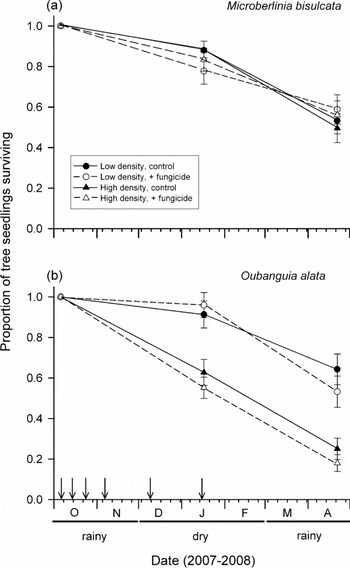
Mean (± SE) proportions of established seedlings of Microberlinia bisulcata (a) and Oubanguia alata (b) trees surviving at the Isangele Road, Korup, Cameroon, in an experiment that manipulated their density and exposure to fungal pathogens over 28 wk (M. bisulcata, n = 144 quadrats; O. alata, n = 72). Seedlings were censused twice, once in the dry season (17 January 2008), and again in the early wet season (22 April 2008) after the experiment's installation on 1–5 October 2007. On the x-axis minor ticks denote 1-wk intervals. Vertical arrows indicate when fungicide applications were made (total of six). Horizontal bars indicate seasonality in rainfall.

Previous on-site work by Newbery et al. (Reference NEWBERY, CHUYONG, GREEN, SONGWE, TCHUENTEU and ZIMMERMANN2002) demarcated an 8.75-ha permanent forest plot (250 m × 350 m) of 35 subplots of 50 m × 50 m each. Seven of these subplots were fertilized by triple-superphosphate totalling 150 kg ha−1 in November 1995–November 1997. We surmise that after 10 y these applications of inorganic P had no residual effects in the soil (M. Isaac, pers. comm.). In terms of basal area, O. alata was ranked first in the 10– <50-cm dbh size class with a basal area of 2.94 m2 ha−1, and M. bisulcata was ranked first in the ≥50-cm stem diameter (above buttress) class, with 5.59 m2 ha−1 (Newbery et al. Reference NEWBERY, CHUYONG, GREEN, SONGWE, TCHUENTEU and ZIMMERMANN2002).
Experimental design
We used a balanced randomized design stratified at three spatial scales (2500, 625 and 4 m2). A map of trees ≥50 cm diameter indicated that 15 of the 35 subplots had at least one living M. bisulcata adult in 1995. When each of the 15 subplots was further divided into four sub-subplots of 25 m × 25 m each, we found that 33 out of the resulting 60 (15 × 4) had an adult tree present. In each of these sub-subplots, a random Cartesian coordinate was used as a starting point to search for a dense patch of recently established M. bisulcata seedlings, whereupon a 2-m × 2-m experimental plot unit (EPU) was set up. All but two of these EPUs had at least 22 M. bisulcata seedlings (max. = 78, median = 40, mean = 39.3); three more EPUs were added in three sub-subplots near a M. bisulcata adult to give a total of 36 EPUs (range of distances from EPUs to nearest adults: 5.4–22.4 m). For O. alata, we set up 18 EPUs in eight subplots with noticeable regeneration (range in density: 24–209 seedlings m−2). The experiment was installed on 1–5 October 2007.
Each EPU was split into four 1-m2 quadrats to each of which were randomly assigned one of the four treatments (combinations of): density (low vs. high) × fungicide (sprayed vs. control). For M. bisulcata, the high-density quadrats were left as they were, whereas the low-density quadrats were hand-thinned down to one, two or three seedlings, depending on initial number of seedlings in the high-density treatment (>22 down to three, 15–22 to two, and <15 to one seedling). Hand-thinning involved plucking individual seedlings out of the ground as opposed to simply clipping them at the base of the stem. These one to three selected M. bisulcata seedlings were typically among the largest in leaf area and firmly rooted. They were individually marked with a numbered nail in the ground (total seedlings followed, n = 272). We chose these healthy looking seedlings because we were interested in evaluating what happens post-establishment, and therefore needed to standardize their sizes and exposure to earlier influences. We assumed that these seedlings were equally susceptible to potential infections as those not selected for monitoring, and avoided seedlings near to the edges of quadrats yet also tried to have them sufficiently dispersed inside. In the high-density treatment an equal number of M. bisulcata seedlings (1–3) were similarly selected. Because greater plant size enhances seedling persistence in the understorey for many tropical trees (Turner Reference TURNER2001), the effects of pathogens and density on plant size were assessed for M. bisulcata only, the species of primary interest. For O. alata, seedlings in the low-density treatments were hand-thinned down to ~10% of the total counts in the high-density quadrats. Oubanguia alata seedlings were not labelled for growth measurement.
Fungal pathogen exclusion
To protect recently established tree seedlings from pathogens, two quadrats of each EPU were treated with Ridomil Gold Plus® (Syngenta Crop Protection AG, Basel, Switzerland). This systemic fungicide has a broad-spectrum activity against a variety of plant fungal root and stem diseases such as the oomycete orders Peronosporales and Pythiales, which include the aggressive damping-off pathogens Phytophthora and Pythium spp. The fungicide combines two active ingredients, copper hydroxide (60%) and metalaxyl-M (6%), a.k.a. mefenoxam (Demanou et al. Reference DEMANOU, MONKIEDJE, NJINE, FOTO, NOLA, TOUGET and KEMKA2004, Monkiedje et al. Reference MONKIEDJE, SPITELLER, MANIEPI and SUKUL2007; and references therein). In Cameroon it is used increasingly to control black pod disease on cacao tree farms, as well as diseases on a range of subsistence crops.
Fungicide powder was dissolved in stream water on-site using proportions as recommended by the manufacturer (50 g per 15 L water) and transferred to a 1-L plastic hand-held spraying bottle. To each 1-m2 quadrat, 50 ml of fungicide (equivalent to a concentration of ~0.17 g m−2) was evenly sprayed across the ground to both soils and seedlings. The control quadrats received the same volume of water instead of fungicide solution. Five applications were made that tracked the decreasing seasonal rainfall in 2007; a sixth application was made in early 2008 (see arrows in Figure 1). In this way, a total of close to 1 g m−2 of fungicide was applied over a 14-wk period.
Seedling mortality and light availability
Seedling survival of M. bisulcata and O. alata were censused twice (Figure 1), and their light environment quantified because very low light levels, which can vary at a fine spatial scale (1–2 m), might affect their resistance to pathogens and hence survival in the forest understorey. Canopy photographs were taken at a height of 60 cm in the centre of each 1-m2 quadrat using a hemispherical lens and a digital Nikon camera. Photographs were taken for both species at dusk in the dry season (15–17 January 2008) and again for M. bisulcata only in the early wet season (21–22 April 2008) under overcast conditions. They were evaluated using our site's geographic coordinates but with default settings in the Gap-Light Analyzer software of Frazer et al. (Reference FRAZER, CANHAM and LERTZMEN1999) to obtain comparative measures of per cent canopy openness (%CO) and per cent daily photosynthetically active photon flux density (diffuse + direct %PPFD). One of us (JMN) made all image threshold adjustments so as to achieve consistency and precision. We caution, however, that computed %PPFD values from hemi-photos are prone to inaccuracy, and likely exceed absolute values. This is because light is scattered by foliage and the ‘halo’ effect intensifies under closed canopies with many small holes, creating an upward bias for sky area during threshold adjustments (Whitmore et al. Reference WHITMORE, BROWN, SWAINE, KENNEDY, GOODWIN-BAILEY and GONG1993).
Microberlinia bisulcata seedling size and growth
Because pinnate leaves can vary widely in actual leaflet numbers present (1–28), we measured photosynthetic area by photographing seedlings and counting their leaflets on 22 November 2008 (Table 1). Relaxed height – measured from ground perpendicular to the tallest live part of the plant, irrespective of tissue type (i.e. stem, leaf, leaf petiole) – and just the numbers of whole leaves, however, were recorded first in the dry season (15 January 2008), and the same again plus number of leaflets 14-wk later on 22 April 2008 (Table 1). Values for the one to three M. bisulcata seedlings monitored per quadrat were averaged to not risk pseudo-replication, as in some instances they were close to one another (10 to 30 cm apart) and could not be considered statistically independent sample units.
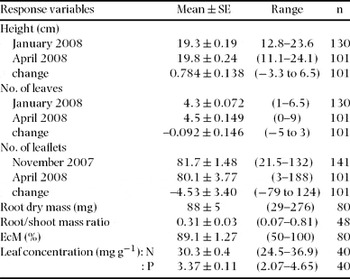
Size and growth of surviving Microberlinia bisulcata tree seedlings (n) recorded in the fungicide experiment at the Isangele Road plot, Korup. Cameroon, with root mass, percentage of intact root tips colonized by ectomycorrhizal fungi (EcM) and seedling leaflet nutrient concentrations of a harvested subset of plants.

Harvested Microberlinia bisulcata seedlings
To control for spatial heterogeneity, harvesting was restricted to those EPUs that had at least one survivor in each of their four (treatment) quadrats (n = 20). Eighty seedlings were carefully removed from the ground on 23–24 April 2008. Their root systems were temporarily wrapped in soft moist litter to prevent desiccation, and transported out of the forest in plastic bags. Roots were stored in Eppendorf tubes containing CTAB buffer (100 mM Tris-HCl (pH 8.0), 1.4 M NaCl, 20 mM EDTA, 1% cetyl trimethyl ammonium bromide). Using a stereomicroscope with 10–50 × magnification, root tips were scored for presence of a fungal mantle. Leaf phosphorus (P) and nitrogen (N) were determined colorimetrically (molybdenum-blue and modified Bertholet reactions, respectively) in diluted H2SO4/Se/H2O2 digests using an automated continuous-flow spectrophotometric system (Skalar Analytical, Breda, the Netherlands).
Data analysis
The proportions of seedlings alive after c. 7 mo were analysed using ANCOVA (analysis of covariance) and GLM (generalized linear model; Galwey Reference GALWEY2006) for O. alata and M. bisulcata respectively. In both models, density, fungicide and their interaction were fixed factors, and the light variables log (%CO) and log (%PPFD) were included as covariates. The GLM assumed a binomial error distribution by using the logit-link function: it allowed for heterogeneity to be fitted as a dispersion parameter (Galwey Reference GALWEY2006). For M. bisulcata, proportions were limited to the five values: 0, ⅓, ½, ⅔ and 1. For O. alata, model checking revealed that ANCOVA, using the arcsine square-root transformation with EPU as blocking factor, satisfied assumptions of the linear model better than GLM, especially in terms of heteroscedasticity. GLMM (generalized linear mixed model), which treated EPU as a random factor, was used to analyse the proportion of intact tips that had EcMs; this taking root mass and total number of tips into account as covariates. Two-factor ANCOVA was used to evaluate plant size, and its change, in M. bisulcata with untransformed light measures as covariates and EPU as the blocking term. Analyses of leaf P and N, and root-shoot ratios, were limited however to 40 and 48 seedlings, respectively, because of insufficient material. Statistical analyses were made in GenStat vers. 10 (VSN Int., Oxford, UK), and assumptions checked for all models.
RESULTS
Microberlinia bisulcata seedling survival
Mortality of M. bisulcata seedlings at 14 wk was very low: only 7.0% (19 out of 272) had died (Figure 1a). Even after 28 wk, density and fungicide treatments had negligible effects on seedling mortality (GLM, main effects, respectively, P = 0.83 and P = 0.51; Figure 1a), with no interaction evident (P = 0.87). Probability of seedling survival increased significantly with distance away from the nearest M. bisulcata adult tree (t 1, 135 = 2.84, P = 0.005), to a lesser degree on log (%PPFD in January) (t 1, 135 = 2.30, P = 0.023), and not on log (%CO in January) (P = 0.085). Light variables in January 2008 were positively correlated with those in April 2008 (P < 0.0001). Mean %CO across the 144 quadrats in January and April 2008 was 3.60% (range = 2.14–5.78) and 3.76% (range = 2.35–5.07), respectively; derived %PPFD from hemi-photos averaged 6.71% (range = 2.86–13.9) and 6.92% (range = 4.67–11.4), respectively. Overall, 55% (150 out of 272) of M. bisulcata seedlings survived the 28 wk to April 2008.
Oubanguia alata seedling survival
In contrast to M. bisulcata, mortality was high in O. alata after 14 wk. At this time we found evidence of a conspecific density effect on O. alata mortality, with ~1.6 times higher proportion of seedlings surviving in the low-density than high-density treatment (Figure 1b). Pooling all quadrats, 61% of O. alata seedlings died (1788 out of 2898).
After 28 wk, the main effect of density was very strong (F 1, 49 = 70.9, P≪0.0001; Figure 1b), with the proportion of seedlings alive in low-density quadrats more than twice that in high-density ones, irrespective of fungicide treatment (interaction term, P = 0.37). At this time, however, a relatively weak negative effect of fungicide was detected (F 1, 49 = 6.44, P = 0.014) in which ~25% more control seedlings than sprayed seedlings survived (mean ± SE: 0.44 ± 0.06 vs. 0.34 ± 0.05). Light availability was a positive predictor of seedling survival among EPUs when expressed as log (%PPFD), but not log (%CO) (P = 0.027 and P = 0.28, respectively). Mean %CO across the 72 quadrats in January 2008 was 3.76% (range = 2.13–5.72) and derived %PPFD from hemiphotos averaged 6.55% (range = 2.60–11.5). By the end of the experiment 25% of all O. alata seedlings were alive and 41% (740 out of 1788) had survived between censuses.
Microberlinia bisulcata seedling size and growth
In early November 2007 the M. bisulcata seedlings monitored had similar number of leaflets between and among treatments (all model terms, P > 0.20). However, by the end of the experiment, in April 2008, seedlings growing at low density without fungicide (L−) had significantly more leaflets (mean ± SE, 94 ± 6.4) than seedlings at low density with fungicide (L+, 70 ± 6.8) or high-density with fungicide (H+, 74 ± 8.3), but not the H− (81 ± 8.2). These means were compared with Ryan–Einot–Gabriel–Welsch test following a significant interaction (F 1, 89 = 8.00, P = 0.006). This pattern was present in the number of leaves in April (interaction, F 1, 89 = 8.40, P = 0.005) and the net change in the number of leaflets between November and April (interaction, F 1, 89 = 4.34, P = 0.041). In these cases seedlings in all treatment combinations except for L– (7 ± 5.3 leaflets) experienced net negative growth (i.e. fewer leaflets in April than in November; mean change in leaflets for L+, −14 ± 6.2; for H+, −7 ± 7.3; for H−, −5 ± 8.1). Seedling heights in January and April were not influenced by density and/or fungicide treatments, nor were changes in height (on average < 1 cm) between censuses (P > 0.20). Table 1 summarizes the size and growth for the entire sample (treatments pooled).
Harvested Microberlinia bisulcata seedlings
EcM colonization among the 80 harvested M. bisulcata seedlings did not differ significantly among densities or treatments, and nor was the interaction significant (P > 0.38). The four treatment combinations each had mean EcM values of 89–90% in spite of the wide range of total intact tips found (range, 4–143 tips; mean ± SE = 64 ± 4). Mean %EcM per EPU did not vary significantly with log-transformed distance to nearest M. bisulcata adult (linear regression, n = 20, P = 0.50). Root dry mass did not vary across densities and treatments (P > 0.23). Concentrations of log-transformed foliar P were 15% higher in sprayed than control leaflets (two-factor ANOVA, 3.62 ± 0.16 vs. 3.12 ± 0.14 mg g−1; F 1, 39 = 10.8, P = 0.003) but concentrations of log-transformed N did not differ significantly among treatments (P > 0.12 for all three model terms). The lower part of Table 1 summarizes the above response variables for the harvested seedlings (treatments pooled).
DISCUSSION
We can place our experiment in the context of previous work at Korup to show how similar were the seedling dynamics for Microberlinia bisulcata. Survival to April 2008 (55%) was greater than that observed in 1997 at the Isangele Road plot (25–30%; Newbery et al. Reference NEWBERY, CHUYONG, GREEN, SONGWE, TCHUENTEU and ZIMMERMANN2002), but less than in 1995 (70%) and equivalent to 1997 (50–55%) in the main grove P-plot at Korup (Newbery et al. Reference NEWBERY, SONGWE, CHUYONG, Newbery, Prins and Brown1998, Reference NEWBERY, CHUYONG, ZIMMERMANN and PRAZ2006a). Overall, our mortality value was close to the average of these other results.
Unlike previous studies, we explored pathogen effects on the survivorship of established seedlings because strong negative density-dependence is not limited to the seed-to-seedling transition of trees (Queenborough et al. Reference QUEENBOROUGH, BURSLEM, GARWOOD and VALENCIA2007, Webb & Peart Reference WEBB and PEART1999). Our results suggest that pathogens did not hasten the mortality of young tree seedlings (~5–8 wk old) in the African rain-forest understorey. Mortality over the 7-mo period of study was density-independent for M. bisulcata, but it was strongly density-dependent for Oubanguia alata: in the latter case it was likely not due to pathogen activity. There is the remote possibility that in spite of its broad-spectrum activity, the fungicide we used was ineffective against a putatively virulent pathogen on O. alata seedlings. Alternatively, uninvestigated factors such as herbivory by insects and/or mammals, or intraspecific competition for resources, may have been responsible for the non-random O. alata mortality we detected.
Why sprayed seedlings of the non-ectomycorrhizal O. alata had higher mortality than controls by the end of the experiment is unclear. Possibly, vesicular-arbuscular mycorrhizal root colonization was checked by the fungicide, as in the study of Hood et al. (Reference HOOD, SWAINE and MASON2004). When applied in a single dose of ≥1 g m−2, Ridomol Gold Plus slightly stimulated N and P mineralization in trials on sandy loam soils at Yaoundé, Cameroon (Demanou et al. Reference DEMANOU, MONKIEDJE, NJINE, FOTO, NOLA, TOUGET and KEMKA2004), although when the equivalent of ~0.9 g m−2 was applied in another trial at the same site it did not significantly affect soil N and P availability (Monkiedje et al. Reference MONKIEDJE, SPITELLER, MANIEPI and SUKUL2007). This suggests that the saprophytic fungi involved in decomposition had been little affected by the fungicide. Alternatively, the fungicide may have prevented the colonization of foliar endophytes that can protect leaves from pathogens (Arnold Reference ARNOLD, Carson and Schnitzer2008).
A negligible pathogenic effect on seedling survival may be explained by insufficiently high host density for virulence (Burdon & Chilvers Reference BURDON and CHILVERS1982), in spite of masting in M. bisulcata trees. The maximum densities for O. alata and M. bisulcata were 209 and 23 m−2 seedlings respectively. These values were much lower than the 416–1018 germinating seedlings m−2 for the subcanopy tree, Sebastiania longicuspis, reported by Bell et al. (Reference BELL, FRECKLETON and LEWIS2006). Conversely, density may not be crucial for seedling susceptibility to pathogens in this forest: O. alata and M. bisulcata densities exceeded those reported for two of three trees (out of seven species) for which damping-off pathogens killed more seedlings near to (vs. far from) parent trees in Panama (Augspurger Reference AUGSPURGER1984). Another intriguing explanation is that the very low soil fertility and high sand content at our site has selected for strong plant resistance against fungal diseases, in spite of the very wet conditions most of the year (Givnish Reference GIVNISH1999).
There are two caveats to our above interpretations, however. First, our results for either species could have changed over a longer census period: one that included a full rainy season with seedlings spending more time in the shade. Second, however unlikely, it is not impossible that a different fungicide may have yielded a different outcome for seedling dynamics of either species. Clearly, long-term experimental field studies of pathogens’ impact should be undertaken, but these will require a very large sample of starting seedlings. In addition, we cannot discount possible pathogenic effects on seeds or during seedling emergence – for example, density-dependent mortality was strong in M. bisulcata over 6 wk in the brief seed-to-seedling transition at the P-plot site in Korup National Park (Norghauer & Newbery, in press). Earlier, in the 1995 mast event, an unidentified white fungus was noted on 36% of M. bisulcata seeds/seedlings monitored in Korup (Green & Newbery Reference GREEN and NEWBERY2002). It was seen again in 2004 and 2007 at Korup, but not at Isangele Road in 2007. Its absence at the latter site may be explained by the absence of Tetraberlinia bifoliolata trees (Newbery et al. Reference NEWBERY, CHUYONG, GREEN, SONGWE, TCHUENTEU and ZIMMERMANN2002), which appear to act as key hosts for this seed-attacking fungus (Green & Newbery Reference GREEN and NEWBERY2002; J. M. Norghauer, unpubl. data).
The high and consistent levels of ectomycorrhizal (EcM) colonization on M. bisulcata roots across treatments matched the results of an earlier transplant experiment of Newbery et al. (Reference NEWBERY, ALEXANDER and ROTHER2000). This suggests that the fungicide did not interfere with this symbiosis and presumably then not with nutrient uptake. By contrast, in Ghana, application of another metalaxyl-M-based fungicide (Fubol Gold®) reduced colonization of arbuscular mycorrhizas on potted seedlings of the light-demanding tree Milicia regia, but increased seedling survival under low light conditions in a controlled herbivore-free setting (Hood et al. Reference HOOD, SWAINE and MASON2004). Although some orange-reddish fungicide residue persisted on M. bisulcata leaflets after spraying, this was likely more a deterrent than an attractant to insect herbivores (Karageorgou et al. Reference KARAGEORGOU, BUSCHMAN and MANETAS2008). A more plausible explanation for diminished leaf area of sprayed M. bisulcata seedlings was slight phytotoxicity caused by Cu in the fungicide, possibly becoming more prominent in sandy soils (Tosselli et al. Reference TOSSELLI, BALDI, MARCOLONI, MALAGUTI, QUARTERIERI, SORRENTI and MARANGONI2009). The Cu may also have contributed, albeit in an unknown way, to the elevated concentrations of P in sprayed leaflets of M. bisulcata (Sonmez et al. Reference SONMEZ, KAPLAN, SONMEZ, KAYA and UZ2007). In passing we note that mean P concentration (Table 1, lower part) in our 5–6-mo-old seedlings was ~2-fold that found in previous studies at Korup which harvested seedlings that were 15–35 mo old (1.43–1.72 mg g−1: Green & Newbery Reference GREEN and NEWBERY2001a, Newbery et al. Reference NEWBERY, ALEXANDER and ROTHER2000, Reference NEWBERY, CHUYONG, GREEN, SONGWE, TCHUENTEU and ZIMMERMANN2002).
Previous published work investigating pathogen-mediated mortality of tropical forest tree seedlings (Augspurger Reference AUGSPURGER1983, Reference AUGSPURGER1984; Augspurger & Kelly Reference AUGSPURGER and KELLY1984, Gilbert et al. Reference GILBERT, HUBBELL and FOSTER1994; reviewed by Gilbert Reference GILBERT2002, Reference GILBERT, Burslem, Hartley and Pinard2005; Grogan & Galvão Reference GROGAN and GALVÃO2006, Wenny Reference WENNY2000) has found mixed support for mortality increasing with seedling density (and/or declining with distance from conspecific adults) as predicted by the mechanism underpinning the hypotheses of Connell (Reference CONNELL, den Boer and Gradwell1971) and Janzen (Reference JANZEN1970). More recently, soil pathogens in a Costa Rican forest did not increase seedling mortality of the dominant trees, but did exaggerate differences in shade tolerance among the 21 species examined (McCarthy-Neumann & Kobe Reference MCCARTHY-NEUMANN and KOBE2008). While the strength of pathogen effects and their degree of host-specificity remains uncertain (Augspurger & Wilkinson Reference AUGSPURGER and WILKINSON2007, Gilbert Reference GILBERT, Burslem, Hartley and Pinard2005), without more field studies from African and South-East Asian forests, any generalizations, if indeed at all possible, will remain difficult.
In some tropical rain forests, especially in Africa, localized dominance of the canopy by one or few species is not uncommon (Aubréville Reference AUBRÉVILLE1938, Letouzey Reference LETOUZEY1968). In many cases the species are locally well-adapted to their soil conditions and, to have reached such high abundances, recruitment could not have been strongly checked by disease or pest pressure (Richards Reference RICHARDS1996). The lack of early density-dependence in M. bisulcata is consistent with other evidence from Korup (Green & Newbery Reference GREEN and NEWBERY2002). Newbery et al. (Reference NEWBERY, CHUYONG, ZIMMERMANN and PRAZ2006a) found that seedling mortality also did not increase with seedling abundance, but it did with neighbouring conspecific basal area, suggesting that negative density-dependent effects are operating on a larger spatial scale than investigated in the present experiment. To have patches of high seedling density for manipulation however, EPUs had to be <25 m from conspecific adult trees (mostly beneath their crowns), so density effects would have been found had they existed.
We conclude that the poor regeneration of M. bisulcata in the groves in Korup is unlikely to be due to fungal pathogen activity at the early post-establishment seedling stage. Instead, one or more other biological factors select against seedling survival in the vicinity of Microberlinia adults (<25 m), and at the same time select for larger seedlings and saplings further away (>40 m) from them (Newbery et al. Reference NEWBERY, PRAZ, VAN DER BURGT, NORGHAUER and CHUYONG2010). It is quite possible that low susceptibility to pathogenic activity of Microberlinia and Oubanguia may have contributed to the promotion of their local dominance in Korup.
ACKNOWLEDGEMENTS
The authors thank S. Njibile and C. Ohka for field assistance, and the Cameroon Ministry of Forestry and Wildlife (MINEF) and Ministry of Scientific Research and Innovation (MINRESI) for research permission. The University of Buea provided logistic support and the University of Bern funded field operations. L.T. acknowledges funding from FIBIR-7434-JD0092.