Introduction
Alkaline phosphatase is one of the most important hydrolase exoenzymes in the soil environment. Soil ALP is thought to arise solely from microorganisms and is responsible for phosphate ester bond cleavage and dephosphorylation of organic substrates (Stevenson and Cole Reference Stevenson and Cole1999). Hence, ALP is central to the decomposition of plant and microbial detritus organic phosphorus and is increasingly incorporated into soil biogeochemical models as a driver for detritus breakdown (Nannipieri et al. Reference Nannipieri, Giagnoni, Landi, Renella, Bünemann, Oberson and Frossard2011; Schimel et al. Reference Schimel, Becerra and Blankinship2017). ALP has also been used as a sensitive indicator for assessing soil-quality changes in response to environmental stresses and management practices (Gülser and Erdoğan Reference Gülser and Erdoğan2008; Vandana et al. Reference Vandana, Rao and Padmaja2012; Xin et al. Reference Xin, Liu, Shi, Wang and Li2016).
Extensive research has been carried out over recent decades on the interactions of exoenzymes with soil minerals, which has helped to advance understanding of the behavior of enzymes in soils. An established and tested hypothesis is that soil clay minerals control the activity and stability of enzymes through undergoing various physical and chemical interactions, including electrostatic, van der Waals, covalent, hydrophobic, and hydrogen bondings (Huang et al. Reference Huang, Liang and Cai2005; Rosas et al. Reference Rosas, López, López, Shukla and Varma2010). The clay–enzyme interaction is a complex process because the enzyme is made up of many hydrophilic, hydrophobic, and negatively, positively, and neutrally charged amino acids (Datta et al. Reference Datta, Anand, Moulick, Baraniya, Pathan and Rejsek2017). Moreover, different active sites on a given mineral behave differently toward the attaching enzymes (Yu et al. Reference Yu, Li, Tong, Zhou, Lin and Xu2013; An et al. Reference An, Zhou, Zhuang, Tong and Yu2015). The adsorbed enzymes are usually more resistant to inactivation and degradation (Zimmerman and Ahn Reference Zimmerman, Ahn, Shukla and Varma2011), while their catalytic activity may be greater (Tietjen and Wetzel Reference Tietjen and Wetzel2003; Allison Reference Allison2006) or less (Naidja et al. Reference Naidja, Huang and Bollag2000; Huang et al. Reference Huang, Liang and Cai2005) than those of the free enzymes. These differences could be due to the fact that adsorbed enzymes may undergo different diffusion, charge, and steric interactions and, hence, experience a completely different microenvironment compared to free enzymes in solution (Zimmerman and Ahn Reference Zimmerman, Ahn, Shukla and Varma2011; Datta et al. Reference Datta, Anand, Moulick, Baraniya, Pathan and Rejsek2017).
Palygorskite and sepiolite are fibrous clay minerals comprising 2:1 layered silicate ribbons that are linked to each other laterally by single basal oxygen ions (Guggenheim and Krekeler Reference Guggenheim, Krekeler, Galàn and Singer2011). The occurrence of palygorskite, and to a much lesser extent sepiolite, has been reported as a silicate mineral in the clay fraction of the calcareous and gypsiferous soils in arid regions worldwide (Khormali and Abtahi Reference Khormali and Abtahi2003; Bouza et al. Reference Bouza, Simón, Aguilar, Del Valle and Rostagno2007; Farpoor and Krouse Reference Farpoor and Krouse2008; Karimi et al. Reference Karimi, Khademi, Kehl and Jalalian2009; Yalçin and Bozkaya Reference Yalçin, Bozkaya, Galàn and Singer2011). Moreover, fibrous clay minerals are used in many industrial and environmental applications as they are capable of adsorbing many organic and inorganic substances (Ruiz-Hitzky et al. Reference Ruiz-Hitzky, Aranda, Álvarez, Santarén, Esteban-Cubillo, Galàn and Singer2011). For instance, adsorption of enzymes onto the fibrous clay minerals, as the mechanically and thermally stable, microbial resistant, low cost, and non-toxic support materials, has been suggested to improve enzyme stabilities and to promise their continuous use in industrial applications (de Fuentes et al. Reference de Fuentes, Viseras, Ubiali, Terreni and Alcántara2001; Sedaghat et al. Reference Sedaghat, Ghiaci, Aghaei and Soleimanian-Zad2009; Cengiz et al. Reference Cengiz, Çavaş and Yurdakoç2012). Enzymes immobilized on the fibrous clay minerals have also been used in biocatalysis and biosensing technologies (Xu et al. Reference Xu, Li, Yin, Zhong, Zhu and Jin2007; Chen and Jin Reference Chen and Jin2010; An et al. Reference An, Zhou, Zhuang, Tong and Yu2015).
Cadmium is a toxic trace metal released to the environment as a result of activities such as smelting, plating, mining, and industrial and municipal waste disposal (McLaughlin and Singh Reference McLaughlin, Singh, McLaughlin and Singh1999). Cadmium is considered to be a primary soil pollutant and a significant problem with respect to human health in various regions of the world (Smolders and Mertens Reference Smolders, Mertens and Alloway2013). Amini et al. (Reference Amini, Afyuni, Khademi, Abbaspour and Schulin2005) assessed Cd contamination in the calcareous soils of the Isfahan province, central Iran, in a set of 255 soil samples and reported that the measured Cd concentrations exceeded the Swiss guide value (0.8 mg kg–1) in more than 80% of the samples. They attributed the considerable amounts of Cd entering the soils of this region to the underlying geology (recent and sub-recent terraces and alluviums of Quaternary age) as well as agricultural activities such as the application of manure, compost, sewage sludge, pesticides, and fertilizers. Ravankhah et al. (Reference Ravankhah, Mirzaei and Masoum2016) also recognized Cd as a major heavy-metal pollutant in the surface soils of central Iran.
Cadmium is known to be an inhibitor of enzymes by displacing the metals associated with their active centers (Coleman Reference Coleman1992; Pan et al. Reference Pan, Liu, Gong, Yu, Hou and Xie2013). Much research has indicated that Cd inhibits the activities of various exoenzymes in soils of different regions of the world (Effron et al. Reference Effron, De la Horra, Defrieri, Fontanive and Palma2004; Sardar et al. Reference Sardar, Qing, Hesham, Yue and He2007; J. Xin et al. Reference Xin, Zhao, Tan, Sun, Wen, Qin and Hu2017; Zheng et al. Reference Zheng, Li, Shang, Dong, Tang and Cheng2019) including calcareous soils of central Iran (Nourbakhsh and Monreal Reference Nourbakhsh and Monreal2004; Khan-Mohammadi and Nourbakhsh Reference Khan-Mohammadi and Nourbakhsh2011). However, such effects of Cd have generally been examined in natural soil systems with no attempts to differentiate between the metal effects on the free and adsorbed enzymes. Specific enzymes adsorbed on different soil clay minerals may represent different catalytic activities and resistances against the inhibitory effect of Cd. In a recent study, for example, Tan et al. (Reference Tan, He, Wang, Li, Kong, Tian, Shen, Megharaj and He2018) showed that Cd toxicity was less for the ALP adsorbed on goethite than that adsorbed on montmorillonite. Little information exists, however, on how palygorskite and sepiolite alter ALP activity and its resistance to Cd toxicity.
In the current study, the aim was to compare the activities and kinetics of the free and clay-adsorbed ALP in the absence of Cd and in the presence of various Cd concentrations. The specific objectives were to determine whether: (1) ALP adsorbed on palygorskite and sepiolite clays could significantly retain its catalytic activity; and (2) exposure to Cd would result in lower inhibition of the adsorbed ALP activities compared to that of the free enzyme.
Materials and Methods
Clay Minerals
Palygorskite from Florida (PFl-1, obtained from the Source Clays Repository of The Clay Minerals Society) and sepiolite from Vicalvaro (supplied by TOLSA, Madrid, Spain) were used in this research. The clay mineral samples were purified according to Kunze and Dixon (Reference Kunze, Dixon and Klute1986) by removing any carbonates, organic matter, and iron/manganese oxides present in the samples using an acetate buffer at pH 5, 30% H2O2, and citrate-bicarbonate-dithionite, respectively. The <2 μm fractions were then separated by centrifugation and saturated with Ca2+ using a 0.5 M CaCl2 solution to make the surface homoionic and very similar to that of natural clay minerals in arid and semi-arid soils. Excess salt was removed by washing with deionized water until the electrical conductivity of eluents reached ~30 μS m–1. The mineral samples were then freeze-dried until used. Oriented clay mineral specimens were prepared by drying a concentrated drop of clay suspension in water on a glass slide at room temperature.
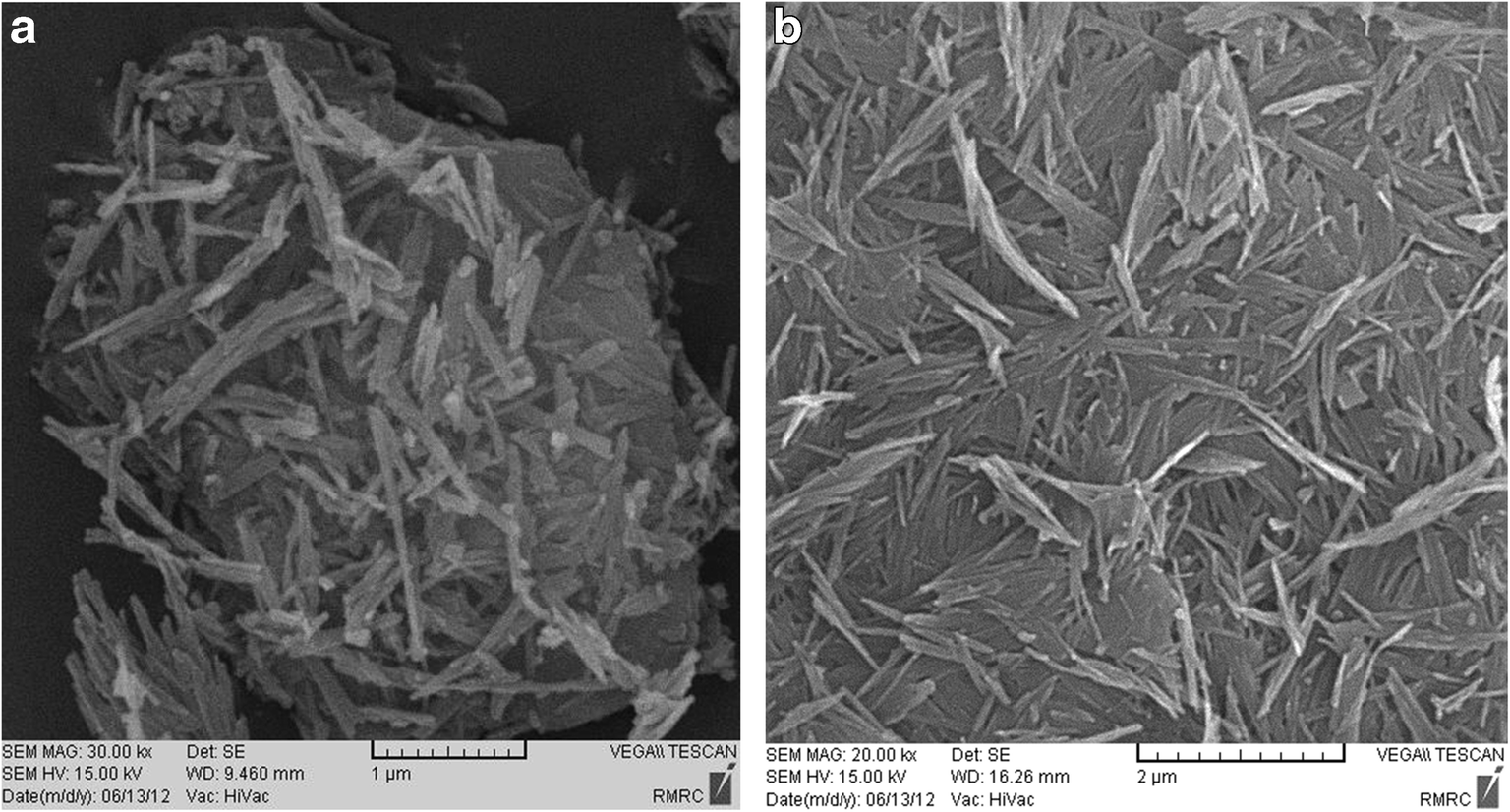
X-ray diffraction patterns were obtained for the orientated clay samples using an XD-610 Shimadzu X-ray Diffractometer (Shimadzu Co., Ltd., Kyoto, Japan) with CuKα radiation (λ = 1.5418 Å) operating at 40 kV and 30 mA. The samples were scanned from 5 to 30°2θ, with a scan rate of 4°2θ min–1. The PFl-1 sample showed (Fig. 1) a sharp peak at 8.34°2θ (d spacing 10.6 Å) while the sharpest peak for the Vicalvaro sepiolite sample emerged at 7.01°2θ (d spacing 12.6 Å), indicating that the palygorskite and sepiolite were the main mineral phases in the samples. The PFl-1 sample contains 80% palygorskite, 10% smectite, 7% quartz, 2% feldspar, and 1% other minerals (Chipera and Bish Reference Chipera and Bish2001). The Vicalvaro sepiolite is almost pure with a trace amount of quartz (Suárez and García-Romero Reference Suárez and García-Romero2012). Scanning electron micrographs (SEM) of the clay samples ( Fig. 2) were obtained using a Tescan (Vega model, Tescan, Brno, Czech Republic) microscope operating at 15 kV accelerating voltage.
XRD patterns of a palygorskite and b sepiolite

SEM images of a palygorskite and b sepiolite

The specific surface area (SSA) values of palygorskite and sepiolite minerals determined by the N2-BET (Brunauer, Emmett, and Teller) adsorption method were 136 and 240 m2 g–1, respectively. The SSA values were measured using a Micromeritics ASAP® 2010 instrument (Micromeritics Instrument Corp., Norcross, Georgia, USA). Each sample was degassed under vacuum at 200°C for 4 h before N2 physisorption. The SSA values were calculated using the multipoint BET adsorption data using ASAP 2010 software. The cation exchange capacity (CEC) values for palygorskite and sepiolite were quite low at 19.5 and 11 cmolc kg–1, respectively, as determined by the ammonium acetate method (Sumner and Miller Reference Sumner, Miller and Sparks1996).
Stock suspensions of the palygorskite and sepiolite were kept at room temperature for 24–48 h, and their pH values were measured periodically until stable at 7.5 and 8.1, respectively.
Reagents
All chemicals used in this study were extra pure analytical grade. Alkaline phosphatase (EC 3.1.3.1) from calf intestinal mucosa was purchased from Sigma-Aldrich (Steinheim, Germany) and used as received. The enzyme’s substrate (p-nitrophenyl phosphate, pNPP) was purchased from Fluka (Buchs, Switzerland). Borate buffer (Merck) was applied in all enzyme assay experiments to maintain the pH at 8.0. p-nitrophenol (pNP) was purchased from Fluka and used to prepare a standard curve required for spectrophotometric measurement of pNP released during enzymatic hydrolysis. CdCl2·2.5H2O (BDH Chemicals, UK) was used as the source of Cd. CaCl2·2H2O (Merck, Darmstadt, Germany) was applied to prepare a 0.01 M CaCl2 background solution.
Enzyme Adsorption
Adsorption of ALP on palygorskite and sepiolite was performed according to the method described by Makboul and Ottow (Reference Makboul and Ottow1979) with a slight modification. Briefly, 0.2 g of clay sample was mixed with 20 mL of 0.1 M borate buffer (pH 8.0) in a 30-mL centrifuge tube and dispersed for 5 s using an ultrasonic probe (Sonicator 3000; Bandeline, MS 72, Germany). Subsequently, 12 mg of ALP was added to the tube. The suspension was shaken for 1 h at room temperature, centrifuged at 5000×g for 20 min, and the supernatant was carefully decanted and saved. The pellet was washed three times with 20 mL of the same buffer, re-centrifuged, and the supernatants were collected in a 100-mL volumetric flask. The clay-enzyme complexes prepared thus (referred to hereafter as Plg-ALP and Sep-ALP) were then re-suspended in 100 mL of the buffer and stored at 4°C until required. The concentration of the un-retained enzyme in the collected supernatants was determined directly at 201 nm using a UV/Vis spectrophotometer (Noble and Bailey Reference Noble, Bailey, Burgess and Deutscher2009); the ALP standard concentration ranged from 5 to 80 mg L–1.
Enzyme Assay
In 10-mL glass tubes, 1.5 mL of each mineral-enzyme suspension was mixed with 2 mL of 0.1 M borate buffer. Considering that the 1.5 mL samples of Plg-ALP and Sep-ALP contained 36.9 and 73.5 μg of the adsorbed enzyme, respectively, the same amounts of the free enzyme were transferred to the glass tubes as controls.
A stock solution of Cd (2.182 mM) was prepared by dissolving an appropriate amount of CdCl2·2.5H2O in 0.01 M CaCl2 solution. This stock solution was then diluted in a 0.01 M CaCl2 solution to give the targeted Cd concentration. Speciation calculations performed using the geochemical computer program PHREEQC (version 2.18.00) showed that Cd2+ and CdCl+ were the main Cd species, comprising ~49% and 48% of the total soluble Cd contents in the applied solutions, respectively.
The kinetics of the free and adsorbed enzymes were studied by adding 2 mL of pNPP as the substrate with increasing concentrations ranging from 0.124 to 4.96 mM. Different concentrations of Cd from 0 to 2.182 mΜ were also added to the tubes to assess the inhibitory effect of Cd on the enzyme kinetics. The mixtures were then swirled thoroughly and incubated for 1 h at 37°C. During the incubation time, ALP reacted with pNPP and produced inorganic phosphate and pNP compounds. The enzyme reaction was stopped by adding 4 mL of 1 M NaOH solution (Rao et al. Reference Rao, Gianfreda, Palmiero and Violante1996). Finally, the concentration of the product (pNP) was measured spectrophotometrically at 402 nm using pNP solutions as standards with concentrations ranging from 0.5 to 20 mg L–1. The specific activities of the free and adsorbed enzymes were expressed as μg pNP produced per μg of enzyme per hour (μg pNP μg–1 AP h–1).
The kinetic constant (K m) and maximum reaction velocity (V max) of the free and adsorbed ALP were determined by plotting the enzyme activity against various concentrations of the substrate and fitting the data to the Michaelis-Menten equation (Eq. 1):

where V is the rate of enzymatic reaction; [S] (mM), the substrate concentration; K m (mM), the Michaelis constant, which characterized the affinity of enzyme to the substrate; and V max (μg pNP μg–1 AP h–1), the maximum reaction rate when the enzyme is fully occupied with the substrate (Nannipieri and Gianfreda Reference Nannipieri, Gianfreda, Huang, Sensi and Buffle1998).
Non-linear regression analysis was used to fit the Michaelis-Menten equation to the data. Curve-fitting and graph preparations were performed using the statistical package GraphPad Prism (version 5.04 for Windows, GraphPad Software, San Diego, California, USA). The goodness of fit was evaluated based on the coefficients of determination (R 2 ) and standard errors of estimate (SEE) calculated as follows:

where EA m and EA e are the measured and estimated enzyme activity values, respectively, and n is the number of measurements.
Activity Recovery of the Adsorbed Enzymes
The activity recovery (AR) of the adsorbed enzymes was calculated from Eq. (3):

where EA ad and EA fr are the activity (μg pNP μg–1 ALP h–1) of the adsorbed and free ALP, respectively.
RESULTS AND DISCUSSION
Adsorption of ALP on Palygorskite and Sepiolite
The amounts of ALP adsorbed on palygorskite and sepiolite, calculated from the difference between the amounts of enzyme initially added and those remaining in the final solutions, were 1.32 and 2.63 mg g–1, respectively. This vast difference in ALP sorption potential between palygorskite and sepiolite could be explained by a much larger SSA of sepiolite (240 m2 g–1) than that of palygorskite (136 m2 g–1), which resulted in more available silanol groups on the sepiolite surface to interact with ALP via hydrogen bonding and van der Waals interactions (Ruiz-Hitzky et al. Reference Ruiz-Hitzky, Aranda, Álvarez, Santarén, Esteban-Cubillo, Galàn and Singer2011). Taking into consideration that both palygorskite and sepiolite have low surface charge densities, hydrophobic forces between the ALP molecules and the neutral siloxane surfaces may also play an essential role in the ALP adsorption (Huang and Shindo Reference Huang and Shindo2000).
Activity Recovery of the Adsorbed ALP
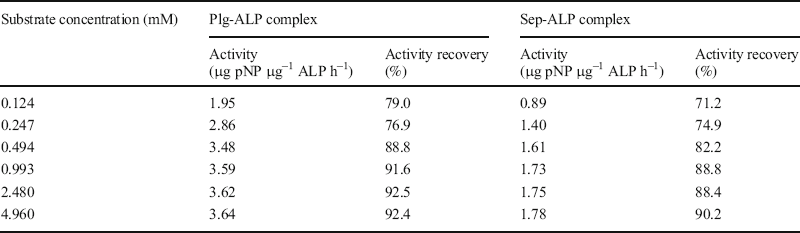
The activity of ALP decreased slightly following adsorption on the fibrous clay minerals (Table 1). The results showed that 7.5–23.1% of the enzyme activity was lost when adsorbed on palygorskite, depending on the substrate concentration added. These findings indicate that partial inhibition occurred in these systems. The enzyme activity also decreased by 9.8% to 28.8% after adsorption on sepiolite (Table 1). These large activity recovery values revealed weak physical interactions between the enzyme and the fibrous clay minerals, avoiding profound deactivation of the enzyme. The results are in agreement with those obtained by Sedaghat et al. (Reference Sedaghat, Ghiaci, Aghaei and Soleimanian-Zad2009) who showed that the activity of ALP adsorbed on Na-sepiolite decreased by 30% compared with that of the free enzyme. Tan et al. (Reference Tan, He, Wang, Li, Kong, Tian, Shen, Megharaj and He2018) reported that montmorillonite had little effect on ALP activity, with an average inhibition rate of 12%, while goethite significantly reduced ALP activity, with an average inhibition rate of 44%, which was attributed to specific adsorption of ALP on the goethite.
Activity and activity recovery of the adsorbed alkaline phosphatase (ALP) on palygorskite (Plg) and sepiolite (Sep) minerals

Kinetic Parameters of the Free and Adsorbed ALP
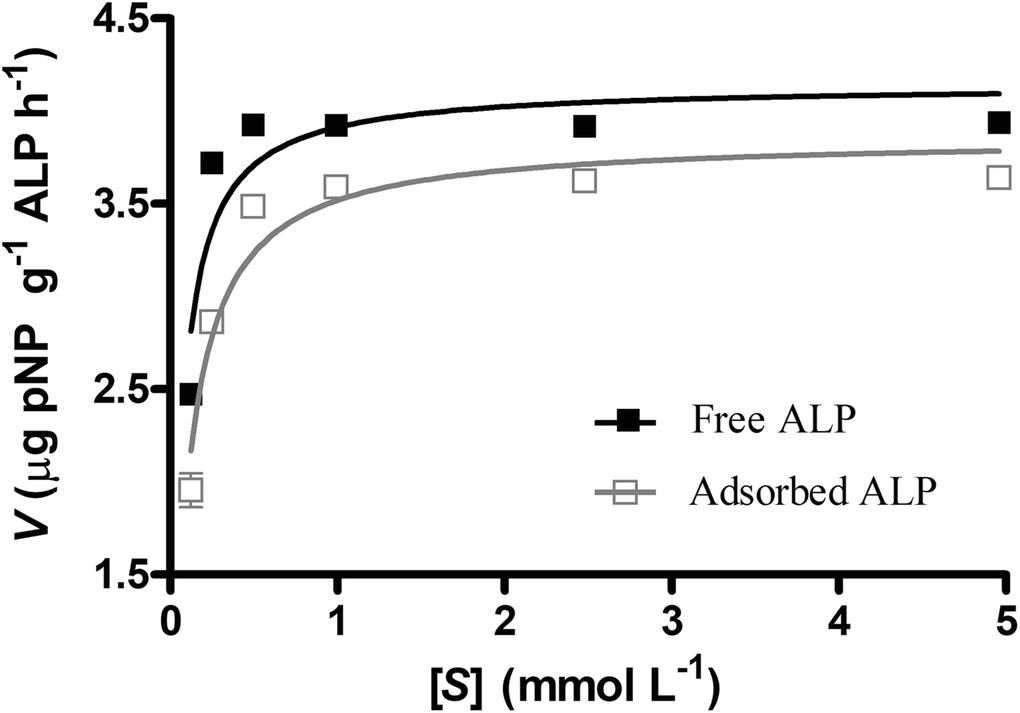
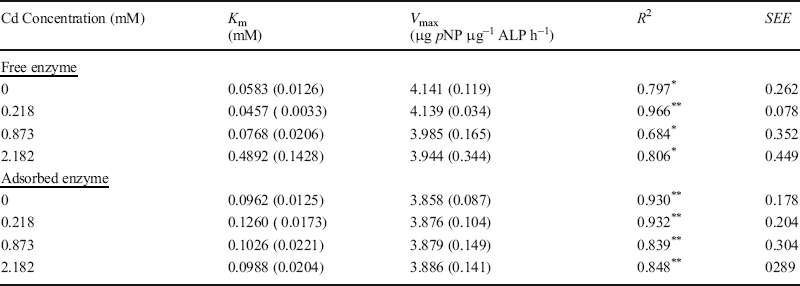
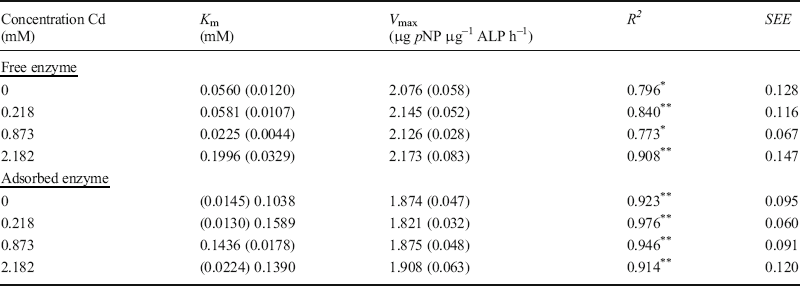
The results showed that the reaction of the substrate with both the free and adsorbed ALP enzymes followed Michaelis-Menten kinetics (Figs 3 and 4). The kinetic parameters of the ALP were altered upon adsorption on fibrous clay minerals (Tables 2 and 3), however. Adsorption of ALP resulted in the V max value decreasing slightly from 4.14 to 3.86 μg pNP μg–1 ALP h–1 for palygorskite and from 2.16 to 2.08 μg pNP μg–1 ALP h–1 for sepiolite, corresponding to reductions of 6.7% and 3.7%, respectively (Tables 2 and 3). These results confirm that ALP maintains considerably its maximum velocity (V max) upon adsorption. The K m values, however, were larger for the adsorbed ALP enzymes compared to the free enzymes. The K m value for the free ALP was 0.058 mM, which increased to 0.096 after adsorption on palygorskite (Table 2). Also, the K m value of ALP was increased from 0.056 mM to 0.104 mM when the ALP adsorbed on sepiolite (Table 3). These findings indicate that the affinities of clay–enzyme complexes towards the substrate were less than that of the free enzyme, possibly due to structural changes in the enzyme or less accessibility of substrate to the active site of the adsorbed enzyme. The increased K m values of enzymes compared to those of the free enzymes have also been reported for ALP adsorbed on Na-sepiolite (Carrasco et al. Reference Carrasco, Rad and Gonzalez-Carcedo1995), and acid phosphatase adsorbed on montmorillonite and kaolinite (Gianfreda and Bollag Reference Gianfreda and Bollag1994). According to inhibition kinetics, it is a mixed type of inhibition that involves both competitive (dominant) and non-competitive processes as K m increased, and V max decreased slightly (Cornish-Bowden Reference Cornish-Bowden2013). Mixed inhibition is a type of enzyme inhibition in which the inhibitor may bind to both the enzyme and the enzyme-substrate complex. Sedaghat et al. (Reference Sedaghat, Ghiaci, Aghaei and Soleimanian-Zad2009) also reported a decrease in V max and an increase in K m values of ALP after adsorption on Na-sepiolite. Binding of both the enzyme and the substrate on the clay surfaces has been proposed for the inhibitory action of clays on enzyme activity (Secundo Reference Secundo2013).
Rate of enzymatic reaction (V) as a function of substrate concentration ([S]) for free and adsorbed alkaline phosphatase (ALP) on palygorskite (squares: experimental points representing means of duplicate samples; error bars: standard deviations from the means; lines: Michaelis–Menten fits)

Rate of enzymatic reaction (V) as a function of substrate concentration ([S]) for free and adsorbed alkaline phosphatase (ALP) on sepiolite (diamonds: experimental points representing means of duplicate samples; error bars: standard deviations from the means; lines: Michaelis–Menten fits)

Kinetic parameters, coefficients of determination (R 2), and standard errors of estimate (SEE) of the Michaelis–Menten model fitted to the kinetic data for free and adsorbed alkaline phosphatase (ALP) on palygorskitea

aValues in parentheses represent standard errors of the estimated model parameters; * and ** show significant fit at P<0.05 and P<0.01, respectively.
Kinetic parameters, coefficients of determination (R 2), and standard errors of estimate (SEE) of the Michaelis–Menten model fitted to the kinetic data for free and adsorbed alkaline phosphatase (ALP) on sepiolite.a

aValues in parentheses represent standard errors of the estimated model parameters; * and ** show significant fit at P<0.05 and P<0.01, respectively.
Cadmium Effects on ALP Activity and Kinetic Parameters
The results revealed that the catalytic activity of the free ALP was affected negatively by Cd ions (Fig. 5 and Tables 2 and 3). With increasing Cd concentration, the K m value of the free ALP increased by up to 7.4 and 2.6 fold in palygorskite- and sepiolite-free systems, respectively, while the V max values of the enzymes remained almost unchanged. These findings suggest that competitive inhibition of free ALP activity by Cd occurred in these systems, in which Cd ions competed with the substrate for the active site of the enzymes (Ferrier Reference Ferrier2017).
Effects of Cd on the kinetics of alkaline phosphatase (ALP) adsorbed on palygorskite and sepiolite compared to those of the corresponding free ALP (symbols: experimental points representing mean of duplicate measurements carried out at 25°C in 0.1 M borate buffer at pH 8.0; error bars: standard deviations; lines: Michaelis–Menten fits)

For the adsorbed ALP, however, the inhibitory effect of Cd was remarkably smaller (Fig. 5 and Tables 2 and 3). The K m value of ALP adsorbed on palygorskite and sepiolite increased by up to 31.2% and 52.9%, respectively, whereas V max values were almost unchanged. The substantially lower inhibitory effect of Cd on the adsorbed ALP than the free ALP is possibly because of Cd adsorption by the clay surfaces, reducing its soluble concentration and lower accessibility of enzyme active sites to Cd ions. Significant sorption capacities of Cd by palygorskite (9.75 μmol g−1) and sepiolite (46.1 μmol g−1) have been reported and attributed to substitution of terminal Mg in octahedral sheets by Cd as well as complexation of Cd by functional groups on the edge surfaces of the clays (Shirvani et al. Reference Shirvani, Shariatmadari, Kalbasi, Nourbakhsh and Najafi2006). Tan et al. (Reference Tan, He, Wang, Li, Kong, Tian, Shen, Megharaj and He2018) showed that the toxicity of Cd to free ALP was lower than that of the enzyme adsorbed on goethite and montmorillonite when the duration of exposure was short (1 h). However, the toxicity of Cd to the adsorbed ALP was less than that of the free ALP after a long enough exposure time (>3 h). Tan et al. (Reference Tan, He, Wang, Li, Kong, Tian, Shen, Megharaj and He2018) proposed that the minerals can adsorb and immobilize Cd ions, and thereby reduce Cd toxicity to ALP activity over time. The inhibitory effect of Cd on the adsorbed ALP may, therefore, depend not only on the type of adsorbent mineral but also on the exposure duration. Wang et al. (Reference Wang, Li, Tan, He, Xie, Megharaj and Wei2017) reported that adsorption of ALP on montmorillonite and goethite reduced arsenate toxicity to ALP by changing the enzyme kinetics and thermodynamics or by reducing arsenate availability through its adsorption. They also showed that the type of arsenate inhibition on free soluble ALP was competitive inhibition, whereas, for immobilized and soil ALPs the inhibition was competitive or mixed inhibition depending on the mineral or soil property. Geiger et al. (Reference Geiger, Livingston, Funk and Schulin1998) reported that goethite could alleviate the inhibitory effect of Cu on β-glucosidase activity, probably due to the stronger affinity of Cu to goethite over that of the enzyme. The transformation of the secondary structure of protein molecules adsorbed on the clay surfaces may also bury the active site of the enzyme and protect it from Cd inhibition (Kelleher et al. Reference Kelleher, Willeford, Simpson, Simpson, Stout, Rafferty and Kingery2004; Huang et al. Reference Huang, Zhu, Qiao, Cai, Rong, Liang and Chen2009).
Conclusions
The results of the present study showed that the catalytic activity of ALP adsorbed on palygorskite and sepiolite was lower than that of the free enzyme. ALP lost 7.5–28.8% of its activity upon adsorption on the clays, suggesting that weak physical adsorption of the enzyme occurred on the mineral surfaces. Larger K m and smaller V max values were obtained for the adsorbed enzyme compared to those for the free enzyme, indicating less efficient enzyme–substrate interactions on the clay surfaces. Moreover, inhibition of both adsorbed and free ALP enzyme were recorded in the presence of Cd. Following Cd addition, the K m value of the enzyme increased, but the V max remained virtually unchanged compared to control, suggesting that the inhibition of ALP by Cd was of the competitive type. In general, adsorption of ALP on palygorskite and sepiolite induces a tradeoff between activity reduction and protection against Cd inhibition. Further spectroscopic work is needed, however, to provide evidence of the mechanisms of ALP binding to Plg and Sep as well as the changes in ALP tertiary structure occurring upon adsorption on these clay minerals.
Funding
This study was funded by Isfahan University of Technology.
Compliance with Ethical Standards
Conflict of Interest
The authors declare that they have no conflict of interest.