1. Introduction
Grammaticalization theory has been used to describe and explain a wide range of linguistic phenomena. While the development of person agreement markers has found some attention in this work (see Siewierska Reference Siewierska2004 for a summarizing discussion), the question of how personal pronouns arise has essentially been ignored so far, especially for the following reason: Markers for personal deixis belong to the most conservative parts of grammar, that is, they are diachronically fairly stable, as is suggested by the fact that in many cases they can be traced back etymologically to or even beyond the earliest stages of reconstructable language history. This is why so far not much progress has been made in unraveling the development of personal pronouns; the number of cases where it has been possible to determine their origin is severely limited. Still, some data do exist and allow us to reconstruct the main contours of this development.
The present paper is organized as follows. In Section 2 we look at the diachronic sources of each of the main categories of personal deixis based on a crosslinguistic perspective. The more general implications of our survey are the subject matter of Section 3, where we will be concerned with the question of how, or to what extent, the development of personal pronouns is covered by grammaticalization theory. In the final Section 4 then we will highlight some general findings presented and draw attention to areas where more research is required.
1.1 On personal pronouns
Sets of personal pronouns can be found in most languages of the world, but they are perhaps most diversified and complex in societies characterized by pronounced forms of hierarchical social organization and status. In such societies, distinctions in personal reference and address are likely to thrive, paradigm cases being found in Southeast and East Asia. Languages such as Thai, Burmese, Khmer, Vietnamese, Korean, and Japanese dispose of complex systems of personal pronouns based on distinctions of honorification (see e.g. Forchheimer Reference Forchheimer1953, Cooke Reference Cooke1968, Head Reference Head, H. Greenberg, Ferguson and Moravcsik1978, Haase Reference Haase1994, Cysouw Reference Cysouw2003, Siewierska Reference Siewierska2004, Heine & Song Reference Heine and Song2010), and a considerable part of the data to be discussed below are taken from languages spoken by these societies.
Our interest here is mainly with independent personal pronouns (henceforth in short: ‘personal pronouns’), that is, with items having the following properties: (a) they are words having their own prosody, (b) their primary or only function is to express distinctions in personal deixis, (c) they lack specific semantic content, (d) they resemble noun phrases in their positional possibilities but do not normally take modifiers, (e) they form a closed class (Sugamoto Reference Sugamoto, Corrigan, Eckman and Noonan1989; Heath Reference Heath, Booij, Lehmann, Mugdan and Skopeteas2004: 1002; Helmbrecht Reference Helmbrecht2004).
Languages are generally assumed to have personal pronouns.Footnote 2 We will treat them as a sub-class of person markers, that is, linguistic elements that are shifters which are specialized for this function and are used for the expression of personal deixis (cf. Cysouw Reference Cysouw2003: 5).Footnote 3 Person markers include a wide range of grammatical elements other than personal pronouns, such as bound markers, agreement markers, etc.
The boundaries between personal pronouns and other kinds of person markers are fluid. Siewierska (Reference Siewierska2004: xv) rightly points out that ‘different instantiations of the category of person are best viewed as defining both a diachronic and a synchronic cline in regard to their formal and functional properties’. Unfortunately, there is so far no diachronic reconstruction of this cline based on crosslinguistic data. Whether or not a given element conforms in every respect to our definition is not a matter of major concern in this paper.
The grammatical status of personal pronouns has been discussed controversially.Footnote 4 We will assume that they are functional categories rather than, say, a subclass of nouns or other categories,Footnote 5 and in doing so we are relying on the parameters of grammaticalization to be discussed in Section 1.2:
(i) Unlike nouns, personal pronouns have a schematic meaning that can be described fairly exhaustively in terms of a few elementary conceptual distinctions, most of all relating to personal deixis and number (desemanticization).
(ii) Personal pronouns have a more restricted categorial potential than lexical categories, frequently lacking e.g. the ability to take modifiers or inflectional and derivational affixes (decategorialization).
(iii) Personal pronouns are as a rule shorter than nouns and verbs (erosion).
A number of generalizations have been proposed on person markers, in particular the following:
(1) Some generalizations on personal pronouns
(a) If a language has gender distinctions in first person pronouns, it always has gender distinctions in the second or third person, or in both. (Greenberg Reference Greenberg and Greenberg1963b, Universal 44)
(b) If a language has a gender distinction in the first and second person, it also has one in the third person.
(c) A language never has more gender categories in non-singular numbers than in the singular. (Greenberg Reference Greenberg and Greenberg1963b, Universal 37)
(d) If a singular and corresponding plural form are suppletive then this is more likely to apply to the first than to the second or third person. (Forchheimer Reference Forchheimer1953: 65; Heath Reference Heath, Booij, Lehmann, Mugdan and Skopeteas2004: 1008)
(e) The majority of the languages of the world show person marking on the verb.Footnote 6
There are two contrasting positions on the typological status of person markers (see Cysouw Reference Cysouw2003: 28ff. for details). At one end there are those who maintain that ‘I’ and ‘you’ are universal in some sense, and that grammaticalized expressions for them are to be expected in any language. This is a view that surfaced in crosslinguistic surveys of the mid-20th century. Thus, Forchheimer (Reference Forchheimer1953: 39) maintained that ‘[t]he distinction of speaker, addressed, and neither speaker nor addressed is universally found’ and Greenberg's (Reference Greenberg and Greenberg1963b: 90) Universal 42 also assumes the presence of three persons and two numbers to be characteristic of pronominal categories in all languages. At the other end there are those who have expressed doubts on whether these deictic concepts are really universal (Mühlhäusler & Harré Reference Mühlhäusler and Harré1990; Cysouw Reference Cysouw2003: 13), and Cysouw (Reference Cysouw2003: 27) concludes that every language can mark person in some way, ‘but whether every language has a category of person remains unproven’.
1.2 Grammaticalization
Grammaticalization is defined as the development from lexical to grammatical forms, and from grammatical to even more grammatical forms.Footnote 7 Since the development of grammatical forms is not independent of the constructions to which they belong, the study of grammaticalization is in the same way concerned with constructions, and with even larger discourse segments (see Heine, Claudi & Hünnemeyer Reference Heine, Claudi and Hünnemeyer1991; Traugott & Heine Reference Traugott and Heine1991a, Reference Traugott and Heineb; Bybee, Perkins & Pagliuca Reference Bybee, Perkins and Pagliuca1994; Lehmann Reference Lehmann1995; Kuteva Reference Kuteva2001; Heine & Kuteva Reference Heine and Kuteva2002; Hopper & Traugott Reference Hopper and Traugott2003 for details). In accordance with this definition, grammaticalization theory is concerned with the genesis and/or development of grammatical forms. Its primary goal is to describe how grammatical forms and constructions arise and develop through space and time, and to explain why they are structured the way they are. One main motivation for grammaticalization consists in using linguistic forms for meanings that are concrete, easily accessible, and/or clearly delineated to also express less concrete, less easily accessible and less clearly delineated meaning contents. To this end, lexical or less grammaticalized linguistic expressions are pressed into service for the expression of more grammatical functions; we will return to this issue in Section 3.
In order to identify processes of grammaticalization, a wide range of criteria have been proposed (see e.g. Lehmann Reference Lehmann1985, Reference Lehmann1995; Hopper Reference Hopper, Traugott and Heine1991; Bybee et al. Reference Bybee, Perkins and Pagliuca1994; Heine & Kuteva Reference Heine and Kuteva2002; Hopper & Traugott Reference Hopper and Traugott2003). A number of notions have been proposed, such as syntacticization, morphologization, obligatorification, subjectification, etc., and several alternative frameworks offer convenient tools for describing grammaticalization phenomena. We believe, however, that they are either too restrictive, thereby excluding a number of such phenomena (e.g. Lehmann Reference Lehmann1985, Reference Lehmann1995)Footnote 8 or too general (Hopper Reference Hopper, Traugott and Heine1991) to isolate the range of processes that we consider to be cases of grammaticalization.Footnote 9 In our model it is the four parameters listed in (2) which, as we argue, take care of the relevant criteria that have been proposed in other frameworks. Henceforth we will rely on these parameters, using them as a tool for identifying instances of grammaticalization.
(2) Parameters of grammaticalization
(a) Extension, i.e. when linguistic expressions are extended to new contexts that invite the rise of grammatical functions (context-induced reinterpretation).
(b) Desemanticization (or ‘semantic bleaching’), i.e. loss (or generalization) in meaning content.
(c) Decategorialization, i.e. loss in morphosyntactic properties characteristic of lexical or other less grammaticalized forms.
(d) Erosion (‘phonetic reduction’), i.e. loss in phonetic substance.Footnote 10
Each of these parameters concerns a different aspect of language structure or language use; (2a) is pragmatic in nature, (2b) relates to semantics, (2c) to morphosyntax, and (2d) to phonetics. Except for (2a), these parameters all involve loss in properties. But the process cannot be reduced to one of structural degeneration. There are also gains. In the same way as linguistic items undergoing grammaticalization lose in semantic, morphosyntactic, and phonetic substance, they also gain in properties characteristic of their uses in new contexts – to the extent that in some cases their meaning and syntactic functions may show little resemblance to their original use.
The ordering of these parameters reflects the diachronic sequence in which they typically apply. Grammaticalization tends to start out with extension, which triggers desemanticization, and subsequently decategorialization and erosion. Erosion is the last parameter to come in when grammaticalization takes place, and in a number of the examples to be presented below it is not (or not yet) involved. Paradigm instances of grammaticalization involve all four paramaters but, as we will see in Section 2.3.2.2, there are also cases where not all of the parameters play a role. We will now look at each of these parameters in turn.
1.2.1 Extension
Of all the parameters, extension is the most complex one, it has a sociolinguistic, a text-pragmatic, and a semantic component. The sociolinguistic component concerns the fact that grammaticalization starts with innovation (or activation) as an individual act, whereby some speaker (or a small group of speakers) proposes a new use for an existing form or construction, which is subsequently adopted by other speakers, ideally diffusing throughout an entire speech community (=propagation; see e.g. Croft Reference Croft2000: 4–5). The text-pragmatic component involves the extension from a usual context to a new context or set of contexts, and the gradual spread to more general paradigms of contexts. The semantic component finally leads from an existing meaning to another meaning that is evoked or supported by the new context; we will return to this parameter in Section 3.
1.2.2 Desemanticization
Desemanticization is frequently triggered by metaphoric processes (Lakoff & Johnson Reference Lakoff and Johnson1980, Lakoff Reference Lakoff1987, Heine et al. Reference Heine, Claudi and Hünnemeyer1991). For example, a paradigm case of grammaticalization involves a process whereby body part terms (‘back’, ‘breast’, etc.) are reinterpreted as locative adpositions (‘behind’, ‘in front’, respectively) in specific contexts. Via metaphorical transfer, concepts from the domain of physical objects (body parts) are used as vehicles to express concepts of the domain of spatial orientation (extension), while desemanticization has the effect that the concrete meaning of the body parts is bleached out, being reduced, or giving way, to some spatial schema.
1.2.3 Decategorialization
Once a linguistic expression has been desemanticized, e.g. from a lexical to a grammatical meaning, it tends to lose morphological and syntactic properties characterizing its earlier use but being no longer relevant to its new use. Decategorialization entails in particular the changes listed in (3).
(3) Salient properties of decategorialization
(a) Loss of the ability to be inflected.
(b) Loss of the ability to take on derivational morphology.
(c) Loss of ability to take modifiers.
(d) Loss of independence as an autonomous form, increasing dependence on some other form.
(e) Loss of syntactic freedom, e.g. of the ability to be moved around in the sentence in ways that are characteristic of the non-grammaticalized source item.
(f) Loss of ability to be referred to anaphorically.
(g) Loss of members belonging to the same grammatical class.
In accordance with this list, nouns undergoing decategorialization tend to lose morphological distinctions of number, gender, case, definiteness, the ability to combine with adjectives, determiners, etc., to be headed by adpositions, they lose the syntactic freedom of lexical nouns, and the ability to act as referential units of discourse.
Verbs undergoing decategorialization tend to lose their ability to inflect for tense, aspect, negation, etc., to be morphologically derived, to be modified by adverbs, to take auxiliaries, to be moved around in the sentence like lexical verbs, to conjoin with other verbs, to function as predicates, and to be referred to by e.g. pro-verbs. Finally, they change from open-class items to closed-class items.
In more general terms, decategorialization tends to be accompanied by a gradual loss of morphological and syntactic independence of the linguistic item undergoing grammaticalization, typically proceeding along the scale described in (4).
(4) Free form > clitic > affix
1.2.4 Erosion
As a result of grammaticalization, a linguistic expression tends to lose parts of its morphophonological substance. We observed above that this parameter is usually the last to apply, and it is not a requirement for grammaticalization to happen. Erosion can be morphological or phonetic. In the former case it leads to the loss of entire morphological elements, and in the latter to the loss of phonetic properties (see Heine & Reh Reference Heine and Reh1984). Phonetic erosion involves any of the processes listed in (5), or some combination thereof.
(5) Kinds of erosion
(a) Loss of phonetic features or segments, including loss of full syllables
(b) Loss of suprasegmental properties, such as stress, tonal distinctions, or intonation
(c) Loss of phonetic autonomy and adaptation to adjacent phonetic units
Sources
The present section is concerned with grammatical evolution. We will try to trace the origin of personal pronouns back to their genesis and to account for their structure with reference to their history. To this end, we will deal with each deictic category in turn, where the three categories are first, second, and third person. For good reasons, third person pronouns are distinguished in many works from the other two categories of personal deixis, most of all because they do not refer to speech participants and crosslinguistically tend to differ in their morphosyntactic behavior from first and second person pronouns. However, we agree with Siewierska (Reference Siewierska2004: 8) in arguing that there is no clear advantage in excluding third person pronouns from the category of person and, as we hope to demonstrate below, this is also borne out by the study of their evolution.
In describing the evolution of personal deixis we will rely on the categories proposed in Heine & Song (Reference Heine and Song2010; see also Helmbrecht Reference Helmbrecht2004, Reference Helmbrecht2005a, Reference Helmbrecht and Haspelmathb), which are hypothesized to provide the main conceptual sources for personal pronouns, namely those listed in (6).
(6) The main conceptual sources of personal pronouns
(a) Nominal concepts
(b) Spatial deixis
(c) Intensifiers
(d) Plurification
(e) Shift in deixis
The primary concern in this paper is with the genesis of new personal pronouns. Not all instances of such a process that have been reported, however, are in fact of this kind. For example, Shibatani (Reference Shibatani1990: 31) says that the personal pronouns of the Ainu language of Japan are derived from any of several existential verbs meaning ‘to exist’. For example, the (colloquial) first person pronoun kuani of Ainu is analyzable as consisting of three components: ku- (transitive affix of first person singular), an ‘exist’, and the nominalizing suffix -i. We will ignore cases such as Ainu in this paper, however, because they do not lead to new categories of personal deixis; rather, they are concerned with the modification of already existing categories. Thus, prior to the rise of kuani ‘I’ there was already an etymologically related first person singular marker *ku- in Ainu which contributed to the form of the new person marker.
Processes such as the one illustrated with this Ainu example, which do not affect the category of personal deixis concerned, also fall within the scope of grammaticalization theory, being referred to as renewal or ‘strengthening’. But they are not responsible for genuinely new personal pronouns, that is, for the genesis of personal pronouns from forms that previously either were not personal pronouns or were pronouns denoting a different category of personal deixis (see Section 2.2.1 for examples of the latter process). Pronoun renewal is quite common in the languages of the world, but it is also a complex topic that would require a separate treatment.
Third person
The main conceptual sources for the genesis of new third person pronouns are listed in (7).
(7) Sources of third person pronouns Footnote 11
(a) Spatial deixis (demonstratives)
(b) Nominal concepts
(c) Intensifiers
We will now look at each of these sources in turn.
2.1.1 Spatial deixis
Perhaps the most common source for third person pronouns is provided by markers of spatial deixis, more precisely by demonstrative pronouns.Footnote 12 Third person pronouns are frequently created by means of a process where in specific contexts demonstrative pronouns are grammaticalized to third person markers (Heine & Reh Reference Heine and Reh1984: 271; Diessel Reference Diessel1997, Reference Diessel1999b; Klausenburger Reference Klausenburger2000). Note that the conceptual source of grammaticalization is a demonstrative used as a pronoun, rather than as a nominal attribute (Diessel Reference Diessel1999b: 115). Relative spatial distance does not appear to be a decisive factor in the process, even though there are more instances of the development that involve distal than proximal demonstratives.
At the initial stage of the process, therefore, the two are hard to separate in that the function of the relevant pronoun is ambiguous between that of a demonstrative and a personal pronoun in many contexts. The Uto-Aztecan language Cora appears to present such a stage in that ‘all third person free pronouns are demonstratives. In the role of pronouns, then, demonstratives show up as subjects, direct objects, and objects of postpositions’ (Casad Reference Casad and Langacker1984: 247). Another example is provided by the Australian Pama-Nyungan language Yindjibarndi, where Wordick (Reference Wordick1982: 71) observes that all of the third person pronouns are also used as demonstratives, and Lewis (Reference Lewis1985: 67–68) reports that in Turkish, the demonstrative pronoun o is used as a third person singular absolutive.
A similar situation appears to have existed in Ancient Egyptian, where the proximal demonstrative pronoun pw ‘this’ was also used as a general third person pronoun (‘he’, ‘she’, ‘it’, ‘they’; Gardiner Reference Gardiner1957: 85f., 103; Heine & Kuteva Reference Heine and Kuteva2002). Finally, in earlier Korean, the demonstratives i ‘this’ (speaker-proximal), geu ‘that’ (hearer-proximal), and jeo ‘that’ (speaker/hearer-distal) were used as third person pronouns (Song Reference Song2002; see Section 2.2.2). At a more advanced stage, the demonstrative and the personal pronoun become separate functional categories, in that the latter undergoes desemanticization by losing its meaning of spatial deixis, decategorialization, and erosion.
That this is a development of crosslinguistic significance is also suggested by the fact that instances of it are also found in pidgins and creoles. In early Eastern Australian Pidgin English (EAPE) there are sporadic occurrences of dat (<English that) as a third person pronoun, e.g.:
(8) Dat make all black pellows get plentybark.
‘He made the Aborigines collect a lot of bark.’ (Baker Reference Baker and Arends1995: 10)
And in the English-based creole Sranan of Surinam, the distal demonstrative da (historically derived from English that>dati>da) ‘that’ is used as a weak third person pronoun ‘it’ (Arends Reference Arends, Muysken and Smith1986).
2.1.2 Nominal concepts
The second major historical source of third person pronouns is provided by nouns. Heine & Song (Reference Heine and Song2010) distinguish the kinds of nominal sources listed in (9).
(9) Domains of nouns recruited for the grammaticalization of personal pronouns
(a) Honorific expressions used for high-ranking personalities
(b) Terms for social status distinctions
(c) Kin terms
(d) Terms for professions
(e) Generic nouns for human beings, or based on distinctions of sex and age
Of these, it is most of all (9e), that is, nouns meaning ‘man’ or ‘person’ (Heine & Kuteva Reference Heine and Kuteva2002: 112–113, 209–210) that tend to develop into personal pronouns. This pathway of grammaticalization has been documented most of all in Africa. The Central Sudanic language Lendu has suppletive forms for the noun ‘man’. The singular stem ke ‘man’ changes to ndrú or kpà ‘people’ in the plural, and this suppletism has been retained in the grammaticalization from noun to personal pronoun – the third person singular pronoun is ke, and the third person plural pronoun ndru or kpa, all lacking tonal features (see (5b) above):
(10) Lendu (Central Sudanic, Nilo-Saharan; Tucker Reference Tucker1940: 392) ma-zhi ndru. ke zhi kpa.1sg-love 3pl 3sg love 3pl‘I love them.’ ‘He loves them.’
In the Central Khoisan language ‖Ani of Botswana, the noun khó(e)-mà (person-m.sg) ‘male person’, ‘man’ has been grammaticalized to a third person masculine singular pronoun khó(e)mà ‘he’, which is undergoing erosion to khóm, e.g.:
(11) ‖Ani (Heine Reference Heine1999: 28) … kánà khó
 hin-‖òè kxˈéí-hὲ. because he do-hab manner-f.sg‘[The crocodile catches her] because this is the way he (=the crocodile) does it.’
 hin-‖òè kxˈéí-hὲ. because he do-
Similarly, the Ubangi language Zande of Zaire has a noun stem *ko ‘man’, ‘male’ which appears to have given rise to the masculine personal pronoun kɔ (Heine & Reh Reference Heine and Reh1984: 223; Claudi Reference Claudi1985). The Nilotic Southern Lwoo languages of Uganda illustrate two different stages in the development from noun to personal pronoun. In two Ugandan languages, the noun for ‘people’ has developed into an anaphoric third person plural pronoun ‘they’, but whereas in Alur the form j  means both ‘people’ and ‘they’, in Adhola the pronoun jó ‘they’ is only diachronically a noun for ‘people’ (Heusing Reference Heusing2004: 218).
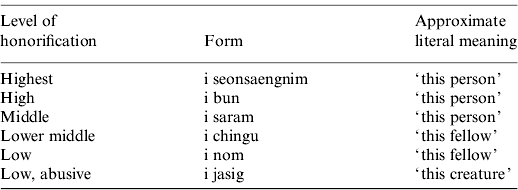
A further example is provided by Korean. We noted above that the demonstratives i ‘this’ (speaker-proximal), geu ‘that’ (hearer-proximal), and jeo ‘that’ (speaker/hearer-distal) were used as third person pronouns in earlier Korean; but since the end of the 19th century, when Korean was standardized as a written language, the demonstratives were reinforced by the noun strategy, whereby an appropriate head noun (e.g. saram ‘person’) was added; Table 1 lists the various head nouns according to the level of honorification in Standard Korean.Footnote 13
Korean forms corresponding to third person pronouns in other languages (illustrated with the speaker-proximal demonstrative i ‘this’; Song Reference Song2002: 10).
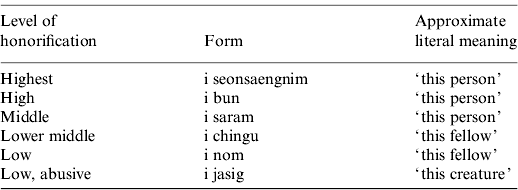
A wealth of third person pronouns derived from nouns expressing distinctions relating to social role relations can be found in Southeast and East Asia. In the Austro-Asiatic language Khmer, the form keeː serves not only as a noun for ‘person’ but also as a third person pronoun of neutral social status and as an indefinite pronoun (John Haiman, p.c.), and the Thai item phráʔo  is not only a person marker for second and third person, referring to high ranking persons, but also a noun or classifier for ‘high ranking royalty’. Cooke (Reference Cooke1968: 17) says that he is listing it ‘as a personal pronoun because pronoun usage predominates over unambiguous noun usage’. And in Vietnamese, the item ho is a noun for ‘family’ but also a pronoun ‘they’ used when speaking of a group of persons who are neutral as to respect or deference, and Ngu
 i is on the one hand a noun or classifier and on the other hand a third person marker used when speaking of gods, kings, or highly respected persons (Cooke Reference Cooke1968: 114).
2.1.3 Intensifiers
A third important source for third person pronouns is provided by what we refer to in a loose sense as ‘intensifiers’. With this term we are referring to three kinds of pronominal concepts, namely reflexives, intensifiers, and identitives (or identity pronouns, ‘the same’).Footnote 14 What the three have in common is that they all presuppose some entity whose referential identity has been established in previous discourse, and that they tend to undergo the same kind of grammaticalization process. In some of the existing literature, reflexive forms (e.g. John killed himself) and intensifiers (John himselfkilled her) are not distinguished terminologically, even if intensifier pronouns tend to be referred to as ‘emphatic reflexives’. It therefore remains frequently unclear which of the two is involved in the creation of personal pronouns; it would seem, however, that in most such cases it is intensifiers, rather than reflexives, that are used; more research is required on this point.
One example of an intensifier source is provided by the Basque identity pronoun ber- ‘same, -self’.Footnote 15 Grammaticalization induced by contact with Romance languages appears to have affected the system of (independent) personal pronouns in Basque, being held responsible by Haase (Reference Haase1992: 135–137) for the fact that ber- is on the way to developing into a third person pronoun; we will return to this issue in Section 3.
Intensifiers in the Ethio-Semitic language Amharic are commonly formed by means of a noun phrase consisting of the noun ras (Ge'ez rəs) ‘head’ plus a possessive modifier, which appears to have provided the basis e.g. for a range of third person pronouns (Praetorius Reference Praetorius1879: 119f.; Hartmann Reference Hartmann1980: 273; Zelealem Leyew and Ulrike Claudi, p.c.). One may also mention Turkish, which appears to have exploited its intensifier in certain contexts to express third person reference:
(12) Turkish (Siewierska Reference Siewierska2004: 226) Kendi-si opera-ya git-ti.self-3sg opera-dat go-past‘He (respectful) has gone to the opera.’
That the development from intensifier to personal pronoun is in fact a process of grammaticalization is suggested by the fact that, first, it is unidirectional. Crosslinguistically there are a number of languages where intensifier (‘-self’) or identity forms (‘the same’) have given rise to personal pronouns, while there is so far no evidence for a development in the opposite direction. Second, this development can be described in terms of desemanticization (see Section 1.2 above), whereby the specific intensifier or identity semantics is bleached out – with the effect that third person reference, that is, a schematic deictic concept, is the only semantic function that is left.
2.1.4 Other sources
Demonstratives, nouns (or noun phrases), and intensifiers are not the only sources for third person pronouns. Another concept that can also be grammaticalized to a third person pronoun is ‘the other(s)’. This has happened in some French-based creoles (see Section 2.2.1 below), as well as in Khmer, where the form kee ‘other(s)’ appears to have given rise on the one hand to a number-neutral third person pronoun and on the other hand to an expression for indefinite agents, much like French on (John Haiman, p.c.).
Once a third person pronoun has evolved, this is not necessarily the endpoint of its development. It may develop further into a second person pronoun, as we will see in the next section. But it may as well lose its pronoun status and end up as an agreement marker on the verb (Givón Reference Givón1984: 353–360; see also Diessel Reference Diessel1999b: 120).
2.2 Second person
In this section we are confined most of all to expressions for singular referents. This however does not mean that plural reference is irrelevant, as we will see below. Second person plural pronouns are semantically complex, they may denote two or more addressees, or one addressee plus at least one nonparticipant (cf. Heath Reference Heath, Booij, Lehmann, Mugdan and Skopeteas2004: 1008), and in a number of cases, this complexity can be accounted for with reference to the respective diachronic sources of these pronouns.
Second person singular pronouns belong to the diachronically most stable parts of grammar. Nevertheless, Hagège (Reference Hagège1993: 114f.) argues that presumably in the majority of the languages of the world there is one or more alternative form for them. Of all concepts of personal deixis, second person pronouns appear to have the largest range of diachronic sources. The sources listed in (13) appear to be crosslinguistically the most common ones:
(13) Sources of second person pronouns
(a) Third person pronouns
(b) Intensifiers
(c) Nominal concepts
(d) Spatial deixis
(e) Plurification
A phenomenon that plays quite some role in the growth of many second person singular pronouns concerns plurification.Footnote 16 Plurification concerns the use of plural pronouns, most commonly of second person plural pronouns, to refer to single persons;Footnote 17 it can be understood as a strategy whereby the use of a plural pronoun is extended to also denote singular referents with the intent to express distinctions in social status, politeness, and/or social distance; following a widespread usage, we will refer to such distinctions summarily with the term honorification.Footnote 18 A paradigm example is provided by French, where the plural pronoun vous ‘you.pl’ was extended to singular referents; for a detailed discussion of plurification, see Heine & Song (Reference Heine and Song2010) .
2.2.1 Third person pronouns
Third person pronouns are crosslinguistically perhaps one of the most common sources for second person pronouns (see e.g. Head Reference Head, H. Greenberg, Ferguson and Moravcsik1978: 167–171). It is especially third person plural pronouns, rather than singular pronouns, that are grammaticalized to second person pronouns. Plural forms have played quite some role in e.g. the history of deictic marking in German (see Simon Reference Simon1997), the Modern High German polite address pronoun Sie ‘you’ (<‘they’) being a modern reflex of this grammaticalization source; see Section 2.2.2 for more details. In fact, German provides a paradigm example of the third-to-second strategy. The way this affected the structure of personal deixis in the German of the 17th century can be shown with the following quotation:
The seventeenth century was the heydey of honorific flourishes and the position of the 3rd person pronoun was strengthened by the continual employment of such expressions as Euer Gnade ‘Your Grace’. But more than this, plural phrases like Euer Gnaden ‘Your Graces’ came into fashion as hyper-polite modes of address. This development provoked a corresponding employment of the 3rd pl. Sie as the most respectful pronoun of all; one could now address a person as ‘They’. By the second half of the eighteenth century the plural Sie had established itself. (Lockwood Reference Lockwood1968: 62)
Some consequences of this process are discussed below. The process may be due either to a straightforward shift from third to second person, or to the fact that the third person pronoun at first refers anaphorically to a nominal address form. It would seem that the latter is more common:Footnote 19 Third person pronouns developing into second person pronouns tend to start out as anaphoric pronouns referring to nominal expressions of address but serving to address second person referents, in a way that can be illustrated with the following example from German. In some upper-middle–class restaurants the customer may not be surprised to be addressed by the waiter as in (14), where the third person pronoun er ‘he’ denotes second person reference but refers anaphorically back to the address form der Herr ‘the gentleman’.Footnote 20
(14) German Was wünscht der Herr? Hat er sich schon entschieden?what wants the gentleman has he himself already decided‘What would you like, Sir? Have you decided already?’
Whether the noun phrase is a singular or a plural form is likely to determine whether the resulting second person pronoun will have singular or plural reference. Examples from other European languages, such as Italian, Danish, Norwegian, or Swedish, suggest in fact that third person pronouns developing into second person pronouns more commonly originate as third person anaphoric markers for honorific noun phrases used as address forms (Head Reference Head, H. Greenberg, Ferguson and Moravcsik1978: 168; Helmbrecht Reference Helmbrecht2004, Reference Helmbrecht2005a).
This pathway, though, is certainly not the only one to be held responsible for the third-to-second strategy. A number of French-based creoles have experienced a development where a form etymologically derived from French les autres ‘the others’ has given rise to third person plural pronouns (>zot), see (15), and further to second person plural pronouns, see (16).
(15) Mauritian (French-based creole; Syea Reference Syea, Baker and Syea1996: 176) liv la ki zot ti lir.book def that they tns read‘It was the book that they read.’
(16) Guyanese Creole French (Corne Reference Corne1971: 92) mo pa uer zot pies.(I neg see you.pl piece)Footnote 21‘I didn't see anyone of you (plural).’
2.2.2 Intensifiers
Intensifiers, reflexives, and identity pronouns (or identitives) are crosslinguistically a common source for second person pronouns, especially in languages spoken in India and generally in Southeast Asia (see Head Reference Head, H. Greenberg, Ferguson and Moravcsik1978: 179ff.). An example of an intensifier is found in (17) and of an identifier pronoun in (18), involving, respectively, the Korean intensifier/reflexiveFootnote 22jane ‘oneself’ and the 18th-century German identity pronoun dieselben ‘the same ones’.
(17) Southeastern Korean (Song Reference Song2002) jane eonje ga-lgeon-ga?int/2.abs when go-fut.intr‘When will you go?’
(18) 18th-century German (Simon Reference Simon2003) Ich bitte dieselben.I ask the.same.ones‘I ask you.’ (Maximally polite form of address)
The crucial role played by intensifiers in the development of personal deixis marking can be illustrated with the following example from Korean.Footnote 23 In accordance with Song (Reference Song2002) we distinguish between three levels of honorification: a high level, a middle level, and a low level.Footnote 24 At least since the 16th century, the form jeo was used as an intensifier/reflexive form of all honorific levels. Towards the end of the 16th century, three new intensifier/reflexive forms arose: dangsin, which became the marker of the high level, and jagi and jane, which became the middle honorific level forms, with jeo being degraded to a low level form. Around the end of the 19th century, jeo developed into a first person pronoun of the low honorific level.
The form dangsin, introduced into the language as a high level intensifer/reflexive towards the end of the 16th century, acquired an additional use as a second person pronoun of the high level around the end of the 18th century. This polysemy of dangsin continued up until around the mid-20th century, when dangsin was discontinued as an intensifier/reflexive and devaluatedFootnote 25 to a second person pronoun of the middle level.
The use of jane was extended from a middle level reflexive to second person pronoun of the middle level in the mid-17th century, and shortly thereafter its intensifier/reflexive use was discontinued. As a second person pronoun, it was devaluated to a low level pronoun around the mid-20th century, and in modern Standard Korean it is restricted to addressing people younger than the speaker, although it appears to be falling into disuse (Song Reference Song2010). The second middle level intensifier/reflexive jagi experienced a similar development as jane: It also acquired the function of a second person pronoun of the middle level in the second half of the 20th century and has remained polysemous between its reflexive and deictic uses up to the present, even though its function as a reflexive was generalized to all three levels of honorification.
To sum up, within the last five centuries there were four developments from intensifier/reflexive to deictic marker in Korean, one giving rise to a first person pronoun (jeo), while the remaining reflexives developed into second person pronouns.
Korean is by no means an isolated case. In Khmer there is no genuine second person pronoun, but the intensifier and reflexive form aeng ‘oneself’, typically in combination with kluan ‘body’, has acquired the meaning of a pronoun for a second person of neutral status (‘you (all)’).Footnote 26 The Thai second person marker tuá, literally meaning ‘body, self’, is (i) an affectionate or intimate term, used for speaking to equal or to inferior not older than the speaker, and (ii) used by a child or young woman speaking to an intimate (sibling, friend, fiancé, husband) in anger, expressing a sense of injury, and implying a disavowal or impersonalization of the close relationship (Cooke Reference Cooke1968: 17).
Another language where intensifiers or reflexives appear to have provided a productive pattern for personal pronouns is the Semitic language Amharic of Ethiopia. Intensifiers in Amharic are commonly formed by means of a noun phrase consisting of the noun ras (or Ge'ez rəs) ‘head’ plus a possessive modifier. It would seem that this construction provided the basis for e.g. the second person singular respect pronoun ərs wo ‘you’ (<*əras-wo ‘your (respectful) head’), but also for a range of third person pronouns, as we saw in Section 2.1.3 above.
Furthermore, Siewierska (Reference Siewierska2004: 227) mentions Tetelcingo Nahuatl, where there are even two reflexive markers that can be used jointly: On the one hand the prefix mo-, derived from the third person reflexive, and the reflexive marker -cinow, used in the case of second person honorific reflexives:
(19) Tetelcingo Nahuatl (Siewierska Reference Siewierska2004: 227) To-mo-kokoh-cinow-a.2.sg.refl-hurt-refl.h.pres‘You (honorific) are sick.’
Compared to the Korean, Amharic, or Khmer situations, the development of the German identity pronoun dieselben ‘the same ones’ to a second person pronoun in the 18th century is suggestive of a process that was restricted in a number of ways. The pronoun surfaced in the middle of the 18th century as an anaphoric pronoun of the highest level. Thus, around that time the influential grammarian Johann Christoph Gottsched describes the following four levels of politeness that were distinguished: dieselben=überhöflich (‘super polite’), Sie=neuhöflich (‘new polite’), er=mittelhöflich (‘middle polite’), ir=althöflich (‘old polite’), and du=natürlich (‘natural’) (Gottsched [1762]1970: 280). But dieselben had a relatively short lifespan, declining in the 19th century, even if it was still mentioned occasionally around 1900. Furthermore, it was largely confined to plural addressees and to uses as an anaphoric marker referring to some antecedent title of dignity (Simon Reference Simon1997: 274–275), and it was never conventionalized to a full-fledged second person pronoun (Simon Reference Simon1997: 268ff.; 2003: 127).
When grammaticalized to a second person pronoun, an intensifier is likely to develop into an invariable form that may no longer refer to different categories of personal deixis. The ‘reflexive’ form ap of Hindi and Urdu, for example, occurs in all categories of person and number; as an address form, however, where it expresses the most respectful pronominal form of address, it has only second person reference (Head Reference Head, H. Greenberg, Ferguson and Moravcsik1978: 180).
Intensifiers may combine with plurification (see Heine & Song Reference Heine and Song2010) to form pronouns of respect or social distance. In Bengali, the second person singular pronoun is an ‘inferior’ address form while the second person plural pronoun is the ‘common’ address form. But the most respectful pronoun is apnara, which is a grammaticalized plural form of the ‘reflexive’ apni (Head Reference Head, H. Greenberg, Ferguson and Moravcsik1978: 180).
Siewierska (Reference Siewierska2004: 226) found that outside the Indian subcontinent the use of reflexives as polite or respectful forms of address is not particularly common. Nevertheless, we have seen that there are a number of other societies outside that subcontinent that have also drawn on intensifiers for functions of personal deixis.
The exact pathways leading from ‘intensifier’ categories to personal pronouns are far from clear; a more detailed analysis of these categories and of the semantic changes leading to grammaticalization is urgently needed.
2.2.3 Nominal concepts
Shibatani (Reference Shibatani1990: 371–372) observes that etymologically, most of the personal pronouns in Japanese ‘derive from regular nouns, e.g. watakusi “I” (<“private (thing)”), kimi “you” (<“emperor”), anata “you” (<“yonder”)’. When grammaticalized to second person pronouns, nouns are likely to occur in possessive constructions, consisting of a noun and a possessive modifier, used as honorific address forms which assume the function of second person pronouns. Mechanisms of grammaticalization involved in the process concern especially the loss of nominal meaning (desemanticization) and of phonetic substance of the forms concerned (erosion; see Section 1.2 above).
Desemanticization has the effect that the meaning of the nominal possessive construction is bleached out, resulting in the rise of a marker of second person deixis used for respect and/or social distance, decategorialization means that the ability to take nominal inflections, derivations and modifiers disappears, while erosion leads to a loss in phonetic substance of the expression concerned. Paradigm examples can be found in some Romance languages: Spanish Vuestra Merced and Portuguese Vossa Mercê, both meaning ‘Your Grace’, were grammaticalized to second person polite pronouns (Usted and Você, respectively), or Dutch Uwe Edelheid ‘Your Nobility’, which also developed into the second-person polite form U (see Head Reference Head, H. Greenberg, Ferguson and Moravcsik1978: 185ff.; Siewierska Reference Siewierska2004: 224). In accordance with their origin as noun phrases, the resulting forms are likely to exhibit third person agreement, even though they are now unambiguously markers of second person deixis (see Comrie Reference Comrie1975). Whether, or to what extent, the head nouns functioning as possessees in such constructions can be regarded as semantically parasitic heads (Levine Reference Levine2010) cannot be determined on account of lack of appropriate data but should be an issue of future research.
Portuguese Vossa Mercê began to be used as a polite form of address for the king around 1460, but was soon devaluated. Around 1490 its use was extended as an address form for dukes, in the 16th century it was further extended to the bourgeois population, and in the 18th century it replaced the earlier vós as a polite and ceremonial form of address for singular referents.
A similar process took place in Romanian, where the noun phrase Domnia Ta ‘Your Grace’ was grammaticalized to the second person address form dumneata (also: Domnia Voastrǎ ‘Your (plural) Grace’ >dumneavoastrǎ). This process was presumably associated with the rise of the Romanian feudal society between the 10th and the 14th centuries, and the synthetic form of the pronoun is documented already in the 16th century (Merlan Reference Merlan and Schmidt-Radefeldt2006: 222–226). We noted in Section 1.2 that erosion is a frequent but not a necessary parameter of grammaticalization, and the present examples of the evolution of nominal honorific expressions illustrate this fact: While the developments in Spanish, Portuguese, or Dutch show massive erosion, there was hardly any erosion in the grammaticalization of the Romanian pronouns.
In a comparable fashion, speakers of some languages of Southeast AsiaFootnote 27 have extended the use of nominal expressions designed by the speaker to humble himself or herself in self-reference to markers of first person reference, and nominal expressions signaling respect to markers of second person address. For example, the second person honorific pronoun tuan ‘you’ of Indonesian is said to originate in an Arabic loan meaning ‘master’, and Old Japanese kimi ‘emperor’ or ‘lord’ developed into a second person singular pronoun ‘thou’ (Shibatani Reference Shibatani1990: 371–372). Note further that the Khmer noun neak ‘person’ is conscripted for use as a second person pronoun ‘you (younger than speaker)’ (John Haiman, p.c.), and the Thai item phráʔo is not only a person marker for second and third person, referring to high ranking persons, but also a noun or classifier for ‘high ranking royalty’ Cooke (Reference Cooke1968: 17; see Section 2.1.2).
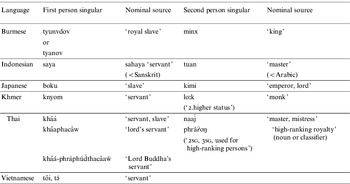
Table 2 (on next page) lists examples from Southeast and East Asia that lend support to what we propose to call the asymmetric-role model of speaker–hearer interaction. According to this model, the speaker understates his or her own social status, describing himself or herself as being of low status while treating the hearer as a personality of high status, deserving a respectful form of address.Footnote 28
Some nominal sources for first and second person markers. (See the text for information on constraints and the social environment in which these forms are used.)

In quite a number of languages there is a secondary strategy of using kin terms or terms for professions (see (9c, d) above) as weakly grammaticalized forms of second person pronouns. In Korean, for example, elusin is employed rarely as a deferential second person pronoun, referring to a respected male of over sixty years of age and as a result, reference terms such as apeci ‘father’, sensayng-nim ‘teacher’, and sacang-nim ‘company president’ are used as pronominal substitutes (Sohn Reference Sohn1999: 208).
2.2.4 Spatial deixis
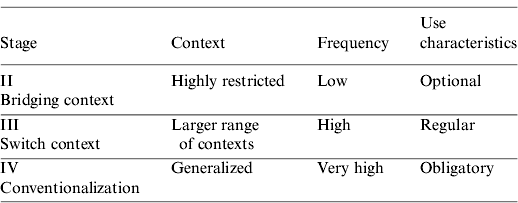
Being a language where avoidance of direct address plays an important role, Korean has developed a range of different expressions for personal deixis. Among them are the following expressions for distal space which can serve as third person pronouns: the noun phrases jeo jjog/pyon ‘that side’, jeo gos ‘that place’, and the locative adverb jeogi ‘there’ (Song Reference Song2002; see Section 2.3.1.3). In addition, the distal adverb jeogi ‘there’ may be used in the function of a second person pronoun. But such expressions are for the most part instances of incipient grammaticalization, not having been incorporated into the paradigm of personal pronouns (suggestive of a bridging context; see Section 3, Table 6 below), as is also the case in a number of other languages where distinctions of spatial deixis provide a contextually available alternative, that is, they are not conventionalized to regular forms of personal deixis.
In some cases, however, spatial deixis has given rise to fully grammaticalized second person pronouns. The Japanese second person pronoun anata, for example, originates in a spatial deictic noun signaling roughly ‘over there’ (or ‘that part’) in Late Old Japanese, having been used as a third person marker (‘person over there’) in Early Modern Japanese, before it shifted to a second person pronoun around 1750 (Traugott & Dasher Reference Traugott and Dasher2002: 230). This example is suggestive of a chaining process whereby expressions for spatial deixis give rise first to third person markers which again develop into second person pronouns.
2.2.5 Plurification
Finally, there is another important strategy that provides a source for new categories of second person deixis, namely plurification. With this term we refer to a process whereby second or third person plural pronouns are also used for (honorific or polite) second person singular address. What distinguishes this process from other processes discussed in this paper is that it is restricted to one and the same paradigm, in that one category of person marking turns into another category of person marking; we will return to this issue in Section 3. A number of languages in Europe have developed new forms of second person singular address; in English the process has proceeded further, with the effect that the new pronoun you, formerly a honorific pronoun, has replaced the old pronoun thou (Brown & Gilman Reference Brown, Gilman and Fishman1968; Helmbrecht Reference Helmbrecht2004, Reference Helmbrecht2005a).
Plurification is discussed in detail in Heine & Song (Reference Heine and Song2010; see also Siewierska Reference Siewierska2004: 216–221 and Sections 3 and 4 below); one example may therefore suffice to illustrate the process. The process looked at occurred within the last fifty years in a modern African society. Sango, a Ubangian language of the Niger-Congo family, is the national language of the Central African Republic, being an official language side by side with French. One of the changes that this language underwent recently concerns the rise of a new functional category via the extension of the second person plural pronoun álà, resulting in a new deferential second person singular pronoun (Samarin Reference Samarin, Carstens and Parkinson2002). The use of the new category, which must have arisen in the 1960s is flexible: Except for children under 13 years of age, essentially any Sango speaker can give álà to anyone else instead of the traditional second person singular pronoun mò, but female addressees are generally more likely to receive álà than males, and the probability that grandparents and parents receive álà is the highest. Being a young category, it has not yet been fully conventionalized; its use remains largely optional, being determined to some extent by social and demographic variables.
2.3 First person
Since singular and plural forms of first person pronouns mostly follow different pathways of grammaticalization (see (1d) above) we are treating the two separately in the present section.
2.3.1 First person singular pronouns
There is only limited information on the origin of first person singular pronouns (see e.g. Blake Reference Blake1934, Cooke Reference Cooke1968), and where there is information, it concerns oppositions in deictic space and social status.
2.3.1.1 Spatial deixis
Claude Hagège characterizes the spatial deixis strategy serving the expression of first and second person pronouns in the following way:
[There are] languages which use spatial adverbs with the meaning of personal pronouns: Japanese kotira ‘here’ often refers to the speaker, Vietnamese Hây ‘here’ and Hây (or Hó ‘there’) are used with the meanings ‘I’ and ‘you’ respectively when one wants to avoid the hierarchical or affective connotations linked to the use of personal pronouns. (Hagège Reference Hagège1993: 216–217)
As we observed in Section 2.2.4, Korean also has recruited distinctions of space for the expression of personal deixis, using proximal demonstrative attributes with locative nouns. Thus, i jjog/pyon ‘this side’ or i gos ‘this place’, as well as the locative adverb yeogi ‘here’, tend to be used as first person pronouns; consider example (20), which illustrates the significance of spatial deixis in encoding the contrast between first and second person referents.Footnote 29
(20) Standard Korean (Song Reference Song2002: 14) ijjog-eun gwaenchan-eunde geu jjog-eun eotteo-seyo?this side-nom good-conn that side-nom how-end‘I am OK, and how about you?’
In Thai, the demonstrative form nîí ‘this (one)’ is used as a first person singular pronoun by certain young women to male non-intimate equals (Cooke Reference Cooke1968: 14); consider also, for comparison, the use of spatial deixis in current colloquial English:
(21) Colloquial English
A: I hate this place!
B: Same here! (=‘So do I.’)
2.3.1.2 Nominal concepts
Nouns used as a source for first person singular pronouns are found especially in some languages of Southeast Asia, such languages being Burmese, Javanese, Khmer, Malay, Sundanese, Thai, and Vietnamese (Cooke Reference Cooke1968; Head Reference Head, H. Greenberg, Ferguson and Moravcsik1978: 187). Underlying this usage there appears to be the asymmetric-role model of speaker–hearer interaction that we proposed in Section 2.2.3 above, whereby nominal expressions are designed by the speaker to humble himself in self-reference, turning into markers of first person reference, and nominal expressions signaling respect into markers of second person address. The examples that we listed in Table 2 were but a selection of the expressions used in languages such as Burmese and Thai to encode first and second person address in terms of concepts that are in accordance with this model (see Cooke Reference Cooke1968 for more examples).
Already at the stage of Classical Malay, the literate noun sahāya (which is said to ultimately come from Sanskrit sahāya ‘assistant’) was polysemous between ‘servant’ and ‘I (humble/polite)’. Later on, the nominal meaning was lost and sahāya underwent erosion to become saya, the first person pronoun for neutral, non-familiar ‘I’ in modern Indonesian (Lehmann Reference Lehmann1995, Cysouw Reference Cysouw2003: 13).
Among the many nominal forms used for first person address in Thai there is the noun khâá ‘servant, slave’, employed as a first person singular pronoun when speaking to inferiors, while khâaphacâw ‘lord's servant’ is used in public address for first person reference (Cooke Reference Cooke1968: 13). In Vietnamese, the noun tôi ‘servant’ (taking the plural marker các ‘group’) is also used as a person marker for ‘I, me’, and in this case the plural marker is chúng ‘they’. The person marker is, however, not ordinarily employed between adults and children or vice versa, or between close blood kin; but otherwise its use is general and fairly neutral. Furthermore, the noun t  ‘servant’ was formerly used especially in North Vietnam as a first person pronoun speaking to one's schoolmates (Cooke Reference Cooke1968: 113). And finally, we noted above that in Japanese the noun boku ‘slave’, a Chinese loanword, gave rise to the first person pronoun boku.
2.3.1.3 Intensifiers
The two sources discussed above account for many but not all pathways of grammaticalization leading to the rise of first person singular markers. Once again, we find cases of intensifiers or reflexives among the sources, like Korean jeo. Around the end of the 19th century, the Korean intensifier/reflexive form jeo was extended to use in the domain of personal deixis, becoming a first person pronoun of the low honorific level, and it has retained this function up to the present, with the traditional first person pronoun na being reduced to use at the middle honorific level (see Section 2.2.2 above).
In Standard Japanese, the reflexive marker jibun (or zibun) may be used for ‘I’ as a first person pronoun, but grammaticalization has gone further in the Kansai dialect area of Japanese, where the reflexive marker jibun is used much more frequently in this capacity, generally acting as one of the ordinary personal pronouns for ‘I’ (Hinds Reference Hinds1986: 124); the following example is taken from the usage in Osaka:
(22) Japanese (Hinds Reference Hinds1986: 263) isshookenmei jibun ga mooshikomi kaite mootekiteta yaro.diligently I nom application write took cop‘I wrote out the application diligently and took [it there].’
The grammaticalization of reflexive jibun to a first person marker was, however, not approved by everybody in Japan. After the end of the American occupation, the government document Kore kara no keigo (‘Honorific Language from Now On’) was officially released. This memorandum of 1952, which can be seen as a signal of Japan's transition to a modern nation state with a new orientation in social relations, proposed a number of new regulations on person markers, and one of them was geared at eliminating jibun as a person marker: ‘The use of jibun “self” instead of [the first person pronoun] watashi should be avoided’ (Coulmas Reference Coulmas, Watts, Ide and Ehlich1992: 308).
There are also a few other languages, in Southeast Asia, where the use of intensifiers or reflexives includes that of first person reference, like Vietnamese mình ‘body, self’, which also serves as a first person term chiefly among females speaking to close intimate equals of either sex (Cooke Reference Cooke1968: 112). One may further mention the Thai first person pronoun ʔàadtamaá that is used by a Buddhist priest speaking to a layman or lower ranking or formally equal priest, which appears to be derived from a term meaning ‘the self, the individual’ (Cooke Reference Cooke1968: 11).
2.3.2 First person plural pronouns
As we observed in (1d) above, more than other deictic categories, first person plural pronouns are conceptually complex and tend to have suppletive forms (Forchheimer Reference Forchheimer1953: 65; Heath Reference Heath, Booij, Lehmann, Mugdan and Skopeteas2004: 1008). But not all languages have a distinct first person plural pronoun, and some languages, such as the Alacalufan language Qawasqar of Chile use the same pronoun for first person singular and first person plural (see Cysouw Reference Cysouw2003). On account of the complex interaction of personal deixis and number of first person plural pronouns, analyzing their structure and grammaticalization behavior would require a study of their own (but see Cysouw Reference Cysouw2003, Reference Cysouw and Haspelmath2005a, Reference Cysouw and Haspelmathb).
2.3.2.1 Nominal concepts
There is one salient pathway leading to the genesis of first person plural pronouns, namely via nouns meaning ‘person’ or ‘people’ serving as a conceptual source. Most of the examples found so far stem from African languages. In the Central Sudanic language Ngiti of the Nilo-Saharan family, the noun alʵʵ ‘person, people’ appears to have given rise to a first person plural inclusive pronoun àlὲ ‘we’. In the process of grammaticalization, the erstwhile noun was, in accordance with (5c) above, adapted to the phonological paradigm of pronouns, taking the same tonal pattern as the first and second person plural pronouns, and it underwent erosion, being shortened to lὲ or l- in fast speech (Kutsch Lojenga 1994: 195).
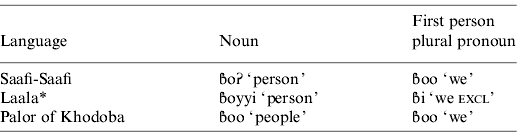
Another example is provided by the languages of the Cangin group of Senegal, belonging to the Atlantic branch of the Niger-Congo family. Three of the five Cangin languages appear to have experienced a similar grammaticalization whereby a noun for ‘person’ or ‘people’ has given rise to a first person plural pronoun; Table 3 presents the pronominal forms and their hypothesized lexical sources. This transfer cannot be traced back to Proto-Cangin, that is, it appears to have occurred independently in the different languages after the split of the proto-language.
First person plural pronouns in Cangin languages of Senegal and their lexical sources (Ursula Drolc, p.c.).
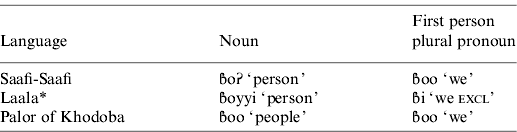
* In Laala, the noun  oyyi ‘person’ has also developed into an impersonal pronoun.
African languages offer a wealth of further examples of the development from noun to first person plural pronoun. In the northern and western dialects of !Xun of the North Khoisan family, spoken in South Angola and North Namibia, the noun djù ‘person’ has given rise to a first person plural exclusive pronoun, see (23).
(23) !Xun, W2 dialect (North Khoisan, Khoisan; own field data) djù- tcā má g‖à- ‖xˈāē.1.pl.exdutop stay together‘We two stay together.’
In the Mande language Kono of Sierra Leone, the noun m  ‘man, person, people’ (24a) has developed into a first person plural pronoun m
 ‘we (inclusive)’, see (24b), where on the way from nominal meaning to marker of personal deixis the item concerned underwent erosion.
(24) Kono (Mande, Niger-Congo; Donald A. Lessau, p.c.)
(a) m
kúndú- nùperson short pl‘short people’(b) m
dè án nέ.we.in mother emph here‘This is our mother.’ (Historically: *‘This is people's mother.’)
Susu, another Mande language of Guinea, has developed its noun mikhi ‘man’, exemplified in (25a), into a first person exclusive plural pronoun mukhu ‘we, us, our’ (Friedländer Reference Friedländer1974: 25; note that there is free variation in Central Mande between the high vowels i and u), illustrated in (25b).
(25) Susu (Mande, Niger-Congo; Friedländer Reference Friedländer1974: 28)
(a) mikhi mundue?(man which)‘which people?’
(b) mukhu khunyi(we head)‘our heads’
In the Labwor language of northeastern Uganda there is an inclusive first person plural pronoun j  ‘we (including you)’. As the evidence from closely related Western Nilotic languages suggests, this is a grammaticalized form of the noun j ‘people’. The Labwor pronoun is very weakly grammaticalized, meaning that it is never used as a subject pronoun and only occasionally used as an object pronoun, as in (26a), and only with a limited number of head nouns as a possessive attribute, as in (26b). Furthermore, there is considerable variation among speakers as to whether its use is allowed or disallowed.
(26) Labwor (Western Nilotic, Nilo-Saharan; own field data)
(a) έn
nὲnj.3sg see.pfv.3sg people‘He has seen us all.’(b) ὲthín
j.children people‘our children (including yours)’
 nὲn
To conclude, there are examples from a range of African languages, covering three of the four African language phyla: The Niger-Congo family is represented with languages such as Kono, Susu, and the Cangin languages, Nilo-Saharan with Ngiti, Labwor and other Western Nilotic languages, and Khoisan with !Xun.
But there are also examples from other parts of the world, including European languages. A paradigm example is provided by Portuguese, where the feminine singular noun phrase a gente ‘the people’ has been grammaticalized to a first person plural pronoun, to some extent also to a first person singular pronoun – a process that is said to have started in the 17th century.Footnote 30 In its lexical form, gente ‘people’ is a full-fledged noun, which can be inflected and modified; as a pronoun it has undergone decategorialization in its definite form (with the preposed article a ‘the’), as is illustrated in (27).
(27) European Portuguese (Merlan Reference Merlan and Schmidt-Radefeldt2006: 230) Agente fala mais tarde.(the people talk more late)‘We'll talk later.’
While a gente typically shows third person singular agreement, it has been adapted conceptually and morphologically to its new function to some extent, in that there are also quite a number of examples where there is first person plural agreement. The extent to which a gente has been grammaticalized can be seen in the fact that, at least in European Portuguese, it serves not only as a subject pronoun but also as a direct and an indirect object pronoun, a prepositional object pronoun, and even as a possessive attribute:Footnote 31
(28) European Portuguese (Merlan Reference Merlan and Schmidt-Radefeldt2006: 236) Pode ficar na casa da gente.can remain in.the house of.the people‘You can remain in our house (or with us).’
This new deictic is found not only in European Portuguese but rather occurs in all four continents where Portuguese is spoken. In all the varieties the noun phrase a gente ‘the people’ has been grammaticalized to a first person plural pronoun (Merlan Reference Merlan and Schmidt-Radefeldt2006). As we will see in Section 3, in Brazilian Portuguese, a gente ‘we’ has – more than in European Portuguese – replaced the earlier pronoun nós, also serving both as a first person plural pronoun (‘we’) and as an impersonal pronoun (‘one’; Albán & Freitas 1991; Schwegler Reference Schwegler, Byrne and Holm1993: 152; Merlan Reference Merlan and Schmidt-Radefeldt2006: 235; Travis & Silveira Reference Travis and Silveira2009; Martelotta & Cezario Reference Martelotta, Maura Cezario, Narrog and Heinein press).
And there is also evidence from a creole language. In the Spanish-based creole Palenquero of Colombia, the noun (ma) hende ‘people’, ultimately derived from Spanish gente ‘people’, has given rise to a pronoun (h)ende, which serves both as an impersonal pronoun ‘one’ and as a first person pronoun ‘we’, see (29).Footnote 32
(29) Palenquero (Spanish-based creole; Schwegler Reference Schwegler, Byrne and Holm1993: 152–153) Hende a ablá pa bo rihá ri e ma kusa!people/we tam say for you leave alone this pl thing‘We have [already] told you to leave these things [=a machete] alone!’
Another example concerns the French impersonal pronoun on ‘one’, which historically goes back to Latin homo ‘person, man’). In informal spoken French it has been grammaticalized to a first person plural pronoun on, which is said to be used by all French speakers, side by side with the inherited pronoun nous ‘we’. As example (30) shows, it has not yet undergone extension to the extent that it is used in all contexts.
(30) Colloquial Modern French (Coveney Reference Coveney2000: 459) C'est nous qu' on est les vainqueur-s.(that.is we who we is the.pl winner-pl)‘It is us who's the winners.’
A final example concerns another Romance language, namely Romanian. In this language, at the eastern end of the Romance world, there is a pronoun lumea, which is historically derived from the feminine noun lume ‘people, the people, human beings’ plus definite article -a;Footnote 33 (31a) exhibits the lexical and (31b) the deictic use of this item:
(31) Romanian (Merlan Reference Merlan and Schmidt-Radefeldt2006: 227)
(a) Lumea a râs.(people.def have laughed)‘The people have laughed.’
(b) Hai, Mihaela, că lumea pleacă.(come Michaela here people.def go.away)‘Come on, Michaela, we go away.’
As a personal pronoun for ‘we’ or ‘you (plural)’, lumea obligatorily has the definite article on it. Thus, like the corresponding form a gente in Portuguese it is decategorialized, no longer being inflected, and taking no modifiers other than the quantifier toată ‘all (feminine singular)’ and the locative adverb (de) aici ‘(from) here’. In grammars of written Romanian, lumea tends to be ignored. It serves as an inclusive first person pronoun when the speaker and other persons form a Solidar- oder Konsensgruppe (Merlan Reference Merlan and Schmidt-Radefeldt2006: 228, 231). Merlan points out that (toată) lumea as a deictic pronoun is a ‘sporadic phenomenon’, being restriced almost totally to use as a subject pronoun.
A common pathway underlying this grammaticalization process, even if presumably not the only one, appears to be the following: noun (‘person’ or ‘people’)>indefinite pronoun (‘people in general’)>first person plural pronoun. For example, in Brazilian Portuguese, a gente ‘the people’ was first used as an indefinite pronoun before it turned into a personal pronoun ‘we’ in the 19th century (Travis & Silveira Reference Travis and Silveira2009: 249).
2.3.2.2 Discussion
What such examples suggest is that there is robust evidence for a conceptual development from ‘person’ or ‘people’ to first person plural pronoun, whereby a deictic pronominal category is conceptualized in terms of a non-deictic entity, a concrete noun. As we saw above, the result may be a new pronoun for either inclusive reference (‘we, including you’) or exclusive reference (‘we, excluding you’), or both; more research is needed on this issue. Initially, the process tends to be confined to contexts where the noun serves as the subject of the clause, before it spreads to contexts where it is also used as the object or as a possessive modifier; but once again there is at least one exception: In the Nilotic language Labwor, the noun j ‘people’ has given rise to an inclusive object or possessive pronoun but not to a subject pronoun (see Section 2.3.2.1 above).
All the examples presented above are in accordance with the four parameters of grammaticalization introduced in Section 1.2. Extension, i.e. use in new contexts that suggest a deictic meaning, desemanticization, whereby the nominal meaning is bleached out, giving rise to a deictic meaning, and decategorialization, in that a former noun loses its nominal properties, such as the ability to be inflected and to take modifiers. Finally, there is also erosion in a number of cases, in that the erstwhile noun lost part of its phonetic substance: The Ngiti noun alε ‘person, people’ was reduced to l- in fast speech as a pronoun but not as a noun, the Saafi-Saafi noun oʔ ‘person’ lost its glottal stop (oʔ>oo), and the Laala disyllabic noun oyyi ‘person’ was shortened to a monosyllabic form i.
3. Grammaticalization in a wide sense
An issue that has figured in a number of discussions on grammatical change is where grammaticalization ends and other phenomena begin, that is, where the limits of grammaticalization are (see e.g. Ramat & Hopper Reference Ramat and Hopper1998, Bisang, Himmelmann & Wiemer Reference Bisang, Himmelmann and Wiemer2004). The observations made in this paper suggest that personal pronouns are the product of regular processes of grammatical change arising in specific contexts. That these processes are unidirectional is suggested by the following observations:
(a) We have not found any general processes that would contradict the unidirectionality principle. While it is possible that such cases exist, but if they do exist they must be rare.
(b) Many of the processes that we have been dealing with concern a cognitive process leading from a domain that can be defined in terms of physical objects and physical space to the domain of personal deixis, which is defined in terms of the participants of a communicative situation. Accordingly, there appears to be a common conceptual development from referring expressions to address forms – that is, from non-speech participants to speech participants. While it may happen that address forms turn into referential expressions, such a process appears to be clearly less common.
(c) Many of the processes involve relevant parameters of grammaticalization (see (2) in Section 1.2 above and Section 2.3.2.2 above for an example). A linguistic expression is extended to a context suggesting a new meaning, where the literal meaning does not make sense (extension). Once the new meaning is conventionalized, the expression loses the lexical meaning it once had in favor of the new meaning (=desemanticization), and with the transition from lexical to functional meaning it also loses many or all of its morphosyntactic properties (=decategorialization), becoming an invariable marker confined to denoting one specific grammatical function, and at a more advanced stage it may also lose in phonetic substance (=erosion).
(d) The nominal and spatial expressions developing into personal pronouns tend to involve lexical items such as noun phrases or adverb phrases, such as Spanish Vuestra Merced ‘Your Grace’>Usted ‘You’, while personal pronouns are functional categories, that is, grammatical forms having a schematic meaning. Such processes are therefore in accordance with the general directionality from lexical to grammatical categories. Conversely, we will not expect any directionality whereby pronominal particles turn into morphologically complex structures such as possessive noun phrases or prepositional phrases.
But there are also differences compared to canonical instances of grammaticalization. First, one of the features characterizing grammaticalization is that it tends to lead from referential to non-referential expressions: Nouns and verbs are categories that typically can be referred to anaphorically while this does not apply to functional categories such as tense or case markers (see (3f) above). By contrast, in the development of new personal pronouns, such a change from referential to non-referential function cannot be observed: Personal pronouns are invariably referential. Accordingly, in order to define the evolution of personal pronouns in terms of grammaticalization, an extended concept of grammaticalization is needed – one that parts with the stipulation that this process leads from referential to non-referential expressions.
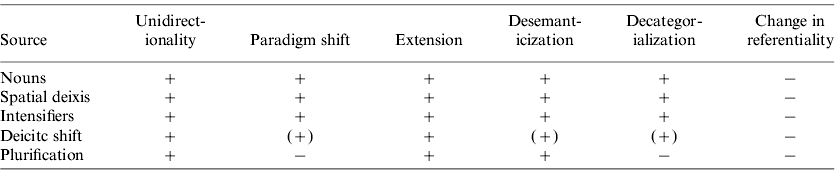
Second, and more importantly, none of the processes described in Section 2 can in fact be said to qualify as unambiguous instances of grammaticalization, for the following reason. Grammaticalization can be understood as a process leading to a shift in morphological classes:Footnote 34 Linguistic expressions belonging to lexical classes such as those of verbs or nouns change into classes like those of tense-aspect or case markers, etc. Such a shift can in fact be observed in the case of three of the sources that we observed in Section 2, namely those of nouns, spatial deixis, and intensifiers. But obviously, there is no shift in morphological class when plurification (from plural to honorific singular function; see Section 2.2.5 above) or a shift in deixis (from third to second person) are involved. What happens is that a member of the paradigm of personal pronouns changes into another member of the same paradigm. Thus, with the extension of the erstwhile English plural pronoun you to also serve as a singular pronoun, you continued to be part of the paradigm of English personal pronouns, and the German third person plural pronoun sie did not experience any paradigm shift when it acquired the additional function of a second person pronoun (Sie) in the 18th century.
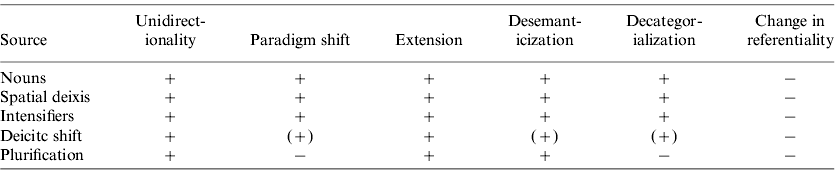
And third, we described grammaticalization in Section 1.2 in terms of four parameters. Now, one of these parameters, namely extension, applies to all instances of pronoun genesis. Two other parameters, desemanticization and decategorialization, can be said to be at work when nouns, spatial expressions, and intensifiers develop into personal pronouns, in that the source forms lose in semantic and morphosyntactic properties characterizing their lexical uses. But neither of these parameters is involved when there is plurification or shift in deixis.
Table 4 (on next page) provides an overview of the characteristics associated with the evolution of personal pronouns. In the case of canonical instances of grammaticalization one would expect that all criteria distinguished be fulfilled. Accordingly, there is reason to argue that none of the cases discussed in this paper qualifies as an instance of grammaticalization. Alternatively, we argue that we are dealing with an extended notion of grammaticalization since two core properties are present, namely extension and – most importantly – unidirectionality. We propose to call the latter grammaticalization in a wide sense (GWS) to distinguish it from the former, which is in accordance with all the criteria listed in Table 4 and may be referred to as grammaticalization in a narrow sense (GNS).
The evolution of personal pronouns and parameters of grammaticalization. (In this table, we are ignoring the parameter of erosion since it may, but need not, accompany grammaticalization; see Section 1.2.)
What the notion GWS exactly means with reference to a more general understanding of grammaticalization is an issue that is beyond the scope of the present paper and requires much further research. Such research needs to take other, and more general concepts into account, like that of ‘supergrammaticalization’ as proposed by Lindström Tiedemann (Reference Lindström Tiedemann2006), which goes one step further than the present proposal by also subsuming phenomena such as word order, intonation, and sound change as showing manifestations of grammaticalization.
3.1 The extension model
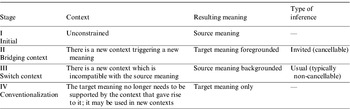
A number of approaches have been used to deal with the phenomena relating to extension (see e.g. Bybee et al. Reference Bybee, Perkins and Pagliuca1994; Traugott & Dasher Reference Traugott and Dasher2002: 34–39); in the present paper we use the pragmatic model of context-induced reinterpretation of Heine (Reference Heine, Wischer and Diewald2002), presented in Table 5 (on next page), to describe the most salient characteristics of extension.Footnote 35
A model of extension (context-induced reinterpretation).

Table 5 suggests that the transition from a meaning of stage I to one of stage IV does not proceed straight from one to another; rather, it involves two intermediate stages, namely stages II and III. The model of extension has been shown to be applicable to canonical instances of grammaticalization, and it also accounts for the development of personal pronouns as described in the preceding sections.
We may illustrate the relevance of the model by looking again at the evolution from generic human noun (‘people’ or ‘person(s)’) to first person plural pronouns that we discussed in Section 2.3.2.1. The situation in the Labwor language is characteristic of the bridging stage II, where the noun j ‘people’ expresses in certain contexts the meaning of a first person plural pronoun, even if the meaning ‘people’ is never entirely ruled out. This innovation is confined to very few contexts, and not every Labwor speaker makes use of it. Furthermore, it shows a low frequency of occurrence, its use is optional, and speakers do not to consider it to be a distinct new category; rather, it tends to be interpreted as a deviant application of the old category of nouns.
While the bridging context of stage II is suggestive of the incipient stage of grammaticalization, the switch stage III leads to the establishment of a new grammatical category. The situation of a gente in European Portuguese is an instance of this stage. In certain contexts the nominal reading (‘the people’) makes little, if any, sense; rather, a gente can only be understood as a category of personal deixis (‘we’) in such contexts. Furthermore, it is used in its new function fairly frequently and in a wider range of social and linguistic contexts. At the same time, however, there remain contexts where its use is barred, i.e. social and linguistic contexts that remain reserved for the old category of a noun, and while used quite regularly, speakers need not use it in all environments where it might be expected.
It is only at the final, conventionalization stage IV that the innovation has attained the status of a new full-fledged grammatical category, where it no longer shows contextual restrictions, being used roughly as frequently as other members of the same paradigm, and showing the same degree of obligatoriness as the other members of that paradigm. In addition, the innovated category may lose morphosyntactic properties that were characteristic of its former category status but are no longer in line with the morphosyntax of the new paradigm. Being a stage III category in European Portuguese, a gente is approaching a stage IV situation in Brazilian Portuguese (Albán & Freitas Reference Albán and Freitas1991; Schwegler Reference Schwegler, Byrne and Holm1993: 152; Merlan Reference Merlan and Schmidt-Radefeldt2006: 235; Travis & Silveira Reference Travis and Silveira2009; Martelotta & Cezario Reference Martelotta, Maura Cezario, Narrog and Heinein press): It has become a regular member of a newly emerging paradigm of personal pronouns and, accordingly, is used generally in this new function (see Section 2.3.2.1 above). The fact that a gente has largely replaced the earlier pronoun nós ‘we’Footnote 36 in Brazilian Portuguese suggests that its use has been generalized to the extent that it is employed in contexts that formerly were reserved for nós, hence that it is largely conventionalized (stage IV). While gente continues to exist as a lexical noun (‘people’), the noun gente and the pronoun a gente now appear to be distinct categories,Footnote 37 with the relationship between the two being more appropriately described as one of homonymy rather than of polysemy.Footnote 38
Table 6 (on next page) summarizes the main pragmatic features associated with the unidirectional evolution of both kinds of grammaticalization. It would seem that all developments leading to new expressions for personal deixis that we discussed in this paper are in accordance with the extension model (Table 5), but some lack salient properties of GNS. Plurification in particular lacks what in Table 4 above is referred to as paradigm shift, such as a shift from open to closed class category or from one kind of closed class category to another: When a plural pronoun is extended to also serve for honorific singular address then it does not shift from one paradigm to another; rather, it remains a member of the same paradigm of person markers, hence it does not qualify as an instance of grammaticalization in the narrow sense (GNS). We propose to call this kind of grammatical change, which takes place within one and the same morphosyntactic paradigm, a lateral shift, a term proposed by Joseph (Reference Joseph2005) .Footnote 39 We argue that lateral shift falls squarely within the domain of grammaticalization in a wide sense (GWS) in that it conforms to both the unidirectionality principle and the model of extension.Footnote 40 The exact boundary between GNS and GWS is unclear; there are types of grammatical change that can be classified as instances of both. More research is needed on this issue.
Some pragmatic characteristics of extension in grammaticalization.
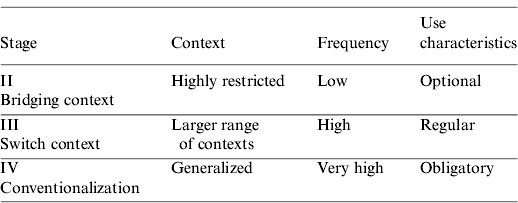
4. Conclusions
In a survey of the kind carried out here it is not possible to draw on a representative sample of languages; what we thought we could achieve was simply to find as much information from as many languages as possible in order to reconstruct crosslinguistically regular mechanisms leading to the creation of new personal pronouns. Accordingly, the languages figuring in this paper are neither areally nor genetically evenly distributed; certain regions of the world, such as Australia or the Americas, are clearly underrepresented while others, in particular Southeast and East Asia, Europe, and Africa, are more strongly represented than might be justified. What effect this has on the results obtained is a question that is open to future research.
The preceding discussions may have shown that personal deixis is not necessarily a crosslinguistically neat and stable conceptual domain. We observed in Section 2 that in some languages of Southeast and East Asia there is some pragmatically defined fluidity in the deictic significance of grammatical forms: What serves as a second person pronoun in one context can be used as a first person pronoun or an intensifier (reflexive) in another context. We pointed out, for example, that since the 16th century the Korean form jeo was used as an intensifier/reflexive form for all honorific levels, later on being degraded to a low level form, and around the end of the 19th century, jeo became a first person pronoun of the low honorific level. And Khmer does not really have a second person pronoun, although the intensifier ‘aeng ‘oneself’ is commonly used in this function (‘you (plural)’). However, if there is a close personal relationship between speaker and hearer, then ‘aeng may as well refer to the first person (‘I’ or ‘we’; John Haiman, p.c.).
We saw in Section 2 that there is a limited pool of conceptual sources that speakers tend to recruit in order to create new forms of personal pronouns, most of all the sources listed in (7) above. Using the emergence of the Calunga language in Brazil as an example, Heine & Song (Reference Heine and Song2010; see also Byrd Reference Byrd2006) demonstrate how an entirely new system of personal pronouns can arise. This creation was based essentially on the exploitation of two conceptual sources, namely nominal concepts and spatial deixis.
Figure 1 rests on generalizations on the conceptual domains that appear to provide the major cognitive templates for the development of personal pronouns.Footnote 41 Both this figure and generally the discussion in this paper are based on a number of simplifications of the phenomena examined. These phenomena are the product of a multitude of communal acts of language use extending over long periods of time. But what ends up as a communal act is likely to have started as an individual act, where a certain rhetorical strategy was propagated by someone, adopted by others, in some cases spreading across the entire speech community, thereby leading to a new form of expressing personal deixis. This individual act is no longer recoverable; the findings presented here therefore have to be taken with care: They are based on hypotheses on how people interacted in the past, rather than on ‘facts’ that are readily accessible to the student of language use. The general motivation underlying the pathways distinguished in Figure 1 can be seen in human activity aimed at finding optimal ways of saying what is both socially appropriate and most advantageous for the speaker in a given sociolinguistic context.
The main conceptual sources and pathways leading to personal pronouns.