Transmission of healthcare-associated pathogens from contaminated surfaces can lead to patient infection and mortality.Reference Dancer1–Reference Shams, Rose and Edwards3 Currently sampling methods are not standardized, causing concern about their efficiency. Standardized surface sampling methods would enhance confidence in determination of environmental reservoirs thus identifying appropriate infection control interventions.Reference Moore and Griffith4 One part of achieving this goal is selecting the best surface-sampling tool to enable detection of organisms by downstream laboratory applications. In this study, we evaluated the ability of 7 environmental sampling tools to release organisms into an elution buffer with and without an artificial soil (simulated organic contamination) present and overnight storage at 4°C to assess the effects of cold-chain shipping.
Methods
In total, 7 surface-sampling tools were evaluated: foam swab (EnviroMax Puritan Healthcare, Guilford, ME), cotton gauze (Fisherbrand, Pittsburgh, PA), rayon wipe (Clorox Handi-wipe, Oakland, CA), microfiber wipe (Rubbermaid HYGEN, Huntersville, NC), foam sponge (prototype Aquazone product, not yet commercially available, Puritan Healthcare, Guilford, ME), polyester wipe (Vectra QuanTex, Kernersville, NC), and cellulose sponge (Sponge Stick, 3M, Maplewood, MN) (see supplementary materials). Organisms tested included Acinetobacter baumannii (AB) multilocus strain type 12, carbapenemase-producing KPC+ Klebsiella pneumoniae (KP) ATCC BAA-1705, methicillin-resistant Staphylococcus aureus (MRSA) ATCC 43300, vancomycin-resistant Enterococcus faecalis (VRE) Van A+256, and Clostridioides difficile spores ATCC 43598 (CD). The vegetative bacteria were grown on trypticase soy agar with 5% sheep blood (TSAII, Becton Dickson, Franklin Lakes, NJ) 18–24 hours at 35°C, and a suspension was then prepared for inoculation onto the materials. The CD spores were prepared as described by Hasan et alReference Hasan, Japal, Christensen and Samalot-Freire5 and was stored at 4°C in sterile water. In phase 1 of testing, all materials (replicates of n ≥ 6) were premoistened and were then inoculated with 104 CFU of each organism suspended in Butterfield buffer (BB) only, which simulated a “clean” environment. Each material was held for 1 hour at ambient room temperature, then processed to elute the organisms. Foam swabs were vortexed and sonicated in 10 mL phosphate buffered saline with 0.02% Tween 80 (PBST). The other materials were processed in a stomacher bag with 90 mL PBST by agitation in a paddle blender (Stomacher 400 Circulator, Seward, Bohemia, NY) at 200 rpm (AB, KP, VRE) or 260 rpm (CD, MRSA). The eluate was centrifuged for 20 minutes at 2,700×g and 85–88 mL was decanted. The remaining volume of 2–5 mL of eluate was measured, pulse-vortexed, diluted in series, and cultured on appropriate agar for each organism: TSAII for MRSA, AB, VRE, and KP and brain heart infusion agar with horse blood and taurocholate (BHIY-HT, Anaerobe Systems, Morgan Hill, CA) for CD at 36°C under anaerobic conditions. Colony-forming units (CFU) were counted after incubation. In phase 2 of testing, the 4 tools with the highest median elution efficiency (%E; foam sponge, microfiber wipe, cellulose sponge, foam swab) were chosen to investigate the influence of a simulated “dirty” environment with organic contaminants, artificial test soil (ATS), Healthmark Industries, Fraser, MI) on organism release. Organisms were suspended in 20% ATS (104 CFU), and the tools were inoculated and processed. The eluate was cultured in the same way as in phase 1. In phase 3 of testing, 3 of the 4 materials with the highest median %E (foam swab, microfiber wipe, and cellulose sponge), were spiked with 104 CFU in the presence of ATS. Material hold times (HT) were 1 hour at room temperature and 24 hours at 4°C to simulate cold-chain shipping. The %E was determined relative to the inoculum. Statistical significance between 2 independent groups (1 hour vs 24 hours HT and BB vs BB+ATS) was determined using the Mann-Whitney U test in SPSS version 21 statistical software (IBM, Armonk, NY).
Results
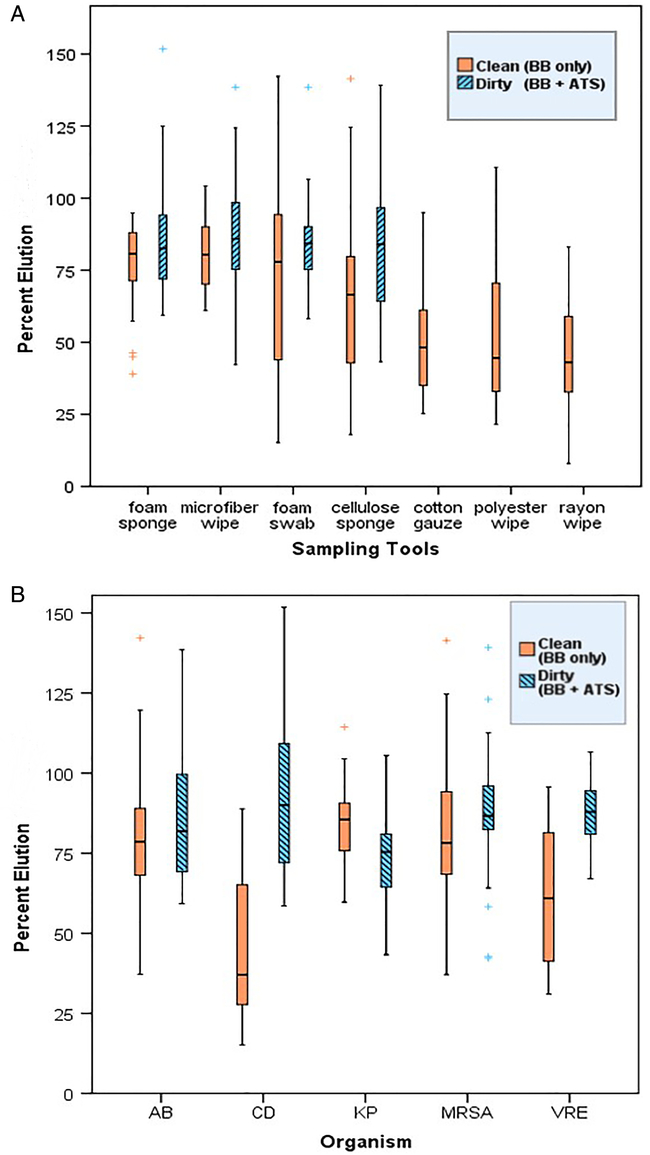
Figure 1A shows the %E for the 7 tools inoculated with cells suspended in BB (phase 1) and 4 tools with cells suspended in ATS (phase 2). The materials with the highest median %E were foam sponge (80.6), microfiber wipe (80.5), foam swab (77.9), and cellulose sponge (66.5). The remaining 3 materials demonstrated a %E < 50% and were not selected to be evaluated in phase 2: rayon wipe (43.1), polyester wipe (44.5), and cotton gauze (48.3). When data for all organisms were pooled for each tool, and the 4 materials that were chosen for phase 2 were compared, the presence of ATS did not significantly increase the %E for any materials (P > .05), except the cellulose sponge (P < .05), (Fig 1A).
(A) Median percent elution (%E) for all organisms suspended in Butterfield buffer (BB) alone (simulated ‘clean’ environment), and BB + artificial testing soil (ATS) (simulated ‘dirty’ environment). All 7 sampling tools were spiked with an inoculum of 104 CFU. Data for all organisms were pooled for each tool. (B) Median percent elution (%E) for all pathogens when 4 top-performing sampling tools (foam sponge, microfiber wipe, foam swab, and cellulose sponge; data were pooled) were spiked with organisms in Butterfield buffer (BB) alone (simulated ‘clean’ environment), or BB + artificial testing soil (ATS) (simulated ‘dirty’ environment) at an inoculum of 104 CFU. Box-and-whisker plot: box; interquartile (IQ) range, line; median, whiskers; maximum and minimum data point, plus signs (+); outliers, likely due to clusters of cells being dispersed during spread-plating, Note: AB, Acinetobacter baumannii; CD, Clostridioides difficile; KP, Klebsiella pneumoniae; MRSA, methicillin-resistant Staphylococcus aureus; VRE, vancomycin-resistant Enterococcus faecalis.

The addition of ATS resulted in a statistically significant difference (P < .05) in the median %E for 3 of the 5 organisms (CD, VRE, and KP). The %E values for these 3 organisms in the absence and presence of ATS, respectively, were CD, 37.1 and 90.1; VRE, 61.0 and 87.9; and KP, 85.6 and 75.4 (Fig. 1B).
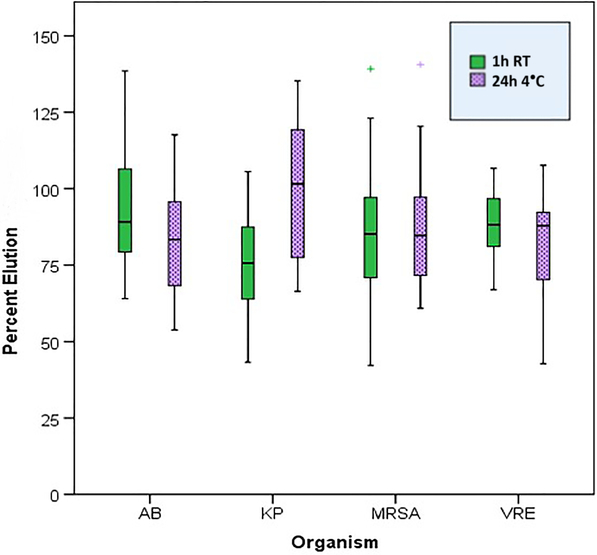
When comparing hold times of 1 hour at room temperature and 24 hours at 4°C (phase 3), the median %E differences were not significant (P > .05) for 3 of the 4 organisms; they exhibited <7% change between 1 hour and 24 hours, respectively: AB, 89.2 and 83.4; MRSA, 85.2 and 84.6; VRE, 88.1 and 87.9. The %E for KP (75.6 and 101.6), however, increased by 34% after 24-hours at 4°C. (Fig. 2).
Median percent elution (%E) of 4 vegetative organisms when 3 top-performing materials (foam swab, microfiber wipe, and cellulose sponge; data were pooled) were spiked at an inoculum of 104 CFU in the presence of ATS with a 1 hour at room temperature and 24 hours at 4°C HT (hold time). Box-and-whisker plot: box; interquartile (IQ) range, line: median, whiskers; maximum and minimum data point, plus signs (+): outliers, likely due to clusters of cells being dispersed during spread-plating, Note: AB, Acinetobacter baumannii; CD, Clostridioides difficile; KP, Klebsiella pneumoniae; MRSA, methicillin-resistant Staphylococcus aureus; VRE, vancomycin-resistant Enterococcus faecalis.

Discussion
Common environmental surfaces are known to serve as reservoirs for healthcare pathogens due to suboptimal cleaning and disinfection practices. The sampling tool and elution methods are known to influence %E and detection of organisms.Reference Da Silva, Filliben and Morrow6 We showed that the %E varied with the sampling tool and pathogen in the absence and presence of ATS as a simulant for organic contamination. The addition of ATS resulted in a significant difference in the %E for some organisms (CD, VRE, and KP). However, when all organisms were pooled for each sampling tool, the addition of ATS only significantly increased the %E for 1 of the 4 top-performing materials (cellulose sponge). This finding could be an indication that the differences in %E may be attributed more to the adherence properties of the organisms than the sampling materials. Several factors, including the hydrophobicity and charge of the cells, the presence of extracellular polysaccharide, pili, or flagella, and the presence of organic material, can influence cellular adherence to surfaces and sampling tools.Reference van Merode, van der Mei, Busscher and Krom7, Reference Katsikogianni and Missirlis8
The hold time of 24 hours at 4°C did not significantly impact the %E for AB, MRSA, and VRE, which supports standard cold-chain shipping practices. However, an increase in %E was demonstrated for KP held for 24 hours at 4°C. Whether the hold time allowed for growth of KP or enhanced the release of the organisms from the sampling materials is unclear.
Although not presented in this study, sampling efficiency, elution methods, surface type, assay limit of detection, surface area and presence of inhibitors are all important factors to consider in choosing the right sampling tool.Reference Sehulster, Rose, Noble-Wang and Mayall9
We previously developed an optimized processing method for elution of B. anthracis spores from the cellulose sponge,Reference Rose, Hodges, O’Connell and Noble-Wang10 and we applied this method for sampling antimicrobial-resistant healthcare-associated pathogens from environmental surfaces. The current work confirms that the elution efficiency of the cellulose sponge and the other 3 top-performing tools are acceptable choices for recovery of healthcare-associated organisms. A limitation of this study was the exclusion of sampling efficiencies; however, ongoing studies will be published in the future. These data contribute to the optimization and standardization of sampling methods for the detection of pathogens on healthcare surfaces.
Supplementary material
To view supplementary material for this article, please visit https://doi.org/10.1017/ice.2019.264
Acknowledgments
We would like to thank Monica Chan, Paige Gable, Hollis Houston, Amanda Lyons, Marla Martinez-Smith, Carrie Whitworth, and Angela Coulliette-Salmond for their laboratory support. Disclaimer: The conclusions, findings, and opinions expressed by authors contributing to this journal do not necessarily reflect the official position of the US Department of Health and Human Services, the Public Health Service, the Centers for Disease Control and Prevention, or the authors’ affiliated institutions. The use of trade names is for identification only and does not imply endorsement by the Public Health Service or by the US Department of Health and Human Services.
Financial support
No financial support was provided relevant to this article.
Conflicts of interest
All authors report no conflicts of interest relevant to this article.